Normative need for orthodontic treatment and
perception of the need for such treatment among
Brazilian adolescents
Ana Karla de Almeida Pinto Monteiro1, Dmitry José de Santana Sarmento2, Tássia Cristina de Almeida Pinto-Sarmento3, Michele Baffi Diniz4, Ana Flávia Granville-Garcia5, Danilo Antônio Duarte4
Objective: The aim of the present study was to evaluate the normative need for orthodontic treatment and the perception of such need among students aged 11-14 years. Methods: A cross-sectional study was conducted with a sample of 346 students, randomly selected from public and private schools. The Dental Aesthetic Index (DAI) was used to evaluate the normative need for orthodontic treatment (NNOT). The perceived need for treatment among students was assessed by a previously validated questionnaire. Data was analyzed by Pearson’s Chi-squared test (α = 5%). Results: The prevalence of malocclusion and NNOT was 65.6%. Of the sample, 73.7% felt they needed treatment, 66.2% wanted orthodontic treatment and 62.7% were satisfied with their dental aesthetics. A statistically significant association was observed between NNOT and the perception of the need for treatment among the students (p < 0.001). Conclusion: The present study demonstrated a high prevalence of malocclusion, which was reflected in the high normative need for orthodontic treatment. The opinion of patients regarding their expectations of orthodontic treatment should be valued. The students perceived a need for orthodontic treatment.
Keywords:Aesthetics, dental. Perception. Dental health surveys.
1 Universidade Estadual do Rio Grande do Norte, Department of Dentistry
(Caico/RN, Brazil).
2 Universidade de São Paulo, School of Dentistry, Division of Pathology,
Department of Stomatology (São Paulo/SP, Brazil).
3 Universidade Federal de Campina Grande, Academic Unit of Biological
Sciences (Patos/PB, Brazil).
4 Universidade Cruzeiro do Sul, Department of Dentistry (São Paulo/SP, Brazil). 5 Universidade Estadual da Paraíba, Department of Dentistry
(Campina Grande/PB, Brasil).
» The authors report no commercial, proprietary or financial interest in the products or companies described in this article.
DOI: https://doi.org/10.1590/2177-6709.22.3.041-046.oar
How to cite this article: Monteiro AKAP, Sarmento DJS, Pinto-Sarmen-to TCA, Diniz MB, Granville-Garcia AF, Duarte DA. Normative need for orth-odontic treatment and perception of the need for such treatment among Brazilian adolescents. Dental Press J Orthod. 2017 May-June;22(3):41-6.
DOI: https://doi.org/10.1590/2177-6709.22.3.041-046.oar
Submitted: August 24, 2016 - Revised and accepted: October 26, 2016
Contact address: Dmitry José de Santana Sarmento
Av. Coronel Pedro Targino, s/n – Araruna/PB, Brasil – CEP: 58.233-000 E-mail: [email protected]
Objetivo: o objetivo do presente estudo foi avaliar a necessidade normativa de tratamento ortodôntico e a percepção
dessa necessidade entre alunos de 11-14 anos de idade. Métodos: realizou-se um estudo transversal com uma amostra
de 346 alunos selecionados aleatoriamente de escolas públicas e privadas. O Índice de Estética Dental (DAI) foi utilizado para avaliar a necessidade normativa de tratamento ortodôntico (NNTO). A percepção da necessidade de tratamento entre os estudantes foi avaliada por meio de um questionário previamente validado. Os dados foram analisados pelo teste qui-quadrado de Pearson (α = 5%). Resultados: a prevalência de má oclusão e NNTO foi de 65,6%. Da amostra,
73,7% relataram que precisavam de tratamento, 66,2% queriam tratamento ortodôntico e 62,7% estavam satisfeitos com sua estética dentária. Observou-se associação estatisticamente significativa entre o NNTO e a percepção da ne-cessidade de tratamento entre os alunos (p < 0,001). Conclusão: o presente estudo demonstrou alta prevalência de má
oclusão, o que se refletiu na alta necessidade normativa de tratamento ortodôntico. A opinião dos pacientes sobre suas ex-pectativas de tratamento ortodôntico deve ser valorizada. Os alunos perceberam a necessidade de tratamento ortodôntico.
INTRODUCTION
The need for orthodontic treatment can be deter-mined by objective or normative evaluations. How-ever, when based only on occlusal indices, the sub-jective perception of the patient has been ignored in the planning of treatment.1 Such indices are utilized to assess the severity of malocclusion and the nor-mative need for orthodontic treatment (NNOT).2-10 The Dental Aesthetic Index (DAI) is a quantitative index which is recommended by the World Health Organization(WHO), and is considered the most frequently used tool in literature.7
The desire and perception of need of the popula-tion to use dental appliances should be considered.11 Aesthetic alterations to the face are easily perceived by individuals and can affect quality of life. Physi-cal attractiveness is considered an important fac-tor in personal relationships for young people.12-13 The perceived need for treatment by the patient or his/her family must be incorporated in clinical cri-teria.1 The aim of the present study was to evaluate the normative need for orthodontic treatment and the perception of this need by students aged 11-14 years.
MATERIALS AND METHODS
This study was approved by the Ethics Commit-tee on Human Research of the State University of Paraíba (CAAE 0100.0.133.000-11).
A cross-sectional study was conducted. The population studied consisted of students aged 11-14 years enrolled in public and private schools. The city of Campina Grande, Paraíba (PB), which has a Human Development Index of 0.721414, is divided into six health districts. The sample was collected based on health districts and clusters (schools), by stratification. Schools were randomly selected, with at least one public school and one private school chosen from each district. A random sample was selected in each school, proportional to the number of students per district.
The following were considered as eligibility cri-teria: (1) students aged 11-14 years enrolled in public and private schools in Campina Grande/PB; (2) ab-sence of orthodontic treatment, before or at the time of the study; (3) authorization to participate in the study from parents/guardians; (4) cooperation of the student; (5) student had no neuropsychomotor
defi-ciencies or deviations (mental, physical, sensory and behavioral order).
In the pilot study, 63 students were proportion-ally and randomly selected (public school, n = 23 and private school, n = 40). The prevalence of mal-occlusion was 63.5% and this value was used to calculate the final sample of the present study. The examinations were performed by a single examiner, who was an orthodontic specialist (Kappa = 0.816). Students who participated in the pilot study were not included in the main study. The reliability of the questionnaire was measured; for this, the test and re-test of the survey instrument was conducted after an interval of seven days. The agreement value was equal to 0.866.
The sample size was obtained by calculating the ratio estimation, considering a significance level of 95%, an error margin of 10% and a 63.5% preva-lence of malocclusion (pilot study). A deff (design ef-fect) of 1.515 was used and 20% was added to the sample size to compensate for losses.16 The sample was calculated as 397 students, and there was a loss of 12.8%. The final sample included 346 students.
The DAI index was used to assess NNOT. This in-dex includes the assessment of the following conditions: dentition (upper and lower tooth loss); space (crowd-ing, spac(crowd-ing, diastema, anterior maxillary irregularity, anterior mandibular irregularity); occlusion (maxillary overjet, mandibular overjet, vertical anterior open bite and molar relationship).7 The intraoral physical exam was performed in natural light, with a lashlight used when needed as an auxiliary light. Periodontal probes (CPI type, Community Periodontal Index) were uti-lized to assess DAI index. Biosecurity standards were strictly followed.
A structured questionnaire, with epidemiological and socioeconomic data, was answered by students. Regarding the perception of the student in relation to the need for orthodontic treatment, three ques-tions were asked: “Do you think you need to use brac-es?”, “Do you want to use braces?” and “Are you satisfied with the aesthetics of your smile?”16
Table 1 - Characterization of the sample in terms of sociodemographic data.
* Minimum salary = U$ 311.00. ** the variable has missing data.
RESULTS
The students were mostly female, 12 years old, whose parents had over 8 years of schooling, with a family income of up to two minimum salaries. The majority of students from public school were male, 13 years old, had parents with up to 8 years of schooling, and a family income of up to two mini-mum salaries. Most students of private school were 12 years old, female, with parents with more than 8 years of study, who also had a family income of two minimum salaries (Table 1). The prevalence of mal-occlusion was high (65.6%, n = 227). Most of the students had a need for elective treatment (Table 2).
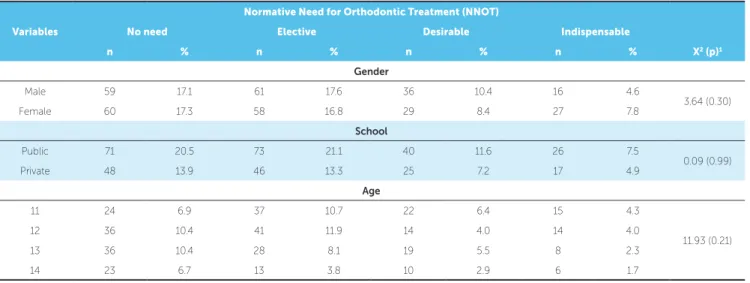
There was no statistical association between the need for orthodontic treatment and gender, age or type of school (Table 3). Most of the students be-lieved they needed orthodontic treatment and de-sire to use braces and indicated that they were satis-fied with their smiles (Table 4). Students of public school had a greater desire to use orthodontic braces than students of private schools (p < 0.001) (Table 5). An association was observed between the perceived need for orthodontic treatment by the students and the evaluation of a normative need for treatment. The students had the perception that they needed orthodontic treatment (p < 0.001) (Table 6).
Variables Public Private TOTAL
n % n % n %
Age (years)
11 57 27.2 41 30.2 98 28.3
12 53 25.2 52 38.2 105 30.3
13 60 28.6 31 22.8 91 26.3
14 40 19 12 8.8 52 15.1
Gender
Male 111 52.9 61 44.9 172 49.7
Female 99 47.1 75 55.1 174 50.3
Education of father**
Illiterate 11 7.6 0 0 11 4.2
Up to 8 years 88 60.7 13 11.3 101 38.9
Over 8 years 46 31.7 102 88.7 148 56.9
Education of mother**
Illiterate 8 4.9 0 0 8 2.7
Up to 8 years 89 53.9 12 9.8 101 35.1
Over 8 years 68 41.2 111 90.2 179 62.2
Household income**
Up to 2 salaries * 171 92.5 67 56.8 238 78.5
Between 3 and 5 salaries * 11 5.9 32 27.1 43 14.2
More than 5 salaries * 3 1.6 19 16.1 22 7.3
Table 2 - Characterization of the sample regarding normative need for orthodontic treatment according to the DAI index.
Prevalence of malocclusion DAI Normative need for treatment n %
Yes
Deined malocclusion Elective treatment 119 34,4
Severe malocclusion Highly desirable treatment 65 18,8
Very severe malocclusion Indispensable treatment 43 12,4
No No abnormality No or low need for treatment 119 34,4
Table 3 - Association between normative treatment needs and demographic data in students aged 11-14 years.
Table 4 - Characterization of the sample regarding the perceived need for orthodontic treatment and dental aesthetics by students.
Table 5 - Association between the perception of need for orthodontic treatment and demographic variables.
* Statistically significant association (p < 0,05). 1 Pearson’s chi-squared test. **Variable has missing data. 1 Pearson’s chi-squared test.
Normative Need for Orthodontic Treatment (NNOT)
Variables No need Elective Desirable Indispensable
n % n % n % n % X2 (p)1
Gender
Male 59 17.1 61 17.6 36 10.4 16 4.6
3.64 (0.30)
Female 60 17.3 58 16.8 29 8.4 27 7.8
School
Public 71 20.5 73 21.1 40 11.6 26 7.5
0.09 (0.99)
Private 48 13.9 46 13.3 25 7.2 17 4.9
Age
11 24 6.9 37 10.7 22 6.4 15 4.3
11.93 (0.21)
12 36 10.4 41 11.9 14 4.0 14 4.0
13 36 10.4 28 8.1 19 5.5 8 2.3
14 23 6.7 13 3.8 10 2.9 6 1.7
Variable n %
Do you think you need to use braces?
Yes 255 73.7
No 89 25.7
No answer 2 0.6
Do you want to use braces?
Yes 229 66.2
No 116 33.5
No answer 1 0.3
Are you satisfied with the aesthetics of your smile?
Yes 217 62.7
No 127 36.7
No answer 2 0.6
TOTAL 346 100
Groups
Need** χ² Willingness to use** χ²
No Yes (p)1 No Yes (p)1
n % n % n % n %
Gender
Male 41 11.9 130 37.8
0.63 (0.42) 51 14.8 121 35.1 2.42 (0.11)
Female 48 14 125 36.3 65 18.8 108 31.3
School
Public 51 14.8 158 45.9
0.60 (0.43) 52 15.1 158* 45.7 18.88
(<0.001)
Private 38 11 97 28.3 64* 18.6 71 20.6
Age (years)
11 17 4.9 81 23.5
5.41 (0.14)
34 9.9 64 18.6
1.24 (0.74)
12 31 9 74 21.5 38 11 67 19.3
13 25 7.3 65 18.9 30 8.7 61 17.7
DISCUSSION
The adoption of the DAI index for conducting studies like this is based on the fact that it is rec-ommended by the WHO and is classically used in epidemiological surveys to assess the presence of malocclusion and the normative need for orthodon-tic treatment.8,13,17-19 The prevalence of malocclusion and the normative need for treatment was high in this study. The need for treatment was highly de-sirable or essential among almost half the students. This data is consistent with other studies in litera-ture.6,19,20 There was no association between the normative need for orthodontic treatment and the age and gender of the students, findings that were in agreement with the results of Marques et al16. The high prevalence of a need for orthodontic treat-ment among low-income populations can be ex-plained by difficulties in access to health services.21
Decisions regarding orthodontic treatment should include the opinions of adolescents and their rela-tives.1 The perception of adolescents regarding their need for treatment is a success factor for such treat-ment.1,12 In the present study a high percentage of students reported needing orthodontic treatment. Cases of malocclusion can affect aesthetics and lead to the search for orthodontic treatment. Such need can also be influenced by the desire to appear at-tractive due to the search for greater self-esteem.4,20 The present study observed that most students were satisfied with their smiles, data which disagreed with the study of Winnier et al19.
Public school students exhibited a greater desire to use orthodontic braces than private school stu-dents. This situation can be explained by the fact that students of public schools do not have access to this type of treatment, which is considered very expensive. This data is consistent with literature.1 Peres et al18 re-ported an association between the perception of dental aesthetics and gender. Girls seem to value beauty and attractiveness more than boys. This association was not observed by Badran22 or in the present study.
An association was observed between the perceived need for orthodontic treatment by the student and the evaluation of a normative need for treatment. These indings were re-ported by other studies.16,22 For Claudino and Traebert,23 there was a strong correlation between the presence of mal-occlusions and the perception of dental aesthetics requiring orthodontic treatment observed by these individuals.
Nowadays, teenagers have developed the awareness and perception to identify their oral problems. How-ever, this factor has not been included in the deinition of the normative clinical criteria for malocclusion. Pa-tients can have a more positive outlook on malocclu-sions, and oten the opinions of professionals overesti-mate the need for treatment.24 There was a correlation in this study between the normative need for treatment and the perception of this need by students. However, the association between the normative need for treat-ment and the perception of the aesthetics of the smile was not statistically signiicant. These results difered from data found by Winnier et al19 who identiied a strong statistical association between these variables.
Table 6 - Association between the perception of need for orthodontic treatment and oral aesthetics among students and normative need for orthodontic treatment among students.
*Statistically significant association (p < 0,05). 1 Pearson’s chi-squared test. **The variable has lost data. Normative need for orthodontic treatment
Perception of student
No need Elective Desirable Indispensable χ²
n % n % n % n % (p)1
Need for orthodontic treatment**
No 40* 11.6 39* 11.3 8 2,3 2 0,6 23.44
Yes 79 23 78 22.7 57* 16.6 41* 11.9 (<0.001)
Desire to orthodontic treatment**
No 45 13 39 11.3 20 5,8 12 3.5 1.82
Yes 74 21.5 79 22.9 45 13 31 9 (0.61)
Perception of aesthetics of smile**
Unsatisfactory 36 10.5 44 12.8 30 8,7 17 4.9 4.93
1. Oliveira CM, Sheiham A. The relationship between normative orthodontic treatment need and oral health-related quality of life. Community Dent Oral Epidemiol. 2003 Dec;31(6):426-36.
2. Bernabé E, Flores-Mir C. Orthodontic treatment need in Peruvian young adults evaluated through dental aesthetic index. Angle Orthod. 2006 May;76(3):417-21.
3. Ngom PI, Diagne F, Dieye F, Diop-Ba K, Thiam F. Orthodontic treatment need and demand in Senegalese school children aged 12-13 years. Angle Orthod. 2007 Mar;77(2):323-30.
4. Marques LS, Pordeus IA, Ramos-Jorge ML, Filogonio CA, Filogonio CB, Pereira LJ, et al. Factors associated with the desire for orthodontic treatment among Brazilian adolescents and their parents. BMC Oral Health. 2009 Dec 18;9:34.
5. Dias PF, Gleiser R. Orthodontic concerns of Brazilian children and their parents compared to the normative treatment need. J Oral Sci. 2010 Mar;52(1):101-7.
6. Aikins EA, Costa OO, Onyeaso CO, Isiekwe MC. Orthodontic treatment need and complexity among Nigerian adolescents in Rivers State, Nigeria. Int J Dent. 2011;(2011):813525.
7. Cardoso CF, Drummond AF, Lages EMB, Pretti H, Ferreira EF, Abreu MHNG. The dental aesthetic index and dental health component of the index of orthodontic treatment need as tools in epidemiological studies. Int J Environ Res Public Health. 2011;8(8):3277-86.
8. Costa RN, Abreu MHNG, Magalhães CS, Moreira AN. Validity of two occlusal indices for determining orthodontic treatment needs of patients treated in a public university in Belo Horizonte, Minas Gerais State, Brazil. Cad Saúde Pública. 2011 Aug;8(8):3277-86.
9. Paula JS, Leite ICG, Almeida AB, Ambrosano GMB, Pereira AC, Mialhe FL. The inluence of oral health conditions, socioeconomic status and home environment factors on schoolchildren’s self-perception of quality of life. Health Qual Life Outcomes. 2012 Jan 13;10:6.
10. Väkiparta MK, Kerosuo HM, Nyström ME, Heikinheimo KAK. Orthodontic treatment need from eight to 12 years of age in an early treatment oriented public health care system: a prospective study. Angle Orthod. 2005 May;75(3):344-9.
11. Marques LS, Ramos-Jorge ML, Paiva SM, Pordeus IA. Malocclusion: esthetic impact and quality of life among Brazilian schoolchildren. Am J Orthod Dentofacial Orthop. 2006 Mar;129(3):424-7.
12. Xiao-Ting L, Tang Y, Huang XL, Wan H, Chen YX. Factors inluencing subjective treatment need and culture-related diferences among Chinese natives and foreign inhabitants. Int J Oral Sci. 2010 Sept;2(3):149-57.
REFERENCES
13. Bhardwaj VK, Veeresha KL, Sharma KR. Prevalence of malocclusion and orthodontic treatment needs among 16 and 17 year-old school-going children in Shimla city, Himachal Pradesh. Indian J Dent Res. 2011 July-Aug;22(4):556-60.
14. Instituto Brasileiro de Geograia e Estatística. Primeiros resultados do Censo 2010. [Access in: 2010 30 May]. Available from: http://www.censo2010.ibge. gov.br/dadosdivulgados/index.php?uf=25
15. Peres KG, Peres MA, Araújo CLP, Menezes AMB, Hallal PC. Social and dental status along the life course and oral health impacts in adolescents: a population-based birth cohort. Health Qual Life Outcomes. 2009 Nov 22;7:95.
16. Marques LS, Barbosa CC, Ramos-Jorge ML, Pordeus IA, Paiva SM. Prevalência da maloclusão e necessidade de tratamento ortodôntico em escolares de 10 a 14 anos de idade em Belo Horizonte, Minas Gerais, Brasil: enfoque psicossocial. Cad Saúde Pública. 2005 July-Aug;21(4):1099-106. 17. Shivakumar KM, Chandu GN, Subba Reddy VV, Shaiulla MD. Prevalence of
malocclusion and orthodontic treatment needs among middle and high school children of Davangere city, India by using dental aesthetic index. J Indian Soc Pedod Prev Dent. 2009 Oct-Dec;27(4):211-8.
18. Peres SHCS, Goya S, Cortellazzi KL, Ambrosano GMB, Meneghim MC, Pereira AC. Self-perception and malocclusion and their relation to oral appearance and function. Cien Saúde Colet. 2011 Oct;16(10):4059-66. 19. Winnier JJ, Nayak UA, Rupesh S, Rao AP, Reddy NV. The relationship of two
orthodontic indices, with perceptions of aesthetics, function, speech and orthodontic treatment need. Oral Health Prev Dent. 2011;9(2):115-22. 20. Dogan AA, Sari E, Uskun E, Saglam AMS. Comparison of orthodontic
treatment need by professionals and parents with diferent socio-demographic characteristics. Eur J Orthod. 2010 Dec;32(6):672-6. 21. Cândido IRF, Cysne SS, Santiago BM, Valença AMG. Prevalence of malocclusion
In 6-12 year-old school children in the city of João Pessoa/ Paraíba. Rev Bras Cienc Saúde. 2009;13(2):53-62.
22. Badran SA. The efect of malocclusion and self-perceived aesthetics on the self-esteem of a sample of Jordanian adolescents. Eur J Orthod. Dec;32(6):638-44.
23. Claudino D, Traebert J. Malocclusion, dental aesthetic self-perception and quality of life in a 18 to 21 year-old population: a cross section study. BMC Oral Health. 2013 Jan 7;13:3.
24. Peres KG, Traebert ESA, Marcenes W. Diferenças entre autopercepção e critérios normativos na identiicação das oclusopatias. Rev Saúde Pública. 2002 Apr;36(2):230-6.
CONCLUSIONS
The present study demonstrated a high preva-lence of malocclusion, which reflects a high nor-mative need for orthodontic treatment. There is a clear need to value the opinions of patients regarding their expectations of orthodontic treatment.
Authors’ contribution