*e-mail: [email protected]
Nanostructured MgH
2Obtained by Cold Rolling Combined
with Short-time High-energy Ball Milling
Ricardo Florianoa*, Daniel Rodrigo Leivab, Stefano Deleddac,
Bjørn Christian Haubackc, Walter José Bottad
aPrograma de Pós-graduação em Ciência e Engenharia de Materiais,
Universidade Federal de São Carlos – UFSCar,
Rod. Washington Luiz, Km 235, CEP 13565-905, São Carlos, SP, Brasil
bFaculdade de Ciências Aplicadas, Universidade Estadual de Campinas – UNICAMP,
Rua Pedro Zaccaria, 1300, CEP 13484-350, Limeira, SP, Brasil
cPhysics Department, Institute for Energy Technology, PO Box 40, N-2027 Kjeller, Norway dDepartamento de Engenharia de Materiais, Universidade Federal de São Carlos – UFSCar,
Rod. Washington Luiz, Km 235, CEP 13565-905, São Carlos, SP, Brasil
Received: June 7, 2012; Revised: August 23, 2012
MgH2 was processed by short time high-energy ball milling (BM) and cold rolling (CR). A new alternative processing route (CR + BM) using the combination of CR followed by short time BM step was also applied. The effects on the final morphology, crystalline structure and H-sorption properties were evaluated. The CR + BM processing (compared to BM and CR process) resulted in an inhomogeneous particle size distribution and the biggest crystallite size of MgH2, showing that there is a clear dependence between the size/shape of the particles which compose the starting material and the efficiency of crystallite size reduction during the BM process. On the other hand, we observed that a short BM step improved the kinetic properties of the cold rolled material. It shows that the particle size reduction of MgH2 obtained by CR combined with the increase in specific surface area attained by short BM step could be key factors to allow the use of the CR + BM route.
Keywords: magnesium hydride, cold rolling, high-energy ball milling, nanostructures
1. Introduction
In spite of its high desorption temperature and slow kinetics, MgH2 is still considered a good candidate for hydrogen storage applications due its high hydrogen storage reversible capacity, 7.6 wt. (%), and low cost1.
Many studies2-5 have shown that processing of MgH 2 by high-energy ball milling techniques can result in nanocrystalline structures with relatively low desorption temperatures and good H-sorption kinetics. These results are easily enhanced with elemental or compound additives, such as, transition metals and their fluorides and oxides.
However, the high consumption of energy, the high cost and longer processing times involved in ball milling techniques are still drawbacks from the upscale point of view. Furthermore, the poor air-resistance to oxidation associated with the fine powder product produced requires a complex and expensive handling process.
In this scenario, severe plastic deformation (SPD) techniques such as High Pressure Torsion (HPT), Equal Channel Angular Pressing (ECAP), Cold forging (CF) and Cold rolling (CR) have recently been explored to process/synthesize metal hydrides resulting in materials
with hydrogen storage properties as good as ball milling techniques6-9.
In addition to the refined nanocrystalline structure and presence of selective catalyst elements, the remarkable improvements on hydrogen storage properties have also been related to the presence of metastable phases (such as γ-MgH2), introduction of a high density of defects and modification of the texture in the processed materials.
More recently it has been shown that cold rolling could be successfully performed on the fully hydrided MgH2 resulting in a nanocrystalline structure and reduction of crystallite size similar to the one obtained by ball milling10-12.
Other remarkable aspects of cold rolling processing of MgH2 are the important reduction in processing time and energy and the possibility of handling the material under air atmosphere during all processing without negative effect on the hydrogen storage capacity or the kinetic properties.
in a stainless crucible with stainless steel balls in a glove box under argon atmosphere. The ball milling experiment was carried out in a SPEX mill for 20 minutes with a ball-to-powder weight ratio of 40:1. The balls diameter of 10 mm and material mass of 1 g were used. The CR + BM sample was prepared using the same conditions applied to the other samples separately, namely, cold rolled five times followed by short ball milling step for 20 minutes.
2.2.
Characterization techniques
Microstructural characterization of the samples was carried out by X-ray diffraction (XRD) and scanning electron microscopy (SEM). XRD patterns were recorded with a Siemens diffractometer (Model D5005) equipped with a C-monochromator using monochromatic Cu Kα
radiation (40 kV and 40 mA). The XRD data was also used to calculate the mean crystallite size through Scherrer analysis13. For that, the contribution of the instrumental broadening was deconvoluted using a known pattern (Corundum). SEM images were obtained in a Philips XL-30 TMP Microscope.
The hydrogen desorption behavior of the samples was investigated by differential scanning calorimetry (DSC) coupled with a quadrupole mass spectrometry (QMS), performed in a NETZSCH assembly (STA 449C and QMS403C, respectively). Samples with mass around 10 mg were used. The measurements were performed with a heating rate of 10 K/min.
The H-sorption properties after the first desorption were evaluated with a volumetric PCT apparatus built in-house at Institute for Energy Technology (IFE), using samples with mass of around 140 mg. Absorption and desorption curves were recorded at 623 K, with pressures of 2 MPa and 0.05 MPa, respectively. The procedures to measure the absorption/desorption kinetic curves and to calculate the hydrogen capacity using a volumetric apparatus are found in Léon17.
3. Results and Discussion
3.1.
Scanning electron microscopy
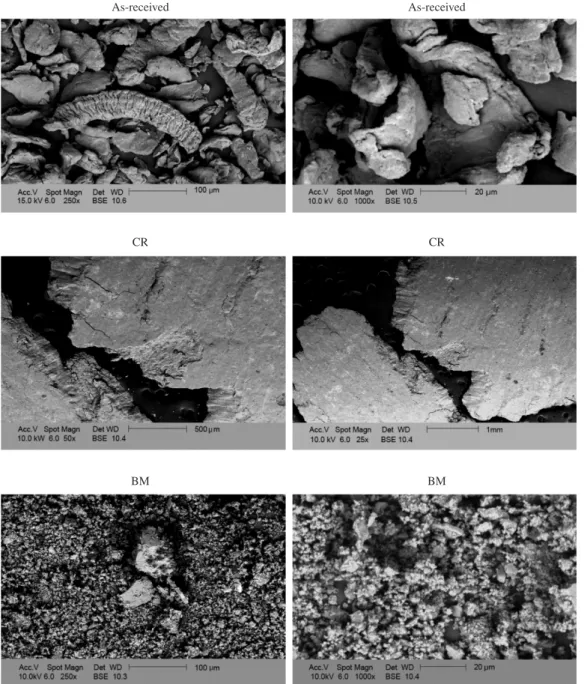
Figure 1 presents the SEM micrographs of as-received MgH2, CR, BM and CR + BM samples. The as-received sample has worm-like shaped particles with a width of about 10-20 µm and length of the order 200 µm. In the micrograph for the CR sample, the MgH2 powders are transformed
morphological products are obtained which is strongly related to the hardening level of the starting material.
During the BM process, the big MgH2 particles are constantly broken into smaller particles as shown in Figure 1.
3.2.
Crystalline structure
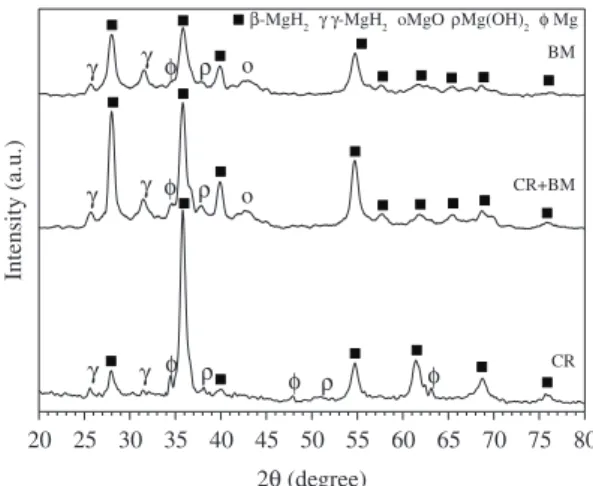
The XRD pattern of as-received MgH2 (Figure 2) shows the predominant β-MgH2 and remaining Mg. Furthermore, a small contamination with Mg(OH)2 is observed, appearing also in the processed samples (Figure 3). Figure 3 presents XRD patterns of the CR, BM and CR + BM samples. The Bragg peaks of these samples are much broader than for the as-received sample (Figure 2). A closer inspection shows that the Bragg peaks of the BM sample are even broader than the other samples. The peak broadening is a clear indication of the presence of a nanocrystalline microstructure, resulting from the formation of defects and the crystallite size reduction processes.
Values for the average crystallite size were estimated using the Scherrer formula and are given in the Table 1. The angle 2θ used to calculate the crystallite size is around 36°. The processed samples (Figure 3) show a significant reduction in the crystallite size compared to the as-received sample (>100 nm). The average crystallite size for the BM sample is 11 nm while for the CR sample is 22 nm. The value of the average crystallite size for the BM sample is much smaller than the value found in Imamura18 (~23 nm). While in Lang and Huot11, the value found for the average crystallite size (~13 nm) can be considered equivalent to our value. Although the slight differences in the BM conditions, our results indicate that, under the conditions used in this work, BM is more effective to reduce the crystallite size than CR.
A significant preferred orientation along the (011) direction is observed only in the XRD pattern for the CR sample (2θ≈ 36°). We have previously reported this effect8.
The XRD patterns of all processed samples show that the β-MgH2 phase has partially been converted to the high pressure γ-MgH2 phase. The formation of γ-MgH2 during CR and BM of MgH2 has previously been discussed by Lang and Huot11. They pointed out that, compared to the BM process performed in 30 minutes, its formation after five passes of CR process requires shorter activation times and less energy.
MgO was identified in the XRD patterns after ball milling (that is, for both BM and CR+BM samples), whereas it was not observed in the CR sample. The formation of MgO is a
large reduction in the specific surface area caused by the cold rolling process. This was attributed to the grain (sub-grain) refinement produced by the cold rolling process8.
It should be noted that the BM and CR + BM samples show double DSC peaks while the CR sample presents only one asymmetric peak. The double peak is more distinct for the CR + BM sample than for the BM sample, but the peak temperature observed in the low-temperature DSC peak are similar in both samples. The existence of double peak in the DSC curves can be associated with the total decomposition of the high pressure γ-MgH2 phase (identified in the XRD patterns) and the simultaneous partial decomposition of β-MgH2 in the low-temperature DSC peak, whereas the high-temperature DSC peak corresponds to β-MgH2 decomposition to Mg[15]. At the same time, the presence of the double DSC peak can also be attributed to the inhomogeneous distribution in the particle size, as seen in the micrographs of the samples16, especially for the CR + BM sample. The QMS analysis indicated that all endothermic events detected by DSC are related to hydrogen desorption from MgH2.
3.4.
Hydrogen sorption properties
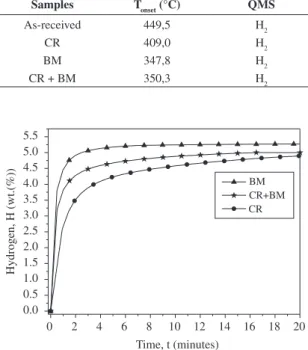
The hydrogen absorption and desorption kinetic curves for the BM, CR and CR + BM samples are shown in Figures 5 and 6, respectively. The as-received sample displayed a very slow absorption and desorption kinetics during the time interval that was studied and therefore these curves are not shown here. Some general features can be observed in Figures 5 and 6: all samples show very good H-sorption properties with hydrogen storage capacities around 5.3 wt. (%) and sorption times in the range of minutes. However, some differences in the kinetic behavior and shape between the curves are observed.
The absorption and desorption kinetics started faster for the samples in the following sequence: BM, CR + BM and CR. At absorption, the storage capacity of the BM sample is slightly higher than for the CR + BM and CR samples, the latter samples showing the same storage capacity.
For the CR + BM sample, the kinetics during the first 4 minutes of desorption is slightly faster than the BM sample as can be seen in the inset graph of the Figure 6. In addition, the kinetic of the CR+BM sample is better than for the CR sample, which means in a faster kinetic than CR sample. This shows the importance of short ball milling after the cold rolling process in order to produce more surface area which is one of the key factor for good kinetics behavior. Figure 2. X-ray diffraction pattern for commercial as-received MgH2.
Figure 3. X-ray diffraction patterns for MgH2: Cold rolled five times (CR, bottom), ball milled for 20 minutes (BM, top) and cold rolled + ball milled (CR + BM, middle).
Table 1. Values for the average crystallite size.
Samples Crystallite size (nm)
As-received >100
CR 22(4)
BM 11(5)
and scalable application, but also, the ability to produce materials with a very refined structure with a homogenous particle size distribution.
4. Conclusions
A significant decrease of desorption temperature range was observed in the DSC analysis of all processed samples compared to as-received sample. The BM and CR + BM samples presented double DSC peak both with lower temperature compared to the CR sample.
We observed that short-time BM improves the kinetic properties of the cold rolled material. At the same time, the efficiency of particle size reduction during BM is strongly dependent of the size and shape of the particles which compose the starting material. This result could be noticed when the short BM step was applied in a MgH2 sample already processed by CR whose initial product submitted to the BM step is a deformed material with size and shape of particles different of a MgH2 sample only processed by BM, that in this case, the initial state of the sample is a homogenous powder. Nanocrystalline γ-MgH2 was found in all MgH2 processed samples.
Thus, these results indicate that a combined route for SPD processing, which includes a short ball milling step, can be a key factor for achieving better kinetic properties of cold rolled sample.
We also believe that the reduction of processing time achieved by the combination of cold rolling and an additional short milling step can be interesting processing routes for producing materials with enhanced hydrogen properties compared to materials processed separately by cold rolling or ball milling.
Acknowledgements
The authors wish to thank FAPESP by the financial support. Floriano R. also would like to thanks CNPq for a
PhD scholarship. Figure 4. DSC curves for MgH2: As received, cold rolled five times
(CR), ball milled for 20 minutes (BM) and cold rolled + ball milled (CR + BM). The values for the peak temperatures are included in the figure.
Figure 5. Absorption kinetics at 623 K and under 2 MPa hydrogen pressure for MgH2: cold rolled five times (CR), ball milled for 20 minutes (BM) and cold rolled+ball milled (CR + BM). Table 2. Onset temperature (Tonset) and QMS analysis from the DSC peaks.
Samples Tonset (°C) QMS
As-received 449,5 H2
CR 409,0 H2
BM 347,8 H2
CR + BM 350,3 H2
The kinetic behavior showed by the CR sample is in agreement with our previous papers8,10, and could be explained considering two possible reasons: a) the nanoscale grain (sub-grain) refinement; b) the better heat transfer due to the consolidation of particles in small plates.
In general, these results indicate that there is an important compromise between the particle size distribution, surface area and the kinetic behavior. For this reason, the processing route chosen should take into account not only the optimization of factors such as processing time, cost
org/10.1016%2Fj.jallcom.2011.09.084
13. Lu L and Lai MO. Mechanical Alloying. Boston: Kluwer; 1998. http://dx.doi.org/10.1016%2FS0921-5093%2898%2900676-5
14. Reed-Hill RE. Physical Metallurgy and Principles. 2nd ed. D.Van Nostrand Company; 1973.
15. Gennari FC, Castro FJ and Urretavizcaya G. Hydrogen desorption behavior from magnesium hydrides synthesized by reactive mechanical alloying. Journal of alloys and
compounds. 2001; 321:46-53. http://dx.doi.org/10.1016%2
FS0925-8388%2800%2901460-2
16. Varin RA, Czujko T, Chiu C and Wronski Z. J. Particle size effects on the desorption properties of nanostructured magnesium dihydride (MgH2) synthesized by controlled reactive mechanical milling (CRMM). Journal of Alloys
and Compounds. 2006; 424:356-364. http://dx.doi.
org/10.1016%2Fj.jallcom.2005.12.087
17. L é o n A , e d i t o r. H y d ro g e n Te c h n o l o g y. B e r l i n : Springer-Verlag; 2008. chapt. 16: Kinetics and Thermodynamics.
18. Imamura H, Masanari K, Kusuhara M, Katsumoto H, Sumi T and Sakata Y. High hydrogen storage capacity of nanosized magnesium synthesized by high energy ball-milling. Journal
of Alloys and Compounds. 2005; 386:211-216. http://dx.doi.
org/10.1016%2Fj.jallcom.2004.04.145 dx.doi.org/10.1016%2FS0925-8388%2899%2900442-9
4. Barkhordarian G, Klassen T and Bormann R. Fast hydrogen sorption kinetics of nanocrystalline Mg using Nb2O5 as catalyst.
Scripta Materialia. 2003; 49:213-217. http://dx.doi.org/10.10 16%2FS1359-6462%2803%2900259-8
5. Yavari AR, LeMoulec A, De Castro FR, Deledda S, Friedrichs O, Botta WJ et al. Improvement in H-sorption kinetics of MgH2 powders by using Fe nanoparticles generated by reactive FeF3 addition. Scripta Materialia. 2005; 52:719-724. http://dx.doi. org/10.1016%2Fj.scriptamat.2004.12.020
6. Leiva DR, Jorge AM, Ishikawa TT, Huot J, Fruchart D, Miraglia S et al. Nanoscale grain refinement and H-sorption properties of MgH2 processed by high-pressure torsion and other mechanical routes. Advanced Engineering Materials. 2010; 12:786-792. http://dx.doi.org/10.1002%2Fadem.201000030
7. Skripnyuk V, Rabkin E, Estrin Y and Lapovok R. The effect of ball milling and equal channel angular pressing on hydrogen absorption/desorption properties of Mg–4.95 wt% Zn-0.71 wt% Zr (ZK60) alloy. Acta Materialia. 2004; 52:405-414. http:// dx.doi.org/10.1016%2Fj.actamat.2003.09.025