J. Evid. Based Med. Healthc., pISSN- 2349-2562, eISSN- 2349-2570/ Vol. 3/Issue 76/Sept. 22, 2016 Page 4131
USEFULNESS OF A SIMPLE PREDICTION MODEL FOR VAGINAL BIRTH AFTER CAESAREAN
SECTION IN A LOW RESOURCE SETTING
S. Tahmina1, Satish Korah Kuruvila2, Mary Daniel3
1Assistant Professor, Department of Obstetrics and Gynaecology, Pondicherry Institute of Medical Sciences.
2Professor, Department of Obstetrics and Gynaecology, Pondicherry Institute of Medical Sciences.
3Professor and HOD, Department of Obstetrics and Gynaecology, Pondicherry Institute of Medical Sciences.
ABSTRACT
BACKGROUND
The rising caesarean section rates can be curtailed by increasing the rates of Vaginal Birth After Caesarean (VBAC). Ability to predict vaginal birth after caesarean with certainty may enable better counselling and decision making regarding mode of delivery for pregnant women with a previously scarred uterus.
AIM
To assess the accuracy of a simple validated vaginal birth after caesarean score in predicting the mode of delivery in pregnant women with previous one caesarean section.
MATERIALS AND METHODS
Data for all patients who delivered at this institution between November 2011 and October 2013 were reviewed. Data of women who delivered after one caesarean section were analysed and details of the index pregnancy, labour and mode of delivery were noted. A vaginal birth after caesarean prediction model was applied to all women who underwent a Trial of Labour After Caesarean (TOLAC) using data at admission. Women who delivered after two or more caesarean sections were excluded from the study. The primary outcome assessed was the mode of delivery.
SETTINGS AND DESIGN
Retrospective Cohort study at a 650-bedded tertiary care hospital in South India.
STATISTICAL ANALYSIS
For categorical variables, data was compiled as frequency and percent. For continuous variables, data was calculated as mean±SD. Performance of the vaginal birth after caesarean score was assessed by receiver operating characteristic curve analysis.
RESULTS
Six hundred and eighty-seven women were delivered by caesarean section. Among them, 280 women who had a previous caesarean section were included in the study. Vaginal birth after caesarean scores were computed for 82 women who underwent a trial of labour after caesarean. 57.3% had a successful vaginal birth after caesarean and the remaining had a repeat caesarean section after a failed trial of labour. The score performed fairly well with an area under receiver operating characteristic curve of 0.75.
CONCLUSION
The vaginal birth after caesarean score maybe useful tool in counselling eligible women in favour of a trial of labour after caesarean thereby reducing the number of elective repeat caesarean sections.
KEYWORDS
Vaginal Birth After Caesarean, Prediction Score, Trial of Labour, Repeat Caesarean.
HOW TO CITE THIS ARTICLE: Tahmina S, Kuruvila SK, Daniel M.Usefulness of a simple prediction model for vaginal birth after caesarean section in a low resource setting.J. Evid. Based Med. Healthc. 2016; 3(76), 4131-4135.
DOI: 10.18410/jebmh/2016/882
INTRODUCTION: The persistent rise in caesarean section rates has become a global concern. The World Health Organisation (WHO) in 1985 recommended a caesarean section rate of 10-15% to reduce the maternal and perinatal mortality and concluded that rates above these were not associated with any additional benefits.1 Data
from the National Family Health Survey-3 report (2005-2006) of India indicate that the overall caesarean section rate in India was nine percent with 28% reported in the private sector compared to 15% in the public sector.2 The
Financial or Other, Competing Interest: None. Submission 25-08-2016, Peer Review 05-09-2016, Acceptance 20-09-2016, Published 22-09-2016. Corresponding Author:
Dr. S. Tahmina,
Assistant Professor, Department of Obstetrics and Gynaecology, Pondicherry Institute of Medical Sciences, Kalapet-605014, Pondicherry.
J. Evid. Based Med. Healthc., pISSN- 2349-2562, eISSN- 2349-2570/ Vol. 3/Issue 76/Sept. 22, 2016 Page 4132
preliminary data available from the 2015-2016 National Family Health Survey-4 indicate a 1.5 to 2 times rise in the caesarean section rate in most states.3 Population-based
studies from various Indian states also reveal that the caesarean section rate in most Indian states has increased remarkably reaching even up to 53%.4-9
Increasing the rates of vaginal birth after caesarean is as important as reducing the rate of primary caesarean sections in reducing the overall caesarean section rate. Various vaginal birth after caesarean prediction models using data at antenatal visits or at the time of admission have been suggested and validated.10-13 Use of one such
simple validated prediction model maybe more useful than to have different prediction models leading to lack of consensus and standardisation. We adopted one such simple model for vaginal birth after caesarean suggested by Metz et al, which has been validated and published recently.10
The objectives of the study were:
To estimate the primary and repeat caesarean section rates,
To classify women undergoing caesarean section
according to Robson’s 10-Group Classification
System,
To apply a simple validated vaginal birth after caesarean score to women who underwent a trial of labour after caesarean and determine its accuracy in predicting the mode of delivery.
METHODS: We performed a retrospective study in the Department of Obstetrics and Gynaecology at a tertiary level teaching centre and a 650-bedded hospital with an average of 1100 deliveries per year and a neonatal intensive care unit. This study was approved by the Institute Ethics Committee. A two-year retrospective review of all post caesarean deliveries was done. The data of all women who delivered after at least one previous caesarean section between November 2011 and October 2013 were analysed and details of the index pregnancy, labour and mode of delivery were noted. Women who delivered after two or more caesarean sections were excluded from the study.
Data at admission including age, history of a vaginal birth, indication of previous caesarean section, body mass index and Bishop Score were noted for all women who underwent a trial of labour. The vaginal birth after caesarean score as suggested by Metz et al10 was computed
as a sum total of Bishop score at admission (0 to 13) and two points if maternal age at the time of delivery was less than 35 years; four points for history of a vaginal delivery; three points if there was a nonrecurring indication for primary caesarean section; two points if pre-pregnancy body mass index was less than 30. The primary outcome assessed was the mode of delivery.
Data was entered in Microsoft Excel worksheet and analysed using SPSS software version 19.0. For categorical variables, data was compiled as frequency and percent. For
continuous variables, data was calculated as mean±SD. A receiver operating characteristic curve was constructed using the predicted vaginal birth after caesarean rates to assess the performance of the vaginal birth after caesarean score.
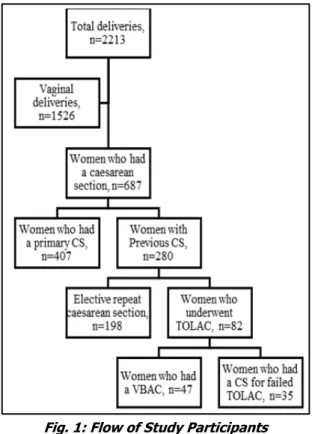
RESULTS: Among 2213 women who delivered in the two-year study period, 687 women delivered by a caesarean section with a caesarean section rate of 31.0%. Flow diagram of study participants is shown in Figure 1. Primary caesarean sections i.e. caesarean section for women who have not had a prior caesarean regardless of parity were 407 in number making the primary caesarean section rate 18.4%. The elective repeat caesarean sections accounted for 198 (70.7%) of the 280 women with previous caesarean. Twenty-eight (10%) women underwent elective repeat caesarean section as they had two prior caesarean sections and were not offered a trial of labour. The remaining 170 had one previous caesarean section and 36.1% of these women had an elective repeat caesarean section as they were not willing for a trial of labour (Robson group 5).14 However, the reasons for their unwillingness
were not evaluated.
Fig. 1: Flow of Study Participants
(CS - caesarean section; VBAC - Vaginal birth after caesarean; TOLAC - Trial of labour after caesarean).
J. Evid. Based Med. Healthc., pISSN- 2349-2562, eISSN- 2349-2570/ Vol. 3/Issue 76/Sept. 22, 2016 Page 4133
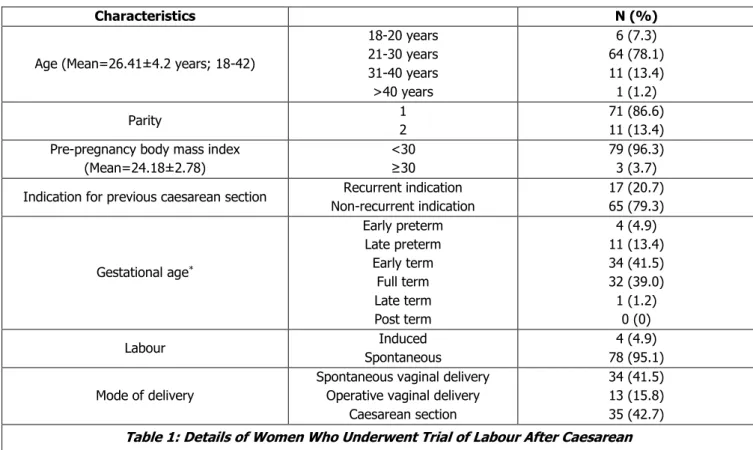
Characteristics N (%)
Age (Mean=26.41±4.2 years; 18-42)
18-20 years 21-30 years 31-40 years >40 years
6 (7.3) 64 (78.1) 11 (13.4) 1 (1.2)
Parity 1
2
71 (86.6) 11 (13.4) Pre-pregnancy body mass index
(Mean=24.18±2.78)
<30
≥30
79 (96.3) 3 (3.7)
Indication for previous caesarean section Recurrent indication Non-recurrent indication
17 (20.7) 65 (79.3)
Gestational age*
Early preterm Late preterm Early term
Full term Late term Post term
4 (4.9) 11 (13.4) 34 (41.5) 32 (39.0) 1 (1.2)
0 (0)
Labour Induced
Spontaneous
4 (4.9) 78 (95.1)
Mode of delivery
Spontaneous vaginal delivery Operative vaginal delivery
Caesarean section
34 (41.5) 13 (15.8) 35 (42.7)
Table 1: Details of Women Who Underwent Trial of Labour After Caesarean
*Early preterm: 28 wks. 0 days to 33 wks. 6 days; late preterm: 34 wks. 0 days to 36 wks. 6 days; early term: 37 wks.
0 days to 38 wks. 6 days; full term: 39 wks. 0 days to 40 wks. 6 days; late term: 41 wks. 0 days to 41 wks. 6 days; post-term: 42 wks. 0 days and beyond.
Vaginal birth after caesarean scores were calculated for these women. A successful vaginal birth was observed in 83.3% of women with a vaginal birth after caesarean score of more than 16. A score of 10-16 predicted, a vaginal birth in 64.2%, while a successful vaginal birth was observed only in 34.8% of those with a score of less than 10. The area under receiver operator characteristic curve obtained was 0.75 (95% confidence interval 0.642-0.857) for predicting a successful vaginal birth after caesarean (Figure 2).
The indications for caesarean section among those who underwent a trial of labour (n=35) were doubtful scar integrity (51.4%), abnormal foetal heart pattern on cardiotocography (37.1%) and failure to progress (11.4%).
According to the Robson’s classification 74.3% of these
women belonged to group 10 and 25.7% to group 5.14 Scar
dehiscence was observed in two women (5.7%) and two others (5.7%) had atonic postpartum haemorrhage requiring blood transfusion.
There were no instances of uterine rupture among those who underwent a trial of labour (n=82). Among women who had a successful vaginal birth after caesarean (n=47), one woman suffered a third-degree perineal laceration, two women had traumatic postpartum haemorrhage due to vaginal lacerations and one woman had a retained placenta requiring manual removal. There was one neonatal death on day two of birth due to extreme prematurity. None of the neonates born following a trial of labour suffered any neurological impairment either in the vaginal birth group or the caesarean section group.
Fig. 2: Receiver Operating Characteristic (ROC) Curve for the Predicted Vaginal Birth after Caesarean Scores
DISCUSSION: India is the second most populous country in the world with a population of over 1.2 billion people.15
With a total fertility rate of 2.5 children born per woman,
India’s contribution to the global caesarean section rates
J. Evid. Based Med. Healthc., pISSN- 2349-2562, eISSN- 2349-2570/ Vol. 3/Issue 76/Sept. 22, 2016 Page 4134
the National Family Health Survey-3 (2005-2006). The overall caesarean section rate in our institution was 31.04%, which is consistent with other population-based studies from different states in India. Some studies indicated that the caesarean section rate is higher in the private sector as is in our study.4,6,7,9,16
The vaginal birth after caesarean rate in our study was 16.8% similar to those in the private sector of the same region7 in contrast to other studies, which had success rates
between 60 and 78%.10,17,18 This is due to a very high rate
of repeat caesarean section on maternal request (33.8% - 36.07%) in both the studies. Rates of caesarean section for maternal request appear to correspond with age, higher socioeconomic status and educational attainment.16,19,20 This
group is underreported in most studies and not represented adequately in any of the Robson or modified Robson groups.14,21
Systematic reviews of randomised control trials, which provided various forms of decision support interventions including prenatal information, support and cognitive therapy failed to show any significant benefit in decision making about mode of delivery in women with a previous caesarean section.22,23 In our study, among women who
underwent elective repeat caesarean, there was inadequate documentation in the case files regarding counselling for a trial of labour. Hence, it could not be determined if the decision was influenced by counselling if any and whether the benefits and harms of both the vaginal birth after caesarean and elective repeat caesarean section were adequately explained to them.
A multitude of vaginal birth prediction models for post-caesarean pregnancies have been used at prenatal visits or at the time of admission with varying success and have been compared in various studies.11-13,17,24 A review of eleven such
scoring models by Eden et al concluded that all the models predicted success of vaginal birth after caesarean reasonably, but none of them could consistently predict the failure of a trial of labor.24 Further, the various scoring
systems do not adequately compare differences in the counselling methods, patient preference, the availability of facilities and outcomes at particular centres.
The model proposed by Metz et al was created using a regression model and validated externally. The authors also showed that a large number of repeat caesarean sections could have been avoided by offering a trial of labour to
women who were found to be “good candidates for trial”
according to this score.10,25 The area under the receiver
operator characteristic curve obtained in the initial study by the same authors in 2013 was higher (0.80) than that observed in our study (0.75). From our results, it seems that the score performs fairly well even in an Indian population.
The simplicity of the model proposed by Metz et al makes it easy to use by any healthcare worker including a community midwife especially in low resource settings who can identify women with a high likelihood of having a vaginal delivery and provide preliminary counselling and support to the women. This may be of some value considering that a large majority of women still believe the old adage “once a
caesarean, always a caesarean”. It may also be considered
for integration into the vaginal birth after caesarean/elective repeat caesarean section checklist for future use in antenatal care pathways for all women with a scarred uterus as has been recommended by the Royal College of Obstetricians and Gynaecologists.26
Our study may have been limited by its sample size. The high rate of repeat caesarean section is contributed by a policy of not offering a trial of labour to subgroups of women who do not have spontaneous onset of labour until 40 completed weeks, women with two prior caesarean sections and maternal request. Another drawback of this study could be the lack of representativeness of the sample, which limits the generalisability of results. Prospective studies of larger magnitude would confirm the clinical usefulness of the scores.
With the existence of multiple prediction models, no single model has been universally accepted or adopted for routine use. Similar to the WHO recommendation to adopt
the Robson’s classification for caesarean sections as a global
standard,27 a global standard for prediction of success of trial
of labour after caesarean would be useful for comparison between different populations and centres. The delay in formulating consensus guidelines and adopting standardised classifications and scoring systems will lead to inadequate comparisons between studies due to differential reporting of classifications, criteria and scoring systems.
CONCLUSIONS: The decision to undergo a trial of labour after caesarean is often influenced by antenatal counselling,
patient preference, healthcare provider’s views, availability
of facilities and outcomes at the particular centre. Simplicity of the vaginal birth after caesarean score increases ease of application enabling incorporation into routine antenatal checklists and maybe useful in counselling eligible women for a trial of labour of caesarean section by any healthcare worker including a community midwife. This shared decision making can increase vaginal birth after caesarean rates and
decrease the “self-perpetuating effect of caesarean
section.”18
Application of any score does not however eliminate need for senior obstetrician review especially prior to labour in women with risk factors. Individual differences and future reproductive preferences play an important role in the final decision regarding mode of delivery.
REFERENCES
1. Appropriate technology for birth. Lancet 1985;2(8452):436-437.
2. International institute for population sciences, India. National family health survey (NFHS-3), 2005-06.
2007:Vol-1. Available at:
http://rchiips.org/nfhs/NFHS-3%20Data/VOL-1/India_volume_I_corrected_17oct08.pdf.
J. Evid. Based Med. Healthc., pISSN- 2349-2562, eISSN- 2349-2570/ Vol. 3/Issue 76/Sept. 22, 2016 Page 4135
4. Nagpal J, Sachdeva A, Bhartia A, et al. Widespread non-adherence to evidence-based maternity care guidelines: a population-based cluster randomised household survey. BJOG 2015;122(2):238-247. 5. Rani J, Sharma D, Sehgal A. Role of partogram in high
risk pregnancies: an experience at a tertiary centre. Arch Gynecol Obstet 2015;291(1):73-78.
6. Neuman M, Alcock G, Azad K, et al. Prevalence and determinants of caesarean section in private and public health facilities in underserved South Asian communities: cross-sectional analysis of data from Bangladesh, India and Nepal. BMJ Open 2014;4(12):e005982.
7. Ramya V, Ghose S, Pallavee P. Membrane sweeping for vaginal birth after caesarean section and its outcome - a comparative study. J Clin Diagn Res 2015;9(8):QC01-3.
8. Ghosh S. Increasing trend in caesarean section delivery in India: role of medicalisation of maternal health. Bangalore: Institute for Social and Economic Change 2010:p. 16
9. Sreevidya S, Sathiyasekaran BW. High caesarean rates in Madras (India): a population-based cross sectional study. BJOG 2003;110(2):106-111.
10. Metz TD, Stoddard GJ, Henry E, et al. Simple, validated vaginal birth after cesarean delivery prediction model for use at the time of admission. Obstet Gynecol 2013;122(3):571-578.
11. Grobman WA, Lai Y, Landon MB, et al. Does information available at admission for delivery improve prediction of vaginal birth after cesarean? Am J Perinatol 2009;26(10):693-701.
12. Costantine MM, Fox KA, Pacheco LD, et al. Does information available at delivery improve the accuracy of predicting vaginal birth after cesarean? Validation of the published models in an independent patient cohort. Am J Perinatol 2011;28(4):293-298.
13. Fagerberg MC, Maršál K, Källén K. Predicting the
chance of vaginal delivery after one cesarean section: validation and elaboration of a published prediction model. Eur J Obstet Gynecol Reprod Biol 2015;188:88-94.
14. Robson M. Classification of caesarean sections. Fetal Matern Med Rev 2001;12(1):23-39.
15. WHO India. 2015. Available from: http://www.who.int/countries/ind/en/
16. Leone T. Demand and supply factors affecting the rising over medicalisation of birth in India. Int J Gynaecol Obstet 2014;127(2):157-162.
17. Mone F, Harrity C, Mackie A, et al. Vaginal birth after caesarean section prediction models: a UK comparative observational study. Eur J Obstet Gynecol Reprod Biol 2015;193:136-139.
18. Thomas J. Royal College of Obstetricians and Gynaecologists (Great Britain), Clinical Effectiveness Support Unit. The national sentinel caesarean section audit report. London: RCOG Press 2001.
19. Bhasin SK, Roy R, Agrawal S, et al. An epidemiological study of major surgical procedures in an urban population of East Delhi. Indian J Surg 2011;73(2):131-135.
20. Panda S, Jha V, Singh A. Review of cesarean section on maternal request in a tertiary care institute; scenario in developing country. Kathmandu Univ Med J 2015;11(4):349-354.
21. Allen V, Scott H, Baskett TF. Classification of caesarean sections in Canada: the modified robson criteria. J Obstet Gynaecol Can 2012;34(10):976-983. 22. Horey D, Weaver J, Russell H. Information for pregnant women about caesarean birth. Cochrane Database Syst Rev 2004;(1):CD003858.
23. Horey D, Kealy M, Davey MA, et al. Interventions for
supporting pregnant women’s decision-making about
mode of birth after a caesarean. Cochrane Database Syst Rev 2013;(7):CD010041.
24. Eden KB, McDonagh M, Denman MA, et al. New insights on vaginal birth after cesarean: can it be predicted? Obstet Gynecol 2010;116(4):967-981. 25. Metz TD, Stoddard GJ, Henry E, et al. How do good
candidates for trial of labor after cesarean (TOLAC) who undergo elective repeat cesarean differ from those who choose TOLAC? Am J Obstet Gynecol 2013;208(6):458.e1-458.e6.
26. Birth after previous caesarean birth (Green-top Guideline No- 45). Royal College of Obstetricians &
Gynaecologists. 2015. Available from:
https://www.rcog.org.uk/en/guidelines-research-services/guidelines/gtg45/.
27. WHO statement on caesarean section rates. WHO 2015.