PERINEAL PAIN RELIEF THERAPIES AFTER POSTPARTUM
1Marília Vieira Peleckis2, Adriana Amorim Francisco3,Sonia Maria Junqueira Vasconcellos de Oliveira4
1 With support from the Conselho Nacional de Desenvolvimento Cientíico e Tecnológico for inancing the project (Process no 478646/2012-7). 2 Resident in the Residency Program in Nursing, Primary Care in Family Health. Escola de Enfermagem da Universidade de São Paulo
(USP). São Paulo, São Paulo, Brazil. E-mail: [email protected]
3 Ph.D. in Sciences. Escola de Enfermagem, USP. São Paulo, São Paulo, Brazil. E-mail: [email protected]
4 Ph.D. in Obstetric Nursing. Professor, Maternal-Infant Nursing and Psychiatry Department, Escola de Enfermagem, USP. São Paulo,
São Paulo, Brazil. E-mail: [email protected]
ABSTRACT
Objective: identifying therapies for treating perineal pain after vaginal birth and to verify indication, technique and duration of local cooling. Method: an exploratory study (survey) conducted in 32 public maternity hospitals in the city of São Paulo (Brazil). A nurse or midwife who
provided direct care to the woman was interviewed in each maternity ward. We investigated: institutional characterization, professional qualiication, pain relief method, criterion for administration of therapies, indication, contraindication, method, local cooling technique and interval. A descriptive analysis was also carried out.
Results: pharmacological and non-pharmacological methods were used for perineal pain relief, despite the use of non-pharmacological
therapies not having protocols in these institutions. Among the pharmacological-based methods, analgesics and anti-inlammatories were the most common. Local cooling was the most used non-pharmacological method, and its main indication was perineal edema. Application time and local cooling interval ranged from 10-30 min and 3-8 h, respectively. Ice cubes in latex gloves were the main cooling technique.
Conclusion: drug therapies predominated for control of perineal pain. Considering the advantages of non-pharmacological therapies, it
is necessary to develop protocols to ensure their safe and effective use in maternity care.
DESCRIPTORS: Cryotherapy. Perineum. Postpartum period. Pain. Maternal-child nursing.
TERAPIAS DE ALÍVIO DA DOR PERINEAL NO PÓS-PARTO
RESUMO
Objetivo: identiicar as terapias para tratamento da dor perineal pós-parto normal e veriicar indicação, técnica e duração da crioterapia. Método: estudo exploratório (survey) conduzido em 32 maternidades públicas do município de São Paulo (Brasil). Em cada maternidade,
entrevistou-se uma enfermeira ou obstetriz que prestasse assistência direta à puérpera. Investigaram-se: caracterização institucional, qualiicação proissional, método de alívio da dor, critério de administração das terapias, indicação, contraindicação, modalidade, técnica e intervalo da crioterapia. Realizou-se análise descritiva.
Resultados: métodos medicamentosos e não medicamentosos foram utilizados no alívio da dor perineal, apesar do uso das terapias
não medicamentosas não estar protocolado nessas instituições. Entre os métodos medicamentosos destacaram-seos analgésicos e anti-inlamatórios. A crioterapia foi o método não medicamentoso mais utilizado, sendo sua principal indicação o edema perineal. Tempo de aplicação e intervalo da crioterapia variaram 10-30min e 3-8h, respectivamente. Cubos de gelo em luva de látex foi a principal técnica de resfriamento.
Conclusão: as terapias medicamentosas predominaram no controle da dor perineal. Considerando as vantagens das terapias não
medicamentosas, faz-se necessário desenvolver protocolos para garantir seu emprego seguro e eicaz na assistência obstétrica.
TERAPIAS DE ALIVIO DEL DOLOR PERINEAL EN EL POSTPARTO
RESUMEN
Objetivo: identiicar las terapias para el tratamiento del dolor perineal en el post-parto normal y veriicar indicación técnica y duración
de la crioterapia.
Método: estudio exploratorio (survey) conducido en 32 maternidades publicas del Municipalidad de São Paulo (Brasil). En cada maternidad,
se entrevistó una enfermera u obstetra que prestase asistencia directa a la puérpera. Se investigaron: caracterización institucional, caliicación profesional, método de alivio del dolor, criterio de administración de las terapias, indicación, contraindicación, modalidad de la técnica e intervalo de la crioterapia. Se realizó análisis descriptivo.
Resultados: métodos medicamentosos y no medicamentosos fueron utilizados en el alivio del dolor perineal, a pesar del uso de las terapias
no medicamentosas no estar protocolado en estas instituciones. Entre los métodos medicamentosos se destacaron los analgésicos y anti-inlamatorios. La crioterapia fue el método no medicamentoso más utilizado, siendo su principal indicación el edema perineal. Tiempo de aplicación e intervalo de la crioterapia varió 10-30 minutos y 3-8 horas, respectivamente. Cubos de hielo en guante de latex fue la principal técnica de resfrío.
Conclusión: las terapia medicamentosos predominaron en el control del dolor perineal. Considerando las ventajas de las terapia no
medicamentosas, se hace necesario desarrollar protocolos para garantizar su empleo seguro y eicaz en la asistencia obstétrica.
DESCRIPTORES: Crioterapia. Perineo. Periodo posparto. Dolor. Enfermería maternoinfantil.
INTRODUCTION
Humanized obstetric care advocates offer-ing different relief therapies for perineal pain after vaginal delivery.1 Although the administration of analgesics and anti-inlammatories is the con-ventional treatment for this discomfort, it can be supplemented by localized pharmacological and non-pharmacological therapies such as ice, anes-thetic sprays, sitz baths, suppositories, laser, and transcutaneous electrical nerve stimulation (TENS), among others.2-3
A study in the 1980s carried out with 50 English maternity hospitals mapped the therapies offered for perineal pain relief, identifying that oral analgesia was prescribed as the irst treatment option in 78% of these services, and ice application was the most frequently mentioned non-pharma-cological method by the midwives (84%).4 Another exploratory study with 215 Australian postpartum women 72 hours after vaginal delivery showed that oral analgesia was offered to 75% of these women, and 69% of them also received the application of an ice pack, and 25% received anti-inlammatory medication. Although a variety of methods have been used to control perineal pain, 90% of women still report perineal pain, of which 37% reported moderate to severe pain.5
Evidence regarding the use of pharmacologi-cal measures for perineal pain relief after delivery is based on studies of poor methodological qual-ity.6-8 The evidence is also limited for non-pharmo-cological therapies.2 Thus, even though there are numerous forms of therapies available, perineal pain relief is not always adequate; consequently, the pain can worsen, generating more discomfort and
suffering to the woman. Therefore, we questioned how perineal pain management is being performed by midwives and nurse-midwives in our country.
Thus, the objectives of this study were to iden-tify the types of therapies used in treating perineal pain after vaginal delivery and to verify the indica-tion, technique and duration of local cooling.
METHOD
This is an exploratory study (survey) conduct-ed between December 2013 and September 2014, in public obstetrical services in the city of São Paulo which operate within the Uniied Health System (SUS), identiied in the National Registry of Health Establishments (CNES) of the Municipal Health Department of São Paulo.
The study population consisted of 32 nurses: 26 nurse-midwives, three midwives, and three nurses who did not have a specialization or quali-ication in obstetrics. The inclusion criterion was that this professional provided direct assistance to the woman who had recently given birth. Only one professional was interviewed in each institution, thus, the total number of hospitals corresponded to 32.
pain relief therapies (method, indication, contrain-dication of the therapies and barriers or dificulties to using them).
The collected data are presented in descrip-tive form as absolute and reladescrip-tive frequencies for the categorical variables, and central tendency and dispersion measurements for quantitative variables.
The study was approved by the Research Ethics Committee of the University of São Paulo Nursing School (ID: 657.088). Authorization was requested from the Ofice of the Municipal Health Secretariat (SMS), as the SMS units correspond to more than one Regional Health Coordination. Moreover, the study was submitted for approval by the Research Ethics Committee of some institutions. Participation of the professionals was voluntary after the signing of the Clear and Informed Consent Form which was printed two ways, with one copy for the nurses and another for the researcher.
RESULTS
Thirty-two (94.1%) of the total 34 obstetrical services initially planned to compose the study sample authorized it. In 15.6% (5/32) of them, de-liveries were performed at the Birth Center (BC), 71.9% (23/32) in the Obstetric Center (OC) and 12.5% (4/32) in the BC or the OC. The monthly vaginal delivery average exceeded those of cesar-ean section and forceps for all services, being 186.8 (SD=149.1) (minimum=19 and maximum=650); 85.1 (SD=65.9) (minimum=90 and maximum=350) and 7.7 (SD=16.9) (minimum=0 and maximum=70), respectively.
The interviewed nursing professionals were female and had a mean age of 37.3 years (SD=10.2), 13.3 years (SD=8.6) since inishing their under-graduation, 9.6 years (SD=8.4) of obstetric care, and 7.1 years (SD=8.2) working at the institution. Approximately 81% of them were specialized in midwifery, and 19% worked in this area without speciic training.
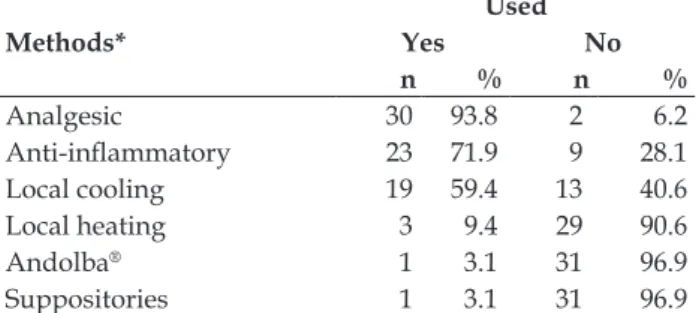
Pharmacological and non-pharmacological methods for perineal pain management were used, despite none of the institutions having speciic pro-tocols for the use of non-pharmacological therapies. Among the medications used were non-steroidal anti-inlammatory drugs (NSAIDs) and oral analge-sics. A single professional reported using anesthetic spray (Andolba®) for topical application and sup-positories. Among the non-medicated methods, the most cited was local cooling (Table 1).
Table 1 – Methods used for perineal pain relief in the postpartum period. São Paulo, SP, Brazil 2013-2014
Used
Methods* Yes No
n % n %
Analgesic 30 93.8 2 6.2
Anti-inlammatory 23 71.9 9 28.1
Local cooling 19 59.4 13 40.6
Local heating 3 9.4 29 90.6
Andolba® 1 3.1 31 96.9
Suppositories 1 3.1 31 96.9
* Nurses reported indicating one or more analgesic methods.
Criteria for administrating drug therapies were woman’s complaint of perineal pain (40.6%, 13/32), timely medical prescription (31.3%, 10/32), and a combination of medical prescription and com-plaints from postpartum women (25%, 8/32). Only one institution (3.1%) did not administer medication for perineal pain relief.
Indications for local cooling differed among the professionals; the main criterion for the use of this therapy was edema, followed by hematoma and perineal pain. The occurrence of episiotomy or 2nd, 3rd or 4th degree lacerations were also criteria for implementing local cooling, regardless of the presence of edema, hematoma or pain (Table 2). No professional reported any obstetric condition or diagnosis that contraindicated local cooling.
Table 2 - Main indications for the use of local cooling reported by the 32 nurses. São Paulo, SP, Brazil, 2013-2014
Indications* Frequency
n %
Perineal edema 31 96.9
Perineal hematoma 20 62.5
Perineal pain 19 59.4
Episiotomy/2nd, 3rd or 4th degree lacerations 1 3.1
* Nurses reported one or more indication for local cooling.
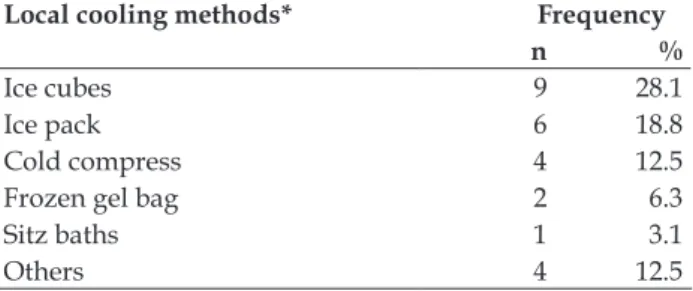
Table 3 - Local cooling methods used for perineal pain relief. São Paulo, SP, Brazil, 2013-2014
Local cooling methods* Frequency
n %
Ice cubes 9 28.1
Ice pack 6 18.8
Cold compress 4 12.5
Frozen gel bag 2 6.3
Sitz baths 1 3.1
Others 4 12.5
* Nurses reported one or more local cooling methods.
Regarding the local cooling techniques, all professionals who applied ice or frozen gel reported using a compressed cloth to wrap it in during the application in order to avoid direct contact with the perineum region. The cooling time ranged from 10 to 30 minutes, where the percentages found were: 20 minutes (52.7%, 10/19); 15 minutes (26.3%, 5/19); 10 minutes (10.5%, 2/19) and 30 minutes (10.5%, 2/19). Local cooling application time was not standardized in one of the institutions, varying according to the professional who indicated it. Application repeti-tion interval was determined at the professional’s discretion (26.3%, 5/19) or by prescription: every 8 hours (36.8%, 7/19); every 4 hours (21%, 4/19); every 3 hours (10.5%, 2/19) and every 6 hours (5.3%, 1/19). The main barriers mentioned for the use of local cooling were the lack of protocol, and equip-ment or materials such as refrigerator, ice packs, and compresses, among others.
DISCUSSION
It has been observed that pharmacological and non-pharmacological methods are used in treating perineal pain; however, drug treatments correspond to the irst option in most institutions studied.
These results resemble that of an Australian study aimed at promoting changes in managing perineal pain within the irst 48 hours after vaginal birth with perineal trauma. The authors identiied that the main forms of pain relief included oral ad-ministration of anti-inlammatories and analgesics, as well as ice and warm water compresses. How-ever, they found that the diclofenac sodium and paracetamol, either associated or not with codeine, were administered to 66% of puerperal women, while only 33% used an ice pack.9
In the current study, oral administration of analgesics and non-steroidal anti-inflammatory drugs were the main treatment for perineal pain
relief, while the topical route represented by apply-ing anesthetic aerosols and rectal pain relief with suppository use were little used.
The choice of type of treatment for pain is determined by factors that include pain intensity, side effects, cost, administration route, and patient satisfaction.10 In the case of postpartum women, it is also important to consider drugs being passed on through breast milk. Traditionally, acute pain has been treated by oral therapies, however these agents have potential dose-limiting adverse effects such as gastric irritation, nausea, vomiting, and constipa-tion. Thus, topical and rectal agents12 are important alternatives to oral administration.
The effectiveness of rectal analgesia for peri-neal trauma was also assessed through a systematic review that included three randomized controlled clinical trials with 249 postpartum women. It was concluded that the use of nonsteroidal anti-inlammatory suppositories is associated with less perineal pain and less need for additional analgesia compared to placebo.6
Topical drugs can effectively alleviate acute pain representing an alternative to the oral admin-istration route, with less systemic absorption and consequently a lower risk of toxicity.11 However, a systematic review that included eight randomized controlled clinical trials with 976 participants as-sessing the effects of topical anesthetics on perineal pain relief after delivery found that there is still insuficient evidence to prove the eficacy of these agents in perineal pain relief.7
Regarding the effectiveness of the treatment routes for perineal pain, after the interview with 215 postpartum women and 72 hours after vaginal birth, it was identiied that oral analgesia was the main relief method, and was used by 75% of the women; where 52.5% of whom considered it as quite effective, and 10.8% as extremely effective. Suppositories were used by 24.7%; the majority within 48 hours after delivery with sutured lacera-tions or episiotomy, where 54.9% evaluated the method as quite effective, and 27.5% as extremely effective. Injectable drugs were used by 3.7% of the women, of whom 25% reported this method as being quite effective, and 75% as extremely effective.5
when postpartum women need to request them,9 as
they do not want to disturb the health team. Thus, caregivers should identify women’s pain complaints by frequently asking them about perineal pain or discomfort, and offering treatment based on the best evidence available.13
One study that evaluated the satisfaction of women who had recently given birth with the care received in the shared wards identiied that good communication with the nursing team and provid-ing medications at the correct times are indicators of the quality of care in the postpartum period.14
Non-pharmacological methods have been pointed out as the second option for perineal pain relief, among which local cooling followed by local heat were highlighted. Using local heat for painful complaint relief is a common obstetric practice, although in this study it was referred by only two professionals. The justiication for using heat in acute trauma is that it provides an increase in the rate of local metabolism, resulting in dilation of the arterioles. Showers, sitz baths and hot water bags are reported after the irst 24 hours among the different strategies for applying heat.14
Local cooling is a low-cost, easy-to-use, non-contraindicated and non-damaging to breastfeeding method for perineal pain relief, and can be used with or without medication. Thus, this method is often used by patients and professionals who provide obstetric care.
In this study, the main indication of local cooling was for cases of edema, followed by hema-toma and perineal pain. Some textbooks in the ob-stetrics area indicate local cooling as a prophylactic measure to reduce edema, hematoma and perineal discomfort occurrence within the irst 24 hours after delivery; however, they fail to specify the frequency and application time.14-15 In the
guide-lines of the Technical Area of Women’s Health of the Ministry of Health, the use of an ice pack in the irst 24 hours postpartum is recommended for edema, ecchymosis or hematoma occurrence.1 However, cooling is weakly effective in reducing bruising and edema.16
As an analgesic method, one study showed that 42 (84%) midwives and English nurses applied ice as their primary topical therapy for treating perineal pain.4 Another study showed that among 69% of postpartum women who used ice within 48 hours of delivery, 32.8% considered it to be less ef-fective, 43% quite efef-fective, and 15.6% considered it extremely effective.5
In the current study, the most commonly reported cooling techniques were ice cubes inside latex gloves and ice packs. Cooling application techniques reported in the literature are sitz baths, ice packs, and cold-gel pads.2 However, the choice of the local cooling technique should consider its effectiveness and the woman’s preference, since some cooling techniques may be refused for being uncomfortable.17
Sitz baths seem to be a quite acceptable prac-tice for postpartum women.18 Compact ice packs have also been considered uncomfortable due to stiffness, sharp corners and the sensation of humid-ity, which make them unpleasant.17 However, they can be replaced by bags illed with crushed ice that more easily mold to the perineum,19 or cold-gel
pads which have greater acceptance by postpartum women compared to ice packs.20 A clinical trial comparing the application of ice packs, soft ice (a mix prepared with two thirds water and one third 70% alcohol) and cold-gel pads on the thighs of 32 healthy volunteers for 20 minutes found that the gel was more eficient in cooling compared to the other two methods.21 However, a systematic review com-paring the analgesic eficacy of different modalities of local cooling showed no difference in analgesic eficacy or in the satisfaction of puerperal women comparing ice and cold-gel pads.2
In addition to the cooling techniques, this study also sought to identify the duration time and the interval between local cooling applications. It was found that the application time ranged from 10 to 30 minutes, with 20 minute applications being most frequent. Local cooling was used in more than one session in all institutions, and the repetition in-terval ranged from 3 to 8 hours or was determined by the professional’s evaluation.
Establishing the application time and the in-terval between the local cooling sessions is impor-tant to promote tissue cooling to the temperature required to obtain therapeutic effects and minimize the discomfort and adverse effects that may result from excessive cold exposure. In perineal care, the variability of duration and repetition of local cool-ing sessions makes it dificult to use it safely and effectively in clinical practice.
and that it can be repeated (if necessary) at least every 2 hours due to the long lasting analgesic effect of this therapy.22
In treating perineal pain, two clinical trials found that ice packs applied for 20 minutes between 2 and 48 hours postpartum were effective in pain control, with effects ranging from 40 minutes to 2 hours after the end of the therapy.23-24
Another controlled clinical trial comparing the eficacy of using an ice pack for 10, 15, and 20 minutes between 2 and 56 hours postpartum found that there was no difference in analgesic eficacy between these three application times, and that analgesia was maintained for up to 40 minutes.25
Yet another clinical trial also found a signii-cant reduction in perineal pain which was main-tained for up to 1 hour after therapy by using a plastic bag containing crushed ice in the form of a pad as a cooling technique, applied for 20 minutes between 6 and 24 hours after childbirth.19
These results show that the analgesic effect duration of local cooling applied to the perineum is still unknown, which makes it unfeasible to safely establish a repetition interval of the session. There-fore, it is recommended that the interval between applications should be at least twice as long as the cooling time, since periods shorter than this can cause adverse effects due to excessive cooling.16
Other care should be taken to avoid adverse effects caused by cooling, such as using protection between the cooling device and the skin. In this study, in all institutions where ice packs or frozen gel bags were adopted as a cooling technique, a compressed cloth was used during the application in order to avoid direct contact of the ice pack or gel with the perineum. On the other hand, it should be noted that the presence of a barrier between the cool-ing device and the skin makes it dificult to reach the appropriate cooling temperature for analgesia (10 to 15º C).2
The lack of protocols, equipment and material for preparing and storing the cooling device were the main barriers cited for the use of local cooling. In this sense, although they represent a low cost and easy to apply method, health professionals still ind dificulties to implement them in clinical practice.
An absence of care protocols can lead to great diversity in the delivery of care and the fragility of care. However, elaborating assistance protocols depends on the availability of resources,26 which was pointed out in the current study as another barrier to executing local cooling.
One of the limitations of this study is that only one professional from each institution was inter-viewed, and since none of the maternity hospitals had established protocols for prescribing perineal pain relief methods, the participants’ responses may not represent the overall conducts.
CONCLUSION
Pharmacological methods are the main form of treating perineal pain after vaginal birth, with non-pharmacological methods appearing as a second alternative. Oral administration of anti-inlamma-tories and analgesics is the most commonly used type of treatment for pain management, followed by local cooling (cryotherapy) and local heating.
The main criterion for drug administration is pain complaints after delivery, while for local cooling it is the occurrence of edema, hematoma and perineal pain.
The most used local cooling techniques are ice cubes inside latex gloves and ice packs, wrapped in compressed cloth. Application duration and intervals ranged from 10 to 30 minutes every 3 to 8 hours, respectively. This variation is mainly due to the lack of protocols in the institutions.
Main barriers to the use of local cooling are the lack of protocols, as well as the equipment and materials to produce and store the cooling device.
Effective pain control involves the combined use of non-pharmacological and pharmacological therapies. This study provides an overview of how perineal pain has been managed in public obstetric services in the city of São Paulo, reveal-ing the need to develop evidence-based protocols, thus allowing for safer and more effective perineal pain control.
REFERENCES
1. Silva EFS, Strapasson MR, Fischer ACS. Métodos não
farmacológicos de alívio da dor durante trabalho de parto e parto. Rev Enferm UFSM. 2011 Mai-Ago; 1(2):261-71.
2. East CE, Begg L, Henshall NE, Marchant P, Wallace
K. Local cooling for relieving pain from perineal trauma sustained during childbirth. Cochrane Database Syst Rev [Internet]. 2012a [cited 2016 Oct 18]; 5(3):CD006304. Available from: http://onlinelibrary. wiley.com/doi/10.1002/14651858.CD006304.pub2/ abstract
3. Santos JO, Oliveira SM, Silva FM, Nobre MR, Osava
clinical trial. J Clin Nurs. 2012 Dec [cited 2016 Oct 18]; 21(23-24):3513-22. Available from: doi 10.1111/j.1365-2702.2011.04019.x
4. Sleep J, Grant A. Relief of perineal pain following
childbirth: a survey of midwifery practice. Midwifery [Internet]. 1988 [cited 2016 Oct 18]; 4(3):118-22. Available from: https://doi.org/10.1016/S0266-6138(88)80024-X
5. East CE, Sherburn M, Nagle C, Said J, Foster D. Perineal pain following childbirth: prevalence, effects on postnatal recovery and analgesia usage. Midwifery [Internet]. 2012 [cited 2016 Oct 18]; 28(1):93-7. Available from: http://dx.doi.org/10.1016/j. midw.2010.11.009
6. Hedayati H, Parsons J, Crowther CA. Rectal analgesia
for pain from perineal trauma following childbirth. Cochrane Database Syst Rev [Internet]. 2003 [cited 2016 Oct 18];6(3):CD003931. Available from: http:// onlinelibrary.wiley.com/doi/10.1002/14651858. CD003931/abstract
7. Hedayati H, Parsons J, Crowther CA. Topically applied
anaesthetics for treating perineal pain after childbirth. Cochrane Database Syst Rev [Internet]. 2007 [cited 2016 Oct 18]; 18(2):CD004223. Available from: http:// onlinelibrary.wiley.com/doi/10.1002/14651858. CD004223.pub2/abstract
8. Chou D, Abalos E, Gyte GM, Gülmezoglu AM.
Paracetamol/acetaminophen (single administration) for perineal pain in the early postpartum period. Cochrane Database Syst Rev [Internet]. 2013 [cited 2016 Oct 18]; 31;1. Available from: http://onlinelibrary. wiley.com/doi/10.1002/14651858.CD008407/ abstract
9. Swain J, Dahlen HG. Putting evidence into practice: a quality activity of proactive pain relief for postpartum perineal pain. Women Birth [Internet]. 2013 [cited 2016 Oct 18]; 26(1):65-70. Available from: http://dx.doi. org/10.1016/j.wombi.2012.03.004
10. Enkin M, Keirse MJNC, Neilson J, Crowther C, Duley
L, Hodnett E, Hofmeyr Justus. Dor e desconforto perineais. In: Enkin M, Keirse MJNC, Neilson J, Crowther C, Duley L, Hodnett E, Hofmeyr Justus. Guia para atenção efetiva na gravidez e no parto. 3a ed.
Rio de Janeiro (RJ): Guanabara Koogan; 2005; p.243-7.
11. McCarberg B, D’Arcy Y. Options in topical therapies
in the management of patients with acute pain. Postgrad Med [Internet]. 2013 [cited 2016 Oct 18]; 125(4 suppl 1):19-24. Available from: http://dx.doi. org/10.1080/00325481.2013.1110567011
12. Dodd JM, Hedayati H, Pearce E, Hotham N, Crowther
CA. Rectal analgesia for the relief of perineal pain after childbirth: a randomised controlled trial of diclofenac suppositories. BJOG [Internet]. 2004 [cited 2016 Oct 18]; 111(10):1059-64. Available from: http://onlinelibrary.wiley.com/doi/10.1111/j.1471-0528.2004.00156.x/abstract
13. Steen M. “I can’t sit down”: easing genital tract
trauma. Br J Midwifery. 2005 May; 13(5):311-4.
14. Perry SE. Cuidado de enfermagem da família durante
o período pós-parto. In: Lowdermik DL, Perry SE, Cashion K, Alden KR. Saúde da mulher e enfermagem obstétrica. Rio de Janeiro (RJ): Elsevier; 2012. p. 482-502.
15. Cunningham FG, Leveno KJ, Bloom SL, Spong CY, Dashe JS, Hoffman BL, et al. O puerpério. In: Cunningham FG, Leveno KJ, Bloom SL, Spong CY, Dashe JS, Hoffman BL, et al. Obstetrícia de Williams. 24ª ed. Porto Alegre (RS): Artmed; 2016. p. 668-81.
16. Knight KL. Crioterapia no tratamento das lesões
esportivas. São Paulo (SP): Manole; 2000.
17. Steen M, Briggs M, King D. Alleviating postnatal
perineal trauma: to cool or not to cool? Br J Midwifery. 2006; 14(5):304-8.
18. Ramler D, Roberts J. A comparison of cold and
warm sitz baths for relief of postpartum perineal pain. J Obstet Gynecol Neonatal Nurs. 1986 Nov-Dec; 15(6):471-4.
19. Beleza ACS. A dor perineal no pós-parto normal com episiotomia: mensuração, caracterização e efeitos da crioterapia [tese]. Ribeirão Preto (SP): Universidade de São Paulo, Escola de Enfermagem de Ribeirão Preto; 2008.
20. Navvabi S, Abedian Z, Steen-Greaves M. Effectiveness
of cooling gel pads and ice packs on perineal pain. Br J Midwifery. 2009 Nov; 17(11):724-9.
21. Leventhal LC, Bianchi RC, Oliveira SMJV. Clinical trial
comparing three types of cryotherapy in nonpregnant women. Rev Esc Enferm USP [Internet]. 2010 [cited 2016 Oct 18]; 44(2):339-45. Available from: http:// dx.doi.org/10.1590/S0080-62342010000200014
22. Starkey C. Therapeutic modalities. 4th ed. Philadelphia
(US): F.A. Davis; 2013.
23. Leventhal LC, de Oliveira SMJV, Nobre MRC, da
Silva FMB. Perineal analgesia with an ice pack after spontaneous vaginal birth: a randomized controlled trial. J Midwifery Womens Health [Internet]. 2011 [cited 2016 Oct 18]; 56(2):141-6. Available from: http://onlinelibrary.wiley.com/doi/10.1111/j.1542-2011.2010.00018.x/epdf
24. Souza CPB, Oliveira SMJV, Francisco AA, Silva RL,
Mendes EPB, Steen M. Length of perineal pain relief after ice pack application: A quasi-experimental study. Women Birth [Internet]. 2016 [cited 2016 Oct 18]; 29(2):117-22. Available from: http://dx.doi. org/10.1016/j.wombi.2015.09.002
26. Lopes LD, Rodrigues AB, Brasil DRM, Moreira MMC,
Amaral JG, Oliveira PP. Prevention and treatment of mucositis at an oncology Octpatient clinic: a collective
construction. Texto Contexto Enferm [Internet]. 2016 [cited 2016 Oct 18]; 25(1):e2060014. Available from: http://dx.doi.org/10.1590/0104-070720160002060014
Correspondence: Sonia Maria Junqueira Vasconcellos de Oliveira
Av. Dr Enéas de Carvalho Aguiar, 419
05403-000 - Cerqueira César, São Paulo, SP, Brasil E-mail: [email protected]