• Nenhum resultado encontrado

Hierarchical Bayesian space-time interpolation versus spatio-temporal BME approach

N/A
N/A
Protected

Academic year: 2017

Share "Hierarchical Bayesian space-time interpolation versus spatio-temporal BME approach"

Copied!
6
0
0

Texto

(1)

www.adv-geosci.net/25/97/2010/

© Author(s) 2010. This work is distributed under

the Creative Commons Attribution 3.0 License.

Geosciences

Hierarchical Bayesian space-time interpolation versus

spatio-temporal BME approach

I. Hussain, J. Pilz, and G. Spoeck

Department of Statistics, University of Klagenfurt, Klagenfurt, Austria

Received: 21 October 2009 – Revised: 9 Februray 2010 – Accepted: 13 February 2010 – Published: 30 March 2010

Abstract.

The restrictions of the analysis of natural

pro-cesses which are observed at any point in space or time to

a purely spatial or purely temporal domain may cause loss

of information and larger prediction errors. Moreover, the

arbitrary combinations of purely spatial and purely temporal

models may not yield valid models for the space-time

do-main. For such processes the variation can be characterized

by sophisticated spatio-temporal modeling. In the present

study the composite spatio-temporal Bayesian maximum

en-tropy (BME) method and transformed hierarchical Bayesian

space-time interpolation are used in order to predict

precip-itation in Pakistan during the monsoon period. Monthly

av-erage precipitation data whose time domain is the monsoon

period for the years 1974–2000 and whose spatial domain

are various regions in Pakistan are considered. The

predic-tion of space-time precipitapredic-tion is applicable in many sectors

of industry and economy in Pakistan especially; the

agri-cultural sector. Mean field maps and prediction error maps

for both methods are estimated and compared. In this

pa-per it is shown that the transformed hierarchical Bayesian

model is providing more accuracy and lower prediction error

compared to the spatio-temporal Bayesian maximum entropy

method; additionally, the transformed hierarchical Bayesian

model also provides predictive distributions.

1

Introduction

Pakistan is located between 23

and 37

north latitude and

61

and 76

east longitude. The economy of Pakistan is

highly supported from the agricultural sector; the occurrence

of monsoon (June–September) rainfall being of vital

impor-tance for the said sector. The accurate prediction of

precip-itation in Pakistan provides useful information for decision

Correspondence to:

I. Hussain

([email protected])

making. Monthly average precipitation data over a period

of twenty-seven years (1974–2000) were collected from the

meteorological department of Pakistan, providing monthly

average rainfall data for fifty-one gauged sites.

(2)

2

Material and methods

2.1

Study area

Monthly average precipitation data of fifty-one gauged sites

in Pakistan were collected from the meteorology department

of Pakistan. Some gauged sites have been recording data

since 1947, the year of the foundation of Pakistan, while

many other gauged sites were installed later. Data from a

period of twenty-seven years (1974–2000) were used. The

monsoon period in Pakistan lasts from June to September.

The monthly average precipitation data during the monsoon

period of twenty-seven years are used in the present study.

2.2

Bayesian maximum entropy method

Most of the statistical techniques for the estimation of

char-acteristics of space-time processes are based on hard data and

do not take into account any physical knowledge (soft data)

for estimation purposes. Christakos et al. (2002) proposed

the Bayesian maximum entropy spatio-temporal estimation

method which can take into account physical knowledge in

terms of prior information which, in turn, results in

improve-ments for the estimation of time processes. The

space-time random field is described as

Z (s,t)

where

(s,t )

D

·

T

:

D

R

2

represents spatial coordinates and

T

R

+

are

posi-tive real numbers describing temporal coordinates. The BME

method can be described briefly as consisting of five different

phases: In the first phase the estimation of space-time mean

trend is performed, a smooth spatial trend is computed using

an exponential spatial filter which is then applied to the

aver-age measurements of each spatial location. A smooth

tempo-ral trend for each time replication is computed using an

expo-nential temporal filter applied to the averaged measurements

at each time instant. In the second phase the space-time mean

trend

m(s,t)

is interpolated on a grid. In the third phase the

residuals are computed by subtracting the space-time mean

trend from the original data i.e.

R (s,t )

=

Z (s,t)

m(s,t)

.

The residual data matrix is then used to estimate the

sep-arate spatial covariances, temporal covariances and

spatio-temporal experimental co-variograms. In the fourth phase

theoretical covariance models are fitted to the experimental

co-variograms. In the last phase prediction is performed at

unobserved locations for any time instant using the fitted

co-variogram model and space-time kriging, Christakos (1992),

Chiles and Delfiner (1999). Since the co-variograms are

es-timated based on residuals the resulting predicted data will

correspond to residual values. The space-time mean trend

surfaces and predicted residual surfaces are to be added to

get predicted values at the original scaling.

2.3

Transformed hierarchical Bayesian model

Let

Z

[

g

]

and

Z

[

u

]

be the response variables of gauged and

ungauged locations and correspondingly

Y

[

g

]

and

Y

[

u

]

be the

Box-Cox transformed response variables, respectively, i.e.

Y

[

.

]

=

(Z

[

.

]

λ

1

)

λ

:

λ

6=

0

Y

[

.

]

=

log

(Z

[

.

]

)

:

λ

=

0

(1)

The transformed response variables follow a Gaussian

model conditional on the hyper-trend parameter

β

and the

covariance matrix

6

. The hyper-parameter

β

itself follows a

Gaussian model conditional on the hyper-parameter

β

0

and

the covariance matrix

6

. Finally, the covariance matrix

6

follows a generalized inverted Wishart distribution. Thus,

the suggested model of Le et al. (1997) for the transformed

response variable can be expressed as;

Y /β,6

N (V β,I

n

6)

β/6β

0

N

β

0

,F

−1

6

6

GI W (2,δ)

(2)

Here

N (.,.)

denotes the multivariate normal distribution

and

V

represents the matrix of

l

covariates describing the

time replications i.e.

V

t

=

(V

t

1

,...V

t l

)

remaining constant

for all sites at each time point

t

. Since four months(June–

September) are taken into consideration for a twenty seven

years period, we have

l

=

4 and

t

=

27.

The

β

0

is an

l

×

(g

+

u)l

matrix of regression hyper-parameters and

F

−1

is an

l

·

l

positive definite matrix specifying covariance

be-tween the rows of

β

. In Le et al. (1997) an empirically

Bayesian EM-algorithm is suggested to estimate these

hyper-parameters. With regard to the prior specification in the last

line of Eq. 2, we follow Brown et al. (1994), where a

gener-alized inverted Wishart (GIW) distribution for the covariance

matrix

6

is proposed and detail this prior as follows:

τ

[

u

]

/ Ŵ

[

u

]

N

τ

00

,H

0

Ŵ

[

u

]

Ŵ

[

u

]

I W (1

0

,δ

0

)

τ

j

/ Ŵ

j

N τ

0

j

,H

j

Ŵ

j

,j

=

1

,

2

...n

g

1

Ŵ

j

I W 1

j

,δ

j

,j

=

1

...n

g

(3)

The abbreviation IW stands for the Inverted Wishart

dis-tribution.

Here

τ

u

is the slope of optimal linear

predic-tors of

Y

[

u

]

based on

Y

[

g

]

and the residual covariance of

the optimal linear predictor

Ŵ

[

u

]

; also

τ

j

and

Ŵ

j

for

j

=

1

,

2

,....n

g

1 have similar interpretations. Suppose

H

is the

set of hyper-parameters in Eq. 3, i.e.

H

=

(2,δ,F,β)

, where

2

=

00

,H

0

,1

0

),,.. τ

0

n

g

−1

,H

n

g

−1

,1

n

g

−1

,1

n

g

with

degree of freedom parameters

δ

=

δ

0

1

,..δ

n

g

.

The

di-mension of the

H

j

’s and

1

j

’s are

g

j

+1

+

...

+

g

n

g

l

·

g

j

+1

+

...

+

g

n

g

l

and

g

j

·

g

j

respectively. The


is a hyper

scale matrix between responses and is assumed to be

com-mon across all sites.

2.3.1

Heterogeneous covariance

(3)

structures of random functions

Z

it

=

Z (x

i

,t )

; here

x

i

=

(

1

,

2

,...N )

are locations and

t

=

1

,

2

...T

are time

replica-tions. The estimation method is based on the assumption

of temporal stationarity but spatial non-stationarity.

Samp-son and Guttorp (1992) use the spatial dispersions

d

ij

2

=

var Z

it

Z

j t

=

s

ii

+

s

jj

2

·

s

ij

as natural metric for the

spatial covariance structure model. Their method constructs

a smooth mapping of the geographic space of gauged

lo-cations onto the dispersion space (D-space) and does not

need any assumption of stationarity. An isotropic variogram

model is fitted on the basis of observed correlations and

dis-tances in D-space. The spatial correlations of ungauged

lo-cations can be estimated in conjunction with an estimated

isotropic variogram model by using a thin plate smoothing

spline as a nonlinear 1–1 mapping function. The estimated

nonstationary covariance model is of the form

D

b

2

(x

a

,x

b

)

=

g

b

f (x

a

)

f (x

b

b

)

=

g

y

i

y

j

, here for covariance

esti-mation

y

i

are referred as D-plane coordinates and for the

details about function

f

and

g

, see Sampson and Guttorp

(1992).

2.3.2

Predictive distributions

The predictive distribution can be specified as matrix t-

distri-bution. The transformed random variable

Y

n

·

m

is said to have

a matrix t-distribution,

Y

n

·

m

t

n

·

m

(Y

n

·

m

,A

B,δ)

, where

A

is

n

·

n

and

B

is

m

·

m

, if its density function has the form

f (Y )

A

2

m

B

2

n

I

n

+

δ

−1

n

A

−1

Y

Y

(

0

)

on

Y

Y

(

0

)

B

−1

o

t

δ

+

m

+

n

1

2

(4)

The normalizing constant of this density is given by

K

=

"

δπ

2

nm

2

Ŵ

n

+

m

n

δ

+

m

+

n

1

2

o

Ŵ

n

δ

+

n

1

2

Ŵ

n

+

m

δ

+

m

1

2

#

, where

Ŵ

p

(t )

is the multivariate

Gamma function and

Y

(

0

)

is the mean of

Y

. The predictive

distribution of the unobserved transformed responses

con-ditional on the observed transformed data

Y

[

g

]

and

hyper-parameter

H

is given by

Y

[

u

]

/Y

[

g

]

,H

t

n

u

·

n

u

l

µ

[

u/g

]

,(δ

0

n

u

l

+

1

)

1

8

[

u/g

]

(1

0

),δ

0

n

u

l

+

1

(5)

where

µ

[

u/g

]

=

V β

0

[

u

]

+ ˆ

ǫ

[

g

]

τ

0

n

u

,

8

[

u/g

]

=

I

n

u

+

V F

−1

V

´

+

ˆ

ǫ

[

g

]

H

0

ǫ

ˆ

[

g

´

] and

ǫ

ˆ

[

g

]

=

Y

[

g

]

V β

0

[

g

]

. The software provided

by Le and Zidek (2006) offers the possibility to simulate

realizations

Y

i

[

u

]

,i

=

1

,

2

,...

5000 from the predictive

distri-bution Eq. 5. These simulated values have just to be

back-transformed to the original scale by means of the inverse

Box-Cox transformation. Multivariate histograms based on

these back-transformed simulated values are then used to

ap-proximate the predictive distributions at the original scale.

Fig. 1.

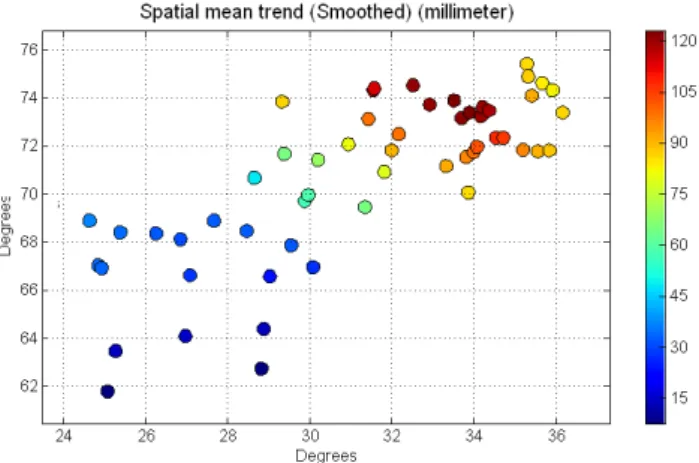
The map of smoothed mean trend aggregated over time.

Fig. 2.

The temporal mean trend aggregated over the regions.

3

Results and discussions

3.1

Estimation by the Bayesian maximum entropy

method

The spatial mean trend and temporal mean trend for

precip-itation are estimated as described in Sect. 2.2. The smooth

spatial mean trend for the whole period of study is displayed

in Fig. 1. The regions between 73

–75

longitude and 32

34

latitude show very heavy precipitation compared to other

regions. The regions falling between 62

–64

longitude and

24

–29

latitude are getting very little rainfall. The

tem-poral mean trend during the whole period of study is

pre-sented in Fig. 2. The temporal trend of precipitation is

cycli-cal and the amount of precipitation is decreasing while time

increases. In the next phase of the BME method the

spa-tial and temporal dependence of precipitation is estimated.

A nested spatial covariance model is fitted as a

combina-tion of a Gaussian and an exponential covariance funccombina-tion

i.e.

C (r,τ

=

0

)

=

5000exp

−3

12

r

+

5000exp

−3

r

2

1

.

5

2

.

The

(4)

Fig. 3.

The spatial experimental covariance and nested spatial

co-variance model.

Fig. 4.

The experimental temporal covariance and the nested

co-variance model.

i.e.

C (r

=

0

,τ )

=

5000exp

−3

τ

40

+

5000

sin

π τ

(π τ )

. The nested

spatial covariance model and the experimental covariance

are shown in Fig. 3, the dots show the experimental

covari-ances and the line represents the fitted covariance model.

The nested temporal covariance model and the

experimen-tal temporal covariance are displayed in Fig. 4. According to

Sect. 2.2, in the last phase, the Bayesian maximum entropy

predictions are calculated for the year 2000 using the fitted

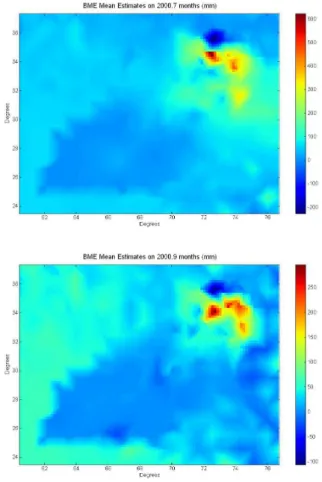
co-variograms. The prediction maps for the months of July

and September in 2000 are displayed in the left two panels of

Fig. 5. These prediction maps suggest that heavy rainfall

oc-curs in the regions between 73

–75

longitude and 32

–34

latitude while the remaining regions of Pakistan have very

little rainfall.

3.2

Estimation of hyper-parameters

A time series trend analysis is made and temporal

correla-tions are removed by fitting an autoregressive model of

or-der 2. To meet the assumption of normality for hierarchical

Bayesian space time interpolation the Box-Cox

transforma-tion is used and it is observed that the data fulfill the

as-sumption of normality for Box-Cox transformation

param-eter

λ

=

0

.

1575. The posterior distributions of

β

0

and

6

are estimated on the basis of the EM algorithm in Le and

Zidek (2006) using their software. The hyper-parameters

H

= {

2,δ,F,β

0

}

for gauged locations are estimated by the

Fig. 5.

The maps of average predicted rainfall BME spatio temporal

method for the month of July and September of year 2000.

EM algorithm, too. The method for estimating a

nonstation-ary spatial covariance matrix for ungauged locations is

ap-plied in three phases. In the first phase, the method utilizes

the empirical correlations and fits an empirical Gaussian

vari-ogram model;

γ (h)

=

a

0

+

(

2

a

0

)(

1

exp

(

t

0

·

h))

, where

a

0

=

0

.

0260 and

t

0

=

1

.

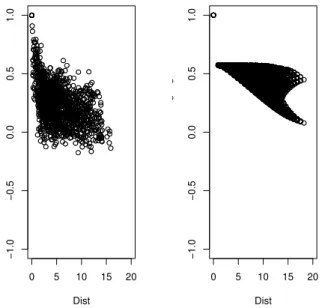
032. For the fitted variogram based

on empirical correlations see Fig. 6. In the second phase,

a thin plate smoothing spline parameter

λ

0

=

20 is used to

estimate the coefficients of the thin plate spline smoothing

splines.

In the third phase, the correlations between the

gauged sites and 196 ungauged sites are estimated. The

cor-relations for ungauged locations are obtained by first

convert-ing ungauged geographic coordinates to D-plane coordinates

and then calculating correlations based on fitted variogram

parameters and the inter-distances in D-space. A comparison

of the empirical correlations of gauged sites and ungauged

sites is shown in Fig. 7.

3.2.1

Predictive distributions

Imagem

Fig. 1. The map of smoothed mean trend aggregated over time.
Fig. 3. The spatial experimental covariance and nested spatial co- co-variance model.
Fig. 8. The predicted maps for the months of July and September of year 2000 using the transformed hierarchical Bayesian model

Referências

Documentos relacionados

Here we estimated the sensitivity of fish assemblages in a set of estuaries distributed worldwide (based on species vulnerability and resilience), and the exposure to

Os dados dos recebidos do Alarm Dosimeter são processados obtendo-se os níveis de radiação presentes nas diferentes salas e depois são adicionados aos gráficos da interface

Silva, Departamento de Matemática, Instituto Superior Técnico, Universidade Técnica de Lisboa, "A Bayesian spatio-temporal analysis of forest fires in Portugal"..

Existindo a possibilidade de análise da granulometria obtida através do recurso a uma fotografia digital, a presente dissertação aborda o contributo da análise

We present a velocity-based approach for modeling animal movement in space and time that allows for temporal heterogeneity in an animal’s response to the environment, allows

We present a randomised algorithm that accelerates the clustering of time series data using the Bayesian Hierarchical Clustering (BHC) statistical method.. BHC is a general method for

Finally we extracted data about the method used to derive indirect inference (Bucher method, meta-regression, Bayesian hierarchical model or multi- variate meta-analysis) and the

Vale salientar que há dificuldade, especialmente nos países da América Latina, de formar coalizões capazes de equacionar minimamente políticas públicas capazes de