METHODS AND EDUCATIONAL MATERIALS USED BY NURSES FOR PREVENTION
OF SEXUALLY TRANSMITTED DISEASES IN ADOLESCENCE: INTEGRATIVE
REVIEW
MÉTODOS E MATERIAIS EDUCATIVOS UTILIZADOS POR ENFERMEIROS PARA PREVENÇÃO
DAS DOENÇAS SEXUALMENTE TRANSMISSÍVEIS NA ADOLESCÊNCIA: REVISÃO INTEGRATIVA
MÉTODOS Y MATERIALES EDUCATIVOS UTILIZADOS POR ENFERMEROS PARA LA PREVENCIÓN DE LAS ENFERMEDADES DE TRANSMISIÓN SEXUAL EN LA ADOLESCENCIA: REVISIÓN INTEGRADORA
Adriana Gomes Nogueira Ferreira1, Anny Giselly Milhome da Costa2, Francisca Elisângela Teixeira Lima3, Marta Maria Coelho Damasceno4, Thelma Leite de Araújo5, Patrícia Neyva da Costa Pinheiro6
ABSTRACT
Objective: to identify methods and instructional materials used by nurses in educational interventions with adolescents for the prevention of Sexually Transmitted Diseases and AIDS. Method: integrative review conducted in the databases Scopus, PubMed, CINAHL, Cochrane and SAGE with uncontrolled descriptors: adolescent, teenage, nursing, health education, prevention, STD or AIDS, intervention, strategy and method. We analyzed 12 articles and educational interventions with their categorization methods and instructional materials. Results: methods: group discussion, individual instruction, demonstration, lecture and role play. Materials: written resources, auditory, and visual models for demonstrations. Educational interventions were characteristic of innovation, creativity and respect for the reality of teenagers. Conclusion: the methods and materials contributed to critical thinking in schools, communities and health facilities. The findings enable evidence-based practice of nurses as health educators with teenagers. Descriptors: Nursing; Health Education, Adolescent; Sexually Transmitted Diseases; Acquired Immune Deficiency Syndrome.
RESUMO
Objetivo: identificar métodos e materiais instrucionais utilizados pelos enfermeiros nas intervenções educativas com adolescentes para prevenção das Doenças Sexualmente Transmissíveis e Aids. Método: revisão integrativa realizada nas bases de dados Scopus, PubMed, CINAHL, Cochrane e SAGE com descritores não controlados: adolescent, teenage, nursing, health education, prevention, STD or AIDS, intervention, strategy
e method. Foram analisados 12 artigos e suas intervenções educativas com categorização em métodos e materiais instrucionais. Resultados: métodos: discussão em grupo, instrução individual, demonstração, dramatização e aula expositiva. Materiais: recursos escritos, auditivos, visuais e modelos para demonstrações. As intervenções educativas apresentaram características de inovação, criatividade e respeito à realidade dos adolescentes. Conclusão: os métodos e materiais contribuíram para a reflexão crítica em escolas, comunidades e unidades de saúde. Os achados possibilitam a prática baseada em evidências do enfermeiro como educador em saúde com adolescentes. Descritores: Enfermagem; Educação em Saúde; Adolescente; Doenças Sexualmente Transmissíveis; Síndrome da Imunodeficiência Adquirida.
RESUMEN
Objetivo: identificar los métodos y materiales didácticos utilizados por las enfermeras en las intervenciones educativas con adolescentes para la prevención de enfermedades de transmisión sexual y SIDA. Método: revisión integradora realizada en la base de datos Scopus, PubMed, CINAHL, Cochrane y SAGE con descriptores no controlados: los adolescentes, adolescente, enfermería, educación para la salud, prevención, enfermedades de transmisión sexual o el SIDA, intervención, estrategia y método. Se analizaron 12 artículos e intervenciones educativas con sus métodos de categorización y materiales de instrucción. Resultados: los métodos: discusión en grupo, instrucción individual, demostraciones, conferencias y clases. Materiales: recursos escritos, auditivos, visuales y modelos para demostraciones y clases. Las intervenciones educativas fueron características de la innovación, la creatividad y el respeto a la realidad de los adolescentes.
Conclusión: los métodos y materiales aportados al pensamiento crítico en las escuelas, las comunidades y los centros de salud. Los resultados permiten la práctica basada en la evidencia de las enfermeras como educadores de salud con adolescentes. Descriptores: Enfermería; Educación para la Salud; Adolescentes; Enfermedades de Transmisión Sexual; Síndrome de Inmunodeficiencia Adquirida.
1Nurse, PhD Student, Graduate Program in Nursing/Doctorate of Nursing, Universidade Federal do Ceará/PPGENF. Fortaleza (CE), Brazil. E-mail: [email protected]; 2Clinical Nurse, Graduate Program in Nursing / Doctorate of Nursing, Universidade Federal do Ceará/PPGENF. Fortaleza (CE), Brazil. E-mail: [email protected]; 3,5,6Nurses, PhD in Nursing, Nursing Department, Faculty of Pharmacy, Dentistry and Nursing, Universidade Federal do Ceará/UFC. Fortaleza (CE), Brazil. E-mails: [email protected]; [email protected]; [email protected]; 4Nurse, Post PhD Professor in Nursing, Nursing Department, Faculty of Pharmacy, Dentistry and Nursing, Universidade Federal do Ceará/UFC. Fortaleza (CE), Brazil. E-mail: [email protected]
Adolescence is characterized as a period in
individual’s lives with severe trials, marked by
impulsive actions and expectations
immediacy. Romantic relationships among adolescents may be less stable and durable1,
making them vulnerable to sexually
transmitted diseases (STDs) and Acquired Immunodeficiency Syndrome (AIDS)
The prevention of STD / AIDS in this age group is based primarily on education and counseling. Teenagers should be able to prevent potential exposure to STDs through changes in sexual behavior helped by health professionals of local services2. Literature
points to the need for incentives to practices to prevent STD / AIDS go over the theme of sexuality and to involve family, educational, cultural and social background. 3
In this scenario, the role of the nurse is beyond caregiver educator, since nursing care
are transformed into educational
interventions to recognize that the other is a vulnerable person, who needs to change behaviors to acquire wholesome behaviors that increase their levels of health. 4
In nursing, the educational intervention is mainly characterized by the act of using teaching methods and specific instructional materials. In this respect it is necessary to differentiate the method of instructional material, the first is how information is taught through: lecture, group discussion, individual
instruction, demonstration and
implementation, games, simulation, role playing, modeling, self-instructional activities
. Whereas instructional materials are
accessories used to enhance teaching and
learning, categorized into: writings,
statements and media. 5
The initiatives of nurses for prevention of STD / AIDS in adolescents are often published in the scientific literature, however it remains dispersed in their local experiences, featuring a fragmented view of the panorama of the production in this area. Therefore, the synthesis of these educational interventions may provide greater visibility of context, facilitating better planning and effective implementation of nursing actions.
The participation of the nurse as educator and a means of spreading this process may potentiate the actions of STD / AIDS in a positive manner, since successful experiences, when carefully analysed, may be possible to be reapplied. In this sense, the present study
aimed to identify the methods and
instructional materials used by nurses in educational interventions with adolescents for prevention of STD / AIDS.
A descriptive, documentary, integrative
review6-7 conducted from the research
question << What materials and
instructional methods are used by nurses in educational interventions for the prevention of STD / AIDS with adolescents? >>
The survey was conducted of articles in five international electronic data bases: Scopus, PubMed, Cumulative Index to Nursing & Allied Health Literature (CINAHL), Cochrane and SAGE, through free access on the website of the Coordenação de Aperfeiçoamento de Pessoal de Nível Superior (CAPES-Brazil), in the months of March and April 2011.
The selection stage of the studies involved the careful and critical reading of abstracts and then the text in full, applying the following criteria: 1) Inclusion - original studies, published in English, that focused educational interventions for the prevention of STD / AIDS with teenage audiences, with at least one author nurse; 2) Exclusion - not available in full or double indexed in databases.
Data collection of selected articles was performed using two instruments developed by the researchers. The first with information on the design, journal, year of publication, level of evidence and country. To facilitate data analysis, the second instrument included: objectives sample, methods and / or materials, method of evaluation of the intervention, results, conclusions and / or considerations.
The structure of the research in each database was conducted by means of
uncontrolled descriptors: adolescent,
teenage, nursing, health education, prevention, STD or AIDS, intervention, strategy and method that were searched
simultaneously using ‘and’. At this stage 140 abstracts were found, as shown in Table 1. It is noteworthy that the period of publication of articles was not defined at this stage, incorporating all available years in bases.
INTRODUCTION
Table 1. Number of articles selected for review after integrative electronic search, delete after reading the abstract and delete after reading the article in full.
Articles (N=140)
Electronic Data Bases
Scopus PubMed CINAHL Cochrane SAGE Total
Found 65 3 10 2 60 140
Exclusion (by summary) 28 2 8 1 31 70
Exclusion (by article) 34 - 1 1 22 58
Selected 3 1 1 - 7 12
Data analysis was performed using the critical reading of the twelve (N = 12) selected articles and their respective data sheets. The methods and instructional
materials identified in educational
interventions were grouped based on the author's rating instrument Bastable5 focusing on the quality of pre-selected items.
A summary of the data is presented in
figure form, gathering the knowledge
produced in the categories methods and instructional materials. For presentation purposes, the articles were numbered 1-12 in the figures, according to the order of selection in the consulted databases.
In the discussion sector, the theme was explored in depth in dialogue with other literatures. Such exploration can contribute to a new understanding of the phenomenon of interest, and implications for nursing practice are emphasized, as well as research initiatives.3,7-8
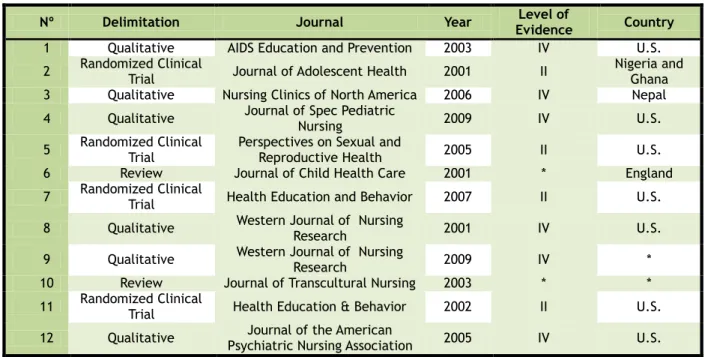
Initially articles were categorized according to study design, journal, evidence level, year of publication and country of the study, as shown in Figure 1.
Nº Delimitation Journal Year Level of
Evidence Country
1 Qualitative AIDS Education and Prevention 2003 IV U.S. 2 Randomized Clinical
Trial Journal of Adolescent Health 2001 II
Nigeria and Ghana 3 Qualitative Nursing Clinics of North America 2006 IV Nepal 4 Qualitative Journal of Spec Pediatric
Nursing 2009 IV U.S.
5 Randomized Clinical Trial
Perspectives on Sexual and
Reproductive Health 2005 II U.S. 6 Review Journal of Child Health Care 2001 * England 7 Randomized Clinical
Trial Health Education and Behavior 2007 II U.S. 8 Qualitative Western Journal of Nursing
Research 2001 IV U.S.
9 Qualitative Western Journal of Nursing
Research 2009 IV *
10 Review Journal of Transcultural Nursing 2003 * * 11 Randomized Clinical
Trial Health Education & Behavior 2002 II U.S. 12 Qualitative Journal of the American
Psychiatric Nursing Association 2005 IV U.S.
Figure 1. Classification of publications according to study design, journal, year of publication, level of evidence
and country of study. * Not reported in the article. The analyzed articles in this review were published between 2001 and 2009, six were published in professional journals in nursing, as in other journals in the areas of AIDS (n = 1), child health (n = 1), adolescent health (n = 1), reproductive health (n = 1) and education (n = 3). This shows the inclusion of nurses researchers in the various areas of knowledge related to the topic.
Regarding the level of evidence and
research design: Level II evidence -
randomized controlled trials (n = 4), level IV from non-experimental studies, such as comparative and correlational descriptive study with a qualitative approach and case studies (n = 6) and without setting level (n = 2).
The institution in which the studies were developed included: community (n = 4), schools (n = 3), health services (n = 2)
detention center (n = 1), residence (n = 1). Most publications (n = 9) were performed in the United States (U.S.).
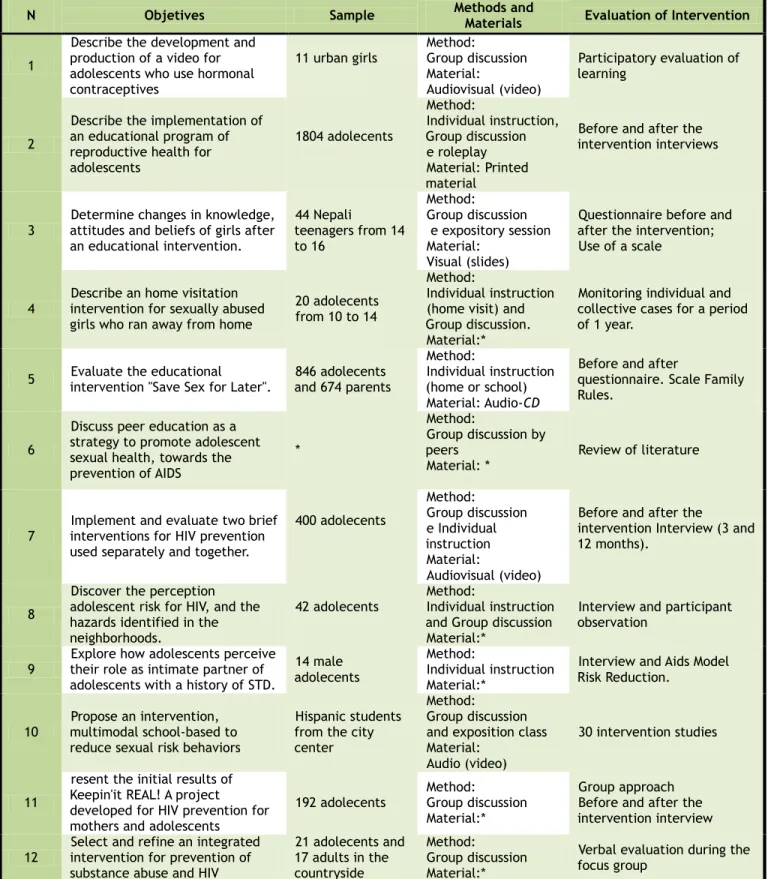
Figure 2 presents the studies in accordance with the presented objectives, sample, methods / instructional materials, evaluation of the intervention.
RESULTS
N Objetives Sample Methods and
Materials Evaluation of Intervention
1
Describe the development and production of a video for adolescents who use hormonal contraceptives
11 urban girls
Method:
Group discussion Material:
Audiovisual (video)
Participatory evaluation of learning
2
Describe the implementation of an educational program of reproductive health for adolescents 1804 adolecents Method: Individual instruction, Group discussion e roleplay Material: Printed material
Before and after the intervention interviews
3
Determine changes in knowledge, attitudes and beliefs of girls after an educational intervention.
44 Nepali
teenagers from 14 to 16
Method:
Group discussion e expository session Material:
Visual (slides)
Questionnaire before and after the intervention; Use of a scale
4
Describe an home visitation intervention for sexually abused girls who ran away from home
20 adolecents from 10 to 14
Method:
Individual instruction (home visit) and Group discussion. Material:*
Monitoring individual and collective cases for a period of 1 year.
5 intervention "Save Sex for Later". Evaluate the educational and 674 parents 846 adolecents
Method:
Individual instruction (home or school) Material: Audio-CD
Before and after
questionnaire. Scale Family Rules.
6
Discuss peer education as a strategy to promote adolescent sexual health, towards the prevention of AIDS
*
Method:
Group discussion by peers
Material: *
Review of literature
7
Implement and evaluate two brief interventions for HIV prevention used separately and together.
400 adolecents Method: Group discussion e Individual instruction Material: Audiovisual (video)
Before and after the
intervention Interview (3 and 12 months).
8
Discover the perception adolescent risk for HIV, and the hazards identified in the neighborhoods.
42 adolecents
Method:
Individual instruction and Group discussion Material:*
Interview and participant observation
9
Explore how adolescents perceive their role as intimate partner of adolescents with a history of STD.
14 male adolecents
Method:
Individual instruction Material:*
Interview and Aids Model Risk Reduction.
10
Propose an intervention, multimodal school-based to reduce sexual risk behaviors
Hispanic students from the city center
Method:
Group discussion and exposition class Material:
Audio (video)
30 intervention studies
11
resent the initial results of Keepin'it REAL! A project developed for HIV prevention for mothers and adolescents
192 adolecents
Method:
Group discussion Material:*
Group approach Before and after the intervention interview 12
Select and refine an integrated intervention for prevention of substance abuse and HIV
21 adolecents and 17 adults in the countryside
Method:
Group discussion Material:*
Verbal evaluation during the focus group
Figure 2. Summary of studies included in the review according to integrative research objectives, sample, methods and
instructional materials, and evaluation of educational intervention. * Not reported or not identified in the article.
The instructional methods used in
educational interventions for the prevention of STD / AIDS with adolescents were predominantly group discussion and individual
instruction. Regarding the instructional
materials used, most studies did not demonstrate this tool, however we identified two studies using video, one with the use of audio and slides and two with printed materials.
To discuss the studies that developed methods like individual instruction, we considered the interview which took place within 30 to 90 minutes, and their guiding
questions enabled the discussion and
reflection on the theme of sexuality in relationships, enabling reflection on the relationship with the girlfriend, which
conceived the idea about sex and how it was addressed in the relationship10. It was also used along with earlier themes in the discussion group, which allowed filling the gaps identified in this educational activity.11
Home visits were focused on the client, and was considered as an individual instruction. The approaches were positive. They focused on the development of relations of trust between nurses and teens, and were focused on harm reduction and the promotion of sexual and reproductive health. The nurses talked about the experience of the young in school, family and health services. 12 The
For the group discussions, the focus of the group type was used as instructional method in four studies11-4. In one of them, 23 sessions were held, lasting 45 minutes to 2 hours11. Another study used four focus groups, guided by the themes: risk factors related to drugs and HIV virus and resilience factors to drugs and involvement in risky sex. 14
For peer education we used group discussion, for these groups, facilitators teenagers were selected in schools and / or communities, attended training on anatomy, physiology, pregnancy, STIs / HIV and contraception, and acquired communication skills , counseling and data collection for
research. ‘Teenagers-educators’ provided
information to their peers, using the following methods: Drama and distribution of written materials on themes: sexual and reproductive health. Peer education has strengthened the local youth role. 15-6
Another identified instructional method was an educational meeting with adolescents and their mothers during fourteen sessions, lasting two hours each, in which we used four methods: group discussion and lecture and as instructional material: visual (video). These included not only the teenager, but also family members, with the goal of building feelings of efficacy in various aspects of life
through enhanced self-concept and
achievement motivation of families with
community support, developing skills,
information, motivation to succeed and to promote behaviors of family and community support. 17
Still on educational initiatives, it was developed an approach, covering topics such as: Introduction to the force of class diversity, plans for the future, the human body, sexuality, and sex hormones, self-esteem, STD / AIDS, ability to use a condom,
decision-making and negotiation. Regarding
instructional methods it was recommended
group discussions, role plays and
demonstration, and as material: audio (vignettes) and models for demonstration. 18
The instructional materials used by parents and children in their homes were in the form of a software with three Compact Disc (CD), called "Save the sex for later." The audio CD was developed with stories of drama and humor of three families - a black family, a Hispanic family and a Caribbean family. The stories follow the growth of children and the themes include body changes, relationships, influences and pressure to sexual initiation. 19
A video of 21 minutes, built and tested by the authors, focusing mainly on the risk of exposure to HIV among girls who use oral
contraceptives and are only concerned to avoid pregnancy, was used as another material in educational interventions. The filming involved the stories and testimonies of two girls and two boys HIV positive HIV negative, demonstrating that HIV can happen to anyone. Those living with HIV are no different, protection against pregnancy does not protect against infection. 13,20
Ten studies have identified the theoretical basis used to guide educational interventions. Theories of learning and / or social and cognitive development, such as: Social Cognitive Theory10,13,20-1, Social Learning Theory15-6, Theory of Social Development19. Other studies have addressed the Health Belief Model, AIDS Risk Reduction Model (ARRM)10, resilience, rationalized action and concepts of Paulo Freire17.
Considering that most educational
interventions were conducted in the U.S. having as target adolescent females, black or
Latino and Hispanic descents, studies
identified that youngsters of racial and ethnic minorities are characterized as a segment of the population vulnerable to STD / AIDS, being the priority audience target in performing preventive strategies. 22
Another aspect was the importance of schools and communities as sites for health education for adolescents. It is noteworthy that about 88% of high school students in the U.S. report learning about the prevention of HIV / AIDS through school.22 And, by providing
a forum for raising awareness and
opportunities for youth, schools and
communities are important scenarios for nursing-educator.5 This reality is also present in Brazilian society, including those involving nursing work in health education and prevention of STD / AIDS. 3
The action research techniques used in the articles emphasize the importance of the nurse and adolescent cooperation and participation in the research for the resolution of collective problems. This technique helps in understanding the issues that arise from the results. 23
Interventions to prevent STDs / AIDS for teenagers aim to prevent primary infection by changing risky sexual behavior. For this group, the behavioral changes mainly involve abstaining from sex, delaying the beginning of them, reducing the number of partners and using condoms correctly and often.24
To achieve these behavioral changes, the studies evaluated methods and instructional materials used in order to facilitate the
learning process and thus enable a reflection on adoption of healthy sexual behavior. Considering the context of adolescents, it is important to respect their experiences and reflect on the risks they are exposed.
The HIV prevention programs should consider the specific behavior and teach teens about safe sex practices and risks, which
should facilitate the development of
underlying skills, such as: goal setting, recognition of stimuli that trigger risk behaviors, reinforcement of positive behavior and effective communication skills that are vital to the formation of relationships and negotiation. 17
A study made with young black Americans
concluded that to succeed in the
implementation of educational interventions, health professionals need to commit to their development, considering the variety of factors involving the teenager; expanding the understanding of the context of sexuality and
risk reduction; tailoring messages and
programs; innovating approaches, and mainly involving the young in developing and promoting the intervention, in order to
promote their healthy growth and
development. 24
Another important issue to be considered is the communication between partners about sex and STDs, as it is positively associated
with condom use. An important
communication antecedent in society is the level of dialogue of teenagers to their parents about these issues. Those teenagers who do not talk to their parents about these issues may be less likely to communicate well with their partners.25
In this sense, it was found in this review that the use of instructional methods and materials that have considered the context of young people, prepared and discussed with them the issues proposed, according to their reality. The method of group discussions makes teens actively participate, comment on what they have learned, even when the researchers had no content, as a result of their own efforts, allowing also a space for the adolescent voice, where they can express what they think, how and by whom the
educational activities should be
conducted.11,14
During teenage years changes take place in
patterns of interpersonal relationships.
Typically, the greatest importance is given to colleagues as providers of advice, support, companionship, role models and sources of comparison. Thus, peer education has a greater influence on the values, interests, attitudes and behaviors of most teenagers. 16
In the debate on HIV prevention programs, the age of sexual initiation should not be ignored. It is of great concern the growth of unprotected sexual activity with casual partners among young people who begin sexual life before being 14. 26
When dealing with health promotion in relation to sexuality and initiatives of
prevention with adolescents, beliefs,
opinions, values and group should be valued, and considered, both in form and content of such approaches. 27
In response to the question of the study, educational interventions were shown. They sought to change behavior, through reflection on the reality and the risk of infection with HIV / AIDS, using group discussion, individual instruction, lecture and role play as instructional methods and materials with the aid of written, audiovisual, slides and models for demonstration, considering issues such as sexuality, communication, family participation and involvement of health and education.
Nurses use different methods and
instructional materials in health education with teens who favor the transformation of nursing care in the prevention of STD / AIDS. However, it is necessary to identify ways to
develop new educational interventions,
theoretically grounded that may promote the autonomy of adolescents and strengthen their self-esteem. Only then can the teens develop healthier sexual behaviors.
These methods indicate the importance of respect to prior knowledge of adolescents about sexuality. The articulated materials and methods should subsidize, either individually or collectively, specific interventions to groups considered vulnerable, such as racial and ethnic minorities, and can be carefully adapted and used in the context of Latin American adolescents.
The evidence-based practice of nursing must go beyond the studies identified in this research, because other professional fields are also applying and developing methods and instructional materials. Other interventions may be explored in order to contribute to the practice of nursing, such consideration remains as a stimulus for the development of new research review.
1. Ministério da Saúde do Brasil, Secretaria de Atenção em Saúde, Departamento de Ações
Programáticas Estratégicas. Diretrizes
nacionais para a atenção integral à saúde de
CONCLUSION
adolescentes e jovens na promoção, proteção e recuperação. Brasília (DF): Ministério da Saúde; 2010. 132p.
2. Campo-Arias A, Ceballo GA, Herazo E. Prevalence of pattern of risky behaviors for reproductive and sexual health among middle- and high-school students. Rev latinoam enferm [Internet]. 2010 [cited 2011 June
09];18(2):170-4. Available from:
http://www.scielo.br/scielo.php?script=sci_ar ttext&pid=S010411692010000200005&lng=en&
tlng=pt.
3. Toledo MM, Takahashi RF,
De-La-Torre-Ugarte-Guanilo MC. Elementos de
vulnerabilidade individual de adolescentes ao HIV/AIDS. Rev bras enferm [Internet]. 2011 [cited 2011 Dec 26];64(2):370-5. Available
from: http://www.scielo.br
/scielo.php?script=sci_arttext&pid=S00347167
2011000200024&lng=pt.
4. Costa D, Silva R, Davim R, Silva R. Health education on sexually transmitted diseases with adolescents: a case report. J Nurs UFPE on line [Internet]. 2012 [cited 2012 Sept
2];6(9):2312-7. Available from:
http://www.ufpe.br/revistaenfermagem/inde
x.php/ revista/article/view/2583.
5. Bastable SB. O enfermeiro como educador: princípios de ensino-aprendizagem para a prática de enfermagem. 3th ed. Porto Alegre: Artmed; 2010.
6. Ganong LH. Integrative reviews of nursing research. Res Nurs Health. 1987 Jan [cited 2013 Apr 24];10(1):1-11. Available from:
http://onlinelibrary.wiley.com/doi/10.1002/n
ur.4770100103/abstract
7. Whittemore R, Knafl K. The integrative review: updated methodology. J Adv Nurs [Internet]. 2005 Dec; [cited 2013 Apr 24]
52(5):546-53. Available from:
http://www.ncbi.nlm.nih.gov/pubmed/16268
861n.
8. Barbosa LR, Melo MRAC. Relações entre qualidade da assistência de enfermagem: revisão integrativa da literatura. Rev Bras Enferm [Internet]. 2008 May-June [cited 2013
Apr 24];61(3):366-70. Available from:
http://www.scielo.br/scielo.php?script=sci_ar
ttext&pid=S0034-71672008000300015&lng=pt&nrm=iso&tlng=pt 9. Stetler CB, Morsi D, Rucki S, Broughton S, Corrigan B, Fitzgerald J, et al. Utilization focused integrative reviews in a nursing service. Appl Nurs Res [Internet]. 1998 Nov [cited 2013 Apr 24];11(4):195-206. Available from:
http://www.sciencedirect.com/science/journ
al/08971897/11
10. Collins JL, Champion JD. Male adolescent sexual behavior: what they know and what they wish they had known. West J Nurs Res [Internet]. 2009 Oct [cited 2013 Apr
24];31(6):748-71. Available from:
http://wjn.sagepub.com/content/31/6.toc
11. Anderson NLR, Nyamathi A, Mcavoy JA, Conde F, Casey C. Perceptions about risk for HIV/Aids among adolescents in juvenile detention. West J Nurs Res [Internet]. 2001 June [cited 2013 Apr 24];23(4):336-59.
Available from:
http://wjn.sagepub.com/content/23/4/336.f
ull.pdf+html
12. Edinburgh LD, Saewyc EM. A novel, intensive home visiting intervention for runaway, sexually exploited girls. J Spec Pediatr Nurs [Internet]. 2009 Jan [cited 2013
Apr 24];14(1):41–8. Available from:
http://onlinelibrary.wiley.com/doi/10.1111/j .1744-6155.2008.00174.x/pdf
13. Roye CF, Silverman PP, Krauss B. A brief,
low-cost, theory-based intervention to
promote dual method use by black and latina female adolescents: a randomized clinical trial. Health Educ Behav [Internet]. 2007 Aug [cited 2013 Apr 24];34(4):608-21. Available from:
http://heb.sagepub.com/content/34/4/608.f
ull.pdf+html
14. Brown EJ, Waite CD. Perceptions of risk and resiliency factors associated with rural
African American adolescents’ substance
abuse and HIV behaviors. J Am Psychiatr Nurses Assoc [Internet]. 2005 Apr [cited 2013
Apr 24];11(2):88-100. Available from:
http://jap.sagepub.com/content/11/2/88.full
.pdf+html
15. Brieger WR, Delano GE, Lane CG, Oladepo O, Oyediran KA. West African youth initiative: outcome of a reproductive health education program. J Adolesc Health [Internet]. 2001
Dec [cited 2013 Apr 24];29(6):436–46.
Available from:
http://ac.els-
cdn.com/S1054139X01002646/1-s2.0- S1054139X01002646-main.pdf?_tid=7888c7f2-
ad4e-11e2-b055-00000aab0f6c&acdnat=1366856511_f7d08007d
e309f55640fab960aa309cb
16. Ochieng BMN. Health promotion strategy for adolescents' sexual behavior. J Child Health Care [Internet]. 2001 June [cited 2013
Apr 25];5(2):77-81. Available from:
http://chc.sagepub.com/content/5/2/77.full.
pdf+html
25];29(1):104-23. Available from:
http://heb.sagepub.com/content/29/1/104.f
ull.pdf+html
18. Talashek ML, Norr KF, Dancy BL. Building teen power for sexual health. J Transcult Nurs [Internet]. 2003 July [cited 2013 Apr
25];14(3):207-16. Available from:
http://tcn.sagepub.com/content/14/3/207.fu
ll.pdf+html
19. O’Donnell L, Stueve A, Agronick G, Wilson -Simmons R, Duran R, Jeanbaptiste V. Saving sex for later: an evaluation of a parent education intervention. Perspect Sex Reprod Health [Internet]. 2005 Dec [cited 2013 Apr
25];37(4):166-73. Available from:
http://onlinelibrary.wiley.com/doi/10.1363/3
716605/pdf
20. Roye CF, Hudson M. Developing a culturally appropriate video to promote dual-method use by urban teens: rationale and methodology. AIDS Educ Prev [Internet]. 2003
Apr [cited 2013 Apr 25];15(2):148-58.
Available from:
http://guilfordjournals.com/doi/abs/10.1521
/aeap.15.3.148.23837
21. Mahat G, Scoloveno MA. An HIV/AIDS
Education intervention for Nepalese
adolescent females. Nurs Clin N Am [Internet]. 2006 Sept [cited 2013 Apr 25];41(3):409–23.
Available from:
http://ac.els-
cdn.com/S0029646506000430/1-s2.0- S0029646506000430-main.pdf?_tid=aa33b48e-
ad52-11e2-b5c0-00000aacb361&acdnat=1366858313_52b4a49b
1d220bc3e7d343c1a3f1a168
22. Centers for Disease Control and Prevention (US). CDC HIV/AIDS fact sheet. HIV/AIDS among youth [Internet]. 2008 Aug [cited 2011
June 17]. Available from:
http://www.cdc.gov/hiv/resources/factsheet s/PDF/youth.pdf
23. Moreno, CL. The relationship between culture, gender, structural factors, abuse, trauma, and HIV/AIDS for Latinas. Qual Health Res [Internet]. 2007 Mar [cited 2013 Apr
24];17(3):340-52. Available from:
http://qhr.sagepub.com/content/17/3/340.fu
ll.pdf+html
24. Miller KS, Boyer CB, Cotton G. The STD and HIV Epidemics in African American youth:
reconceptualizing approaches to risk
reduction. J Black Psychol [Internet]. 2004
Feb [cited 2013 Apr 24];30(1):124-37.
Available from:
http://jbp.sagepub.com/content/30/1/124.fu
ll.pdf+html
25. Crosby RA, DiClemente RJ, Wingood GM, Cobb BK, Harrington D, Kathy SL. Condom use and correlates of African American adolescent
females' frequency in communication with sex
partners about preventing sexually
transmitted diseases and pregnancy. Health Educ Behav [Internet]. 2002 Apr [cited 2013
Apr 25];29(2):219-31. Available from:
http://heb.sagepub.com/content/29/2/219.f
ull.pdf+html
26. Paiva V, Aranha F, Bastos FI. Opiniões e atitudes em relação à sexualidade: pesquisa de âmbito nacional, Brasil 2005. Rev Saúde Públ [Internet]. 2008 Jun [cited 2013 Abr
24];42(Suppl 1):54-64. Available from:
http://www.scielo.br/scielo.php?script=sci_ar
ttext&pid=S0034-89102008000800008&lng=pt&nrm=iso&tlng=pt
27. Santana I, Santos Y, Carvalho K, Araujo E. Use of condoms by male students in a public school. J Nurs UFPE on line [Internet]. 2011 Dec [cited 2012 Jan 10];5(Suppl):2616-23.
Available from:
http://www.ufpe.br/revistaenfermagem/inde
Submission: 2012/09/16 Accepted: 2013/04/21 Publishing: 2013/06/01
Corresponding Address
Adriana Gomes Nogueira Ferreira Universidade Federal do Maranhão Rua Ceará, 1600 / Bl 1 /Ap. 105 Bairro Nova Imperatriz