Artigo Original
Júlia Escalda1 Stela Maris Aguiar Lemos2 Cecília Cavalieri França3
Descritores
Audição Percepção auditiva Linguagem infantil Música Testes auditivos Keywords
Hearing Auditory perception Child language Music Hearing tests
Correspondence address:
Júlia Escalda
R. Oliveira, 140, Cruzeiro, Belo Hori-zonte (MG), Brasil, CEP: 30310-150. E-mail: [email protected]
Received: 8/16/2010
Accepted: 12/9/2010
Study conducted at the Graduate Program (Master) in Music, Universidade Federal de Minas Gerais – UFMG – Belo Horizonte (MG), Brazil, with funding from Coordenação de Aperfeiçoamento de Pessoal de Nível Superior (CAPES).
(1) Graduate Program (Master) in Music, Universidade Federal de Minas Gerais – UFMG – Belo Horizonte (MG), Brazil; Speech-Language Pathology and Audiology Undergraduate Program, Universidade Federal de Minas Gerais – UFMG – Belo Horizonte (MG), Brazil.
(2) Speech-Language Pathology and Audiology Undergraduate Program, Universidade Federal de Minas Gerais – UFMG – Belo Horizonte (MG), Brazil.
(3) Graduate Program (Master) in Music, Universidade Federal de Minas Gerais – UFMG – Belo Horizonte (MG), Brazil.
of five-year-old children with and without musical
experience
Habilidades de processamento auditivo e consciência
fonológica em crianças de cinco anos com e sem
experiência musical
ABSTRACT
Purpose: To investigate the relations between musical experience, auditory processing and phonological awa-reness of groups of 5-year-old children with and without musical experience. Methods: Participants were 56 5-year-old subjects of both genders, 26 in the Study Group, consisting of children with musical experience, and 30 in the Control Group, consisting of children without musical experience. All participants were assessed with the Simpliied Auditory Processing Assessment and Phonological Awareness Test and the data was statistically analyzed. Results: There was a statistically signiicant difference between the results of the sequential memory test for verbal and non-verbal sounds with four stimuli, phonological awareness tasks of rhyme recognition, phonemic synthesis and phonemic deletion. Analysis of multiple binary logistic regression showed that, with exception of the sequential verbal memory with four syllables, the observed difference in subjects’ performance was associated with their musical experience. Conclusion: Musical experience improves auditory and meta-linguistic abilities of 5-year-old children.
RESUMO
Objetivos: Investigar as relações entre experiência musical, habilidades de processamento auditivo e de cons-ciência fonológica de crianças de 5 anos de idade com e sem experiência musical. Métodos: Participaram 56 sujeitos de ambos os gêneros, na faixa etária de 5 anos, sendo 26 do Grupo Estudo, composto por crianças com experiência musical, e 30 do Grupo Controle, composto por crianças sem experiência musical. Todos os participantes foram avaliados por meio da Avaliação Simpliicada do Processamento Auditivo e do Teste de Consciência Fonológica, e os dados foram analisados estatisticamente. Resultados: Observou-se diferença en-tre os resultados obtidos nos testes de memória sequencial verbal e memória sequencial não-verbal com quatro instrumentos, tarefas de identiicação de rimas, síntese e exclusão fonêmica. A análise de regressão logística múltipla demonstrou que, com exceção do teste de memória sequencial para sons verbais com quatro sílabas, a diferença de desempenho observada nos testes e tarefas teve relação com a experiência musical dos sujeitos.
INTRODUCTION
Musical development depends on acoustic experiences, including sound discrimination, perception of musical themes, sensitivity to rhythm, texture and timbre and also on the ability to produce or play music(1). Through hearing, the individual
acquires knowledge about the physical world around him and learn his irst words. The auditory behaviors are one of the favo-rable conditions for acquisition and development of language(2).
Several studies have investigated the neural mechanisms involved in the processing and production of linguistic stimuli, such as speech, and non-linguistic, such as music. A recent study shows that there are differences in neural activity of the auditory association areas of professional musicians, related to the early beginning of their musical training(3). There is
evidence of overlapping brain areas during the processing of musical and linguistic stimuli(4). Musical experience seems to
inluence children’s brain structure and reorganization(5), as
well astheir cognitive, auditory and linguistic development(6).
Hearing integrity is relevant for the development of phono-logical awareness, reading and writing(7,8). It has been shown
that musical experience fosters auditory skills of discrimination of frequency and duration(9,10), speech recognition in competing
acoustic situations with noise in adults(11) and auditory pattern
recognition of frequencies(12) and igure-ground(13) in children.
In addition, there is evidence that musical perception, phono-logical awareness and early reading development are correlated in children of 4 and 5 years of age(14). Similar indings have
also shown that children with high musical aptitude had better performance than children with low musical aptitude in pho-nological awareness verbal tasks(15). In addition, studies with
preschoolers showed that children who received four months of music education had superior performance in the development of phonemic segmentation ability when compared to children who did not receive music lessons(16).
At present, musical activity has been widely practiced in preschool education. Some efforts have been made to inves-tigate the inluence of musical experience in other cognitive domains, its role on the acquisition of new skills, including auditory and linguistic abilities. Nevertheless, the literature on the investigation of auditory and phonological awareness skills in the same population is still of limited size, especially in children.
Thus, the present study was designed to investigate the rela-tionship between musical experience, auditory processing abi-lities and phonological awareness skills of 5-year-old children with and without musical experience. Also, we will compare the results of the Simpliied Auditory Processing Assessment and the Phonological Awareness Test between groups of 5-year-old children with and without musical experience.
METHODS
The study was approved by the Ethics Committee of the Universidade Federal de Minas Gerais (COEP/UFMG) pro-tocol number 641/07. Parents and caregivers received and were asked to sign a consent form. The study is
descriptive-comparative with a transversal design and non-probabilistic convenience sample, consisting of groups of children with and without musical experience. The study was conducted at specialized music schools and regular schools (with no formal music classes in their daily activities), all situated at Belo Horizonte, Brazil.
The irst stage of the study consisted of the application of questionnaires to parents/caregivers in order to select the participants of the study and to characterize the proile of the sample. The following inclusion criteria were considered: to be aged between 5 years and 5 years and 11 months; to pre-sent the auropalpebral relex; no evidence or previous history of neuropsychological, motor, auditory, speech and language related disturbs.
The auropalpebral relex was tested within the Simpliied Auditory Processing Assessment and it is usually referred as an inclusion criterion of participants, given that Rabinovich(17) has
reported that the auropalpebral relex is only shown by children with normal hearing or with moderated hearing losses. In cases of moderated, severe and profound hearing losses, without au-ditory recruitment, and in cases of liquid in the middle ear, the auropalpebral relex is not observed. The auropalpebral relex test was taken into account in combination with complementary auditory data about the hearing of the participants, collected with the questionnaire answered by parents/caregivers of the participants in the sample. None of the children included in the study presented an absent auropalpebral relex, however, one of the participants whose parents reported hearing impairment was excluded from the sample.
The data obtained from the questionnaires was analyzed using the Chi-Square test in order to compare categorical variables between groups. This analysis showed three signi-icantly different variables between groups, namely: maternal education, age of enrollment in school, habit of listening to classical music, which were included as explanatory variables in the regression analysis along with the variables gender and group. The results of statistical analysis are detailed in the item referring to the results.
In the second stage, we assessed the auditory processing and phonological awareness skills of the participants with the following tests:
1. Phonological Assessment of Children(18):in order to ensure
that responses to verbal tests were not to be inluenced by any speech and language disorders.
2. Simpliied Auditory Processing Assessment: consisting of elicitation of the auropalpebral relex through instrumental sounds(17,19), Sound Location Test in ive directions,
Sequen-tial Verbal Memory Test for sounds with three and four syllables; Sequential Non-verbal Memory Test with three and four instruments. The results were analyzed following the criteria reported in the literature(20,21).
3. Phonological Awareness Test(22): consisting of syllabic
words, the number of correct answers was counted for each participant in each of the tasks of the test.
We assessed 71 children, 56 of which were selected to be analyzed. Losses occurred because of failure to meet the inclusion criteria, such as speech disorders observed with the Phonological Assessment of Children or hearing impairments reported by parents/caregivers in the questionnaire. Children who have been diagnosed with any speech, language or hea-ring disorder were referred to treatment within the local public health system. The selected participants were distributed into the following groups:
Study Group: 30 participants (20 female e 10 male) en-rolled in specialized music schools. Two music schools with long history of formal music education in Belo Horizonte were selected to participate in the study. Both music schools have students in different age ranges (children, adolescents, adults) and their teachers have speciic training in Music with Bachelor’s degrees of Music. The two music schools provided one music class (musical initiation) per week with duration of one hour and also choral singing and musical instruments as optional classes. The musical content covered in the music classes includes musical parameters of duration, pitch, tim-bre, intensity, expressive character, initiation to structure and musical notation. The activities are structured to address the musical content in a playful manner, consistent with the age of group of children. Participants in the study group attended regular music classes and had at least four months of musical experience at those classes, although this was not considered as an inclusion criterion.
Control Group: 26 participants (13 female and 13 male) enrolled in regular schools without formal music classes in their daily activities. The regular schools were selected to ensure the similarity of the scenarios studied, with the condition that they should not have formal music classes in their curriculum. Thus, regular schools with a reduced number of students per classroom, about seven and 12 children per class were chosen because of its similarity to the classes at the music schools. This required the choice of ive regular schools in order to select the participants in the control group. All regular schools offered recreation during the morning and regular classes in the afternoon. Additional data about the musical proile of the participants in the study was collected with the application of the questionnaire that was used to characterize the sample.
The questionnaire brought up questions about the musical habits of the children, the places where they listen to music more often, the musical genres usually heard, and their enroll-ment in music classes at regular or specialized schools, their enrollment in music instruments classes as well as the duration of these activities. Data obtained from this questionnaire was analyzed using the Chi-square test and, with respect to the variables of the music proile of the participants, there was a signiicant difference between the two groups in their habit of listening to classical music, which was included as explanatory variable in the regression analysis.
The results of the Simpliied Auditory Processing Assess-ment and of the Phonological Awareness Test were analyzed using the Mann-Whitney non-parametric test in order to
com-pare the performance between the two groups. To estimate the association between the results of the Simpliied Auditory Processing Assessment and of the Phonological Awareness Test and the explanatory variables, procedures of multiple logistic regression were carried out. The dependent variables included in the model were the results of the Simpliied Auditory Pro-cessing Assessment and of the Phonological Awareness Test and as explanatory variables were those selected in the analysis of the questionnaire (maternal education, age of enrollment in school, habit of listening to classical music, gender and group).
The dependent variables were transformed into binary variables according to the number of correct responses in the tests. Data was processed and analyzed using SPSS 13.0, with signiicance level of 95% (p≤0.05).
RESULTS
The analysis of the questionnaire showed differences be-tween groups in the following variables: maternal education (p=0.015), age of enrollment in school (p=0.021) and habit of listening to classical music (p=0.030). Due to this difference, these variables were included in the regression analysis as ex-planatory variables along with the variables gender and group.
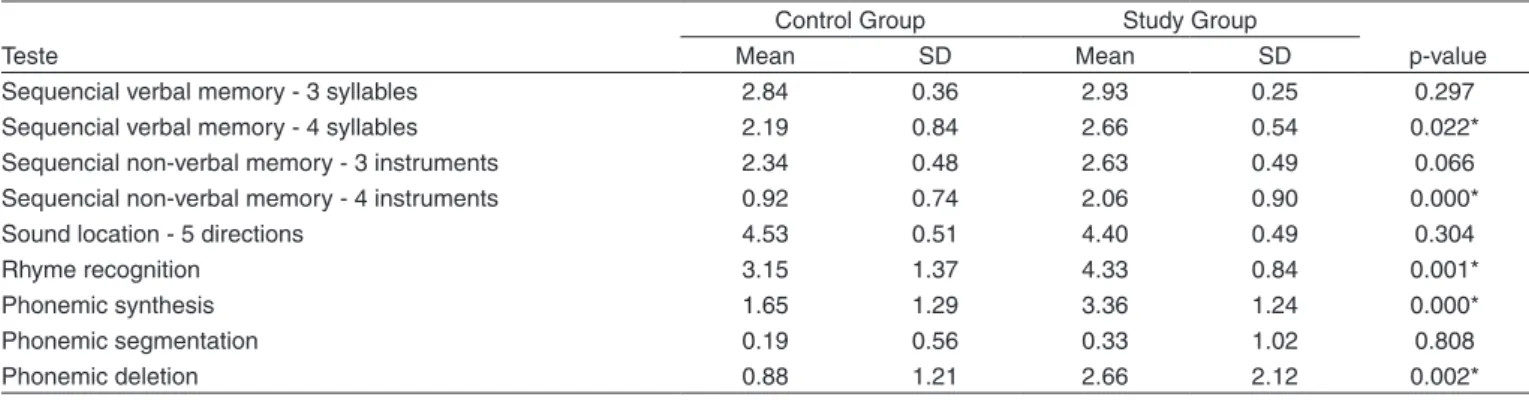
All participants presented the auropalpebral relex and answered correctly to all items of the syllabic synthesis task of the Phonological Awareness Test. Results from the participants in the Control Group and in the Study Group of the Simpliied Auditory Processing Assessment and of the Phonological Awareness Test are presented below (Table 1).
The Study Group obtained the highest mean score in the Sequential Verbal and Non-verbal Memory Test with four sound stimuli, rhyme recognition, phonemic synthesis, and phonemic deletion tasks when compared with the Control Group. The association of the results of these tests, enrollment in music classes and the other explanatory variables were tested by the logistic regression model (Table 2).
Table 1. Results of the Simpliied Auditory Processing Assessment and Phonological Awareness Test of the Control Group and Study Group
Teste
Control Group Study Group
p-value
Mean SD Mean SD
Sequencial verbal memory - 3 syllables 2.84 0.36 2.93 0.25 0.297
Sequencial verbal memory - 4 syllables 2.19 0.84 2.66 0.54 0.022*
Sequencial non-verbal memory - 3 instruments 2.34 0.48 2.63 0.49 0.066
Sequencial non-verbal memory - 4 instruments 0.92 0.74 2.06 0.90 0.000*
Sound location - 5 directions 4.53 0.51 4.40 0.49 0.304
Rhyme recognition 3.15 1.37 4.33 0.84 0.001*
Phonemic synthesis 1.65 1.29 3.36 1.24 0.000*
Phonemic segmentation 0.19 0.56 0.33 1.02 0.808
Phonemic deletion 0.88 1.21 2.66 2.12 0.002*
* Signiicant values (p<0.05) – Mann-Whitney test
Note: SD = standard deviation
DISCUSSION
The results of this study demonstrated that the performance of both groups was expected at the tests of Sound Localization, Sequential Verbal and Non-verbal Memory with three sound
stimuli as described in the literature(20) for 5-year-old children.
Children with musical experience had superior performance at the Sequential Verbal and Non-verbal Memory Test with four sound stimuli and in the rhyme recognition, phonemic synthesis and phonemic deletion tasks, with statistical difference.
Table 2. Multiple logistic regression for association of the tests sequencial verbal memory and sequential non-verbal memory with four sound stimuli, rhyme recognition, phonemic synthesis and phonemic deletion, and explanatory variables
B SE p-value 95% CI - OR
Lower OR Upper
Sequencial verbal memory 4 syllables
Group (Control – Reference) 1.48 1.29 0.254 0.34 4.396 56.08
Age of enrollment in school 0.13 0.85 0.875 0.21 1.145 6.13
Habit of listening to classical music 1.06 1.31 0.421 0.21 2.891 38.35
Maternal education -0.14 0.52 0.786 0.31 0.868 2.40
Gender -0.54 1.09 0.619 0.06 0.580 4.96
Sequencial non-verbal memory 4 instruments
Group (Control – Reference) 2.23 0.81 0.006* 1.88 9.31 46.12
Age of enrollment in school 0.56 0.49 0.250 0.67 1.75 4.59
Habit of listening to classical music 0.10 0.79 0.893 0.23 1.11 5.31
Maternal education 0.04 0.44 0.925 0.43 1.04 2.50
Gender -1.10 0.80 0.170 0.06 0.33 1.60
Rhyme recognition
Group (Control – Reference) 2.52 1.20 0.037* 1.16 12.46 133.04
Age of enrollment in school 1.31 0.87 0.134 0.66 3.73 20.84
Habit of listening to classical music 0.60 1.05 0.567 0.23 1.82 14.42
Maternal education -0.42 0.45 0.346 0.26 0.65 1.58
Gender 0.29 0.89 0.743 0.23 1.34 7.74
Phonemic synthesis
Group (Control – Reference) 3.41 0.94 0.000* 4.80 30.39 192.34
Age of enrollment in school -0.40 0.62 0.518 0.19 0.66 2.26
Habit of listening to classical music 0.29 0.89 0.740 0.23 1.34 7.81
Maternal education 0.95 0.60 0.115 0.79 2.60 8.55
Gender -0.42 0.92 0.650 0.10 0.65 4.02
Phonemic deletion
Group (Control – Reference) 1.96 0.81 0.015* 1.45 7.16 35.25
Age of enrollment in school -0.35 0.50 0.474 0.26 0.69 1.86
Habit of listening to classical music 0.73 0.73 0.320 0.49 2.07 8.78
Maternal education -0.19 0.43 0.648 0.35 0.82 1.91
Gender 0.78 0.71 0.271 0.54 2.19 8.90
* Signiicant results
Regression analysis showed that, with exception to the Sequential Verbal Memory Test with four syllables, this di-fference was associated only to the musical experience of the participants. Regarding the Sequential Non-verbal Memory Test with four instruments, our indings corroborate results from other Brazilian investigations in which subjects with musical experience had better performance in auditory pattern recognition of frequencies(9,10,12) when compared to subjects
without musical experience.
Participants with musical experience showed higher chan-ces to correctly respond to two or three sequenchan-ces of four instruments at the Sequential Non-verbal Memory Test when compared to children without musical experience. It is only expected that children respond correctly to two sequences of four sounds in this task when they are 6 years old(20). Therefore,
in the present study participants in the Study Group had similar performance to 6-year-old children, which was determined by their musical experience.
Regarding the rhyme recognition task, the indings of our study are consistent with researches that suggest the collabo-ration of educators and music teachers in promoting musical activities in the classroom to stimulate phonological aware-ness(23). Several tasks of learning how to read music involve
to recite verses of songs, identify rhyming words and replace them by others with the same sound patterns(24). The mutual
inluence between musical experience and rhyme recognition skills is a possible explanation for this inding of the present study. Children with musical experience are exposed more often to this kind of stimulus, therefore, they are more likely to recognize rhymes with eficiency.
All participants responded correctly to the ive items of the syllabic synthesis task and most of them did not respond correctly to any of the items of phonemic segmentation task. These indings indicate that syllabic awareness is already de-veloped in preschool children and it is independent of formal education as it has been widely reported in previous studies(25,26).
Previous studies have observed that children’s school experience inluences the development of their phonological awareness skills and that some of these abilities, such as pho-nemic awareness, are learned through formal education within the school context(27,28). The analysis of the questionnaire of
the present study demonstrated that participants in the Control Group have a difference of about one more year of school en-rollment than the children on the Study Group. Thus, it would be expected that children in the Control Group showed better performance, when compared to participants in the Study Group, at phonemic awareness tasks. However, participants in the Study Group showed superior results both in the phonemic synthesis and phonemic deletion tasks, which were associated with statistical signiicance to their musical experience. There-fore, musical experience favored the development of phonemic synthesis and phonemic deletion of the children in the study. Notwithstanding, in both groups the mean of correct responses in the phonemic segmentation task was low. This inding is indicative that such a complex skill is not inluenced only by the musical experience of the subjects, since it is also strongly correlated with the school experience of the children.
The results of the phonemic synthesis and phonemic dele-tion tasks corroborate studies that show a signiicant correladele-tion between musical experience/skills, phonemic awareness and reading development in preschool children(14-16,29). It can be
inferred that the similarity of the skills required for the analysis and organization of musical stimuli is a factor that supports the analysis and organization of speech sounds, and contributes to the execution of phonological awareness tasks.
Moreover, it is known that phonological awareness skills depend, to some extent, on auditory skills(7,8) and are related to
the development of reading(23,24). Taken together, the results of
the Simpliied Auditory Processing Assessment and of the Pho-nological Awareness Test indicate that auditory skills involved in music perception might also be involved in the acquisition and development of phonological awareness skills. In addition, the effect of musical experience may be observed in posterior reading and writing skills.
We can say that musical experience provide subsidies for the manipulation of linguistic and non-linguistic sound stimuli. Thus, it can be used as way of optimize and improve aspects of auditory processing and phonological awareness and should be considered as a protective factor of human communication disorders.
CONCLUSION
The indings of this study represent one of the many possi-bilities of Music Education and Speech and Language Therapy working together in partnership in order to contribute with the multidisciplinary scientiic research. Musical experience was the factor that determined the observed differences related to auditory processing and phonological awareness skills between groups of 5-year-old children with and without musical experience. In the present study, 5-year-old children with musical experience had similar performance to 6-year-old children in the Sequential Non-verbal Memory Test with four instruments. Musical practi-ce, in addition to its cultural role, also promotes improvement of auditory and metalinguistic skills of 5-year-old children.
REFERENCES
1. Gardner H, Costa S. Estruturas da mente: a teoria das inteligências múltiplas. Porto Alegre; 1994.
2. Pereira LD. Avaliação do processamento auditivo central. In: Lopes Filho O. Tratado de fonoaudiologia. 2a ed. Ribeirão Preto: Tecmedd; 2005. 3. Gaser C, Schlaug G. Brain structures differ between musicians and
non-musicians. J Neurosci. 2003;23(27):9240-5.
4. Levitin DJ, Menon V. Musical structure is processed in “language” areas of the brain: a possible role for Brodmann Area 47 in temporal coherence. Neuroimage. 2003;20(4):2142-52.
5. Ohnishi T, Matsuda H, Asada T, Aruga M, Hirakata M, Nishikawa M, et al. Functional anatomy of musical perception in musicians. Cereb Cortex. 2001;11(8):754-60.
6. Tallal P, Gaab N. Dynamic auditory processing, musical experience and language development. Trends Neurosci. 2006;29(7):382-90.
7. Fellippe AC, Colafêmina JF. Avaliação simpliicada do processamento auditivo e o desempenho em tarefas de leitura-escrita. Pró-Fono. 2002;14(2):225-34.
9. Gil D, Almeida CC, Phee AM, Artoni AL, Pellogia CC, Antunes F, Pereira LD. Efeito do treinamento auditivo para percepção musical nos testes de padrão de frequência e duração. Acta AWHO. 2000;19(2):64-7. 10. Ishii C, Arashiro PM, Pereira LD. Ordenação e resolução temporal em
cantores proissionais e amadores ainados e desainados. Pró-Fono. 2006;18(3):285-92.
11. Soncini F, Costa MJ. Efeito da prática musical no reconhecimento da fala no silêncio e no ruído. Pró-Fono. 2006;18(2):161-70.
12. Cioqueta EP. Efeito da prática musical no processamento auditivo em escolares de sete a 14 anos de idade [dissertação]. Santa Maria: Universidade Federal de Santa Maria; 2006.
13. Amatucci MA, Lupion SA. Das habilidades auditivas de localização, memória e igura-fundo em crianças integrantes do coral da Unicastelo. Fono Atual. 2001;5(18):13-7.
14. Anvari SH, Trainor LJ, Woodside J, Levy BA. Relations among musical skills, phonological processing, and early reading ability in preschool children. J Exp Child Psychol. 2002;83(2):111-30.
15. Peynircoglu ZF, Durgunoglu AY, Uney-Kusefoglu B. Phonological awareness and musical aptitude. J Res Read. 2002;25(1):68-80. 16. Gromko JE. The effect of music instruction on phonemic awareness in
beginning readers. J Res Music Educ. 2005;53(3):199-209.
17. Rabinovich K. Avaliação da audição na criança. In: Lopes Filho O. Tratado de fonoaudiologia. 2a ed. Ribeirão Preto: Tecmedd; 2005. p.259-74.
18. Yavas MS, Hermandorena CL, Lamprecht RR. Avaliação fonológica da criança: reeducação e terapia. Porto Alegre: Artes Médicas; 1991.
19. Azevedo MF, Vilanova LC, Vieira RM. Desenvolvimento auditivo de crianças normais e de alto risco. São Paulo: Plexus; 1995.
20. Pereira LD. Processamento auditivo: abordagem passo a passo. In: Pereira LD, Schochat E. Processamento auditivo central: manual de avaliação. São Paulo: Lovise; 1997.
21. Corona AP, Pereira LD, Ferrite S, Rossi AG. Memória sequencial verbal de três e quatro sílabas em escolares. Pró-Fono. 2005;17(1):27-36. 22. Santos MT, Pereira LD. Consciência fonológica. In: Pereira LD, Schochat
E. Processamento auditivo central: manual de avaliação. São Paulo: Lovise; 1997.
23. Fisher D, Mcdonald N. The intersection between music and early literacy instruction: listening to literacy! Read Improv. 2001;38(3):106-15. 24. Hansen D, Bernstorf E. Linking music learning to reading instruction.
Music Educ J. 2002;88(5):17-21.
25. Maluf MR, Barrera SD. Consciência fonológica e linguagem escrita em pré-escolares. Psicol Relex Crít. 1997;10(1):125-45.
26. Salles JF, Mota HB, Cechella C, Parente MA. Desenvolvimento da consciência fonológica de crianças de primeira e segunda séries. Pró-Fono. 1999;11(2):68-76.
27. Capovilla AGS, Capovilla FC. O desenvolvimento da consciência fonológica em crianças durante a alfabetização. Temas Desenvolv. 1997;35(6):15-21.
28. Godoy DM. O papel da consciência fonológica no processo de alfabetização. Pró-Fono. 2003;15(3):241-50.