1Institute of Geosciences, Universidade Estadual de Campinas – UNICAMP, Campinas (SP), Brasil. E-mails: [email protected]; [email protected]
*Corresponding author.
Manuscript ID: 30133. Received: 07/16/2014. Approved: 06/06/2015. ABSTRACT: Some present-day eolian sand sheets have small and width dunes, called zibars, as common type of depositional morphology. heir formation is related to diferent stabilizing factors, which reduce the availability of clastic materials for eolian processes. In fact, zibars are dunes which do not have time to develop a larger dune with slipface (proto-dune). Dunes in sands sheet areas generally are constructed by wind ripple laminations and commonly generate sedimentary succession less than 20 m thick, which are the consequence of low sand supply. his study deals with an uncommon eolian sand sheet sedimentary succession more than 50 m thick, Proterozoic in age, known as Bandeirinha Formation. his paper tries to explain the anomalous thick of this sand sheet sedimentary succession. High thickness was probably the result of a high input of sand material, combine with low availability of sand, thus allowing the only construction of proto-dunes (zibars). Early cementation, due to near-surface evaporation of saline water, has been proposed as main factor that reduced the sand availability into this eolian system. Finally, the subsidence processes related to the irst stage of rift Espinhaço Basin must have generated the accommodation space to preserve the sand sheet succession.
KEYWORDS: Eolian sand sheet; zibar; ephemeral channel rivers; Bandeirinha Formation; Paleoproterozoic.
RESUMO: Em alguns lençóis de areia eólica atuais existem dunas pequenas e largas, chamadas zibars, como tipo comum de morfologia deposicional. Sua formação é relacionada a diferentes fatores de estabilização, os quais reduzem a disponibilidade de materiais clásticos para os processos eólicos. De fato, os zibars são dunas que não tiveram tempo para se desenvolver como grandes dunas (protodunas). As dunas dos lençóis de areia (zibars) geralmente são construídas por laminações de marcas onduladas de vento e comumente geram sucessões com menos de 20 m de espessura, consequência da baixa oferta de sedimento. Este estudo trata de uma sucessão sedimentar com depósitos de lençóis de areia de espessuras incomuns, com mais do que 50 m de espessura, encontrados na Formação Bandeirinha, de idade Proterozoica. Este trabalho tenta explicar essas espessuras anômalas de depósitos de lençol de areia. A elevada espessura desses depósitos deve-se provavelmente ao grande aporte de material clástico no sistema, combinado com a baixa disponibilidade de sedimentos, que não permitiu a formação de dunas com faces de deslizamento, mas somente de protodunas (zibars). Cimentação precoce, causada pela evaporação de água salina próxima à superfície, tem sido proposta como principal fator para a redução da disponibilidade de areia neste sistema eólico. Finalmente, os processos de subsidência relacionada aos primeiros estágios de rifteamento da Bacia Espinhaço devem ter gerado o espaço de acomodação para preservar a sucessão de lençol de areia.
PALAVRAS-CHAVE: Lençol de areia; zibar; rios efêmeros; Formação Bandeirinha; Paleoproterozoico.
Unusual thick eolian sand sheet
sedimentary succession: Paleoproterozoic
Bandeirinha Formation, Minas Gerais
Insólita espessura de uma sucessão de lençol de areia:
Formação Bandeirinha, Proterozoico, Minas Gerais
Fábio Simplicio1*, Giorgio Basilici1
INTRODUCTION
Eolian sand sheet depositional systems are lattened areas where the main bedforms are wind ripples, faceless dunes (zibars and nabkhas) and more rarely slip-faced dunes. Poor availability of clastic material is main responsible factor to not form slipfaced dunes (Nielson & Kocurek 1986; Lea & Waythomas 1990). Poor avail-ability of sand for wind transport and deposition is con-trolled by vegetation, which constitutes an obstacle to the wind, water table, causing cohesion of the grains, abundance of coarse-grained sands or granules, cemented depositional surface, and seasonal looding that causes cohesive muddy covering (Kocurek & Nielson 1986; Clemmensen & Dam 1993; Chakraborty & Chakraborty 2001; Basilici & Dal Bó 2014). More recently, studies in the Arctic and Antarctic areas have pointed out that the ice can be an important factor to poor availability of sand (Lea & Waythomas 1990; Bristow et al. 2010). All these factors may be considered for Precambrian eolian sand sheet deposition with exception to vegetation factor, which appeared on the earth surface only after Silurian (Clemmensen & Dam 1993).
Present-day eolian sand sheets are areas of deposition or delation, which occur in warm or cold, arid or semi-arid climates (Kocurek & Nielson 1986; Mountney & Russell 2004; Mountney 2006; Basilici & Dal Bó 2014). he delation areas generate deposits constituted by granule or gravel lags, whereas the depositional areas are predomi-nantly constituted by nabkhas and/or zibars and rare slip-faced dunes. Present nabkhas are associated to vegetation, thus their presence in Precambrian eolian systems should be excluded. Zibars probably resulted to be most com-mon dunes in Precambrian eolian sand sheets depositional systems. Zibars, which are also considered proto-dunes (Nielson & Kocurek 1986), are described in present-day eolian sand sheet environments, but their recognition in the geological record is not clear. Sets of wind ripple lam-inations, separated by erosive truncation surfaces, are the main depositional expression of zibars and nabkhas depos-its (Kocurek & Nielson 1986; Lea & Waythomas 1990; Mountney & Russel 2004; Bristow et al. 2010; Basilici & Dal Bó 2014).
Ancient eolian sand sheets are typically less than 20 m thick (Mountney 2006), as these environments are char-acterized by low sand supply. However, the Bandeirinha Formation, a sedimentary succession c.250 m thick, is composed by four intervals of sand sheet deposits, each one more than 50 m thick. hese intervals are interbedded with 1.5 – 18 m thick sandy conglomerates, interpreted
as deposits of highly concentrated river lows. he aim of this paper was to discuss the reasons which have induced the accumulation of this unusually thick eolian sand sheet succession.
GEOLOGICAL SETTING
he Bandeirinha Formation is the lowermost unit of Espinhaço Supergroup, deposited into a homonymous Paleoproterozoic Basin, located in a wide area between the San Francisco Craton and the Araçuaí fold and thrust belt (Fig. 1A) (Almeida 1977; Chaves & Brandão 2004). he Bandeirinha Formation crops out near the Diamantina city, in Minas Gerais (Fig. 1B).
An extensional event at Statherian age (1.8 – 1.6 Ga), which generated a lithospheric stretching and subse-quent break-up of the São Francisco-Congo Craton, is supposed to have been the responsible mechanism of the creation of accommodation space in the Espinhaço Basin (Alkmin & Marshak 1998). Chemale et al. (2012) and Santos et al. (2013) consider two phases of basin evolu-tion. he irst phase developed according to N-S fault-block activity that created a rift basin, and the second phase related to lexural subsidence, which was associ-ated to thermal process (Martins-Neto 2000; Chemale et al. 2012). he Espinhaço Supergroup is subdivided in Diamantina and Conselheiro Mata groups (Dussin & Dussin 1995). he lower Diamantina Group is composed of Bandeirinha, São João da Chapada, Sopa-Brumadinho and Galho do Miguel formations (Fig. 1B) (Fogaça et al. 1984; Silva 1998; Martins-Neto 2000; Chemale et al. 2012). he Bandeirinha Formation (1.7 – 1.8 Ga; Chemale et al. 2012) is c.250 m thick mostly composed of laminated sandstone packages interbedded with three conglomerate beds (Fig. 2). his litostratigraphic unit was previously interpreted by Silva (1998) as result of coastal and braided river depositional process, where the interbedded conglomerate beds represented mainly mass low deposits in proximal areas of alluvial fans, related to tectonic activity. Simplicio (2013) proposed a paleoen-vironmental model in which sandstones were deposited in sand sheet context and conglomerates correspond to deposition in ephemeral streams.
METHOD
A stratigraphic section of more than 250 m thick was measured in type area of Bandeirinha Formation (Fig. 2). Detailed facies analysis, based on grain-size, sorting, type and organization of the sedimentary structures, form and dimension of the beds, characteristics of the bounding sur-faces, lateral and vertical variation of lithofacies, and inter-pretation of the depositional mechanisms, was applied to the measured section (Miall 1985; Walker 2006).
SEDIMENTOLOGICAL ANALYSIS
he sedimentary succession of the Bandeirinha Formation is formed of eolian deposits, constituted by laminated and cross-stratiied sandstone facies and luvial deposits, consti-tuted by sandy conglomerate facies.
Laminated sandstone
L a m i n a t e d s a n d s t o n e i s f o r m e d o f b i m o d a l fine- to coarse-grained reddish to white sand-stone, moderately to well-sorted, with rounded to well-rounded grains. Planar to low-angle inclined (up to 10º), parallel laminations, are the dominant sedimentary structures (Fig. 3A). The laminae are 2 – 12 mm thick with grain-size segregation and some-times characterized by inverse grading; they are similar to the “pin stripe lamination” described by Fryberger and Schenk (1988) (Fig. 3B). Laminated sandstone sets, 0.4 – 2.0 m thick, laterally extended 4 to more than 9 m, are vertically and laterally overlapped. The bound-ing surfaces of the sets are erosive, 0 – 15° dippbound-ing, and are parallel to the laminae of the overhead set (Fig. 3A). Locally, asymmetrical undulating laminations may be observed in gradual transition with the planar lamina-tions (Fig. 3C). The laminated sandstone sets constitute
12°
A B
44° São Francisco
Craton Diamantina
Diamantina
Belo Horizonte
Espinhaço Supergroup
Galho do Migel Formation
Espinhaço Supergroup
Barão de Guaicuí Formation
Bandeirinha Formation Bandeirinha
Formation
43°41’30”W
18°18’00”S
São João da Chapada Formation Sopa Brumadinho Formation
200 km Northern Espinhaço Range Southern Espinhaço Range Araçuaí Fold-Thrust Belt São Francisco Craton Limit
Atlantic Ocean
250 m
43°44’0”W
Study Area
Datas Gouveia
MUD SAND GRAVEL
Crossstratification Sandstone -Bandeirinha Formation Laminated Sandstone - Banderinha Formation Stratified Conglomerate - Bandeirinha Dormation Conglomerate - Bandeirinha Formation
Trough CrossBadded Sandstone -São João da Chapada Formation Schists
-Barão de Guaicuí Formation
Diamantina
BR 259
BR 367
BR 259
MG 220
BR 367
43°36’0”W
18°16’0”S
18°24’0”S
200 m
100m
0 m
84% of the thickness of the measured succession and form interval more than 50 m thick.
Horizontal or low-angle planar and parallel laminae are interpreted as subcritical climbing translatent strata (Hunter 1977; Hunter 1981) (Figs. 3A and 3B). his sed-imentary structure is produced by migration of climbing wind ripples. he similarity with the “pin stripe lamina-tion” of Fryberger and Schenk (1988), the grain-size seg-regation (Eriksson & Simpson 1998) and the presence of high rounded sandstone clasts, typical of wind transport (Mahaney 2002), suggest this interpretation. Also the archi-tectural framework, in which the laminated sandstone sets are separated by inclined (< 15°) bounding surfaces (trun-cation surfaces), supports this interpretation (Kocurek &
Nielson 1986). he asymmetrical undulating laminations are considered supercritically climbing translatent strata related to the increase of deposition rate (Hunter 1977) similar to interpreted for Basilici and Dal Bó (2014) in Tulum Valley (Argentina).
Cross-stratified sandstone
Well- to very well-sorted, very fine- to fine-grained sandstone characterizes this facies. Cross-stratified sets, 0.12 – 0.3 m thick, 3 – 7 m laterally extended, consti-tute the sedimentary structure (Fig. 4). The foreset lam-inae are 2 – 10 mm thick, and dip 21 – 26º. The fore-sets display alternation of fine- and very fine-grained laminae. Reactivation surfaces (sensu Brookfield 1977) are also observed. This facies forms lenticular and iso-lated beds, which are embedded in laminated stone sets with erosive contact. Cross-stratified sand-stone corresponds to 2% in thickness of the measured sandstone succession.
Cross-stratiied sandstone indicates that this deposit was formed for avalanching processes, allowing its inter-pretation as lee side of small dunes. he and very ine-grained foreset laminae, the interbedding with wind-rip-pled strata, the presence of reactivation surfaces and the absence of sedimentary structures associated to subaque-ous lows suggest that these structures are eolian dunes (Hunter 1977; Kocurek 1996; Mountney 2006). Real height of the dunes is unknown because the erosive bound-ary surfaces, but the restricted lateral extension and rare occurrence of this structure suggests small dimension of the original bedforms.
Sandy conglomerate
Sandy conglomerate facies has an erosive and slightly concave-up bottom surface and planar top surface. Two types
Figure 3. Laminated sandstone. (A) Low-angle, parallel laminated sandstone, corresponding to subcritical translatent climbing strata, organized in sets separated by erosive surfaces (red lines indicate truncation surfaces). (B) Observe the grain-size segregation highlight the planar and parallel laminations (arrows point the ine-grained laminae). (C) Asymmetrical undulating laminations (dotted rectangle) in gradual transition with planar and parallel laminations. Pencil: 14 cm.
A
B
of sandy conglomerate subfacies are present: structureless sandy conglomerate and stratiied sandy conglomerate (Fig. 5A). he structureless sandy conglomerate represents 12% of the thickness of the sedimentary succession; it is constituted of poorly sorted, clast-supported, pebble- to boulder-grained conglomerate within medium- to coarse-grained sandstone, poorly sorted matrix. he thickness of this lithofacies is 7–18 m, its bounding surfaces are erosive and concave-up, and its upper surface, when it is in con-tact with translatent climbing ripples strata, has bounding surface planar and probably non-erosive. he conglom-erate clasts are constituted of laminated sandstone facies (Fig. 5B), whose abundance is 87 – 100%, and the oth-ers clasts (vein-quartz, quartzite, banded iron formation and schist), whose abundance is 13 – 0%. Laminated sandstone clasts are angular to rounded, with prevalence of subangular (Fig. 5B); the other clasts are rounded or subrounded. he dimension of the clasts is extremely variable. Maximum particle size of laminated sandstone clasts is 0.35 m. he other clasts have maximum particle size of 0.09 m. his subfacies does not display any inter-nal organization.
Stratiied conglomerate is less than 1.5 m thick, and it constitutes 2% of the thickness of the measured sedi-mentary succession. Maximum particle size of the clasts is 0.14 m; the matrix is a medium- and coarse-grained, poorly-sorted sandstone, and it is more abundant than structureless sandy conglomerate. Roundness and com-position of the clasts are similar to the other lithofacies. he beds of this lithofacies are commonly interbedded with ine- and medium-grained, well sorted, inverse grading
laminated sandstone, 0.04 – 0.15 m thick, which form lenticular beds laterally extended up to 3 m (Fig. 5A and 5C). hese sandstone beds have gradual transition at the base to sandy conglomerate, but the top surface is sharp and smooth (Fig. 5C). he sandstone beds display planar parallel laminations, constituted of laminae 3 – 10 mm thick, at times with inverse grading.
he concave-up bottom and the planar top surface of the sandy conglomerate are evidences that this facies represents the illing of channelized morphological struc-tures, generated by subaqueous lows. he grain-size het-erogeneity and the absence of internal structures of the conglomerate subfacies suggest highly concentrated sub-aqueous lows as depositional mechanisms (Tooth 2000; Rodriguéz-Lopez et al. 2012). More diluted subaqueous lows deposited the stratiied sandy conglomerate sub-facies. Most of the clasts that constitute these deposits were originated by the erosion of the substratum, con-stituted of laminated sandstone. his demonstrates that laminated sandstone had certain degree of competence before the transport (Trewin N.H. 1993; Mountney & Howell 2000). Angular or subangular roundness of these clasts means that the laminated sandstone clasts (intra-clasts) did not undergo a long transport. he rounded exotic clasts indicate that the catchment area was exter-nal to the depositioexter-nal basin.
Two hypotheses are possible to explain the laminated sandstone beds associated with stratiied sandy conglom-erate. hese deposits may correspond to subaqueous or eolian deposits. If interpreted as subaqueous deposits they represent parallel laminations formed in upper low regime (Fielding 2006). However, we do not observed part-ing laminations and laminae with normal gradpart-ing, which are characteristics of this structure. hus, we propose an eolian origin for these laminae due to clasts dimensions, sorting and inverse grading, consequently these laminae are interpreted as wind ripple laminations. Indeed, sand reworking by wind inside ephemeral channels in dry peri-ods is very common (Cowan 1993; Tooth 2000; Jain et al. 2005; Krapf et al. 2005).
DISCUSSION
Paleoenvironment analysis
he Bandeirinha Formation is constituted by a monot-onous sedimentary succession, composed by laminated sandstone with small lenticular cross-stratiied sandstone sets, and sandy conglomerate (Fig. 2). Laminated sand-stone deposits are interpreted as climbing wind ripples, Figure 5. Sandy conglomerate facies. (A) The dashed
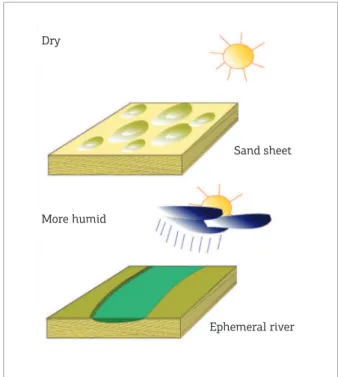
cross-stratiied sandstone as small eolian dunes, while sandy conglomerate were produced by ephemeral stream lows. he depositional environment is interpreted as dry eolian sand sheet, which was episodically occupied by ephemeral river systems that cut through the depositional surface. Laminated sandstone facies were probably part of zibar-like dunes (Fig. 6) and cross-stratiied sets corre-sponded to small and isolated slipfaced dunes (Kocurek & Nielson 1986; Nielson & Kocurek 1986; Mountney & Russell 2004). Zibars are bedforms considered dunes which do not have time to fully develop (proto-dunes), their internal architecture is composed by low-angle or tabular sets separated by truncation surface (Nielson & Kocurek 1986; Bristow et al. 2010). his eolian sand sheet was characterized by abundance of zibar dunes, as well as many present-day eolian systems (Nielson & Kocurek 1986; Wang et al. 2009). Nielson and Kocurek (1986) analyzed zibars deposits in a sand sheet area from Entrada Sandstone Formation and observed that slip-faced dunes deposits had to ine- to medium-grained sand (0.1 – 0.3 mm) and the zibars ine- to coarse -grained sand (0.1 – 1.0 mm) and claimed that this grain-size may be an important factor to preventing the slipfaced dunes formation. Laminated sandstones deposits of Bandeirinha Formation have analogous grain-size of zibar described by Nielson and Kocurek (1986) suggesting an analogous interpretation of this facies. In present day, zibar dunes are common in sand sheet areas that are near to dune ields where the clastic input is high, but the availabil-ity is low, to form slipfaced dunes (Nielson & Kocurek 1986). he availability depends not only on the input but on other factors that limit the quantity of loose sand due to the creation of protection surfaces, as well as the efect of water table rise and capillarity fringe action, which aggregate sand, coarse to pebble grained materi-als concentration, that shield the surface, early cementa-tion, freezing and seasonal looding (Kocurek & Nielson 1986; Basilici & Dal Bó 2014).
he Bandeirinha Formation is a sandstone succession deposited in eolian-dominated paleoenvironment inter-bedded with three ephemeral luvial episodes (Fig. 2). Eolian processes predominated for long time and they were interrupted by luvial ephemeral systems (Fig. 6). During the luvial episodes, the increase of precipitations inhibited the eolian processes of transport and sedimen-tation, and formed luvial channels that cannibalized pre-vious eolian deposits, bringing about the illing of the channels with sandstone intraclasts. Probably the alter-nation between eolian and luvial episodes has climatic causes, as related by Trewin (1993) and Mountney and Howell (2000).
Dry
More humid
Ephemeral river Sand sheet
Figure 6. The interbedding between laminated sandstone and sandy conglomerate facies is interpreted as due to alternating climate phases, where laminated sandstone, which represents an eolian sand sheet with zibars bedforms, formed in dry phase and sandy conglomerate, that represent a river channel illing, is related to more humid periods.
Unusual high thickness of the eolian
sand sheet succession
Eolian sand sheet sedimentary successions are com-monly less than 20 m thick (Mountney 2006), because these depositional systems are transitional to dune ields or because geographic position diicult their accumula-tion (e.g. proximity to river systems). Chakraborty and Chakraborty (2001) considered the Shikaoda Formation (Hosangabad, India), 40 m thick, a thicker eolian sand sheet deposits that has been recognized. hese authors noted that the eolian system developed in supratidal setting, in which the sand sheet area was afected, directly or indi-rectly, by the tides, as suggested by subaqueous structures, adhesion strata, and evaporites deposits. Chakraborty and Chakraborty (2001) concluded that frequent tidal lood-ing dampen the sand, supplied by the coastal settlood-ing, thus inhibiting the availability of sand and the consequent con-struction of slipfaced dunes.
Clemensen & Dam 1993; Rodriguéz-Lopez et al. 2010; Basilici & Dal Bó 2014). However, alike to the Shikaoda Formation, the eolian sand sheet sedimentary succession of the Bandeirinha Formation is characterized by a high thickness, which suggests high sandy supply. In general, when an eolian system receives large input of sediment slip-faced dunes form (Kocurek & Nielson 1986). Nevetheless, Bandeirinha Formation shows rare dunes with slipface, testifying low availability of sand. To explain the apparent inconsistency between high supply and low availability of sediment, two other factors may be invoked according to recorded features: early cementation of the sand and coarse grain-size. Early cementation of the sand, soon after the deposition, was probably the main control factor that allowed the accumulation of these sand materials and its poor availability. his is suggested by the sandy conglom-erate facies, which is constituted by intraclasts of lami-nated sandstone. Stream low cannibalized the previously cemented eolian sand sheet deposits, which furnished the main clastic source of the luvial conglomerates, indicating the sand materials were been subjected to early cementation processes. In dry and hot continental environments, where the evaporation exceeds the meteoric inlux, the ground-water lux is upward directed, facilitating the mineral pre-cipitation (Worden & Burley 2003). Similar interpretation was described by Rodriguéz-Lopez et al. 2012 to explain the origin of sandy intraclast in eolian Teruel Basin (Spain). Early cementation may be due to evaporitic mineral precip-itation, as observed by Basilici and Dal Bó (2014) in pres-ent sand sheet deposits, but the later metamorphism and diagenesis masked or modiied previous evaporite cements of Bandeirinha Formation.
In conclusion, early cementation is recognized as an important factor that determined the accumulation of the sandstone. he preservation of Bandeirinha Formation
was possible by accommodation space that placed eolian accumulation below the erosional base level (Kocurek & Havholm 1993). Accommodation space was related to high subsidence rate attributed to the early stages of rift evolution proposed for Espinhaço Basin (Dussin & Dussin 1995; Silva 1998; Martins-Neto 2000; Chemale et al. 2012).
CONCLUSIONS
he Bandeirinha Formation is constituted of a sand-stone succession interbedded with three sandy conglomerate episodes. Sandstone beds are deposited in an eolian sand sheet paleoenvironment, whereas the sandy conglomerate beds were formed in ephemeral river channels for highly concentrated subaqueous lows. Probably, alternating cli-mate phases, dry and more humid, were responsible for sand sheet and luvial depositional palaeoenvironments, respectively. he anomalous thickness of the eolian sand sheet deposits was due to high supply of sand material com-bined with early cementation of the sand, which decreased the sand availability and caused the accumulation of low and wide dunes (zibar). High rate of subsidence associated with an extensional tectonic phase enabled the eolian sand sheet preservation.
ACKNOWLEDGEMENT
he authors gratefully acknowledge the Capes for inan-cial support. We would like to thank also Mrs. Carmem and Mr. Rommel, wonderful employees of the Casa da Gloria in Diamantina.
Alkmim F.F. & Marshak S. 1998. Transamazonian Orogeny in the Southern São Francisco Craton Region, Minas Gerais, Brazil: evidence for Paleoproterozoic collision and collapse in the Quadrilátero
Ferrífero. Precambrian Research, 90:29-58.
Almeida F.F.M. 1977. O Cráton do São Francisco. Revista Brasileira
de Geociências, 7:285-295.
Basilici G. & Dal Bó P. 2014. Inluence of subaqueous processes into
the construction and accumulation of an aeolian sand sheet: Upper
Tulum Valley (San Juan Province, Western Argentina). Earth surface
processes and landforms, 39:1014–1029.
Bristow C.S., Jol H.M., Augustinus P., Wallis I. 2010. Slipfaceless
‘whaleback’ dunes in a polar desert, Victoria Valley, Antarctica: Insights
from ground penetrating radar. Geomorphology, 114:361-372.
Brookield M.E. 1977. The origin of bounding surfaces in ancient
aeolian sandstones. Sedimentology, 24:303-332.
Chakraborty T. & Chakraborty C. 2001. Eolian-aqueous interactions
in the development of a Proterozoic sand sheet: Shikaoda Formation,
Hosangbad, India. Journal of Sedimentary Geology, 71:107-117.
Chaves M.L.S.C & Brandão P.R.G. 2004. Diamante variedade
carbonado na Serra do Espinhaço (MG/BA) e sua enigmática gênese. Revista Escola de Minas, 57:33-38.
Chemale F., Dussin I.A., Alkmim F.F., Martins M.S., Queiroga G.,
Armstrong R., Santos M.N. 2012. Unravelling a Proterozoic basin
history through detrital zircon geochronology: The case of the
Espinhaço Supergroup, Minas Gerais, Brazil. Gondwana Research,
22:200-206.
Clemmensen L.B. & Dam G. 1993. Aeolian sand-sheet deposits in the
Lower Cambrian Neksø Sandstone Formation, Bornholm, Denmark:
sedimentary architecture and genesis. Sedimentary Geology, 83:71-85.
Cowan G. 1993. Identiication and signiicance of aeolian deposits within the dominantly luvial Sherwood Sandstone Group of the dominantly luvial Sherwood Sandstone Group of the East Irish
Sea Basin U.K. In: North C.P. & Prosser D.J. (eds.) Characterization
of Fluvial and Aeolian Reservoirs. Special Publication, 73:231-245.
Dussin I.A. & Dussin T.M. 1995. Supergrupo Espinhaço: modelo de
evolução geodinâmica. Geonomos, 3:19-26.
Eriksson K.A. & Simpson E.L. 1998. Controls on spatial and
temporal distribution of Precambrian eolianites. Sedimentary Geology, 120:275-294.
Fielding C.R. 2006. Upper low regime sheets, lenses and scour ills: extending the range of architectural elements for luvial sediment bodies. Sedimentary Geology, 190:227-240.
Fogaça A.C.C., Almeida-Abreu P.A., Schorscher H.D. 1984. Estratigraia da sequência supracrustal arqueana na porção mediana central da Serra do Espinhaço, MG. In: 33 Congresso Brasileiro de Geologia, Anais, p. 2652-2667.
Fryberger S.G. & Schenk C.J. 1988. Pin stripe lamination: a distinctive
feature of modern and ancient eolian sediments. Sedimentary
Geology, 55:1-15.
Hunter R.E. 1977. Basic type of stratiication in small eolian dunes. Sedimentology, 24:361-367.
Hunter R.E. 1981. Stratiication styles in eolian sandstones: some
Pennsylvanian to Jurassic examples from western interior U.S.A. In:
Ethridge F.G. & Flores R.M. (eds.) Recent and Ancient Non marine
Depositional Environments: Models for Exploration. SEPM Special
Publication, 31:315-329.
Jain M., Tandon S.K., Singhvi A.K., Mishra S., Bhatt S.C. 2005. Quaternary alluvial stratigraphical development in a desert setting:
a case study from the Luni River basin, Thar Desert of western
India. Fluvial Sedimentology VII. IAS, Special Publication, 35:349-371.
Kocurek G. 1996. Desert aeolian systems. In: Reading H.G. (eds.)
Sedimentary environments: Processes, Facies and Stratigraphy. Blackwell, Oxford, 3 ed., p. 125-153.
Kocurek G. & Havholm K.G. 1993. Eolian Sequence Stratigraphy -
a conceptual framework. In: Weimer P. & Posamentier H.W. (eds.)
Siliciclastic sequence stratigraphy: recent developments and aplications. American Association of Petroleum Geologists, 58, p. 393-409.
Kocurek G. & Nielson J. 1986. Conditions favourable for the formation
of warm-climate aeolian sand sheets. Sedimentology, 33:795-816.
Krapf C.B., Stanistreett I., Stollhofen H. 2005. Morphology and Fluvio-Aeolian Interaction of the Tropical Latitude, Ephemeral
Braided-River Dominated Koigab Fan, North-West Namibia. In: Blum M.D.,
Marriott S.B., Leclair S.F. (eds.) Fluvial Sedimentology VII. International
Association of Sedimentologists. Special Publication, 35:99-120.
Lea P.D. & Waythomas C.F. 1990. Late-Pleistocene eolian sand sheets
in Alaska. Quaternary Research, 34:269-281.
Lopes-Silva L. & Knauer L.G. 2011. Posicionamento Estratigráico da Formação Bandeirinha na Região de Diamantina, Minas Gerais: Grupo Costa Sena ou Supergrupo Espinhaço? Geonomos, 19:131-151.
Mahaney W.C. 2000. Atlas of sand grain surface textures and
applications. Oxford University Press. 141 p.
Martins-Neto M.A. 2000. Tectonics and sedimentation in a paleo/
mesoproterozoic rit-sag basin in Espinhaço basin, southeastern
Brazil. Sedimentary Geology, 103:147-173.
Miall A.D. 1985. Architectural-element analysis: a new method of
facies analysis applied to luvial deposits. Earth-Science Reviews,
22:261-308.
Mountney N.P. 2006. Aeolian facies model. In: Posamentier H.W. &
Walker R.G. (eds.) Facies models revisited. Society for Sedimentary
Geology, Special Publication, 84:19-83.
Mountney N.P. & Howell J. 2000. Aeolian architecture, bedform climbing and preservation space in the Cretaceous Etjo Formation, NW Namibia. Sedimentology, 47:825–849.
Mountney N.P. & Russell A.J. 2004. Sedimentology of cold-climate
aeolian sand sheet deposits in the Askja region of northeast Iceland. Sedimentary Geology,166:223-244.
Nielson J. & Kocurek G. 1986. Climbing Zibars of the Algodones. Sedimentary Geology, 48:1-15.
Rodríguez-López J.P., Liesa C.L., Van Dam J., Lafuente P., Arlegui
L., Ezquerro L., De Boer P.L. 2012. Aeolian construction and alluvial dismantling of a fault-bounded intracontinental aeolian dune ield (Teruel Basin, Spain); a continental perspective on Late Pliocene climate change and variability. Sedimentology,
59:1536-1567.
Rodriguéz-López J.P., Melendez N., De Boer P.L., Poppe L., Soria A.R.
2010. The action of wind and water in a mid-Cretaceous subtropical
erg-margin system close to the Variscan Iberian Massif, Spain. Sedimentology, 57:1315-1356.
Santos M.N., Chemale Jr. F., Dussin I.A., Martins M., Assis T.A.R., Jelinek A.R., Guadagnin F., Armstrong R. 2013.Sedimentological and Paleoenvironmental Constraints of the Statherian and Stenian
Espinhaço Rit System, Brazil. Sedimentary Geology, 290:47-59.
Silva R.R. 1998. As bacias proterozóicas do Espinhaço e São Francisco em Minas Gerais: Uma abordagem do ponto de vista da estratigraia de sequências. Geonomos, 6:1-12.
Simplicio F. 2013. Formação Bandeirinha, região de Diamantina (MG): Um exemplo, no proterozoico, de lençol de areia eólica. MS Dissertation, Instituto de Geociências, Universidade Estadual de
Campinas, Campinas, 74p.
Tooth S. 2000. Process, form and change in dry land rivers: a review
of recent research. Earth-Science Reviews, 51:67-107.
Trewin N.H. 1993. Mixed aeolian sand sheet and luvial deposits in the Tunblagoda Sandstone, Western Australia. In: North C.P. &
Prosser D.J. (eds.) Characterization of luvial and aeolian reservoirs.
Geological Society of America, Special Publication, 73:219-230.
Walker R.G. 2006.Facies models revisited: introduction. In:
Posamentier H.W. & Walker R.G. (eds.) Facies models revisited.
Society for Sedimentary Geology, Special Publication, 84:1-19.
Wang Z.T., Sun Q.F., Ren X.Z., Wang T., Chen F.H. 2009. Pseudo-feathery dunes in the Kumtagh desert reclassiied as linear dunes and zibars. Aeolian Research, 1:87-89.
Worden R.H. & Burley S.D. 2003. Sandstone Diagenesis: The Evolution
of Sand to Stone. In: Burley S.D. & Worden R.H. (eds.) Sandstone
Diagenesis: Recent and Ancient, Blackwell, Oxford. p. 1-44.