Article
0103 - 5053 $6.00+0.00
*e-mail: [email protected]
Lewis Acid Promoted Friedländer Condensation Reactions between Anthranilonitrile
and Ketones for the Synthesis of Tacrine and its Analogues
Jessie S. da Costa,Diego S. Pisoni, Claudia B. da Silva, Cesar L. Petzhold,
Dennis Russowsky and Marco A. Ceschi*
Instituto de Química, Universidade Federal do Rio Grande do Sul, Campus do Vale, 91501-970 Porto Alegre-RS, Brazil
Nesse trabalho estudou-se a reação de ciclodesidratação entre antranilonitrila e várias cetonas na presença de diferentes ácidos de Lewis não reportados na literatura, para a obtenção de 9-amino-1,2,3,4-tetrahidroacridinas. As reações de ciclodesidratação foram realizadas em condições térmicas empregando-se diferentes solventes e também na ausência de solvente, seguidas de hidrólise alcalina, levando à obtenção dos produtos em bons a excelentes rendimentos após isolamento.
The scope of Lewis acid-promoted cyclodehydratation reactions between anthranilonitrile and several ketones, to afford tacrine and its derivatives, was expanded to include the use of various metal chloride salts not reported in the literature. The ability of the Lewis acids to effectively promote the cyclodehydratation between anthranilonitrile and cyclohexanone as the ketone was found to be the following order: InCl3 > AlCl3 ~ BF3.Et2O > FeCl3 > BiCl3 ~ SbCl3 ~ SnCl2.2H2O. The reactions were performed under both solvent and solvent-free conditions in good to excellent yields. Other
Lewis acids screened, such as RuCl3, CeCl3, NiCl2, CoCl2.2H2O and CsCl were not effective.
Keywords: tacrine analogues, Lewis acid, Friedländer reaction, Alzheimer’s disease
Introduction
Tacrine (1a, 9-amino-1,2,3,4-tetrahydroacridine or THA) is a reversible inhibitor of acetylcholinesterase (AChE), and was launched in 1993 as the first drug for the symptomatic treatment of Alzheimer’s disease (AD).1-2
However, the use of tacrine in AD has been limited by serious side effects such as hepatotoxicity, which often forces patients to discontinue treatment.3-5 Tacrine has also
been shown to possess a much broader pharmacological profile than cholinesterase inhibition: blockage of potassium channels,6,7 inhibition of neuronal monoamine
uptake processes,8 and inhibition of monoamine oxidase9
have all been reported (Figure 1).
A recent contribution to the development of tacrine related agents showed that tacrin-1-ol (1b, velnacrine),10,11
an active metabolite of tacrine, has been chosen for clinical trial. Compared to tacrine, 6-fluoro-tacrin-1-ol (1c) has been reported to be slightly more potent, and 6-chlorotacrin-1-ol (1d), 30 times more potent.12 In particular, 6-chlorotacrine
(1e) has been found to be more potent than other substituted analogues (Figure 1).2, 11, 13
The importance of these compounds has led to the development of various methods for their synthesis. The Friedländer reaction is a well-known method for preparing quinolines and polypyridyl bridging ligands,14,15,16 and
is still considered to be one of the most useful methods for preparing quinolines and related bicyclic azaaromatic compounds. In its original form, the Friedländer reaction is the reaction between an aromatic ortho-aminoaldehyde and an aldehyde or ketone bearing α-methylene functionality. Since Friedländer’s initial discovery, the reaction has been extended to a wide range of substrates, including aromatic ortho-aminoketones and nitrogen-containing heterocycles.16,17,18 In this regard, condensation reactions
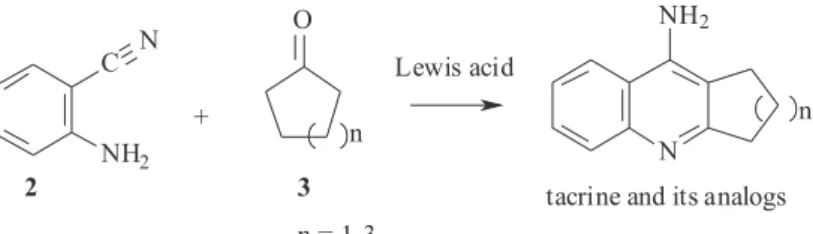
between anthranilonitrile (2) and ketones 3 (also classified as Friedländer reaction), have been recognized as an important and general approach to the synthesis of tacrine and its analogues (Scheme 1).18
These reactions are usually performed in the presence of a protic acid such as p-toluenesulfonic acid (PTSA) or a Lewis acid,18,19 including AlCl
3, 20 ZnCl
2, 21 BF
3.Et2O, 7 SnCl
4, 22
CuCl, CuCl2, TiCl4, P2O5.23,24 However, these methods suffer
from low yield and long reaction time, and are limited in terms of substrate applicability.7,18-24 As part of our interest
in the development of synthetically useful methods by combining Lewis acid-mediated organic transformations,25
we investigated the cyclodehydratation reactions between several ketones and anthranilonitrile to afford the corresponding 9-amino-1,2,3,4-tetrahydroacridines, employing various Lewis acids not reported in the literature. The condensation reactions were investigated under solvent-free and solvent-reflux conditions.
Results and Discussion
In order to extend the scope of Lewis acids in the cyclodehydratation reactions between anthranilonitrile and ketones, cyclohexanone was chosen as the substrate, the aim being to examine some of the general features of these reactions, such as stoichiometry, solvent, temperature and product conversion. The remarkable utility of indium trihalides in various reported organic transformations,26 along with our own contribution in
this field,25 motivated us to initially test the use of InCl 3
as catalyst in the Friedländer reaction. In fact, we found that the use of 1.0 equiv. of InCl3 under toluene reflux for 24 h, followed by an additional 24 h of alkaline hydrolysis work up, afforded tacrine (1a) in a quantitative yield as depicted in Table 1 (entry 1). However, attempts to use a substoichiometric amount of InCl3 (0.5 and 0.8 equiv.), shortening the reaction or hydrolysis work up time, led to lower yields. The influence and the nature of the solvent are noteworthy. Other solvents such as acetonitrile and
n-nonane, under solvent reflux for 24 h, provided lower yields (entries 4 and 6). The excellent result achieved using nonpolar toluene and InCl3 (1.0 equiv.) could be
explained by the efficient coordination of catalyst and reactants. It was also observed that the use of toluene as the reaction solvent increased the solubility of the reaction solution, compared with the nonpolar n-nonane. In protic solvents such as anhydrous ethanol and n-propanol, a complex mixture of products was observed (entries 7 and 8). In the latter solvents, coordination of the Lewis acid with reactants was less favorable, as a result of the strong solvent interaction which has to be disrupted. To compare the efficiency of the solution vs. solvent-free system, a mixture of anthranilonitrile and cyclohexanone was heated at 120 oC for 24 h in the presence of 1.0 equiv.
of InCl3, affording tacrine in 80% yield (entry 9). Despite varying the reaction time, it was observed that changing the reflux time from 24 to 48 h (entry 5) or 60 h (entry 3) led to comparable yields of 1a. It is also noteworthy that shorter reaction times under solvent-free conditions at 120 oC (entries 10 and 11) led to similar yield.
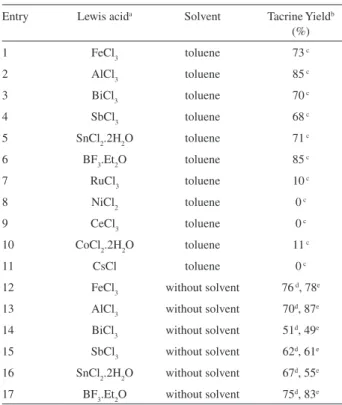
Our next series of experiments examined the use of various metal chloride salts as Lewis acid promoters in the cyclodehydratation reactions between anthranilonitrile and cyclohexanone, as depicted in the Table 2. Among these, Scheme 1.
Table 1. InCl3 promoted condensation reactions of anthranilonitrile and cyclohexanone under different conditions
Entry Solventa Reaction Time (h) Tacrine Yieldb (%)
1 toluene 24 50c, 80d, 100e
2 toluene 6 40e
3 toluene 60 80d
4 acetonitrile 24 50e
5 acetonitrile 48 50e
6 n-nonane 24 80e
7 ethanol 24 complex mixturee
8 n-propanol 24 complex mixturee
9 without solvent 24 80e,f
10 without solvent 6 79e,f
11 without solvent 1 75e,f
aThe reactions were performed under solvent reflux and additional 24 h
of alkaline hydrolysis work up was required. bAll yields refer to isolated
product. c0.5 equiv. d0.8 equiv. e1.0 equiv. fThe reactions were performed
AlCl320,27,28 and BF
3.Et2O complex
7 have previously been
applied in the Friedländer reaction and were included in our set of experiments for comparative purposes.
In the screening, the chloride salts of Fe(III), Al(III), Bi(III), Sb(III), Sn(II), and the BF3.Et2O complex gave tacrine 1a with good yields under toluene reflux at 120 oC
(entries 1-6). Under similar conditions, other Lewis acids such as the chloride salts of Ru(III), Ce(III), Co(II), Ni(II) and Cs(I) were not effective for the above reaction (entries 7-11). In the case of solvent-free conditions (entries 12-17), tacrine 1a was obtained with good yield using Fe(III), Al(III), Sb(III), Sn(II) and BF3.Et2O complex.
A fair number of ketones are known participants in the Friedländer cyclodehydratation reaction with ortho -amino-substituted benzonitriles promoted by a Lewis acid.18 Its
mechanism, however, has not been thoroughly studied. In this regard, some mechanistic considerations have been offered.16,18,19,21 We believe that the reaction may
proceed through an initial imine-enamine tautomerism (whose preparation or isolation has been reported in some cases, depending upon the structure of the imine and enamine), activated by Lewis acid coordination under equilibrium conditions.7,12,18,19 Next, we propose that
the weakly basic nitrile of 7 is activated by Lewis acid coordination,followed by the intramolecular addition of the enamine carbon to the nitrile group to afford the intermediate 8. Next, an imine-enamine tautomerism should take place, during or prior to the alkaline hydrolysis work up, to afford 9. The proposed mechanism shows a delicate balance, where the ability of the Lewis acid to coordinate with the starting materials intermediates and product, in an interchangeable manner through the reaction pathway, should play an important and critical role in the reaction course. In this sense, we believe that the Lewis Table 2. Condensation reactions of anthranilonitrile and cyclohexanone
using different Lewis acids
Entry Lewis acida Solvent Tacrine Yieldb
(%)
1 FeCl3 toluene 73 c
2 AlCl3 toluene 85 c
3 BiCl3 toluene 70 c
4 SbCl3 toluene 68 c
5 SnCl2.2H2O toluene 71 c
6 BF3.Et2O toluene 85 c
7 RuCl3 toluene 10 c
8 NiCl2 toluene 0 c
9 CeCl3 toluene 0 c
10 CoCl2.2H2O toluene 11 c
11 CsCl toluene 0 c
12 FeCl3 without solvent 76 d, 78e
13 AlCl3 without solvent 70d, 87e
14 BiCl3 without solvent 51d, 49e
15 SbCl3 without solvent 62d, 61e
16 SnCl2.2H2O without solvent 67d, 55e
17 BF3.Et2O without solvent 75d, 83e
a1.0 equiv. bAll yields refer to isolated product. cThe reactions were
performed under solvent reflux for 24 h and additional 24 h of alkaline hydrolysis. dHeating for 24 h at 120 oC and additional 24 h of alkaline
hydrolysis. eHeating for 6 h at 120 oC and additional 24 h of alkaline
hydrolysis.
acid activation of the nitrile group followed by cyclization should be the rate-limiting step in the above reaction.
Next, under optimized conditions, the cyclodehydratation reaction under toluene reflux was further evaluated with several ketones and anthranilonitrile in the presence of different Lewis acids. As depicted in Table 3 (entries 1 and 2), cyclopentanone (10) and cycloheptanone (12), delivered a lower yield of products 11 and 13, comparative to the six-membered ring substrate cyclohexanone (Tables 1 and 2). In this regard, there was no difference with the results reported in the literature. This feature can presumably be ascribed to the ring strain in the cyclization step, along with a slower rate reaction. Even so, it is evident from the results that InCl3 proved to be an efficient promoter for the cyclodehydratation reaction in the cases of ketones 10 and
12, to afford higher yields in comparison with results in the literature.7 In the case of diketones 14 and 16 (entries
3 and 4), the tacrine analogues 15 and 17 were observed
in good yields restrictively for InCl3 and FeCl3. Next, (+/-)-camphor was examined as the ketone, and shown to be a highly acid sensitive substrate under the screened metal chloride salts (entry 5). A reasonable yield (45%) of 19 was achieved using AlCl3. In comparison with a precedent in the literature, BF3.Et2O under similar reaction conditions led to only 3.8% yield of 19.7
In summary, this work has extended the use of Lewis acid promoters in cyclodehydratation reactions between anthranilonitrile and cycloketones to afford tacrine and its analogs with good to excellent yields, employing both organic solvent and solvent-free conditions. The ability of the Lewis acids to effectively promote the cyclodehydratation between anthranilonitrile and cyclohexanone as the ketone was found to be the following order: InCl3 > AlCl3 ~ BF3.Et2O > FeCl3 > BiCl3 ~ SbCl3 ~ SnCl2.2H2O. Other Lewis acids screened, such as RuCl3, CeCl3, NiCl2, CoCl2.2H2O and CsCl were not effective.
Table 3. Lewis acids promoted condensation reactions of anthranilonitrile and several cycloketonesa
Entry Ketones Product Lewis acidb Yieldc (%)
1
InCl3 83
BiCl3 36
FeCl3 39
SbCl3 40
SnCl2.2H2O 33
AlCl3 57
2
InCl3 87
BiCl3 64
FeCl3 65
SbCl3 31
SnCl2.2H2O 59
AlCl3 95
3
InCl3 67
BiCl3 35
FeCl3 60
SbCl3 24
SnCl2.2H2O 25
AlCl3 Complex mixture
4
InCl3 80
BiCl3 51
FeCl3 63
SbCl3 58
SnCl2.2H2O 42
AlCl3 0
5
InCl3 Complex mixture
BiCl3 15
FeCl3 27
SbCl3 0
SnCl2.2H2O Complex mixture
AlCl3 45
This general trend was observed by employing different ketones as substrates. We also found that lower reaction time is required under solvent-free conditions.
Experimental
Melting points were recorded on a Büchi B-545 apparatus in open capillary tubes. IR spectra were measured on a Mattson Galaxy Series FT-IR 3000 (model 3020). 1H
and 13C NMR spectra were recorded on a Varian Gemini
300 MHz spectrometer. The chemical shifts are expressed as d (ppm) relative to TMS as an internal standard and J
standard values are given in Hz.
Cyclodehydratation reaction of 2-aminobenzonitrile (2) with ketones under solvent reflux
To a mixture of 2-aminobenzonitrile (1.0 mmol) and ketone (1.0 mmol) in toluene (8 mL) placed in a round bottom flask connected to a Dean-Stark water separator, was added Lewis acid (1.0 mmol). The mixture was heated at reflux for 24 h under stirring. After cooling to rt, the toluene was decanted, the remaining solids were treated with NaOH solution (2 mol L-1, 8 mL) and this mixture
was heated at reflux for 24 h. On cooling to rt, the reaction mixture were extracted with CHCl3 (3 × 8 mL), the organic layers were combined and dried over Na2SO4. The solvent was evaporated under reduced pressure to give the desired product.
Cyclodehydratation reaction of 2-aminobenzonitrile (2) with ketones under solvent-free
To a mixture of 2-aminobenzonitrile (1.0 mmol) and ketone (1.0 mmol) placed in a round bottom flask connected to a reflux condenser, was added Lewis acid (1.0 mmol). The mixture was heated at 120 oC for 24 h under stirring.
After cooling to rt, the remaining solids were treated with NaOH solution (2 mol L-1, 8 mL) and this mixture was
heated at reflux for 24 h. On cooling to rt, the reaction mixture were extracted with CHCl3 (3 × 8 mL), the organic layers were combined and dried over Na2SO4. The solvent was evaporated under reduced pressure to give the desired product.
Both procedures were performed under an argon atmosphere in the cases of AlCl3 and BF3.Et2O. The isolated products showed to be sufficiently clean and no further purifications were runned. 1H and, 13C NMR, IR analysis
and melting point were consistent with the literature data. (See NMR spectra of isolated products at Supplementary Information).
9-amino-1,2,3,4-tetrahydroacridine (1a)
IR (KBr) ν
max/cm
-1: 3478, 3302, 3050, 2933, 1646, 756;
1H NMR (300 MHz, CDCl
3): d7.91 (d, J 8.4 Hz, 1H), 7.72
(dd, J 8.4, 0.6 Hz, 1H), 7.57 (t, J 7.5 Hz, 1H), 7.37 (t, J 7.5 Hz, 1H), 4.66 (br s, 2H), 3.04 (t, J 6.0 Hz, 2H), 2.62 (t, J 6.0 Hz, 2H), 2.00-1.93 (m, 4H); 13C NMR (75 MHz, CDCl
3):
d158.3, 146.5, 146.3, 128.4, 128.3, 123.6, 119.8, 117.0, 110.1, 33.9, 23.5, 22.6, 22.5; mp = 175-177 ºC. For reported data of melting point, IR, and NMR, see reference.7,29
9-amino-2,3-dihydro-1H-cyclopenta[1,2-b]quinoline (11)
IR (KBr) ν
max/cm
-1: 3342, 3241, 2960, 1659, 1568, 761;
1H NMR (300 MHz, CDCl
3): d7.94 (d, J 8.4 Hz, 1H), 7.71
(dd, J 8.4, 0.6 Hz, 1H), 7.56 (t, J 7.8 Hz, 1H), 7.35 (t, J
7.8 Hz, 1H), 4.68 (br s, 2H), 3.10 (t, J 7.8 Hz, 2H), 2.83 (t,
J 7.5 Hz, 2H), 2.18 (quintet, J 7.5 Hz, 2H); 13C NMR (75
MHz, CDCl3): d167.5 , 148.5, 144.5, 128.9, 128.2, 123.7, 119.8, 117.6, 115.0, 35.1, 27.3, 22.6; mp = 174-176 ºC. For reported data of melting point, IR, and NMR, see reference.7
11-amino-2,3,4,5-tetrahydro-1H-cyclohepta[1,2-b] quinoline (13)
IR (KBr) ν
max/cm
-1: 3487, 3310, 3162, 2908, 1648, 1579,
748; 1H NMR (300 MHz, CDCl
3): d7.91 (d, J 8.4 Hz, 1H),
7.68 (d, J 8.4 Hz, 1H), 7.55 (t, J 7.5 Hz, 1H), 7.36 (t, J
7.5 Hz, 1H), 4.77 (br s, 2H), 3.14-3.11 (m, 2H), 2.76-2.72 (m, 2H),1.89-1.63 (m, 6H); 13C NMR (75 MHz, CDCl
3):
d164.7, 146.1, 145.1, 128.9, 128.2, 124.2, 120.1, 117.9, 115.7, 39.7, 31.9, 27.5, 26.7, 26.3; mp = 170-172 ºC. For reported data of melting point, IR, and NMR, see reference.7
9-amino-3,4-dihydroacridin-1(2H)-one (15)
IR (KBr) ν
max/cm
-1: 3274, 3113, 2935, 1634, 1612, 1571,
1548, 1007, 755; 1H NMR (300 MHz, CDCl
3): d10.27 (br,
1H, NH2), 7.88-7.83 (m, 2H), 7.70 (t, J 8.1 Hz, 1H), 7.41 (t, J 7.8 Hz, 1H), 6.23 (br, 1H, NH2), 3.12 (t, J 6.6 Hz, 2H), 2.74 (t, J 6.6 Hz, 2H), 2.15 (quintet, J 6.3 Hz, 2H);
13C NMR (75 MHz, CDCl
3): d201.6, 163.7, 154.4, 148.1,
132.0, 129.0, 124.8, 120.9, 117.6, 106.5, 39.8, 34.5, 21.6; mp = 238-240 ºC. For reported data of melting point, IR, and NMR, see reference.30
9-amino-3,4-dihydro-3,3-dimethylacridin-1(2H)-one (17)
IR (KBr) ν
max/cm
-1: 3291, 3119, 2960, 2922, 1623, 1613,
1546, 760; 1H NMR (300 MHz, CDCl
3): d10.26 (br, 1H,
NH2), 7.92-7.88 (m, 2H), 7.70 (t, J 7.5 Hz, 1H), 7.43 (t, J
7.5 Hz, 1H), 6.39 (br, 1H, NH2), 3.01 (s, 2H), 2.58 (s, 2H), 1.13 (s, 6H); 13C NMR (75 MHz, CDCl
3): d201.2, 162.6,
9-amino-1,4-methano-1,2,3,4-tetrahydro-4,11,11-trimethylacridine (19)
IR (KBr) ν
max/cm
-1: 3327, 3143, 2956, 2869, 1643,
1594, 760; 1H NMR (300 MHz, CDCl
3): d7.96 (d, J 8.4
Hz, 1H), 7.64 (d, J 8.1 Hz, 1H), 7.48 (t, J 7.5 Hz, 1H), 7.32 (t, J 7.8 Hz, 1H), 4.47 (br s, 2H), 2.85 (d, J 3.9 Hz, 1H), 2.09-2.00 (m, 1H), 1.88-1.79 (m, 1H), 1.39 (s, 3H), 1.37-1.17 (m, 2H), 0.62 (s, 3H); 13C NMR (75 MHz, CDCl
3):
d171.9, 147.3, 140.8, 129.1, 127.7, 123.9, 120.0, 119.6, 119.2, 55.3, 54.5, 47.5, 32.5, 25.6, 20.1, 19.1, 10.6; mp = 160-162 ºC. For reported data of Melting point, IR, and NMR, see reference.7,33
Acknowledgements
The authors wish to thank the following Brazilian agencies for financial support: CNPq (Conselho Nacional de Desenvolvimento Científico e Tecnológico), FAPERGS (Fundação de Amparo à Pesquisa do Estado do Rio Grande do Sul) and PROPESQ - UFRGS (Pró- Reitoria de Pesquisa da Universidade Federal do Rio Grande do Sul).
Supplementary Information
Supplementary data are available free of charge at http://jbcs.org.br, as PDF file.
References
1. Davis, K. L.; Powchik, P.; Lancet 1995, 345, 625.
2. Recanatini, M.; Cavalli, A.; Belluti, F.; Piazzi, L.; Rampa, A.; Bisi, A.; Gobbi, S.; Valenti, P.; Andrisano, V.; Bartolini, M.; Cavrini, V.; J. Med. Chem. 2000, 43, 2007; Peçanha, E. P.; Fraga, C. A. M.; Barreiro, E. J.; Braga, M. F. M.; Pereira, E. F. R.; Albuquerque, E. X.; J. Braz. Chem. Soc. 2001, 12, 408. 3. Francotte, P.; Graindorge, E.; Boverie, S.; de Tullio, P.; Pirotte,
B.; Curr. Med. Chem.2004, 11, 1757.
4. Watkins, P. B.; Zimmerman, H. J.; Knapp, M. J.; Gracon, S. I.; Lewis, K. W.; J. Am. Med.Assoc. 1994, 271, 992.
5. Ames, D. J.; Bhathal, P. S.; Davies, B. M.; Fraser, J. R. E.; Gibson, P. R.; Roberts, S.; N.Z. J. Med. 1990, 20, 193. 6. H a r vey, A . L . ; R owa n , E . G . I n A c t i o n o f T H A ,
3,4-diaminopyridine, physostigmine and galanthamine on
neuronal K+ currents at a cholinergic nerve terminal, Current
Research inAlzheimer Therapy, Giacobini, E.; Becker, R., eds.; Taylor and Francis: New York, 1988.
7. McKenna, M. T.; Proctor, G. R.; Young, L. C.; Harvey, A. L.; J. Med. Chem. 1997, 40, 3516.
8. Drukarch, B.; Leysen, J. E.; Stoof, J. C.; Life Sci. 1988, 42, 1011; Sokhwinder, J.; Adem, A.; Winblad, B.; Oreland, L.; Pharmacol. Toxicol. 1992, 71, 213.
9. Kaul, P. N.; J. Pharm. Pharmacol. 1962, 14, 243; Neilsen, J. A.; Mena, E. E.; Williams, I. H.; Nocerine, M. R.; Liston, D.; Eur. J. Pharmacol. 1988, 173, 53; McNally, W.; Roth, M.; Young, R.; Bockbrader, H.; Chang, T.; Pharm. Res. 1989, 924. 10. Antuono, P. G.; Arch. Intern. Med. 1995, 155, 1766.
11. Hu, M. K.; Wu, L. J.; Hsiao, G.; Yen, M. H.; J. Med. Chem. 2002, 45, 2277.
12. Shutske, G. M.; Pierrat, F. A.; Kapples, K. J.; Cornfeldt, M. L.; Szewczak, M. R.; Huger, F. P.; Bores, G. M.; Haroutunian, V.; Davis, K. L.; J. Med. Chem.1989, 32, 1805; Shutske, G. M.; Pierrat, F. A.; Cornfeldt, M. L.; Szewczak, M. R.; Huger, F. P.; Bores, G. M.; J. Med. Chem.1988, 31, 1279.
13. Gregor, V. E.; Emmerling, M. R.; Lee, C.; Moore, C. J.; Bioorg. Med. Chem. Lett.1992, 2, 861.
14. Cheng, C. C.; Yan, S. J.; Org. React. 1982, 28, 37.
15. Zong, R.; Wang, D.; Hammitt, R.; Thummel, R. P.; J. Org. Chem.2006, 71, 167.
16. Yang, D.; Jiang, K.; Li, J.; Xu, F.; Tetrahedron 2007, 63, 7654; Muchowski, J. M.; Maddox, M. L.; Can. J. Chem.2004, 82, 461.
17. Friedlander, P.; Ber. 1882, 15, 2572; Jones, G. In The Chemistry ofHeterocyclic Compounds, Quinolines, Part I, Jones, G., Ed.; John Wiley and Sons: New York, 1977.
18. Proctor, G. R.; Harvey, A. L.; Curr. Med. Chem. 2000, 7, 295. 19. Khalilzadeh, M. A.; Hosseini, A.; Tajbakhsh, M.; J. Heterocyclic.
Chem. 2007, 44, 535.
20. Marco-Contelles, J.; León, R.; los Ríos, C.; García, A. G.; López, M. G.; Villarroya, M.; Bioorg. Med. Chem. 2006, 14, 8176; Marco J. L.; los Ríos, C.; Carreiras, M. C.; Baños, J. E.; Badía, A.; Vivas, N. M.; Bioorg. Med. Chem.2001, 9, 727. 21. Moore, J. A.; Kornreich, L. D.; Tetrahedron Lett. 1963, 20,
1277; Li, J.; Zhang, Lijun; Shi, D.; Li, Q.; Wang, D.; Wang, C.; Zhang, Q.; Zhang, Ling; Fan, Y.; Synlett, 2008, 233. 22. Sestili, I.; Borioni, A.; Mustazza, C.; Rodomonte, A.; Turchetto,
L.; Sbraccia, M.; Riitano, D.; Del Giudice, M. R.; Eur. J. Med. Chem. 2004, 39, 1047.
23. Girgis, N. S.; Pedersen, E. B.; Synthesis 1985, 547.
24. Li, J. R.; Zhang, L. J.; Chen, J. N.; Yang, X. Q.; Wang, L. J.; Zhao, X. F.; Qiu, J. X.; Chin. Chem. Lett. 2007, 18, 636. 25. Ceschi, M. A.; Felix. L. D.; Peppe, C.; Tetrahedron Lett.
26. Takahiro, T.; Li, C. J.; Chan, T. H.; Tetrahedron 1999, 55, 11149; Babu, G.; Perumal, P. T.; Aldrichim. Acta 2000, 33, 16; Ghosh, R.; Indian J. Chem. Soc. 2001, 40B, 550; Chen, J. X.; Liu, M. C.; Yang, X. L.; Ding, J. C.; Wu, H. Y.; J. Braz. Chem. Soc. 2008, 19, 877.
27. León, R.; Marco-Contelles, J.; García, A. G.; Villarroya, M.; Bioorg. Med. Chem. 2005, 13, 1167.
28. Carreiras, M. C.; Eleutério, A.; Dias, C.; Brito, M. A.; Brites, D.; Marco-Contelles, J.; Gómez-Sánchez, E.; Heterocycles 2007, 71, 2249.
29. Merk Index, p 1298, nº. 8907.
30. Kugelmann, E.; Holzgrabe, U.; ARKIVOC 2008, 247. 31. Burov, Y. V.; Goncharenko, S. B.; Robakidze, T. N.; Portnov, Y.
N.; Kadysheva, L. V.; Penke, I.; Peganov, E. M.; Suchanova, S. A.; Tananoba, G. V.; Voronin, A. E.; WO Patent 9219598, 1992.
32. Hisashi, T.; Atsushi, K.; Mitsuru, O.; Hiroyoshi, S.; EP Patent 371388, 1990.
33. Love, B. E.; Ren, J.; J. Org. Chem. 1993, 58, 5556; Love, B. E.; Ren, J.; Synth.Commum. 1995, 25, 73.
Received: November 25, 2008
Web Release Date: August 14, 2009
Additions and Corrections
On page 1448, where it was read: “Jessé S. da Costa”
Now reads: