Review
J. Braz. Chem. Soc., Vol. 25, No. 12, 2186-2214, 2014. Printed in Brazil - ©2014 Sociedade Brasileira de Química 0103 - 5053 $6.00+0.00
*e-mail: [email protected]
This article is dedicated to the memory of Prof Roberto F. de Souza
Recent Progress in the Use of Pd-Catalyzed C-C Cross-Coupling Reactions in the
Synthesis of Pharmaceutical Compounds
André F. P. Biajoli, Cristiane S. Schwalm, Jones Limberger, Thiago S. Claudino and Adriano L. Monteiro*
Laboratory of Molecular Catalysis, Institute of Chemistry, UFRGS, Av. Bento Gonçalves, 9500, 91501-970 Porto Alegre-RS, Brazil
A grande capacidade do paládio de formar ligações carbono-carbono entre substratos apropriadamente funcionalizados permitiu que os químicos orgânicos efetuassem transformações antes impossíveis ou alcançáveis somente através de rotas muito longas. Neste contexto, uma das mais elegantes e importantes aplicações das reações de acoplamento cruzado catalisadas por paládio é a síntese de compostos de interesse farmacêutico. A presente revisão tem por objetivo apresentar uma visão geral do uso de acoplamentos cruzados na síntese de componentes de medicamentos (ou de candidatos a medicamentos), independentemente da escala, compreendendo o período de 2011 até o final de julho de 2014.
The impressive ability of palladium to assemble C-C bonds between appropriately functionalized substrates has allowed synthetic organic chemists to perform transformations that were previously impossible or only possible using multi-step approaches. In this context, one of the most important and elegant applications of the Pd-catalyzed C-C coupling reactions currently is the synthesis of pharmaceuticals. This review is intended to give a picture of the applications of Pd-catalyzed C-C cross-coupling reactions for the synthesis of drug components or drug candidates regardless of the scale from 2011 through to the end of July, 2014.
Keywords: cross-coupling reactions, Heck reactions, palladium, pharmaceuticals
1. Introduction
Palladium-catalyzed cross-coupling reactions comprise one of the most efficient methods for the construction of carbon-carbon bonds.1-3 The impressive ability of
palladium to assemble C-C bonds between appropriately functionalized substrates has allowed synthetic organic chemists to perform transformations that were previously impossible or only possible using multi-step approaches. Therefore, these cross-coupling methodologies have revolutionized the way of thinking regarding synthetic organic chemistry, having found widespread use in organic synthesis and material science, as well playing an important role in pharmaceutical, agrochemical and fine chemical industries.4-8 In this scenario, the award of the Nobel Prize
in Chemistry in 2010 was a deserved recognition, rewarding jointly Richard F. Heck, Ei-ichi Negishi9 and Akira Suzuki10
for their remarkable contributions for the Pd-catalyzed cross-couplings in organic synthesis.11
The generally accepted mechanisms for Pd-catalyzed C-C cross-coupling reactions are summarized in Scheme 1. All reactions start with a Pd zerovalent species preformed or formed in situ from Pd divalent catalyst precursors.
The first step is common for all reactions, consisting of the oxidative addition reaction of organic halide (or pseudohalide) to the Pd zerovalent species affording the R1-Pd-X intermediate. In the case of coupling reactions
involving an organometallic partner (R2M), the R1-Pd-R2
intermediate is formed by a transmetalation step. Finally, reductive elimination provides the R1-R2 coupling product,
and regenerates the Pd zerovalent species. The Sonogashira reaction involves the coupling between organic halides and alkynes. When copper salts are used as the co-catalyst, copper acetylides are formed in situ and are involved in the
a syn migratory insertion occurs and the organopalladium
species formed undergoes β-hydride elimination to form the alkene product. Finally, a base-assisted elimination of HX regenerate the Pd(0) catalyst.12-17 When an aryldiazonium
salt is used in place of an aryl halide, the reaction is known as Heck-Matsuda reaction.18-21 The difference in terms of
mechanism is that the oxidative addition of aryldiazonium salts to the Pd zerovalent species generates a cationic [R1-Pd]+ intermediate.
In our opinion, the most important and elegant application of the coupling reactions is the synthesis of pharmaceuticals. In this context, there is an excellent review about the applications of Pd-catalyzed coupling reactions. This review covers the period from 2001 to 2008, and highlights examples that have been performed on at least a kilogram scale in the chemical and pharmaceutical industries.5 In addition, Pfizer researchers have reviewed
the large-scale applications of transition metal-catalyzed coupling reactions for the manufacture of drug components in the pharmaceutical industry through to the end of August, 2010.4 This review is intended to give a picture
of the applications of Pd-catalyzed C-C cross-coupling reactions for the synthesis of drug components or drug candidates, regardless of scale, from 2011 through to the end of July, 2014.
2. Suzuki-Miyaura Reactions
The transition metal-catalyzed reaction between an organoboron compound and a halide or pseudohalide is known as Suzuki-Miyaura cross-coupling.22 This important
reaction is well-known for the assembly of biphenyl motifs.23 For example, Dalby et al.24 reported a concise
synthesis of D159687 (1), a partial allosteric modulator
of phosphodiesterase 4 (PDE4), an enzyme related to inflammatory and respiratory diseases. The first synthesis of 1 involved six steps, with one Suzuki reaction step, with an overall yield of 8%.25 By using the benzyl aryl
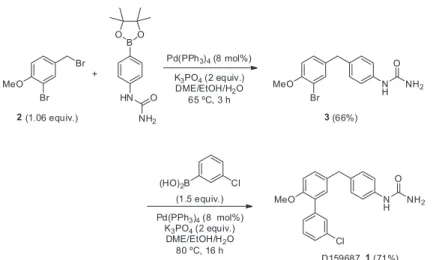
dibromide 2 as starting material, the synthesis of 1 was shortened to two-steps with an overall yield of 47% on the gram scale (Scheme 2).
The more reactive benzyl bromide moiety of dibromide 2 was coupled with a pinacol arylboronic ester, providing diarylmethane 3 in 66% yield. Activation of the remaining bromide in 3 was carried out using the same conditions, only changing the temperature and reaction time, and furnishing 1 at a yield of 71%. The optimal conditions displayed in Scheme 2 were established after a screening of Pd sources [Pd(PPh3)4, PdCl2(PPh3)2 and Pd(OAc)2/PPh3],
solvents [dimethoxyethane/EtOH/H2O, dioxane/H2O and dimethylformamide (DMF)] and bases (K3PO4, K2CO3,
Na2CO3 and Cs2CO3). It is worth noting that a reduction of the amount of catalyst increased the conversion in some cases, while higher amounts generally increased the level of impurities and difficult purification. This process was applied to the synthesis of two new PDE4D partial allosteric modulators, D159404 (4) and D159153 (5) (Figure 1), with overall yields of around 26% for the two Suzuki reactions. Thiel et al. described the preparation of several
inhibitors of p38 mitogen-activated protein (MAP) kinases, which are enzymes that positively regulate the production of pro-inflammatory mediators (TNF-α and IL-1).26 These
mediators are involved in rheumatoid arthritis, Crohn’s disease and psoriasis. The original synthetic route27
presented some challenges for scaling-up, most notably the employment of toxic carbon tetrachloride, silver salts and microwave irradiation. Therefore, the authors optimized the route, on a kilogram scale, employing the aryl chloride 6
LnPd0
LnPdI I
R
X R-X LnPdI I
R
R1
R1-M
M-X R-R1
R2
R
IIPdL nX
R2 H
R2 R
X PdIILn
H
R2 R
HX
base
oxidative addition r eductive
elimination
tran smetalati on
synmi gratory insertion
synβ-h ydr ide eliminatio n
Heck-Mizoroki Heck-Matsud a (with [LnPdIIR]+after oxid ative addition) Negishi (M = ZnR)
Suzuki-Miyaura [M = B (OH)2or B(O R)2] Stille (M = SnR3)
Son ogashira (M = CuI)
Scheme 2. Sequential Suzuki reactions in the synthesis of D159687 (1).
MeO K3PO4(2 equiv.)
DME/EtOH/H2O 65 ºC, 3 h Br
Br
BO O
HN
NH2 O
MeO Br
N
H NH2
O
(1.5 equiv.)
Pd(PPh3)4(8 mol%) K3PO4(2 equiv.)
DME/EtOH/H2O 80 ºC, 16 h
Cl (HO)2B
MeO N
H NH2
O
Cl +
2(1.06 equiv.) 3(66%)
D1596871(71%) Pd(PPh3)4(8 mol%)
MeO N
H NH2
O
R F
R = Cl (4) R = NO2(5)
Figure 1. PDE4D allosteric modulators D159404 (4) and D159153 (5).
as starting material and avoiding the use of toxic solvents (Scheme 3). For activation of the less reactive C-Cl bond, ligand screening was necessary, and MePhos (7) was identified as the most effective. Thus, this ligand combined with a mixture of ethanol/aqueous sodium hydroxide was employed with Pd2(dba)3, where dba = dibenzalacetone, as
pre-catalyst to provide 8 in yields between 70 and 81%. In contrast to the medicinal chemistry route, the final step did not employ a palladium-catalyzed reaction, allowing easier removal of this metal: the synthesis of 9 employed
Scheme 3. Suzuki reaction of an aryl chloride en route to 9.
Pd2(dba)3,NaOH (aq), EtOH, reflux
N N
1. CDI, imidazole,
EtOAc, r.t. - 50 ºC N
N N
N N
Cl O
Me
CO2H (HO)2B
N O
CO2H
Me
N
Me O
N H O
6 8(70-81%)
MePhos (7)
9(70% 2 steps) +
PCy2 Me
2. cyclopropylamine, r.t.
1,1-carbonyldiimidazole (CDI) and cyclopropylamine in ethyl acetate leading to the desired product in 70% yield after two steps. The authors believe that any significant amount of palladium present as an impurity in intermediate 8 was removed quantitatively with the aid of imidazole employed in the carbonyl activation step.
It is worth noting that the large scale synthesis of 10, another inhibitor of p38 MAP kinases, demanded a completely different catalytic system for the Suzuki reaction. While the original medicinal chemistry route employed Pd(PPh3)4 for the coupling of 11 with a boron pinacolate derivative, on a large scale, the authors were capable of reducing the catalyst loading (albeit no amounts were disclosed in the text) by using PdCl2(APhos) (12),
allowing a very clean reaction to be performed due to the high activity of this catalyst (Scheme 4).26 Thus, the Suzuki
potassium phosphate, with a mixture of isopropyl alcohol and water as solvent. Finally, treatment of 13 with CDI in tetrahydrofuran (THF) provided 10 in 94% yield.
Gillmore et al. developed a multi-kilogram preparation
of PF-01367338 (14), a drug candidate for the treatment of breast and ovarian cancers.28 It is an inhibitor of poly(ADP
ribose) polymerase (PARP), an enzyme that is responsible for repairing damaged DNA in normal and tumour cells.28
The described synthetic route delivered 2 kg of the salt 14, and the authors described how they had to overcome some synthetic challenges in order to scale up the synthesis to multi-kilogram scale. The overcome problems include: understanding of the thermal hazards of the Leimgruber-Batcho indole synthesis, installation of the side chain through a reductive alkylation procedure, improvements in the robustness of the Suzuki coupling, removal of hydrogen cyanide generation during a reductive amination reaction, and reliable generation of good-quality free base for the final salt formation step.
The Suzuki reaction between the tricyclic bromide 15 and 4-formylphenylboronic acid was first carried out in multi-kilogram scale using by Pd(PPh3)4 as catalyst. The reaction did not reach completion requiring an additional catalyst charge. In the sequence, the Suzuki reaction was performed with [PdCl2(dppf)·CH2Cl2] as a pre-catalyst, and
full conversion was obtained after 2 h at 90 °C (Scheme 5), providing 16 with yield of 92%.
Grongsaard et al. reported a scalable synthetic route of
17, an inhibitor of Akt kinase, which is an enzyme that is up-regulated in several types of cancer, such as colon, breast, brain, lung and prostate.29 This interesting polycyclic was
prepared on small scale through a Suzuki reaction between a pyridyl chloride and an aryl boronate. However, given the harsh conditions required for this reaction [140 °C, microwave heating, 20 mol% of Pd(PPh3)4], an improvement of this step was clearly necessary for scale-up. Thus, an optimization study was performed for the Suzuki reaction between triflate 18 and boron pinacolate 19, with a screening of ligands [XPhos, 1,4-bis(diphenylphosphino)butane (dppb), (R)-(2,2’-bis(diphenylphosphino)-1,1’-binaphthyl)
(BINAP), 1,1’-bis(diphenylphosphino)ferrocene (dppf) and 1,1’-bis(di-i-propylphosphino)ferrocene (dippf)]. Electron-rich, ferrocen-derived phosphines presented superior performances (Scheme 6). Also, a mixture of THF and water was found to be the optimal solvent, but 2-MeTHF was chosen instead of THF because enables a simpler purification by crystallization. Notably, water proved to be essential to this transformation, the yields were lower in anhydrous media. However, the authors did not provide an explanation for this. Optimal conditions were found and are shown in
Scheme 4. Optimized Suzuki reaction for the synthesis of 10.
N Me
K3PO4
iPrOH/H
2O O
Me
CO2H (HO)2B
Br N
N F
N
Me O
N N F
Me
CO2H
N
Me O
N N F
Me
H N
O
11 13(93%)
10(94%)
+
P Pd
tBu
tBu
P
tBu
Cl
Cl
12
CDI, cyclopropylamine
F F
F THF
tBu
NMe2 Me2N
Scheme 5. Suzuki reaction for the synthesis of PF-01367338 (14).
N H H N O
F
PdCl2(dppf).CH2Cl2(2.5 mol%),
Br (HO)2B
CHO
N H H N O
F
CHO
N H H N O
F HN Me
.CSA PF-01367338 (14)
15 (1.2 equiv.) 16(92%)
+
Scheme 6. Synthesis of 17 by means of a Suzuki reaction with the advanced boron pinacolate intermediate 19. Pd(OAc)2(3 mol%)
N N
N
N F
F
NHBoc HO Me
N N
N
N F
F
OTf
+ NHBoc
Me HO
B O
O
EtOH/H2O
N N
N
N F
F
NH2 HO Me
18 19(1.1 equiv.) 21(84%)
17(93%) Fe P P
Pri Pri
iPr
iPr
dippf (20, 3 mol%) K3PO4(2 equiv.), 2-MeTHF/H2O
r.t - 50 °C, 1 h
HCl (aq)
Scheme 7. Synthesis of boron pinacolate derivative 19.
(Bpin)2(1.2 equiv.) Pd(OAc)2(3 mol%) XPh os (6 mol%) KOAc (3 equiv.) MeCN, 80oC, 18 h Cl
CO2H
22
NHBoc Me HO
23
Cl multistep
NHBoc Me HO
B O
O
19(91%)
PCy2 iPr iPr
iPr XPho s
Scheme 6: 3 mol% of both Pd(OAc)2 and dippf (20) were
employed with potassium phosphate as base and a mixture of 2-MeTHF and water as solvent, with the heating temperature steadily raised from room temperature to 50°C. The desired product 21 was obtained in 84% yield, and removal of the
tert-butyloxycarbonyl (Boc)-protecting group afforded 17
in 93% yield.
In the Suzuki reaction mentioned above, the valuable boron pinacolate 19 was employed only in slight excess. Even though borylations are out of the scope of this review, the synthesis of 19 deserves particular mention, since this compound demanded more than ten steps to be reached starting from acid 22 and was finally obtained by an elegant Pd-catalyzed borylation of the aryl chloride 23 (Scheme 7). Tian et al. described a convergent synthesis for
GDC-094130 (24), a phosphatidylinositol 3-kinase (PI3K)
inhibitor (Scheme 8). The PI3K pathway is frequently activated in tumours and its inhibition has a role in human cancers. The indazole-derived boronic acid 26 was employed as its tetrahydropyran-protected derivative due to solubility issues and to render an easier purification. Previous studies identified Pd- or Ni-catalyzed systems for this Suzuki reaction. The first employed PdCl2(PPh3)2 with
Na2CO3 as base and 1,4-dioxane as solvent; regarding the
economically more attractive nickel, Ni(NO3)2.6H2O/PPh3 was identified as an optimal pre-catalyst, with K3PO4 as base
and acetonitrile as solvent. In the Ni-catalyzed reaction, boronic acid 26 performed better than the corresponding boronate ester. The yield of the Pd-catalyzed reaction was 60%, whereas the Ni-catalyzed reaction provided 27 in 79% yield. Mild removal of the THP-protecting group then provided 24. Regarding purification after the Suzuki reaction, residual Ni was easily removed through an aqueous ammonia wash followed by crystallization, while the removal of residual Pd demanded expensive scavengers and a large volume of solvents. The easy removal of nickel traces compensated for the high loadings of its pre-catalyst (30 mol%); Pd loadings were lower (4.5 mol%), however the lower yield and difficult purification impaired the use of this noble metal.
Hicks et al. reported the synthesis of 28 (Scheme 9),
a molecule connected to PI3K and AKT/PKB signalling pathway that inhibits cell proliferation and tumour growth.31
(see Scheme 9) with this base resulted in incomplete conversions. Surprisingly, substitution of sodium carbonate by potassium phosphate allowed an impressive decrease of the Pd loading to 0.2 mol%; nonetheless, careful removal of palladium impurities was necessary, and after some testing with L-cysteine, an optimal procedure was disclosed
in which the desired Suzuki product was isolated as 1:1
N,N-dimethylacetamide solvate 31 and redissolved in DMF,
with Pd being removed by means of a scavenger supported on silica. Thereafter, ethanol was added as an anti-solvent for crystallization, providing 28 with palladium amounts lower than 1 ppm.
A process chemistry development was performed for the synthesis of CEP-32215 (32) (Scheme 10), an antagonist of the histamine H3 receptor;32 its antagonists
can be used in a variety of central nervous system (CNS) disorders associated with attention and cognitive deficits
(wakefulness, attention-deficit hyperactivity disorder, Alzheimer’s disease, mild cognitive impairment and schizophrenia). The synthesis of this compound employed a curious Suzuki-type reaction of acid chloride 33 and arylboronic acid 34: this boronic acid was used in its crude form, since it was more reactive than the chromatography-purified product. The authors attributed this remarkable behaviour to the fact that, in its crude form, the boronic acid was more soluble in toluene than in its purified crystalline version. A screening of different bases, solvents, catalysts and temperatures led to the identification of PdCl2(PPh3)2
as an optimal pre-catalyst and cesium carbonate as the most effective base. Toluene proved to be the best solvent, and a small amount of water was necessary in order to solubilize the cesium carbonate. Additional ligands generally impaired the reaction. Therefore, ketone 35 was obtained in 75% yield.
Scheme 8. Synthesis of GDC-0941 (24) through a Suzuki reaction of THP-protected boronic acid 26.
Na2CO3(2 equiv.), dioxane, 88 °C, 16 h
60% N
N + S
N Cl
N S OO
N O
B(OH)2
N
N THP N
N S
N
N S OO
N O
Me Me
N N
THP
60 °C , 5 h N
N S
N
N S OO
N O
Me
NH N
25 26
(1.25 equiv. for Pd catalyzed reaction)
(1.5 equiv. for Ni catalyzed reaction)
27
GDC-0941 (24, 90%) K3PO4(3 equiv.),
MeCN, 60 °C, 25 h 79% Ni(NO3)2.6H2O (28 mol%)
PPh3(56 mol%)
Pd(PPh3)2Cl2(4.5 mol%)
MsOH, MeOH/H2O
Scheme 9. Optimized Suzuki reaction en route to 28.
PdCl2L (0.2 mol%)
N N
Cl N O
N O
Me F F
O S
O OH
Me
+ BO O
HN
HN O
N N N O
N O
Me F F
Me Me
N H NH
O
2. EtOH, crystallization
N N N O
N O
Me F F
Me
N H NH
O
Me N
O
Me Me
29 30(1 equiv.) 31(90%)
28(81%)
Fe P
P
t
Bu
t
Bu
t
Bu
t
Bu
L (1,1´-Bis(di- butylphosphino)ferrocenet
K3PO4(5 equiv.) DMA, H2O, 75 °C, 1 h
Scheme 10. Suzuki-like reaction of acid chloride 33 for the synthesis of 32.
1. PdCl2(PPh3)2(0.5 mol%), Cs2CO3(1.5 equiv.) PhMe/H2O, 45 °C, 1.5 h +
MeO O
(HO)2B
O
O NBoc
Me Me
O
O NBoc
MeO O
O Me Me
O
O N
HCl N
HN
O Me Me
33(1.1 equiv.) 34
35(75%) Cl
O
CEP-32213 (32) 2. Isolute® SiO2-Thiol, 45 ºC 3. NaOH (aq) 3N, HCl (aq) 4N
Scheme 11. First generationconditions or the Suzuki reaction aiming at 36.
N Me
Me
N
O
Cl CHO
37
N
N O
O NH
N O
Me
N N
Me Me
O HO N
N O
O NH N
B O O
O Me
+
Pd(OAc)2(2 mol%) Xan tPhos (3 mol%)
N Me
Me
N
O CHO
39(84%)
N
N O
O NH
N O
Me
K2CO3(2 equiv.) DMF, 90-100oC
38
36
O
PPh2 PPh2
Xan tPhos N
N
O O NH
N O
Me
N N
Me Me
O O
40
Hong et al. developed a scalable synthesis of a Bruton’s
tyrosine kinase (BTK) inhibitor (36), an important cell signalling enzyme involved in early B cell development and mature B cell activation and survival.33 These cells
play a key role in autoimmune and inflammatory diseases. In the first approach for this compound, a Suzuki reaction between aryl chloride 37 and boronate ester 38 was applied in a late synthetic stage (Scheme 11).
Even though this reaction was successful in providing the desired product 39, up to 20% of impurities (40) arising from condensation of the aldehyde moiety of 39 were detected by high performance liquid chromatography (HPLC) when the reaction was carried out for longer times (as it is commonly the case in large scale synthesis). Therefore, a new strategy for this final coupling was necessary. An initial attempt was performed by protection
of the free nitrogen of 38 with the Boc group, thus rendering the pyridinone ring of 39 less nucleophilic: indeed, a cyclization like that observed in 40 was avoided after the Suzuki reaction; nonetheless, conditions for removal of the Boc group cleaved the morpholine moiety as well. Thus, instead of aldehyde 39, the authors envisioned a Suzuki coupling between alcohol 41 and boron pinacolate 38. However, this change in the electronic nature of the aryl halide coupling partner demanded re-optimisation of the Suzuki reaction, and then tricyclohexylphosphine and Pd(dba)2 were identified as the optimal ligand and
Kallman et al. reported a synthesis of LY2801653 (42),
a type-II ATP competitive inhibitor of mesenchymal epithelial transition factor (MET), which is a member of the receptor tyrosine kinase family.34 The MET pathway has
been associated with the progression of some tumours and MET overexpression has been observed in many, including colon, renal, lung, head and neck squamous cell carcinoma and gastric cancer. In a first study, Suzuki coupling between bromide 43 and protected pinacolboron 44 furnished a mixture of 45 and 46, showing that the Boc protecting group was not stable under the employed Suzuki conditions. Moreover, 46 significantly poisoned the Pd catalyst (Scheme 13).
The conditions for the Suzuki reaction were screened again, and with THF as solvent and Boc2O as additive, the
yield of 45 could be improved to 75%. Nonetheless, further manipulation of 45 led to cleavage of the Boc group and gave rise to dangerous, mutagenic impurities. As a result, the authors decided to investigate a different approach
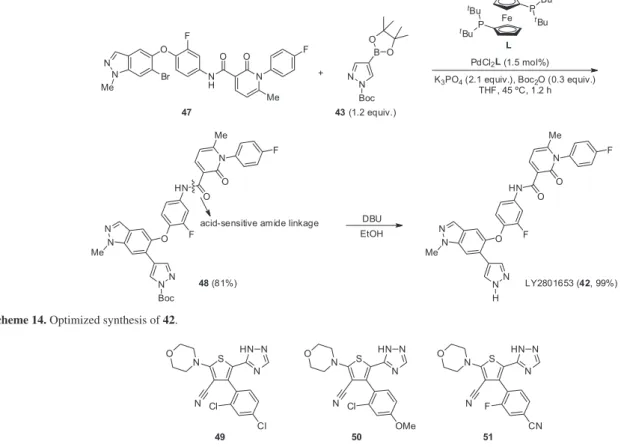
to the synthesis, performing a Suzuki reaction with aryl bromide 47, which is very close to the final product, thus minimizing the manipulation of the Boc-containing product. Removal of this protecting group could then be performed in basic media, which prevented the amide linkage of 48 from being cleaved (Scheme 14).
Tetrasubstituted tiophenes 49-51 were identified by Huang et al. as highly promising candidates for the selective
inhibition of the PI3K receptor, a property that is associated with the treatment of some types of cancer (Figure 2).35
The initial routes to these compounds displayed no cross-coupling reactions, with the benzene rings of 49-51 being introduced in the first step of the synthesis, therefore making a common intermediate impossible. For the scale-up, a synthesis featuring a Suzuki reaction between substituted iodothiophenes 51 and the corresponding arylboronic acids was envisioned (Scheme 15); however, some challenges were anticipated, such as the poor reactivity of iodothiophenes in the coupling step and the sterically
Scheme 12. Optimized Suzuki reaction in the synthesis of 36.
Pd(dba)2(3 mol%) PCy3(6 mol%)
+ N
N N
Me Me
N
O
Cl
O O NH N
B O O
O Me
N
N O
O NH
N O
Me
N N
Me Me
O HO
HO
41
37(1.3 equiv.)
35(83%) K2CO3(2 equiv.)
2-MeTHF/H2O reflux, overnight
Scheme 13. Aiming at 42 by means of a Suzuki reaction.
N N Me
O F NO2
45(60% after reprotection of45) N
N
Boc N
N Boc
B O O
N N Me
O F
N H N
HN O
N F
O Me
44
LY2801653 (42)
N N Me
O
Br F
NO2
43
+
N N Me
O F NO2
46
N N
H
+
Fe P
P
t
Bu
tBu t
Bu
t
Bu
L
Pd2(dba)3(2 mol%) L (4 mol%) K3PO4(aq), dioxane
Scheme 15. Suzuki reaction of iodothiophenes.
Scheme 14. Optimized synthesis of 42.
Fe P
P
t
Bu
tBu t
Bu
t
Bu
L
PdCl2L(1.5 mol%) +
N N Me
O
Br F
N N Boc
B O O
N N Me
O F
NN Boc
N
H N
O O
Me F
HN N
O O Me
F
47 43(1.2 equiv.)
48(81%) LY2801653 (42, 99%)
acid-sensitive amide linkage DBU EtOH
K3PO4(2.1 equiv.), Boc2O (0.3 equiv.) THF, 45 ºC, 1.2 h
N N Me
O F
NN H
HN N
O O Me
F
Figure 2. Examples of PI3K selective inhibitors.
S N
N HN N
O
N Cl
OMe S
N N HN N
O
N Cl
Cl
S N
N HN N
O
N F
CN
49 50 51
demanding nature of 51. The Suzuki cross-coupling reaction indeed proved itself to be difficult; for example, reaction with 51a furnished only low to moderate yields of the desired product after approximately 100 conditions being tested, with large amounts of deiodinated by-products being observed. The authors believe that the poor solubility of 52a impaired the Suzuki reaction, and an additional drawback was the fact that the corresponding cross-coupling product was also poorly soluble, therefore making purification difficult. On the other hand, when the corresponding ethyl ester 52b was investigated, very satisfactory conditions could
S N O
N I
O
OEt
S N O
N O
OEt
R2
R3 Suzuki coupling
arylboronic acid (1.2 equiv.) Pd(t
Bu3P)3(5 mol%) CsF (1.2 equiv.) dioxane/H2O/PhMe
85oC, 12 h
R2= R3= Cl (49, 70%) R2= Cl, R3= OMe (50, 100%) R2= F, R3= CN (51, 90%)
targets
S N O
N O
R1
R2
R3
S N O
N I
O
R1
52aR1= NH 2
52bR1=OEt
be identified after the employment of a high-throughput experimentation methodology, with catalysts [Pd(tBu
3P)4,
Pd(PPh3)4, PdCl2(dppf)], bases (CsF, diisopropylethylamine, K2CO3, K3PO4) and solvents (toluene, dioxane, ethanol,
water) being combined under 200 different conditions. After data analysis, the conditions displayed in Scheme 15 were identified, with the three desired coupling products being obtained in good to excellent yields after purification by crystallization.
Walker et al. developed a large-scale synthesis of
is being currently investigated as possible therapeutic agents for the treatment of type 2 diabetes.36 The target
compound, AMG 837 (53), was obtained in a convergent way by joining Suzuki cross-coupling derived biphenyl 54 with enantiomerically pure β-alkynylcarboxylic acid 55 (Scheme 16).
The first synthetic approach to 53 was based on a Suzuki reaction between aryl bromide 55 and arylboronic acid 56. A catalytic system containing palladium supported on charcoal, sodium carbonate and diisopropylamine/water as solvents was employed (Scheme 17), providing biphenyl 57 in 91% yield. In turn, compound 53 was obtained by borane-mediated reduction of 57 and bromination of the resulting benzylic alcohol.
Further investigation, however, was carried out in order to shorten the preparation of 54 and to avoid the reduction step. Thus, the authors were able to couple economically more attractive aryl chloride 59 with arylboronic acid 60 employing 1 mol% of Pd2(dba)3 as a pre-catalyst and
2.2 mol% of tricyclohexylphosphine as a ligand in a mixture of water and THF, 61 was obtained in an excellent yield of 95% (Scheme 18). Hydroxyl displacement with SOBr2 then furnished biphenyl 54 in an overall yield of 86% starting from the aryl chloride 59.
En route to producing large quantities of Crizotinib (62), a c-Met/anaplastic lymphoma kinase (ALK) inhibitor in advanced clinical tests, De Koning et al. employed a Suzuki
reaction in order to generate an advanced intermediate.37
However, before describing the large-scale synthesis itself, it is worth noting some aspects of the initial medicinal chemistry screening: compounds with the basic structure 63 were obtained through a sequence of protection, palladium-catalyzed borylation, deprotection and Suzuki reactions (Scheme 19) in order to allow for late-stage functionalization with substituted bromopyrazoles.
Then, once crizotinib (and its R isomer) had been
identified as the most promising candidate, the Suzuki cross-coupling was performed in an inverse way: the pyrazol moiety was employed as its boron pinacolate derivative (64, Scheme 20). Even though 64 was obtained in a moderate 40% yield, its Suzuki reaction furnished the desired product in excellent quantities, thus allowing a better use of the valuable chiral intermediate 65.
The large-scale synthesis demanded further modifications: the preparation of multi-kilogram amounts of imidazole 64 presented high levels of dimerization; therefore, the palladium-catalyzed borylation was abandoned in favour of a Knochel-type procedure.38
Scheme 16. Retrosynthetic plan for the final steps of the Walker et al.36 large-scale synthesis of AMG 837 (53).
F3C
O
CO2H Me
F3C
Br HO
CO2H Me
+
+ CF3
R1
R2
R3
R1= B(OH) 2or Cl R2= B(OH)
2or Br R3= CO
2H or CH2OH
AMG 837(53)
54 55
Suzuki coupling
Scheme 18. Optimized preparation of biphenyl 54.
+ CF3
Cl B(OH)2
Pd2(dba)3(1 mol%) PCy3(2.2 mol%) K3PO4, THF/H2O 65oC, 20 h
F3C F3C
Br OH
HO
59 60(1.1 equiv.) 61(95%) 54(90%)
SOBr2 Et3N, PhMe
40oC
Scheme 17. Original Suzuki reaction employed for the synthesis of biphenyl 54.
+ CF3
B(OH)2
CO2H
Br
Pd/C cat. Na2CO3 iPr2NH/H2O
F3C
CO2H
F3C
56 57 58(91%) 54(89%, 2 steps)
1. Reduction 2. Bromination
Scheme 19. Simplified initial route for preparation of compounds 63.
O Me
N N N
NH
NH2
F Cl Cl
O Me
N Br
NH2
F Cl Cl
(Boc)2O, DMAP
O Me
N Br
N(Boc)2
F Cl
Cl (Bpin)2(1.2 equiv.)
PdCl2(dppf) (5 mol%) KOAc (3.4 equiv.)
DMSO, 40oC
O Me
N B
N(Boc)2
F Cl Cl
O O
4 N HCl dioxane
O Me
N B
NH2
F Cl Cl
O O
N N R
Br
Na2CO3(1.2 equiv.) DME/H2O, 87oC O
Me N
NH2
F Cl Cl
N N
R c ompound s f or ini t ial scr eening s
Synt het hic plan fo r initial medicinal chemis try s cr een ing :
(1.2 equiv.) crizotinib (62)
63(~60%) DMF, r.t.
(100%) (97%)
(97%) PdCl2(PPh3)2(5 mol %)
Scheme 20. Modified Suzuki reaction in the synthesis of 62.
N N I
N Boc
(Bpin)2(1.4 equiv.) PdCl2(PPh3)2(5 mol%)
KOAc (4 equiv.) DMSO, 80oC
N N B
N Boc O
O
O Me
N Br
NH2
F Cl Cl
Cs2CO3(3 equiv.) DME/H2O, 90oC, 3 h
65
crizotinib (62, 94% after deprotection)
64(40%)
PdCl2(dppf ) (4 mol%)
The Suzuki cross-coupling was performed in a different solvent system: in order to avoid the undesirable DME, toluene and water were employed together with the phase-transfer catalyst tetrabutylammonium bromide (TBAB). This new procedure allowed the catalyst loading to be reduced to 0.9 mol% with a significant simplification of the purification procedure, once the cross-coupling product was soluble in toluene and hence easily separated from the water layer (Scheme 21).
The β2-adrenoreceptor PF-00610355 (66, Scheme 22),
recently found to be effective in the treatment of respiratory diseases, was synthesized on a large scale by Thomson et al..39 The biaryl moiety of the target compound
was assembled by means of Suzuki cross-coupling, which
delivered 67 in good yield with a very low charge of palladium pre-catalyst (Scheme 22). Interestingly, in this reaction, 3% of the aryl bromide 68 remained unconverted after 2 h of reaction, demanding a second loading of the same initial amount of the pre-catalyst in order to achieve full conversion.
Bowles et al. developed a large-scale preparation of
PF-03052334-02 (69), a pyrazole displaying reduced risk of musculoskeletal side effects in the treatment of coronary diseases (Scheme 23).40 For coupling of the
Therefore, an alternative was found in which 70 was coupled with styrenyl boronic acid 72, delivering the Suzuki product 73 in excellent yield. After that, 73 was submitted to ozonolysis, providing aldehyde 74 in 76% yield. The side chain was then installed by a Wittig reaction, whose product 75, after chemo- and regioselective reductions and deprotections, afforded 69.
Regarding bench-scale processes, Patel and Barret achieved a total synthesis of AT13387 (76), a molecule that is capable of interacting with chaperones that are essential for the survival of cancer cells.41 In their synthesis, the
piperazino-iso-indoline 77 was assembled by a sp3-sp2
Suzuki cross-coupling reaction employing the Molander protocol (Scheme 24).42
Scheme 21. Employment of a different solvent system for the Suzuki reaction en route to 62.
N N
B N
Boc
O O
O Me
N Br
NH2
F Cl Cl
Cs2CO3(3.3 equiv.) TBAB (1 mol%) PhMe/H2O, 70oC, 4.5 h
Cr izotinib (61, 76% after deprotection)
64(1.2 equiv.)
65
+ PdCl2(dppf).CH2Cl2(0.9 mol%)
Scheme 22. Low loading of Pd in a Suzuki reaction for the synthesis of 66.
H N OH
H N
O
OH
BocHN
Br + (HO)2B OH OH
R
R ONa
O
OH +
PdCl2(dppf).CH2Cl2(2 x 0.1 mol%)
Na2CO3(1.5 equiv.) dioxane/H2O, 65-70oC, 2 h
65
66 67(72%)
H2N
BocHN
Scheme 23. A Suzuki reaction followed by ozonolysis for the preparation of 69.
Me
NH
O N N
Me Me
ONa O OH OH
F
N N
Me Me
OTf
F EtO2C
N N
Me Me
F EtO2C
N N
Me Me
F O KBr (0.2 equiv.), K2CO3(3.0 equiv.)
PhMe/H2O/iPrOH (HO)2B
OR O O O
(HO)2B
no reaction
O3,CH2Cl2/MeOH, then ester hydrolysis
and amidation
CO2Et OTBS O Ph3P
O NH
PhMe, 90oC N N
Me Me
F O
NH
O
CO2Et TBSO
PF-03052334-02 (69) Suzuki coupling
70
71
72(1.07 equiv.)
73(91%)
74(51%, 3 steps)
75(95%)
PdCl2(PPh3)2(2.5 mol%)
Scheme 24. Preparation of 76 by means of a Suzuki reaction with activation of a sp3 carbon.
N N
BF3K
Me + NBoc
Br Pd(OAc)XPhos (6 mol%)2(3 mol%)
Cs2CO3(3 equiv.) THF/H2O, 80oC, 24 h
NBoc N
N Me
N N
N
Me O
OH OH Me
Me PCy2
iPr iPr
iPr XPh os
AT13387 (76)
77(72%) (1 equiv.)
Scheme 25. Key steps in the synthesis of 77.
N TfO
H2N Br
Me CO2Me N
MeO
Me EtO2C
O
NPG
N SnMe3
OMe MeO
OMe
CuI (10 mol%), CsF PhMe, 110oC
N
H2N Br
Me CO2Me N
OMe MeO
OMe
K3PO4 dioxane/H2O, 110oC
N
H2N Me
CO2Me N
OMe MeO
OMe
OBn
OMe OMe
(±)-st reptonigr in (77) N
H2N Me
CO2H N
O MeO
O
OH
OMe OMe H2N
Stille coupling
Suzuki coupling
OBn
OMe OMe BO O
A B
C
D
(±)-str ept onigrin (78)
79
80
81(77%)
82(74%)
Pd(PPh3)4(5 mol%)
Pd(PPh3)4(10 mol%) N
MeO
Me EtO2C
O NPG RCM
Donohoe et al. achieved a total synthesis of the
antitumor antibiotic (±)-streptonigrin (78), employing a variety of transition metal-catalysed reactions.43 While
out of the scope of this text, it is worth noting that pentafunctionalized pyridine 79 was obtained by means of a challenging ring-closing metathesis reaction. Then, for constructing the AB-C ring system, the authors expected the triflate moiety of 79 to be more reactive towards Pd(0) oxidative addition in comparison to the bromide, mostly due to the increased reactivity of cross-coupling active substituents at the 2-position of pyridine (Scheme 25).
3. Negishi Reaction
The Negishi reaction is the coupling between an aryl (or vinyl) halide and an organozinc compound.44,45 This coupling
presents a greater tolerance towards sensitive groups like esters or amides when compared to organomagnesium or organolithium-based reactions; moreover, the enhanced reactivity of organozinc compounds allows this reaction to be performed at or even below room temperature, while boron or tin coupling partners demand harsher conditions. In 2013, a Negishi coupling was employed as one of the key steps in a new synthetic approach to BMS-599793 (84), an HIV entry inhibitor licensed from Bristol-Myers Squibb (BMS) by the International Partnership for Microbicides aiming towards its further development as a topical microbicide candidate for use in underdeveloped countries.46 While the original medicinal chemistry route
employed a Stille coupling as the last step of the sequence, this new synthetic approach anticipates the metal-catalyzed C-C bond forming reaction using a Negishi coupling as the first step, which eliminated the inconvenience of high levels of toxic tin residues previously observed in the final product. The coupling between diarylzinc reagent 85 and azaindol 86 led to adduct 87, obtained in 41 to 59% yield for several batches of 400 g each. A single experiment carried out at a 1.5 kg scale afforded 87 in 54% yield and 99.6% HPLC purity (Scheme 26).
Acylation of the adduct’s azaindole moiety with methyl chlorooxalate followed by ester hydrolysis and amidation afforded the final product which, however, still exhibited a high residual content of palladium (16 ppm) and zinc (100 ppm), requiring additional purification steps. At the end of the synthetic sequence, product treatment
with activated charcoal followed by several washes, a precipitation step and polymorphic conversions led to the final active pharmaceutical ingredient (API) with Pd and Zn contents of only 1 ppm each.
A Negishi reaction was also used in a multi-gram synthesis of compound 88, a CHRT2 receptor antagonist with good pharmacological profile that was previously identified by Roche.47 Since it is believed that CHTR2
plays a pro-inflammatory role in allergic processes, its antagonists are viewed as potential new drugs for the treatment of asthma, allergic rhinitis, chronic obstructive pulmonary disease (COPD) and atopic dermatitis, among other diseases. En route to 88, the Negishi coupling between benzylzinc reagent 89 and aryl triflate 90 represented a major challenge. According to the previously developed medicinal chemistry synthetic route, the arylzinc preparation required a highly exothermic zinc activation process and the subsequent coupling step employed very high catalyst loadings, both of which are serious drawbacks for the scaling-up of the synthesis (Scheme 27).
During the process development, a traditional zinc activation approach was found to be effective, and by using trimethylchlorosilane in DMF, 237 g of zinc dust could be activated with only a 5 °C temperature increase over a 30 min period.
Regarding the proper Negishi coupling step, in a first moment, the authors were able to perform a 20-fold reduction in both palladium and phosphine quantities; however, the high cost of SPhos ligand was still prohibitive for large-scale production, even at 1 mol% loading. Fortunately, the inexpensive PdCl2(PPh3)2 complex was
equally effective when employed as the sole catalyst at 0.5 mol% loading. Due to safety reasons associated with transferring a high reactive zinc reagent, the coupling reaction was performed at the same pot of zincate formation by the sequential addition of the Pd source and aryl triflate followed by heating to 60-65 °C, which initiated the reaction. Without further heating, a temperature increase of up to 30 °C in a 10 min period was observed for batches involving 500 g of trifate 90, which should be bypassed
P Ph
Ph N
N
Ph Ph
83
Figure 3. Chiral ligand employed for the asymmetric Suzuki reaction
of 81.
Scheme 26. Synthesis of 84 with a Negishi coupling as key step.
N
N I
i)nBuMgCl (1 equiv.), THF
PdCl2(dppf).CH2Cl2(10 mol%) ii) ZnCl2(0.5 equiv.), THF
Zn N
N N
N
85(1.5 equiv.)
N N
H +
OMe
Cl
THF, 58oC, 8 h
N N
H OMe
N
N 87(60%)
N N
H O
N N
Me O N
O NC
Scheme 27. Synthesis of 88 with low loadings of Pd in a Negishi coupling. F
OTf Me
CO2tBu
SO2Me
Pr ocess c onditions PdCl2(PPh3)2(0.5 mol%)
89(1.4 equiv.)
DMF, 65-85oC, 2.5 h crystallization
F Me
CO2tBu SO2Me
ZnCl
HCl
AcOH
SO2Me
F Me
CO2H Pd: 6 ppm Zn: 20 ppm Initial MedChem co nditions
Pd(OAc) (10 mol%) SPhos (20 mol%) cromatography, 98% yield
+ SO2Me
Cl
Zn, TMSCl DMF
91(95%)
90 88(95%)
PCy3
MeO OMe
SPhos
Scheme 28. Optimal Sonogashira conditions for the synthesis of 92.
O I
CO2Me
+ OH
(PPh3)2PdCl2(5 mol%) CuI (10 mol%) Et3N (4 equiv.) DMF, 25oC, 5 h
94(2 equiv.)
Pd(OAc)2(10 mol%) P(o-tol)3(25 mol%) piperidine (7 equiv.) HCO2H (1,1 equiv.) DMF, 92oC, 3 h
O
CO2Me OH O
CO2Me OH
95(94%) Br Br
96(80%)
O
CO2H NMe2 HCl
olopatadine hydr ochloride (92)
93
for further scale-up. Filtration of the reaction crude trough Celite and treatment with N-acetyl-L-cysteine followed by
crystallization afforded the coupling product 91 in 95% yield and > 99% HPLC purity. The final hydrolysis step afforded the desired API, which displayed well-controlled levels of residual palladium and zinc (6 and 20 ppm, respectively).
4. Sonogashira Reactions
The construction of a new bond between sp2- and
sp-hybridized carbons is known as the Sonogashira reaction,48
and it is nowadays a widely employed methodology for the construction of arylacetylenes.3,49,50 For example, a
Sonogashira coupling was employed by the research and development group of Kyowa Hakko Kirin in a new and concise synthetic route for olopatadine hydrochloride (92), a commercial anti-allergic drug that was previously developed by the same company.51
The reported synthesis goes through the Sonogashira reaction between the easy accessible aryl halide 93 and alkyne 94 leading to adduct 95 in 94% yield. This adduct is
then subjected to a second metal-catalyzed transformation, a stereospecific palladium-catalyzed intramolecular cyclization, whose optimum conditions were identified based on an elegant and comprehensive Design of Experiments (DoE) investigation to provide 96 (Scheme 28).
Elaboration of the cyclization product 96 through aminomethylation and ester hydrolysis followed by acid work-up completes the synthesis of the final target. Although the presented synthetic route is very promising and concise, providing olopatadine hydrochloride in 54% overall yield for 6 steps from commercially available materials, it has so far been reported only on a laboratory scale (5 g for the Sonogashira coupling and 200 mg for the cyclization step).
In 2012, in order to obtain necessary quantities for preclinical and phase 1 clinical studies, investigators at Wyeth Research reported the process implementation for the multi-kilogram preparation of GRN-529 (97), a highly selective mGluR5 negative allosteric modulator that was previously identified by the same company.52 The authors
good yield observed for this transformation, the conditions originally employed were not amenable for the scale-up of the reaction, requiring high loadings of metallic catalysts and drastic reaction conditions, as well as chromatographic purification of the product. During the developmental work, process friendly conditions were identified for the effective coupling between aryl halide 98 and alkyne 99, resulting in at least 10-fold reduction of metal catalyst loadings and considerably lower reaction temperatures (Scheme 29).
A purification process involving the treatment of the crude reaction with an aqueous cysteine and ammonia solution followed by crystallization of the product afforded the coupling adduct 100 with high purity, acceptable levels of residual palladium and copper, and an even higher yield (86%). Elaboration of the coupling product 100 through ester hydrolysis followed by amidation furnished the final API, which was further purified via crystallization, leading to even lower residual levels of palladium and copper (< 1 and 15 ppm, respectively). This process was successfully employed in the preparation of 5.5 kg of 97.
Process chemistry researchers from Merck recently employed Heck and Sonogashira reactions in the multi-gram preparation of the macrocyclic compound MK-1220 (101),53 a potent hepatitis C virus (HCV) protease inhibitor
with good therapeutic profile which has been evaluated as a potential new drug for the treatment of hepatitis C.54
As an early synthetic step, a Heck reaction was used to introduce the nitrogen and two carbon atoms of the isoquinoline moiety present in the final target. The presence of a bulky substituent in the olefin 102 allowed the achievement of a 90:10 regioselectivity favouring the arylation of the terminal carbon, leading to adduct 103 in 76% isolated yield (Scheme 30).
A Sonogashira reaction was employed at a later stage of the synthesis, allowing the coupling of the advanced fragments 104 and 105 in 90% yield. The reaction
conditions for this coupling were chosen based on a high throughput screening (HTS) study, which evaluated, among other factors, the use of 12 distinct ligands. Among them, only PtBu
3.HBF4 led to a clean reaction and satisfactory
conversion. The triple bond reduction of the coupling adduct 106 with concomitant removal of carboxybenzyl (CBz) protecting group led directly to the substrate for the key macrocyclization step (107). The side chain installation in 107 completed the total synthesis of MK-1220. According to the authors, this synthetic sequence could be successfully scaled-up to produce kilograms of the final API.
The Sonogashira reaction has also recently been used in the synthesis of Filibuvir (108), a potential drug for hepatitis C treatment, which acts as an inhibitor of RNA polymerase and has been evaluated by clinical and toxicological studies.55
The coupling between the alkyne 109 and aryl bromide 110 (Scheme 31), employed to introduce the pyridine moiety present in the final target, required the careful exclusion of oxygen from the reaction medium and addition of the palladium source prior to the copper catalyst, taking special care to avoid the formation of by-products through the oxidative coupling of the alkyne coupling partner (Scheme 31).
The coupling adduct 111 was then subjected to an acylation reaction followed by reduction of the triple bond to afford 112. One of the drawbacks initially observed in this sequence was the high catalyst loading required for the hydrogenation step, which was attributed to poisoning of the metallic catalyst by residues of copper and phosphine derived from the initial Sonogashira coupling. Thus, previous purification of the acylated coupling product by washes with aqueous ethylenediaminetetraacetic acid (EDTA) followed by filtration through activated charcoal was necessary. This sequence of reactions was carried out on a pilot scale, producing 11.95 kg of the advanced intermediate 112.
Scheme 29. Sonogashira cross-coupling with alkynyl pyridine 99.
OMe O I
O
F F
N +
PdCl2(PPh3)2(1 mol%) CuI (2 mol%) NH4OH (4 equiv.) NMP, 35-40oC, 1 h
OMe O
O
F F
N Init ial Med Chem c onditions
157(1.5 equiv.), PdCl2(PPh3)2(20 mol%)
CuI (20 mol%) Et3N (2 equiv.) PhMe, 100oC, 6 h chromatography, 80% yield
Scale-up co nditions 100(86% yield,
98.5% purity)
Pd: 25 ppm Cu: 182 ppm af ter washes and a single crystallization
N O
O
F F
N
N
GRN-529 (97)
Scheme 30. Heck reaction as a tool for assembling the isoquinoline ring of 101. I
Br MeO
CO2Me
N O
O
Pd(OAc)2(1 mol%) Et3N (3 equiv.) 2-MeTHF, reflux, 16 h
102(1.07 equiv.) N
O
O OMe
O MeO
Br
103(76%)
N.HCl
O MeO
Br
N CO2Bn
CO2Et N
MeO
Br
Cl
[(allyl)PdCl]2(1.7 mol%) PtBu
3.HBF4(6.9 mol%)
iPr
2NH (5.6 equiv.) MeCN, 50oC, 1h
CO2H H N
O O Me
Me
N.HCl
O MeO
N CO2Bn
CO2Et
H N
O O Me
Me
N.HCl
O MeO
N CO2H
O H
N
O O Me
Me
N.HCl
O MeO
N
O HN
O O
N H
S O
O
101
CO2H H N
O O Me
Me
105(1.4 equiv.)
104
106(90%)
107
Scheme 31. Sonogashira reaction between bromide 110 and advanced alkyne 109.
N O
O O
Bn
+
N Br
Et Et
TsOH
PdCl2(Ph3P)2(1 mol%) CuI (1 mol%)
Et3N (3 equiv.) PhMe, 45oC, 5 h
110(1.02 equiv.)
HO N
O
O O
Bn HO
N Et
Et
i) MsOH, Ac2O, PhMe aq. Na2CO3workup ii) H2, Pd/C (10 mol%) iii) TsOH, MeOH/THF
N O
O O
Bn AcO
N Et
Et TsOH
N Et
Et
112(59%, 3 steps)
O O
O N
N N
N Me
Me H
108
O O
Cl + TMS
i) PdCl2(Ph3P)2(0.3 mol%) CuI (1 mol%), Et3N (2 equiv.) PhMe, 35oC, 4 h (83%)
(1.54 equiv.) ii)iPr2NEt, MeOH/PhMe (89%)
109 111
113 114
It should be mentioned that alkyne 109 is prepared by an aldol addition to the ketone 113 which, in turn, may also be prepared through a Sonogashira-type reaction involving the acid chloride 114 followed by desilylation. Although the authors present alternative and possibly more suitable synthetic routes for the preparation of this alkynyl ketone, the procedure based on the coupling between 109 and 110 could be successfully employed in the preparation of 100 kg of this material.
5. Stille Cross-Coupling
The coupling between an organic electrophile and an organotin compound is known as the Stille reaction.56 It
system based on Pd2(dba)3.CH3Cl and Ph3As provided
cyclic advanced intermediate 116 with 72% yield. However, it must be mentioned that 60 mol% of palladium was employed in the reaction. The Stille coupling was chosen instead of a Suzuki reaction for this macrocyclization due to the fact that hydroboration of the alkyne intermediate 117 proved difficult to generate the Suzuki partner while the hydrostannylation afforded the intermediate stannane 118 with 75% yield. This result was attributed to the high functional group tolerance of the hydrostannylation in comparison with hydroboration.
In 2013, the total synthesis of the HIV-1 integrase inhibitor 119 was described in a nine step route (Scheme 33).58 The authors employed the
bromopyridine 120 as starting material and the target compound was obtained with 18% overall yield. In the insertion of a side chain in the pyridinone central ring, the Stille cross-coupling of a vinyl stannane was applied and led to the product 121 with 83% yield after 1 h of reaction in DMF. A large amount (10 mol%) of the pre-catalyst PdCl2(PPh3)2 in combination with a 20% excess
of the tin reagent was necessary to provide high yields. It must be mentioned that the iodinated substrate was also applied in the cross-coupling; however, according
to the authors, the bromo derivative was preferred due to a simpler chromatographic purification.
6. Kumada Cross-Coupling
The coupling of organomagnesium compounds and organic electrophiles is known as the Kumada reaction and is normally catalyzed by palladium or nickel complexes.59
ST1535 (122) is a highly selective adenosine A2A receptor
ligand antagonist with good pharmacological properties, which might be considered a potential new drug for the treatment of Parkinson’s disease.60 Previous approaches
for its synthesis explored Stille or Suzuki couplings for the installation of the alkyl side chain present in the final target.61,62 Despite the good yields observed, both
approaches suffered from major drawbacks such as drastic reaction conditions, low turnover number and frequency for the palladium catalysts employed, the need to prepare organoboron or tin reagents and the toxicity of starting materials and by-products in the special case of Stille reaction.
In this context, in 2014, the authors described a new approach exploring the Kumada coupling of a Grignard reagent, one of the cheapest organometallic
Scheme 32. Intramolecular Stille reaction to provide macrocycle 116.
MeO
Me
Me Me
O
O Me
Me N H
O H
N
O H
HO Me
OMe Me
115
Intramolecular Stille cross-coupling
MeO
Me
Me Me
O
O Me
Me
N H O
H N
O H
TBSO Me
Bu3Sn Me
OMe I
Pd2(dba)3.CHCl3(30 mol%) Ph3As (1.28 equiv.) iPr
2NEt (20.8 equiv.)
DMF, 23oC
MeO
Me
Me Me
O
O Me
Me Me
OMe Me
R
R =
R
116
Me N H O Me
HO
Me TBSO
H N
O H
X
Me N H O Me
HO
Me TBSO
H N
O H
R2B
Me N H O Me
HO
Me TBSO
H N
O H
Bu3Sn
Bu3SnH, PdCl2(dppf ), THF, 25oC
(R2= 9-BBN, pinacol, catechol)
117
Scheme 33. Total synthesis of the HIV-1 integrase inhibitor 119 using a Stille reaction to append the carbonylated side-chain to the central pyridine ring.
N OMe
Br
HN O
F
F
HN O
F
F
N O
F
F F
Br
N O
F
F F
Br
N O
F
F F
Br Bu3Sn
EtO
(1.2 equiv.) 1.
2. HCl 1M
O
CH3 N
O
F
F
F OH O
O H N N
O N
O
F
F
F OH O
O H N N
O
Stille cross-coupling
119
121(83%)
120
PdCl2(PPh3)2(10 mol%) DMF, 70oC, 1 h
119(18% overall yield, 9 steps)
Scheme 34. Example of an iron-catalyzed Kumada reaction in the synthesis of 122.
N
N N
N
Me Cl
+ M
M=MgCl (1.18 equiv.)
Fe(acac)3(10 mol%)
NMP/THF 6:1 r.t., 1 h
N
N N
N
Me
NBn2 NBn2
N
N N
N
Me NH2
N
ST1535 (122) Previous reported methods:
A) M: SnBu3, Pd(PPh3)4(20 mol%), NMP, 120oC, 48 h, 79% yield B) M: BBu2, PdCl2(dppf) (6 mol%), CsCO3(3 equiv.), THF, 60oC, 16 h, 85% yield
123(91%)
N N
reagents available, catalyzed by Fe(acac)3, where acac = acetylacetonate, which is also a low-cost and easily removable catalyst. Besides the advantages regarding the cost of reagents and catalysts, the new procedure also generates less waste, due to the intrinsic higher atom-economy and also by not requiring an excess base, as seen for the Suzuki coupling approach. This procedure was successfully employed in the preparation of 38.5 g of 123, which could be converted to 122 through bromination and bromine displacement with triazole followed by benzyl protecting group removal, as previously described in the literature (Scheme 34).
7. Heck Reactions
The palladium-catalyzed olefination of a sp2 or
benzylic carbon attached to a (pseudo)halogen is known as the Heck reaction.2,63 It is a powerful tool, mainly
used for the synthesis of vinylarenes, and it has also been employed for the construction of conjugated double bonds. The widespread application of this reaction can be illustrated by numerous examples in both academia small-scale64 and industrial syntheses.5 As an example, in
2011, a idebenone (124) total synthesis based on a Heck reaction was described (Scheme 35).65 This compound,
initially designed for the treatment of Alzheimer’s and Parkinson’s diseases, presented a plethora of other interesting activities, such as free radical scavenging and action against some muscular illnesses. The key step in the synthesis was the coupling of 2-bromo-3,4,5-trimethoxy-1-methylbenzene (125) with dec-9-en-1-ol affording products 126. Under non-optimized conditions (Pd(OAc)2, PPh3, Et3N, 120 °C), a mixture composed of 60% linear
olefins 126 and 15% of the undesired branched product 127 was obtained after three days of reaction. Therefore, the conditions were optimized, allowing the preparation of 126 in 67% yield with no detection of 127 after only 30 min of reaction employing DMF, Pd(PPh3)4, iPr
2NEt
under microwave heating. To conclude the synthesis, the Heck adducts were submitted to hydroxyl protection/ deprotection, hydrogenation, and ring oxidation. After these reactions, idebenone was obtained with 20% overall yield over 6 steps.
inhibitor, as shown in Scheme 36.66 Benzoic acid 88 was
used as starting material in order to obtain the triflate 130. This intermediate and the 1-tridecene were employed as coupling partners in the Heck reaction to obtain 131. The system used was based on PdCl2(dppf) and K2CO3, affording the coupling product in 78% yield after 12 h with 3.2 mol% of palladium. An alternative pathway to link the alkyl and aryl fragments was also tested: the coupling was performed in the presence of 9-borabicyclo(3,3,1)-nonane (9-BBN) to generate an alkylborane in situ from
olefin 132 and achieve Suzuki coupling. However, this methodology was not productive. Once the Heck reaction was performed, 128 was obtained with 34% overall yield after the reduction of the double bond and the hydrolysis of the acetal protecting group.
An intramolecular Heck-based cyclization was used as a key step for commendable synthesis of the antihistaminic drug olopatadine (133) and its trans isomer (134).67 Besides
the Heck reaction, another vital step in this route was a stereoselective Wittig olefination using a non-stabilized phosphorus ylide that afforded the olefins 135 and 136 (E:Z ratio = 9:1 for 135, for instance). Concerning the
Heck reaction, Pd(OAc)2, K2CO3, and NBu4Cl (TBAC)
were allowed to react with 135 and 136 at 60 °C during 24 h, providing the cyclic adducts 137 and 138 with reasonable 60% and 55% yields, respectively. However, it is important to note that in catalytic terms, the results were not encouraging, considering that 20 mol% of palladium was used and a disappointing turnover number (TON) of 3 was observed (Scheme 37).
Scheme 35. Synthesis of idebenone (124) based on Heck reaction of 2-bromo-3,4,5-trimethoxy-1-methylbenzene with dec-9-en-1-ol under microwave
irradiation.
Heck Reaction
Me Br
OMe OMe MeO
OH 7
a) non-optimized conditions: Pd(OAc)2,Et3N, PPh3120oC, 3 days
Me
OMe OMe MeO
OH
Me
OMe OMe MeO
OH
Me
OMe OMe MeO
OH +
a or b
a) 60% combined yield of productive isomers126
b) 67% combined yield of productive isomers126 125
126a
126b
127
126
Me
OMe OMe MeO
O 9
O idebenone (124, 20% overall
yield over 6 steps) 7
[Pd] 2.5 mol%
124
b) optimized conditions: Pd(PPh3)4,iPr2NEt, DMF, MW
120oC, 30 min (1.64 equiv.)
OH Me
O O
MeO OMe
OH Me
O O
MeO OMe
Scheme 36. Synthesis of the ginkgolic acid based on the Heck reaction of aryl triflate 130.
OH O
OH
Heck Reaction
OH
OH OH
O
O O
OTf
O
Me Me
PdCl2(dppf ) (3.2 mol%) 10
DMF, K2CO3(1.1 equiv.) 75oC, 12h
O O
O
Me Me
10
129 130 131(78%)
131
OH O
OH 1. Pd/C, H2, EtOAc, 98%
2. KOH, DMSO, 90% gin kgolic acid (128,
34% from129)
128
Scheme 37. Heck reaction in synthesis of olopatadine (133) and trans-olopatadine (134).
O
I
N Me Me
CO2Me
Pd(OAc)2, TBAC
O
N Me
Me
CO2Me
O
N Me
Me
CO2Me H
IPd H
O
N Me
Me
CO2Me H
H IPd
EtOH/H2O
O
N Me
Me CO2H
O
CO2Me
I
N Me Me
O
CO2Me
N Me
Me
O
N
Me Me
CO2Me H
H PdI
O
H
CO2Me H
IPd N
Me Me
sy n insertion
O
CO2H
t r ans-olopatadine (134) NaOH
135 137
136 138
sy n
β-elimination K2CO3,MeCN/H2O
60oC, 24h
sy n insertion
N Me
Me Pd(OAc)2, TBAC
K2CO3,MeCN/H2O
60oC, 24 h EtOH/H2O
NaOH
sy n
β-elimination
olopatadine (133)
In relation to the stereochemistry of the Heck products, the above results were not surprising since they were consistent with a syn-insertion of the arylpalladium
intermediate (provided by oxidative addition step) at the olefinic moiety followed by a synβ-elimination that afforded the product with the ascribed stereochemistry. Finally, with the cyclic products in hands, the syntheses were completed by alkaline hydrolysis of methyl esters that afforded the target olapatadine and trans-olapatadine.
Two Heck-based strategies were applied in the synthesis of caffeine-styryl compounds (139) with dual A2A antagonist/MAO-B inhibition properties and potential
application in Parkinson’s disease (Scheme 38).68 In the first
approach, the bromide 140 was submitted to a Suzuki cross-coupling with vinylboronic acid pinacol ester affording the vinyl-caffeine intermediate 141 in 67% yield. This intermediate was used as substrate in the Heck reaction with various aryl bromides in a system composed of Pd(OAc)2,
P(o-tol)3, Et3N and DMF. Accordingly, the caffeine-styryl
analogues 139 were obtained with yields ranging from 30 to 84% in 2 h of reaction at 80 °C, with 10 mol% of palladium. In the second approach, the organic bromide 140 was used directly under Heck conditions in combination with styrene derivatives, DMF, NBu4Br (TBAB) and Pd(OAc)2. With
this strategy, the target compounds 139 obtained with 20 to 86% yield in 20 h of reaction with 5 mol% of catalytic precursor. In terms of biological activities, the compound that exhibited the best results was 142, the structure of which is shown at the bottom of Scheme 38.
A facile synthesis of styryl analogues of piperidine alkaloids was developed recently using N-Boc-piperidine
as starting material (Scheme 39).69 These alkaloids,
including the (+)-caulophyllumine B (143), display high anti-cancer activity in vitro.69 The first step of the synthesis
was an enantioselective vinylation of the starting material affording the intermediate 144 that was used as substrate for Heck reactions with aryl iodides. In order to perform this Heck reaction, palladium acetate (5 mol%) was used as a pre-catalyst, in combination with an N-heterocyclic
carbene (NHC) precursor and the phase transfer reagent TBAB. Under these conditions, styryl-piperidine adducts 145 were produced in excellent yields (88-93%). Finally, the target structures 146 were obtained by the reductive removal of the Boc protective group of compounds 145. Compound 143 could be prepared after methylation of the appropriate precursor 146.