Microbiological Analyses of
MmZuccius
merluccius hubbsi
(Marini, 1933) Fillets Treated
with Co-60 Ionizing Radiation1
E.
VALDBS~ &D.
SZEINFELD~Fillets
of
I* hake, Merluccius merluccius hubbsi, were exposed to 2 kGy, 6 kGy, and 10 kGyof
ionizing radiation from a Cobalt 60 source and were subsequently stored frozen at 0°C. Both these irradiated samples and control samples were examined to determine their bacterial counts and organoleptic qualities (texture, elasticity, odor, color, and drip loss) for a periodof seven
weeks following the irradiation. The irradiated fillets showed an initial marked decrease in the total number of bacteria-amounting to roughlyone
orderof
magnitude for those exposed to 2 kGy and roughly three orders of magnitudefor
those exposed to 6 kGy and 10 kGy as compared to the controls. The samples irradiated with 6 and 10 kGy had bacterial counts well below the minimum acceptable levelof
0.8 x 10⁶ bacteria pergram
for
the entire seven-week study period. Regarding organoleptic quality, the fillets ex- posed to 2 kGy and 6 kGy were found to retain acceptable qualitiesfor an average of
about six weeks, somewhat longer than the controls and other irradiated samples. Considering both bacterial counts and organoleptic qualities, themost
effectiveof
the three radiation doses employed was 6 kGy.I
rradiation can be used to considerably prolong the storage life of certain foods, both at room temperature and un- der refrigeration, if appropriate packag- ing is used that prevents the foods from becoming contaminated (Z-3).In 1896, one year after Roentgen dis- covered the X ray and the same year that Becquerel discovered radioactivity, a work was published with the title “Study of the Effect of Roentgen Rays on Bacteria and the Possibility of their Eventual Use” (4).
Nevertheless, the work initially under- taken in this field proceeded slowly, be-
‘This article has been published in Spanish in the BoZetin de la Ojicina Sanitaria Panamericana, Vol. 106, No. 1,1989, pp. 41-47.
%ea Fisheries Research Institute, Private Bag X2, Rogge Bay 8012, Cape Town, South Africa.
3Research Institute for Medical Biophysics, Tyger- berg, South Africa.
cause only low-intensity emitters were available. It was not until the mid-1940s that sources of radiation became available that had the intensity and energy needed for preserving foods. Since then, a consi- derable bibliography has accumulated on food irradiation (5-6).
In 1980, a mixed WHOIFAOIIAEA committee of experts declared that con- sumption of foods irradiated with an average of 10 kilograys (kGy) was not dangerous (7).
The aim of the work reported here, per- formed in mid-1981, was to determine how much bacterial decay might be re- duced by exposing fillets of a hake
(Merluccius merluccius hubbsi) packed and frozen at -18°C to Cobalt 60 ionizing ra- diation if the fish were subsequently stored frozen at 0°C. Counts of the total bacteria, total coliforms, and fecal coli- forms present were made for both the
control and irradiated samples, and vari- ice was still present, thereby confirming ous organoleptic qualities of the samples that isothermic conditions had been were assessed. maintained.
MATERIALS AND METHODS
Methodologic and economic criteria were applied in choosing the fish (8). That is, a low-fat species was chosen so as to minimize organoleptic changes in the fillets that would result from oxida- tion of lipids; and the species selected was also one of commercial importance.
Fillets of Merluccius merluccius hubbsi were provided by the A.C.E.R. fishing company of Uruguay. The area of capture was along the fortieth parallel of the Uru- guayan Maritime Front. After capture, the fish were stored for 40 days in a re- frigeration chamber at -18°C. Those destined for irradiation were then packed in bags of 30-micron polyethylene that had been presterilized with a dose of 54 kGy.
The radiation device used was a Gama- cell 4000 type belonging to the Nuclear Research Center of the University of Uru- guay (Centro de Investigaciones Nu- cleares, Universidad de la Repdblica, Uruguay). This device, which has a cylin- drical chamber 14 cm in diameter and 20 cm tall, employs an electromechanical system and an elevator to provide the op- erator with access through the top of the unit. The sample-holder weighs 800 kg. Irradiation is provided by 48 Cobalt 60 rods laid out in a cylindrical pattern, and these in turn are surrounded by four tons of lead shielding.
In order to irradiate samples under iso- thermic conditions at -78.5”C, we used thermal insulation consisting of 2 cm polystyrene foam shaped to the maxi- mum dimensions allowed by the irradia- tion chamber. The samples were placed inside this insulation and were sur- rounded by pieces of dry ice. After irradi- ation, it was verified that part of the dry
The radiation doses used were 2 kGy, 6 kGy, and 10 kGy. Since the radiation dose was constant (0.8 kGy per hour), the exposure times of different samples varied. Control samples were subjected to -78.5”C for the length of time that the samples receiving the highest dose were irradiated. The storage temperature after irradiation for both the control and irradi- ated samples was O”C, the samples being kept in a frozen state,
Microbiologic analyses of the irradiated and control samples were performed at the Fish Research Institute (School of Vet- erinary Medicine) and the Institute of Hygiene (Medical School) of the Univer- sity of Uruguay.
To estimate the total bacteria present, total plate counts were made using Aero- bic Plate Count Agar (D&o), the pour plate method, and a surface count, with the plates being incubated at 25°C for 72 hours (9). These counts were made in triplicate at the end of the first seven weeks following irradiation.
To estimate total coliforms, the tech- nique of counting dilutions to determine the most probable number (MPN) was used. The bacteria were grown on Bril- liant Green Lactose Broth with 2% bile (D&o) and were incubated for 48 hours at 37°C (10).
To estimate fecal coliforms, we used the McKenzie, Taylor, and Gilbert technique, growing the coliforms on Brilliant Green Lactose Broth with 2% bile (Difco) and Tryptone Broth (Difco) incubated at 445°C for 48 hours (10). Both total coli- form and fecal coliform counts were made in triplicate at one week following irradiation.
Organoleptic analyses were performed on the raw control and irradiated fillets by a panel at Uruguay University’s Nu- clear Research Center in Montevideo.
The organoleptic qualities assessed were texture, elasticity, odor, drip loss, and color. This examination employed a scale from zero to five as described elsewhere (II), the score for the best organoleptic state being five and for the greatest spoil- age being zero. Average values for the analyses, which were done in quintupli- cate, were graphed as a function of time (weeks of study), considering two to be the lowest score of samples still fit to eat.
RESULTS AND DISCUSSION
Bacterial Counts
The total bacterial counts found for the control and irradiated samples indicated that the bacterial populations in the irra- diated samples had been markedly re- duced. The average apparent reduction was greatest in the samples receiving the higher doses of radiation.
As shown in Table 1, one week after irradiation the average apparent reduc- tion was around one order of magnitude in the samples irradiated with 2 kGy and roughly three orders of magnitude in the samples irradiated with 6 kGy and 10 kGy.
The limit value in fish flesh otherwise fit for consumption is considered to be 0.8 x lo6 bacteria per gram. Quantities of bacteria greater than this are felt to have a critical impact upon freshness.
By the third week the control fillets had developed over lo6 bacteria per gram, and by the fourth week this number had increased another order of magnitude. Further microbiologic analyses were not performed, since the fillets had clearly become unfit for consumption.
Samples irradiated with 2 kGy devel- oped roughly lo6 bacteria per gram dur- ing the seventh week following irradia- tion. Samples irradiated with 6 kGy and 10 kGy had less than lo6 bacteria per gram throughout the seven weeks of the study period.
As Figure 1 shows, the control samples and those irradiated with 2 kGy showed stasis or fairly steady growth of bacterial counts during the study period, while those irradiated with 6 kGy and 10 kGy showed fluctuations in these counts. These observations appear reasonable, since bacterial growth after irradiation is affected by many circumstances- creation of mutant bacteria with differen- tial growth rates among those that sur- vive the irradiation process and factors influencing competitiveness when cer- tain numbers and types of bacteria disap- pear (factors including upsets in biologic equilibria when certain types of associa- tions are interrupted as well as modifica- tion of prevailing antagonistic and symbi- otic relationships--12, 23).
The Merluccius merluccius hubbsi fillets irradiated with 2 kGy showed a conside-
Table 1. Average counts of total bacteria per gram in control and irradiated samples
during the seven weeks following irradiation.
Time
(weeks Average no. of bacteria per gram of sample
following Control Samples irradiated with:
irradiation) samples 2 kGy 6 kGy 10 kGy
1 3.2 x 10⁵ 1.6 x 10“ 8.5 x lo2 8.5 x 10²
2 6.0 x lo5 7.4 x 10⁴ 8.5 x 10⁴ 9.4 x 10⁴
3 3.3 x 10⁶ 2.9 x 10⁴ 1.1 x 10³ 4.5 x 10’
4 3.0 x 10⁷ 1.6 x 10“ 2.1 x 10³ 1.6 x 10’
5 >lO’ 2.3 x lo4 9.6 x lo4 3.5 x 10⁴
6 4.3 x 10⁵ 1.2 x 10⁴ 2.0 x 10³
7 1.5 x 10⁶ 6.5 x 10“ 1.0 x 10⁴
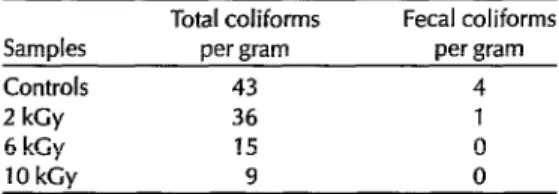
Figure 1. Average counts of total bacteria per Table 2. Total coliforms and fecal coliforms per gram in controls and in samples irradiated with gram in controls and in irradiated samples one 2 kGy, 6 kGy, and IO kGy at one to seven weeks week after irradiation with 2 kGy, 6 kGy, and 10
after irradiation. kGy.
Weeks after irradiation Levels of irradiation:
H Controls - 2kGy o--o 6kGy m-n 10 kGy
rable initial drop in the total number of bacteria relative to the controls. How- ever, since the competitive relationships among the microorganisms present were not fundamentally altered (14), the bacte- rial population tended to maintain itself and then increase steadily over time.
In contrast, 6 kGy and 10 kGy doses have been found to affect the relation- ships among bacteria by eliminating cer- tain types. This accounts for the apparent lack of steady microbial growth after irra- diation, and for fluctuations in the bacte- rial counts obtained (E-18).
Regarding coliform bacteria, counts in the range of 50 to 100 bacteria per gram are low enough to ensure good control of hygienic conditions during production and marketing. Studies of total coliforms and fecal coliforms were performed at one week after irradiation in order to as- sess relationships between these bacterial populations and the doses of irradiation applied (19). Table 2 shows the results ob- tained. Doses of 6 and 10 kGy are lethal for Escherichiu coli and most other entero-
Total coliforms Fecal coliforms
Samples per gram per gram
Controls 43 4
2 kGy 36 1
6 key 15 0
10 kCiy 9 0
bacterial populations (7); hence, it seems reasonable that no fecal coliforms were found in the samples irradiated with these doses.
Organoleptic Qualities
The results of the organoleptic analyses are shown in Figure 2. The control fillets fell below the acceptable values for elas- ticity and texture in the fifth and sixth
weeks, respectively, and fell below the acceptable values for odor, drip loss, and color between the sixth and seventh weeks.
The fillets irradiated with 2 kGy fell be- low the acceptable values for elasticity and texture around week seven, but ex- ceeded acceptable limits for odor and drip loss somewhat earlier (between weeks six and seven). These fillets re- tained acceptable color values through- out the study period.
The fillets irradiated with 6 kGy fell be- low acceptable values for elasticity and color between weeks six and seven but retained acceptable odor and drip loss scores until week seven and maintained an acceptable texture throughout the study period.
The fillets irradiated with 10 kGy re- tained acceptable texture and elasticity throughout the study period. However, odor became unacceptable between weeks six and seven, and color and drip loss values fell below acceptable levels between weeks five and six.
I I ! I ,
1 2 3 4 5 6 7 1 2 3 4 5 6 7
0
I- f &W....*
‘*..
l- **.,
2345
J1
6Weeks after lrradlatlon
Levels of lrradlatlon
o----e Controls
. . . . 2 kGy
- 6kGy
. . . . 10 kGy
I I I I I
1 2 3 4 5 6 7
Weeks after lrradrabon
Figure 2. Average organoleptic scores of controls and of samples irradiated with 2 kCy, 6 kCy, and 10 kGy at one to seven weeks after irradiation. The different charts show scores of raw fillets in terms of texture, elasticity, drip loss, odor, and color. A score below two indicates a sample unfit for consumption.
CONCLUSIONS
The work reported here evaluated irra- diation of Merluccius merluccius hubbsi fS- lets with doses of 2 kGy, 6 kGy, and 10 kGy. All of these doses bring about consi- derable reductions in the total number of bacteria capable of causing spoilage and decay.
Comparative study of the three doses applied to the fillets shows that the mi- crobial load present in the Merluccius merluccius hubbsi fillets diminished as the dose of radiation applied increased. However, consideration of both the bac- terial counts and the organoleptic quali- ties of the samples over time suggests that the most effective dose for sound preservation of this fish is 6 kGy.
The study also serves to demonstrate, in terms of both bacterial content and the organoleptic qualities assessed, that the
combined processes of Cobalt 60 irradia- tion and frozen storage at 0°C have syn- ergistic effects and extend the time over which the fish studied can be maintained in an acceptable condition for consump- tion. Employment of these two processes in combination can thus be expected to make a significant contribution to human
health.
REFERENCES
Bertin, J. I?, and T. Sadat-Shafai. Conser- vacion des prod&s agro-ahmentaires per
rayonnement ionisant. Revue Generule Nu-
cleaire 1:2631,1982.
Szczawinska, M. Effect of the Irradiation of Bacteria upon their SurvivaI Rate dur- ing Conventional Methods of Meat Pres- ervation. In: International Atomic Energy Agency. Combination processes in food irradi- ation. Vienna, 1981, pp. 401-411.
Szeinfeld, D., and A. Rubbo. Irradiaci& bacteriana inducida in vitro. Revista de la Facultad de Farmacia de la Uiziversidad Cen- tral de Venezuela 38:38-41, 1977.
Brennan, J. G., J. R. Butters, N. D. Cow- 5. 6. 7. 8. 9. 10. 11. 12. 13. 14. 15.
ell, and A. E. LiUy. Las operaciones de la ingenietia de 10s alimentos. Ed. Acribia, Zaragoza, 1980,540 pp.
World Health Organization. Wholesome- ness of Irradiated Food. WHO Technical Re- port Series, No. 604. Geneva, 1977. World Health Organization. Wholesome- ness of Irradiated Food. WHO Technical Re- port Series, No. 659. Geneva, 1981. Henon, Y. Traitment ionisant des produits de la peche. Sci Peche 350:1-9,1984. Ortin, N. Factibihdad tecnico-economica y perspectivas comerciales de la irradia- cidn de alimentos. In: International Atomic Energy Agency. OIEAIFAO Actas de un Seminario sobre Irradiacio’n de Alimen- fos para Paaises de America Latina. LAEA Technical Documents, No. 331. Vienna, 1985, pp. 191-203.
Kietzmarm, V, K. Priebe, D. Rakow, and K. Reichstein. Inspection veterinaria de pes- cados. Ed. Acribia, Zaragoza, 1974,316 pp. Baker, F. J. Manual de fecnica bacteriologica. Ed. Acribia, Zaragoza, 1970,510 pp. Larmond, E. Food Quality Evaluation: A Review of Sensory Methods. In: R. Kreu- zer (ed.). Fish Inspection and Quality Con- trol. Food and Agriculture Organization, Rome, 1971, pp. 172-175.
Idziak, E. S., and F. S. Thatcher. Some physiological aspects of mutants of Es- cherichiu coli resistant to gamma radiation. Can J Microbial 10:683-697, 1964.
De la Sierra Serrano, D. Pruebas de radur- izacion de fiIetes de pescado fresco y de arenques ahumados conservados a di- ferentes temperaturas. In: R. Kreuzer (ed.). The Technology of Fish Ufihzation: Freezing and Irradiation of Fish. Food and Agriculture Organization, Rome, 1969, pp. 434444.
VaIdes, E., R. Canto de VaIIone, and D. Szeinfeld. Relation de do&+efecto en la action de la radiation gamma en fiIetes de Merluccius merluccius hubbsi. In: R. M. Ca- pocasale (ed.). Memorias de las III Jomadas de Ciencias Naturales. Montevideo, LJru- guay, September 1983, Vol. 3, pp. 24-25. Farkas, J. Principio de la irradiacidn de ahrnentos. In: International Atomic En- ergy Agency. OIEAIFAO Actas de un Seminario sobre Irradiation de Alimentos paru Paises de Amt%ca Latina. L4EA Technical Documents, No. 331. Vienna, 1985, pp. 11-23.
16. Idziak, E. S. Effect of radiations on micro- organisms. Int. J Radiat Sterilization 1:45- 49,1973.
17. Szeinfeld, D., and E. Valdes. Variaciones en la dinamica de poblaciones de diversas cepas bacterianas inducidas por irradia- cion fotosensibilizante. Revista de Biologia y Medicina Nuclear13:36-37, 1981.
18. Valdes, E., R. Canto de Vallone, and D. Szeinfeld. Consideraciones radiobiologi- cas en Merluccius merluccius hubbsi. In: R.
M. Capocasale (ed.). Memorias de Zas III Jornadas de Ciencias Naturales. Montevideo,
LJ;J;yy, September 1983, Vol. 3, pp.
19. Valdes, E., and D. Szeinfeld. Aspectos fo- tofisiol6gicos in vitro en huevas de Merluc- cius merluccius hubbsi. In: Memorias de1 VIII Simposio Lutinoamericano sobre Oceanografia Biol@ica. Montevideo, Uruguay, 28 November-2 December 1983. UNESCO/ ALICMAR (in press).
Horticulture and Human Health Symposium
The American Society for Horticultural Science (ASHS) is sponsoring the Second International Symposium on Horticulture and Human Health: Contribution of Fruits and Vegetables, to be held 2-5 November 1989 in Al- exandria, Virginia, USA. The objective of the symposium is to provide a forum for horticultural scientists, nutritionists, and physicians to exchange the latest information on the relationship of horticultural products to hu- man health, with the additional goal of disseminating that information to other interested scientists, newswriters, public health officials, and the lay public.
The scientific program will include discussion of the following topics: biotechnology, delayed senescence, and modified atmospheric packaging for enhanced food quality and nutritive retention; safety of biotechnology- derived food ingredients; role of fruit and vegetable dietary fiber and pec- tin in lowering cholesterol; global crop diversification process; home vege- table gardens and nutrition in Third World countries; role of selected vitamins and minerals from fruits and vegetables in disease control; and pests, pesticides, and irradiation as they affect consumer perceptions of produce quality and safety.
For further information contact either Bruno Quebedeaux (General Chairperson of the Symposium), Department of Horticulture, University of Maryland, College Park, MD 20742; Hamdy Eisa (Scientific Program Committee Chairperson), World Bank, 1818 H Street, N. W., Washington, D.C. 20433; or Skip M&fee, ASHS, 701 North Saint Asaph Street, Alex- andria, VA 22314-1998, telephone (703) 8364606.