The aim of this paper was to estimate the loss caused by rust (Puccinia psidii) to ‘Paluma’ guava production in orchards located in Rio de Janeiro State. The disease intensity on the reproductive organs of plants was observed during two chemical control experiments carried out in 2003 and 2004. The loss was estimated based on simple linear regression and the production reduction (fruit number and weight ha-1
) on the incidence of diseased buds and fruits. In the first experiment, no relationship was established between incidence of diseased buds and loss since there was a
Martins, M.V.V.; Silveira, S.F.; Maffia, L.A. Guava fruit loss caused by rust. Summa Phytopathologica, v.40, n.2, p.107-113, 2014.
Additional keywords: Psidium guajava, Myrtaceae, Puccinia psidii
ABSTRACT
delay in spraying and the incidence of buds showing rust was high (mean of 47%) at the beginning of flowering. In the second experiment (2003-2004), spraying occurred at the beginning of the epidemics and there was a linear relationship between incidence of diseased buds and loss, justifying fungicide intervention at this stage. For the fruiting stage, a significant relationship was found between incidence of diseased fruits and loss in both experiments. In the absence of chemical control, rust reduced fruit production by around 90%.
The loss caused by plant diseases is very important to guide study actions and research funding (3, 4). Loss has been estimated for several pathosystems in different experiments (14, 15, 16, 19, 21, 22), especially involving cereal crops and rust diseases (2, 14, 16, 22, 23, 24). However, studies of loss induced by rust disease on tropical fruit trees are scarce, but this has led to a large number of tropical pathosystems such as the Brazilian guava-rust pathosystem.
Brazil is the world’s major producer of guava (Psidium guajava L.), which supplies local food industries of significant economic importance, especially in the southeastern and northeastern states of the country. Guava fruits are primarily consumed fresh or as sweet, jam, jelly, juice and ice cream; in addition, guava-derived foods are nutritionally important since the fruit shows high contents of sugars, vitamins A, B and C, fiber and minerals such as iron, calcium and phosphorus (28). Most guavas in the market are still produced domestically, and guava
RESUMO
Palavras-chave adicionais: Psidium guajava, Myrtaceae, Puccinia psidii
Objetivou-se estimar os danos causados pela ferrugem (Puccinia psidii) à produção da goiabeira ‘Paluma’ em pomares localizados no estado do Rio de Janeiro. Intensidade de doença foi observada nos órgãos reprodutivos das plantas em dois experimentos de controle químico ocorrido em 2003 e 2004. Estimaram-se os danos através de regressão linear e a redução da produção (número e peso de frutos ha-1) em função da incidência de botões e frutos doentes. No primeiro experimento, não foi obtida relação entre incidência de botões doentes e dano
Martins, M.V.V.; Silveira, S.F.; Maffia, L.A. Danos em frutos da goiabeira causados pela ferrugem. Summa Phytopathologica, v.40, n.2, p.107-113, 2014.
devido ao atraso nas pulverizações e à alta incidência de botões com ferrugem (média de 47%) no início da floração. No segundo experimento (2003-2004) as pulverizações foram realizadas no início da epidemia e houve uma relação linear entre incidência de botões doentes e dano justificando a intervenção com fungicidas neste estádio. Para o estádio de frutos, foi obtida relação significante entre incidência de frutos doentes e dano em ambos os experimentos. Na ausência de controle, a ferrugem reduziu a produção de frutos em torno de 90%.
Guava fruit loss caused by rust
Marlon Vagner Valentim Martins
1, Silvado Felipe da Silveira
2e Luiz Antônio Maffia
31Embrapa Agroindústria Tropical, Laboratório de Fitopatologia, 60511-110, Fortaleza-CE; 2Universidade Estadual do Norte Fluminense Darcy Ribeiro
–UENF, Laboratório de Entomologia e Fitopatologia, 28015-620, Campos dos Goytacazes-RJ; 3Universidade Federal de Viçosa, Departamento
de Fitopatologia, 36570-000, Viçosa-MG.
Autor para correspondência: Marlon Vagner Valentim Martins ([email protected]) Data de chegada: 11/07/2013. Aceito para publicação em: 11/03/2014w.
10.1590/0100-5405/1904
crops have great potential to expand, improving the productivity in Brazil and abroad (20). On the other hand, rust is a serious hazard to guava commercial production in Brazil; it is caused by the fungus
Puccinia psidii Winter and is the most common and disseminated aerial disease affecting Myrtaceae in American countries. When P. psidii epidemics affect ‘Paluma’ cultivar, the most important commercial guava variety in Brazil, frequent fungicide spraying is required (9, 13). However, the effect of rust on guava yield has not been experimentally quantified yet.
P. psidii can infect various Myrtaceae species; it is also very destructive to eucalyptus forest and has recently been introduced in the Australian continent (5, 8, 10, 11). P. psidii has some physiological specialization to P. guajava since guava isolates are frequently non-virulent to eucalyptus and other hosts (1, 6). This relationship, however, is not absolute to designate formae speciales because certain guava
isolates can induce mild symptoms in some eucalyptus genotypes and other hosts (1, 12). Chemical control with protective fungicides during flowering and mobile penetrant fungicides during fruiting is highly recommended for environments favorable to rust (17, 18). Humid regions with mild temperatures and long periods of leaf wetness during flowering and initial fruiting stages favor rust epidemics in guavas (26). The fungal rust infects the buds, the flowers and the young fruits of guava plants. In the nursery, the shoots of guava seedlings are severely affected, while in guava orchards the damage is primarily caused by lesions on reproductive organs. Large rust lesions completely jeopardize the quality of mature guava fruits. In addition, the rust lesion is a predisposing factor to decay by secondary infections (rot pathogens) and opportunistic insects in maturing fruits.
According to a study of the chemical control of guava rust (17), systemic fungicide spraying is necessary to ensure guava production under environmental conditions that are favorable to rust. The use of fungicides to obtain disease gradients in experiments focused on estimating losses does not always result in reasonable data, as obtained in the above-mentioned study. The importance of guava rust in Brazil and its potential to cause great losses to crops have evidenced high scientific relevance in analyzing losses based on the data of a previous experiment (17). There is no precedent in the scientific literature. Therefore, the aim of the present study was to determine the relationship between rust intensity and fruit yield for guava crops in Brazil.
MATERIALS AND METHODS
The studies were carried out based on the data from two experiments performed at a commercial orchard of ‘Paluma’ guava located in São Francisco do Itabapoana, Rio de Janeiro State, Brazil, during two consecutive crop seasons, in 2003 and 2004. The orchard was established in 1998, when ‘Paluma’ cultivar was planted at 7 x 6 m spacing. The plants reached 2 m height in the two experiments. Cultural practices had been done and pests had been controlled by using insecticide.
A randomized block design was adopted including seven and five treatments and five replicates in the first and second experiments, respectively. One plot consisted of one plant.
In the first experiment, from April to October 2003, the following systemic fungicides were sprayed: [azoxystrobin (100 mgL-1
), cyproconazole (150 mgL-1
), pyraclostrobin (100 mgL-1
), tebuconazole (150 mgL-1
) and triadimenol (310 mgL-1
)] and the protective mancozeb (1600 mgL-1). Control plants were only sprayed with water. Occurrence
of rust on buds was determined at the beginning of spraying. Each organic fungicide was sprayed five times alternatively with copper oxychloride (2400 mgL-1) at biweekly intervals after the disease was
first detected. However, copper fungicide was sprayed only at the initial fruiting stage, when fruits were smaller than two cm in diameter, to avoid injuries to larger fruits (13, 25). Treatments stopped at the end of the susceptible phase, when fruits reached approximately four cm in diameter (26).
In the second experiment, conducted from September 2003 to May 2004, copper oxychloride at 2400 mgL-1 was first sprayed on all plants,
except the controls. Copper oxychloride was sprayed twice, on the 3th
and the 10th day after the disease onset. According to the obtained data,
the average rust incidence on flowers and buds had reached 7% and copper spraying continued until the detection of around 10% flower/ bud infection. After the initial copper spraying, the systemic fungicides
azoxystrobin (100 mgL-1
), tebuconazole(150 mgL-1
) andtriadimenol (310 mgL-1
), as well as the protective fungicide mancozeb (1600 mgL -1
), were applied five times. The control was only sprayed with water. Rust incidence was evaluated every week in the first experiment, and at bi-weekly intervals in the second experiment. Four quadrants (north, south, east and west) of branches of each evaluated tree were marked. The total and the diseased buds and fruits were counted. The presence of one rust pustule on one bud or fruit was enough to consider the organ diseased. The incidence (%) of diseased buds and fruits was considered rust incidence [(number of diseased organs/total number of organs)*100]. The evaluations proceeded until approximately 80 days after the emergence of the first buds. At the end of the cycle (180 days after pruning), healthy fruits were harvested at three-day intervals. Guava yields were estimated based on the total fruit weight and by counting the total number of fruits per plant.
Relationships between disease intensity (diseased buds and fruit incidence) and loss (weight and total number of fruits per hectare) were obtained based on linear regression, using the critical point (CP) and the integral models (AUDPC, by Campbell and Madden, 1990), where “y” and “AUDPC” define the disease intensity (diseased flowers/buds or diseased fruit incidence) and the area under the disease progress curve, respectively. The mean AUDPC was calculated from the original disease incidence data versus time by means of AVACPD software (29). Using the critical point model, the maximum and the final diseased buds and fruit incidence and AUDPC were considered independent variables. The loss (dependent variable) in weight and number of fruits per hectare was estimated based on the difference from the plot with the highest yield, using the formula D = (MP – RP), where D is the yield loss, MP is the yield of the most productive plot (maximum production) and RP is the plot production (actual production). The loss in percentage was estimated according to the formula D(%) = (MP-RP/MP)*100. The obtained value underwent Anova and Tukey’s test (P≤0.05). All statistical analyses were performed by using SAEG 9.1 software (30).
RESULTS
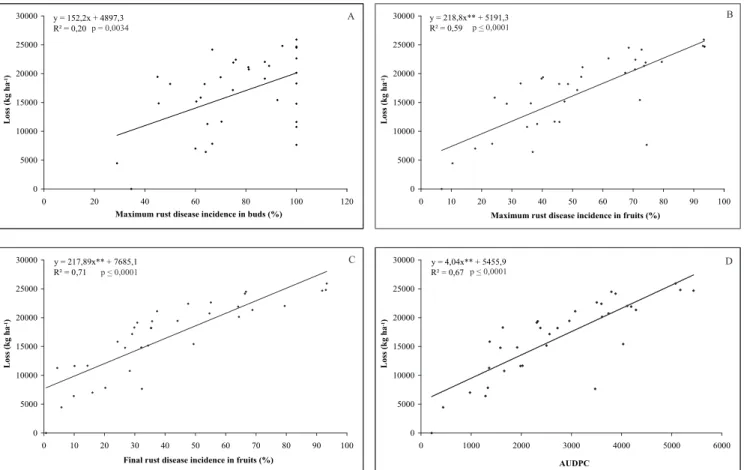
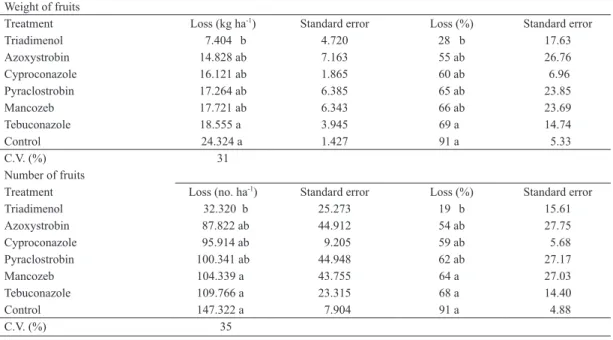
The fungicide treatments used to control rust led to different incidence of diseased buds and fruits (%) in both experiments. Rust incidence during flowering and fruiting directly influenced guava yield. In both experiments, rust was shown to be the main cause of yield loss (Figures 1, 2, 3 and 4). This was confirmed by a mean reduction of 24.324 kg guava fruits per hectare for plots without chemical spraying in the first experiment, which was equivalent to 91% of the average yield with the best treatment. In the second experiment, the mean reduction was 88%, corresponding to 19.627 kg fruits per hectare. There was an equivalent reduction in the number of fruits. Treatment with triadimenol provided the smallest loss caused by guava rust (Tables 1 and 2).
The final incidence of rust disease on fruits and the AUDPC were the only variables showing coefficient of determination (R2
Figure 2. Relationship betweenguavaloss (number of fruits ha-1) and maximum rust incidence for buds (A), maximum and final rust incidence for fruits (B and C) and AUDPC (D), obtained in 2003.
Figure 1. Relationship between guavaloss (kg of fruits ha-1) and maximum rust incidence for buds (A), maximum and final rust incidence for fruits (B and C) and
AUDPC (D), obtained in 2003.
y = 152,2x + 4897,3 R² = 0,20
0 5000 10000 15000 20000 25000 30000
0 20 40 60 80 100 120
Maximum rust disease incidence in buds (%)
-1
Loss (kg ha
)
y = 218,8x** + 5191,3 R² = 0,59
0 5000 10000 15000 20000 25000 30000
0 10 20 30 40 50 60 70 80 90 100
Maximum rust disease incidence in fruits (%)
Loss (
)
-1
kg ha
y = 217,89x** + 7685,1 R² = 0,71
0 5000 10000 15000 20000 25000 30000
0 10 20 30 40 50 60 70 80 90 100
Final rust disease incidence in fruits (%)
-1
Loss (kg ha
)
y = 4,04x** + 5455,9 R² = 0,67
0 5000 10000 15000 20000 25000 30000
0 1000 2000 3000 4000 5000 6000
AUDPC
-1
Loss (kg ha
)
p = 0,0034 p < 0,0001
p < 0,0001 p < 0,0001
A
C D
B
y = 910,92x + 26778 R² = 0,16
0 20000 40000 60000 80000 100000 120000 140000 160000 180000
0 20 40 60 80 100 120
Maximum rust disease incidence in buds (%)
-1
Loss (No. ha
)
y = 1386,2x** + 24542 R² = 0,53
0 20000 40000 60000 80000 100000 120000 140000 160000 180000
0 10 20 30 40 50 60 70 80 90 100
Maximum rust disease incidence in fruits (%)
-1
Loss (No. ha
)
y = 1424,9x** + 38520 R² = 0,70
0 20000 40000 60000 80000 100000 120000 140000 160000 180000 200000
0 10 20 30 40 50 60 70 80 90 100
Final rust disease incidence in fruits (%)
-1
Loss (No. ha
)
y = 25,974x** + 25184 R² = 0,64
0 20000 40000 60000 80000 100000 120000 140000 160000 180000
0 1000 2000 3000 4000 5000 6000
AUDPC
-1
Loss (No. ha
)
p = 0,0089 p < 0,0001
p < 0,0001 p < 0,0001
A
C
B
Figure 4. Relationship betweenguavaloss (number of fruits ha-1
) and final rust incidence for buds (A), maximum and final rust incidence for fruits (B and C) and AUDPC (D), obtained in 2003-2004.
Figure 3. Relationship between guavaloss (kg of fruits ha-1) and final rust incidence for buds (A), maximum and final rust incidence for fruits (B and C)
and AUDPC (D), obtained in 2003-2004.
y = 339,7x**+ 1021,8 R² = 0,75
0 5000 10000 15000 20000 25000
0 10 20 30 40 50 60 70
Final rust disease incidence in buds (%)
-1
Loss (kg ha
)
y = 193,18x** + 1858,3 R² = 0,87
0 5000 10000 15000 20000 25000
0 20 40 60 80 100 120
Maximum rust disease incidence in fruits (%)
-1
Loss (kg ha
)
y = 178,75x** + 3801,3 R² = 0,86
0 5000 10000 15000 20000 25000
0 20 40 60 80 100 120
Final rust disease incidence in fruits (%)
-1
Loss (kg ha
)
y = 1,42x** + 2277,8 R² = 0,85
0 5000 10000 15000 20000 25000
0 2000 4000 6000 8000 10000 12000 14000 16000
AUDPC
-1
Loss (kg ha
)
p < 0,0001
p < 0,0001 p < 0,0001
p < 0,0001
A B
C D
y = 2202,1x** + 10111 R² = 0,76
0 20000 40000 60000 80000 100000 120000 140000 160000
0 10 20 30 40 50 60 70
Final rust disease incidence in buds (%)
-1
Loss (No. ha
)
y = 1227,1x** + 16518 R² = 0,84
0 20000 40000 60000 80000 100000 120000 140000 160000
0 20 40 60 80 100 120
Maximum rust disease incidence in fruits (%)
-1
Loss (No. ha
)
y = 1136,1x** + 28837 R² = 0,82
0 20000 40000 60000 80000 100000 120000 140000 160000
0 20 40 60 80 100 120
Final rust disease incidence in fruits (%)
-1
Loss (No. ha
)
y = 9,12x** + 18706 R² = 0,84
0 20000 40000 60000 80000 100000 120000 140000 160000
0 2000 4000 6000 8000 10000 12000 14000 16000
AUDPC
-1
Loss (No. ha
)
p < 0,0001
p < 0,0001 p < 0,0001
p < 0,0001
A
C D
direct relationship to yield loss, either for weight or number of fruits per hectare. The reduction in weight and number of fruits per hectare could be explained by all analyzed variables, showing significant loss functions (Figures 3 and 4), and according to the linear regression equations, over 75% of the change in loss was a consequence of the disease (Figures 3 and 4).
There was a 93% correlation between the number of healthy fruits at the end of the susceptibility period and the final guava yield in the first experiment, while in the second experiment this correlation was 97% (Table 3).
DISCUSSION
Single-point and integral models were used to describe the relationship between rust incidence and guava crop production, at a single time and over the whole growth phase, respectively.
Yield loss caused by P. psidii has not been experimentally estimated for guava production. The phenology of guava reproductive phases
provides practical support to establish a relationship between loss and yield. In the first experiment, there was a high incidence of diseased buds before spraying. Thus, most treatments showed high incidence of diseased organs (buds and fruits), and the maximum incidence of diseased buds did not describe precisely the loss in weight and number of fruits per hectare. Consequently, important loss function was not obtained for the maximum incidence of diseased buds, where R2 was
0.20 and 0.16 for weight and number of fruits, respectively. Severe epidemics in the bud phase resulted in incidence of highly diseased fruits at the beginning of fruiting (high primary inoculum). Moreover, guava production was impaired by the initial number of infected buds. Before the fruiting phase, rust may affect the yield of a plant when there are infected buds. A significant correlation was obtained between the number of healthy buds and the yield. The greater amount of healthy buds contributes to increased production.
In the first evaluation of the disease in the second experiment, there were 0.5% infected buds. Environmental conditions were favorable to rust infection and from the fifth evaluation (=final incidence of diseased buds), the number of diseased buds remained well distributed
Table 1. Yield reduction due to rust, expressed as weight (kg) and number of fruits ha-1
in 2003.
Weight of fruits
Treatment Loss (kg ha-1
) Standard error Loss (%) Standard error
Triadimenol a7.404 ab 4.720 28 b 17.63
Azoxystrobin 14.828 ab 7.163 55 ab 26.76
Cyproconazole 16.121 ab 1.865 60 ab 6.96
Pyraclostrobin 17.264 ab 6.385 65 ab 23.85
Mancozeb 17.721 ab 6.343 66 ab 23.69
Tebuconazole 18.555 aa 3.945 69 aa 14.74
Control 24.324 aa 1.427 91 aa 5.33
C.V. (%) 31
Number of fruits
Treatment Loss (no. ha-1) Standard error Loss (%) Standard error
Triadimenol a32.320 b 25.273 19 ab 15.61
Azoxystrobin a87.822 ab 44.912 54 ab 27.75
Cyproconazole a95.914 ab 9.205 59 ab a5.68
Pyraclostrobin 100.341 ab 44.948 62 ab 27.17
Mancozeb 104.339 aa 43.755 64 aa 27.03
Tebuconazole 109.766 aa 23.315 68 aa 14.40
Control 147.322 aa 7.904 91 aa a4.88
C.V. (%) 35
Table 2. Yield reduction due to rust, expressed as weight (kg) and number of fruits ha-1 in 2003-2004.
Weight of fruits
Treatment Loss (kg.ha-1
) Standard error Loss (%) Standard error
Triadimenol a1.685 aac 1.963 7 aac 8.8a
Tebuconazole a6.804 aba 1.639 30 aba 7.35
Azoxystrobin a8.910 aba 3.200 40 aba 14.35
Mancozeb a9.979 aba 1.502 45 aba 6.73
Control 19.627 aaa 500 88 aaa 2.24
C.V.(%) 21
Number of fruits
Treatment Loss (no. ha-1) Standard error Loss (%) Standard error
Triadimenol aaa18.992 aac 15.632 a12 aac 10.26
Tebuconazole aaa42.221 abc a8.937 a28 abc a5.86
Azoxystrobin aa60.976 ab a8.269 40 ab a5.42
Mancozeb aa67.164 ab 18.147 44 ab 11.91
Control 132.804 a a2.301 a87 aaa a1.51
on the plant, even after two copper oxychloride sprayings and another spraying of systemic fungicides. There was a 97% positive correlation between healthy buds (fifth evaluation) and plant yield. This showed that maintaining the buds healthy is important to predict the harvest and reduce guava yield loss due to rust.
Even though the final incidence of diseased buds reached 25% of the total buds in the second experiment, fungicide application preceded by disease monitoring offered protection to the remaining buds, assuring an economic production of the best treatments. Thus, bud stage (equivalent to the beginning of the sprouting phase) was considered determinant to guava yield, and fungicide protection was considered desirable even when there is great bud fall due to natural abortion or rust itself.
The sprouting phase should be the initial phase to establish preventive rust control by spraying protective fungicides. On the other hand, as buds do not last long on the plant, systemic fungicides must be used, preferably when the first fruits (diseased or not) appear and under favorable conditions for the disease. In cases of delay or negligence in preventive control using protective fungicides, systemic fungicides must be sprayed on the buds, even if they do not last long (17, 18).
The final phase of fruit susceptibility must also receive attention for disease chemical control under favorable environmental conditions. This was observed when the AUDPC was analyzed over the evaluated period. There was a positive linear relationship between the loss expressed as weight and number of fruits per hectare and the AUDPC. The conclusion was that the whole susceptible period between flowering and the emergence of fruits smaller than four centimeters in diameter was also important in limiting guava yield. These findings also indicated that the initial fruiting phases, before the fruit size reaches four cm in diameter, must receive fungicide spraying during rust epidemics. Although the AUDPC showed coefficient of determination higher than 0.84 in the second experiment, bud and fruit phases can be considered critical to establish the economic loss threshold.
Rust loss functions should be used to improve decisions in the disease management. For example, when rust is particularly severe in the initial season (bud), the economic benefit of fungicide application to reduce rust incidence can be evaluated by determining the reduction in rust incidence based on the loss functions.
The single-point model has been employed to study the loss due to several diseases (23, 24). Reis et al. (24) have conducted trials to quantify the loss caused by Cercospora zea-maydis in corn and have reported that the single-point stage is feasible to predict the loss and calculate the economic loss threshold. For barley (Hordeum vulgare), Reis et al. (23) have shown that tillering stage reveals the best loss function. In these experiments, single-point stage was important to describe the loss in bud and fruit phases and have been allowed to obtain an increase in loss. The loss coefficient could be used to obtain the economic loss threshold, which should be calculated for every year
according to guava valuation, fungicides and control cost.
The economic loss threshold has not been obtained yet for the chemical control of guava rust but has already been established for some pathosystems. Reis et al. (22) obtained the economic loss threshold of 12.7% for leaf rust incidence at the elongation stage. In these experiments, the loss equations were obtained under favorable environment for rust and should be used to predict the loss in different guava phases.
The relevance of P. psidii in ‘Paluma’ guava orchards in the north of Rio de Janeiro State has already been reported in epidemiologic research (26). However, the loss functions presented here reflected the importance of the disease in reducing crop yield during the most favorable seasons for the disease. Loss functions demonstrated that there was a linear relationship between buds and/or fruits showing rust and loss increase. Fungal infection in the fruit occurs continuously, the incidence of diseased fruits persists until fruits reach about four cm in diameter (from 70 to 80 days after pruning) (26). Thus, spraying with systemic fungicide has to be prioritized to restrain the emergence of new pustules and to prevent sporulating lesions on the remaining fruits. Considering guava fruit production for direct human consumption, the individual quality of the fruits could be impaired by the existence of a single rust pustule. In this case, loss could be even greater, since a fruit with one pustule can lose its commercial value. Use of the fungicide triadimenol led to lower loss because small rust pustules were extinguished and the lesions were healed (17). In the present study, a fruit with healed lesions was counted as healthy and the loss would then be underestimated.
Even assuming that the maximum fixation index of the guava fruit is 20% during flowering and fruiting phases (7, 27), all buds and fruits must be protected. As far as new control methods or new rust resistant cultivars are developed, fungicides should be used in the susceptible phases to keep as many healthy buds and fruits as possible to ensure the highest guava yield. Thus, the initial flowering phase must be considered critical and the most important phase to prevent rust attack. In this phase, protective spraying can result in better economic profits. Finally, an economic loss threshold of chemical spraying could be established based on the yield estimate at different stages of the year, considering that a high incidence of young diseased buds and fruits is followed by severe yield loss.
ACKNOWLEDGMENTS
The authors thank Rio de Janeiro State Research Aid Foundation (FAPERJ) for the scholarship provided to M. V. V. Martins, and Darcy Ribeiro Rio de Janeiro State University (UENF), which allowed this study to be undertaken. Special thanks to Mr. Luiz Cláudio Macedo Ramos, a kind farmer and owner of the guava orchard where the studies
Table 3. Pearson’s correlation coefficients between production (kg/plant) and mean number of healthy buds and fruits per guava tree (‘Paluma’ variety) obtained in 2003 and 2004.
Variables/ year of a field trial Pearson’s correlation Significance
Maximum number of healthy buds / 2003 0.72 0.033
Final number of healthy buds / 2004 0.97 0.003
Maximum number of healthy fruits / 2003 0.82 0.012
Maximum number of healthy fruits / 2004 0.97 0.003
Final number of healthy fruits /first / 2003 0.93 0.001
were conducted; without his help and permission this study could not have been carried out.
REFERENCES
1. Aparecido, C. C.; Figueiredo, M. B.; Furtado, E. L. Grupos de variabilidade fisiológica em populações de Puccinia psidii. Summa Phytopathologica, Botucatu, v. 29, n. 3, p. 234-238, 2003.
2. Bowen, K. L.; Everts, K. L.; Leath, S. Reduction in yield of winter wheat in North Carolina due to powdery mildew and leaf rust. Phytopathology, Saint Paul, v. 81, n. 5, p. 503–511, 1991.
3. Campbell, C. L.; Madden, L. V. Introduction to plant disease epidemiology.
New York: John Wiley, 1990. 532p.
4. Carlson, G. A.; Main, C. E. Economics of disease-loss management. Annual Review of Phytopathology, Palo Alto, v. 14, p. 381–403, 1976. 5. Carnegie, A. J.; Lidbetter, J.; Walker, J.; Horwood, M. A.; Tesoriero, M.;
Glen, M.; Priest, M. J. Uredo rangelii, a taxon in the guava rust complex, newly recorded on Myrtaceae in Australia. Australasian Plant Pathology, Victoria, v. 39, n. 5, p. 463-466, 2010.
6. Coelho, L.; Alfenas, A. C.; Ferreira, F. A. Variabilidade fisiológica de Puccinia psidii – Ferrugem do eucalipto. Summa Phytopathologica, Botucatu, v. 27, n. 3, p. 295-300, 2001.
7. Corrêa, M. C. M.; Prado, R. M.; Natale, W.; Silva, M. A. C.; Pereira, L. Índice de pegamento de frutos de goiabeiras. Revista Brasileira de Fruticultura, Jaboticabal, v. 24, n. 3, p. 783–786, 2002.
8. Coutinho, T. A.; Wingfield, M. J.; Alfenas, A. C.; Crous, P. W. Eucalyptus rust: a disease with the potential for serious international implications. Plant Disease, Saint Paul, v. 82, n. 7, p. 819-925, 1998.
9. Ferrari, J. T.; Nogueira, E. M. C.; Santos, A. J. T. Control of rust (Puccinia
psidii) in guava (Psidium guajava). Acta Horticulturae, Leuven, v. 452, p. 55-58, 1997.
10. Ferreira, F.A. Ferrugem do eucalipto. Revista Árvore, Viçosa, v. 7, p. 91-109, 1983.
11. Ferreira, F. A. Ferrugem do eucalipto. In: Patologia florestal - principais doenças florestais no Brasil. Viçosa, MG, Sociedade de Investigações Florestais, 1989, p. 129-152.
12. Furtado, G. Q.; Castro, H. A.; Pozza, E. A. Variabilidade fisiológica de
Puc-cinia psidii Winter em Eucalyptus grandis e no hibrido urograndis. Summa Phytopathologica, Botucatu, v. 31, n. 3, p. 227-231, 2005.
13. Goes, A.; Martins, R. D.; Reis, R. F. Efeito de fungicidas cúpricos, aplicados isoladamente ou em combinação com mancozeb, na expressão de sintomas de fitotoxicidade e controle da ferrugem causada por Puccinia psidii em goiabeira. Revista Brasileira de Fruticultura, Jaboticabal, v. 26, n. 2, p. 237-240, 2004.
14. Groth, J. V.; Zeyen, R. J.; Davis, D. W.; Christ, B. J. Yield and quality losses caused by common rust (Puccinia sorghi Schw.) in sweet corn (Zea mays) hybrids. Crop Protection, Kent, v. 2, n. 1, p. 105–111, 1983.
15. Jesus Junior, W. C.; Vale, F. X. R.; Coelho, R. R.; Hau, B.; Zambolim, L.; Costa, L. C.; Bergamin Filho, A. Effects of angular leaf spot and rust on yield loss of Phaseolus vulgaris. Phytopathology, Saint Paul,v. 91, n. 11,
p. 1045–1053, 2001.
16. Khan, M. A.; Trevathan, L. E.; Robbins, J. T. Quantitative relationships between leaf rust and wheat yield in Mississippi. Plant Disease, Saint Paul, v. 81, n. 7, p.769-772, 1997.
17. Martins, M. V. V.; Silveira, S. F.; Maffia, L. A.; Rocabado, J. M. A.; Mussi-Dias, V. Chemical control of guava rust (Puccinia psidii) in the Northern region of Rio de Janeiro state, Brazil. Australasian Plant Pathology, Victoria, v. 40, n. 1, p. 48-54, 2011.
18. Martins, M. V. V.; Serrano, L. A. L; Lima, I. M.; Oliveira, E. B. Incidência e controle químico da ferrugem da goiabeira em diferentes épocas de poda na região norte do Espírito Santo. Revista Ceres, Viçosa, v. 59, n. 2, p. 178-184, 2012.
19. Pataky, J. K. Quantitative relationships between sweet corn yield and common rust, Puccinia sorghi. Phytopathology, Saint Paul,v. 77, n. 7, p. 1066–1071, 1987.
20. Pereira, F. M.; Kavati, R. Contribuição da pesquisa científica brasileira no desenvolvimento de algumas frutíferas de clima subtropical. Revista Brasileira de Fruticultura, Jaboticabal, volume especial, p. 092-108, 2011. 21. Pinho, R. G. V.; Ramalho, M. A. P.; Silva, H. P.; Resende, I. C.; Pozar, G. Danos causados pelas ferrugens polissora e tropical do milho. Fitopatologia Brasileira, Brasília, DF, v. 24, n. 3, p. 400–409, 1999.
22. Reis, E. M.; Casa, R. T.; Hoffmann, L. L.; Mendes, C. M. Effect of leaf rust on wheat grain yield. Fitopatologia Brasileira, Brasília, DF, v. 25, n. 1, p. 67–71, 2000.
23. Reis, E. M.; Hoffmann, L. L.; Blum, M. M. C. Modelo de ponto crítico para estimar os danos causados pelo oídio em cevada. Fitopatologia Brasileira, Brasília, DF, v. 27, n. 6, p. 664–646, 2002.
24. Reis, E. M.; Santos, J. A. P.; Blum, M. M. C. Critical-point yield to estimate yield damage caused by Cercospora zea-maydes in corn. Fitopatologia Brasileira, Brasília, DF, v. 32, n. 2, p. 110–113, 2007.
25. Rezende, A. M. F. A.; Tomita, C. K.; Uesugi, C. H. Fungicidas cúpricos, clo-retos de benzalcônio e composto bioativo líquido (Bokashi): fitotoxicidade e controle da seca dos ponteiros causada por Erwinia psidii em goiabeiras. Tropical Plant Pathology, Brasília, DF, v. 33, n. 4, p. 288-294, 2008. 26. Rocabado, J. M. A. Epidemiologia e Patogênese da ferrugem-da-goiabeira,
causada por Puccinia psidii. 2003. 119 p. Tese (Doutorado em Produção
Ve-getal) - Universidade Estadual do Norte Fluminense Darcy Ribeiro, Campos. 27. Serrano, L. A. L.; Marinho, C. S.; Lima, I. M.; Martins, M. V. V.; Ron-chi, C. P.; Tardin, F. D. Fenologia da goiabeira ‘Paluma’ sob diferentes sistemas de cultivos, épocas e intensidades de poda de frutificação.
Bragantia, Campinas,v. 67, n. 3, p. 701–712, 2008.
28. Sousa, M. S. B.; Vieira, L. M.; Silva, M. J. M.; Lima, A. Caracterização nutricional e compostos antioxidantes em resíduos de polpas de frutas tropicais. Ciência Agrotécnica, Lavras, v. 35, n. 3, p. 554-559, 2011. 29. Torres, J.C.; Ventura, J.A. AVACPD: um programa para calcular a área e o
volume abaixo da curva de progresso da doença. Fitopatologia Brasileira, Brasília, DF, v. 16, n. 2, p. 52-53, 1991.