Introduction
It is widely recognized that macroalgae community structures display considerable change according to spatial and temporal scales. Temperate communities are highly seasonal and variable at different spatial scales (Underwood & Chapman 1998; Underwood 2000). Ecological processes such as herbivory, disturbance, predation, and recruitment, as well as oceanographic conditions have been shown to structure the communities (Menge & Branch 2001). In the tropics, macroalgal communities may also vary through time. However, the processes driving community dynamics are not well understood and it is not clear how algal communities vary at different spatial and temporal scales.
Macroalgae are diverse and well distributed on the tropical western Atlantic continental shelf, where a generally well-illuminated infralittoral and moderate nutrient loadings can be optimal environments for the development of macroalgae (Pereira et al. 1981).
The marine macroalgal resources along Rio Grande do Norte coast have been studied since the sixties by Câmara Neto (1966, 1971a, 1971b), Pinheiro-Vieira &
Ferreira (1968), Pinheiro-Vieira & Ferreira-Correia (1970), Ferreira et al. (1981), Pereira et al. (1981), Oliveira-Filho
(2002), although little is known about their distribution patterns. These patterns vary according to the local algal communities since they are related to photosynthetic pigments specialized in capturing light energy over a broad range of the visible spectrum present in each group of algae. Green macroalgae possess photosynthetic pigments similar to those of higher plants and they also store the same reserve product - starch (Levinton 1995). In general, they respond rapidly to nutrient enrichment and tend to dominate in shallow water environments.
Rio Grande do Norte littoral is located in the tropical region of Brazil and corresponds to the Oriental zone proposed by Oliveira-Filho (1977); it is characterized by oligotrophic waters, abundant hard substrate available for development of a diverse fl ora of marine algae (Horta et al.
2001). Oliveira-Filho (1977) was fi rst to present the number of infrageneric taxa of marine macroalgae known for Brazil, reporting 504 taxa, with 327 Rhodophyta, 113 Chlorophyta, and 64 Phaeophyta. Later, Horta et al. (2001) updated this
macroalgal diversity database to 642 taxa distributed in 388
1 Universidade Federal de Pernambuco, Departamento de Oceanografi a, Recife, PE, Brazil
2 Secretaria do Meio Ambiente do Estado de São Paulo, Instituto de Botânica, São Paulo, SP, Brazil 3 PETROBRAS - Gerência de Segurança, Meio Ambiente e Saúde, Natal, RN, Brazil
4 Author for correspondence: [email protected]
Diversity and distribution Patterns of the infralittoral green macroalgae
from Potiguar basin, Rio Grande do Norte, Northeastern Brazil
Adilma de Lourdes Montenegro Cocentino1,4, Mutue Toyota Fujii2, Thiago Nogueira de Vasconcelos Reis1,Nathalia Cristina Guimarães-Barros1, Marcia de França Rocha3 and Sigrid Neumann-Leitão1
Recebido em 17/11/2009. Aceito em 06/10/2010
RESUMO – (Diversidade e padrão de distribuição das macroalgas verdes da bacia Potiguar, Rio Grande do Norte, Nordeste do Brasil). Diversidade e padrão de distribuição das algas verdes do infralitoral da Bacia potiguar, RN, nordeste do Brasil foram analisados a partir de material coletado em profundidades que variaram de 2 a 100 m. As coletas foram feitas em dois tipos de dragas durante as quatro campanhas: julho de 2002, maio e novembro de 2003 e maio de 2004, em 43 estações. Chlorophyta está representada por 54 espécies, cinco variedades e três formas. A família mais representativa é Caulerpaceae e dentro da família, o gênero mais diverso é Caulerpa, com 11 espécies. Os resultados mostraram que muitos táxons são raros (89%) e 10% estão presentes em baixa frequência. A espécie mais freqüente foi Caulerpaprolifera (Forssk.) J.V. Lamour. ocorrendo em quase todas as estações das plataformas costeiras e internas, encontradas em todas as campanhas. A distribui-ção das espécies por intervalo de profundidades mostrou que o maior número de táxons ocorreu entre 10 a 20 m, e uma ampla distribuidistribui-ção vertical foi registrada para
Anadyomenestellata (Wulfen in Jacq.) C. Agardh,Chamaedoris peniculum (J. Ellis & Solander) Kuntze, Codium isthmocladum Vickers, Microdictyon sp., Udotea occidentalis A. Gepp & E. Geppe Ventricaria ventricosa (J. Agardh) J.L. Olsen & J.A. West. Quatro espécies, Cladophoracoelothrix Kütz., C. ordinata (Børgensen) C. Hoek, Caulerpellaambigua (Okamura) Prud’homme & Lokhorst e Halimedasimulans M. Howe foram registradas pela primeira vez para o Rio Grande do Norte.
Palavras chave: padrões de distribuição, algas verdes, infralitoral, região tropical, Brasil
ABSTRACT – (Diversity and distribution patterns of the infralittoral green macroalgae from Potiguar basin, Rio Grande do Norte, Northeastern Brazil). Diversity and distribution pattern of the infralittoral green macroalgae at Potiguar basin, Rio Grande do Norte, Northeastern Brazil were analyzed from material collected at depths varying from 2 to 100 m. Collections were carried out with two types of dredges during four campaigns: July 2002, May and November 2003 and May 2004 at 43 stations. Chlorophyta is represented by 54 species, fi ve varieties and three forms. The most representative family is Caulerpaceae, and the most diverse genus is Caulerpa, with 11 species. The results showed that most taxa (89%) are rare, and 10% are present at low frequencies. The most frequent specieswas Caulerpa prolifera (Forssk.) J.V. Lamour. occurring at almost all coastal and inner shelf stations, recorded in all campaigns. Species distribution by depth range showed that higher species number occurred on the inner shelf from 10 to 20 m, and a wide vertical distribution pattern was registered for Anadyomenestellata (Wulfen in Jacq.) C. Agardh,Chamaedoris peniculum (J. Ellis & Solander) Kuntze, Codium isthmocladum Vickers, Microdictyon sp., Udoteaoccidentalis A. Gepp & E.
Geppand Ventricaria ventricosa (J. Agardh) J.L. Olsen & J.A. West. Four species, Cladophoracoelothrix Kütz., C.ordinata (Børgensen) C. Hoek, Caulerpella ambigua (Okamura) Prud’homme & Lokhorst and Halimedasimulans M. Howe, were recorded for the fi rst time in Rio Grande do Norte.
987
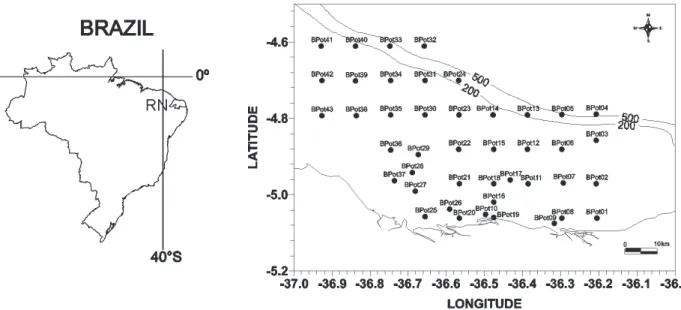
Cocentino et al.: Diversity and distribution Patterns of the infralittoral green macroalgae from Potiguar basin...Figure 1. Area and sampling stations studied at Potiguar basin (Bpot), Rio Grande do Norte state, Brazil.
Rhodophyta, 166 Chlorophyta, and 88 Phaeophyta. More recently data on number of marine macroalgae in Brazil were summarized by Fujii et al. (2008) revealing 774 infrageneric
taxa, including subspecies, varieties, and forms, corresponding to 482 Rhodophyta, 191 Chlorophyta, and 101 Phaeophyta. In this account, Rio Grande do Norte state appears with less than 30% (57 taxa) of all Chorophyta known for Brazil, making clear the scarcity of studies in this area.
The aim of this paper is to improve understanding of the diversity of Chlorophyta and its distribution patterns on the infralittoral of Potiguar basin, a tropical region in Northeast Brazil.
Materials and methods
Study area - The Rio Grande do Norte continental shelf extends 30-40 km from shore; the slope begins at 50-60 m depth and the morphology is irregular, with an average gradient of 1:1,000. The shelf underwent strong vertical tectonism during the Meso-Cenozoic, and grabens and horsts that dominate the Potiguar basin play an important role in sedimentation and shelf morphology (Testa 1997). A series of submerged points and banks exist alongside the shelf, constituting very rough relief. The most common facies is composed mainly of calcareous algae, such as
Lithothamnion Heydr., Lithophyllum Phil., and Halimeda J.V. Lamour. (Mabesoone & Coutinho 1970). Siliciclastic sands are present in shallow waters near the coast, while carbonate sands are present offshore; mud occurs at the mouths of the rivers and in the fi lling channels on the shelf (Vital et al. 2005).
Sampling strategy - On the Rio Grande do Norte continental shelf, sampling was carried out during four campaigns: July 21-30, 2002 (Campaign 1), May 12-30, 2003 (Campaign 2), November 14-23, 2003 (Campaign 3), and May 17-31, 2004 (Campaign 4), by the CENPES/ PETROBRAS Project “Potiguar Basin Environmental Assessment”. Potiguar Basin is an area of oil and gas exploitation where the research center (CENPES) of the Brazilian oil company PETROBRAS is carrying out an extensive program of environmental assessment. Macroalgae were sampled at daytime at up to 43 stations along 9 transects perpendicular to the Rio Grande do Norte coast (lat. 4o-5o S, long. 36o-37o W), in depths varying from 2-100 m (Fig. 1). Collections were made using
Charcot dredges with about 50 L collecting capacity (stations over 8 m deep) and Agassiz dredges (coastal stations less than 8 m). After col-lection, samples were fi xed in 4% formalin/seawater. In the laboratory, Chlorophyta was identifi ed to species level, analyzing external and internal morphology. Transverse and longitudinal hand-sectionswere made with a stainless steel razor blade under a Zeiss, Stemi 2000C stereomicroscope (Göettingen, Germany), stained with 0.5% aqueous aniline blue solutions acidifi ed with 1 N HCl (Tsuda & Abbott 1985). Observations were done with a Zeiss-Axiostar plus microscope (Göet-tingen, Germany). Voucher specimens are deposited in the herbarium of the Universidade Federal de Pernambuco, Recife (UFP). Herbarium abbreviations follow the on-line Index Herbariorum (http://www.nybg. org/bsci/ih/ih.html).
Taxonomic nomenclature and classifi cation system was based on Wynne (2005), except where otherwise indicated. The frequency of occurrence was defi ned as the number of stations in which each species occurred. Cluster analysis was performed on a presence-absence matrix with the Sorensen index using NTSYS PC 2.10 Exeter Software© 2000 by Applied Biostatistics, Inc.
Results
Chlorophyta was present in 37% of the samples and corresponded to 54 species, five varieties and three forms as listed below. In all campaigns higher species concentrations occurred from 10-20 m depth (Table 1, Fig. 2). Four orders (Ulvales, Cladophorales, Bryopsidales and Dasycladales) and twelve families were identifi ed. The families Caulerpaceae (11 species, four varieties and two forms), Udoteaceae (seven species, one variety and one form), Cladophoraceae (seven species), Halimedaceae (seven species) and Siphonocladaceae (five species) had highest taxonomic diversity (Fig. 3). Caulerpa (11
species, four varieties and two forms) and Halimeda
(seven species) presented greatest species number. In
Caulerpa, C. prolifera was most frequent and abundant.
Table 1. Chlorophyta depth distribution at Potiguar basin, Rio Grande do Norte (Brazil), in July 2002, May and November 2003 and May 2004.
Species Depth <10 m 10-20 m 20-30 m 30-40 m 40-50 m >50 m
Acetabularia calyculus x x
Anadyomenestellata x x x x x x
Anadyomene sp. x x
Avrainvillea longicaulis x x x x x
A. nigricans x
Boodleopsis pusilla x
Bryopsis pennata x
Caulerpa cupressoides var. lycopodium x
C. cupressoides var. lycopodium f. disticha x
C. cupressoides var. serrata x x x x x
C. kempfi i x x x x x
C. lanuginosa x
C. mexicana x x
C. prolifera x x x
C. pusilla x x x x
C. racemosa x
C. racemosa var. peltata x
C. serrulata x
C. sertularioides x x
C. sertularioides f. longipes x
C. verticillata x
Caulerpa sp. x
Caulerpella ambigua x
Chaetomorpha antennina x
Chaetomorpha sp. x
Chamaedoris peniculum x x x x x x
Cladophoracoelothrix x
C. dalmatica x
C. ordinata x
C. vagabunda x
Cladophora sp. x
Codium decorticatum x
C. isthmocladum x x x x x x
Codium sp. x x x x x
Dasycladusvermicularis x x x x
Dictyosphaeria cavernosa x x x x x
D.versluysii x x x x
Halimeda discoidea x x x x x
H.gracilis x x x
H.incrassata x x x x
H. opuntia x
H. simulans x
H.tuna x x
Acta bot. bras. 24(4): 986-996. 2010.
989
Figure 2. Chlorophyta distribution in Rio Grande do Norte (Brazil), in July 2002 (Campaign 1), May 2003 (Campaign 2), November 2003 (Campaign 3) and May 2004 (Campaign 4).
Species Depth <10 m 10-20 m 20-30 m 30-40 m 40-50 m >50 m
Halimeda sp. x x x x
Microdictyon sp. x x x x x x
Penicilluscapitatus x x x x x
Siphonocladus tropicus x
Udotea cyathiformis var. cyathiformis f. cyathiformis x x x x
U. fl abellum x x x x x
U. occidentalis x x x x x x
Udotea sp. x
Ulva compressa x x x x
U. fasciata x
U. lactuca x
Valoniaaegagropila x x x x x
V. macrophysa x x x x x
Valonia sp. x
Ventricaria ventricosa x x x x x x
Species of Chlorophyta at Potiguar basin, Rio Grande do Norte (Brazil), in July 2002, May and November 2003 and May 2004:
Ulvophyceae Ulvales
Ulvaceae
Ulva L., 1753
Ulva compressa (L.) Nees Ulva fasciata Delile Ulva lactuca L.
Cladophorales Anadyomenaceae
Anadyomene J. V. Lamour., 1812
Anadyomenestellata (Wulfen in Jacq.) C. Agardh Anadyomene sp.
Microdictyon Decne., 1841 Microdictyon sp.
Cladophoraceae
Chaetomorpha Kütz.,1845
Chaetomorpha antennina (Bory) Kütz. Chaetomorpha sp.
Cladophora Kütz., 1843 Cladophoracoelothrix Kutz. Cladophora dalmatica Kutz.
Cladophora ordinata (Borgesen) C. Hoek Cladophora vagabunda (L.) C. Hoek
Cladophora sp.
Siphonocladaceae
Chamaedoris Mont., 1842
Chamaedoris peniculum (J. Ellis & Solander) Kuntze Dictyosphaeria Decne. ex Endl., 1843
Dictyosphaeria cavernosa (Forssk.) Børgesen Dictyosphaeriaversluysii Weber Bosse Siphonocladus F. Schmitz, 1879
Siphonocladus tropicus (P. Crouan & H. Crouan in
Schramm & Mazé) J. Agardh
Ventricaria J. L. Olsen & J. A. West, 1988
Ventricaria ventricosa (J. Agardh) J. L. Olsen & J.
A. West Valoniaceae
Valonia C. Agardh, 1823 Valoniaaegagropila C. Agardh Valonia macrophysa Kütz. Valonia sp.
Bryopsidales Bryopsidaceae
Bryopsis J. V. Lamour., 1809 Bryopsis pennata J. V. Lamour.
Codiaceae
Codium Stackh., 1797
Codium decorticatum (Woodw.) M. Howe Codium isthmocladum Vickers
Codiumsp.
Caulerpaceae
Caulerpa J. V. Lamouroux, 1809
Caulerpa cupressoides var. lycopodium Weber Boss Caulerpa cupressoides var. lycopodium f. disticha
Weber Boss
Caulerpa cupressoides var. serrata (Kütz.) Weber
Bosse
Caulerpa kempfi i A. B. Joly & S. Pereira Caulerpa lanuginosa J. Agardh
Caulerpamexicana Sond. ex Kütz.
Caulerpaprolifera (Forssk.) J. V. Lamouroux Caulerpa pusilla (Kützing) J. Agardh Caulerpa racemosa (Forsskal) J.Agardh
Caulerpa racemosa var. peltata (J. V. Lamour.) Caulerpa serrulata (Forssk.) J. Agardh
Caulerpasertularioides (S. G. Gmel.) M. Howe Caulerpa sertularioides f. longipes (J. Agardh) Collins Caulerpa verticillata J. Agardh
Caulerpa sp.
Caulerpella Prud’ homme & Lokhorst, 1992
Caulerpella ambigua (Okamura) Prud’ homme
& Lokhorst Halimedaceae
Halimeda J. V. Lamour., 1812 Halimeda discoidea Decne
Halimedagracilis Harv. ex J. Agardh Halimedaincrassata (J. Ellis) J. V. Lamour. Halimeda opuntia (L.) J. V. Lamour. Halimeda simulans M. Howe
Halimedatuna (J. Ellis & Sol.) J. V. Lamour. Halimeda sp.
Udoteaceae
Avrainvillea Decne., 1842
Avrainvillea longicaulis (Kütz.) G. Murray & Boodle Avrainvilleanigricans Decne
Boodleopsis A. Gepp & E. Gepp, 1911
Boodleopsis pusilla (Collins) W. R. Taylor, A.B. Joly
& Bernat.
Penicillus Lamour., 1813 Penicilluscapitatus Lamour. Udotea J. V. Lamour.,1812
Udotea cyathiformis var. cyathiformis f. cyathiformis
Decne
Udoteafl abellum (J. Ellis & Sol.) J. V. Lamour. Udoteaoccidentalis A. Gepp & E. Gepp Udotea sp.
Dasycladales Dasycladaceae
Dasycladus C. Agardh, 1828
Dasycladusvermicularis (Scop.) Krasser
Polyphysaceae
Acetabularia J. V. Lamour.,1812
Acta bot. bras. 24(4): 986-996. 2010.
991
Four species, Cladophoracoelothrix Kütz., C.ordinate
(Børgensen) C. Hoek, Caulerpellaambigua (Okamura)
Prud’homme & Lokhorst and Halimedasimulans M. Howe
were recorded for the fi rst time in Rio Grande do Norte. Frequency of occurrence for four campaigns is shown in Figure 4. Caulerpa prolifera was the most frequent followed
by C. cupressoides (H. West in Vahl) C. Agardh var. serrata
(Küz.) Weber Bosse, C. mexicana Sond. ex Kütz., Halimeda incrassata (J. Ellis) J. V. Lamour. and Ventricaria ventricosa
(J. Agardh) J. L. Olsen & J. A. West.
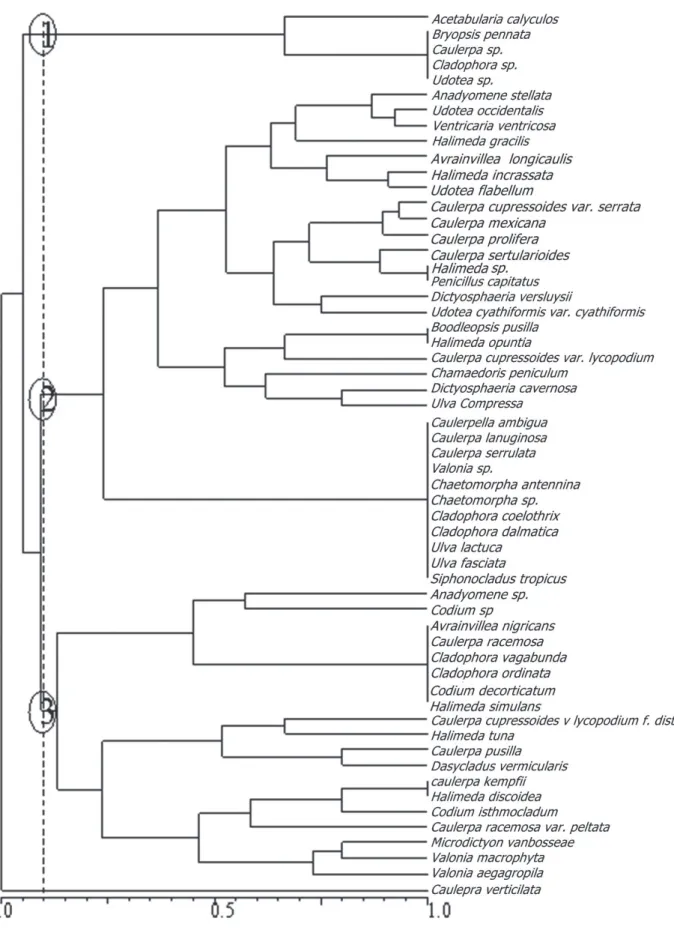
The dendrogram including all species identifi ed consisted of three groups. Group 1 associated fi ve species that occurred only in campaign 1. Group 2 had the most frequent species, and Group 3, with nine species, occurred mainly during campaigns 3 and 4. Caulerpa verticillata did not group,
occurring once during campaign 3 (Fig. 5).
Species distribution by depth range showed that higher species number occurred on the inner shelf, between depths from 10-20 m (Table 1). In depths over 50 m only 12 species were recorded. Anadyomenestellata (Wulfen in Jacq.) C.
Agardh, Chamaedoris peniculum (J. Ellis & Solander)
Kuntze, Codium isthmocladum Vickers, Microdictyon sp., Udoteaoccidentalis A. Gepp & E. Gepp and Ventricaria ventricosa occurred at depths from < 10 m to > 50 m, with
wide vertical distribution in the area.
The coastal species and those occurring on the inner shelf were associated with fi ne to medium lithoclastic sands while species from the shelf break were related to coarse bioclastic sand.
Discussion
Green macroalgae identifi ed in this paper represented 31.52% of Brazilian phycofl oristic richness. This percentage corresponds to the same pattern as other tropical coastal areas in Brazil, and the species were similar to those in studies carried out on the northeastern coast (Oliveira-Filho & Ugadim 1976, Ugadim & Pereira 1978, Pereira et al. 1981,
Ferreira et al. 1988, Cocentino & Pereira 1995, Pereira &
Accioly 1998) and the southeastern coast (Pedrini et al.
1989, Bravin et al. 1999, Horta et al. 2001). Among the
Chlorophyta the orders Cladophorales and Bryopsidales presented highest species number.
In this study, the number of identifi ed species increased when compared to previous studies carried out in the same area by Pereira et al. (1981) who identifi ed 32 chlorophycean
species occurring from 10 to 45 m depth. However, of the 54 species, fi ve varieties and three forms recorded in the present study 52% occurred only once, and one species (Caulerpa prolifera) showed wide distribution, corroborating previous
observations presented by Pereira et al. (1981). This species
was also important in the infralittoral of Pernambuco state (Kempf 1970), southeast of the area under study.
Caulerpa prolifera was epilithic in the low intertidal
zone, and it is widely distributed in tropical and warm temperate seas as previously observed by Leliaert & Coppejans (2003). C. prolifera produces erect blades,
rhizomes (stolons), and descending rhizoids with continuous cytoplasm throughout the plant (Dawes & Rhamstine 1967). The rhizomes allow horizontal expansion while the rhizoids attach in both unconsolidated and hard substrata (Dawes 1998). The species also regenerates easily from cut blades or rhizomes and exhibits clonal growth similar to some vascular plants (Collado-Vides 2002, Levi & Friedlander 2004). In general, C. prolifera looks like C. racemosa in
forming a dense network of overlapping stolons, resembling
a green web on the sea fl oor. We believ e that the dominance of C. prolifera in Potiguar basinis a result of the same
behavior by C. racemosa,that spreads by fragmentation
(Ceccherelli & Piazzi 2001, Levi & Friedlander 2004, Capiomont et al. 2005) and sexual reproduction (Panayotidis
& Zuljevic 2001), and has spherical branchlets (ramuli) that act as propagules (Renoncourt & Meinesz 2002). Long-range dispersal of C. racemosa and C. prolifera may
be a consequence of human activities (e.g., disturbance by anchors, fi shing). C. prolifera, like C. racemosa,can inhabit
a wide range of subtidal substrata (sand , mud, rocks, dead matte of seagrass, from 0-50 m depth), and has the potential to expand its range over the entire coastline (Meinesz 1979).
C. racemosa modifi es density and diversity of the benthic
communities (Argyrou et al. 1999, Piazzi et al. 2001, Dumay et al. 2002), and C. prolifera has the same behavior.
Acta bot. bras. 24(4): 986-996. 2010.
993
In the Potiguar basin, as in Florida (USA), Caulerpa prolifera is more abundant at greater depths while Halodule wrightii, the most abundant species of seagrass, often
dominates in percentage cover at shallower water depths, suggesting that C. prolifera may be better adapted to low
light conditions. Studies have demonstrated reduced light requirements for C. prolifera (Terrados & Ros 1992) and
the production of longer fronds at reduced light levels (Collado-Vides 2002), indicating that the greater abundance and biomass at 80 m depth may be a result of favorable physiological performance at lower light levels. As with other coastal areas, seagrass cover has declined over the past several decades, and lower water quality (more specifi cally decreased clarity) contributes to greater light attenuation, due to the decline in seagrass cover. Given the invasive characteristics exhibited by members of the Caulerpales, and the tendency for C. prolifera to occur in greater
abundance at depths where light levels are lower, there is concern that as water quality declines, shifts in community structure may occur, with C. prolifera replacing H. wrightii
(Taplin et al. 2005) Chlorophyta vertical distribution in
deeper waters is limited (Lobban & Harrison 1994). Thus, a tendency was registered for species richness to decrease from coastal area to shelf break. Higher richness at depths under 10 m was expected, however higher species numbers occurred at depths from 10-20 m. This is probably caused by the kind of dredges used in collecting the samples, which was underestimated due the calcareous sandy bottom characteristic. Ichthyofauna samples collected during the same project with a trawl net collected high macroalgae density under 10 m depth.
Genus Caulerpa distribution along Pernambuco and
Fernando de Noronha Archipelago was studied by Bryner et al. (2008). Caulerpa kempfi i A. B. Joly & S. Pereira was fi rst
identifi ed for the Pernambuco coast by Joly & Pereira (1975), and now in the present study, but it was only registered during campaign 3 in the shelf break area.
Some species such as Caulerpa prolifera and Halimeda incrassata contained high biomass (personal observation),
displaying their importance to the area, supplying food, shelter and reproduction sites for local fauna, as mentioned by Pereira
et al. (1981). The green macroalgae have an important role in
the Potiguar shelf system, favoring the occurrence of a rich fauna that depends on the algae to survive including species economically important to the region.
Pereira et al. (1981) identifi ed 32 species from 10 m to
45 m depth from Paraiba state, next to Rio Grande do Norte, stressing the signifi cant biomass of Caulerpa and Halimeda
as characteristic of typical tropical fl ora. Fredericq, Phillips & Gavio (2000) reported nine species of Chlorophyta collected from 18-32 m depth during the monitoring cruise conducted on two midshelf banks in the northwestern Gulf of Mexico. The composition of chlorophycean fl ora found is somewhat different from the present, showing only Bryopsis plumosa
and B. pennata in common with Potiguar basin fl ora.
Hernández-Gonzáles et al. (2004a, 2004b) studied the
submerged plant communities of the Canary Islands from 5-30 m depth and identifi ed seven species of Chlorophyta:
Ulothrix fl acca (Dillwyn) Thuret, Ulva rigida C. Agardh, Anadyomene stellata, Chaetomorpha sp., Caulerpa mexicana, C. prolifera, C. racemosa var. cylindracea
(Sonder) Verlaque, Huisman & Boudouresque, C. webbiana
Mont. and Codium intertextum Collins & Herv. Although the
number of species they have found is low, over 50% of the species was the same as found in the present study. Pereira, Ribeiro & Bandeira-Pedrosa (2007) studied seaweed fl ora from Gaibu Beach at Pernambuco coast to 30 m depth, and also identifi ed seven species (Anadyomene stellata, Caulerpa cupressoides, Caulerpa lanuginosa J. Agardh, C. peniculum, Cladophora sp., Halimedagracilis and Peniciluscapitatus).
They justifi edthe low number of species found in that area due to low availability of nutrients and scanty consolidated substrate available for algae.
Guimarães et al. (2008) identified 15 species of
Chlorophyta: Anadyomene stellata, Caulerpa kempfi i, C. pusilla, C. mexicana, Chamaedoris peniculum, Cladophora
sp., Halimeda discoidea, H. gracilis, H. incrassata, H. opuntia, H. tuna, Microdyction sp., Udotea fl abellum, Ventricaria ventricosa and Valonia aegagropila from the
northeastern coast of Brazil between Piauí and Alagoas states, from 42-166 m depth. The authors commented that the possible reason for such low numbers of species in as wide a sampling region as in the Potiguar basin could be related to the form of material storage during the expeditions, since they found many algae fragments in these samples.
Yoneshigue-Valentin et al. (2006), investigated
macroalgae of the “Programa REVIZEE/SCORE-Central”, and identifi ed 103 species of Chlorophyta from Bahia, Espírito Santo, and Rio de Janeiro states. According to Horta
et al. (2001) this high number of species can be related to two different phytogeographic zones, the tropical and subtropical ones that encompass the study areas.
Among the species indentifi ed in the present investigation, some are considered unusual, infrequent or endangered (Oliveira Filho 2002), such as Acetabularia calyculus,
which was classifi ed as infrequent, Avrainvillea longicaulis
and A. nigricans, both included in species threatened with
extinction. Oliveira Filho (2002) also emphasized that these species were more frequent in the past than today.
Acknowledgements
This work was supported by the Brazilian Petroleum Company
Acta bot. bras. 24(4): 986-996. 2010.
995
References
Argyrou, M.; Demetropoulos, A. & Hadjichristophorou, M. 1999. Expansion of the macroalga Caulerpa racemosa and changes in soft bottom macrofaunal assemblages in Moni Bay, Cyprus. Oceanologica Acta22: 517-528.
Bravin, I.C.; Torres, J.; Gurgel, C.F.D. & Yoneshigue-Valentin,Y. 1999. Novas ocorrências de clorofíceas marinhas de profundidade para o Brasil. Hoehnea26: 121-133.
Brayner, S.G.; Pereira, S.M.B. & Bandeira-Pedrosa, M.E. 2008. Taxonomia e distribuição do gênero Caulerpa Lamouroux (Bryopsidales-Clorophyta) na costa de Pernambuco e Arquipélago de Fernando de Noronha-Brasil. Acta Botanica Brasilica22: 30-40.
Câmara Neto, C. 1966. Algumas algas de provável aproveitamento industrial no litoral do Rio Grande do Norte. Boletim do Instituto de Biologia Marinha3: 53-57.
Câmara Neto, C. 1971a. Primeira contribuição ao inventário das algas marinhas bentônicas do litoral do Rio Grande do Norte. Boletim do Instituto de Biologia Marinha5: 137-154.
Câmara Neto, C. 1971b. Contribuição ao conhecimento qualitativo e quantitativo das “arribadas” da Redinha. Boletim do Instituto de Biologia Marinha5: 3-30.
Capiomont, A.; Breugnot, E.; den Haan, M. & Meinesz, A. 2005. Phenology of a deep-water population of Caulerparacemosa var. cylindracea in the northwestern Mediterranean Sea. Botanica Marina 48: 80-83.
Ceccherelli, G. & Piazzi, L. 2001. Dispersal of Caulerparacemosa
fragments in the Mediterranean: lack of detachment time effect on establishment. Botanica Marina44: 209-213.
Cocentino, A.L.M. & Pereira, S.M.B. 1995. Algas marinhas dragadas pelo Navio Victor Hensen no Nordeste brasileiro.Resumos. Congresso Latinoamericano de Ciências del Mar, Mar del Plata. Associacíon Latinoamericana de Investigadores em Ciências del Mar. p. 169. Collado-Vides, L. 2002. Morphological plasticity of Caulerpaprolifera
(Caulerpales-Chlorophyta) in relation to growth form in a coral reef lagoon. Botanica Marina45: 123-129.
Dawes, C.J. 1998. Marine Botany 2 ed. New York, John Wiley and Sons.
Dawes, C.J. & Rhamstine, E.L. 1967. An ultrastructural study of the giant green algal coenocyte Caulerpaprolifera. Journal of Phycology3: 117-126.
Dumay, O.; Pergent, G.; Pergent-Martini, C. & Amade, P. 2002. Variations in caulerpenyne contents in Caulerpataxifolia and Caulerparacemosa.
Journal Chemistry and Ecology28: 343-352.
Ferreira, M.V.; Câmara Neto, C.; Oliveira-Filho, E.C.; Morais, S.B. & Vasconcelos, M.D.T. 1981. Prospecção dos bancos de algas do Estado do Rio Grande do Norte -1ª parte. Profundidade de 0 a 10 metros. SÉRIE: Brasil, SUDENE. Recife. Estudos de Pesca9: 9-23.
Ferreira, M.V.; Pereira, S.M.B.; Carvalho, F.A.F.; Teixeira, G.C.; Guedes, E.A.C.; Paes e Melo, L.B.; Mattos, S.M.G.; Silva, R.L.; Pedrosa, M.E.B. & Carvalho, G.V.S. 1988. Prospecção dos bancos de algas marinhas dos Estados da Paraíba, de Pernambuco e de Alagoas (Profundidade de 0 a 10 metros). Gayana Botanica45(1-4): 413-422. Fredericq, S.; Phillips, N. & Gavio, B. 2000. Observations on the macroalgae inhabiting deep-water hard bank communities in the northwestern Gulf of Mexico. Gulf of Mexico Science 18: 88-96.
Fujii M.T., Barata D., Chiracava S. & Guimarães S.M.P.B. 2008. Cenário brasileiro da diversidade de algas marinhas bentônicas e sua contribuição para a política de conservação dos recursos naturais e do meio ambiente. In: 59° Congresso Nacional de Botânica, 2008, Natal. Atualidades, Desafi os e Perspectivas da Botânica no Brasil. Natal. Imagem Gráfi ca e Editora Ltda. p. 375-377.
Guimarães, N.C.L.; Reis, T.N.V. & Cocentino, A.L.M. 2008. Chlorophyta Bentônicas da Zona Econômica exclusiva do Nordeste Brasileiro (REVIZEE NE-I). Insula 37: 35-52.
Hernández-Gonzáles, C.L.; Gil-Rodríguez, M.C.; Cruz-Reyes, A.; Dominguez-Álvarez, S. & Sole-Onís. E. 2004a. Comunidades vegetales submarinas. Análisis prévio a la instalación de um cultivo off-shore.
Revista de la Academia Canaria de Ciencias16(4): 9-36. Hernández-Gonzáles, C.L.; Cruz-Reyes, A.; Sole-Onís, E.;
Dominguez-Álvarez, S. & Gil-Rodríguez, M.C. 2004b. Comunidades vegetales submarinas. Seguimento trás la investigación de um cultivo off-shore.
Revista de la Academia Canaria de Ciencias16(4):37-57.
Horta, P.A.; Amancio, E.; Coimbra, C.S. & Oliveira, E.C. 2001. Considerações sobre a distribuição e origem da fl ora de macroalgas marinhas brasileiras. Hoehnea28: 243-265.
Joly, A.B. & Pereira, S.M.B. 1975. Caulerpakempfi i Joly et Pereira, a new
Caulerpa from Norheastern Brazil. Ciencia e Cultura24(40): 417-419.
Kempf, M. 1970. Notes on the benthic bionomy of the N-NE Brazilian shelf. Marine Biology 5: 213-224.
Leliaert, F. & Coppejans, E. 2003. The marine species of Cladophora
(Chlorophyta) from the South African East Coast. Nova Hedwigia 76(1-2): 45-82.
Levi, B. & Friedlander, M. 2004. Identifi cation of two putative adhesive polypeptides in Caulerpaprolifera rhizoids using an adhesion model
system. Journal of Applied Phycology16: 1-9.
Levinton, J.S.1995. Marine Biology. Function, Biodiversity, Ecology.
New York, Oxford University Press.
Lobban, C.S. & Harrison, P.J. 1994. Seaweed Ecology and Physiology. Cambridge, Cambridge University Press.
Mabesone, J.M. & Coutinho, P.N. 1970. Littoral and shallow marine geology of northern and northeastern Brazil. Trabalhos Oceangráfi cos da Universidade Federal de Pernambuco 12: 1-214.
Meinesz, A. 1979. Contribution à l´étude de Caulerpaprolifera (Forsskàl) Lamouroux (Chlorophycée, Caulerpale). I. Morphoénèse et croissance dans une station dês cotes continentales de la Méditerranée. Botanica Marina22: 27-39.
Menge, B.A. & Branch, G.M. 2001. Rocky intertidal communities. Pp. 221-251. In: Bertness, M.D.; Gaines, S.D. & Hay, M.E. (ed.). Marine community ecology. Sinauer Associates.
Oliveira-Filho, E.C. 1977. Algas marinhas bentônicas do Brasil. Livre-Docência Thesis, Universidade de São Paulo, São Paulo.
Oliveira-Filho, E.C. 2002. Macroalgas Marinhas da Costa Brasileira - Estado do Conhecimento, Uso e Conservação Biológica. Pp. 122-126. In: Araújo, E.L.; Moura, A.N.; Sampaio, E.S.B.; Gestinari, L.M.S. & Carneiro, J.M.T. (ed.). Biodiversidade Conservação e uso Sustentável da Flora do Brasil. Recife, UFRPE/Imprensa Universitária. Oliveira-Filho, E.C. & Ugadim, Y. 1976. A survey of the marine algae of
Atol das Rocas (Brazil). Phycologia15: 41-44.
Panayotidis, P. & Zuljevic, A. 2001. Sexual reproduction of the invasive green alga Caulerpa racemosa var. occidentalis in the Mediterranean
Sea. Oceanologica Acta24: 199-203.
Pedrini, A.G.; Gonçalves, J.E.A.; Fonseca, M.C.S.; Zaú, A.S. & Lacorte, C.C. 1989. A survey of the marine algae of Trindade Island, Brazil.
Botanica Marina32: 97-99.
Pereira, S.M.B.; Oliveira-Filho, E.C.; Araújo, M.S.V. B.; Melo, L.B.P.; Carvalho, F.A.F. & Câmara Neto, C. 1981. Prospecção dos bancos de algas do Estado do Rio Grande do Norte-2ª parte. Profundidade de 10 a 45 metros. Estudos de Pesca 9: 25-81. (Série: Brasil. SUDENE) Pereira, S.M.B. & Accioly, M.C. 1998. Clorofíceas marinhas bentônicas da Praia
de Serrambi, Pernambuco, Brasil. Acta Botanica Brasilica12: 25-52.
Pereira, S.M.B.; Ribeiro, F.A. & Bandeira-Pedrosa, M.E. 2007. Algas pluricelularis do infralitoral da praia de Gaibú (Pernambuco-Basil).
Revista Brasileira de Biociências5(2): 951-953.
Piazzi, L.; Ceccherelli, G. & Cinelli, F. 2001. Threat to macroalgal diversity: effects of the introduced green alga Caulerparacemosa in the Mediterranean. Marine Ecology Progress Series210: 149-159. Pinheiro-Vieira, F. & Ferreira, M.M. 1968. Segunda contribuição ao
inventário das algas marinhas bentônicas do nordeste brasileiro.
Arquivos de Estudos de Biologia Marinha da Univiversidade Federal do Ceará 8(1): 75-82.
Pinheiro-Vieira, F. & Ferreira-Correia, M.M. 1970. Quarta contribuição ao inventário das algas marinhas bentônicas do nordeste brasileiro.
Arquivos de Estudos de Biologia Marinha da Univiversidade Federal do Ceará 10(2): 189-192.
Renoncourt, L. & Meinesz, A. 2002. Formation of propagules on an invasive strain of Caulerpa racemosa (Chlorophyta) in the Mediterranean sea.
Phycologia41: 533-535.
Taplin, K.A.; Irlandi, E.A. & Raves, R. 2005. Interference between the macroalga Caulerpa prolifera and the seagrass Halodule wrightii.
Aquatic Botany83: 175-186.
and respiration. Journal of Experimental Marine Biology and Ecology162: 199-212.
Testa, V. 1997. Calcareous algae and corals in the inner shelf of Rio Grande do Norte, NE Brazil. Proceedings of 8th International Coral Reef
Symposium1: 737-742.
Tsuda, R.T. & Abbott, I.A. 1985. Collecting, handling, preservation and logistics. Pp. 67-86. In: Littler, M.M. & Littler, D.S. (ed). Handbook of Phycological Methods, Ecological Field Methods: Macroalgae.
v.4. Cambridge, Cambridge University Press.
Ugadim, Y. & Pereira, S.M.B. 1978. Deep water marine algae from Brazil collected by the Recife Commission. I. Chlorophyta. Ciência e Cultura30(7): 839-842. Underwood, A.J. 2000. Experimental ecology of rocky intertidal habitats:
what are we learning? Journal of Experimental Marine Biology and Ecology 250: 51-76.
Underwood, A.J. & Chapman, M.G. 1998. Variation in algal assemblages on wave-exposed rocky shores in New South Wales. Marine and Freshwater Research49: 241-254.
Vital, H., Silveira, I.M. & Amaro, V.E. 2005.Carta sedimentólogica da plataforma continental brasileira - área Guamaré a Macau (NE Brasil), utilizando integração de dados geológicos e sensoriamento remoto.
Revista Brasileira de Geofísica 23: 233-241.
Wynne, M.J. 2005. A checklist of benthic marine algae of the tropical and subtropical western Atlantic: second revision. Nova Hedwigia129: 1-152.
Yoneshigue-Valentin, Y., Gestinari, L.M.S. & Fernandes, D.R.P. 2006. Macroalgas. Pp. 67-105. In: Lavrado, H.P. & Ignacio, B.L. (Eds.).
Biodiversidade Bentonica da Regiao Central da Zona Exclusiva Brasileira. Rio de Janeiro, Museu Nacional.