Acta Limnologica Brasiliensia, 2017, vol. 29, e19 http://dx.doi.org/10.1590/S2179-975X0517 ISSN 2179-975X on-line version
This is an Open Access article distributed under the terms of the Creative Commons Attribution License, which permits unrestricted use, distribution, and reproduction in any medium, provided the original work is properly cited.
Assessing disruption of longitudinal connectivity on
macroinvertebrate assemblages in a semiarid lowland river
Avaliando a interrupção da conectividade longitudinal em assembleias
de macroinvertebrados em um rio semi-árido
Marta Leiva1*, Mercedes Marchese2,3, Liliana Diodato1 and Héctor Tévez1
1 Facultad de Ciencias Forestales – FCF, Universidad Nacional de Santiago del Estero – UNSE, Avda. Belgrano 1912, CP 4200, Santiago del Estero, Argentina
2 Instituto Nacional de Limnología – INALI, CONICET-UNL, Ciudad Universitaria, Paraje El Pozo, CP 3001, Santa Fe, Argentina
3 Facultad de Humanidades y Ciencias, UNL, Ciudad Universitaria, Paraje El Pozo, 3001, Santa Fe, Argentina
*e-mail: [email protected]
Cite as: Leiva, M. et al. Assessing disruption of longitudinal connectivity on macroinvertebrate assemblages in a semiarid lowland river. Acta Limnologica Brasiliensia, 2017, vol. 29, e19.
Abstract:Aim: Our aim in this study was evaluate the effects of flow regulation for irrigation on
the macroinvertebrate assemblages in a semiarid river. Methods: We sampled two reaches in Dulce River; one placed upstream a weir that diverts flow into a network of irrigation channels and the other downstream that weir, in the assessment of the fluvial discontinuity. We assess the differences among reaches and sites, environmental variables, invertebrate density, richness and Shannon-Wiener index applying non-parametric analyses of variance Kruskal Wallis. The similarity percentage analysis (SIMPER) was used to identify which species contributed to the dissimilarities on macroinvertebrate assemblage structure. Canonical Correspondence Analysis (CCA) was performed with the total set of samples to explore macroinvertebrate distribution in reaches and associations of the assemblages with habitat variables. Results: The density, richness and Shannon index values did not show differences between the reaches located upstream and downstream. Beta diversity (Whittaker) was 0.72 among upstream sites, 0.56 among downstream sites and higher species turnover (0.73) was obtained between both reaches. The Canonical Correspondence Analysis explained 46.71% of the variance differentiating upstream sites explained by higher values of organic matter of bottom sediments and discharge, high density of Nais communis, Bothrioneurum americanum, Pelomus, Stephensoniana trivandrana, Pristina menoni, P. jenkinae, P.longidentata, P. americana, Dero obtusa, Endotribelos, Heleobia and Turbellaria. The downstream sites were associated to coarser substratum and higher density of
Lopescladius, Polypedilum, Cricotopus, Thienamaniella, Cryptochironomus, Baetidae, Nematoda and
Corbicula fluminea. Conclusions: The low-flow disturbance had effects on the composition of the
benthic invertebrate assemblages, but attributes (such as density and richness) showed a lower variability probably because of taxa replacement.
Keywords: flow regulation; water deviation; river ecology; macroinvertebrates diversity; Dulce River.
according to the resilient capacity of the organisms (Dewson et al., 2007b; Resh et al., 2013).
Although dams construction is one of the most widespread human impacts and the negative effects of large reservoirs are well documented, there are few studies on the effects of small dams (e.g. <10 m height) (Sharma et al., 2005; Ambers, 2007; Principe 2010, Fencl et al., 2015). The understanding of this phenomenon and its consequences for the maintenance of ecosystem functions and associated services is needed to guide management decisions on water resources and river restoration projects (Arthington et al., 2006, 2010).
We hypothesized that the flow reduction resulting from the subtraction of water to the irrigation system modifies the composition and structure of macroinvertebrate assemblages dowsntream.
2. Material and Methods
2.1. Study area
The study was performed in the Dulce River (Santiago del Estero Province) of Salí-Dulce endorheic basin, with headwaters in the mountainous regions from the northwest, then flow through the plain into the Mar Chiquita lake in central region of Argentina.
The Dulce River is located in Chaco Seco Ecoregion (Burkart et al., 1999; Brown & Pacheco, 2005). The Chaco climate is distinguished by its strong seasonality, with summer maxima of up to 49 °C. The rainfall declines from over 1000 mm/year in the east to less than 500 mm/year in the west,
1. Introduction
Streams and rivers are intensely modified due to different hydrological alteration (dam construction and water diversion) that may have large impacts on invertebrate community composition (Rosenberg et al., 2000). The river regulation alters natural flow regime (frequency, magnitude and duration) with effects on the physical-chemical characteristics, the morphology of the river, and the heterogeneity of habitats. These alterations have significant effects on the distribution and structure of macroinvertebrate assemblages and affect the natural connectivity of lotic ecosystem (Poff et al., 1997; Bunn & Arthington, 2002; Suen & Eheart, 2006).
Human disruption of hydrological linkages, such as the longitudinal connectivity (Ward & Stanford, 1983) and lateral connectivity (Amoros & Roux, 1988) through the dam or reservoir built impact on ecological process. The flow regulation generate spatial variations (among others) in stream bed topography, local flow regime, changes in the sedimentation rates, nutrient dynamics, organic matter input and decomposition patterns and productivity (Ward & Stanford, 1983; Dewson et al., 2007b; Tupinambás et al., 2015).
Additionally, the reduction and stabilization of the flow to a minimum in streams where the water is diverting for agricultural and industrial uses, constitutes a disturbance factor for the ecosystem process. These changes have effects on the aquatic biota, restructuring the biological assemblages
diferenças entre os trechos e sítios de amostragem com relação às variáveis ambientais, a densidade de invertebrados, a riqueza e o índice de Shannon aplicando análise de variância não-paramétrica de Kruskal-Wallis. A Análise de Porcentagem de Similaridade (SIMPER) foi usada para identificar quais espécies contribuiram para as dissimilaridades da estrutura das assembleias de macroinvertebrados. A Análise de Correspondência Canônica (CCA) foi executada com o conjunto total de amostras para explorar a distribuição dos macroinvertebrados nos trechos e as associações das assembleias com as variáveis do habitat. Resultados: Os valores da densidade, da riqueza e do índice de Shannon não mostraram diferenças entre os trechos a montante e a jusante da barragem de desvio. A diversidade beta (Whittaker) foi de 0,72 entre os locais à montante, 0,56 entre os locais a justante e a maior taxa de reposição de espécies (0,73) foi obtida ente ambos os trechos. A Análise de Correspondência Canônica explicou 46,71% da variância diferindo os locais a montante explicados pelos altos valores de matéria orgânica do sedimento e descarga, altas densidades de Nais communis, Bothrioneurum americanum, Pelomus, Stephensoniana trivandrana, Pristina menoni, P. jenkinae, P.longidentata, P. americana, Dero obtusa, Endotribelos, Heleobia e Turbellaria. Os sítios de amostragem a jusante estiveram associadas a substrato mais grosseiro e densidade maior de Lopescladius, Polypedilum, Cricotopus, Thienamaniella, Cryptochironomus, Baetidae, Nematoda e Corbicula fluminea. Conclusão: O distúrbio de baixo fluxo teve efeitos sobre a composição das assembleias de invertebrados bentônicos, mas também atributos (tais como densidade e riqueza) apresentaram menor variabilidade provavelmente devido à reposição de táxons.
with a dry season in the winter and spring and a rainy season in the summer (Pennington et al., 2000).
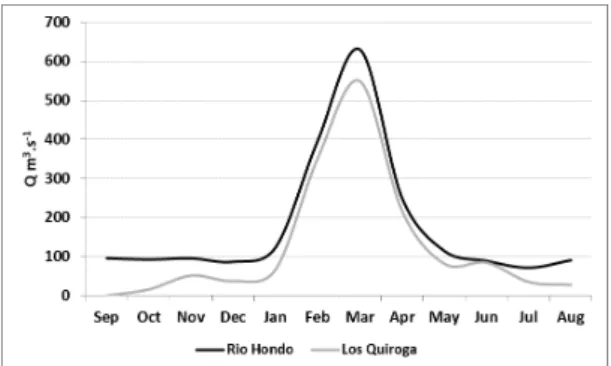
The Dulce River is regulated since 1966 from headwaters by Río Hondo dam with an annual medium discharge of 130 m3.s-1. The peak flows pulse start in November/December reaching the maximum flow in February/March, and the low water level occurs since April to October (Gallego, 2012) .
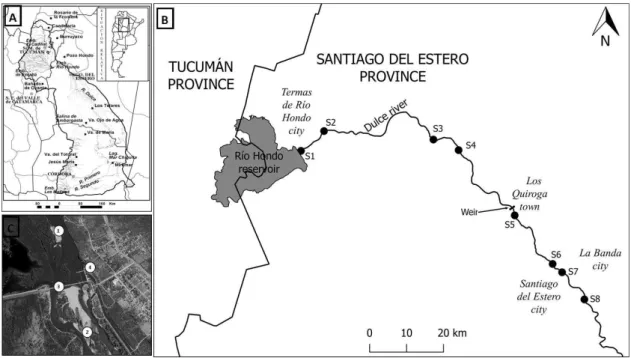
The water use of the Dulce River occurs 50 km downstream at Los Quiroga town, where is located a weir, that by raising water level diverts flow into a network of irrigation channels (Figure 1). From 60 to 80 m3.s-1 are diverting during practically the whole year, with the exception of June when the floodgates are closed in order to carry out their cleaning (Figure 2).
2.2. Sampling
Two reaches were selected in Dulce River, one was placed upstream the weir at Los Quiroga and the other downstream for the assessment of the fluvial discontinuity. Four sites were sampled in each reach (S1-S4 upstream and S5-S8 downstream) in October 1st, 2014 (Figure 1). On each site, the center and the right bank were sampled. Three samples of bottom sediments for assessing benthic invertebrates and one sample for granulometric and bottom organic matter analyses were also collected in each sampling site (center and right bank) with a Rigosha
grab of 100 cm2. The benthic samples were sieved (200 µm mesh size) and fixed in 5% formaldehyde solution in the field.
In each sampling site, temperature (standard thermometer), conductivity and pH (with Hanna checker), dissolved oxygen (Winkler method), BOD5 (incubated 20 °C), transparency with Secchi disc, depth and current velocity (with floats) were measured in the center.
The granulometric composition of each sample (%) was determined using a screening method according to Wentworth scale (1932). The organic content of the sediment samples was determined using ash-free dry-weight method (550 °C for 3 h); the difference between the initial weight of sample and weight after ashing gave the percentage of the organic sediment content.
At the laboratory, macroinvertebrates were sorted from samples under stereoscopic microscope (4X) and then preserved (70% alcohol) for later identification to the lowest possible taxonomic level and counting. The identifications were made using available keys (Brinkhurst & Marchese, 1991; Lopretto & Tell, 1995; Domínguez & Fernández, 2009; Trivinho-Sixtrino, 2011).
2.3. Data analysis
To assess the differences among reaches and sites, environmental variables, invertebrate density, richness and Shannon-Wiener index were subjected to non-parametric analyses of variance
(Kruskal–Wallis test, p<0.05). The analyses were run using InfoStat software (version 2016, Di Rienzo et al. 2016). Beta diversity (spatial species turnover) among the sites upstream and downstream the weir, and between the two reaches was calculated according to Whittaker (1972). The similarity percentage analysis (SIMPER) was used to identify which species contributed to the dissimilarities (Bray-Curtis matrixes) on macroinvertebrate assemblage structure.
Canonical Correspondence Analysis (CCA) (Ter Braak, 1986) was performed with the total set of samples to explore macroinvertebrate distribution in reaches and associations of the assemblages with habitat variables. Redundant variables were removed using a Spearman Rank Correlation comparison method (threshold value: r ≥ 0·6 or r ≤0·6), CCA and SIMPER were performed using the Past Software (version 3.14, Hammer et al., 2015). Only taxa with density >100 ind.m-2 were selected. Abundance data were log10 (x+1) transformed and a Monte Carlo permutation test was performed for determining the significance of eigenvalues derived from the CCA.
3. Results
3.1. Environmental variables
The temperature, conductivity, transparency, depth, discharge and coarse sand percentage presented differences between reaches upstream and downstream according to Kruskal-Wallis results (Table 1). The lowest dissolved oxygen values (3.24 mg.l-1) and the transparency (15 cm) were obtained in S8, where the BOD (18.7 mg.l-1) and conductivity (794 µS.cm-1) reach the maximum value.
The bed substratum was characterized by scarce percentages of gravel with higher values only in the banks of S4 (45%) and S6 (40%) and mainly composed of medium and coarser sands substratum. Finer substrate were dominant in the reach upstream the dam, bank of S2 (65.52%) and center S1 (46.67%), where the highest organic matter values was obtained (1.39% in S2 and 1.26% in S1). 3.2. Macroinvertebrate assemblage structure
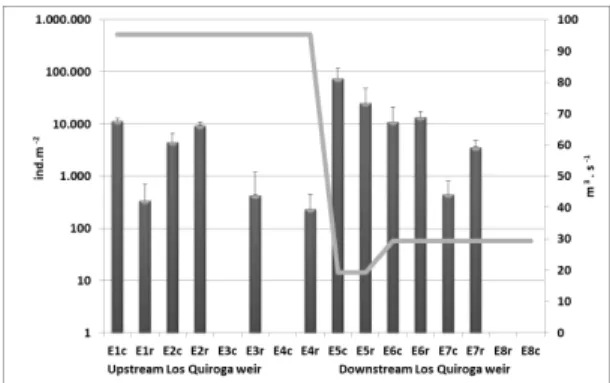
Density, richness and Shannon index did not show significant differences between the upstream and downstream reaches (KW test, p=0.07, p= 0.47 and p=0.87).
However, higher values of density were registered downstream with the maximum obtained in S5 (74 927 (± 42976) ind.m-2 in the center and 25 267 (± 22745) ind.m-2 in the bank (Figure 3).
A total of 66 taxa of macroinvertebrates were identified and composed by Oligochaeta (22 species), Chironomidae (21 genera), other Diptera (6 taxa), Ephemeroptera (4 taxa), Mollusca (2 species), microcrustaceans (3 taxa), and Trichoptera, Psocoptera, Coleoptera, Turbellaria, Nematoda, Hirudinea, Hydridae, Acari (1 taxa each) (Table 2).
It was found that the upstream and downstream sites differed in the macroinvertebrate
Figure 2. Hydrogram corresponding to the period 2014/2015 based on average monthly flows in the Río Hondo dam and the estimated downstream of the weir at Los Quiroga town.
Table 1. Environmental variables analyzed, Mean and Standard Deviation.
Variables Upstream Downstream
T (°C)* 23.50 (±0.58) 27.75 (±2.06)
pH 8.30 (±0.17) 7.99 (±0.78)
Conductivity (µS.cm-1)*
559.00 (±0.24) 641.25 (±101.93)
Oxygen (mg.l-1)
9.33 (±3.78) 7.04 (±3.74)
BOD5 6.01 (±4.81) 8.80 (±8.36)
Transparency (cm)*
80.75 (±10.69) 50.25 (±27.33)
Depth (cm)* 106.50 (±44.96) 56.50 (±17.77) Current velocity
(m.s-1)
0.73 (±0.24) 0.58 (±0.33)
Discharge (m3.s-1)*
95. 16 (±0.0) 26 (±4.9)
Fine sand (%)
17.26 (±21.54) 3.68 (±3.01)
Medium sand (%)
45.07 (±17.53) 50.40 (±5.88)
Coarse sand (%)*
30.63 (±27.59) 43.66 (±6.73)
Gravel (%)
6.57 (±4.43) 9.67 (±14.13)
Organic matter (%)
0.63 (±0.43) 0.39 (±0.05)
composition. The dominant taxa upstream were Limnodrilus hoffmeisteri CLAPAREDE, 1862 and Pristina americana CERNOSVITOV, 1937. Whereas P. menoni (AIYER, 1929), P. longidentata HARMAN, 1965, P. jenkinae (STEPHENSON,
1931), P. sinclytes STEPHENSON, 1925,
Stylaria fossularis LEIDY, 1852, Dero (Dero) obtusa D’UDEKEM, 1855, Stephensoniana trivandrana AIYER, 1926, Slavina sp., Aulodrilus piguetti KOWALEWSKI, 1914, Heleobia sp., Pelomus sp., Endotribelos sp., Hirudinea, Euthyplocidae, and Abtrichia sp. were found only upstream.
Downstream, the dominant taxa were Dicrotendipes sp. and Chironomus sp. The Insecta was
Figure 3. Average density (ind.m-2) of macroinvertebrates sampled in each site and the mean discharge (m3.s-1) corresponding to the previous month to the sampling date. The bars indicate the standard deviation.
Table 2. Average of taxa density (ind.m-2) ± standard deviation in upstream and downstream reach.
Taxa Acronym Upstream Downstream
Ephemeroptera Caenidae Ce 33 (±82) 258 (±731)
Baetidae Be 8 (±15) 35 (±45)
Euthyplocidae Eut 4 (±12) 0
Leptophlebiidae Lep 0 13 (±35)
Diptera Chironomidae Ablabesmyia sp. Abl 0 46 (±130)
Procladius sp. Pro 0 13 (±35)
Djalmabatista sp. Djal 0 42 (±77)
Tanytarsus sp. Tany 0 371 (±707)
Rheotanytarsus sp. Rheo 0 9 (±25)
Caladomyia sp. Cal 0 24 (±58)
Riethia sp. Riet 0 23 (±43)
Dicrotendipes sp. Dicr 71 (±134) 4774 (±8680)
Chironomus sp. Chir 358 (±577) 3912 (±7185)
Goeldichironomus sp. Goel 33 (±64) 8 (±24)
Apedilum sp. Ape 0 13 (±35)
Polypedilum sp. Poly 13 (±25) 882 (±1494)
Endotribelos sp. End 33 (±94) 0
Cryptochironomus sp. Cryp 0 503 (±846)
Parachironomus sp. Para 0 7 (±19)
Pelomus sp. Pel 17 (±47) 0
Harnischia sp. Harn 8 (±24) 17 (±47)
Lopescladius sp. Lop 0 383 (±918)
Oukuriella sp. Ouk 0 4 (±12)
Thienemanniella sp. Thie 0 160 (±253)
Cricotopus sp. Cric 25 (±71) 39 (±60)
Other Dipterans Culicidae Cu 8 (±15) 4 (±12)
Simuliidae Sim 0 7 (±19)
Ceratopogonidae Cer 104 (±124) 193 (±268)
Dolichopodidae Dol 0 21 (±40)
Athericidae Athe 0 4 (±12)
Ephydridae Ephy 0 8 (±24)
Trichoptera Abtrichia sp. Abtr 4 (±12) 0
Coleoptera Georissus sp. Geor 0 4 (±12)
Psocoptera Pso 0 20 (±47)
Acari Hydrachnidia Acar 0 18 (±27)
Crustacea Copepoda Cop 17 (±25) 500 (±1044)
Ostracoda Ostr 13 (±25) 63 (±177)
more frequent and abundant in this reach, mainly the Chironomidae Thienemaniella sp., Tanytarsus sp. Procladius sp., Djalmabatista sp., Caladomyia sp. Riethia sp., Apedilum sp., Cryptochironomus sp. and Lopescladius sp., Ablabesmya sp., Rheotanytarsus sp., Parachironomus sp., Oukuriella sp. The dipterans Simuliidae, Dolichopodidae, Athericidae, Ephydridae; and Psocoptera, Georissus sp., and Acari Hydrachnidia, were also recorded only downstream.
The Ephemeroptera Caenidae and Baetidae and Corbicula fluminea MÜLLER, 1774 (Bivalvia) were mainly associated with downstream sites. Ceratopogonidae was represented in both reaches. Crustacea Copepoda and Ostracoda were more abundant in the downstream reach.
The highest taxa turnover was found among the upstream sites (0.72) and lower among the downstream sites (0.56), whereas between both reaches was 0.73.
SIMPER analysis showed that 7 taxa were responsible by the 70% of the dissimilarity between upstream and downstream reaches: Li m n o d r i l u s h o f f m e i s t e r i (Oligochaeta), Dicrotendipes, Chironomus, Lopescladius and
Polypedilum (Chironomidae); Ceratopogonidae and Corbicula fluminea (Bivalvia) (Table 3).
The CCA grouped benthic samples mainly by reaches (Figure 4). The first two ordination axes explained 46.71% of species-environment relation (Eigenvalues: axis 1: 0.41; axis 2: 0.26) and Monte Carlo permutation test showed that the difference between axes was significant (p =0.001).
Most samples from upstream sites were located on the negative quadrant of the first axis where the most important environmental variables in the ordination were bottom organic matter, dissolved oxygen and discharge and the invertebrates with the highest density were Pristina menoni, P. jenkinae, P.longidentata, P. americana, P. sima, Stephensoniana trivandrana, Slavina sp., Aulodrilus piguetti, Dero obtusa, Nais communis, Bothrioneurum americanum, Pelomus, and Turbellaria. On the other hand samples collected in downstream sites were placed on the positive quadrant (Figure 4), associated to coarser substratum (gravel, coarse and medium sand) and higher density of Lopescladius, Riethia, Apedilum, Caladomya, Dajlmabatista, Tanytarsus,
Table 2. Continued...
Taxa Acronym Upstream Downstream
Cnidaria Hydridae Hyd 96 (±258) 204 (±577)
Turbellaria Turb 292 (±569) 78 (±211)
Nematoda Nem 83 (±236) 64 (±88)
Mollusca Gastropoda Heleobia sp Hel 17 (±47) 0
Bivalvia Corbicula fluminea Corb 21 (±35) 159 (±259)
Hirudinea Hir 8 (±15) 0
Oligochaeta Chaetogaster diaphanus Cdf 88 (±234) 1296 (±3652)
Ch. diastrophus Cds 21 (±47) 46 (±130)
Dero obtusa Dob 92 (±201) 0
D. pectinata Dpe 8 (±24) 0
Dero sp. Dsp 17 (±31) 0
D. sawayai Dsw 4 (±12) 0
Stylaria fossularis Sf 38 (±52) 0
Slavina sp. Slav 13 (±35) 0
Nais comunis Nco 121 (±244) 7 (±14)
N. variabilis Nva 21 (±59) 310 (±792)
Pristina americana Pam 383 (±945) 0
P. jenkinae Pje 33 (±64) 0
P. longidentata Plo 29 (±82) 0
P. menoni Pme 54 (±110) 0
P. notopora Pno 8 (±24) 0
P. osborni Pos 38 (±70) 32 (±54)
P. sima Psi 0 7 (±19)
P. sinclytes Psin 38 (±106) 0
Stephensoniana trivandrana Steph 88 (±247) 0
Aulodrilus piguetti Api 13 (±25) 0
Bothrioneurum americanum Bam 96 (±133) 82 (±211)
Harnischia, Baetidae, Nematoda and Corbicula fluminea (Figure 4).
4. Discussion
The longitudinal connectivity in fluvial system disrupted by dam construction of different size, including weirs, alter the physical and chemical conditions downstream, influencing habitat availability, which will be reflected in changes of macroinvertebrates structure (Poff & Hart, 2002; Tupinambás et al., 2015). In coincidence with Dewson et al. (2007a) the water abstraction decreased water velocity and depth downstream of the weir in the fluvial system of the Río Dulce. Increase of sedimentation rate and finer sediments deposition upstream are often a consequence of flow regulation in small impoundments and substrate
size increases below low dams (Fencl et al., 2015). We obtained similar results with finer substratum and higher bottom organic matter in the upstream reach and coarser substratum downstream. However, changes in size substratum and depth around dams depend on many local factors, such as, spatial patterns of channel morphology and sedimentation can decrease because suspended sediment levels in the water decrease because of the presence of aquatic plants that accumulate sediment (Bond 2004; Skalak et al., 2009; Csiki & Rhoads, 2014). Despite it was expected a decrease in the number of taxa downstream of the weir, we did not found significant differences in richness between upstream and downstream reaches. Nevertheless, the taxonomic composition was different with more richness and density of Insecta downstream
Table 3. Macroinvertebrates contributing to dissimilarity (SIMPER analysis) between upstream and downstream reaches of the weir, and among the sites in both reaches.
Taxa Between reaches Upstream Downstream
Contribution % Contribution % Contribution %
Limnodrilus hoffmeisteri 18.19 22.41 13.21
Dicrotendipes 15.02 1.75 26.24
Chironomus 14.54 14.76 28.69
Lopescladius 9.47 0 0.45
Ceratopogonidae 6.27 0.95 1.33
Polypedilum 5.22 0.17 3.72
Corbicula fluminea 2.97 0.2 1.02
compared to upstream, mainly taxa of short life cycle preferring coarse substratum and low organic matter deposition.
Some authors have reported changes in benthic taxonomic composition due to alteration of fluvial habitats by effect of large dams (Gumiero & Salmoiraghi, 1998; Growns & Growns, 2001; Lessard & Hayes, 2003; Dewson et al., 2007b; Poff & Zimmerman, 2010) but others found a relatively minor impact of small dams on the river biota in downstream reaches (Sharma et al., 2005; Ambers, 2007; Principe, 2010). The higher density found downstream (but not significantly different) could be associated with flow regime variability, with the low or reduced flow benefiting the periphyton development and benthic algal biomass in gravel-bed rivers (Suren et al., 2003; Biggs et al., 2005). Therefore, increases in food resources can cause invertebrate densities to increase. However, investigators have found both positive and negative relationships between low flows, substratum particle size and density (Rabeni, et al., 2005; Dewson et al., 2007a; Eedy & Giberson 2007).
Our results are similar to previous studies reported by Maroneze et al. (2011) where density and richness increase when the flows is reduced with dominance of Chironomidae and decrease of Oligochaeta. The Oligochaeta species replacement in the Dulce River upstream and Chironomidae downstream is a result of the disturbance that occurs for the abstraction and water deviation. The CCA results showed that habitat type was the most important source of variation of faunal composition, being substrate composition and discharge the environmental variables affecting the ordination. Upstream was characterized by deeply habitat, finer substratum and high organic matter and Oligochaeta showed a close association with this reach. Downstream reach was characterized by coarse -medium sands, low variation in flow, high green algal mat biomass and Chironomidae and Ephemeroptera were associated with this reach. These habitats produced by hiydrogeomorphologic changes in the river system may be recolonized by organisms of short life cycle (e.g. Diptera), as it has already been reported (Maitland, 1990; Erskine et al., 1999).
The colonization of new habitats depend on the organism dispersion capacity, as passive drift decreases in response to low water velocities during periods of low flow (Bilton et al., 2001; Cañedo-Argüelles et al., 2015; Tonkin et al., 2016), but many studies have shown that active
drift increases during periods of low flow (Poff & Ward, 1991). In addition, Walters & Post (2011) concluded that the behavioral responses and the relative mobility of aquatic insects are important in understanding the impacts of flow reduction, as they found decreased biomass, shifts in density of aquatic insect families with significantly increase densities of more mobile insects.
The flow regulation is a dominant factor organizing stream communities and water diversion constitutes barriers that disrupt connectivity of lotic ecosystems and may generate discontinuities in the structure of biological communities. This study finds support for this in that the low-flow disturbance had effects on the composition on the benthic invertebrate assemblages, but also attributes (such as density and richness) showed a lower variability probably because of taxa replacement.
Acknowledgements
This study was supported by a fellowship gave to the first author by Consejo Nacional de Investigaciones Científicas y Técnicas (CONICET) and Universidad Nacional de Santiago del Estero, Argentina. We also thank P. A. Pamplin for Portuguese abstract.
References
AMBERS, R.K.R. Effects of a small, century-old dam on a second order stream in the Virginia piedmont.
Southeastern Geographer, 2007, 47(2), 181-201. http://dx.doi.org/10.1353/sgo.2007.0018. AMOROS, C. and ROUX, A.L. Interaction between
water bodies within the floodplains of large rivers: function and development of connectivity.
Münstersche Geographische Arbeiten, 1988, 1(29), 125-130.
ARTHINGTON, A.H., BUNN, S.E., POFF, N.L. and NAIMAN, R.J. The challenge of providing environmental flow rules to sustain river ecosystems.
Ecological Applications, 2006, 16(4), 1311-1318. PMid:16937799. http://dx.doi.org/10.1890/1051-0761(2006)016[1311:TCOPEF]2.0.CO;2. ARTHINGTON, A.H., NAIMAN, R.J., MC CLAIN,
M.E. and NILSSON, C. Preserving the biodiversity and ecological services of rivers: new challenges and research opportunities. Freshwater Biology, 2010, 55(1), 1-16. http://dx.doi.org/10.1111/j.1365-2427.2009.02340.x.
BILTON, D.T., FREELAND, J.R. and OKAMURA, B. Dispersal in freshwater invertebrates. Annual Review of Ecology and Systematics, 2001, 32(1), 159-181. http://dx.doi.org/10.1146/annurev. ecolsys.32.081501.114016.
BOND, N.R. Spatial variation in fine sediment transport in small upland streams: the effects of flow regulation and catchment geology. River Research and Applications, 2004, 20(6), 705-717. http://dx.doi. org/10.1002/rra.787.
BRINKHURST, R. and MARCHESE, M. Guía para la identificación de oligoquetos acuáticos continentales de Sud y Centro América. 2nd ed. Santo Tomé: Asociación Ciencias Naturales del Litoral, 1991. BROWN, A. and PACHECO, P. Propuesta de
actualización del mapa ecorregional de la Argentina. In: A. BROWN, U. MARTÍNEZ ORTIZ, M. ACERBI and J. CORCUERA, eds. La situación ambiental argentina. 2005, pp. 28-31.
BUNN, S.E. and ARTHINGTON, A.H. Basic principles and ecological consequences of altered flow regimes for aquatic biodiversity. Environmental Management, 2002, 30(4), 492-507. PMid:12481916. http:// dx.doi.org/10.1007/s00267-002-2737-0.
BURKART, R., BÁRBARO, N., SÁNCHEZ, R. and GÓMEZ, D. Eco-regiones de la Argentina. Argentina: Secretaría de Recursos Naturales y Desarrollo Sostenible, Presidencia de la Nación Argentina, 1999. CAÑEDO ARGÜELLES, M., BOERSMA, K.S.,
BOGAN, M.T., OLDEN, J.D., PHILLIPSEN, I., SCHRIEVER, T.A. and LYTLE, D.A. Dispersal strength determines meta-community structure in a dendritic riverine network. Journal of Biogeography, 2015, 42(4), 778-790. http://dx.doi.org/10.1111/ jbi.12457.
CSIKI, S.R. and RHOADS, B.L. Influence of four run-of-river dams on channel morphology and sediment characteristics in Illinois, USA. Geomorphology, 2014, 206, 215-229. http://dx.doi.org/10.1016/j. geomorph.2013.10.009.
DEWSON, Z., JAMES, A. and DEATH, R. Stream ecosystem functioning under reduced flow.
Ecological Applications, 2007b, 17(6), 1797-1808. PMid:17913141. http://dx.doi.org/10.1890/06-1901.1.
DEWSON, Z.S., JAMES, A.B.W. and DEATH, R.G. A review of the consequences of decreased flow for instream habitat and macroinvertebrates. Journal of the North American Benthological Society, 2007a, 26(3), 401-415. http://dx.doi.org/10.1899/06-110.1.
DI RIENZO, J.A., CASANOVES, F., BALZARINI, M.G., GONZALEZ, L., TABLADA, M. and ROBLEDO, C.W. InfoStat versión 2016 [online], 2016 [viewed 24 Jan. 2017]. Argentina: Grupo
InfoStat, FCA, Universidad Nacional de Córdoba. Available from: http://www.infostat.com.ar
D O M I N G U E Z , E. and F E R N Á N D E Z , H.
Macroinvertebrados bentónicos sudamericanos. San Miguel de Tucumán: Fundación Miguel Lillo, 2009. EEDY, R.I. and GIBERSON, D.J. Macroinvertebrate
distribution in a reach of a north temperate eastern Canadian river: Relative importance of detritus, substrate and flow.Archiv für Hydrobiologie, 2007, 169(2), 101-114. http://dx.doi.org/10.1127/1863-9135/2007/0169-0101.
E R S K I N E , W.D., T E R R A Z ZO LO , N. and WARNER, R.F. River rehabilitation from the hidrogeomorphic impacts of a large hidro-electric power Project: Snowy River, Australia.
Regulated Rivers: Research and Management, 1999, 15(1-3), 3-24. http://dx.doi.org/10.1002/ (SICI)1099-1646(199901/06)15:1/3<3::AID-RRR532>3.0.CO;2-R.
FENCL, J.S., MATHER, M.E., COSTIGAN, K.H. and DANIELS, M.D. How big of an effect do small dams have? Using geomorphological footprints to quantify spatial impact of low-head dams and identify patterns of across-dam variation. PLoS One, 2015, 10(11), 141-210. PMid:26540105. http://dx.doi. org/10.1371/journal.pone.0141210.
GALLEGO, A. Santiago del Estero y el agua: crónica de una relación controvertida. Santiago del Estero: Editorial Lucrecia, 2012.
GROWNS, I.O. and GROWNS, J.E. Ecological effects of flow regulation on macroinvertebrate and periphytic diatom assemblages in the Hawkesbury – Nepean River, Australia. Regulated Rivers: Research and Management, 2001, 17(3), 275-293. http:// dx.doi.org/10.1002/rrr.622.
GUMIERO, B. and SALMOIRAGHI, G. Influence of an impoundment on benthic macroinvertebrate habitat utilization. Verhandlungen des Internationalen Verein Limnologie, 1998, 26, 2063-2069.
HAMMER, Ø., HARPER, D.A.T. and RYAN, P.D. PAST: paleontological statistics software package for education and data analysis. Palaeontologia Electronica, 2015, 4(1), 1-9.
LESSARD, J.L. and HAYES, D.B. Effects of elevated water temperature on fish and macroinvertebrate communities below small dams. River Research and Applications, 2003, 19(7), 721-732. http://dx.doi. org/10.1002/rra.713.
LOPRETTO, E. and TELL, G. Ecosistemas de aguas continentales: metodologías para su estudio. La Plata: Ediciones SUR, 1995.
MAITLAND, P.S. Communities and energy flow. In: P.S. MAITLAND. Biology of fresh waters. Netherlands: Springer, 1990, p. 176-200.
and spillways on the composition and structure of benthic macroinvertebrate communities in a Brazilian river reach. Brazilian Journal of Biology = Revista Brasileira de Biologia, 2011, 71(3), 639-651. PMid:21881787. http://dx.doi.org/10.1590/S1519-69842011000400008.
PE N N I N G TO N, R.T., P R A D O, D.E. and PENDRY, C.A. Neotropical seasonally dry forests and Quaternary vegetation changes. Journal of Biogeography, 2000, 27(2), 261-273. http://dx.doi. org/10.1046/j.1365-2699.2000.00397.x.
POFF NL, HART DD. 2002. How dams vary and why it matters for the emerging science of dam removal. Bioscience, 52: 659-668. http://dx.doi. org/10.1641/0006-3568(2002)052[0659:HDVA WI]2.0.CO;2.
POFF NL, WARD JV. 1991. Drift responses of benthic invertebrates to experimental streamflow variation in a hydrologically stable stream. Canadian Journal of Fisheries and Aquatic Sciences, 48: 1926-1936. http:// dx.doi.org/10.1139/f91-229.
POFF, N.L. and ZIMMERMAN, J.K.H. Ecological responses to altered flow regimes: a literature review to inform the science and management of environmental flows. Freshwater Biology, 2010, 55(1), 194-205. http://dx.doi.org/10.1111/j.1365-2427.2009.02272.x.
POFF, N.L., ALLAN, J.D., BAIN, M.B., KARR, J.R., PRESTEGAARD, K.L., RICHTER, B.D., SPARKS, R.E. and STROMBERG, J.C. The natural flow regime. Bioscience, 1997, 47(11), 769-784. http://dx.doi.org/10.2307/1313099.
PRINCIPE, R.E. Ecological effects of small dams on benthic macroinvertebrate communities of mountain streams (Córdoba, Argentina). Annales de Limnologie-International Journal of Limnology, 2010, 46(2), 77-91. http://dx.doi.org/10.1051/limn/2010010. RABENI, C.F., DOISY, K.E. and ZWEIG, L.D. Stream
invertebrate community functional responses to deposited sediment. Aquatic Sciences, 2005, 67(4), 395-402. http://dx.doi.org/10.1007/s00027-005-0793-2.
RESH, V.H., BROWN, A.V., COVICH, A.P., GURTZ, M.E., LI, H.W., MINSHALL, G.W., REICE, S.R., SHELDON, A.L., WALLACE, J.B. and WISSMAR, R.C. The Role of Disturbance in Stream Ecology. Journal of the North American Benthological Society, 2013, 7(4), 433-455. http:// dx.doi.org/10.2307/1467300.
RO S E N B E RG , D . M . , M C C U L LY, P. a n d PRINGLE, C.M. Global-scale environmental effects of hydrological alterations: introduction.
Bioscience, 2000, 50(9), 746-751. http://dx.doi. org/10.1641/0006-3568(2000)050[0746:GSEEO H]2.0.CO;2.
SHARMA, C.M., SHARMA, S., BORGSTROM, R. and BRYCESON, I. Impacts of a small dam on macroinvertebrates: A case study in the
Tinau River, Nepal. Aquatic Ecosystem Health & Management, 2005, 8(3), 267-275. http://dx.doi. org/10.1080/14634980500218332.
SKALAK, K., PIZZUTO, J. and HART, D.D. Influence of small dams on downstream channel characteristics in Pennsylvania and Maryland: implications for the long-term geomorphic effects of dam removal.
Journal of the American Water Resources Association, 2009, 45(1), 97-109. http://dx.doi.org/10.1111/ j.1752-1688.2008.00263.x.
SUEN, J.P. and EHEART, J.W. Reservoir management to balance ecosystem and human needs: incorporating the paradigm of the ecological flow regime. Water Resources Research, 2006, 42(3), 1-9. http://dx.doi. org/10.1029/2005WR004314.
SUREN, A.M., BIGGS, B.J.F., KILROY, C. and BERGEY, L. Benthic community dynamics during summer low-flows in two rivers of contrasting enrichment 1. Periphyton. New Zealand Journal of Marine and Freshwater Research, 2003, 37(1), 53-70. http://dx.doi.org/10.1080/00288330.2003 .9517146.
TER BRAAK, C.J.F. Canonical correspondence analysis: a new eigenvector technique for multivariate direct gradient analysis. Ecology, 1986, 67(5), 1167-1179. http://dx.doi.org/10.2307/1938672.
TONKIN, J.D., STOLL, S., JÄHNIG, S.C. and HAASE, P. Contrasting metacommunity structure and beta diversity in an aquatic-floodplain system.
Oikos, 2016, 125(5), 686-697. http://dx.doi. org/10.1111/oik.02717.
TRIVINHO-SIXTRINO, S. Larvas de Chironomidae: guia de identificação. São Carlos: Universidad Federal de São Carlos, 2011.
TUPINAMBÁS, T.H., CORTES, R.M.V., HUGHES, S.J., VARANDAS, S.G. and CALLISTO, M. Macroinvertebrate responses to distinct hydrological patterns in a tropical regulated river. Ecohydrology, 2015, 9(3), 460-471. http://dx.doi.org/10.1002/ eco.1649.
WALTERS, A. and POST, D.M. How low can you go? Impacts of a low flow disturbance on aquatic insect communities. Ecological Applications, 2011, 21(1), 163-174. PMid:21516895. http://dx.doi. org/10.1890/09-2323.1.
WARD JV, STANFORD JA. 1983. The serial discontinuity concept of lotic ecosystems. Dynamics of Lotic Ecosystems, 10: 29-42.
WHITTAKER RH. 1972. Evolution and measurement of species diversity. Taxon, 21: 213-251. http:// dx.doi.org/10.2307/1218190.