Revista Gaúcha
de Enfermagem
DOI: http://dx.doi.org/10.1590/1983-1447.2015.03.50032
Preference and factors associated with
the type of delivery among new
mothers in a public maternity hospital
Preferência e fatores associados ao tipo de parto entre puérperas de uma maternidade pública
Preferencia y factores associados al tipo de parto entre parturientas de una maternidad
a Universidade do Estado do Rio Grande do Norte (UERN). Caicó, Rio Grande do Norte, Brasil. b Universidade do Estado do Rio Grande do Norte (UERN). Curso de Graduação em Enfermagem. Curso de Graduação em Odontologia. Caicó, Rio Grande do Norte, Brasil.
c Universidade do Estado do Rio Grande do Norte (UERN). Curso de Graduação em Enfermagem. Caicó, Rio Grande do Norte, Brasil.
d Universidade Federal do Rio Grande do Norte (UFRN). Natal, Rio Grande do Norte, Brasil. Luana Dantas Valea
Eudes Euler de Souza Lucenab
Cristyanne Samara Miranda de Holandac
Rosângela Diniz Cavalcantec
Marquiony Marques dos Santosd
ABSTRACT
Objective: To identify reproductive and socioeconomic factors that infl uence the preference for a method of childbirth.
Method: Data were collected using semi-structured interviews with 233 women in postpartum care. Data were analyzed using association tests, namely the Chi-square test and multiple logistic regression.
Results: The preference for vaginal childbirth was cited by 58% of women. The main reasons for this preference were quick post-partum recovery, a negative experience in Caesarean childbirth and fulfi lment through motherhood. Analysis of the logistic models of preference for vaginal delivery according to the independent variables revealed a greater occurrence in women who had previous experience of this type of delivery (PR: 1.91; CI: 1.15-3.17) and had received prior guidance (PR: 1.76; CI: 1.06-2.90).
Conclusion: Findings highlight the need to transform the model of care provided during pregnancy and childbirth.
Keywords: Parturition. Perception. Women’s health.
RESUMO
Objetivo: Identifi car os fatores obstétricos e socioeconômicos que infl uenciam a preferência pelo tipo de parto. A coleta de dados se deu por meio de entrevista semiestruturada com 233 puérperas.
Método: Analisaram-se os dados por meio dos testes de associação do tipo teste qui-quadrado e regressão logística múltipla.
Resultados: A preferência pelo parto vaginal foi citada por 58% das mulheres. As principais justifi cativas que apontaram essa pre-ferência foram a recuperação pós-parto rápida, experiência negativa no parto cesáreo e realização pessoal a partir da maternidade. Ao analisar o modelo de regressão logística da preferência pelo parto vaginal em função das variáveis independentes, evidenciou-se maior ocorrência nas mulheres que tiveram experiência anterior desse tipo de parto (RP: 1,91; IC: 1,15-3,17) e orientação prévia (RP: 1,76; IC:1,06-2,90).
Conclusão: Achados evidenciam necessidade de transformação no modelo de atenção à gestação e ao parto.
Palavras-chave: Parto. Percepção. Saúde da mulher.
RESUMEN
Objetivo: Identifi car los factores reproductivos y socioeconómicos infl uyen la preferencia por el tipo de parto. La recolección de datos se realizó mediante entrevista semiestructurada a 233 parturientas.
Método: Fue utilizado el análisis la asociación de tipo test qui-cuadrado y regresión logística múltiple.
Resultados: La preferencia por el parto vaginal fue nombrada por el 58% de las mujeres. Los principales motivos que justifi caron esta preferencia fueron: recuperación postparto rápida, experiencia negativa con la cesárea y realización personal a partir de la mater-nidad. Al analizar el modelo de regresión logística de la preferencia por el parto vaginal en función de las variables independientes, destacó la mayor frecuencia en mujeres que tuvieron experiencia anterior de este tipo de parto (RP: 1,91; IC: 1,15-3,17), así como orientación previa (RP: 1,76; IC: 1,06-2,90).
Conclusión: Los resultados de este estudio indican la necesidad de transformar el modelo de atención a la gestación y el parto, a través de iniciativas que incluyan acciones de preparación al parto.
INTRODUCTION
Since the 1970s, there has been an increase of interfer-ence in the process of birth in hospitals that has led to a higher number of surgical births, the active management of labour, the routine performance of episiotomy and the absence of companions during this moment(1).
With the institutionalization of labour and the intro-duction of new actors in this process, a new model of as-sistance was established that is leading to the increasing performance of interventions. This trend also reveals the existence of a model of care provided at birth and the rou-tine use of interventionist practices that result in high rates of Caesarean sections(2).
The Ministry of Health encourages normal childbirth, the reduction of unnecessary C-sections and the recov-ery of childbirth as a physiological act. However, Brazil still has one of the highest rates of Caesarean section in the world. This reality can be justified by scientific ad-vancements in the field of obstetrics and improved sur-gical techniques. Other possible reasons are the fear of pain linked to vaginal birth, the possibility of scheduling childbirth, surgical sterilization, prior Caesarean delivery, fear of injuries to the anatomy and physiology of the va-gina, and the belief that vaginal birth is riskier and that Caesarean childbirth is painless(2-3). In addition, another cause of the growing number of C-sections in Brazil, as in other countries, is the preference of women for this type of delivery(4).
The process of choosing the type of delivery is complex and controversial(5) and can be infl uenced by professionals, patients and their relatives, health institutions, and others. It is therefore necessary to closely observe and better un-derstand the process of choosing a method of childbirth in diff erent locations. This is especially necessary in Brazil due to the extensive social heterogeneity of Brazilian regions.
Although literature presents important data that can shed further light on the factors that determine the preference for a childbirth method, related studies on the predictors of women residing in areas with high social inequality and a low human development index are scarce. Studies that improve childbirth assistance are essential for the better elaboration of public health policies that help reduce the alarming rate of Caesarean delivery in the country, especially in areas far from large urban centres.
In light of this requirement, the assumption is that the high rate of Caesarean births in Brazil is infl uencing the im-age women construct around the idea of the birth meth-od. Reasons such as the fear of pain associated to normal
birth, the belief that the Caesarean delivery is less painful and less risky for the mother and her newborn, lack of due preparation during prenatal care and labour, or the pref-erence of obstetricians for Caesarean section because it is less time-consuming, seem to infl uence the choice of this childbirth method.
Consequently, the aim of this paper is to analyze the preference for childbirth methods and verify asso-ciations with obstetric and socioeconomic factors in a benchmark public maternity hospital in the State of Rio Grande do Norte.
METHODS
This is a cross-sectional study conducted at a public maternity hospital that is a benchmark in deliveries in the city of Caicó/RN and surrounding cities. Cross-sectional studies are investigations that produce “snapshots” of the health of a population or community based on an individ-ual assessment of the health status of each of the members of the investigated group(6).
The population defi ned for this study was women in the puerperium. The criteria for inclusion were women who had given vaginal birth 18 hours previously or more; women who had undergone a Caesarean section 24 hours previously; and women who were between 13 and 40 years of age. Although adolescents are confi gured as a vulnera-ble group, they were included in this study due to the high number of pregnant adolescents. They accounted for 18% of all the pregnant women registered at the SISPRENATAL in 2010 in the State of Rio Grande do Norte, while women ≥ 40 years were less frequent.
The births registry of the institution reported 450 nor-mal births and 645 Caesarean births in the year preceding the study. The indicator of proportion of women who had normal childbirth was employed to calculate the sample, as this group was smaller in number. The prevalence of normal childbirth of 42% in a fi nite population of 1,095 pregnant women the year before the investigation was considered to calculate the sample. The employed pa-rameters were type I errors at 5% and type II errors at 20%. The result was multiplied by 1.5% as a non-response rate, obtaining a number of 233 women. The strategy of allocating the participants was for convenience purpos-es, since they were the volunteers who had given birth during the data collection period.
wage, one to two minimum wages, three to four minimum wages, fi ve or more minimum wages), education (illiter-ate, incomplete primary school, fi nished primary school, incomplete secondary school, fi nished secondary school, incomplete higher education, fi nished higher education), marital status (single, married, divorced, common-law mar-riage); and the following obstetric variables: antenatal con-sultation, type of previous birth (for multiparous women), gestational age, complications of childbirth (dystocia and dehiscence), a professional who provided prenatal care (doctor and nurse), number of pre-natal consultations, complications during pregnancy (yes/no), current labour method (normal, C-section or forceps), and prior guidance on the labour process. These variables were used to cre-ate closed questions, with the option of “other” for cases in which the available options were not accurate.
The interview was applied with the new mothers who were willing to participate in the survey after signing an informed consent statement, at the nursing sector of the maternity ward and in the individual rooms in the private sector of the hospital.
Data were analysed using the Statistical Package for So-cial Sciences (SPSS) version 20.0. Once the database was structured, a descriptive analysis of the data was initially carried out based on the socioeconomic and reproduc-tive variables. The association between the preference for type of childbirth and socioeconomic and reproductive variables was verifi ed using the Chi-square statistical test. To check the magnitude of these associations, we used the Prevalence Ratios (PR) and their respective Confi dence In-tervals (95%).
To meet the predictors, logistic regression was used through hierarchical analysis (forward) to estimate the prevalence of a preference for a method of delivery. Mod-elling was initiated by the most signifi cant variables, and then the other variables were added one by one, accepting a p value of critical <0.20 to compose the model. The per-manence of the variable in multiple analysis was based on the Likelihood Ratio Test, absence of multicolinearity, and its capacity to improve the model using the Hosmer-Leme-show test. Finally, residue was analysed to isolate the cases that had undue infl uence on the model, causing little ad-herence. The signifi cance level of 5% was adopted for all the tests.
The ethical aspects of research involving human be-ings were observed, pursuant to Resolution No. 466/2012. The research project was submitted to the Research Ethics Committee of the Universidade do Estado do Rio Grande do Norte - UERN and approved with protocol number 0060.0.428.428-11 (CAAE).
RESULTS
In all, data from 233 recent mothers were collected. Of the women participating in the study, 111 (47.6%) were un-employed, 89 (38.2%) had completed their secondary edu-cation, 152 (65.2%) were married or in a common-law mar-riage, and 133 (57.1%) had a household income of one to two minimum wages. The average age of the new mothers was 24 years (Table 1).
More than half of the population in the survey were fi rst-time mothers (51.2%). Among the participants with previous birth history, most of them had the experience of vaginal birth (56.8%). Of the 233 new mothers, 184 (79%) reported having attended at least six prenatal consulta-tions. However, 110 (47.2%) of them did not receive any guidance on childbirth during the consultations with the doctor or nurse.
Of the total 233 deliveries, 131 (56.2%) were C-sections and 102 (43.8%) were vaginal births. The average gestation-al age at time of delivery was around 39 weeks.
With respect to professionals who provided pre-natal care, the nurses provided 55.4% of the consul-tations, doctors provided 30% of the consulconsul-tations, and 14.6% of the consultations were provided by both professionals. The preference for vaginal childbirth was quoted by 135 women (58%). The justifications for the preference for normal childbirth included faster post-partum recovery and negative experience in the Cae-sarean postpartum. The desire for CaeCae-sarean section was related to the fear of the pain, insecurity in relation to local assistance, negative normal birth experiences, the desire to have tubal ligation and positive Caesare-an birth experiences.
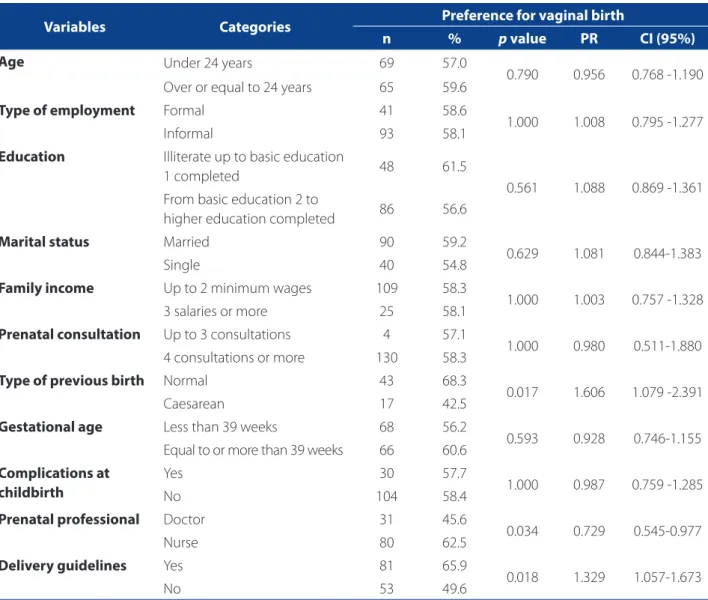
In terms of association, there was no relationship between the variable age, job type, education, marital status, income, number of prenatal consultations and gestational age with the variable preference for vaginal delivery. On the other hand, the preference for vaginal birth was associated with previous normal delivery, showing a prevalence of 60.60% over previous Caesare-an births; who received prior guidCaesare-ance (33.9%) in com-parison to those who did not receive prior guidance; and among the women who received pre-natal care from the physician had a “protection” factor of 27.1% to not prefer vaginal birth (Table 2).
DISCUSSION
In this study, there was a higher prevalence of Cae-sarean section, although the preference for vaginal birth was cited by 135 (58%) of the interviewed women, which agrees with other authors(7) who indicated that vaginal birth is desired by 82.1% of new mothers. The study Nascer no Brasil showed that approximately 66% of the respon-dents preferred vaginal birth at the beginning of pregnan-cy, 27.6% reported preference for Caesarean delivery and 6.1% did not have a well-defi ned preference(4).
The reasons presented by the women who prefer vag-inal birth are diverse(8). Some claim that it is due to bet-ter postpartum recovery in comparison with Caesarean section, while others ascribe this preference not only to faster recovery, but also to possible complications during Caesarean section. On the other hand, the justifi cations presented for the preference for Caesarean delivery are
fear of pain and Caesarean section as a convenience for tubal sterilization(4-9).
An investigation on the aspects related to the prefer-ence for a given type of delivery concluded that the fear of pain, the experience of friends and the possibility of vaginal injuries were singled out by women as being some of the reasons for the preference for Caesarean birth(5).
This indicates that the assumption that C-section is quick and painless is widespread in society. It is oftentimes presented as the best method of childbirth, and is defend-ed by some actors in this process, such as health services, professionals, families, and others, among others, who use this conception to justify the intervention to themselves and to others(5).
According to the Ministry of Health, labour and birth assistance is strongly marked by intense medicalization, as well as unnecessary and potentially iatrogenic inter-ference(2-10). Corroborating this fact, the occurrence of
Variables Categories Caesarean Normal
N % n %
Employment Employed 42 18 30 12.9
Unemployed 60 25.7 51 21.9
Self-employed 11 4.7 5 2.1
Other 18 7.7 16 6.9
Education Illiterate 0 0 3 1.3
Did not fi nish primary school 21 9 30 12.9
Finished primary school 10 4.3 15 6.4
Did not fi nish secondary school 29 12.4 17 7.7
Finished secondary school 55 23.6 34 14.6
Did not fi nish university 10 4.3 0 0
Finished university 6 2.6 2 0.9
Marital status Married 42 18 20 8.6
Single 45 19.3 31 13.3
Common-law marriage 42 18 48 20.6
Divorced 2 0.9 3 1.3
Family income Up to 1 minimum wage 26 11.1 30 12.9
1-2 minimum wages 72 30.9 61 26.2
3-4 minimum wages 28 12 11 4.7
5 minimum wages or more 5 2.1 0 0
Total 131 56.2 102 43.8
Table 1 – Socioeconomic profi le of the new mothers of a public maternity ward, according to the delivery method. Caicó/ RN, 2014
Caesarean section in this research is well above the levels stipulated by the World Health Organization (15%). In a study carried out in hospitals in the states of São Paulo, Pernambuco and Distrito Federal(11), the proportion of this method was 30.1%. This trend was also detected in a national survey, where the proportion of Caesarean de-liveries was much greater than the desire of the women for this intervention. In fact, it was approximately three times greater than the initially referred preference, both in the private and public sector(4). A high rate of Caesare-an sections are particularly worrying in fi rst-time mothers because it reinforces the idea of a greater possibility of future Caesarean sections, considering that, in practice, a prior Caesarean section is confi gured as an almost abso-lute indication for a new C-section(5).
It is worth mentioning that fear of vaginal birth is also associated, in a more masked manner, with the care provid-ed during labour and birth to the women and their fami-lies. A study conducted with healthcare professionals from three institutions in the city of Cuiabá, Mato Grosso, with re-gard to the humanized practices advocated by Ministry of Health(2), showed that the humanization of childbirth and birth assistance is not yet a reality. Although professionals have a clear idea of the main aspects of humanization, they admit having diffi culties in changing their care practices(10). With regard to women who already had a history of vaginal birth, it was found that they prefer this method for a possible second pregnancy at a rate of 60% higher than those who had previously had a Caesarean birth. Literature shows that women who deliver by vaginal birth have a
Variables Categories Preference for vaginal birth
n % p value PR CI (95%)
Age Under 24 years 69 57.0
0.790 0.956 0.768 -1.190
Over or equal to 24 years 65 59.6
Type of employment Formal 41 58.6
1.000 1.008 0.795 -1.277
Informal 93 58.1
Education Illiterate up to basic education
1 completed 48 61.5
0.561 1.088 0.869 -1.361
From basic education 2 to
higher education completed 86 56.6
Marital status Married 90 59.2
0.629 1.081 0.844-1.383
Single 40 54.8
Family income Up to 2 minimum wages 109 58.3
1.000 1.003 0.757 -1.328
3 salaries or more 25 58.1
Prenatal consultation Up to 3 consultations 4 57.1
1.000 0.980 0.511-1.880
4 consultations or more 130 58.3
Type of previous birth Normal 43 68.3
0.017 1.606 1.079 -2.391
Caesarean 17 42.5
Gestational age Less than 39 weeks 68 56.2
0.593 0.928 0.746-1.155
Equal to or more than 39 weeks 66 60.6
Complications at childbirth
Yes 30 57.7
1.000 0.987 0.759 -1.285
No 104 58.4
Prenatal professional Doctor 31 45.6
0.034 0.729 0.545-0.977
Nurse 80 62.5
Delivery guidelines Yes 81 65.9
0.018 1.329 1.057-1.673
No 53 49.6
Table 2 – Association of preference for vaginal birth with the socioeconomic and obstetric variables. Caicó/RN, 2014
clear preference (85.3%) for this same method. The expe-rience of previous births is confi gured as a strong element that infl uences the current decision on the method of de-livery. These women also claim that if the prior experience of childbirth was positive, it becomes their fi rst preference for later deliveries, and if negative, the experience leaves marks that reinforces their fears and concerns(9).
In the group that preferred vaginal birth, most of the participants also claimed they had been exclusively accompanied by a professional nurse and had received prior guidance on labour during prenatal care. However, in the multivariate analysis model, this variable was not signifi cant.
It is possible to affi rm that the nurse, a member of the multidisciplinary team, is confi gured as one of the health professionals to encourage vaginal birth, promote the ex-pression of sensitivity, subjectivity and intersubjectivity in the care environment, stimulate the physiology of birth, al-low female protagonism, and respect their citizenship and their human and reproductive rights(12).
This study shows that the participation of professional nurses in prenatal care can contribute to improve compli-ance with actions recommended by the Labour and Birth Humanization Programme. According to the new moth-ers, the guidelines they received helped them learn more about the gestational process and the moment of labour itself, which is feared and involves many expectations(13).
The women who maintained their decision to give vagi-nal birth at the end of their pregnancy showed a lowest proportion of Caesarean sections, which shows the impor-tance of supporting and encouraging women to choose
vaginal birth(4).
Most participants were housewives who had no formal-ly registered employment(14). The small number of women who had paid employment in this study opposes the cur-rent trend of women´s insertion into the labour market, since statistics show a growing economically active popu-lation represented by women(15).
The occurrence of vaginal birth among women with up to eight years of schooling was greater than among those who had more than eight years of schooling, although there was not statistical signifi cance with the preference for a delivery method. Studies conducted by other authors(16-18) also found no association between the educational level and the type of delivery. On the other hand, some stud-ies(19-20) found a higher incidence of births by Caesarean section among women with a higher educational level. With respect to the marital status of participants, again no statistically signifi cant association was detected(7).
The limitations of this study include the fact that the subjects had just given birth and that they were the only ones to participate in the research. The current negative or positive experience in relation to birth may have contribut-ed to the preference for the method of delivery. However, the results of this study show that the form of organization of care and the infl uence of medical professionals during prenatal care aff ects the manner in which these women de-cide and express their preference for a method of delivery.
These fi ndings reveal the need to change the practices of professionals who off er healthcare services for women during pregnancy and the puerperium in order to min-imize damage and maternal mortality, and stimulate the conscious participation of women in the delivery process.
CONCLUSIONS
Caesarean section is the most prevalent childbirth method experienced by the participants of this study, representing more than half of the total number of births. However, vaginal birth was the preferred method for the majority of the new mothers interviewed for this study. The main factors that determined the preference for nor-mal childbirth were faster postpartum recovery, prior expe-rience of this delivery method and information/guidance on the risks and benefi ts of the diff erent childbirth meth-ods during prenatal follow-up.
Variablesa Categories PR CI (95%) PRaj CIaj (95%)
Reference Exposure
Type of previous birth Normal Caesarean 1.81 1.15-2.84 1. 91b 1.15-3.17
Previous guidelines Yes No 1.48 1.08-2.01 1.76b 1.06 - 2.90
Table 3 – Logistic regression model between the preference for Caesarean childbirth associated with socioeconomic and obstetric variables. Caicó/RN, 2014
Source: Research data, 2014.
Logistic regression identifi ed that women who had al-ready been submitted to Caesarean delivery and had not received previous guidelines during pregnancy were more prone to decide against normal childbirth.
The preference for method of birth did not present signifi cant associations in relation to socioeconomic vari-ables, although there were signifi cant associations in terms of the obstetric factors experienced by the women. This fi nding supports the planning of actions through scientif-ic evidence and reveals the need to redirect professional conduct and practices so that medical professionals may provide the appropriate care for this populations during pregnancy and the puerperium.
REFERENCES
1. Schneck CA, Riesco MLG, Bonadio IC, Diniz CSG, Oliveira SMJV. Resultados ma-ternos e neonatais em centros de parto normal peri-hospitalar e hospitalar. Rev Saúde Pública. 2012;46(1):77-86.
2. Ministério da Saúde (BR), Secretaria de atenção à Saúde, Departamento das Ações Programáticas Estratégicas. Política nacional de atenção integral à saúde da mulher: princípios e diretrizes. Brasília; 2009.
3. Sakae TM, Freitas PF, D’Orsi E. Fatores associados a taxas de cesáreas em hospital universitário. Rev Saúde Pública. 2009;43(3):472-80.
4. Domingues RMSM, Dias MAB, Nakamura-Pereira M, Torres JA, D’Orsi E, Pereira APE, et al. Processo de decisão pelo tipo de parto no Brasil: da preferência inicial das mulheres à via de parto fi nal. Cad Saúde Pública. 2014;30(supl. 1):S101-16. 5. Mandarino NR, Chein MBC, Monteiro Júnior FC, Brito LMO, Lamy ZC, Nina VJS, et al. Aspectos relacionados à escolha do tipo de parto: um estudo comparativo entre uma maternidade pública e outra privada, em São Luís, Maranhão, Bra-sil. Cad Saúde Pública. 2009;25(7):1587-96.
6. Medronho RA. Epidemiologia. 2. ed. São Paulo: Atheneu; 2009.
7. Cardoso PO, Alberti LR, Petroianu A. Morbidade neonatal e maternas relaciona-da ao tipo de parto. Ciênc Saúde Coletiva. 2010;15(2):427-35.
8. Miranda DB, Bortolon FCS, Matão MEL, Campos PHF. Parto normal é cesária: representações de mulheres que vivenciaram as duas experiências. Rev Eletrôn Enferm. 2008;19(2):337-46.
9. Ferrari J. Preferência pela via de parto nas parturientes atendidas em hospi-tal público na cidade de Porto Velho, Rondônia. Rev Bras Saúde Mater Infant. 2010;10(supl. 2):S409-17.
10. Souza TG, Gaíva MAM, Modes PSSA. A humanização do nascimento: percepção dos profi ssionais de saúde que atuam na atenção ao parto. Rev Gaúcha Enferm. 2011 set;32(3):479-86.
11. Padua KS, Osis MJD, Faúndes A, Barbosa AH, Moraes Filho OB. Fatores associados à realização de cesariana em hospitais brasileiros. Rev Saúde Pública. 2010;44(1):70-9. 12. Clapis MJ. Competências de enfermeiras obstétricas na atenção qualifi cada ao
parto: contribuição do curso de especialização em enfermagem obstétrica e neonatal [tese]. Ribeirão Preto: Escola de Enfermagem de Ribeirão Preto; 2005. 13. Shimizu HE, Lima MG. As dimensões do cuidado pré-natal na consulta de
enfer-magem. Rev Bras Enferm. 2009;62(3):387-92.
14. Queiroz MVO, Jorge MSB, Marques JF, Cavalcante AM, Moreira KAP. Indicadores de qualidade da assistência ao nascimento baseados na satisfação de puérperas. Texto Contexto Enferm. 2007;16(3):479-87.
15. Sanches NC, Mamede FV, Vivancos RBZ. Perfi l das mulheres submetidas à cesa-reana e assistência obstétrica na maternidade pública em Ribeirão Preto. Texto Contexto Enferm. 2012;21(2):418-26.
16. Silveira DS, Santos IS. Fatores associados à cesariana entre mulheres de baixa renda em Pelotas, Rio Grande do Sul, Brasil. Cad Saúde Pública. 2004;20(supl. 2):S231-41. 17. D’Orsi E, Chor D, Giffi n K, Angulo-Tuesta A, Barbosa GP, Gama AJ, et al. Factors
associated with cesarean sections in a public hospital in Rio de Janeiro, Brazil. Cad Saúde Pública. 2006;22(10):2067-78.
18. Meller FO, Schafer AA. Fatores associados ao tipo de parto em mulheres brasilei-ras: PNDS 2006. Ciênc Saúde Coletiva. 2011;16(9):3829-35.
19. Freitas PF, Sakae TM, Jacomino MEMLP. Fatores médicos e não-médicos asso-ciados às taxas de cesarianas em um hospital universitário no Sul do Brasil. Cad Saúde Pública. 2008;24(5):1051-61.
20. Bonfante TM, Silveira GC, Sakae TM, Sommacal LF, Fedrizzi EN. Fatores associa-dos à preferência pela operação cesariana entre puérperas de instituição pública e privada. Arq Catarin Med. 2009;38(1):26-32.
Author’s address:
Eudes Euler de Souza Lucena Rua André Sales, 667, Paulo XI 59300-000 Caicó – RN
E-mail: [email protected]