THE IMPLICATIONS OF THE COCHLEAR IMPLANT
FOR DEVELOPMENT OF LANGUAGE SKILLS:
A LITERATURE REVIEW
As implicações do implante coclear para desenvolvimento
das habilidades de linguagem: uma revisão da literatura
Anderson Jonas das Neves(1), Ana Claudia Moreira Almeida Verdu(2),
Adriane de Lima Mortari Moret(3), Leandra Tabanez do Nascimento Silva(4)
(1) Universidade Federal de São Carlos, UFSCar, São Carlos, SP, Brasil.
(2) Universidade Estadual Paulista, UNESP, Bauru, SP, Brasil. (3) Departamento de Fonoaudiologia e Programa de
Pós-Gra-duação em Fonoaudiologia, Faculdade de Odontologia de Bauru (FOB), Universidade de São Paulo, USP, Bauru, SP, Brasil.
(4) Centro de Pesquisas Audiológicas do Hospital de Reabilita-ção de Anomalias Craniofaciais, HRAC, Bauru, SP, Brasil.
Grants: Fundação de Amparo à Pesquisa do Estado de São Paulo (FAPESP # 2012/05696-0) and supported by INC&T – ECCE (CNPq#573972/2008-7 e FAPESP#2008/57705-8). Conlict of interest: non-existent
INTRODUCTION
Hearing loss is among the most common
disabling conditions in decades and afects about
5.3% of the world population1. Of this quota, 8.9% are children under 10 years of age1, with an incidence of congenital hearing loss from 1.5 to 5.95 every 1000 births1,2. These international statistics approached proportion to the Brazilian census data of 2010, that
is, approximately 5.10% of the population has some
hearing loss and 10.3% of these are children or young people up to 19 years of age, with congenital
and / or acquired frames in the irst years olife2,3.
ABSTRACT
The auditory rehabilitation by means of cochlear implant has constituted an ield of interdisciplinary
activity and research, whose interests have focused on the investigation of variables and processes related to the language skills of this population. This study aimed to present a systematic review of studies that investigated the relations between the use of cochlear implant and language development.
For this, was conducted a search in scientiic bases Web of Science®, Scielo® and LILACS®, of
2003-2013, the studies in scope of Audiology (and related areas), Education, Rehabilitation and Behavioral Sciences; applying the terms “cochlear implant”, “auditory recognition”, “recognition”, “speech”, “speech production” and “language”. After an initial processing of the results, were selected for analysis 86
articles that were classiied according to the following criteria: year of publication, journal, research
area, study type, skill and investigated topic. The results indicate growing progress in these studies and an emphasis on evaluating and/or identify possible factors that interfere language processes’
cochlear implant users, and that these research conducted majority by the Audiology and related areas. The comparative and explanatory studies were the most frequent and have emphasized the auditory skills, speciically the factors that afect the auditory perception.While future perspectives, can be glimpsed largest scientiic involvement of interdisciplinary areas of Audiology, expansion of research on expressive skills (such as oral production) and promotion of studies investigating interventions
(evidence-based practices) in language to the public.
pre-lingual hearing loss, may be related to speciic
factors 7. The age of implantation, time of use of cochlear implant, previous auditory skills, auditory rehabilitation and the educational environment has
been identiied as components that interfere with
the language processes of this public6,10-12.
The point is that hearing plays an important role in the development of spoken language, in that it directs and facilitates the skills considered more
complex, such as the production and the recombi -nation of phonemes, which is a basis of speech13. Considering that are habilitation program with the cochlear implant establishes goals for auditory skills and spokenlanguage4,13, the aim of this study was to
expose a literature review on this subject.
Speciically, this study aimed to identify and
describe the current panorama of research produced on cochlear implants and language, from 2003 to 2013.The route was through the selection
of studies published in journals indexed in national
and international impact databases, within some areas of knowledge (the areas of Audiology, Speech
and Language Pathology, Rehabilitation, Education
and Behavioral Sciences) with the aim view of what types and under what conditions the investigations were performed, and therefore, which is the current knowledge about the use of cochlear implants and the relationship established with the development of language (especially speech).
METHODS
For the national and international literature review
on the subject, article searches were performed in the Web of Science, SciELO (Scientiic Electronic Library Online) and LILACS (Latin American and
Caribbean Health Sciences) data bases during the period from June 1st to the 30th, 2013. Published studies were selected up to that date which met the following eligibility criteria: (1) contemplated research articles or review studies (article or review), (2) related areas of research (research area) of
Audiology, Speech and Language Pathology, Rehabilitation, Education and Behavioral Sciences, respectively, in English.(3) those which were published between 2003 and 2013. The selection of publications in the delimited period had the intention of covering the largest number of recent studies on
the subject, which could provide a current overview of the research ield and signal some future research
prospects.
The uni-terms or keywords applied in this review were: “cochlear implant”, “auditory recognition”, “recognition”, “speech”, “speech production” and “language”, which were exchanged with syntaxes/
expressions of three to four terms for electronic
Considering the impact on language devel-opment and implications for the individual’s quality of life, this study highlights sensorineural type hearing loss, severe-profound, bilateral and pre-lingual4,5. Hearing loss can be deined as senso
-rineural if damage is identiied in the auditory nerve
or hair cells in the cochlea (present in the inner ear). Regarding the auditory thresholds, it is considered severe to profound if the individual only hear sounds above 70 dB (between 71-90 dB, severe and, above
91 dB profound). Laterality, it is called bilateral when both ears are afected. The pre-lingual expression,
in turn, indicates that hearing loss has occurred prior to the acquisition of language4,5. This diagnosis constitutes an important component for making decisionsof rehabilitation in order to direct the clinical management and the indication of electronic devices for deafness, such as the cochlear implant 4-6.
The cochlear implant is a biomedical device surgically implanted in the cochlea that performs the function of the hair cells of the Organ of Corti by electrically stimulating the remaining auditory
nerve ibers 4,7. This stimulation, in turn, produces
an auditory sensation to the subject that allows the
detection of sounds, especially speech sounds 4,6,8. Generally, cochlear implants function from the same principle, namely the processing of auditory stimuli for electric stimuli 6,8 and is conigured as one of the important features that have been developed for auditory rehabilitation in the last decades8. Given
the technological potential that it ofers, this device
has been recommended mainly for severe/profound hearing loss bilateral neurosensorial conditions (who not obtained gains from conventional hearing aids),
but studies have also shown the beneits in other
auditory pathologies (such as Auditory Neuropathy
Spectrum Disorder) and multiple deiciencies
cases 5,6.
One of the main, if not the main target of auditory rehabilitation of the cochlear implant is the devel-opment of language (ie, the ability to abstract and symbolize linguistic signs in a meaningful and
contextualized way, allowing interaction and commu -nication between people of the same linguistic community7) in oral modality, especially when it comes to children with pre-lingual auditory hearing loss7-10.Following this concern, researchers have
obtained important indings about what variables
and processes are related to the language devel-opment of these children10, conditions that could improve auditory skills5 and possible relations that
these establish with the development of expressive
skills, such as speech production 6,11.
(source), volume (volume), number (issue) and research area (research area), which were shown by
reinement tools available in the databases. Already
descriptive data such as type of study, approached
skill, objectives, participants, procedure and results were extracted from the complete article that was
available.
In the second step, the results were compiled and integrated ina single database. The studies
reported in more than one expression of terms (i.e.,
repeated) were recorded on only one (the others being deleted), which allowed an actual survey of
how many and which of these articulated the subject.
The analysis procedure of the data was the categori-zation of articles by investigating the variables “year” (year published), “magazine” (source), “research area” (research area), “type of study”, “approached
skill” and “speciic phenomena”.
search, ie: “cochlear implant [AND] auditory recog-nition [AND] speech [AND] language”, “cochlear implant [AND] auditory recognition [AND] speech production”, cochlear implant [AND] recognition [AND] speech [AND] language” and “cochlear implant [AND] recognition [AND] speech production”.
These multiple combinations of uni-terms aimed at
ofering the tracking of the greatest possible number of studies that explore the theme in question.
Analysis procedure of the results
Initially, the survey considered valid all derivative
search studies of exchanged uni-terms that met the
criteria, regardless of whether the records found were repeated. For each selected study, additional information was collected, such as title (title), authors (author), year (year published), periodical
Figure 1 – Diagram of studies number found and selected after a strategy of search and analysis of inclusion and exclusion criteria
LITERATURE REVIEW
The initial survey of the studies, to be compiled into a single database, added 179 records of
scientiic works on the subject. After the exclusion
of repeated studies, a reduction of 48.04% of the records was noted, computing 86 articles.
The scientiic production on the relation between
cochlear implants and language skills were mostly
found in international journals indexed in the Web of
Science®, corresponding to 95.35% of the records.
This inding may be explained, among several
hypotheses, by the time and consolidation of this research front on the international scene, especially in countries like the United States and Germany5.
National studies comprised 4.65% of the records
(four studies), three studies indexed in Scielo and one in the LILACS database. One hypothesis about the brazilian scientiic production detected
The 86 articles considered valid underwent
diferent analysis, guided by the research of variables of the year (year published), journal
(source), research area (research area), study type,
approached skill and speciic phenomenon.
Analysis by Publication Year
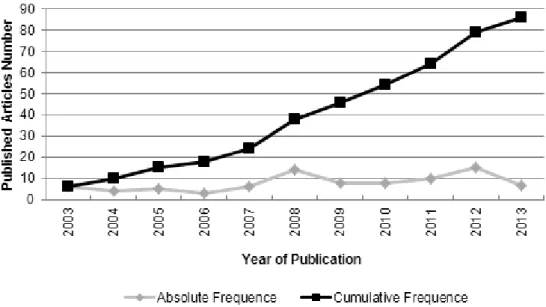
Figure 2 shows the number of articles published by year during the period 2003 to 2013. The absolute-frequency curve is shown in gray and the cumulative frequency in black.
diferent fronts/research problems - such as
studies on electrophysiological 14 and psychologi-cal15aspects- published in journals indexed in other
databases and with diferent descriptors than those
employed in that review. There are few studies that
speciically see the relations between the cochlear
implant, language, auditory recognition and speech production. Another hypothesis to be entertained is the recency of researcher groups when compared to international centers, since they were created
in the mid-1990s, due to the irst cochlear implant
surgeries in Brazil16.
Figure 2 – Number of scientiic publications relate to subject, by publication year, from 2003 to 2013, registered as absolute-frequency and cumulative-frequence curves
A steady increase of articles on the relation between the cochlear implant and language was observed, being evidenced by the cumulative frequency curve in constant positive acceleration.
In the irst ive-year period observed (2003-2008),
a gradual increase in publications was noted, with
a signiicant leap in 2008 (14 articles), totaling 38
studies. Already in the period between 2009 and
the irst half of 2013, there was a higher science
production rate of 26.31%, compared to the previous
ive years, and these studies represented 55.81% of
the total found in this literature review.
These results show a continuous increase in
articles that portrayed the beneits of cochlear
implants on the language processes. The growth of
this scientiic production can be explained/specu
-lated by some political, technological, scientiic and
educational factors.
In the political sphere, a gradual expansion
and consolidation in policies in the area of hearing health was observed in the last decades, both in developed (like the United States, Germany and England) and emerging (Brazil, China and
India, for example) countries5. One efect of these
policies was the intensiication of early diagnosis of
severe-profound hearing loss (in neonatal auditory
screening, for example), quick insertion in hearing
assistance programs and increased indication
of cochlear implants, mobilizing the scientiic
community to endorse with studies onhow this device has promoted language development5. It is noteworthy that there is a considerable variation in funds invested by each country for the purchase of cochlear implants, since this device still requires
high inancial investment5.
of this was the investment in the production of processors with increasingly sophisticated
technol-ogies that enable a high level of reinement of the
captured sound stimuli20which demanded research
on the possible efects of these on the auditory detection/discrimination and cost-efectiveness
among the models20.
Scientiic and educational determinants may
have further supported the current panorama. In the
scientiic ield, we can infer that the foundation and
consolidation of research groups in the cochlear implant services (of multi-professional character rand linked to universities and centers of reference) have provided a favorable condition for research, monitoring and intervention in cochlear implant users16,20-22.
Still, the growing demand for students with cochlear implants in the last decades may have been another factor. The inclusion of these students in the common education system and the
indica-tions of academic and language diiculties (in some
cases)5,10 may have encouraged researchers to investigate the relation between the use of cochlear implants and the development of auditory and
language skills, as well as the ramiications for
reading and writing acquisition processes11,23,24.
Analysis by Journal
The impact journals that are indexed in the databases investigated in this work (Web of Science, SciELO and LILACS) represent recognized dissemi
-nation channels of scientiic importance in the ield of
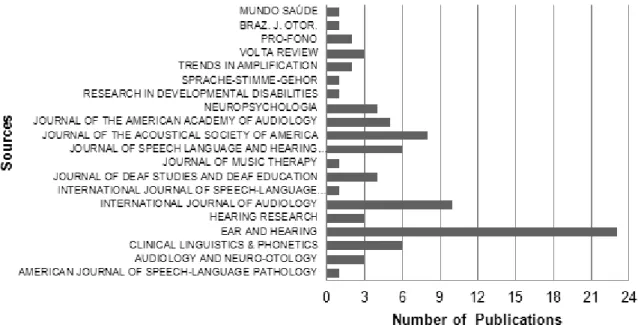
various sciences. Figure 3 illustrates the distribution
of studies based on journals found in this review.
the implementation of the National Hearing Health
Policy in 2004) and is contextualized in this juncture
of internationalization, there is still a reality that little corresponds to the international scenario17.
That condition can be explained, at least in part, by
the irregular distribution of hearing health services
in territorial extension and insuicient inancial
resources, and other socio-political complications in the consolidation of reference centers for this part of the public17.
Given the international context of hearing health
policies, greater investment in such research can be seen, which have been conducted by groups linked to cochlear implant services, with public and/or private support. In general, these research
groups have sought to endorse the efectiveness
of this technology (and the consequent subsidy by the government and/or health plans) and provide evidence for changes in current policies, as the implementation of bilateral cochlear implant by groupsin the United States, Germany, England6,9 and more recently in Brazil18.
The advancement and technological enhancement in cochlear implant devices can be another important factor in the growth of researches6,19,20. From 2003 to 2013, companies have produced models of cochlear implants with
important diferences in the components (such as waterproof devices, for example), the programming
and mapping software and the coding strategies (such as CIS, SPEAK and ACE); these changes,
in turn, may imply distinct efects on perception of
speech sounds and, therefore, the development of auditory skills and oral production5,20.An example
Analysis by search area
Studies which dealt with the cochlear implant and the relations established with the language mainly integrated (85% of the total) a large area of research to Audiology and related sciences
(Speech and Language Pathology). Audiology as a research ield has studied “hearing, vestibular
and its disorders and related processes, as well as the means to prevent, identify, evaluate, diagnose and intervene in hearing and vestibular disorders in children, adults and seniors”17. Given this study
object, the concentration of studies in this area is justiied, in part.
However, given the complexity of the phenomena
involving the cochlear implant and language,
knowledge coming from other scientiic ields have
established interfaces with Audiology, such as Engineering, Physics (especially the acoustics area), Genetics, Otorhinolaryngology, the Rehabilitation Sciences, Education and Psychology. From this perspective, studies related to cochlear implants
have conigured an interdisciplinary research ield, as can be seen by the large list of journals from
other areas.
It was noted that other areas selected in this review (Rehabilitation, Education and Behavioral Sciences) presented a low production in these studies (15% of the articles found), distributed in
three of the Behavioral Sciences, eight in the ield of
Education and two in Rehabilitation. This panorama, duly illustrated in Figure 4, indicates a lack of studies of the interface areas with Audiology and the need for greater investments and the involvement of these to investigate language processes in cochlear implant users.
The dissemination of studies on cochlear implants and language was concentrated in two
international journals, namely, the Ear and Hearing and International Journal of Audiology, which jointly
provides 38.37% of the total scientiic production (33 articles) in this study. Traditionally, these two journals
include Audiology, hearing, hearing impairment, auditory rehabilitation and applied technologies
in its scope topics, which may explain, in part, the
prevalence (in quantitative terms) of the studies found about cochlear implants and language.
The periodicals Clinical Linguistics & Phonetics
(6 articles), Journal of Acoustical Society of America
(8 articles) and Journal of Speech Language and Hearing Research (6 articles) provide, in addition, 23.25% of the published studies of this review. The remaining 33 articles (38.38%) are distributed in 15
other journals.
One data that drew attention refers to the fact that although there is a concentration of studies
in journals in Audiology and related areas (such
as the Ear and Hearing, International Journal of Audiology and the Journal of Speech Language and Hearing Research), that can be noted as journal
sunder the scope of various areas of knowledge, such as Engineering and Physics (Journal of the Acoustical Society of America), Linguistics (Clinical Linguistics & Phonetics), Education (Journal of Deaf Studies and Deaf Education) and Psychology (Neuropsychology). This result may indicate that the studies related to cochlear implants have set
up an interdisciplinary research ield, in which each
science can contribute to the research, techno-logical upgrading, planning and intervention with this population.
Analysis by Study Type
The studies can also be classiied with based
on the methodological designs and goals, which are important components of research,
estab-lishing conditions under which scientiic results are
produced25.That categorization of study type is not
consensual, however possible identiied object/ subject scientiically discussed, which possible gaps and methodological reinements are still
necessary25.
Figure 5 represents the number of articles selected according to the type of study.
Figure 5 – Number of scientiic publications relate to subject, from 2003 to 2013, deined by study type
By deinition, studies of comparative type aim to
analyze, in single or multiple aspects, the similarities
and diferences between the conditions, problems
and populations 25. In this review, there was a preva-lence of this type of research (37.21%, the equiv-alent of 32 articles), which have compared language
skills (receptive and expressive) between diferent
groups, by controlling systemic of variables (such as hearing, the time of use of cochlear implant, age, gender, speech processor and education).
With distinctive designs, such studies have made
it possible to establish relation between language
skills and some speciic features, for example the
development of auditory skills and the time of use of cochlear implant. The comparisons observed were between groups of: children with cochlear implants and normal-hearing peers (13 articles); adults with cochlear implants and normal-hearing peers (6 articles); adults with post-lingual and pre-lingual cochlear implants (2 articles); children with cochlear implants and children with hearing aids (1 article); children with cochlear implants and children with hearing loss and without cochlear implants (1 article); children with cochlear implants with greater time of use and with less time of use (3 articles); children with cochlear implants, hearing aids and children with normal hearing peers (3 articles); children with cochlear implants, deaf children without cochlear implants and normal-hearing peers (1 article); children with cochlear implants, normal-hearing
peers and normal hearing adults (1 article); and
adults with cochlear implants in diferent sound
environment conditions (1 article).
The explanatory studies are deined depending on the objective of the identifying factors that inluence the phenomenon (without necessarily
controlling the variables)25 and represent in this review, the second most frequent type of study (29.07%, 25 articles). In the scope of this theme, these surveys have evaluated and measured skills in the area of language, from the measured variables (such as time of use of cochlear implant, age, gender, speech processor, education, etc.)26,27 and have established possible correlations, such as the perception of speech in Mandarin in cochlear implant users with a particular speech processor28.
It was observed that the comparison of language skills between groups (usually cochlear implant users and normal-hearing peers) over a certain
period (six months, on average) was a target of
10 studies of this review (11.63%) which can be
classiied as comparative longitudinal studies25. Other types of studies (theoretical, only longitu-dinal and literature review25) amounted to a total of 22.09% of the analyzed studies (19 articles).
It is noteworthy that we found no studies that
describe the efects of training/education programs of auditory and expressive abilities, with or without an experimental design. This inding may show
Audiology as detection, discrimination, recognition and comprehension4,13. The expressive skills, in turn, are characterized by communication actions
in which individuals express themselves through
speech, writing and reading7,29.
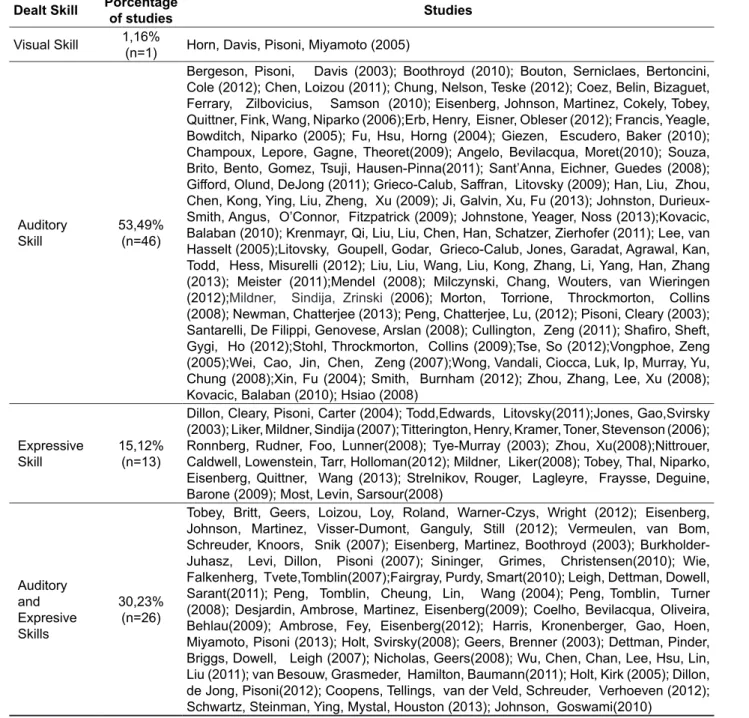
Given the scope of this analysis by skill, visual skills were also incorporated into the study, such as visual attention. These skills are considered important components for language, since they are prerequisites for the acquisition of linguistic skills29. Table 1 shows the distribution of studies according to the categories of skills.
Audiology, Speech and Language Pathology,
Rehabilitation, Education and Behavioral Sciences) and, therefore, provide a need for applied research that address issues regarding auditory rehabilitation and strategies for teaching language skills.
Analysis by approached skill
The skills identiied in this review were classiied into auditory, expressive and, auditory and expressive. Auditory skills are deined by relation
established with auditory stimuli and described by
Table 1 – Distribution of studies by categories of dealt skills
Dealt Skill Porcentage
of studies Studies
Visual Skill 1,16%
(n=1) Horn, Davis, Pisoni, Miyamoto (2005)
Auditory Skill
53,49% (n=46)
Bergeson, Pisoni, Davis (2003); Boothroyd (2010); Bouton, Serniclaes, Bertoncini, Cole (2012); Chen, Loizou (2011); Chung, Nelson, Teske (2012); Coez, Belin, Bizaguet, Ferrary, Zilbovicius, Samson (2010); Eisenberg, Johnson, Martinez, Cokely, Tobey, Quittner, Fink, Wang, Niparko (2006);Erb, Henry, Eisner, Obleser (2012); Francis, Yeagle, Bowditch, Niparko (2005); Fu, Hsu, Horng (2004); Giezen, Escudero, Baker (2010); Champoux, Lepore, Gagne, Theoret(2009); Angelo, Bevilacqua, Moret(2010); Souza, Brito, Bento, Gomez, Tsuji, Hausen-Pinna(2011); Sant’Anna, Eichner, Guedes (2008); Giford, Olund, DeJong (2011); Grieco-Calub, Safran, Litovsky (2009); Han, Liu, Zhou, Chen, Kong, Ying, Liu, Zheng, Xu (2009); Ji, Galvin, Xu, Fu (2013); Johnston, Durieux-Smith, Angus, O’Connor, Fitzpatrick (2009); Johnstone, Yeager, Noss (2013);Kovacic, Balaban (2010); Krenmayr, Qi, Liu, Liu, Chen, Han, Schatzer, Zierhofer (2011); Lee, van Hasselt (2005);Litovsky, Goupell, Godar, Grieco-Calub, Jones, Garadat, Agrawal, Kan, Todd, Hess, Misurelli (2012); Liu, Liu, Wang, Liu, Kong, Zhang, Li, Yang, Han, Zhang (2013); Meister (2011);Mendel (2008); Milczynski, Chang, Wouters, van Wieringen (2012);Mildner, Sindija, Zrinski (2006); Morton, Torrione, Throckmorton, Collins (2008); Newman, Chatterjee (2013); Peng, Chatterjee, Lu, (2012); Pisoni, Cleary (2003); Santarelli, De Filippi, Genovese, Arslan (2008); Cullington, Zeng (2011); Shairo, Sheft, Gygi, Ho (2012);Stohl, Throckmorton, Collins (2009);Tse, So (2012);Vongphoe, Zeng (2005);Wei, Cao, Jin, Chen, Zeng (2007);Wong, Vandali, Ciocca, Luk, Ip, Murray, Yu, Chung (2008);Xin, Fu (2004); Smith, Burnham (2012); Zhou, Zhang, Lee, Xu (2008); Kovacic, Balaban (2010); Hsiao (2008)
Expressive Skill
15,12% (n=13)
Dillon, Cleary, Pisoni, Carter (2004); Todd,Edwards, Litovsky(2011);Jones, Gao,Svirsky (2003); Liker, Mildner, Sindija (2007); Titterington, Henry, Kramer, Toner, Stevenson (2006); Ronnberg, Rudner, Foo, Lunner(2008); Tye-Murray (2003); Zhou, Xu(2008);Nittrouer, Caldwell, Lowenstein, Tarr, Holloman(2012); Mildner, Liker(2008); Tobey, Thal, Niparko, Eisenberg, Quittner, Wang (2013); Strelnikov, Rouger, Lagleyre, Fraysse, Deguine, Barone (2009); Most, Levin, Sarsour(2008)
Auditory and Expresive Skills
30,23% (n=26)
the expressive abilities, particularly in the speech production of this public. Indeed, these indings may have signiicant ramiications for the auditory rehabilitation process, to the extent that they seek
to identify what conditions cause the aspects of listening and speaking tointerrelate5,13,31.
Only one survey focused on the visual skills32.
When comparing groups of children with
normal-hearing and cochlear implant users in visual attention tasks, the study found that cochlear implant users showed improved visual attention after two years of using the device, with gains in reading and writing processes.
Analysis by phenomena
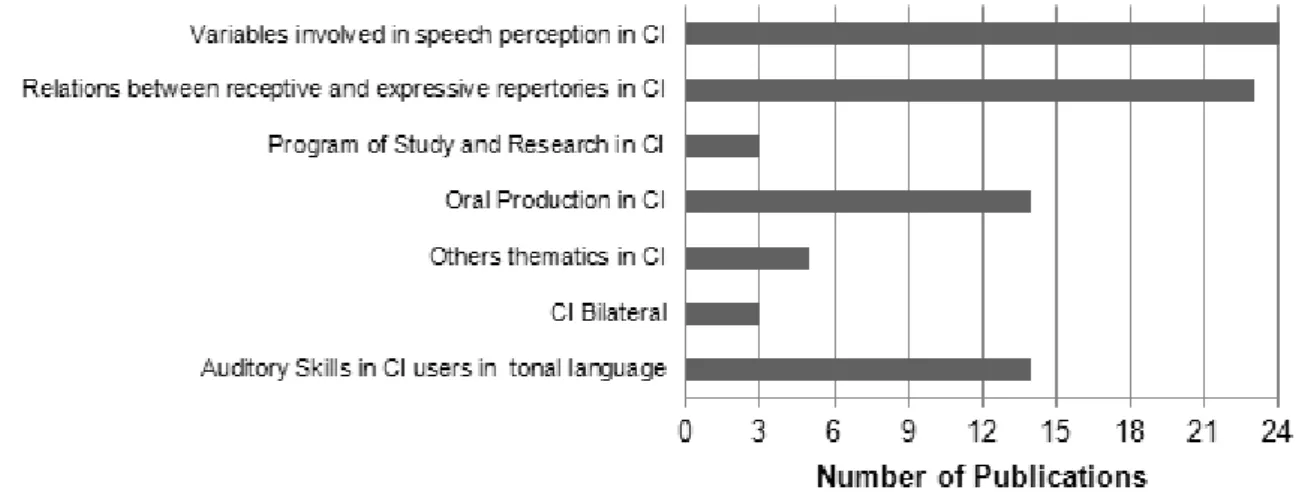
Studies of this review were submitted to a categorization by phenomena, carried out by reading the articles in full. Seven phenomena were found in the scope of research on cochlear implants and language: variables involved in speech perception (24 articles), relations between
receptive and expressive repertoires (23 articles),
research programs (3 articles), oral production (14 articles), other phenomena (5 articles), bilateral cochlear implant (3 articles) and auditory skills in tonal languages (14 studies). Figure 6 shows the distribution of studies by said categorization.
Noted were the most frequent researches that approached auditory skills, with a total of 46 articles.
This inding may indicate, in part, an engagement of the scientiic community to study the processes
of development of auditory skills via cochlear implant5,20. Yet, this emphasis can be endorsed by the rapid improvement of technology of this device (especially the speech processor)20, which promotes researches (recommended or not by companies)
on the efects of these technological reinements in
certain auditory skills.
Thirteen researches that only highlighted the
expressive skills were found. Although the number
of studies is small, the interest to investigate these skills (especially in pre-lingual cochlear implant users), could constitute a research front, given the evidence that even after the acquisition of auditory
skills, the expressive skills do not follow the same
rhythm and incur commitments (such as in speech intelligibility)22.
An interesting inding refer the range of research that overlap the auditory and expressive skills, of
which corresponded to 30.23% (26 articles). Guided by the premise that the functions of hearing and language are interdependent and correlated2,29,30,
these studies have determined to what extent
the skills involved in listening have interfered in
Figure 6 – Number of scientiic publications by investigated phenomenas in studies, from 2003 to 2013
The phenomenon “variables involved in speech perception” included studies that evaluated and
measured the efects of the independent variables - technological (such as diferent speech processors),
audiological (use of cochlear implants, type of auditory training), linguistic (such as intonation, tone
and speech rhythm) and contextual (silence-noise
environments with competition from sound sources)
character – in the discrimination and perception of speech sounds for pre and/or post-lingual cochlear implant users.26,33Such theme corresponded to
27.9% of the studies and reined the data found
diferentially regarding speech stimuli, it constitutes
one of the basic listening skills, investigations that
verify all of the variables that afect the perception of this public becomes crucial, in order to ofer techno -logical and rehabilitation conditions so that they may acquire it.
The phenomenon “Relations between auditory
and expressive skills” involved research that
has been engaged in identifying, evidencing and
forecasting the efects that listening skills (such as
auditory discrimination, recognition and
compre-hension) have on the development of expressive
language (especially oral production), especially for children with pre-lingual cochlear implants. Accounting for 26.74% of the total research, such as that of Dettman et al,34 - included in that category - can synthesize some of the questions that have
directed these studies: What are the relations estab -lished between the listener and speaker repertoires
in pre-lingual cochlear implants users? What are the auditory skills that interfere in acquiring expressive
skills? And what auditory skills are needed for the development of speech and oral language?
The phenomenon “Research program” consisted
of studies describing scientiic programs developed by some referral centers of cochlear implants. With
3.49% of the total of this review, these studies
proposed to review and speciically expose the
research program such as the Dallas’sCenter21and
HouseResearchInstitute8.
Another phenomenon which included 3.49% was the “Bilateral cochlear implantation”. It was composed of research about binaural hearing by cochlear implants, with an interest in investigating whether this condition interferes with the acquisition of auditory skills, the time of auditory rehabilitation, academic performance and quality of life9,35.
It should be noted that the phenomena “Relations
between auditory and expressive skills”, “Research
program” and “Bilateral cochlear implantation” encompassed recent studies, starting from 2011. This scenario allows speculation for the tendency of research for years to come. Other phenomenon of interest that may also have an increase in
scien-tiic production refers to “Hearing abilities in tonal
languages” and “Oral production”.
The 14 studies on “Hearing abilities in tonal languages” have investigated the variables that
afect the auditory skills in cochlear implants users
whose language is tonal, such as Mandarin and Cantonese36,37. Such surveys are justiied by the fact that in tonal languages, the tonal range of speech sets an important dimension to be perceived by the listener (unlike what happens in phonetic languages like English, Portuguese and Spanish) and can
transmit diferent lexical meanings of words37.
Thus, the cochlear implant models using certain processing strategies (CIS or SPEAK) and capture
diferent tonal ranges may be insuicient to favor auditory accuracy in tonal perception, creating dii -culties when cochlear implant users communicate with members of the verbal community5,30.
The phenomenon “Oral production” consisted of 16.28% of the studies found and included the research role that evaluated and /or measured the dimensions of speech (such as intelligibility, rhythm and prosody), as well as the processes related to the acquisition of that skill by cochlear implants
users. Studies such as Liker, Mildner and Sindija38 were part of this category.
The rest of the research was composed of the category “Other phenomena.” Part of this group were studies that included evaluations and measure-ments of attention, memory and visual tracking of this public, establishing the necessary correlations with the language, such as the Pisoni and Cleary39 and Horn, Davis, Pisoni and Miyamoto40.
FINAL CONSIDERATIONS
The pioneering studies with cochlear implants
were conducted by Djourno and Eyriès from year of
1957, but gained the due space in the mid-90`s, when the FDA (Food and Drug Administration) released it for medical use6,16. Although the emergence of this
scientiic technology can be seen in recent years, a growing panorama of studies about the efects
of this device for the areas of language, cognition, quality of life and public policies were observed5.
Regarding the implications of cochlear implants for the development of language, which was of interest in this review, an increase in the number of articles from 2003 to 2013was noted, with optimistic
projections for the coming years. Thus, such a
scenario may suggest that the interface between cochlear implants and language have consolidated a research front, being a promising area for the insertion of researchers. Public policies for hearing
health, technological advances, the joint research
groups and the growing educational demands
are important inluences that allowed this current situation and will facilitate scientiic development of
this issue in the coming decades.
As can be seen, the scientiic dissemination of this theme was mainly made by international journals
and national studies represented less than 5% of that production. This result may indicate, among other things, that a gradual consolidation of this theme occurs in Brazilian research (in recent processes)16 and tend to occur in several countries8,21.
This study list still requires continuity, given the
speciicities of speech perception tones for this
public.
At the same time, the growth of the studies that
integrate auditory and expressive skills can make up
a front of interesting research. In this scope, some interface investigations have been monitoring the
efects of teaching listening skills on the accuracy of oral production in naming tasks of object igures
and actions31, requiring a sentence with [subject] -
[verb] - [object].
Based on the indings of this literature review, it was possible to identify part of the scientiic panorama on the subject of cochlear implants and
language and envision future prospects. Some of
these projections refer primarily to the phenomena
of interest, such as bilateral cochlear implants9,10,19,
scientiic and technological innovation for cochlear
implants (like breakthroughs in speech processors and the possibilities of totally implantable cochlear implants)5,10,19 and strategies in auditory rehabili-tation evidence-based10,19.
Pathology) concentrated most studies, and the other sciences (Rehabilitation, Education and Behavioral Sciences), together held only 15% of this total. The limited production of these areas that interface with Audiology can serve as a clue to broaden their participation in research on cochlear implants and language in order to consolidate an interdisciplinary space.
These studies have been framed largely as
comparative and explanatory and researches,
are not found that refer to intervention and / or teaching of language skills. In this sense, studies that prioritize aspects of intervention, rehabilitation
and teaching - with experimental designs (or not) intra-subject, inter-subject and groups - can favor
useful knowledge about this public learning process and should require contributions from other areas of knowledge, such as Education, Psychology and Behavioral Sciences.
Auditory skills, especially the perception of speech in with tonal language cochlear implants users covers much of the research of this review.
RESUMO
A reabilitação auditiva por meio do implante coclear tem constituído um campo de atuação e de
pes-quisa interdisciplinar, cujos interesses têm incidido na investigação das variáveis e processos rela
-cionados às habilidades de linguagem dessa população. O presente estudo teve como objetivo apre
-sentar uma revisão sistemática das pesquisas que investigaram as relações entre o uso do implante coclear e o desenvolvimento da linguagem. Para isso, foi realizada uma busca nas bases cientíicas Web of Science®, Scielo® e LILACS®, de 2003 a 2013, de estudos sob escopo da Audiologia (e de áreas correlatas), Educação, Reabilitação e Ciências do Comportamento; aplicando os unitermos
“cochlear implant”, “auditory recognition”, “recognition”, “speech”, “speech production” e “language”.
Após um tratamento inicial dos resultados, foram selecionados para análise 86 artigos que foram classiicados de acordo com os seguintes critérios: ano de publicação, periódico, área de pesquisa, tipo de estudo, habilidade investigada e a temática. Os resultados indicaram crescente avanço nes
-ses estudos e uma ênfase em avaliar e/ou identiicar possíveis fatores que interferem nos processos de linguagem de implantados cocleares, sendo essas pesquisas conduzidas majoritariamente pela Audiologia e áreas correlatas. Os estudos comparativos e explicativos foram os mais frequentes e têm destacado as habilidades auditivas, especiicamente os fatores que afetam a percepção audi
-tiva. Enquanto perspectivas futuras, poderão ser vislumbrados maior envolvimento cientíico de áreas interdisciplinares à Audiologia, ampliação de pesquisas sobre habilidades expressivas (como a pro
-dução oral) e fomento à estudos que investiguem intervenções (práticas baseadas em evidências)
em linguagem para esse público.
DESCRITORES: Implantes Cocleares; Desenvolvimento da Linguagem; Literatura de Revisão como
24: revisão da literatura. Rev Bras Otorrinolaringol. 2004;70(1):112-8.
15. Yamada MO, Bevilacqua MC. Dimensão afetiva da pessoa com surdez adquirida, antes e após o implante coclear.Estud Psicol. 2012;29(1):63-9. 16. Mesquita ST, Faria MEB, Bevilacqua MC. O Centro de Pesquisas Audiológicas e o Programa de Implante Coclear: uma história de avanços na
(re)habilitação do deiciente auditivo no HRAC/USP.
Rev Soc Bras Fonoaudiol. 2000;4(6):12-8.
17. Bevilacqua MC, Melo TM, Morettin M, Lopes AC. A avaliação de serviços em Audiologia: concepções
e perspectivas. Rev Soc Bras Fonoaudiol. 2009;14(3):421-6.
18. Hyppolito MA, Bento RF. Rumos do Implante Coclear bilateral no Brasil.Braz J Otorhinolaryngol. 2012;78(1):2-3.
19. Eshraghi AA, Nazarian R, Telischi FF, Rajguru
SM, Truy E, Gupta C. The Cochlear Implant: Historical Aspects and Future Prospects. Anat Rec. 2012;295:1967-80.
20. Danieli F, BevilacquaMC. Reconhecimento
de fala em crianças usuárias de implante coclear
utilizando dois diferentes processadores de fala. Audiol Commun Res. 2013;18(1):17-23.
21. Tobey EA, Britt L, Geers A, Loizou P, Loy B, Roland P et al. Cochlear implantation updates: the Dallas Cochlear Implant Program. J Am Acad Audiol. 2012;23(6):438-45.
22. Moret ALM, Bevilacqua MC, Costa OA. Implante coclear: audição e linguagem em crianças
deicientes auditivas pré-linguais. Pró-Fono R Atual
Cient. 2007;19(3):295-304.
23. Geers AE. Factors afecting the development of speech, language, and literacy in children with early
cochlear implantation. Lang Speech Hear Serv.
2002;33(3):172-83.
24. Geers AE, Moog JS, Biedenstein J, Brenner
C, Hayes H. Spoken Language Scores of Children
Using Cochlear Implants Compared to Hearing Age-Mates at School Entry. J Deaf Stud Deaf Educ. 2009;14:371-85.
25. Gil AC. Como elaborar projetos de pesquisa. 4.
ed. São Paulo: Atlas; 2007.
26. KovacicD, Balaban E. Hearing history inluences voice gender perceptual performance in cochlear implant users. Ear Hear. 2010;31(6):806-14.
27. Dillon CM, de Jong K, Pisoni DB. Phonological awareness, reading skills, and vocabulary knowledge in children who use cochlear implants. J Deaf Stud Deaf Educ. 2012;17(2):205-26.
28. Peng SC, Tomblin JB, Cheung H, Lin YS, Wang LS. Perception and Production of Mandarin Tones in
Prelingually Deaf Children with Cochlear Implants. Ear Hear. 2004;25(3):251-64.
REFERENCES
1. World Health Organization (WHO). Deafness and hearing loss. [texto da internet]. Genebra (SC): World Health Organization. 2013 [atualizada em 2013 mar 03; acesso em 2013 ago 05]. Disponível
em: http://www.who.int/mediacentre/factsheets/ fs300/en/
2. Gatto CI, Tochetto TM. Deiciência auditiva infantil: implicações e soluções. Rev CEFAC.
2007;9(1):110-5.
3. Instituto Brasileiro de Geograia e Estatística (IBGE). Censo Demográico 2010. [texto da internet]. 2010. [acesso em 2013 ago05]. Disponível em: http://www.censo2010.ibge.gov.br.
4. Bevilacqua MC. Implante coclear multicanal: uma
alternativa na habilitação de crianças surdas [Livre Docência]. Bauru (SP): Faculdade de Odontologia
de Bauru, Universidade de São Paulo; 1998. 5. Sarant J. Cochlear Implants in Children: A Review. In: Naz S, editor. Hearing Loss. Shanghai: InTech; 2012. p. 40-75.
6. Francis HW, NiparkoJK. Cochlear implantation update. Ped Clin N Am. 2003;50:341-61.
7. Fortunato CAU, Bevilacqua MC, Costa MPR.
Análise Comparativa da Linguagem Oral de Crianças Ouvintes e Surdas usuárias de Implante
Coclear. Rev CEFAC. 2009;11(4):662-72.
8. EisenbergLS, Johnson KC, Martinez AS,
Visser-Dumont L, Ganguly DH, Still JF. Studies in pediatric
hearing loss at the House Research Institute.J Am Acad Audiol. 2012;23(6):412-21.
9. Johnston JC, Durieux-Smith A, Angus D, O’Connor A, Fitzpatrick E. Bilateral padiatric cochlear implants: A critical review. Int J Audiol. 2009;48:601-17.
10. Geers AE, Nicholas JG, Moog JS. Estimating
the Inluence of Cochlear Implantation on Language Development in Children. Audiol Med.
2007;5(4):262-73.
11. Geers ae, hayes h. reading, writing, and phonological processing skills of adolescents with
10 or more years of cochlear implant experience.
Ear Hear. 2011;32(1):49-59.
12. Hay-McCutcheon MJ, Kirk KI, Henning SC, Gao
S, Qi R. Using Early Language Outcomes to Predict Later Language Ability in Children with Cochlear
Implants. AudiolNeuro-Otol. 2008;13(6):370-8. 13. Robbins AM. Rehabilitation after Cochlear Implantation. In: Niparko JK, editor. Cochlear Implants: Principles and Practices. Philadelphia:
Lippincott, Williams & Wilkins; 2000. p. 323-62.
35. Cullington HE, Zeng FG. Comparison of bimodal and bilateral cochlear implant users on speech recognition with competing talker, music
perception, afective prosody discrimination, and talker identiication. Ear Hear. 2011;32:16-30.
36. TseWT, So LKH. Phonological awareness of cantonese-speaking pre-school children with
cochlear implants. Int J Speech Lang Pathol.
2012;14(1):73–83.
37. Chen F, Loizou PC. Predicting the intelligibility of vocoded and wide band Mandarin Chinese. J Acoust Soc Am. 2011;129(5):3281-90.
38. Liker M, Mildner V, Sindija B. Acoustic
analysis of the speech of children with cochlear
implants: a longitudinal study. Clin Linguist Phon.
2007;21(1):1-11.
39. Pisoni DB, Cleary M. Measures of working memory span and verbal rehearsal speed in deaf children after cochlear implantation. Ear Hear. 2003;24(1 Suppl):106S-20S.
40. Horn DL, Davis RA, Pisoni DB, Miyamoto RT.
Development of visual attention skills in prelingually deaf children who use cochlear implants. Ear Hear.2005;26(4):389-408.
29. Greer RD, Ross DE. Verbal behavior analysis:
Inducing and expanding complex communication
in children with severe language delays. Boston: Allyn&Bacon; 2008.
30. Oliveira LN, Goulart BNG, Chiari BM. Language
disorders associated with deafness. Rev Bras Crescimento Desenvolv Hum. 2013;23(1):41-5.
31. Neves AJ, Verdu ACMA, Moret ALM, Silva LTN.
Speech correspondence while reading and the designation of sentences in children with hearing
disabilities Who use pre-lingual cochlear implants.
Int Arch Otorhinolaryngol. 2013;17(Suppl. 1):7.
32. Horn DL, Davis RA, Pisoni DB, Miyamoto RT.
Development of Visual Attention Skills in Prelingually
Deaf Children Who Use Cochlear Implants. Ear
Hear. 2005;26(4):389-408.
33. Eisenberg LS. Speech recognition at 1-year follow-up in the childhood development after cochlear implantation study: methods and preliminary
indings. AudiolNeuro-Otol. 2006;11:259-68.
34. Dettman SJ, Pinder D, Briggs RJ, Dowell
RC, Leigh JR. Communication development in
children who receive the cochlear implant younger
than 12 months: risks versus beneits. Ear Hear.
2007;28(2):11-8.
Received on: April 15, 2015 Accepted on: June 05, 2015
Mailing address:
Anderson Jonas das Neves
R. Christiano Pagani, 8-51, 42F, Jardim Contorno Bauru – SP – Brasil
CEP: 17047-144