(1) Universidade Estadual Paulista Júlio de Mesquita Filho – Faculdade de Filosoia e Ciências, UNESP, Marília, São Paulo, Brasil.
Source: Fundação de Amparo à Pesquisa do Estado de São Paulo (FAPESP)
Conlict of interest: non-existent
Characterization of communicative interaction between parent
of hearing impaired children and adolescents that use oral
communication
Caracterização da interação comunicativa entre pais de crianças e
adolescentes deficientes auditivos que utilizam comunicação oral
Laura Mochiatti Guijo(1)
Eliane Maria Carrit Delgado-Pinheiro(1)
Received on: December 30, 2015 Accepted on: May 23, 2016 Mailing address:
Eliane Maria Carrit Delgado-Pinheiro Rua José da Silva Matos, 350 – Condomínio Pedra Verde – Bairro Jardim Tropical Marília – SP – Brasil CEP: 17516-540 E-mail: [email protected]
ABSTRACT
Purpose: to characterize the communicative interaction among hearing parents and children or adoles -cents with hearing loss who use oral communication through the video analysis.
Methods: this study included parents of nine children and nine adolescents with bilateral sensorineural pre-lingual hearing impairment, from moderate to profound degree, who attend or attended an aural reha-bilitation program with emphasis on the development of hearing and oral communication. Among the nine children, four are aided by cochlear implant and ive are aided by hearing aid. Regarding the adolescents, six are aided by cochlear implant and three are aided by hearing aids. The procedure used was a checklist composed by 22 behaviors that analyze the interaction on the stimulation of hearing and language. These behaviors were scored from a Likert scale and classiied as “rarely”, “occasionally” and “frequently”. The interaction among the hearing impaired children or adolescents and their parents was recorded for later analysis by three judges with experience in aural rehabilitation.
Results: there were 18 interactions recorded, in which it was possible to establish a relation of 97.8% among the judges. The occurrence of behavior “frequently” was statistically signiicant.
Conclusion: the results showed that parents involved into an aural rehabilitation program that emphasizes
the use of communication strategies to improve the development of linguistic and auditory skills, suitably
use communicative behaviors during interaction with their children or adolescents in a controlled situation.
Keywords: Hearing Loss; Parent-Child Relations; Family
RESUMO
Objetivo: caracterizar a interação comunicativa entre pais ouvintes e crianças ou adolescentes com dei-ciência auditiva que utilizam comunicação oral, por meio da análise de ilmagens.
Métodos: participaram deste estudo os pais de nove crianças e nove adolescentes com deiciência audi-tiva sensorioneural bilateral, pré-lingual de grau moderado a profundo, que frequentam ou frequentaram um programa de intervenção fonoaudiológica, com ênfase no desenvolvimento da função auditiva e comunicação oral. Entre as nove crianças, quatro fazem uso de implante coclear e cinco de Aparelho de Ampliicação Sonora Individual. Em relação aos adolescentes, seis fazem uso de implante coclear e três de Aparelho de Ampliicação Sonora Individual. O procedimento adotado foi a Escala de Índice de
Comportamentos que promovem a Comunicação, a qual apresenta 22 comportamentos que analisam a
interação quanto à estimulação da audição e linguagem. Os referidos comportamentos foram pontuados a partir de uma escala Likert e classiicados como “raramente”, “ocorre” e “frequentemente”. A interação entre os deicientes auditivos e seus pais foi ilmada para posterior análise de três juízes com experiência
na área de audiologia educacional.
Resultados: foram realizadas 18 ilmagens da interação, nas quais foi possível estabelecer uma con-cordância entre os juízes de 97,8%. Foi estatisticamente signiicante a ocorrência do comportamento “frequentemente”.
Conclusão: os resultados demonstraram que os pais, inseridos em um programa de reabilitação auditiva
onde se enfatiza o uso de estratégias que favorecem o desenvolvimento de habilidades linguísticas e auditivas, empregam adequadamente comportamentos comunicativos na interação com seus ilhos, em
uma situação controlada.
INTRODUCTION
Parents and family members are the irst models in language building and thus they provide a good family interaction in order to integrate hearing, speech, language and communication in all daily opportunities that arise 1-4. Different studies, such as “Dialogue-based
diary with the hearing impaired child: a case report” 5
and “Journal of experiences in the therapeutic process of a child with hearing loss” 6, focus on the importance
of family involvement in the therapeutic process and maintenance of the interaction between parents and children in order to promote language construction.
Parental behavior during interaction may provide or reduce opportunities to stimulate hearing, language and social aspects of the child which are acquired through effective interaction. A procedure called “Communication-Promoting Behavior Index Scale” 7
was used in order to analyze the inluence of commu-nicative behaviors of parents and relatives during inter-action with hearing-impaired children so as to provide guidelines for improving interaction with the video analysis method.
In their studies, the authors claim1,8 that the analysis
method of parental communicative behaviors by means of recording the interaction, used in the analysis of the Communication-Promoting Behavior Index Scale 7,
enables veriication of the importance of the speaker’s attitudes in the auditory and language behavior of the hearing-impaired child 8,9.
One study 9 examined the interaction of ten mothers
with their hearing-impaired children with cochlear implants and ten mothers with their normal-hearing children through the transcription of spontaneous conversation obtained during each interaction as well as by checking the answers each mother provided to their children’s statements. The results of this research showed that the mothers of hearing-impaired children are more responsive to the expressions of their children than mothers of normal-hearing children, and this is due to their awareness of their child’s hearing impairment.
The effect of speech therapy was evaluated in a case study of three dyads composed of a normal-hearing parent and their normal-hearing-impaired child with a cochlear implant, using the interaction analysis method by means of ilming, in which each dyad was assessed before and after speech therapy 10. The indings of this
study showed that the intervention performed with the video analysis of the interaction between parents and their hearing-impaired child may favor the pre-linguistic
communicative development of children with hearing loss.
Other authors11 examined the effect of a
psycho-social intervention program in video- feedback focused on the communication of 14 normal-hearing parents and their children with pre-lingual hearing impairment. The 14 dyads completed 3 intervention sessions analyzing the interaction before and after speech therapy. The authors of this study concluded that the video-feedback method improves communication in families with pre-lingual hearing-impaired children, increases the appropriate use of communicative cues employed with the children and promotes behavior adjustment in parents during the interactions.
The analysis method by means of recording a hearing-impaired child’s interaction has been highlighted by several authors in the area of educational audiology 12-18, since the use of video technology during
intervention allows us to verify the successful elements of communication during the interaction and promotes relection on why these elements were successful.
The use of communication strategies during the interaction with hearing-impaired children or teenagers is favorable for auditory and language development, as these facilitate dialogue. These communication strategies should be employed daily, being related to voice, articulation, verbal and behavioral expres-sions, in addition to recognizing the child’s communi-cation attempts, allowing dialogue and expanding the semantic and grammatical productions, repeating the message, if necessary and emphasizing keywords 19,20.
The aim of this study was to characterize the communicative interaction between normal-hearing parents and children or adolescents with hearing impairment who use oral communication through video analysis.
METHODS
It is a cross-methodological study with quantitative and qualitative analysis. This project was submitted to the Ethics Committee of the School of Philosophy and Sciences, São Paulo State University - FFC / UNESP / Marília – SP, beginning only after its approval (Protocol 730/2013), according to Resolution No. 466 / 12 of the National Health Council.
Participants
Term of Consent. This study included parents of nine children and nine adolescents with moderate to profound bilateral sensorineural pre-lingual hearing impairment. Each of the hearing-impaired participants used a Hearing Aid (HA) and/or Cochlear Implant (CI) and attended a speech therapy intervention program, with emphasis on hearing development and oral communication. The analyzed dyad was composed of the family and the child or adolescent with hearing impairment.
Among the nine children, four had cochlear implant, ive used a Hearing Aid. As for the adolescents, six had cochlear implant and three used Hearing Aids.
The selection criteria for the participation of hearing-impaired children and adolescents were: a) present bilateral sensorineural hearing loss without associated cognitive impairment; b) effectively use the cochlear implant or hearing aid; and c) participate or have partici-pated in the speech therapy process, with emphasis on the development of hearing and oral communication.
Parents or caregivers of children and adolescents with impairments such as: (a) children with associated neurological disorder; (b) post lingual hearing impairment; (c) children with conductive change were excluded from this study.
The descriptive statistics of the group of hearing-impaired children and adolescents in relation to age at diagnosis (months), hearing thresholds of the better ear (dB), hearing rehabilitation time (months) and time interval between diagnosis and speech therapy (months) are shown in Table 1.
The hearing impaired participants were divided into two groups, according to the chronological age of the children and adolescents:
• Group 1: Composed of nine children aged 1 to 10 years
• Group 2: Composed of nine adolescents aged 10 years and 1 month to 15 years.
Table 1. Characteristics of hearing-impaired participants in relation to the variables age, level of hearing loss, electronic device used,
hearing rehabilitation time and interval between diagnosis and intervention
Variables Mean Standard
Deviation Mínimum Median Maximum
Age of participant (months) 22.83 21.36 1 17.5 85
Hearing thresholds of best ear (dB) 100.55 20.13 70 105 120
Hearing Rehabilitation Time (months) 61.38 43.70 11 46 129
Interval between diagnosis and Intervention (months) 11.08 11.28 0 5.5 30
Data collection instrument
The data collection instrument for parents and hearing-impaired children interaction was a checklist7 translated into Brazilian Portuguese as the
Communication-Promoting Behavior Index Scale 8,
composed of 22 items on communicative behavior which analyzed the interaction between hearing parents with their hearing-impaired children. This procedure allows to examine the 22 behavior items ilmed during the interaction, relating them to hearing and language stimulation.
Video analysis of the parent’s communicative behavior during interaction enables veriication of the importance of the speaker’s attitudes in the auditory and language behavior of the hearing-impaired child. These behaviors are divided into four categories shown in Figure 1.
The dyads formed by hearing-impaired children or adolescents and their parents were ilmed for twenty minutes where the irst ive minutes recorded were eliminated from analysis as these minutes were deemed necessary for the participants to adapt to the presence of the camera.
The recordings of each dyad were ilmed with a Sony camera, model DCR-SR 47. All recordings took place in the therapeutic environment of the Center for Education and Health Studies (CEHS) at the School of Philosophy and Sciences in the Universidade Estadual Paulista (São Paulo State University) at the Marilia campus.
absolute and relative frequency and chi-square test for equality of proportions was used.
RESULTS
Each dyad was recorded, totaling 18 videos of the interaction between parents and their hearing-impaired children. In relation to the review and analysis of the judges, it was possible to get a 97.8% agreement among them.
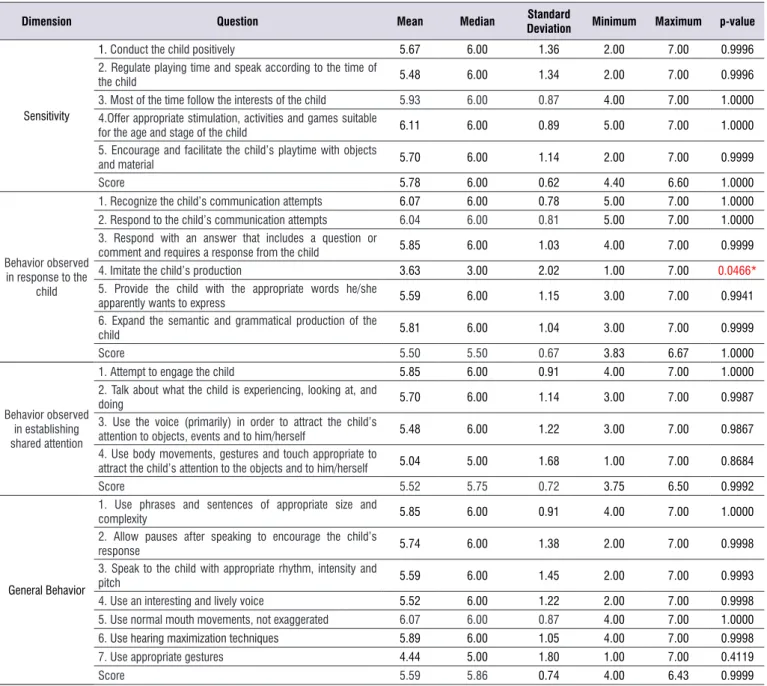
The percentage established by the judges for “frequently observed” behavior was approximately 100% in all interactions analyzed for both the inter-actions of children as well as adolescents and their parents. The results regarding the distribution of behavior scored by the judges as “frequently”, “occasionally” or “rarely” in the analysis of the interac-tions of children as well as the results for the higher scored behavior are found in Table 2. The same results on the interactions of hearing-impaired teenagers and their parents are available in Table 3.
The exploratory data analysis including mean, median, standard deviation, minimum, maximum, absolute and relative frequency and chi-square test for equality of proportions was used in order to evaluate if in each question addressed the proportions of “frequently”, “occasionally” and “rarely” observed are different.
a variety of toys. For the interaction between teens and their parents there were games, story books, magazines and material that replicated activities in a hair salon. Before each recording, the parents and their children were instructed to conduct the interaction spontaneously.
Analysis of the Results
These recordings were submitted for consider-ation by three judges with experience in educconsider-ational audiology. The judges analyzed the footage and scored each of the 22 behavior items included in the Communication-Promoting Behavior Index Scale. As a criterion for analysis of this study, the judges gave the score of 1-3 for the behavior that “is rarely observed,” the score of 5-7 for the behavior that is “frequently observed” and the score of 4 to the observed behavior that is “occasional”, i.e., not frequently observed, but “present”.
The behavior was considered occasional when at least two judges scored within the same category, regardless of the assigned value. The results were presented in a Table containing the evaluations of each of the judges.
Moreover, in order to meet the objectives of the study, the exploratory data analysis including mean, median, standard deviation, minimum, maximum,
Categories Sensitivity Behavior observed in
response to the child
Behavior observed in establishing shared
attention
General Behavior
Behaviors 1. Conduct the child positively
2. Regulate playing time
and speak according to the time of the child 3. Most of the time follow the interests of the child 4.Offer appropriate
stimulation, activities and
games suitable for the age and stage of the child 5. Encourage and facilitate
the child’s playtime with objects and material
1. Recognize the child’s communication attempts 2. Respond to the child’s communication attempts 3. Respond with an answer that includes a question or comment and requires a
response from the child 4. Imitate the child’s
production
5. Provide the child with the appropriate words he/she
apparently wants to express 6. Expand the semantic and grammatical production of
the child
1. Attempt to engage the child
2. Talk about what the child is experiencing, looking at, and doing
3. Use the voice (primarily) in order to attract the child’s attention to objects, events and to him/
herself
4. Use body movements,
gestures and touch appropriate to attract the child’s attention to the objects and to him/
herself
1. Use phrases and sentences
of appropriate size and complexity
2. Allow pauses after speaking to encourage the
child’s response
3. Speak to the child with
appropriate rhythm, intensity and pitch
4. Use an interesting and
lively voice
5. Use normal mouth
movements, not exaggerated
6. Use hearing maximization
techniques
7. Use appropriate gestures
Table 2. Mean, median, standard deviation, minimum and maximum for each question addressed in the sample group of children
Dimension Question Mean Median Standard
Deviation Minimum Maximum p-value
Sensitivity
1. Conduct the child positively 5.67 6.00 1.36 2.00 7.00 0.9996
2. Regulate playing time and speak according to the time of
the child 5.48 6.00 1.34 2.00 7.00 0.9996
3. Most of the time follow the interests of the child 5.93 6.00 0.87 4.00 7.00 1.0000 4.Offer appropriate stimulation, activities and games suitable
for the age and stage of the child 6.11 6.00 0.89 5.00 7.00 1.0000 5. Encourage and facilitate the child’s playtime with objects
and material 5.70 6.00 1.14 2.00 7.00 0.9999
Score 5.78 6.00 0.62 4.40 6.60 1.0000
Behavior observed in response to the
child
1. Recognize the child’s communication attempts 6.07 6.00 0.78 5.00 7.00 1.0000
2. Respond to the child’s communication attempts 6.04 6.00 0.81 5.00 7.00 1.0000
3. Respond with an answer that includes a question or
comment and requires a response from the child 5.85 6.00 1.03 4.00 7.00 0.9999 4. Imitate the child’s production 3.63 3.00 2.02 1.00 7.00 0.0466*
5. Provide the child with the appropriate words he/she
apparently wants to express 5.59 6.00 1.15 3.00 7.00 0.9941 6. Expand the semantic and grammatical production of the
child 5.81 6.00 1.04 3.00 7.00 0.9999
Score 5.50 5.50 0.67 3.83 6.67 1.0000
Behavior observed in establishing shared attention
1. Attempt to engage the child 5.85 6.00 0.91 4.00 7.00 1.0000
2. Talk about what the child is experiencing, looking at, and
doing 5.70 6.00 1.14 3.00 7.00 0.9987
3. Use the voice (primarily) in order to attract the child’s
attention to objects, events and to him/herself 5.48 6.00 1.22 3.00 7.00 0.9867 4. Use body movements, gestures and touch appropriate to
attract the child’s attention to the objects and to him/herself 5.04 5.00 1.68 1.00 7.00 0.8684
Score 5.52 5.75 0.72 3.75 6.50 0.9992
General Behavior
1. Use phrases and sentences of appropriate size and
complexity 5.85 6.00 0.91 4.00 7.00 1.0000
2. Allow pauses after speaking to encourage the child’s
response 5.74 6.00 1.38 2.00 7.00 0.9998
3. Speak to the child with appropriate rhythm, intensity and
pitch 5.59 6.00 1.45 2.00 7.00 0.9993
4. Use an interesting and lively voice 5.52 6.00 1.22 2.00 7.00 0.9998 5. Use normal mouth movements, not exaggerated 6.07 6.00 0.87 4.00 7.00 1.0000
6. Use hearing maximization techniques 5.89 6.00 1.05 4.00 7.00 0.9998
7. Use appropriate gestures 4.44 5.00 1.80 1.00 7.00 0.4119
Score 5.59 5.86 0.74 4.00 6.43 0.9999
*Chi-Square test with p-value less than or equal to 0.05
In all interactions, both the total sample as well as in the separate samples of the interactions of children and adolescents, the only behavior that cannot be considered statistically frequent is “Imitates the child’s productions”, referring to the category “Behavior observed in establishing shared attention”. In all other cases, it can be said that the noted behaviors are statis-tically “frequent”, since the values of their medians are statistically greater than or equal to 5 (p greater than 0.05).
Among these behaviors in the general sample concerning all interactions, “Acknowledges the child’s communication attempts” and “Uses normal mouth
movements, not exaggerated” are the behaviors with the highest score, with a mean of 6.19 and a median of 6.
In the total sample, the behavior “Acknowledges the child’s communication attempts” was the one with the highest proportion of ratings classiied as “frequent” (100% of the cases), while the behavior with the highest proportion of ratings classiied as “rarely” was “Imitates the child’s productions” (63% of the cases).
It was not possible to apply the chi-square test for the behaviors “Provides appropriate stimulation, activ-ities and games appropriate to the age and stage of the child”, “Acknowledges the child’s communication attempts” and “Responds to the child’s communication attempts” since they were classiied as “frequently” in 100% of the cases.
The results showed no signiicant difference between the communicative behaviors observed in the analyses conducted by the judges of the interactions of hearing-impaired children and adolescents. Therefore, there was no association between the frequency of communicative behavior observed and analyzed and the chronological age of the hearing impaired participant.
DISCUSSION
In all interactions between hearing-impaired children and adolescents and their parents, it can be seen that
Table 3. Mean, median, standard deviation, minimum and maximum for each question addressed in the sample group of adolescents
Dimension Question Mean Median Standard
Deviation Minimum Maximum p-value
Sensitivity
1. Conduct the child positively 5.96 6.00 1.13 3.00 7.00 0.9999
2. Regulate playing time and speak according to the time
of the child 5.78 6.00 1.25 1.00 7.00 1.0000
3. Most of the time follow the interests of the child 6.04 6.00 1.06 4.00 7.00 0.9999 4.Offer appropriate stimulation, activities and games
suitable for the age and stage of the child 6.07 6.00 1.11 3.00 7.00 1.0000 5. Encourage and facilitate the child’s playtime with objects
and material 6.41 7.00 0.89 4.00 7.00 1.0000
Score 6.05 6.40 0.86 4.20 7.00 1.0000
Behavior observed in response to the
child
1. Recognize the child’s communication attempts 6.30 7.00 0.82 5.00 7.00 1.0000
2. Respond to the child’s communication attempts 5.96 7.00 1.43 1.00 7.00 0.9999
3. Respond with an answer that includes a question or
comment and requires a response from the child 5.04 5.00 1.43 1.00 7.00 0.6855 4. Imitate the child’s production 2.67 3.00 1.36 1.00 6.00 <.0001*
5. Provide the child with the appropriate words he/she
apparently wants to express 5.67 6.00 1.49 1.00 7.00 0.9998 6. Expand the semantic and grammatical production of the
child 5.00 6.00 1.80 1.00 7.00 0.9331
Score 5.10 5.33 0.82 2.83 6.17 0.9953
Behavior observed in establishing shared
attention
1. Attempt to engage the child 5.81 6.00 0.83 4.00 7.00 1.0000
2. Talk about what the child is experiencing, looking at, and
doing 6.15 6.00 0.82 4.00 7.00 1.0000
3. Use the voice (primarily) in order to attract the child’s
attention to objects, events and to him/herself 6.41 7.00 1.22 1.00 7.00 1.0000 4. Use body movements, gestures and touch appropriate to
attract the child’s attention to the objects and to him/herself 4.22 4.00 1.85 1.00 7.00 0.2706
Score 5.65 5.75 0.51 4.50 6.50 1.0000
General Behavior
1. Use phrases and sentences of appropriate size and
complexity 6.22 6.00 0.89 4.00 7.00 1.0000
2. Allow pauses after speaking to encourage the child’s
response 6.07 6.00 0.83 4.00 7.00 1.0000
3. Speak to the child with appropriate rhythm, intensity and
pitch 6.07 7.00 1.41 1.00 7.00 1.0000
4. Use an interesting and lively voice 5.19 5.00 1.39 3.00 7.00 1.0000 5. Use normal mouth movements, not exaggerated 6.30 6.00 0.78 5.00 7.00 1.0000
6. Use hearing maximization techniques 5.23 5.00 1.14 3.00 7.00 1.0000
7. Use appropriate gestures 4.89 6.00 1.89 1.00 7.00 0.9331
Score 5.72 5.71 0.62 4.57 6.86 1.0000
the behavior examined in the videos led to the frequent use of hearing and language. Thus, these data showed that the participants of this study, in a controlled situation, demonstrated appropriate behavior for inter-acting with their children, allowing the use of auditory function and oral communication as well as the use of communication strategies.
In relation to the sensitivity results, it was observed that the parents often led the children adequately, regulated the playing time and spoke according to the time of the child, followed the interests of the child most of the time, offered appropriate stimulation and performed activities and games suitable to the age and stage of the child. It is important to note that by being a controlled situation, the material had been previ-ously selected and made available, and the behavior to provide appropriate stimulation, with games and activities appropriate to the age and stage of the child may not portray family life.
Regarding behaviors during conversation, these are exposed in topics related to the response to child, shared attention and general behavior. The results showed parents’ positive actions during the conversation.
The results of the video analysis of the interaction revealed that parents know the behaviors that favor communication with their children, an aspect that may have been brought about by participating in the orien-tation and monitoring of children in the therapeutic process 21,22.
In order for parents to know and utilize communi-cation strategies that promote the development of their hearing-impaired children, they must be guided and accompanied in the therapeutic process 23-25. Some
authors emphasize the importance of family focus to succeed in developing the children’s oral communi-cation and speech therapy work 26,27.
The indings of this research may serve as indicators of the degree of adequacy of the parents’ behavior when they interact with their hearing-impaired children. Thus, this data can show the parents’ understanding of the communicative behavior used during commu-nication situations with their child, facilitating the use of dialogic situations with the enrichment of auditory experiences, which should be meaningful and varied so as to dominate oral communication.
Although the results of this study have shown that parents who attend a program with emphasis on the development of hearing and oral communication use appropriate communication strategies in a controlled
situation, it is not possible to say whether the attitudes that enable better communication conditions with hearing-impaired children and adolescents are adopted systematically during the day to day family routine. This analysis showed that parents know these strategies.
The analysis method by means of ilming the hearing-impaired child’s interaction with his family enables a thorough analysis of the communication strategies used and the frequency of their use during a structured interaction situation.
From this assumption, the checklist procedure used in this study was shown to be effective in charac-terizing the communicative interaction of hearing-impaired children and adolescents and their parents in a controlled situation, and may be used for scientiic purposes and in clinical practice in hearing rehabili-tation programs. However, further studies and clinical procedures that may accompany the hearing-impaired child’s exposure time in non-controlled everyday situa-tions are necessary.
There are investigations that verify the relationship between hearing speech sounds, the use of hearing aids and the development of listening skills in children diagnosed with hearing loss, which demonstrate that the consistent use of the electronic device in unsuper-vised everyday situations is a challenge for children and that the partnership between the speech therapists and the families is crucial in raising awareness of the continued use of the hearing aid during the commu-nicative interactions with the hearing impaired, which require the use of communication strategies 28,29.
Given the above, studies analyzing the impact of communicative interactions in the development of auditory and linguistic behavior of children will be beneicial.
CONCLUSION
10. James DM, Wadnerkar-Kamble MB, Lam-Cassettari C. Video feedback intervention: a case series in the context of childhood hearing impairment. Internat J Lang Commun Disord. 2013;48(6):666-78.
11. Lam-Cassettari C, Wadnerkar-Kamble MB, James DM. Enhancing parent–child communication and parental self-esteem with a video-feedback intervention: Outcomes with prelingual deaf and hard-of-hearing children. J Deaf Stud Deaf Educ. 2015;0(0):1-9.
12. Baraldi CM, Delgado-Pinheiro EMC. Orientação em Grupo para as Famílias de Crianças e Adolescentes Deicientes Auditivos que Frequentam a Clínica de Fonoaudiologia da UNESP – Câmpus-Marília. Rev. Inic. Cient – UNESP. 2000:72-80.
13. Harrigan S, Nikolopoulos TP. Parent interaction course in order to enhance communication skills between parents and children following pediatric cochlear implantation. Int J Pediatr Otorhinolaryngol. 2002;66(2):161-6.
14. Chelucci LSO, Novaes BC. Contar histórias com livros infantis: caracterização da interação das díades mãe ouvinte/criança com deiciência auditiva e mãe/criança ouvintes. Disturb. Comun. 2005;17(1):55-67.
15. Pinto ESM, Lacerda CBF, Porto PRC. Comparação entre os questionários IT-MAIS e MUSS com vídeo-gravação para avaliação de crianças candidatas ao implante coclear. Rev. Bras. Otorrinolaringol. 2008;74(1):91-8.
16. Deluzio J, Girolametto L. Peer Interactions of preschools children with and without haering loss. J Speech Lang Hear Res. 2011;54(4):1197-210.
17. Delgado-Pinheiro EMC, Antonio FL, Libardi
AL, Seno MP. Programa de acompanhamento fonoaudiológico de professores de alunos deicientes auditivos que utilizam a comunicação oral. Disturb. Comun. 2009;21(1):67-77.
18. Figueiredo RSL, Novaes B. Rumo às primeiras palavras: o enquadre na terapia fonoaudiológica na terapia fonoadiológica do bebê com deiciência auditiva. Rev. CEFAC. 2011;14(6):1072-89.
19. Bevilacqua MC, Formigoni GMP. Audiologia
educacional: uma opção terapêutica para a criança deiciente auditiva. 3ªed. Barueri (SP): Pró-fono; 2003.
20. Estabrooks W. Auditory-Verbal Therapy for Parents and professionals. 2ª ed. Washington, DC: AG Bell Assn for the deaf; 1994.
ACKNOWLEDGEMENT
The authors wish to thank the Sao Paulo Research Support Foundation for funding the research project, the judges who analyzed the interactions, as well as the participants in this study.
REFERENCES
1. Delgado-Pinheiro EMC, Guijo LM, Bicas RCS. Interação comunicativa entre pais de crianças e adolescentes deicientes auditivos que utilizam comunicação oral. Disturb. Comun. 2014;26(4):2176-724.
2. Nicholas JG, Geers AE. Effects of early auditory experience on the spoken language of deaf children at 3 years of age. Ear Hear. 2006;27(3):286-98. 3. Most T, Shina-August E, Meilijson S. Pragmatic
abilities of children with hearing loss using cochlear implants or hearing aids compared to hearing children. J Deaf Stud Deaf Educ. 2010;0(0):1-16.
4. Alves AMVS, Lemes VAMP. O poder da audição na construção da linguagem. In: Bevilacqua MC, Moret ALM. Deiciência auditiva: conversando com familiares e proissionais de saúde. São José dos Campos: Pulso Editorial. 2005. p.158-78.
5. Hopman EB, Novaes BCAC. O diário dialogado na terapia com a criança surda: um estudo de caso. Pró-Fono R Atual. Cient. 2004;16(3):311-22.
6. Melo ME, Novaes BCAC. Caderno de experiências no processo terapêutico de uma criança portadora de deiciência auditiva. Pró-fono R. Atual. Cient. 2004;13(2):311-22.
7. Cole EB. Interactions between caregivers and hearing-impaired children. In: Cole EB. Listening and talking: a guide promoting spoken language in young hearing – impaired children. Washington, DC: AG Bell Assn for Deaf. 1992. p.41-65.
8. Medeiros MC, Bevilacqua MC. Avaliação da percepção da fala de crianças deicientes auditivas não-oralizadas pela análise de vídeos. Pró-Fono R. Atual. Cient. 2002;14(1):73-84.
21. James D. Video interaction guidance in the context of childhood hearing impairment: A tool for family centered practice. In H. Kennedy, M. Landor & L. Todd (Eds.), Video interaction guidance. A relationship-based intervention to promote attunement, empathy and wellbeing. London, UK: Jessica Kingsley. 2011. p.157-69.
22. Kennedy H, Landor M, Todd L. Video interaction guidance: A relationship-based intervention to promote attunement, empathy and wellbeing. London, UK: Jessica Kingsley Publishers; 2011. 23. James DM. The applicability of normalization
process theory to speech and language therapy: a review of qualitative research on a speech and language intervention. Implement Sci. 2011;6(1):95. 24. Chelucci LSO, Novaes BC. Contar histórias com
livros infantis: caracterização da interação das díades mãe ouvinte/criança com deiciência auditiva e mãe/criança ouvintes. Disturb. Comun. 2005;17(1):55-67.
25. Tye-Murray N. Communication strategies and conversational style. In:Tye-Murray N. Foundations of Aural Rehabilitation: Children, Adults, and Their Family Members(4th Ed.), Stamford, CT: Cengage
Learning. 2015. p.239-76.
26. Moeller MP, Hoover B, Putman C, Arbataitis K, Bohnenkamp G et al. Vocalizations of infants with hearing loss compared with infants with normal hearing: Part II- Transition to words. Ear Hear. 2007;28(5):628-42.
27. Sininger YS, Grimes A, Christensen E. Auditory development in early ampliied children: factors inluencing auditory-based communication outcomes in children with hearing loss. Ear Hear. 2010;31(2):166-85.
28. Figueiredo RSL. Processos de veriicação e validação da ampliicação em crianças com deiciência auditiva: Índice de inteligibilidade de Fala – SII – e comportamento auditivo. [Dissertação] São Paulo (SP): Pontifícia Universidade Católica de São Paulo; 2013.