2010 Jul-Aug; 18(4):786-91 www.eerp.usp.br/rlae
Corresponding Author:
Giovana Abrahão de Araújo Moriya
Universidade de São Paulo. Escola de Enfermagem Av. Dr. Enéas de Carvalho Aguiar, 419
Jardim Paulista
CEP: 05403-000 São Paulo, SP, Brasil E-mail: [email protected]
Sterility Maintenance Assessment of Moist/Wet Material After
Steam Sterilization and 30-day Storage
Giovana Abrahão de Araújo Moriya
1Kazuko Uchikawa Graziano
2Moist/wet materials stored after autoclaving are considered contaminated and not
recommended for use. This study evaluates the maintenance of sterility in moist/wet
material after being submitted to steam sterilization and stored for a period of 30 days.
Aiming to support decision-making in emergency situations, 40 surgical boxes packed in
nonwoven cloth covering Spunbound, Metblouwn, Spunbound (SMS): half (the experimental
group) were placed in an autoclave but the drying phase was interrupted, yielding moist/
wet materials and the other half (the negative control group) underwent the complete
cycle. The external parts of each surgical box were deliberately contaminated with Serratia
marcescens and subsequently stored for 30 days. After this period, the boxes’ contents
were submitted to sterility tests and no growth was observed. The presence of moisture
inside the surgical boxes did not interfere with maintaining their sterility.
Descriptors: Sterilization; Surgical Instruments; Contamination; Cross Infection.
1 RN, Hospital Alemão Oswaldo Cruz. Doctoral, Programa de Pós-Graduação em Enfermagem na Saúde do Adulto, Escola de Enfermagem, Universidade de São Paulo. SP, Brazil. E-mail: [email protected].
Avaliação da manutenção da esterilidade de materiais úmidos/molhados após a esterilização por vapor e armazenamento por 30 dias
Consideram-se contaminados os artigos molhados/úmidos, armazenados após
autoclavação, não sendo recomendados para uso. O objetivo do estudo foi avaliar a
manutenção da esterilidade dos materiais molhados/úmidos, após terem sido submetidos
ao processo de esterilização pelo vapor e armazenados por intervalo de 30 dias. Com a inalidade de auxiliar a tomada de decisão em situações emergenciais, foram preparadas 40 caixas cirúrgicas, embaladas em SMS, sendo a metade (experimental) submetida
a autoclavação, com fase de secagem interrompida, liberando material molhado/
úmido e outras 20 (controle) ao ciclo completo. As partes externas de cada caixa foram
propositalmente contaminadas com Serratia marcescens e, posteriormente, armazenadas
por 30 dias. Após esse período, os conteúdos das caixas foram submetidos a testes de
esterilidade, acusando ausência total de crescimento. A presença de umidade dentro das
caixas não interferiu na manutenção da esterilidade do seu conteúdo.
Descritores: Esterilização; Instrumentos Cirúrgicos; Contaminação; Infecção Hospitalar.
Evaluación de la manutención de la esterilidad de materiales húmedos/ mojados después de esterilizados con vapor y almacenados por 30 días
Se consideran como contaminados los objetos mojados/húmedos almacenados después
de ser esterilizados en autoclave, no siendo recomendados para uso. El objetivo del
estudio fue evaluar la manutención de la esterilidad de los materiales mojados/húmedos
después de sometidos al proceso de esterilización por vapor y almacenados por un intervalo de 30 días. Con la inalidad de auxiliar en la toma de decisiones en situaciones de emergencia, fueron preparadas 40 cajas quirúrgicas embaladas en SMS, siendo la
mitad (experimental) sometidas a un proceso de esterilización en autoclave, con fase de
secado interrumpida, liberando material mojado/húmedo y otras 20 (control) con el ciclo
completo. Las partes externas de cada caja fueron intencionalmente contaminadas con
Serratia marcescens y posteriormente almacenadas por 30 días. Después ese período,
los contenidos de las cajas fueron sometidos a pruebas de esterilidad, acusando ausencia total de crecimiento. La presencia de humedad dentro de las cajas no interirió en la manutención de la esterilidad de su contenido.
Descriptores: Esterilización; Instrumentos Quirúrgicos; Contaminación; Infección
Hospitalaria.
Introduction
Guaranteeing that critical material used in health
care is sterilized and that its sterility is maintained is
essential for the quality of care delivered to patients,
especially in surgical treatment(1-6). In practice,
even when all standards and recommendations are
followed during the sterilization process, material
in moist packages or internal content with water
droplets might be found. We stress that when the
material is packed inside opaque containers, finding
that the material is moist/wet is only possible at the
point of its use.
Despite recommendations to comply with the
standard procedure to re-sterilize moist/wet material, in practice there are some situations that are dificult to manage. For example, when the patient is already
anesthetized in the operating room and there is no
safe material to serve as a replacement or there is no
Despite the fact that the reviewed scientiic
literature(7-11) addresses various aspects related to
moist/wet packages, it leaves an open question: is the
phenomenon of capillarity (moisture passing through the
package) capable of carrying microorganisms present
on packaging 30 days after storage?
In the face of this question, we developed this study
to evaluate how well the sterility of moist/wet material
is maintained after it is sterilized and stored for a period
of 30 days. For this study’s hypothesis we sought to conirm that sterility is maintained 30 days after moist/ wet surgical instrument boxes are stored, even with the
presence of test microorganisms on the boxes’ external
surface, testing that the packaging bacterial barrier
would not allow contamination.
There are several studies addressing the
processing of surgical instruments(12-13). However, none
of these articles address the problem of moist/wet
packages after autoclaving and storage. Hence, this
study provides theoretical support for decision-making
regarding moist/wet material after heat sterilization, an
issue not addressed in articles published in this or other
periodicals.
Method
This is an experimental study, randomized and
carried out in the laboratory, where conditions of care
practice were taken into account. The independent
variables considered in this study were moist/wet
material and duration of storage; and the dependent
variable was the result of the microbiological cultures.
In Brazil, most health facilities use surgical stainless
steel boxes with holes in the sides and bottom with no lids
when submitting surgical instruments to steam sterilization,
to ensure steam penetrates into the boxes and then will dry.
These boxes are wrapped with a proven microbial barrier
to allow appropriate transportation and storage. Therefore,
40 surgical boxes of varied sizes were prepared for this
study. Current professional practice was reproduced and
surgical instruments of several varieties were placed inside
the boxes, occupying 80% of each box’s capacity. Twenty
of these boxes were randomly chosen as the experimental
group and submitted to steam sterilization the cycle of which
was interrupted in the early drying stage. The other 20
boxes composed the control group and were submitted to
the complete cycle of sterilization (pre-vacuum,
exposure-sterilization, and drying).
The boxes were sterilized in a pre-vacuum
autoclave validated according to the ISO 11134:1994(14)
requirements, at a temperature of 134oC for four minutes.
The mechanical parameters achieved in the sterilization
cycles were monitored through the equipment records.
Biological monitoring was performed through an
indicator using Geobacillus stearothermophillus 106
U.F.C./mL (3M®) and chemical monitoring through a
class 6 emulator (Brownie®), inside each box.
The methodology of the Association of Oficial Analytical Chemists – AOAC(15) recommends the use of
carriers with porcelain cylinders or number 2 silk thread
for surgical sutures with 6cm in length forming two
loops for sterility tests. Sets of porcelain cylinders were
prepared for this study and served as test material to
be inoculated in a culture medium. Each set of carriers
in ring form was composed of four porcelain cylinders
(height 7mm, internal diameter 3mm, and external
diameter 7mm) jointed by 6cm of surgical suture thread
(silk no2), totaling ive carriers to be inoculated in each
culture medium(16). Eight sets of rings of porcelain
cylinders were put in each box in the following positions:
three on the superior position, two in the intermediate
position and three in the inferior position, totaling 160
samples of test material in experimental group and 160
in the control group.
This sample size was computed with the help of
a bio-statistics professional considering an expected proportion of 50%, at 5% level of signiicance and sample power of 99.9%. There is a larger amount of test
material in higher and lower positions because these are
more vulnerable to contamination: the highest part is
closest to the wrap and the external environment and
the lowest position, in addition to having the same risk
factors, is in contact with water droplets.
Surgical perforated boxes were packed in a
layer of nonwoven cloth covering - SMS (Spunbound,
Metblouwn, Spunbound), KC 300 (Kimberly Clark®),
a covering compatible with the process of steam
sterilization following AORN 2004(17) and also AAMI
2002(11) recommendations and is used by many health
care facilities in Brazil. Despite the manufacturer’s
recommendation to use two layers, some Brazilian
facilities adopt the practice of using only one layer due to a lack of inancial resources. Because we aimed to reproduce the practice usually adopted as closes as
possible, one layer was used in this study.
All boxes were weighed before and after sterilization
in order to detect the presence or absence of moisture
(water), considering that the presence of moisture
would yield a greater instrument box weight after
Moriya GAA, Graziano KU.
Afterwards, both the boxes from the experimental
group (whose drying phase was interrupted in the sterilization cycle) and the negative control group boxes
(submitted to the complete sterilization cycle) were
deliberately contaminated on their external faces using gloved hands that were dipped in a Serratia marcescens
ATCC 14756 106 U.F.C./mL culture and dried for 3
minutes in environmental conditions. The contaminated
and gloved hands touched the superior, inferior and lateral faces of the boxes. Then, the boxes were stored
on distinct perforated shelves in the same environment for 30 days: one shelf for the boxes of the experimental
group and another for the control group boxes. The long
interval of 30 days was deliberately chosen to constitute a challenge.
To be sure that the Serratia marcescens ATCC 14756 test microorganism would survive for 30 days on
the package surface, positive control was performed. For that, 20 samples of the SMS covering were also
contaminated with the same Serratia marcescens culture and were stored inside dried, and later sealed, sterile test
tubes on the same perforated shelves where the surgical boxes were stored. The air temperature and relative
humidity of the storage environment were controlled by
thermo-hydrometer (Minipa®) and varied respectively
between 16.5oC to 25oC and 51% to 100%.
After a 30-day interval, the boxes were opened
using an aseptic technique and each ring of carriers were
inoculated in 20mL of soybean-casein culture medium and incubated for 14(18) days in an oven regulated at
22.5ºC. When Serratia marcescens is exposed to a temperature above 30oC it loses its ability to produce
the characteristic red pigmentation, which would hinder its identiication(19). Based on these data, we opted to
use the oven at a temperature regulated at 22.5ºC, which is considered optimum for growing Serratia
marcescens(20).
Data analysis consisted of quantitative descriptive analysis through the reading of sterility tests considering positive or negative growth according to turbidity
presented by the tubes in a soybean-casein medium containing the test material. Person’s Chi-square would be used to compare the proportion of the experimental and control groups(21).
Results
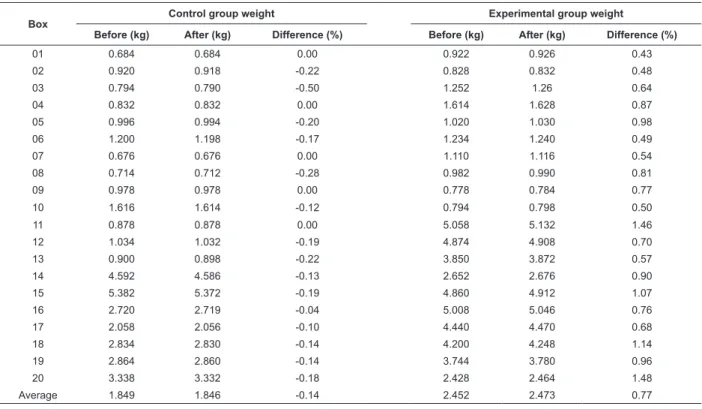
Table 1 presents the comparison of weights before and after steam sterilization of the boxes of the negative control and experimental groups with the respective values of difference (before and after). The experimental group’s inal weight (after sterilization) was heavier than the initial weight (before sterilization), average difference -0.14%, which evidenced there was moisture in the interior of the boxes of this group and therefore, an absence of moisture in the control group; average
difference +0.77%.
Table 1 – Comparison of the weight of instrument boxes, in the control and experimental groups, before and after the
autoclaving process. São Paulo, Brazil 2005
Box Control group weight Experimental group weight
Before (kg) After (kg) Difference (%) Before (kg) After (kg) Difference (%)
01 0.684 0.684 0.00 0.922 0.926 0.43
02 0.920 0.918 -0.22 0.828 0.832 0.48
03 0.794 0.790 -0.50 1.252 1.26 0.64
04 0.832 0.832 0.00 1.614 1.628 0.87
05 0.996 0.994 -0.20 1.020 1.030 0.98
06 1.200 1.198 -0.17 1.234 1.240 0.49
07 0.676 0.676 0.00 1.110 1.116 0.54
08 0.714 0.712 -0.28 0.982 0.990 0.81
09 0.978 0.978 0.00 0.778 0.784 0.77
10 1.616 1.614 -0.12 0.794 0.798 0.50
11 0.878 0.878 0.00 5.058 5.132 1.46
12 1.034 1.032 -0.19 4.874 4.908 0.70
13 0.900 0.898 -0.22 3.850 3.872 0.57
14 4.592 4.586 -0.13 2.652 2.676 0.90
15 5.382 5.372 -0.19 4.860 4.912 1.07
16 2.720 2.719 -0.04 5.008 5.046 0.76
17 2.058 2.056 -0.10 4.440 4.470 0.68
18 2.834 2.830 -0.14 4.200 4.248 1.14
19 2.864 2.860 -0.14 3.744 3.780 0.96
20 3.338 3.332 -0.18 2.428 2.464 1.48
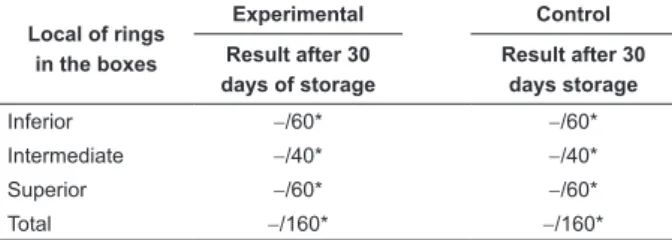
Table 2 presents the microbiological results of
cultures of the test material of the experimental and
control groups after 30 days of storage.
Table 2 – Distribution of the results of microbiological
cultures according to the localization of the rings of
porcelain cylinders in the experimental and control
groups 30 days after storage. São Paulo, Brazil 2005
Local of rings in the boxes
Experimental Control
Result after 30 days of storage
Result after 30 days storage
Inferior −/60* −/60*
Intermediate −/40* −/40*
Superior −/60* −/60*
Total −/160* −/160*
Total number of positive growth/total number of samples
Microbiological growth was observed in 100% of
the positive control group.
Discussion
The recommendation of several authors(7-11)
not to use material that becomes moistened after
steam sterilization is grounded on the premise that
microorganisms proliferate in moist environments,
though there is no evidence for such a statement.
The results presented on Table 2 show
microorganisms did not proliferate after 30 days of
storage even with the presence of moisture. This result
may be due to the fact that the residual water was
also sterilized and boxes were wrapped and stored in
appropriate conditions. In this context, the effectiveness
of the packages’ microbiological barrier assumes a key and deining role in the maintaining the sterility of packaged content(22). In this study, the covering used
(SMS KC 300) was an effective biological barrier for
material stored for 30 days even after having contact with
intense external contamination via test microorganisms.
We add that there is consensus concerning the immediate use of wet material sterilized in a lash cycle of steam sterilization because it is believed that water is free of
microorganisms as is the material.
Another reason for authors(7-11) to condemn the use
of moist/wet material might be related to the capillarity
phenomenon, that is, the ability of moisture to pass
through the covering and thereby carry microorganisms
with it. It is known that bacteria and fungi grow in humid
or moist environments with ambient temperatures.
Fungi were not used in the experiments because their
cells are much larger than bacteria(23). The smallest
size of a known virus is 500 times larger than that of a
water molecule(24). Based on this theoretical framework,
passage of water through critical material does not
necessarily entail the passage of microorganisms. The results of this experiment conirmed the study’s initial hypothesis. During the 30 days of storage
of moist/wet material with test microorganisms present
the entire time on the external surface of the surgical
boxes, the test microorganisms did not breach the
covering or contaminate the interior of the boxes.
A third explanation that might have grounded
the authors’ position that moist/wet material might be
contaminated during storage refers to the occurrence of
micro holes in moist/wet coverings; these would become
more fragile and the biological barrier would break. This
was not evidenced in this experiment, though it is a
plausible possibility.
Person’s Chi-square test was initially intended to
compare proportions of the experimental and negative
control groups, however, since no growth was observed,
there was no need to compare proportions through
statistical inferences.
We stress that studies addressing this same
phenomenon were not found, thereby comparison of
results was not possible.
Conclusion
The presence of moisture in the interior of perforated
surgical boxes submitted to steam sterilization and
then wrapped in a SMS sheet did not interfere in the
maintenance of its content-sterility even after 30 days
of storage.
Given the study’s design with appropriate sample size (power of 99.9%), the indings of this study can support decision-making in practice whether to use
moist/wet material without harming the delivery of qualiied and ethical care.
This study does not intend to contradict standard
recommendations that material must be dry after
completing the process of steam sterilization, however, it presents scientiic evidence to support decision-making in an emergency situation, such as when patients
are already anesthetized in the surgical room and
professionals only discover wet material at the time of
use and when there is no dry material readily available
Moriya GAA, Graziano KU.
References
1. Chu NS, Chan-Meyers H, Ghazanfari N, Antonoplos P. Levels of naturally occurring microorganisms on surgical instruments after clinical use and after washing. Am J Infect Control. 1999;27(4):315-9.
2. Pinto FMG, Queiroz RS, Barreto CS, Jenné LMM, Graziano KU. Analysis of the microbial load in instruments used in orthopedic surgeries. Am J Infect Control. 2010 April; 38(3):229-33. Epub 2009 Nov 12.
3. Rutala WA, Weber DJ. Healthcare Infection Control Practices Advisory Committee. Guideline for disinfection and sterilization in healthcare facilities [online]. [Cited 2009 Sep 21]. Center for Diseases Controle and Prevention. HICPAC; 2008. Available from: http://www.cdc.gov/ncidod/dhqp/pdf/guidelines/Disinfection_ Nov_2008.pdf. (21 set 2009)
4. Rutala WA, Weber DJ. How to assess risk of disease transmission to patients when there is a failure to follow recommended disinfection and sterilization guidelines. Infect Control Hosp Epidemiol. 2007; 28(2):146-55.
5. Recomendações práticas em processos de esterilização em
estabelecimentos de saúde - esterilização a calor: guia elaborado por enfermeiros brasileiros. Campinas: Komedi; 2000.
6. Agência Nacional de Vigilância Sanitária (BR) [homepage
na internet]. Consulta Pública nº 34, de 3 de junho de 2009. Brasília. [acesso em: 4 junho 2009]. Disponível em:
URL http://www4.anvisa.gov.br/base/visadoc/CP/CP[26720-3-0].PDF.
7. Lee SA. Steam Sterilization: troubleshooting wet pack problem. In: Reichert M, Young JH. Sterilization technology for the heath care facility. 2nd ed. Gaithersburg: Maryland; 1997. p. 155-66.
8. Karle DA, Ryan P. Guidelines for evaluating wet packs. AORN J. 1983; 38(2):244-56.
9. Moses RF. Why is a little water such a big deal? Mater Manage. Health Care. 1994; 3(3):68-70.
10. Strauss R. Eliminating stained instruments by controlling steam quality. J Hosp Supply Process Distrib.1984 Jan-Feb; 2(1):30-2.
11. Association for the Advancement of Medical Instrumentation (AAMI). American National Standard. Steam sterilization and sterility assurance in health care facilities. Arlington; 2002.
12. Pereira MS, Moriya TM, GIR E. Infecção hospitalar nos
hospitais escola: uma análise sobre seu controle. Rev.
Latino-Am. Enfermagem. 1996; 4(1):145-62.
13. Graziano KU, Balsamo AC, Lopes CLBC, Zotelli MFM, Couto AT, Phascoal MLH. Critérios para avaliação das dificuldades na limpeza de artigos de uso único. Rev. Latino-Am. Enfermagem. 2006; 14(1):70-6.
14. International Standard Organization. Sterilization of health care products – Requirements for validation and routine control – Industrial moist heat sterilization. ISO 11134:1994.
15. Association of Official Analytical Chemists (AOAC). Methods of analysis of the Association of Official Analytical Chemits. 15th ed. Washington; 1995. p. 65-77.
16. Engler R. Association of Official Analytical Chemists. In: Official Methods of Analysis of the A O A. 14th ed. Washington; 1984. p. 65-77.
17. Association of Perioperative Registered Nurses (AORN). Standards, recommended practices, and guidelines. Denver; 2004.
18. United States Pharmacopoeia. 28th ed. Rockville: United States Pharmacoipeial Convention; 2005.
19. Bishop DG, Still JL. Fatty acid metabolism in Serratia Marcescens: IV. The effect of temperature on fatty acid composition. J Lipid Res. 1963; 4(1):87-90.
20. Dewald RR. Kinetic studies on the destructive action of oxygen on lyophilized Serratia Marcescens. Appl Microbiol. 1966; 14(4):568-72.
21. Dawson B, Trapp RG. Basic and clinical biostatistics. 4th ed. Norwalk: McGraw-Hill; 2004. 416 p.
22. Rodrigues E, Levin AS, Sinto SI, Mendes CF, Barbosa B, Graziano KU. Evaluation of the use and re-use of cotton fabrics as medical and hospital wraps. Braz J Microbiol. 2006; 37(2):113-6.
23. Frey KB, Price P. Introduction to viruses. In: Microbiology for Surgical Technologists. Pacific Grove: Thomson Delmar Learning; 2003. p. 322.
24. Prescott LM, Harley JP, Klein DA. Microbiology. Dubuque: C. Brown; 1996.