CONTRIBUTIONS TO THE ELABORATION
OF A PHONETICALLY BALANCED TEXT
FOR THE EUROPEAN-PORTUGUESE
Contributos para a construção de um texto foneticamente
equilibrado para o português-europeu
Ana Paula Mendes(1), Alexandra Nunes da Costa(2),
Alexandra Delgado Martins(3), André Filipe Oliveira Fernandes(4),
Sara Margarida Dias do Rosário Vicente(5), Tânia Carina Samouco Freitas(6)
(1) Professor of Health School of Polytechnic Institute of
Setú-bal, ESS-IPS, SetúSetú-bal, Portugal; PhD in Speech Sciences from University of Florida.
(2) Speech-Language Pathologist of Sertã School, Portugal;
B.A. in Speech Therapy from Health School of Polytechnic Institute of Setúbal.
(3) Speech-Language Pathologist of Portuguese Red Cross,
Lisbon, Portugal; B.A. in Speech Therapy from Health School of Polytechnic Institute of Setúbal.
(4) Speech-Language Pathologist of Health Clinic Esfera
Saúde of Guimarães, Portugal; B.A. in Speech Therapy from Health School of Polytechnic Institute of Setúbal.
(5) Speech-Language Pathologist of LAB FALA, LDA, Póvoa
de Santa Iria, Portugal; B.A. in Speech Therapy from Health School of Polytechnic Institute of Setúbal.
(6) Speech-Language Pathologist of City Council of Sertã,
Portugal; B.A. in Speech Therapy from Health School of Polytechnic Institute of Setúbal.
Conlict of interest: non-existent
INTRODUCTION
Reading aloud is a phonatory task often used by the Speech-Language Pathologists (SLP) in formal and informal assessment of speech production (e.g., articulation, voice, resonance, luency, speech rate and intelligibility, usage of phonological processes). This phonatory task has physiological demands and consequently acoustic and audio-perceptual patterns similar to spontaneous speech 1,2.
Traditionally, for this phonatory task, SLPs use a text from a daily newspaper or a Phoneti-cally Balanced Text (PBT). For a valid and reliable assessment and analysis, it should use a PBT, because it is a representative text of the standard language. That is, a PBT has all the phonemes and syllabic formats which compose a language, ABSTRACT
Purpose: the aim of this study is to elaborate a Phonetically Balanced Text for the European-Portuguese (EP) called “O Sol” (The Sun). Method: four subjects (two females and two males) with [21-49] year-old read aloud the text. Recordings were obtained with Olympus (VN-240PC and VN-2100PC) and were used to account the produced phonemes. The procedures were: 1) the comparison between the relative frequency of the phonemes of “O Sol” and the relative frequency described in PF_fone through the correlation coeficient of Pearson and the Mann-Whitney, 2) the comparison between the large and short transcriptions in order to analyze the co-articulation phenomenon 3) the analysis of the syllabic formats. Results: statistical analysis showed that relative frequency occurrence of phonemes of the text “O Sol” have a strong correlation with those of PF_fone (r = 0,924). The median values of the relative frequency occurrence of phonemes of “O Sol” were signiicantly equal to the PF_fone (p<.05). Conclusion: the text “O Sol (The Sun)” is close to an ideal phonetically balanced text, since it achieved the predeined assumptions. Phonologically, it shows the most common formats syllable in the EP. We veriied a decrease in relative frequency of phonemes in the close transcription, due to co-articulation phenomenon. Future work will focus on increasing said sample.
languages, however, there is no standardized material for the European-Portuguese (EP)4-9.(see
Table 1). and thus distinguish and highlight those that occur
with higher and lower frequency in commonly speech 3. Currently, there are PBTs in several
Phonetically balanced texts Countries where they are used
1 Arthur the rat5 Australia, Canada, England, India and the USA
2 The rainbow passage6 England and USA
3 The north wind and the sun 7 England and USA
4 Comma gets a cure8 USA
5 I teach Ferdinand…9 England and USA
6 Bother, father caught…9 Australia, Canada, England, Ireland, New Zealand and USA Table 1 – Phonetically balanced texts used in different countries
To design of a PBT, it was necessary to establish the following assumptions:
1. Contain all the phonemes of a language, in this case the EP;
2. Have all phonemes with the same relative frequency of occurrence of spontaneous speech;
3. Contain all syllabic formats; 4. Have contextual cohesion;
5. Have an appealing theme, without childish or scientiic characteristics;
6. Be written in plain language to facilitate its understanding, and reading aloud skills;
7. Be succinct in order to avoid fatigue 10.
For the standard EP there is a language Corpus called PF_Fone, which contains the phoneme relative frequency of occurrence (RF). It was built from the Corpus of Fundamental Portuguese (FP) Frequency, which contains the needed EP vocabulary for effective communication capabilities of everyday life situations. This corpus was developed
in order to select vocabulary and grammar based on scientiic data for educational purposes 11.
The pertinence of a PBT is to provide the SLPs with material that can help to identify possible prob-lems of articulation, voice, resonance, speech rate and intelligibility, as well as phonological processes usage, using a single phonatory task instead of several that can cause fatigue on the patient.
A standardized PBT can be used in audio-perceptual, acoustic and/or physiological evaluation. Moreover, it can contribute to valid and reliable comparisons within and between subjects. It can also be used in clinical trials (e.g. diagnosed patients) or in normative studies (e.g. in populations free of communication, language and speech disorders).
The aim of this study was to create a PBT for EP called “O Sol” (“The Sun”) 12 (Figure 1). This text
aims to contribute for a reading aloud task which SLPs can use to evaluate in a fast, eficient and standardized manner, areas of speech, voice and luency.
The Sun
with a mean age of 35 years, a standard devia-tion of 14, and range [21-49] years. The literacy rate ranged from the fourth grade to college level. The characterization of the sample is described in Table 2.
METHOD
Subjects
Four subjects participated in this pilot study, two males and two females from the Setúbal district,
Subjects Age Sex Literacy rate
JG 25 M University attendance
HM 49 M 4th grade
SP 21 F University attendance
NF 46 F High school
Table 2 – Characteristics of the subjects
Inclusion criteria was: 1) EP domain, 2) robust physical health, 3) no medication taken, 4) absence of smoking and alcohol habits, 5) absence of speech, language and communication problems, and 6) without colds or respiratory problems on recording day. The selected subjects illed out a consent form, as well as, a physical and health voice questionnaire.
Procedures
Subjects read aloud the text “O Sol” (2009 version)12 in a standing position with a comfortable
voice. Audio recordings were performed with Olympus (VN-240PC and VN-2100PC) with built-in microphones. Speech samples were recorded in wav format.
This study consisted of two distinct phases. The procedures outlined for the irst phase consisted on: 1) analysis of the text “O Sol” (2007 version)13, 2)
adjustments of the text “O Sol” (2007 version)13, 3)
broad phonetic transcription of the text “ O Sol” (2009 version)12 and respective analysis, 4) comparison of
phoneme relative frequencies of the text “ O Sol” (2009 version) with the PF_Fone, and 5) analysis of syllabic formats “O Sol “(2009 version)12.
The second phase of the project obey the following steps: 1) recording of the reading aloud of the text “O Sol “ (2009 version)12 of four subjects, 2)
narrow phonetic transcription of the reading aloud (phonetic counting, calculation of the phoneme relative frequencies of the text “O Sol” (2009 version) 12 , the text “O Sol” (2007 version) 13 and the
values of PF_Fone), 3) comparison of the average of the relative frequencies of broad with the narrow transcripts to check coarticulation phenomena,
4) counting and analysis the words of the text “O Sol” (2009 version)12 which were included in the PF
and compare them with results of the text “O Sol” (2007 version)13, and 5) calculate speech rate and
intelligibility of the reading aloud of “O Sol” (2009 version)12.
Statistical analysis was performed with Pear-son’s correlation and Mann-Whitney test. α level for signiicance was .05 and a conidence interval 95%.
The Ethics Committee for Research (ECR) of the Health School of Polytechnic Institute of Setúbal was created on 4/12/2011, which was a later date to the study. However, all subjects illed out and signed the consent form. Moreover, the principal investigator of the PBT is a member of ECR.
RESULTS
The text “O Sol” (2009 version) 12 presented
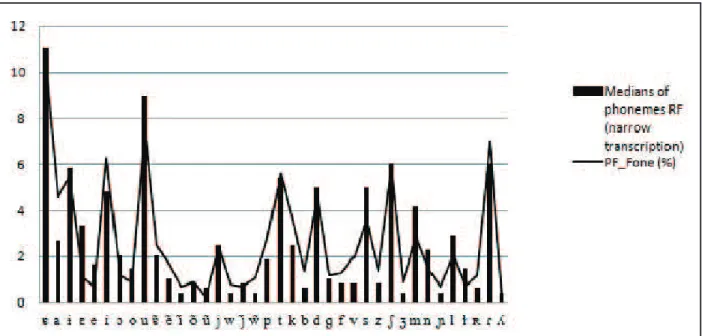
all EP phonemes and had an average of phonetic relative frequency of occurrence similar to the spontaneous speech (PF_Fone), as shown in Table 3. According to Figure 2, the means of phoneme relative frequency (RF), obtained from the narrow transcription, was similar to the spontaneous speech. The Pearson correlation coeficient, r = 0.924, revealed a strong correlation between the phoneme relative frequencies of PF_Fone and the text “O Sol” (2009 version)12. Mann-Whitney statistical
test revealed a p-value = .763, meaning that the medians of the phoneme RF of PF_Fone and the text “O Sol” (2009 version)12 were not signiicantly
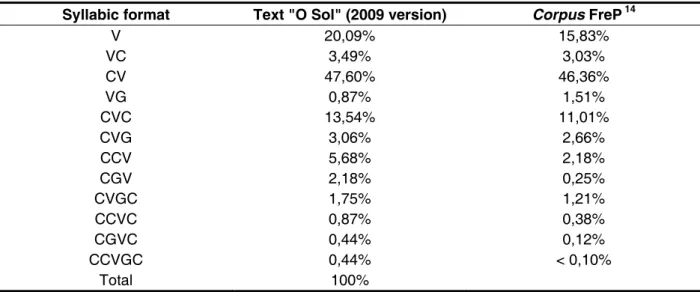
syllabic formats from the text “O Sol” (2009 version)12
and the Corpus FreP 14. The text contained all the
syllabic formats of the EP, and the most common CV (consonant+vowel) format. See Table 4. Concerning coarticulation phenomena, it was
veriied that 10.52% of the phonemes were altered. They were /1/, /p/, /S/, /4/.
The analysis of syllabic structure was performed based on the comparison between the existing
Table 3 – Descriptive statistics of phoneme relative frequency of the text “O Sol” (2009 version) and PF_Fone
N=Number of EP phonemes, RF=Relative frequency, M=Mean, SD=Standard Deviation
N RF (M+SD) Variance Maximum Minimum
Text “O Sol” 38 2,63 + 2,48 6,16 11,21 0,43
PF_Fone 38 2,63 + 2,40 5,76 10,20 0,20
Syllabic format Text "O Sol" (2009 version) Corpus FreP 14
V 20,09% 15,83%
VC 3,49% 3,03%
CV 47,60% 46,36%
VG 0,87% 1,51%
CVC 13,54% 11,01%
CVG 3,06% 2,66%
CCV 5,68% 2,18%
CGV 2,18% 0,25%
CVGC 1,75% 1,21%
CCVC 0,87% 0,38%
CGVC 0,44% 0,12%
CCVGC 0,44% < 0,10%
Total 100%
Table 4 – Analysis of the syllabic formats of the text “O Sol” (2009 version) using the Corpus FreP
The word percentage belonging to the FP of the text “O Sol” (2009 version) 12 was 82.5% and the
2007 version 13, was showed 78.52%. 17/18 words
introduced in the 2009 version (94.4%) were part of FP. See Figure 3.
Speech intelligibility was 100% and speech rate was 114.54 to 168 words/ minute. See Table 5.
Clinical Implications
The PBT allows an evaluation of several areas such as articulation, voice and luency. And it is easy to implement without inducing patient’s fatigue. The demands of this task are reduced during the evaluation. The PBT also allows a homogenized usage by SLPs. Last but not the least, the PBT can be used to evaluate the effectiveness and eficiency of intervention and therapeutic advances.
Limitation of the study
This study has some limitations such as: 1) a small sample considering just a preliminary study of N = 4, consequently does not allow inferences or extrapolations, 2) study was conducted in the Setúbal district not considering the other two EP dialects (i.e., northern and islands), 3) the information source for speech rate was from American-English scientiic studies, rather than EP normative data, and 4) reduced bibliographic databases, since it is an innovative and pioneering study.
Future investigations
In the future, the PBT should be applied to a large sample and in various regions of Portugal (i.e., mainland and islands), to cover the three dialects of EP (northern, central and islands). The literacy level should also be included in the study. Normative data of speech rate is also a target. Other measures that should be included are speech intelligibility, number of words/respiratory group and number of pauses. The descriptive statistics for the PF_Fone for each phoneme in isolation should also be investigated.
CONCLUSION
The text “O Sol” (2009 version)12 had all EP
phonemes and the phoneme RF was similar to the spontaneous speech of PF_Fone. It had the most EP frequent syllabic formats, the most frequent CV syllabic format and the closest to the reference
DISCUSSION
The Pearson correlation coeficient (r = 0.924) indicated a strong correlation between the results of spontaneous speech and the text “O Sol” (2009 version) 12. The value obtained with the
Mann-Whitney test (p = 0.763), showed that the medians of phonemes’ RF of the text “O Sol” (2009 version) 12 and spontaneous speech were not
signif-icantly different.
The results obtained by descriptive and inferential analysis, showed that the text “O Sol” (2009 version) 12 presented all phonemes existing
in the EP and the phoneme RF of the text was similar to those of spontaneous speech, as noted in comparison with the Corpus of PF_Fone.
The coarticulation phenomena observed when reading aloud the text “O Sol” (2009 version) 12 were
similar to those of spontaneous speech. As noted in the reading-aloud the text, the phonemes /S/ and /1/ suffered a coarticulation phenomena, which usually happens in spontaneous speech 15. The phoneme
/1/ was omitted and the phoneme /S/ assimilated. Differences were also observed in the phonemes /p/ e /4/ due to some hesitation during the reading aloud.
In the reading aloud, all the words produced by subjects were intelligible, revealing a speech intelligibility of 100%. The speech rate was 114.54 to 168 words/minute. There are no normative data for the EP. Comparing them with those published in the literature for American-English revealed discrepancies (e.g., 270 words/minute reading aloud), but this comparison has its limitations because they are related to different languages16.
The text “O Sol” (2009 version) 12 presented all
EP syllabic formats. It also presented those that are most frequent and common in spontaneous speech, speciically the CV format.
The text “O Sol” (2009 version)12 had more
words belonging to the PF then the previous version
Subjects Speech intelligibility (%) (words/ minute) Speech rate Normative data (Adults)16
JG 100% 168
270 (reading aloud) 160 – 180 (conversation)
220 – 410 (speech)
HM 100% 114,54
SP 100% 164,35
NF 100% 168
Bachelor of Speech Therapy and Master of Speech and Hearing Sciences majors, which contributed to the development of this work: João Silva, Mário Barroco, Joana Eira, Ana Raquel Fernandes, Joana Batista, Maria João Pedro, Elsa Martins e Jorge Martins. We also thank the students of the Health School of Polytechnic Institute of Setúbal, from the Bachelor in Speech Therapy major: André Barragon, Joana Machado, Teresa Reisinho, Vânia Ribeiro, Vera Sabino, Ana Varge and Raquel Brás.
Finally, our gratitude to Professor António Sardinha, Associate Professor, Department of Mathematics of Technology School of Polytechnic Institute of Setúbal, for his time, availability and help with statistical analysis.
“O Sol” (version 2009)12 had contextual cohesion.
That is, it presented a logical sequence that allowed its meaning, easily. It is a short text which has a reduced physiological demand on the subject. It has no childish vocabulary. Despite being a text with some scientiic terminology, it presented a broad percentage of words that belong to the Corpus of the PF (82.54%), contributing to an easy reading and good comprehension. It is concluded that the text “O Sol” (2009 version) 12 is a PBT for EP.
ACKNOWLEDGEMENTS
We would like to thank the students from the Health School of University of Aveiro, from the
RESUMO
Objectivo: o objectivo deste estudo consiste na criação de um Texto Foneticamente Equilibrado para o Português-Europeu (PE) designado “O Sol”. Método: quatro sujeitos da região de Setúbal, entre [21-49] anos (dois do sexo feminino e dois do masculino) leram em voz alta o texto “O Sol”. As gravações realizadas com Olympus (VN- 240PC e VN- 2100PC com microfones integrados) serviram para a contabilização dos fonemas produzidos. Os procedimentos foram: 1) a comparação entre as frequências relativas dos fonemas do “O Sol” e as frequências relativas descritas no PF_fone, através do coeiciente de correlação de Pearson e do teste de Mann-Whitney; 2) a comparação entre a trans-crição larga e a estreita, veriicando-se os fenómenos de coarticulação; e 3) a análise dos formatos silábicos. Resultados: a análise estatística demonstrou que as frequências relativas de ocorrência dos fonemas do texto “O Sol” têm uma correlação forte com as do PF_fone (r = 0,924). As medianas das frequências relativas de ocorrência dos fonemas do texto foram signiicativamente iguais das do PF_fone (p<.05). Conclusão: o texto “O Sol” está próximo de um texto foneticamente equilibrado ideal, uma vez que se veriicaram os pressupostos pré-deinidos. Fonologicamente, apresenta os formatos silábicos mais frequentes no PE, veriicou-se ainda uma diminuição na frequência relativa de fonemas na transcrição estreita, devido a fenómenos de coarticulação. Futuros trabalhos incidirão no aumento da amostra.
DESCRITORES: Voz; Qualidade da Voz; Fala; Leitura
REFERENCES
1. Mendes A, Castro E. Análise acústica da avaliação vocal I: tarefas fonatórias e medidas acústicas. Revista Port ORL. 2005; 43(2): 127-36 2. Baken, R. Clinical measures of speech and voice. Boston: College-Hill; 1987.
3. Eira J, Fernandes A. Texto foneticamente equilibrado [trabalho académico]. Aveiro (Portugal): Escola Superior de Saúde da Universidade de Aveiro; 2003.
4. Martins E, Martins H. Texto foneticamente equilibrado [trabalho académico]. Aveiro (Portugal):
Escola Superior de Saúde da Universidade de Aveiro; 2004.
5. Abercrombie, D.. Elements of general phonetic. Edinburgh: U.P. Edinburgh; 1967.
6. Fairbanks, G.Voice and articulation drill book. New York: Harper and Brothers; 1960.
7. International Phonetic Association. Handbook of the International Phonetic Association. Cambridge University; 1999.
13. Barragon A, Machado J, Reisinho T, Ribeiro V, Sabino V. Contributos para a elaboração de um texto foneticamente equilibrado [trabalho académico]. Setúbal (Portugal): Escola Superior de Saúde do Instituto Politécnico de Setúbal; 2007.
14. Vigário M, Martins F, Frota S. A ferramenta FreP e a frequência de tipos silábicos e classes de segmentos no português. 2006. Disponível em: www.fl.ul.pt/LaboratorioFonetica/frep/APL2006 VigarioMartinsFrota.pdf
15. Duarte I. Língua Portuguesa: Instrumentos de Análise. 1º ed. Lisboa: Universidade Aberta; 2004. 16. Shipley KG, McAfee JG. Assessment in speech-language pathology: a resource manual. 1th ed. San Diego: Singular Publishing Group Inc; 1998. 9. Alt-uso-english.org [homepage na internet].
Disponível em: http://alt-usage-english.org/audio_ archive.shtml
10. Barragon A, Machado J, Reisinho T, Ribeiro V, Sabino V. Contributos para a elaboração de um texto foneticamente equilibrado [trabalho académico]. Setúbal (Portugal): Escola Superior de Saúde do Instituto Politécnico de Setúbal; 2007.
11. Centro de Linguística da Universidade de Lisboa. Português fundamental: vocabulário e gramática. Tomo I. Lisboa: Garcia & Carvalho; 1984.
12. Costa A, Fernandes A, Freitas T, Martins A, Vicente S. Contributos para a elaboração de um texto foneticamente equilibrado [trabalho académico]. Setúbal (Portugal): Escola Superior de Saúde do Instituto Politécnico de Setúbal; 2009.
http://dx.doi.org/10.1590/S1516-18462012005000030 RECEIVED ON: 06/07/2011
ACCEPTED ON: 09/30/2011
Mailing Address:
Alexandra Nunes da Costa