A
TL-PHYS-PROC-2017-086
25
July
2017
eQCD printed on July 24, 2017 1
LIP - Laborat´orio de Instrumenta¸c˜ao e F´ısica Experimental de Part´ıculas
1 2
Helena Santos, on behalf of the ATLAS Collaboration
5
Ultrarelativistic heavy ion collisions at the LHC produce the Quark
6
Gluon Plasma. Jets are a useful probe to study this state of matter since
7
they are produced at the early stages of the collisions and are expected to
8
be modified as propagating through the medium. One observable is the
9
energy loss lowering the jet yields at a given transverse momentum. Other
10
observables are the modification of the dijet momentum balance and the
11
modification of fragmentation functions. A phenomenon strictly correlated
12
to the jet energy loss is the modification of the charged-hadron momentum
13
spectrum. The large new Pb+Pb data sample collected by ATLAS in Run
14
2 allows precision measurements of these observables in a wide transverse
15
momentum range and in different centrality and rapidity intervals.
16
PACS numbers: 12.38.Mh,13.87.Ce,13.87.Fh
17
1. Introduction
18
A wide research program is ongoing at the Large Hadron Collider with
19
the aim of studying the properties of QCD matter at extreme temperatures
20
and densities. Jets produced in ultra-relativistic heavy ion collisions
consti-21
tute a golden probe of such a state of matter. The hard scattered quarks and
22
gluons emerged from these collisions evolve as parton showers that
propa-23
gate through the hot and dense medium. Constituents of the parton showers
24
emit medium-induced gluon radiation and, as a consequence, the resulting
25
jet loses energy, a phenomenon commonly termed as jet quenching [1]. Jets
26
produced in heavy ion collisions are thus expected to be suppressed at a
27
given pT, relatively to a sample produced in pp collisions. Their internal
28
structure is also expected to be modified. The large acceptance and high
29
granularity of the ATLAS detector [2] is well suited to study these
phenom-30
ena. Results shown in this conference used data produced in Pb+Pb and
31
pp collisions at the center of mass energies of 2.76 TeV and 5.02 TeV. The
32 ∗
This work was supported in part by FCT under the contract Project
IF/01586/2014/CP1248/CT0003
eQCD printed on July 24, 2017 3
centrality of the Pb+Pb collisions is estimated using the total transverse
33
energy deposited in the forward calorimeters (FCal, 3.2 ≤ |η| < 4.9) and
34
compared to a Glauber Monte Carlo model [3], convoluted with pp data
35
taken at the same beam energy. The PEFCal
T distribution is then divided
36
into percentiles of the total inelastic cross-section for Pb+Pb collisions. Jets
37
are reconstructed using calorimeter “towers” as input signals to the anti-kt
38
algorithm, with jet radius parameter size R = 0.4. The underlying event
39
is estimated and subtracted event-by-event in each calorimeter layer and
40
strip of pseudorapidity after excluding regions subtending jet candidates
41
and corrected for flow modulation.
42
2. Results
43
The nuclear modification factor RAA, defined as the ratio of normalized
44
yields in Pb+Pb and pp collision systems, is used to compare the inclusive
45
transverse momentum distributions measured in the two collision systems:
46 RAA ≡ (1/Nevt) d2NjetP bP b/dpTdy cent hTAAi d2σpp jet/dpTdy , (1)
where hTAAi stands for the geometric enhancement of per-collision
nucleon-47
nucleon luminosity and Nevt is the total number of Pb+Pb collisions within
48
a chosen centrality interval. The jet yields, unfolded for detector resolution,
49
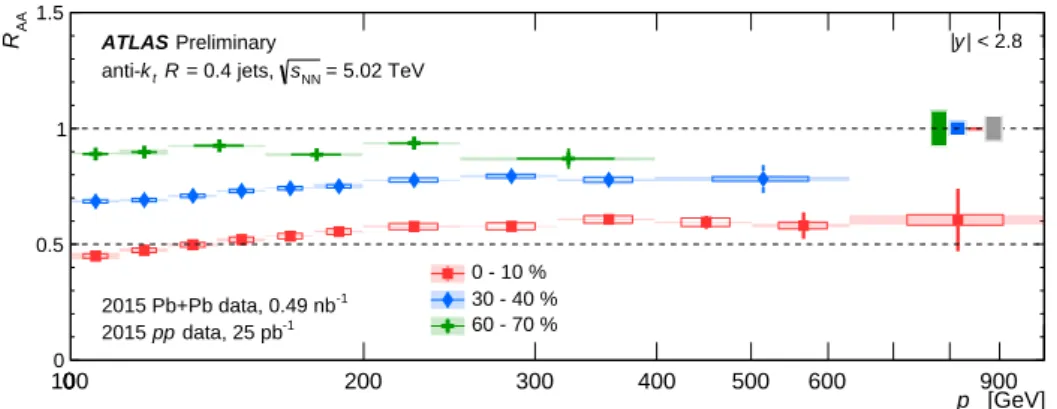
bin-to-bin migration and reconstruction inefficiency, are shown in Fig.1.
50
Jets are suppressed increasingly with collisions centrality, reaching a factor
51
of two in central collisions (0–10%), while showing little dependence on jet
52
transverse momentum and rapidity [4]. These measurements confirm the
53
expectations on the reduction of the jet yields at a given transverse energy
54
due to the interaction of partons in the quark gluon plasma [1].
55
A complementary observable to jet production is the measurement of
56
charged particle spectra, as these contribute to the understanding of jet
57
energy loss mechanisms. Tracks are reconstructed using the ATLAS
in-58
ner detector system in the pseudorapidity range |η| < 2.5 and over the
59
full azimuthal acceptance. Corrections to measured pT spectra, like fake
60
tracks, bin-to-bin migration, and reconstruction inefficiency are estimated
61
from Monte Carlo simulations. The charged hadron RAA as a function of
62
pT is shown in Fig.2. A characteristic pT shape, which becomes more
pro-63
nounced with increasing centrality, is observed. The RAA distributions first
64
increase reaching a local maximum at pT< 2 GeV, a feature commonly
asso-65
ciated with the Cronin effect [5], i.e. hardening of the pT spectrum in heavy
66
ion collisions relative to pp collisions, often understood to be due to multiple
67
[GeV] T p AA R 0 0.5 1 1.5 100000 200 300 400 500 600 900 0 - 10 % 30 - 40 % 60 - 70 % Preliminary ATLAS = 5.02 TeV NN s = 0.4 jets, R t k anti-| < 2.8 y | -1 2015 Pb+Pb data, 0.49 nb -1 data, 25 pb pp 2015
Fig. 1. The RAAas a function of jet pT for jets with |y| < 2.8 for three centrality
bins. The error bars represent statistical uncertainties, the shaded boxes around the data points represent correlated systematic uncertainties, open boxes represent uncorrelated systematic uncertainties. The colored shaded boxes at unity repre-sent hTAAi uncertainties and the gray shaded box represents the uncertainty on
pp luminosity. The horizontal width on the shaded boxes represents the width of the pTinterval and the horizontal widths on the open boxes are arbitrary for better
visibility [4].
at pT = 7 GeV. The rate of charged particles is noticeably suppressed even
69
in the 60–80% centrality interval but the suppression is strongest in the
70
most central 0–5% collisions. Above 7 GeV, the RAA generally increase
71
with increasing pT up to 60 GeV, after which the slope changes. Details of
72
this analysis can be found in [6].
73
Jet fragmentation functions are measured aiming a deeper
understand-74
ing of the jet energy loss nature and constraining jet quenching models. The
75
jet structure is probed in the pT range from 100 to 398 GeV, using tracks
76
with pT > 1 GeV. The fragmentation functions, defined as D[z(pT)] =
77
(1/Njet )dNch /dz(pT), are studied as a function of the longitudinal
momen-78
tum fraction, z = pTch/pTjetcos∆R, and track pT, where pTchstands for the
79
transverse momentum of a charged particle and ∆R is the distance between
80
the charged particle and the jet axis. The D(z) and D(pT) distributions
81
are background subtracted, corrected for reconstruction inefficiency and
un-82
folded with a 2D Bayesian method. Figure 3 shows the modification of the
83
fragmentation functions, assessed with RD(z)= D(z)|Pb+Pb/D(z)|pp in
dif-84
ferent ranges of rapidity. An enhancement at low z, up to 0.03, and at z
85
larger than 0.2, mainly at mid-rapidity, is observed in central collisions. The
86
range 0.03 < z < 0.2 shows a clear depletion. The enhancement of fragment
87
yields at low z is consistent with an interpretation in which the energy lost
eQCD printed on July 24, 2017 5 [GeV] T p 1 10 2 10 AA R 1 − 10 1 Preliminary ATLAS = 5.02 TeV NN s , s -1 Pb+Pb, 0.49 nb -1 p+p, 25 pb |<2.5 η | 0-5% 10-20% 30-40% 50-60% 60-80%
Fig. 2. Nuclear modification factor RAA as a function of pT for charged hadrons
measured in Pb+Pb collisions at √sNN=5.02 TeV for five centrality intervals:
0-5%, 10-20%, 30-40%, 50-60% and 60-80%. Bars represent the statistical uncertain-ties and brackets represent the systematic uncertainuncertain-ties [6].
by partons is transferred predominantly to soft particles [7]. Details on this
89
analysis can be found in [8].
90
Fig. 3. The ratio RD(z) of unfolded D(z) distributions measured in
heavy-ion collisheavy-ions to unfolded D(z) distributheavy-ions measured in pp collisheavy-ions. The RD(z)distributions shown here are evaluated in two different centrality bins (rows)
and four different selections in jet rapidity (columns). The error bars on the data points indicate statistical uncertainties while the shaded bands indicate systematic uncertainties [8].
91
large asymmetrical dijet events [9]. Dijets probe differences in the two
par-93
ton showers since in most of the cases the interaction of the two outgoing
94
partons in the quark gluon plasma is not identical. A new analysis has
95
been performed using 140 µb−1 of Pb+Pb data taken at √sNN=2.76 TeV
96
and benefiting from a deeper understanding of the underlying event and
97
analysis conditions. Figure 4 shows the distribution of dijets produced in
98
Pb+Pb and pp collisions as a function of xJ, the ratio between the
trans-99
verse momenta of the two leading jets. The measured distributions are
100
unfolded to account for the effects of experimental resolution and
inefficien-101
cies on the two-dimensional (pT1, pT2) distributions and then projected into 102
bins of fixed ratio xJ = pT1/pT2. The observation of large asymmetric di-103
jets in central collisions is striking. The distributions in the two colliding
104
systems become increasingly similar with decreasing centrality. Interesting
105
is the study of the variation of the dijet asymmetry with the pT of the
106
leading jet. A modification in the asymmetry in Pb+Pb collisions as the
107
pT of the leading jet increases is observed, indicating that higher transverse
108
momentum jets lose less energy and so tend to be more balanced. This
109
feature is particularly evident for transverse momentum greater than 200
110
GeV. Details on this analysis can be found in [10].
111
3. Conclusions
112
Inclusive jets yields are found to be suppressed with collisions centrality,
113
reaching a factor of two in central collisions, while showing little dependence
114
on jet transverse momentum and rapidity. In contrast, the nuclear
modifi-115
cation factor of charged hadrons shows a striking non-flat pT shape which
116
becomes more pronounced with increasing centrality. The jet structure is
117
modified: in central collisions there is an enhancement of particles at low and
118
high z, while a suppression at intermediate z is observed. The pT balance of
119
dijets produced in Pb+Pb collisions is increasingly asymmetric when
com-120
pared to the pp results as the centrality of the collisions increases. At larger
121
values of pT1the xJdistributions are observed to narrow and the differences 122
between the distributions in central Pb+Pb and pp collisions become much
123
smaller.
124
REFERENCES
[1] J.-P. Blaizot and Y. Mehtar-Tani, J. Mod. Phys. E24 (2015) 1530012 (and
125
references therein). arXiv: 1503.05958 [hep-ph]
126
[2] ATLAS Collaboration, JINST 3 (2008) S08003.
127
[3] M. L. Miller, K. Reygers, S. J. Sanders, and P. Steinberg, Ann. Rev. Nucl.
128
Part. Sci. 57 (2007) 205.
eQCD printed on July 24, 2017 7 J x d N d N 1 0.5 1 1.5 2 2.5 3 3.5 4 < 126 GeV T1 p 100 < 0 - 10 % Pb+Pb pp 10 - 20 % ATLAS = 0.4 jets R t k anti-J x d N d N 1 0.5 1 1.5 2 2.5 3 3.5 4 20 - 30 % 30 - 40 % J x 0.3 0.40.5 0.6 0.7 0.8 0.9 1 J x d N d N 1 0.5 1 1.5 2 2.5 3 3.5 4 40 - 60 % J x 0.3 0.40.5 0.6 0.7 0.8 0.9 1 60 - 80 % = 2.76 TeV NN s -1 data, 4.0 pb pp 2013 -1 2011 Pb+Pb data, 0.14 nb J x d N d N 1 0.5 1 1.5 2 2.5 3 3.5 4 < 126 GeV T1 p 100 < 0 - 10 % Pb+Pb pp < 158 GeV T1 p 126 < ATLAS = 0.4 jets R t k anti-J x 0.3 0.4 0.5 0.6 0.7 0.8 0.9 1 J x d N d N 1 0.5 1 1.5 2 2.5 3 3.5 4 < 200 GeV T1 p 158 < J x 0.3 0.4 0.5 0.6 0.7 0.8 0.9 1 > 200 GeV T1 p = 2.76 TeV NN s -1 data, 4.0 pb pp 2013 -1 2011 Pb+Pb data, 0.14 nb
Fig. 4. Left: The (1/N )dN /dxJ distributions for jet pairs with 100 < pT1 < 126
GeV for different collision centralities and for R=0.4 jets. The Pb+Pb data are shown in red circles, while the pp distribution is shown for comparison in blue dia-monds and is the same in all panels. Right: The (1/N )dN /dxJ distributions with
different selections on pT1, shown for the 0–10% centrality interval (red circles) and
for pp (blue diamonds). In both panels the statistical uncertainties are indicated by the error bars while systematic uncertainties are shown with shaded boxes [10].
[4] ATLAS Collaboration, ATLAS-CONF-2017-009.
130
http://cds.cern.ch/record/2244820
131
[5] J. W. Cronin et al., Phys. Rev. D 11 (1975) 3105.
132
[6] ATLAS Collaboration, ATLAS-CONF-2017-012.
133
http://cds.cern.ch/record/2244824
134
[7] CMS Collaboration, Phys. Rev. C 84 (2011) 024906. arXiv: 1102.1957
[nucl-135
ex].
136
[8] ATLAS Collaboration, Eur. Phys. J C 77 (2017) 379. arXiv:1702.00674
[hep-137
ex]
138
[9] ATLAS Collaboration, Phys. Rev. Lett. 105 (2010) 252303. arXiv:1011.6182
139
[hep-ex]
140
[10] ATLAS Collaboration, submitted to Phys. Lett. B.. arXiv:1706.09363 [hep-ex]