Why
do
peop
le
con
tr
ibu
te
to
open
source
sof
tware?
The
mo
t
iva
t
ions
of
the
d
ifferen
t
con
tr
ibu
tors
to
OSS
pro
jec
ts
,
and
how
the
ir
par
t
ic
ipa
t
ion
is
charac
ter
ized
R
icardo
Carva
lho
152113062
D
isser
ta
t
ion
wr
i
t
ten
under
the
superv
is
ion
of
professor
C
láud
ia
Cos
ta
D
isser
ta
t
ion
subm
i
t
ted
in
par
t
ia
l
fu
l
f
i
lmen
t
of
requ
i
remen
ts
for
the
MSc
in
Bus
iness
Adm
in
is
tra
t
ion,
a
t
the
Un
ivers
idade
Ca
tó
l
ica
Por
tuguesa
,
Apr
i
l
,
2017.
i
Abstract
Open source software has seen a significant evolution in the last few years. From relatively niche products and free alternative solutions to mass commercial software, OSS has been adopted by some of the largest companies in technology as a viable mean to create some of the most used programs and operating systems nowadays.
The past research on this topic has approached the benefits of this perspective, the roles within the communities and the motivations of its contributors. However, there has not been research that has approached a detailed definition of the profiles within these communities, and how these contributors are motivated.
In this research, we defined four profiles within the OSS communities, based on personality traits, as well as taking into account the reasons that lead them to choose the project in which they participate. Furthermore, we characterized these profiles of contributors from the nature of their contribution in OSS projects to demographics. Finally, we assessed the main motivations that drive each of these groups, finding that there are significant differences of motivations between the profiles, particularly in an intrinsic level. Finally, we assessed the difference between groups concerning reasons for contributors to increase their participation, and found, once again, that there are significant differences between groups in what would lead them to participate more. This research found that there is potential for organizations to select the contributors that are a better fit for their communities, and target their motivations and preferred incentives.
ii
Resumo
O software de open source (OSS) tem experienciado uma evolução significativa nos últimos anos. De produtos de nicho e soluções grátis alternativas para software comercial distribuído em massa, OSS foi adotado por algumas das maiores empresas de tecnologia como um meio viável para criar alguns dos programas e sistemas operativos mais utilizados nos dias de hoje. A literatura existente sobre este tema abordou os benefícios desta perspetiva, os papéis dentro das comunidades e as motivações de seus contribuidores. No entanto, não há até à data, segundo nosso conhecimento, estudos que tenham abordado uma definição detalhada dos perfis dentro dessas comunidades e como esses contribuidores são motivados.
No presente estudo, definimos quatro perfis dentro das comunidades OSS, com base em traços de personalidade, bem como tendo em conta as razões que os levam a escolher o projeto em que participam. Além disso, caracterizamos esses perfis de contribuidores, desde a natureza da sua contribuição em projetos de OSS até a dados demográficos. Foram também avaliadas as principais motivações de cada um desses grupos, concluindo que existem diferenças significativas de motivações entre os perfis, particularmente a um nível intrínseco. Finalmente, estudámos a diferença entre os grupos relativamente às razões que levariam os contribuidores a aumentar sua participação e verificámos, uma vez mais, que existem diferenças significativas entre os grupos. Esta pesquisa concluiu que existe potencial para as organizações de selecionar os contribuidores que se ajustam melhor às suas comunidades, e segmentar as suas motivações e incentivos preferenciais.
iii
Acknowledgements
As a preface to this dissertation, I would like to thank the people that were essential not only in this process, but also throughout my life.
I would like to thank my mother, my father, and my grandmother. The person I am today and all that I have accomplished, as well as any positive impact I had in other people’s lives, is thanks to them. They have taught me a great deal throughout my life, and always made clear that my development and needs were their top priority, ahead of their own. Their incredible strength, kindness and values shaped who I am today, and gave me a great knowledge, as well as an incredibly positive view on life. Particularly within the process of this dissertation, despite not being familiar with the topic, of methods, they always gave me the strength and encouragement to finish my dissertation, during an important period in my professional life. I would also like to thank Ana Castro Guimarães, who has been my greatest inspiration, ever since I met her. With her, I have laughed, learned and imagined more than I thought was possible. Her incredible strength and knowledge are what pushed me to finish this dissertation, and what will inspire me and share great moments for years to come. Ana, I hope to spend the rest of my life with you.
I would also like to thank Kyryl Lakishyk, for being one of the most important people in my time in Catolica. He taught me, guided me, influenced me and inspired me like no other person in this stage of my life did. I am truly thankful for all the effort he had with me, not only as a student, but as a person. More than a great professor, Kyryl is a great friend of mine.
Finally, I would like to thank my advisor, Professor Cláudia Costa, for her guidance and help throughout this dissertation. She always showed a great commitment not only in helping me achieve my objectives, but also in always leading me to pursue the right direction, and opening new ways of thinking and looking into the subject. I will never forget the help she gave me along this process.
iv
Table of Contents
ABSTRACT... I RESUMO ... II ACKNOWLEDGEMENTS ... III TABLE OF CONTENTS ... IV TABLES INDEX ... V TABLE OF FIGURES ... VI 1 INTRODUCTION ...1 1.1 TOPIC PRESENTATION ...11.1.1 ACADEMIC AND MANAGERIAL RELEVANCE ...1
1.1.2 ROLES OF OSS CONTRIBUTORS ...3
1.1.3 MOTIVATIONS ...3
1.2 PROBLEM STATEMENT ...4
1.3 RESEARCH QUESTIONS ...4
2 LITERATURE REVIEW ...5
2.1 OPEN SOURCE SOFTWARE: DEFINITIONS & MODELS ...5
2.1.1 COMMUNITIES AND NETWORK EFFECTS ...6
2.1.2 NON-TECHNICAL CONTRIBUTIONS ...6
2.2 OPEN SOURCE INDUSTRY ...6
2.2.1 TYPES OF PROJECTS AND COMMUNITIES ...6
2.2.2 PURE OPEN SOURCE VS OPEN SOURCE AS SUPPORT (THE BREATH OF THE OPEN SOURCE) ...9
2.2.3 SUCCESS CASES BASED ON OPEN SOURCE PROJECTS...9
2.3 ROLE OF PARTICIPANTS ...10
2.4 MOTIVATIONS: SELF DETERMINATION THEORY ...12
2.5 INCENTIVES ...15 3 METHODOLOGY ...17 3.1 RESEARCH DESIGN ...17 3.2 SAMPLING ...17 3.3 PROCEDURE ...18 3.3.1 INTRODUCTION ...18
v
3.3.2 PARTICIPATION/INVOLVEMENT WITH OSS AND MOTIVATIONS ...19
3.3.3 CONTEXT FOR OSS CONTRIBUTION ...23
3.3.4 DEMOGRAPHICS ...24
3.4 VARIABLES ...25
3.4.1 ROLES WITHIN OSS COMMUNITY ...25
3.4.2 MOTIVATIONS ...25
3.4.3 PERSONALITY TRAITS ...26
4 RESULT’S ANALYSIS ...28
4.1 DATA CLEANING ...28
4.2 SAMPLE CHARACTERIZATION ...28
4.3 MEASURES: SCALES RELIABILITY ...30
4.4 RESULTS...31
4.4.1 PARTICIPATION/INVOLVEMENT WITH OSS ...31
4.4.2 MOTIVATIONS ...35
4.4.3 REASONS TO PARTICIPATE FURTHER IN OSS PROJECTS ...37
5 CONCLUSIONS AND RECOMMENDATIONS ...38
5.1 CONCLUSIONS ...38
5.2 LIMITATIONS AND FUTURE RESEARCH ...38
6 BIBLIOGRAPHY ...40
7 APPENDICES ...46
7.1 ITEM DESCRIPTION & SURVEY ...46
7.2 SAMPLE CHARACTERIZATION ...54
7.3 APPENDIX 3 – CLUSTER ANALYSIS ...56
Tables Index
Table 1 - OSS Communities ... 8Table 2 - Model of Motivations ... 14
Table 3 - Links to Online OSS Communities ... 18
Table 4 - Classification of respondents according to their contribution to OSS Projects ... 19
Table 5 - Construct of statements based on the motivation scale (von Krogh et al., 2012) .... 21
vi
Table 7 - Roles of Community Members (Nakakoji et al., 2002) / Construct of statements .. 25
Table 8 - Top 5 Countries of origin ... 29
Table 9 - Continent of Origin... 29
Table 10 – Split between types of contribution ... 30
Table 11 – Cronbach’s Alpha – Internal consistency of scales used ... 30
Table 12 - Cluster Characterization ... 33
Table 13 - Top roles in Clusters ... 33
Table 14 - Motivations ANOVA - Variables with significant results ... 36
Table 15 - Reasons to participate further ANOVA - Variables with significant results ... 37
Table of Figures
Figure 1 - Roles of OSS Project Contributors – (Nakakoji et al., 2002) ... 11Figure 2 – The Self-Determination Continuum Showing Types of Motivation With Their Regulatory Styles, Loci of Causality, and Corresponding Processes (Ryan & Deci, 2000) ... 13
1
1 Introduction
1.1 Topic Presentation
The technology industry has become a central part of the life of modern day consumers, and the value attributed to the industry’s dominant players is rising to historical levels. Indeed, companies in this industry are being valued unlike companies in any other industry. As of today, we find that the 3 most valuable companies in the world (in market capitalization) are all tech companies: Apple, Alphabet (parent company to Google) and Microsoft (Forbes, 2016; Oremus, 2016). In fact, the rise in valuation of these companies has been so aggressive that all of them, as well as other tech players such as Facebook and Amazon, have at least doubled in Market Capitalization in the past five years (GoogleFinance, 2016).
One important attribute these companies all share, , is their origin as software companies (Altair et al., 2004; Google, 2016b; Terrell, 2008), a trait that they all maintain to this day, mainly due to their mobile and desktop Operating Systems (Koch & Kerschbaum, 2014). While they have taken hardware as a more or less significant part of their operations, software drives and defines their innovation (Swisher & Walt Mossberg, 2007).
Open source software, a type of software that is developed while openly sharing the source code (human readable commands) (Hertel, Niedner, & Herrmann, 2003), was once the method to create niche and alternative products (Feller, 2005), but is now a major part in the development of key products of leading tech companies in the world. Google is a prime example in how software development can have mixed approaches, as well as how open source software can be incorporated into mass distribution products, such as the leading mobile Operating System (IDC, 2016), as well as the leading desktop internet browser (Applications.com, 2016).
1.1.1 Academic and Managerial Relevance
With the software industry becoming an increasingly competitive one, it is essential to find new ways to disrupt the status quo of the established products and companies as consumers view radical innovation as expected within the industry. Indeed, when analysing the computer industry, key differences emerge in their approach to the development of new products, both with high success rates in terms of raising market acceptance. Namely, two dominating mobile operating systems, iOS and Android (Gartner, 2016), come from
2 fundamentally different approaches to develop new products: Apple building upon its desktop OS Mac OS X (Honan, 2007), while Google used the Open source foundations of Linux to develop Android (Koch & Kerschbaum, 2014; Schmidt, Schmidt, Clausen, Camtepe, & Albayrak, 2008). It is therefore clear that the influence of OSS Projects is much greater than solely niche products, and can affect even some of the largest companies in the world (Forbes, 2016).
Traditionally, there have been two models of product development, taking into account these different approaches of developing products completely within the organization, or using external resources and communities to develop products (Hippel & Krogh, 2003). The “Private” model relies on internal development of new products (within the organization or group of people), and the appropriation of the benefits resulting from such development, which then allows the creator(s) to control the distribution and future development on the product that was created. This model allows the creator(s) to appropriate the benefits of such development, allowing them a more secure investment on its development, by keeping other companies from exploiting developments made through copyright protection. This model, however, does not maximize the society gains from such inventions, since a free and unfiltered use of the knowledge created would be preferable taking into account the shared benefits that are lost due to the invention being controlled by its creator(s), in addition to featuring a mores strictly defined team throughout time, it is hard to reach the benefits of using a broader community to participate in the project with a much wider skillset. The “Collective Action Model”, on the other hand, relies on the definition of “public goods” that are non-excludable, and instead of being given to firms, are accessible to the general public. This means that after a certain good is developed, the organization or people responsible for its development hold no control or appropriability for its future and distribution (Hippel & Krogh, 2003).
Open source Software (OSS) becomes particularly relevant, in a quest to find a model in this industry that differs from the classic “Private Investment” model, while not completely fitting in the description of “Collective Action Model”. The authors argue that OSS presents a new innovation model (Private Collective), which is able to combine the benefits and attributes of both the private and the collective innovation models. This model combines the factor of private investment, in projects where any skilled person can participate, helping the development of the project. However, the main benefit from this model stems from the fact that even though there is private investment behind the projects, anyone is free to reap the
3 benefits from the development of the project, whether by using the result from past projects in new ones, or by learning from participating in these projects.
1.1.2 Roles of OSS contributors
Open source communities are characterized by the wide breadth of roles that its contributors can partake in, much like in a diversified structure within a company (Nakakoji, Yamamoto, Nishinaka, Kishida, & Ye, 2002). These communities are ultimately the decisive factor in the potential outcome of OSS projects, being responsible for offering a diverse range of skills and often without any direct financial compensation.
Because the success of OSS development is fully reliant on the contributions of the participants, an important topic to understand their success is to study participants’ motivation to contribute. At a first glance, much of the development is performed by a group of highly qualified and not directly compensated contributors (von Krogh, Haefliger, Spaeth, & Wallin, 2012).
1.1.3 Motivations
Several authors have discussed the various reasons why a participant is motivated to contribute to this type of project (Lakhani & Wolf, 2005; Lee & Kim, 2013; von Krogh et al., 2012). One distinction that is often made is between intrinsic motivations (Bitzer, Schrettl, & Schröder, 2007; Lakhani & Von Hippel, 2003; Lakhani & Wolf, 2005; Roberts, Hann, & Slaughter, 2006) and extrinsic motivations, namely financial rewards, such as later employment, bounties for completing a task or sponsorship and grants (Krishnamurthy, 2006; Krishnamurthy, Ou, & Tripathi, 2014).
Researchers have also delved into the organizations of jobs and functions within OSS, and what are the key responsibilities of the participants in such communities (Nakakoji et al., 2002).
Despite all the research developed on this topic, the relation between the role of a participant and their motivation to contribute to an OSS project has not yet been extensively used in the past. An exception is Latteman and colleagues (2008) who looked at motivation of participants, but the scope of the study was somewhat limited. Only three roles of users were reviewed, and the motivations that these participants were organized in 2 categories: intrinsic and extrinsic motivation. This way, it is not possible to appropriately segment more complex
4 roles that participants can have in these communities (Nakakoji et al., 2002), and relate them with wider and more elaborate motivations (Krogh and colleagues 2012). This represents a gap in literature and a topic about which is essential to investigate further. Knowing what the relation is between a contributor’s motivation and their role in the community is paramount, since it allows the organizations to understand their contributors and develop incentives that better suit the needs of their group of contributors, based on their main needs (e.g. if the main necessity of an organization is to have more developers, they can design an incentive scheme created specific for this subset of the community). This will allow the organizations that lead these projects to optimize resources, by attracting the right skills in participants to best perform the tasks, given the needs that they have.
1.2 Problem Statement
This research aims to study the various profiles of contributors within OSS communities, and how their motivations are related to each specific profile. With this information, organizations leading open source software projects can optimize their resources, in order to get more out of their communities, by optimizing incentive plans that are more attractive to the specific kind of contributors they are looking to attract, and their motivations.
1.3 Research Questions
RQ1: How are contributors in open source software development characterized?
This question aims to understand the profiles of contributors to OSS projects, namely the personality traits shared by these contributors, their main reasons to choose an OSS project, and their role within the OSS development process.
RQ2: What motivates a contributor to be a part of an open source community?
This question aims to understand what are the key factors that lead a user to participate in an open source software project. How do members of an open source community benefit from participating, without actively being employed by the company/organization leading the project? Are they looking for internal satisfaction, or more external rewards?
RQ3: What are the most adequate incentives to motivate different members of a community to participate more actively in OSS communities?
This research question aims to understand what can be used to get current contributors to invest more time/resources into their participation in the project.
5
2 Literature Review
The aim of this chapter is to summarize previous studies and findings in the existing literature, as well as to introduce the concepts and scales used and developed. The chapter will first approach the concepts related to Open Source Software, followed by the different kinds of participation and roles of contributors, and finally the motivations and incentives that lead these users to participate will be explored.
2.1 Open Source Software: Definitions & Models
Open source Software (OSS) is a specific branch inside software development, which greatly differs from traditional commercial software. In a traditional commercial software model, in a “Private Investment Model” (Hippel & Krogh, 2003), a company often invests private resources, and protects the end product by copyrighting the finished product, limiting distribution and the sale of that product, exceptionally distributing the software freely in the case of freeware (Corbly, 2014). The “Collective Model”, on the other hand, is defined by its non-excludability and non-rivalry, meaning the software is freely available to all users. Indeed, the source code (i.e. the human-readable commands) of a computer program is publicly available and usually shared via the Internet (Hertel et al., 2003; Lerner & Tirole, 2001).
“The basic Open Source software philosophy is extremely simple: when programmers are allowed to work freely on the source code of a programme, this will inevitably be improved because collaboration helps to correct errors and enables adaptation to different needs and hardware platforms.” (Bonaccorsi & Rossi, 2003)
In Open Source Software development, in a “Private-Collective Model” (Hippel & Krogh, 2003), the benefits of Private and Collective Models are combined, with contributors using private funds to develop the project (akin to development within the Private Investment Model), but then choose to freely distribute the end result through the internet.
The legal licenses of distribution compose an area where the difference of OSS Models, when compared to commercial software, is particularly noticeable. Following Richard Stallman’s (2002) initiative, the Free Software Foundation created the “general public license” (GPL), a legal paper assuring that once software was published under that license, the availability of the source code is guaranteed for all future enhancements. The Linux kernel is one example of software licensed under the GPL. (Hertel et al., 2003). This legal paper effectively defines
6 guidelines that can apply to OSS Projects, in order to avoid that every single project needs to review their distribution rights, since subscribing to the GPL allows the organizations leading the projects to have the legal component of their projects greatly simplified.
2.1.1 Communities and Network effects
OSS thrive on communities of contributors, adding a wide array of skills to perform the various tasks. Therefore, growing the user base is a fundamental step to achieve the network effects required to make a product competitive (Lin, 2008). By keeping the product more accessible to the users, namely in terms of price, and using the expert knowledge of its contributors, open source projects find a way to attract more users, and therefore, more developers and contributors, to further improve the product.
2.1.2 Non-technical contributions
Even though OSS projects are a thriving environment for people with technical knowledge and programming skills, there is still a large subset of people inside within these communities who do not possess technical skills, and but provide important development checks by assessing how usable or user-friendly the software is by using the product as end consumers (Bonaccorsi & Rossi, 2003). These contributors can become incredibly important for the process of new product development by identifying errors within the software (“bugs”), by using the software in its development stages. This in turn, will allow for a better and timely feedback process to the developers within the project.
2.2 Open Source Industry
2.2.1 Types of projects and communities
Although many of the projects are usually only accessible to highly qualified contributors (Bonaccorsi & Rossi, 2006), numerous OSS Projects are led by big companies that help distribute the result of these projects to a wider base of consumers. Two examples of this system are Chromium and Webkit, which create, respectively, the basis for two of the leading browsers in the market, Chrome and Safari, with a combined desktop browser market share of 55% (Apple, 2016; Applications.com, 2016; Google, 2016c). It is therefore clear that the influence of OSS Projects is much greater than solely niche products, and can affect even
7 some of the largest companies in the world, like Apple and Google (Forbes, 2016). Another key market where OSS software is absolutely determinant is that of web servers, in which the Apache Web Server, an OSS project created in 1995 (Apache, 2017), which is the product used in the hosting of approximately 45% of all active websites as of January 2017 (Netcraft, 2017).
Furthermore, the diversity in scope and nature of OSS Projects can be shown in Table 1, which includes a few examples of OSS Projects and their respective description, from smaller project management platforms like Sourceforge, to full Operating Systems like Ubuntu, or projects like Chromium and the Android Open Source Project, which pave the way for products with a much larger commercial distribution - in this case, Chrome and Android, the respective leaders in market share in internet browsers and mobile OSes (Applications.com, 2016; IDC, 2016).
8
Table 1 - OSS Communities
Community Description Type of
project Reference
Sourceforge
Sourceforge is an Online Open Source management platform, which allows contributors to develop, download, review, and publish open source software. Software Project Aggregator (Slashdot Media, 2016) Ubuntu
Ubuntu is an operating system based on Linux with different versions for PC’s, Servers and Smartphones/Tablets Operating System (Canonical, 2016; UbuntuForums, 2016) Chromium
Chromium is an open source project, mostly known by one of its main byproducts, Google Chrome. Indeed, Chromium is the project in which the code that ultimately becomes Google Chrome is developed and compiled, based on the contributions of thousands of contributors.
Internet
Browser (Google, 2016c)
OpenOffice
OpenOffice is one of the biggest open source productivity suites, which directly rivals Microsoft Office, Apple’s iWork, and Google Drive when it comes to the handling of documents, presentations and spreadsheets. Productivity Application (OpenOffice, 2016) Webkit
Webkit is a rendering engine that up to recently, powered 2 of the biggest web browsers available, Google Chrome (which has since moved on to another rendering engine) and Safari (which is still based on Webkit). Internet Browser (Apple, 2016) Android Open Source Project
The Android Open Source Project (AOSP) is the basis for Android, the most popular smartphone Operating System in the world, with an estimated 76.6% market share in Q4 2014 (IDC, 2016).
Mobile Operating
System
9 2.2.2 Pure Open Source Vs Open Source as support (the breath of the open source) Having the knowledge of the various projects that exist and their different specifications, it is, therefore, important to differentiate on how these Open Source Projects are developed. In some cases, such as Ubuntu, and OpenOffice, Open Source Software is their beginning, middle and end. These are projects that can be called as “purely open”(West, 2003). The project is all about uniting the community around a team that organizes these efforts (Hippel & Krogh, 2003), with the main organization overseeing the efforts, often having a non-profit goal, with financial support often coming from donations (Krishnamurthy et al., 2014). Another kind of Open Source Project consists of projects that are backed by big corporations as a mean to develop technologies that will later be used on consumer products, such as are the cases of Webkit and Apple’s Safari Web Browser (both on Macs, iPhones and iPads). Another case where this happens is with the Chromium project, which creates the foundations for what is developed to be the Chrome browser by Google, or Android Open Source Project, which is the basis for Android(Google, 2016a). These projects merely use the Open Source communities as a support to the end product, since part of the development happens in a more closed manner, within these private for-profit corporations. This is such the case for Google Chrome, where the “base” source code is developed under the Chromium project, and Google then builds up on additional features, and packages the software as Google Chrome (Google, 2016c).
One of the most important decisions any organization developing software can make concerns the process that will lead to its development. This decision can make a company go for a route of appropriation, and previously described as the “Private Investment” model, where both for internal development and its proceedings stay within the control of the organization (Hippel & Krogh, 2003). Alternatively, an organization can choose to make its source code open, and allow for contributors outside of the organization to participate in the programming process, which can be done based on tasks needed to complete the project that might otherwise not be fulfilled (Shah, 2006). By stimulating a transparent platform, companies look forward to widen their user base, which will in turn attract more talented developers (West, 2003).
2.2.3 Success cases based on Open Source Projects
In 2007, the most popular operating systems were BBOS and Symbian, respectively the operating systems for Blackberry and Nokia smartphones (“Global market share of
10 smartphone operating systems,” 2007), the year in which the iPhone was launched. In that year, predicting that the most popular mobile OS would soon become one that was based upon an Open Source Project would seem absurd. At the time, the best sample for success in terms of Open Source operating systems was Ubuntu, and other Linux distributions, that all combined formed a mere single digit share of the desktop Operating System market (Applications.com, 2008).
Today, Open Source is a useful strategy, not only for small communities that want to fight the prowess of big companies like Apple, Google, or Microsoft, but also for these large companies themselves, as previously mentioned in the examples of Chromium and Webkit. When being used as a supporting tool in an overall strategy, instead of it being the major strategy, open source projects have proven their usefulness in diverse contexts, whether with or without the participation of major companies within the industry. Therefore, it becomes clear that OSS projects have potential beyond niche and alternative products, and go as far as being the method of choice for large companies to develop some of their main projects, and commercial software that can have a dominating presence within the tech industry, such as the case of the Apache Web Server (Netcraft, 2017).
2.3 Role of Participants
The nature of OSS projects explains the multitude of functions and tasks that members assume when interacting in for the community (Von Krogh, Spaeth, & Lakhani, 2003):
1. Contributors can be active programmers, helping with the coding process, in a process that requires the user to have a very technical knowledge (Von Krogh, Spaeth, & Lakhani, 2003).
2. Contributors can also install versions of the software that are not ready for a “stable release”, testing the unfinished software on their devices (Raymond, 2005), and providing feedback on possible “bugs”, aspects where the software isn’t working as intended and further work must be done in order for the software to be prepared for a “stable release”.
3. Members can as well provide assistance to other users of the product, by delivering “high quality field support” on issues that other users may be experiencing, whether due to lack of experience with the product, or to technical problems with the software (Lakhani & Von Hippel, 2003).
11 Nakakoji and colleagues (2002), suggested a different approach to categorize the roles within OSS communities. The authors defined 8 roles with an order of more important roles to the more peripheral ones: “Project Leader”, “Core Member”, “Active Developer”, “Peripheral Developer”, “Bug Fixer”, “Bug Reporter”, “Reader”, and “Passive User”.
Figure 1 - Roles of OSS Project Contributors – (Nakakoji et al., 2002)
In this study, “Project Leader” and “Core Member” describe coordination roles, in which a contributor either guides and overviews the development of a certain part of the project (“Core member”), or the whole project (“Project Leader”). Following these, there are 2 roles for software developers, depending on a more active contribution (“Active Developer”) or a more irregular contribution (“Peripheral Developer”). Complementary to these roles, are the next two roles, of users that find and correct bugs, differentiating on a role that corrects the bugs found (“Bug Fixer”) and one that merely finds and reports them (“Bug Reporter”). Finally, the two most marginal positions, for users that simply use the software as if it was any other commercial product (“Passive Users”), and those that beyond using it make an effort to read source code and/or read the source code of the same.
To assess the extent to which users participate in open source communities, is to measure their contributions by the hours that they spend in each of these projects. A study on Sourceforge (an online platform that allows software developers to both host their projects and to contribute to projects posted by other developers) found that, on average, contributors spent 7,5 hours on the main project they devoted time to, while spending 14 hours total on all the projects they contributed to (Lakhani & Wolf, 2005).
12
2.4 Motivations: Self Determination Theory
The motivations to participate in OSS Projects have been a thoroughly discussed topic in literature, particularly since the early 2000’s (Bonaccorsi & Rossi, 2006; Feller, 2005; Hann, Roberts, Slaughter, & Fielding, 2002; Lerner & Tirole, 2001; Nakakoji et al., 2002; von Krogh, 2003). There was a wide array of methods to approach the different motivations that OSS contributors may have. The earlier approach was to split motivations into Intrinsic and Extrinsic motivations (Krishnamurthy, 2006; Lakhani & Wolf, 2005; Roberts et al., 2006). Intrinsic motivations originate from an act itself, and what it fulfils to the person who is performing it, like the fun, satisfaction or sense of community one gains when performing such an act. Extrinsic motivations, on the other hand, are external to performing the act itself, and deal usually with a form of reward, whether monetary, or in the form of recognition, career opportunities, etc. (Krishnamurthy, 2006; Roberts et al., 2006). In these studies, the distinction is made in a relatively simplified manner, in which contributors to OSS Projects can have either intrinsic motivations, more based in the self-enjoyment that contributors experience, such as creativity or intellectual stimulation, or extrinsic motivations, more obvious rewards relating rewards in their career or other external rewards they might receive, chiefly monetary compensation.
“For intrinsically motivated behavior, there is no apparent reward but the behavior itself.”
(Siegwart Lindenberg, 2001)
When analysing intrinsic motivations, one of the most important tools when connecting users’ values with their motivations to join this kind of project, is the Self-Determination Theory. Self Determination Theory studies the motivation for individuals to take actions, not due to external incentives, but due to their own intrinsic motivation (Ryan & Deci, 2000). Self Determination Theory has been used in papers related to motivation in other industries, but has been an important point of discussion for motivations within software development in past research (Ke & Zhang, 2010; Krishnamurthy et al., 2014; Lee & Kim, 2013; von Krogh et al., 2012; Xu & Li, 2015).
13
Figure 2 – The Self-Determination Continuum Showing Types of Motivation With Their Regulatory Styles, Loci of Causality, and Corresponding Processes (Ryan & Deci, 2000)
According to figure 2, behaviour is characterized in a continuum, from non-self-determined to self-determined. The end point of the scale indicates interest, enjoyment, and inherent satisfaction in the individual, which removes the need of external incentives as a primary reason to join a project such as open source development.
In order to study the motivations of members to participate in an OSS community, there is an important distinction to make between intrinsic and extrinsic motivation. While testing the effect of both intrinsic and extrinsic motivations, Lakhani and Wolf (2005) found the following 3 intrinsic motivations to be the most relevant to the participants: “Creativity felt during the contribution to a project”, “Intellectual stimulation”, “Self-improvement of code writing abilities”. However, motivations can also be divided amongst a more complex combination of extrinsic and intrinsic motivations. In a study conducted by von Krogh and colleagues (2012), it was argued that motivations can actually be divided into three main categories: “intrinsic”, “internalized extrinsic”, and “extrinsic”. In their construct, they analysed the work made in 38 other studies to get to the reasons inside these 3 categories, as can be seen in the table below:
14
Table 2 - Model of Motivations
Category
(von Krogh et al., 2012)
Motivations
(von Krogh et al., 2012)
Intrinsic Ideology Altruism Kinship Fun Internalized Extrinsic Reputation Reciprocity Learning Own-use Extrinsic Career Pay
Taking into account the nature of OSS projects, where many people contribute without any apparent reward or compensation, a question arises about what may be attributed simply to altruism. However, this explanation might seem more logical for people who work on these projects on their spare time, instead of those who devote more considerable resources of time and intellect (Bonaccorsi & Rossi, 2003).
Another study focusing on the intrinsic motivations (Bitzer et al., 2007) separates this type of motivations into three main drivers:
a) the need for a particular software solution, i.e. the phenomenon of user-programmers; b) the fun of play, i.e. some form of homo ludens payoff;
c) the desire to give a present to the programmer community, i.e. a gift benefit.
There is a match between personal values and the motivations for contributing. Therefore, there are different intrinsic values that an individual has, which will lead them to find motivation in different reasons to contribute to the development of an open source product (Oreg & Nov, 2008).
An alternative perspective on OSS motivations deals with extrinsic motivations. Lerner and Tirole (2002) were amongst the first to explore this kind of motivation in OSS projects, arguing that contributors to these projects did so based on immediate and/or delayed payoff. In the immediate payoff, they covered the improvement in their technical abilities (namely to write code), as an opportunity to be able to perform better at one’s job for those who were
15 employed in related industries. Concerning the delayed payoff, the study approached career advancements as the main motivation, since a software developer (the main target of this study) who contributed to this kind of project would be able to receive advantageous job offers, both in a commercial industry, and in OSS Projects. More recently, Ke and Zhang (2010) also studied extrinsic motivation, defining extrinsic motivations as possible financial benefits coming straight from the software development, or the career advancement it could bring in the future.
The model developed by von Krogh and colleagues (2012) was chosen in the present dissertation to develop research on the topic of motivation. This choice was due mostly to the complexity and depth this model presented, comparing the remaining and previously discussed models. This model allowed for a more intricate categorization of motivations by contributors, while at the same time allowing for a balance and link with Self Determination theory, and its range of Intrinsic and Extrinsic motivations.
2.5 Incentives
In order for organization to be successful in reaching and stimulating their communities, incentives play an important role in making this connection. Incentives can both complement intrinsic motivation to participate in a project, as well as become a main reason why a contributor would participate in a certain project (Hann et al., 2002).
“To encourage private investment in innovation, society grants innovators some limited rights to the innovations they generate via intellectual property law mechanisms such as patents, copyrights, and trade secrets. These rights, in tum, assist innovators in getting private returns from their innovation-related investments” (Arrow 1962, Liebeskind 1996, Dam 1995 in Hippel &Krogh, 2003, p. 212)
This is not to say that external incentives cannot play a role, even in individuals that are Self-Determined. The key here is also to find the role of external incentives, even if they are not the primary motivator. Therefore, incentives can work as an enhancer to the motivation that the user already experiences on his or her own (Roberts et al., 2006).
The role of incentives becomes particularly important, when the relationship between contributor and company responsible for the open source product is not that of employer/employee, since there is not a direct compensation of a salary to participate in the projects. While there is a tendency for many users to contribute to OSS projects without the need for rewards or compensation, incentives still play a role in this kind of project. Indeed,
16 there have been several types of incentives studied regarding OSS contribution (Atal & Shankar, 2015; Hann et al., 2002; Lindman, Juutilainen, & Rossi, 2009). Economic incentives, in particular, are relevant when researching OSS contribution. Economic incentives can consist of monetary rewards for participation (Krishnamurthy et al., 2014), as well as an economic value of the experience gathered while contributing to this kind of project, and the possible future returns it might lead to (Hann et al., 2002).
Krishnamurthy and colleagues (2014) researched the effects of monetary rewards in OSS development. One of their main conclusions is that motivations for developers to contribute to OSS has a great variation, from contributors stating that “open source developers shouldn’t be paid”, to contributors stating that the monetary reward, in particular in the form of donations, is the “most satisfying compensation” (since it meant the users were valuing something they could get for free, instead of a paid alternative). The authors related acceptance of monetary rewards with intrinsic and extrinsic motivations, as well as ideology and community motivation, and found that greater levels of both intrinsic and extrinsic motivation lead to a higher propensity to accept the monetary rewards.
Furthermore, other returns from participating in OSS projects can be analysed from an economic perspective. This topic has been researched considering two other possible motivations, the “career concern incentive” and the “ego gratification incentive” (Lerner & Tirole, 2002). Particularly in the case of the “career concern incentive”, contributors to OSS projects often assess time spent in the project as an investment in order to gain skills and develop knowledge that will allow them to either receive improved job offers in the future, participate in commercial open source projects, or have access in the future to the venture capital market, while the “ego gratification incentive” concerns peer recognition, through the appraisal of one’s work by other members of the community.
17
3 Methodology
3.1 Research Design
The main objective of this dissertation is to identify the profiles of members and their contributions to OSS projects, and how profiles relate to their motivations to contribute to OSS Projects. Given the exploratory nature of this study, we used a web survey to reach out to these contributors, Furthermore, past studies used the survey as the preferred method (Choi & Pruett, 2015; Krishnamurthy et al., 2014; Lakhani & Wolf, 2005). A web survey has the advantages of being able to reach a very large target audience, since our target is spread around numerous countries. This method also allows to spread the study much more easily and faster amongst the communities, allowing for a more diverse sample. It also permits for a complete customization of the questions each respondent is subjected to, based on previous answers and users’ characteristics.
As for the disadvantages, an online survey does not allow to select or control who answers the survey neither their credibility to do so. In order to overcome this disadvantage, there were a number of questions implemented in the survey to assess demographic data, knowledge about the topic, past participation in this type of projects and even a control question to test respondents’ attention in the survey (see appendix 1).
3.2 Sampling
This study has the objective of identifying active contributors within OSS communities. However, their activity can be independent from a formal organization, so there is no bind to an organization, or an association with centralized data about contributors that can be accessed to distribute the survey.
Due to the nature of participation (primarily online activity) (Singh & Holt, 2013), we started by identifying discussion forums for OSS Projects, such as groups in social networks as well as other communities attended by this kind of participants. We targeted participants with a survey distributed in Social Networks and Forums where the main topic of discussion were topics related to OSS. The communities where the survey was posted ate featured in the following table:
18
Table 3 - Links to Online OSS Communities
Type Link (number of participants) Size
Reddit www.reddit.com/r/linux 242 374 www.reddit.com/r/opensource 43 189 www.reddit.com/r/programming/ 741 700 www.reddit.com/r/FreeCodeCamp/ 24 127 Forums www.ubuntuforums.org/ 2 053 289 www.linuxforums.org/ 231 023 Facebook
Groups www.facebook.com/groups/ubuntudevelopers/ www.facebook.com/groups/206802742684099/ 60 317 52 486
3.3 Procedure
The web survey was developed and distributed using Qualtrics software and it was targeted at OSS participants. The survey was pre-tested with 4 respondents, 3 men and 1 woman, all with different technical knowledge and a different past contribution to these Projects, in order to have feedback about all the sections of the survey, since there were specific questions that were only displayed if the respondents had some characteristics (example: Past and current contribution to OSS). The pre-test was fundamental to assure the survey was clear and completely understood by the participants. It was also crucial in order to test all the different questionnaire paths.
The survey was available in English and included five different sections: Introduction, Participation/Involvement with OSS and Motivations, Context for OSS contribution, and Demographics.
Participants received an incentive to take part in the survey, with the offer of a 30$ Amazon Gift Card to a random survey respondent.
3.3.1 Introduction
The first section, explained the objective of the study and informed respondents about the incentive of participating in a lottery for an Amazon Gift Card in the Value of 30$ (defined this way due to the mostly expected American audience).
Then, respondents were asked to identify their familiarity with OSS, in the form of a multiple-choice question; they could choose from the following statements: “I've participated in some projects with OSS”, “I am very familiar, but never participated”, “I am somewhat
19 familiar with the term”, “I don't know anything about OSS”, with an additional option of “Not Sure”.
3.3.2 Participation/Involvement with OSS and Motivations
The next section evaluated the participation and involvement of respondents with OSS projects. The first two questions dealt with the current and past participation of respondents (“Are you currently participating in a software development project that could be considered an open source Software?” and “In the past (not considering the projects in which you are currently involved), have you participated in OSS projects?”, where users could answer “No” or the number of projects in which they were involved (interpreted as a “Yes”, since they participate in 1 or more projects). These two questions approached both the past and the present contributions and led to the first classification of each respondent, according to the response in each of these two questions, according to table below.
Table 4 - Classification of respondents according to their contribution to OSS Projects
C ur re nt P ar tic ip ati on Y es Current Contributor Past and Current Contributor
No Contributor Non- Contributor Past
No Yes
Past Contribution
This way, each user was classified as one of Non-Contributor, Current Contributor, Past Contributor or Past and Current Contributor. This was crucial to define the paths of the survey, since there were questions that were only displayed to some of these groups of respondents. Non-Contributors were particularly affected, since they were not shown any of the questions related to the contribution in OSS projects, since it would not be applicable. Hence, the remaining questions of this section were only displayed to contributors (current and/or past).
20 Following the split, the respondents (who are/were contributors) were asked “How many years would you say you have been contributing to the OSS projects in any form?”, with the answer in the form of inputting the number of years. This allowed to broadly assess the experience that each respondent had in this field.
Next, respondents were asked about their motivations to participate in OSS projects (“Considering the reasons why you contribute to OSS Projects, please state how much you agree with the following sentences”). For this purpose, a construct scale was developed, based on the findings of von Krogh and colleagues (2012), and their classification of 10 motivations to participate, spread throughout 3 categories (“Intrinsic”, “Internalized Extrinsic”, and “Extrinsic”). Respondents were asked to classify several statements (from 1 - “Strongly disagree” to 7 – “Strongly agree”) listed in the table below.
21
Table 5 - Construct of statements based on the motivation scale (von Krogh et al., 2012)
Category
(von Krogh et al., 2012)
Motivation
(von Krogh et al., 2012)
Statement Construct
(adapted from von Krogh et al., 2012)
Intrinsic
Ideology I contribute to OSS projects because software shouldn't just be developed by large corporations. Altruism I contribute to OSS projects to share my
knowledge with the community.
Kinship
I contribute to OSS projects because I feel a connection with the other members of the community.
Fun I contribute to OSS projects because contributing is fun.
Internalized Extrinsic
Reputation I contribute to OSS projects because it can improve my reputation.
Reciprocity I contribute to OSS projects because I use these projects and feel like I need to give back. Learning I contribute to OSS projects to learn more about
software/programming.
Own-use
I contribute to OSS projects to use the developed products later, or to use part of the code for my own projects.
Extrinsic
Career I contribute to OSS projects to improve my career.
Pay I contribute to OSS projects to get a monetary reward.
The aim of this question was to assess the importance of each statement in participants’ contribution, which corresponded to a particular motivation (e.g. “Ideology”, “Reputation”, “Career”). Furthermore, the objective was also to assess each category of motivations (“Intrinsic”, “Internalized Extrinsic”, and “Extrinsic”) for each respondent.
Subsequently, respondents (still only directed at contributors) were asked about their role within the community. This step consisted of two questions with the objective of classifying each user according to the roles of OSS communities defined by Nakakoji and colleagues
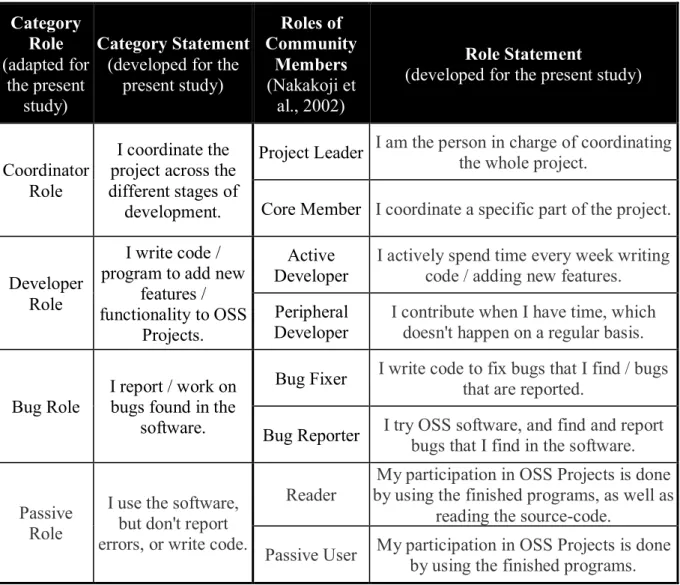
22 (2002). In their work, contributors had eight possible roles within an OSS community; eight statements were constructed within this study to describe each of these 8 roles, according to the authors’ descriptions. However, in order to guarantee the best possible choice by the respondents, by understanding the kind of work corresponding to each role, four categories were adapted (composed by two roles each), and each of these was given a corresponding statement. This way, each respondent first chose a sentence corresponding to a category of role (e.g. “Coordinator Role”) and was in the following question displayed the roles corresponding to that category (e.g. "Project Leader” and “Core Member”), as can be seen in the table below.
Table 6 - Roles inside OSS communities
Category Role (adapted for the present study) Category Statement
(developed for the present study) Roles of Community Members (Nakakoji et al., 2002) Role Statement
(developed for the present study)
Coordinator Role
I coordinate the project across the different stages of
development.
Project Leader I am the person in charge of coordinating the whole project. Core Member I coordinate a specific part of the project.
Developer Role
I write code / program to add new
features / functionality to OSS
Projects.
Active
Developer I actively spend time every week writing code / adding new features. Peripheral
Developer I contribute when I have time, which doesn't happen on a regular basis.
Bug Role I report / work on bugs found in the software.
Bug Fixer I write code to fix bugs that I find / bugs that are reported.
Bug Reporter I try OSS software, and find and report bugs that I find in the software.
Passive Role
I use the software, but don't report errors, or write code.
Reader by using the finished programs, as well as My participation in OSS Projects is done
reading the source-code.
Passive User My participation in OSS Projects is done by using the finished programs.
Following this classification, respondents were asked about their focal project (i.e. the one where they focus most of their attention). First, they were asked to estimate what percentage of their time they dedicated to their focal project, as well as the percentage of time allocated
23 to all other projects combined, in an answer with number input, and adding up to 100%. Furthermore, they were then inquired about the reasons why they chose to dedicate most of their time to that particular project. This question was constructed using 8 statements (e.g. “My focal OSS Project has more users than other projects”, “My focal OSS Project is my profession”, “My focal OSS Project is a product I am looking forward to using”), and a scale of 1 (“Strongly disagree”) to 7 (“Strongly agree”). At last, and concerning the focal OSS project, each respondent was asked to input the name of their focal OSS project, being this the only question of the survey without forced response.
Thereafter, respondents were questioned about their involvement with OSS; firstly, respondents were asked (“Considering your future involvement with Open Source Software development projects, which of the statements below better describes your motivation?”) to state if they planned to be more involved (“In the future, I plan to be involved much more with Open Source Software.”), less involved (“In the future, I plan to be involved much less with Open Source Software.”), or about the same (“In the future, I plan to be involved about the same with Open Source Software.”).
Afterward, respondents were asked about the potential reasons that would lead them to increase their contribution to OSS projects (“Considering your personal and professional reasons to participate in Open Source Software projects, what would lead you to participate more in OSS Projects?”). They did so by classifying to what level they agreed with 5 statements in a scale of 1 (“Not at all”) to 7 (“Very Much”). Besides these statements, users were also asked to classify an “Other” option. For the respondents that classified “Other” as more than 1, an extra question asking to input in text what other reasons would lead them to participate more in OSS projects was displayed.
3.3.3 Context for OSS contribution
In the fifth section, the first two questions worked as a control factor for the impact of the respondents’ professions on their contribution to OSS projects. The first question (“What is the main reason that leads you to participate in OSS projects?”) assessed if they contributed because of professional reasons (“Work need”, “Non-work need” or “Both”), whereas the second question (“Do you work in a software related industry or have a job where Software development is relevant?”) assessed if their knowledge was influenced by their profession, even if their reason to participate was not.
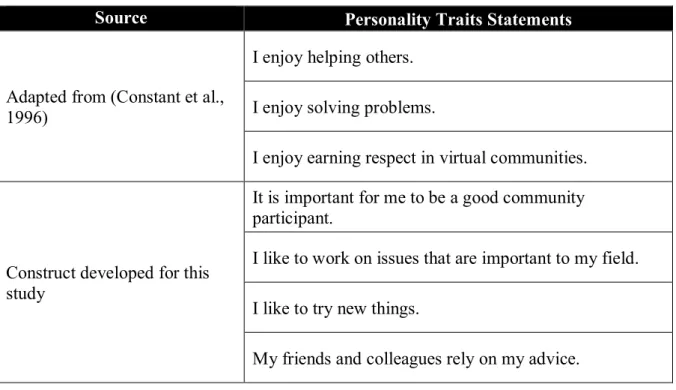
24 The following two questions concerned the personality of the respondents, in order to assess their natural propensity to take part in some specific tasks in OSS. The first question (“Considering your personality, how well do the following statements describe you?”) asked respondents to classify the following seven statements in a scale of 1 (“Strongly disagree”) to 7 (“Strongly agree to 7”): “I enjoy helping others.”, “I enjoy solving problems.”, “I enjoy earning respect in virtual communities.”, “It is important for me to be a good community participant.”, “I like to work on issues that are important to my field.”, “I like to try new things.”, “My friends and colleagues rely on my advice.”. The second question (“Have you ever done any of the following?”) concerned more personal habits, also with the objective of finding if some of these habits were related to people who partake in particular tasks of OSS. This question asked for respondents to select all of the options that applied: "Supported anyone on Patreon (or similar)", "Supported a Kickstarter Campaign", "Contributed on Reddit", "Written on Medium", "Have my own blog", "Created Video tutorials", "Created online tutorials (non-video formats)", "Made or edited entries in Wikipedia", "Other", or "None of the above".
Finally, respondents were inquired about their relation with programming/writing code in two questions. The first one (“Do you know how to do programming/write code?”) was a simple “Yes”/”No” question with respondents being asked to reveal what programming languages they knew in case of a “Yes”. The second question (“Please indicate to what extent do you agree with the following statements”) dealt with involvement with programming, in the form of a 1 (“Strongly disagree”) to 7 (“Strongly agree”) scale on the two following statements: “I am likely to lose track of time when programming.” and “I am likely to devote an extra hour in the day to programming.”.
3.3.4 Demographics
Finally, the last section was composed by a set of demographic questions to characterize our sample. It included questions about the respondents’ gender, year of birth, level of education, and household income. Participants who wanted to get the chance of winning the voucher were given a space to write their personal e-mail. In the good spirit of OSS, respondents who wanted to receive the final dissertation were given an extra space to add their e-mails.
25
3.4 Variables
3.4.1 Roles within OSS community
To classify the participation of contributors, the respondents were asked questions to be placed on one of the roles as defined by Nakakoji and Colleagues (2002b), as described in the following table:
Table 7 - Roles of Community Members (Nakakoji et al., 2002) / Construct of statements
Roles of Community Members (Nakakoji et al., 2002) Statement
(construct developed for the present study)
Active Developer I actively spend time every week writing code / adding new features. Project Leader I am the person in charge of coordinating the whole project.
Peripheral
Developer I contribute when I have time, which doesn't happen on a regular basis. Core Member I coordinate a specific part of the project.
Bug Reporter I try OSS software, and find and report bugs that I find in the software. Bug Fixer I write code to fix bugs that I find / bugs that are reported.
Reader My participation in OSS Projects is done by using the finished programs, as well as reading the source-code.
Passive User My participation in OSS Projects is done by using the finished programs.
3.4.2 Motivations
Regarding the motivations, the main goal was to assess what the main motivation was for each contributor to participate in OSS projects. The basis for the range of motivations was taken from a study made by Krogh and colleagues (2012), which has 10 different motivations, split into 3 different categories.
26
Table 8 - Motivations and categories (von Krogh et al., 2012)
Category
(von Krogh et al., 2012)
Motivations
(von Krogh et al., 2012)
Intrinsic Ideology Altruism Kinship Fun Internalized Extrinsic Reputation Reciprocity Learning Own-use Extrinsic Career Pay 3.4.3 Personality Traits
In order to control the behaviour of other variables, namely the motivations for one to contribute to OSS projects, a construct scale was developed. This scale is composed of 7 statements, in which the first 3 were adapted from a study developed by Constant and colleagues (1996), with the remaining 4 statements being added, based on behaviours that are commonly seen in OSS contributors.
27
Table 9 - Personality traits (Constant, Sproull, & Kiesler, 1996)
Source Personality Traits Statements
Adapted from (Constant et al., 1996)
I enjoy helping others. I enjoy solving problems.
I enjoy earning respect in virtual communities.
Construct developed for this study
It is important for me to be a good community participant.
I like to work on issues that are important to my field. I like to try new things.
28
4 Result’s Analysis
4.1 Data Cleaning
The first step when analysing the database was to proceed to data cleaning, with multiple criteria to remove respondents who did not fill the survey in the desired way. A total of 272 participants started the online questionnaire. From these, 5 respondents were deleted after being identified as test runs and 141 respondents were excluded from analysis due to an incomplete participation in the survey (as identified by Qualtrics in the standard “Finished” results column). Finally, a control variable was included (“Just to make sure you are reading this, please select 1 in this option”), and 10 of the remaining respondents also did not answer correctly. The final sample considered for analysis was composed by 116 respondents.
4.2 Sample Characterization
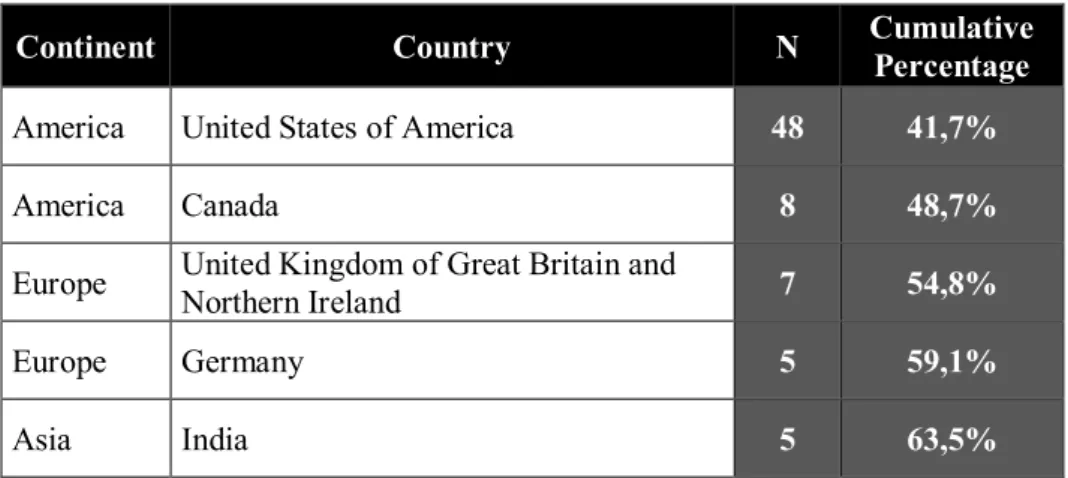
The final sample of 116 people, has a predominantly male composition (92% men and 8% women). The average age is 31.77 years (SD=11.98), with the segment of 26-35 years old representing 46% of the total respondents. These results are consistent with a survey composing 56 003 developers (StackOverflow, 2016), from which 92,8% were men, and the average age was of 29,6 years. The sample is composed by respondents from 32 countries (See Table 9), in 5 different continents (See Table 10). The majority of respondents reside in America (54%), with the USA being the most represented country (42%). The top 5 of countries is spread throughout America, Europe and Asia, and amounts to 64% of the total respondents. Finally, concerning Household Income, the median is placed in the “40 000 US$ – 49 000 US$” range. The most represented ranges were “Less than 30 000 US$” with 34% and “100 000 US$ or more” with 19%. Furthermore, 54% of respondents had a Household Income of 50 000 US$ or less (see appendix 2 for further results).
29
Table 10 - Top 5 Countries of Origin
Continent Country N Cumulative Percentage
America United States of America 48 41,7%
America Canada 8 48,7%
Europe United Kingdom of Great Britain and Northern Ireland 7 54,8%
Europe Germany 5 59,1%
Asia India 5 63,5%
Table 11 - Continent of Origin
Continent N Percent America 62 54% Europe 36 31% Asia 11 10% Africa 3 3% Oceania 3 3%
Respondents were then split in four categories, according to their past and current contribution to OSS projects. If a respondent has contributed both currently and in the past, they were classified as “Past and Current Contributor”. If a respondent only contributed currently or in the past, they were classified, respectively, as "Current Contributor” or “Past Contributor”. If they did not actively contribute to the development of any OSS projects, they were classified as “Non-Contributor”.
30
Table 12 – Split between types of contribution
C ur re nt P ar tic ip ati on Y es Contributor Current (10,3%) Past and Current Contributor (40,2%) No Non-Contributor (24,8%) Past Contributor (23,9%) No Yes Past Contribution
4.3 Measures: Scales Reliability
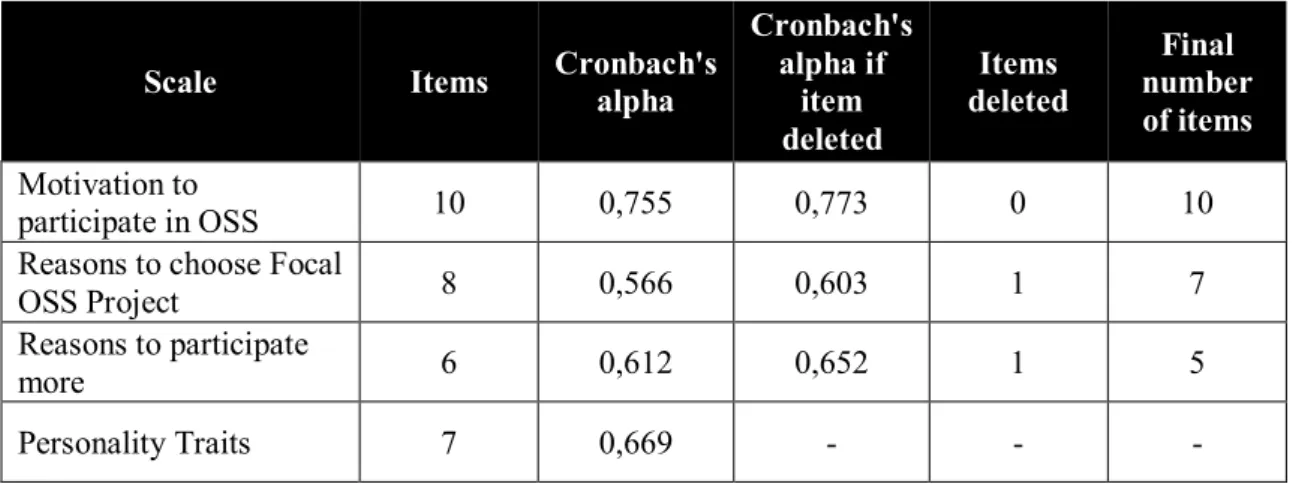
We used Cronbach’s Alpha to evaluate the internal consistency of each of the scales used. Using this method, a minimum value of 0,7 is considered “acceptable” to evaluate the consistency of a scale (UCLA, 2017). The scale of “Motivation to participate in OSS” had the best result of all the scales with an internal consistency of 0,755. Since deleting an item from this scale would not significantly improve its internal reliability, the scale was left with the original number of items. As for the other 3 scales, “Reasons to choose Focal OSS Project” was deemed to be “poor”, with the 2 remaining scales deemed to be questionable. An item was removed from both “Reasons to choose Focal OSS Project” and “Reasons to participate more”, as it significantly increased the internal consistency of each of these scales.
Table 13 – Cronbach’s Alpha – Internal consistency of scales used
Scale Items Cronbach's alpha
Cronbach's alpha if item deleted Items deleted Final number of items Motivation to participate in OSS 10 0,755 0,773 0 10
Reasons to choose Focal
OSS Project 8 0,566 0,603 1 7
Reasons to participate
more 6 0,612 0,652 1 5