Determinants of Cross-Border Mergers and Acquisitions
A case of Nordic acquirers
Dissertation
Master in Finance
September 2016
Indraja Singh Kausika
201400131
Supervised by:
iii
Biographical Note
Indraja Singh Kausika was, born on June 22, 1992 in Visakhapatnam, India.
In 2013, she successfully completed her Bachelor’s Degree in Commerce with first class. In 2014, for an international experience she moved to Porto, Portugal to purse Master’s degree in Finance at Faculty of Economics, University of Porto. During her masters she had an ERASMUS experience at Frankfurt School of Finance and Management, Germany, and an extra-curricular internship opportunity with Deutsche Bank, Luxembourg.
iv
Acknowledgments
This project consumed a huge amount of work, research and dedication. The implementation would not have been possible if not for my supervisor Professor Dr. Jorge Bento Farinha and Professor Dr. Natercia Silva Fortuna, who provided insight and expertise that greatly assisted the research.
I am very much thankful to the Director of Master in Finance, Professor Dr. Paulo Pereira and the University of Porto for this opportunity to be part of the Masters in Finance program. I am also immensely grateful to all the professors from University of Porto and from Frankfurt school of Finance and Management for as every one of them has taught me something valuable that has enhanced my academic qualifications.
Finally, I would like to thank my family, my ultimate strength, for their never ending support and encouragement and believing in me every step of my life. And a very special thanks to my friends who were like a family to me during my time abroad.
v
Abstract
Mergers and Acquisitions are considered as an important part of the world of corporate finance. Over the years they have evolved from horizontal mergers to mega conglomerates. Cross-border mergers and acquisitions, which today represent a major segment of the mergers and acquisitions, first came into play in 1990s. Since then they have gained popularity and the total volume and number of cross-border deals worldwide have increased. Unfortunately, the academic literature on cross-border mergers and acquisitions is not at pace with their growing popularity. Most of the early studies on cross-border M&A, either treated it as a form of FDI or studied it together with domestic mergers and acquisitions and not as an individual study. However recent studies started focusing on cross-border mergers and acquisitions as an individual study and focused on the causes and factors that affect cross-border mergers and acquisitions.
Our study belongs to this growing literature exploring the determinants of cross-border mergers and acquisitions. Several of the studies on cross-border mergers and acquisitions were highly concentrated on US and UK markets. Therefore, in our thesis we will be focusing on Nordic acquirers. We study cross-border mergers and acquisitions deals done by Nordic acquirers for a period of twelve years – 2003 to 2014 to understand the pattern and determinants of cross-border activity in the Nordic countries.
Keywords: Cross-border M&A, Mergers and Acquisitions, Determinants, Nordic countries.
vi
Abstract (Portuguese Version)
Fusões e aquisições são consideradas como uma parte importante do mundo das finanças corporativas. Ao longo dos anos, estas operações evoluíram a partir de concentrações horizontais para mega-conglomerados. As fusões e aquisições transfronteiriças, que hoje representam um importante segmento das fusões e aquisições, vieram pela primeira vez em jogo na década de 1990. Desde então, estas ganharam popularidade e o volume total e número de negócios transfronteiriços em todo o mundo têm aumentado. Infelizmente, a literatura acadêmica sobre as fusões e aquisições transfronteiriças não tem acompanhado a sua crescente popularidade. A maioria dos primeiros estudos sobre fusões e aquisições transfronteiriças tratavam estas como uma forma de IDE-Investimento Direto Estrangeiro ou estudavam-nas juntamente com fusões e aquisições no mercado interno e não de uma forma individualizada. No entanto, estudos recentes começaram a concentrar-se em fusões e aquisições transfronteiras como um estudo individual, incidindo sobre as causas e os fatores que afetam essas operações.
O nosso estudo pertence a esta literatura crescente que explora os determinantes das fusões e aquisições transfronteiriças. Vários dos estudos sobre estas operações foram altamente concentrados nos mercados americanos e do Reino Unido. Desta forma, neste trabalho o nosso enfoque é nos adquirentes nórdicos. Estudamos assim as fusões e aquisições transfronteiriças concretizadas pelos adquirentes nórdicos por um período de doze anos - 2003 a 2014 de forma a poder entender o padrão e os determinantes da atividade transfronteiriça de fusões e aquisições nos países nórdicos.
viii
Index
Biographical Note ... iii
Acknowledgments ... iv
Abstract ... v
Abstract (Portuguese Version) ... vi
Index ... viii
Index of Figures ... x
Index of Tables ... xi
1. Introduction ... 1
1.1 Background of the study ... 1
1.2 Motivation ... 4
1.3 Relevance and Research Question ... 5
1.4 Structure ... 6
2. Literature Review ... 7
2.1 Entry strategies in foreign markets ... 7
2.2 Cross-Border M&As ... 9
2.2.1 Reasons for Cross-border M&A ... 9
2.2.2 Determinants of Cross-border M&As... 15
3. Data and Methodology... 25
3.1 Research Focus and Goals ... 25
3.2 Data and Methodology... 25
3.2.1 Data ... 25
3.2.2 Methodology ... 29
4. Results & Discussion ... 31
ix 4.1.1 Nordic Acquirers... 31 4.1.2 Denmark... 34 4.1.3 Finland ... 38 4.1.4 Norway... 41 4.1.5 Sweden ... 45 4.2 Discussion ... 48
5. Conclusions, Limitations & Future Research ... 51
5.1 Conclusions ... 51
5.2 Limitations & future research ... 52
x
Index of Figures
Figure 1: Mergers and Acquisitions – Value and number of deals Worldwide ... 2
Figure 2: Worldwide Cross-Border M&A Volume – 2005 to 2014 ... 5
Figure 3: Internationalization Process ... 8
Figure 4: Reasons for Cross-border Mergers and Acquisitions ... 10
Figure 5: Determinants of Cross-border M&A... 16
Figure 6: Exchange Rates and Foreign Direct Investment ... 17
Figure 7: World Stock Market Capitalization... 19
Figure 8: Volume of Cross-border Deals – Nordic Acquirers ... 26
Figure 9: Volume of Cross-border deals - Nordic Acquirers ... 31
Figure 10: Cross-border deals distribution - Nordic Acquirers ... 32
Figure 11: Volume of Cross-border deals – Danish Acquirers ... 35
Figure 12: Cross-border deals distribution – Danish acquirers ... 35
Figure 13: Volume of Cross-border deals – Finnish acquirers ... 38
Figure 14: Cross-border deals distribution – Finnish Acquirers... 39
Figure 15: Volume of Cross-border deals – Norwegian acquirers ... 42
Figure 16: Cross-border deals distribution – Norwegian acquirers ... 42
Figure 17: Volume of Cross-border deals – Swedish acquirers ... 45
xi
Index of Tables
Table 1: Expected results ... 29
Table 2: Correlations – Nordic Acquirers... 32
Table 3: Mean,Median,Maximum,Minimum & Standard Deviation-Nordic Acquirers 33 Table 4: Cross-sectional data results – Nordic Acquirers... 34
Table 5: Correlations - Denmark ... 36
Table 6: Mean, Median, Maximum, Minimum & Standard Deviation - Denmark ... 36
Table 7: Cross-sectional data results – Denmark... 37
Table 8: Correlations - Finland ... 39
Table 9: Mean, Median, Maximum, Minimum & Standard Deviation - Finland... 40
Table 10: Cross-sectional data results – Finland ... 41
Table 11: Correlations - Norway ... 43
Table 12: Mean, Median, Maximum, Minimum & Standard Deviation - Norway ... 43
Table 13: Cross-sectional data results – Norway... 44
Table 14: Correlations - Sweden ... 46
Table 15: Mean, Median, Maximum, Minimum & Standard Deviation - Sweden ... 47
1
1. Introduction
1.1 Background of the study
The complex phenomenon that mergers and acquisitions represent has attracted substantial interest from a variety of management disciplines over the past 30 years (Cartwright and Schoenberg 2006). Mergers and Acquisitions (henceforth referred to as M&A) form a large part of the ever changing world of corporate finance. M&As have long been a popular strategy for firms and represent an important alternative for strategic expansion. The popularity of this strategy increased tremendously in the decade of the 1990s (Shimizu et al. 2004). It has evolved over the years and the number of total M&As worldwide has been increasing rapidly. M&As started out as small horizontal mergers, where two or more companies operating in the same market would come together to cut costs and reap the benefits of economies of scale to megadeals at international level to seek new technology, reach new markets, maximize profits, minimize risks, etc. A look back at the history of M&As would help us better understand the how it has evolved over the years. Mergers and Acquisitions are two different terms that are often used interchangeably in spite of the fact that they represent two different aspects. A merger occurs when two or more companies agree to merge into a new single company in order to share resources and reap the benefits of synergies (OECD, 2008). An acquisition on the other hand is the purchase of existing shares issued by another firm in order to take control of the target firm or increase ownership. There are two types of acquisitions: take over, where the acquirer is larger than the target, and reverse take-over, where the target firm is larger than the acquirer (OECD 2008).
The first wave of mergers and acquisitions began in twentieth century with the next two waves occurring in 1920s and 1960s. After a short pause, the mergers and acquisitions were back on track with fourth merger wave in the 1980s. Figure 1 shows the value and volume of M&A deals from mid 1980s when the economy was in the middle of the fourth merger wave – also known as the takeover wave. In the U.S economic history it was unique
2 and one of the most intense mergers and acquisitions period. Compared to prior historical periods, the volume of mergers and acquisitions in the 1980s was exceptional. Besides the boost in the volume of mergers and acquisitions, there was also a steady increase in the average price of each acquisition. Hostile takeovers and corporate raiders were prominent during this phase. Corporate raiders used junk bond market as a tool to obtain access to millions of dollars to target some of the largest and well established corporations. The period also saw a rapid growth of Leverage buyouts. Another prominent feature of this period was a significant percent of takeovers which included foreign bidders although nothing compared to what was to come in the fifth merger wave.
The fourth merger wave came to an end towards the beginning of 1990s with a recession in tow. The economic slowdown, and the fall of junk bond market, which provided financing for the LBOs during the period, can be considered as the reasons behind the fall of the fourth merger wave. After a relatively short recession, in 1993 the economy picked up speed and by 1994 we were headlong into the next full-scale merger wave.
Figure 1: Mergers and Acquisitions – Value and number of deals Worldwide
Source: Institute of Mergers and Acquisitions and Alliances
(https://imaa-institute.org/statistics-mergers-acquisitions/)
The fifth merger wave featured an unprecedented volume of M&As and surpassed the deals values of the 1980s. According to Hitt et al., (2001 a, b) the value of acquisitions
3 completed in 1997 were more than the value of all acquisitions completed in 1980s. The prior merger periods were mainly restricted to the United States but the 1990s wave was however a truly international phenomenon. Not only was there a heighted volume of M&As in Europe but also a spike in volume of deals in Asia. This period featured corporate managers preferring long term and strategic deals to the short-term, financially driven deals of the fourth wave. Other features include affinity towards consolidation deals, privatization of state owned enterprises which increased the number of potential bidders and targets and emerging market acquirers.
The record-setting fifth merger wave came to an end with bursting of the ‘Millennium Bubble’, which resulted in an overall slowdown in economy and recession in the US and other countries in 2000. The period saw many megamergers and a dramatic increase in cross-border mergers and acquisitions.
About three years after the end of the fifth merger wave the sixth merger wave emerged in 2003. From a low of $1.2 trillion in 2002 the pace of merger activity has increased to $3.4 trillion, which is more than double, by the end of 20061. The sixth wave came to an end in late 2007. According to Alexandridis, Mavrovitis, and Travlos (2012) the drivers of this wave is primarily the availability of abundant liquidity. Moreover acquirers were less overvalued than the targets.
The trend of cross-border mergers and acquisitions can be explained as a situation where a company from one country is merged with a company from another country or acquired by a company from another country. Assets and liabilities of the companies from two different countries are combined into a new legal entity in case of a cross border merger on the other hand there is a transfer of assets and liabilities from target to acquirer in case of cross border acquisition (Chen and Findlay 2003). Technological growth and globalization of businesses have hugely effected the expansion and contributed to the popularity of cross border M&As (M. Hitt et al. 1998; M. A. Hitt, Keats, and DeMarie 1998). The first incident of cross-border M&A occurred in 1980s. Throughout the 1980s, the number of cross-border acquisitions occurring each year had more than tripled (Morosini, Shane, and Singh 1998) and in 1999 and 2000 40% of the deals completed were
4 cross border (Hitt et al., 2001 a, b). Until the 1999 the cross-border market within the European nations was dominated by UK, French and German firms. However, Spanish, Dutch, Swiss and Nordic firms, gained momentum by exploiting the start of the globalization. The advent of globalization made the market for cross-border M&A a truly global place with acquirers and targets from all over the world.
From 1995 - 2004 technological industries were the most dynamic buyers and sellers, but from 2000, the financial sector began to dominate the cross-border take-over market. Technological industries were no longer the primary acquirers but continued to be top targets. In 2004, the volume of cross-border M&As rose by 28% amidst an overall expansion of total M&As by nearly 50% (World Investment Report, 2005). In 2008 due to the financial crisis, there was a steep decline of 35% in the value of cross-border deals compared to 2007. The number and value of megadeals fell by 21% and 31% respectively (World Development Report, 2009). Another notable fact is that after mid 2000s several developing countries started acquiring companies all over the world at astounding rates. In 2014 the gross value of cross-border M&A was at $900 billion, considerably more than the recent annual average (2010-2014) which was $775 billion (World Investment Report, 2015). Overall, cross border deals represent a major and stable segment of the mergers and acquisitions market with 33% of total M&A volume in 2015, against 37% in 2014 and 31% in 20132.
1.2 Motivation
From the Figure 2 it is clear that over the years the volume of the cross-border deals have increased considerably. Though there was a dramatic increase in the volume of cross-border M&As in the last decade it is regrettable to say that the academic research on this field has not kept pace with the changes.
5 Figure 2: Worldwide Cross-Border M&A Volume – 2005 to 2014
Source: Global M&A Financial Advisory Review 2014 – Thomson Reuters
According to the Cross-border Mergers and Acquisitions and development report by UNCTAD, World Investment Report 2000 cross-border M&A have been a popular strategy for firms over the past two decades. The growing popularity and importance of international M&As makes it an interesting topic for research. Therefore, it calls for a better understanding of the topic and to explore the determinants of the direction and size of the cross-border deals.
1.3 Relevance and Research Question
Cross-border M&As are considered as implementation instrument by multinational corporations for diversification strategy (Rottig 2007). There has been an extensive literature addressing the various factors and motives for domestic M&As but the same cannot be said for cross-border M&As. Understanding the factors driving the volume of cross-border deals and the motives behind them will shed a light on their intricate workings.
The complexity of the deals and the rapidly changing environment and the not so extensive research in international M&As emphasizes the necessity for an in-depth research
6 in order to add credible and reliable records to understand the dynamics behind cross-border M&As. Understanding the factors that drive the volume may also help us to better understand the reasons for success/failure of a deal. According to The Economist 2007, cross-border M&As continue to be very popular and preferred mode of foreign direct investment despite the failure of majority deals to achieve pre-acquisition objectives. Therefore our goal is to study:
The pattern and determinants of Cross-border Mergers and Acquisitions.
1.4 Structure
In order to achieve our goal of understanding the determinants and pattern of cross-border M&A, the study is organized as follows: Following this introductory section, section two contains the literature review of entry strategies in foreign markets and the main focus of the study - cross-border M&A and its reasons and determinates. Section three summarizes the data used and the methodology employed to study the determinants of international M&A. Section four presents and discusses the results. Section five concludes and presents the implications for further research.
7
2. Literature Review
In this chapter, we will focus on the literature review related to internationalization process in brief in 2.1 Entry Strategies in Foreign Markets. Since the study focuses on Cross-border M&A, we provide various reasons and determinants of cross-border M&A based on several academic researches in 2.2 Reasons for Cross-border M&A and 2.3 Determinants of Cross-border M&A. This section will lay the background to better understand the empirical results in the next chapter.
2.1 Entry strategies in foreign markets
The best way to approach an international market and promote a company’s presence abroad is an important and strategic decision that should be taken based on the company’s objectives and available resources. Anderson and Gatignon (1986) state that, the most efficient mode of entry is one which maximizes long-term efficiency and is a function of trade-off between control and the cost of resource commitment. Also, the choice to go international should include proper consideration of other related costs and risks.
Johanson and Vahlne (1977), based on the empirical studies of Swedish firms, state that the internationalization process is undertaken in small steps rather than by making large foreign production investments at a single point of time. The internationalization process usually begins with exportation, which has lately become less suitable for many firms facing competitive threats. This stage is followed by firms formalizing their entry via deals with intermediaries in the foreign market. If there is sufficient growth in the sales, firms evaluate the possibility of replacing the intermediaries with their own sales organization overseas and subsequently a manufacturing unit (Figure 3). This helps the firm gather information and knowledge about the market conditions in the foreign country, whereby the firm can successfully and gradually move from exporting to foreign direct investment.
8 Figure 3: Internationalization Process
Source: Adapted from (Johanson and Vahlne 1977)
Foreign direct investment (FDI) as a mode of entry offers two options – Greenfield investments and Cross-border mergers and acquisitions. Greenfield investment refers to establishment of new corporation in a foreign country, i.e building new operational facilities, whereas cross-border M&A is a quick way to obtain a strong position in a foreign country by acquiring existing firms. Both cross-border M&As and Greenfield investment have their own advantages and disadvantages. On one hand cross-border M&A is a quick option to enter the market and gain access to skilled workers, but the disadvantages lies with regards to integration process and the ever present cultural, organizational and communication problems. On the other hand, Greenfield investment is able to implement the best long-term strategy with greater control of business and economies of scale and the main disadvantage is it’s a long entry process with high level of investments, followed by government restrictions which can hinder the business.
The choice to select the most promising and profitable mode of entry is dependent on a lot of aspects, it varies from country to country where macroeconomic factors play an important role and of course it also depends on industry and firm level factors.
Export
Franchising
Branch
9
2.2 Cross-Border M&As
Cross-border M&As have grown rapidly during the past two decades. There has been a surge in the value of deals from $432 billion in 2014 to $721 billion (World Investment Report, 2016). They have added to the rapid globalization and restructuring of industries at an international level. Despite the fact that cross border M&A is a large part of worldwide merger activity, majority of the literature focuses on domestic deals. A quick view of the academic literature on cross-border M&A shows that it is fragmented across various disciplines and this topic has not been universally recognized warranting a distinctive examination separate from M&As (domestic) in general (Shimizu et al. 2004). Over the years the research on cross-border M&A has focused on several issues, such as form of FDI (Andersson and Svensson 1994; di Giovanni 2005), shareholder value creation (Datta and Puia 1995; Goergen and Renneboog 2004), capital markets (G. M. Vasconcellos and Kish 1998; McCann 2001), more recently performance of the firms (Slangen 2006; Chakrabarti, Gupta-Mukherjee, and Jayaraman 2009) and corporate governance (Rossi and Volpin 2004; Bris and Cabolis 2008; Bris, Brisley, and Cabolis 2008).
Conceptually, cross-border M&As are very similar to domestic M&As, except for their international nature and unique cross-border challenges. National borders add an extra set of frictions that varies across countries, like economic, institutional and cultural differences, which can help make or break the cross-border deals (Erel, Liao, and Weisbach 2012). The increase in the volume of cross-border M&A worldwide brought forward several questions, more importantly – why do cross-border M&As occur and what are the determinants of cross-border M&As.
2.2.1 Reasons for Cross-border M&A
Generally, there is more than one reason why cross-border deals occur and they usually overlap. To better understand the reasons for cross-border M&A, we will present them in three broad categories: Strategic reasons, External Shocks and Personal motives.
10
A. Strategic Reasons
In cross-border M&As there is usually more than one strategic objective that drives a particular deal. Some of them are:
Figure 4: Reasons for Cross-border Mergers and Acquisitions
(i)Synergies
Synergies are the most frequently cited reasons by managers for acquiring a firm. It is a motive for both domestic and international M&A. Synergies create value and are of two types – Operating synergies if there are economies of scale and scope, and informational synergies if the value of merged firm is higher than the sum of the individual firm values (Goergen and Renneboog 2004).
Operating synergies are derived when the contracting firms combine their operations and activities to increase the firm’s capacity and decrease the costs. This helps in taking full advantage of economies of scale and scope to generate long-term profits. Economies of scale reduce per unit cost, especially in capital-intensive manufacturing firms where per unit cost is high. Economies of scope help utilize a firm’s inputs across a broad range of products and services, for example cost savings from marketing and distribution. Informational synergies are obtained when rich firms with poor investment opportunities acquire smaller firms with outstanding growth opportunities. Some small firms might have excellent growth opportunities but sometimes due to poor managerial skills and lack of expertise hinders them to compete in a broader-market. When a larger firm acquires such a
Strategic
Reasons
• Synergies
• Market Power
• Resource Seeking
• Geographic
Diversification
External Shocks
• Deregulation
• Technological
Changes
• Financial Market
Changes
Personal
Reasons
• Agency Problem
• Hubris and
Winner's Curse
11 firm the smaller firm benefits from the best management and the acquirer’s management feels it can manage the target’s resources better. This argument is often presented as a reason when a large firm takeover smaller firms.
(ii) Market Power
Market power is a product of the firm’s size, the degree of sustainability of its current competitive advantages and its ability to make decisions today that will yield new competitive advantages tomorrow (M. A. Hitt, Harrison, and Ireland 2001). The acquisition of competing firms through horizontal M&A results in a decrease in the number of players in a given industry and an increase in the market share, which in turn may have a significant impact on the combined firm’s market power, that is, its ability to set and maintain prices above competitive levels (Morresi and Pezzi 2014).
According to Hitt et al., (2001), market power can be achieved via cross-border M&A when the firm acquires:
(a) Another firm operating in the same market via horizontal acquisition, this gives a huge advantage whereby the firm can control the prices,
(b) Another firm through vertical M&A, like supplier or distributors, that control more segments of the value chain, which results in extra market power and finally;
(c) Another firm in a related industry. (iii)Resource Seeking
Several studies suggest that cross-border M&A are motivated by an opportunity to acquire new capabilities and learn new knowledge. Acquisition of existing international business allows the acquirer to gain access to resources such as patent-protected technology, superior managerial and marketing skills and special government regulation that creates an entry barrier for other firms (Glaister and Ahammad 2010).
Cross-border M&A not only aids in acquiring new capabilities but also to acquire missing capabilities and enhances the existing ones. It gives an easy access to new technology, which is otherwise a time consuming act requiring adoption of new technology, identifying the required skills for the new technology, training and supervision of hired individuals, etc. Therefore, it is more efficient to acquire a firm with a functioning unit
12 using the desired technology. Another strategic motivation is acquisition of complementary products, resources or knowledge. Cassiman et al. (2005) find that M&A between partners with complementary technologies result in more active R&D performance after the deal and prominent increase in R&D efficiency.
(iv)Geographic Diversification
Diversification is a well-documented strategy for firm expansion and has been suggested as one of the dominant reasons for cross-border M&As (Glaister and Ahammad 2010). Geographic diversification is where firms gain access to new growing markets that are comparatively profitable than the bidding country’s current market. A long line of research results has shown that the size of a country market is a significant factor attracting foreign firm investments3. Geographical market diversification is source of value in cross-border M&A. This is because such sources of value are associated with exchange rate differences, market power due to international scope, and ability to arbitrage tax regimes are unique to international mergers4.
Lu and Beamish (2004) state that geographic diversification provides both exploration and exploitation benefits. Some of the major exploitation benefits are it enables firms to achieve economies of scale and scope, decrease revenue fluctuations by spreading investment risks over different countries, and helps in promoting a firm’s market power over its suppliers, distributors and customers. But the initial impetus to a firm’s internationalization process comes from the opportunity to exploit market imperfections in the cross-border use of its intangible assets. And the exploration benefits can be drawn from a firm’s organizational learning perspective. This perspective emphasizes that acquiring firm’s subsidiaries in disparate host countries can help enhance its knowledge base, capabilities and competitiveness through experiential learning.
B. External Shocks
The external shocks that motivate cross-border M&A deals can be summarized as follows:
3 According to Buckley et., 2007 as mentioned in (Chari and Acikgoz 2016) 4 According to Seth(1990) as mentioned in (Glaister and Ahammad 2010)
13 (i) Deregulation
Changes in the policy and regulatory environment during the past decade have provided more space for international production systems to expand. Examples of such changes relevant to cross-border M&As include the removal of compulsory joint venture requirements, restrictions on majority ownership and authorization requirements (Chen and Findlay 2003). Deregulation limits the restrictions on a firm’s expansion and entry and aids in creating new investment opportunities. Main industries that have undertaken significant deregulation since the 1970s are natural gas and airlines (1978), trucking (1980), broadcasting (1984 & 1996), entertainment (1984), utilities (1992), banking (1994) and telecommunications (1996) (Morresi and Pezzi 2014).
Andrade, Mitchell, and Stafford (2001) show that one particular kind of industry shock, deregulation, while important in previous periods, becomes dominant factor in merger and acquisition activity after the late 1980s and accounts for nearly half of the merger activity since then. The authors explaining the causes of mergers and acquisitions state that the 1990s were the “decade of deregulation”.
(ii) Technological changes
Technological shocks can come in many forms as technological changes can bring about drastic changes in existing industries and can even create new ones (Gaughan 2007). The recent surge of cross-border activities in telecommunications, media and information industries reflect the efforts of firms to capturer new markets created by new technologies. Technological changes have different types of effects in stimulating cross-border M&A. On one hand, decreasing communication and transportation costs have favored international expansion of firms seeking to exploit and consolidate their competitive advantage. On the other hand, the soaring costs of R&D together with the uncertainties of technological change, have forced firms to co-operate with others in global markets through various strategic alliances (Kang and Johansson 2000).
(iii) Financial market changes
According to the reports of Bank of America, the problems related to the financing of entrepreneurial and private activities are brought about by turbulences in financial markets (Sedláček, Konečný, and Valouch 2011), which of course effects the volume of deals. Changes in the financial markets like the introduction of innovative products or
14 techniques helped in facilitating or preventing takeovers. For example, during the fourth merger wave, the investment bank of Drexel Burnham Lambert pioneered the development and growth of the junk bond market. These junk bonds which were previously regarded unworthy became a popular vehicle of investment for corporate raiders to raise required capital for their raids or acquisitions of big prominent corporations (Gaughan 2007).
Harford (2005), who studies the reason for clustering of mergers at the aggregate level, states that merge waves occur in response to specific industry shocks that require large scale reallocation of assets. For merger wave to take effect economic, technological and regulatory shocks are not enough on their own, there must be sufficient capital liquidity to accommodate the asset allocation. The increase in capital liquidity and reduction in financing constraints which are correlated to high asset values must be present for the shock to develop into a wave.
C. Personal Reasons
Personal reasons to merge or acquire firms stem when the managers are intent on maximizing their own utility. We will discuss the following two specific reasons why managers undertake M&As:
(i) Agency Problem:
According to Jensen and Meckling (1976), the agency problem is inherent to any principal-agent relationship and refers to the conflict of interest on the agent’s part to act in the best interest of the principal. In the corporate world, it means that the manager of the company is expected to act in the best interests of the shareholders at all times i.e the decisions taken by him should maximize the shareholders’ wealth and not his own.
Seth, Song, and Pettit (2000) mention that managerial hypothesis suggests that managers embark on M&A in order to maximize their own utility at the expense of the shareholders of the firm. In their study on managerialism as a motive for cross-border M&A, they mention that foreign acquisitions may be more satisfactory vehicle of risk reduction than domestic acquisitions and that the cross-border acquisitions characterized by value destruction appear to be driven by managerialism.
15 Managers can also have private or personal reasons for their decision to make investments which from an economic point of view may seem irrational, but personally can be of high value. The empire building theory maintains that management want firm growth for personal reasons and acquisitions provide the required growth. An important example is the wage explanation, whereby the compensation paid to the managers is related to the size of the company (Glaister and Ahammad 2010).
(ii) Hubris and the Winner’s Curse
The Hubris hypothesis, proposed by Roll (1986), states that decision makers in acquiring firms pay too much for their targets. Essentially, the hypothesis relies upon asymmetric beliefs by the bidder and target about wealth gains associated with an acquisition, with the bidder mistakenly overvaulting the target while believing that his valuation is correct (Seth et al., 2000). Hubris is responsible for the winner’s curse phenomenon. Although the deal offers synergies, the competition between the bidders may cause the winning bidder to pay too much. In this sense, the winner is cursed even after winning the bid by paying excessively high price.
Seth et a., (2000) mention that hubris hypothesis is relevant in explaining cross-border M&A as there is greater information asymmetry between foreign bidders and domestic targets than between domestic bidders and targets. They also find that hubris hypothesis plays an important role in value creating transactions.
2.2.2 Determinants of Cross-border M&As
Over the past two decades there have been several studies trying to understand what drives the volume of these cross border deals. The underlying drivers of these deals are complex and vary according to sector (Kang and Johansson 2000). Generally mergers occur when the controlling persons of the firm feel the value derived from a combined firm is higher than the value of the same firms individually (Seth et al., 2000). A lot of factors play a role in determining this value, especially when it’s an international deal, where national boundary frictions come into play.
Economic growth influences both the supply and demand for cross-border M&As (Kang and Johansson 2000). Several studies focused on the macroeconomic factors to
16 understand the flow of the cross-border deals. Geraldo M. Vasconcellos, Madura, and Kish (1990); G. M. Vasconcellos and Kish (1998) have stressed the importance of macroeconomic factors to understand the trends in cross-border deals over time. Over the past century various factors have been identified as contributing to the rise in the number of cross-border deals. We will discuss several of them in this section.
Figure 5: Determinants of Cross-border M&A
A. Exchange rates
Exchange rates can influence the flow and direction of cross-border M&As in several ways. The relative strength, appreciation or depreciation, of the domestic currency to the foreign currency aids in decision making. According to Geraldo M. Vasconcellos and Kish (1996)5, the effective price of the transaction, it’s financing, the cost of managing the acquired firm and the repatriated profits of the firm are all affected.
5 Authors view was based on a comprehensive discussion found in Weston, Chung and Hoag (1990)
Determinants
Exchange Rates Developement Financial Governance Corporate
Cultural Values, Trade & Geographic
17 Figure 6: Exchange Rates and Foreign Direct Investment
Source: Froot and Stein (1991)
Froot and Stein (1991) state, there is a relationship between exchange rates and foreign acquisition activity. However, they argue that a fall in the value of the dollar makes the US a cheaper place to conduct business be it foreign or domestic. Predictably, there are contrasting academic views as to the role and effect of exchange rates on international M&A.
Uddin and Boateng (2011) conducted a study on the impact of macroeconomic influences on the cross-border M&A activities in the UK. They used new macroeconomic variables which were not a part of location-specific advantages during 1970s to explain the trend in overall cross-border M&As. Their results on outward M&A regression show a positive and significant relationship between sterling appreciation and outbound cross-border M&A deals. This finding supports the notion that a strong sterling in comparison to foreign currencies should result in increased trends in outbound cross-border deals as it makes foreign assets cheaper to acquire. Consistent with the above view Erel, Liao, and
18 Weisbach (2012) show that currency movements are a major factor in cross-border M&A. They find that short term movements in the currencies of the two countries increase the likelihood of purchasing the firms in the depreciating currency country by the country whose currency is appreciating.
However, McCann (2001), who analyzed cross-border acquisition activities in the UK from 1987-1995, reaches a different conclusion. His study suggests that exchange rate is a crucial factor in determining the cross-border M&A. But there is an inconsistency in the relationship – his results showed a negative relationship between both inbound and outbound acquisitions and exchange rates. Goldberg (1993) came to similar conclusions in her study about investment activity in US industry. Her results represented that dollar depreciations in 1980s reduced investments in several sectors and had mixed effects in others.
Several other authors have also explored the relation between exchange rates and foreign acquisitions. Blonigen (1997) have studied the connection between exchange rates and FDI acquisitions involving firm-specific assets and found that there is a strong correlation between periods of weaker dollar and higher levels of acquisition in US industries. On the other hand Görg and Wakelin (2002) study reveals that an exchange rate variation has no effect on US outward and inward investment. Kiyota and Urata (2004) explain these mixed results are due to aggregation of national data. While there are mixed conclusions, the effect of exchange rate activity is ultimately an empirical question6.
B. Financial development
Financial development in a country promotes economic growth and plays an important role in understanding several phenomena. Financial development is defined as a combination of depth (size and liquidity of markets), access (ability of individuals to access financial services), and efficiency (ability of institutions to provide financial services at low cost and with sustainable revenues, and the level of activity of capital markets)7. Financial
6 See (Goldberg 1993; Geraldo M. Vasconcellos and Kish 1996; G. M. Vasconcellos and Kish 1998) 7 As mentioned in IMF Staff Discussion Notes – Rethinking Financial Deepening: Stability and Growth in
19 depth, defined as the level of development of financial markets8, of a country determines what kind of financing is available to the firms and whether they
Figure 7: World Stock Market Capitalization
Source: American Enterprise Institute (https://www.aei.org/worldcap-9/)
can undertake a particular investment or forego it. Financial depth is measured either by size (market capitalization) or liquidity (value of shares traded as a percentage of gross domestic product)9. Figure 7 shows the world stock market capitalization released by World Federation of Exchanges as of end of December 2012. The remarkable increase in the stock market capitalization is a notable feature and raises a question whether a country’s financial development affects its firms to invest abroad.
di Giovanni (2005) conducted a study using gravity model framework on a large data – world international M&A flows from 1990-1999 to uncover the determinants of the
8 According to (Christopoulos and Tsionas 2004)
9 As mentioned in The World Bank – World Federation of Exchanges database.
20 size and direction of international M&A. According to data used in his study the value of the M&A deals have increase seven fold over the data period. The main hypothesis of his paper is to test whether the financially deep markets in the acquiring countries are positively associated to cross-border M&A. His results showed that the development of financial markets in the country of acquisition matters and that particularly stock market plays an important role. Furthermore, his specification shows “a 1% increase in the stock market capitalization to GDP ratio in the acquiring country is associated with a 0.955% increase in cross-border M&A activity”. Hyun and Kim (2010) incorporated the quality of institutions in host countries and financial deepening in home countries together to explain the determinants of the size and direction of cross-border M&As. The study draws several conclusions – firstly they state that external push factors and internal pull factors of a country can explain the cross-border M&A flows and second value of M&As can increase depending on the institutional quality of host country and financial deepening of the source country. His results showed that across country samples of determinants of cross-border M&A, stock market capitalization, trade, common language and distance are robustly significant.
According to Hur, Parinduri, and Riyanto (2011), whose focus of study was on the uneven distribution of cross-border M&A inflows to developing and developed countries, the level of financial development of host countries doesn’t seem to be an important determinant of M&A inflows. Based on di-Giovanni’s (2005) and their result the authors state that the level of financial development of origin countries matters and not that of host countries.
C. Corporate Governance
In Coffee (1999) view, Cross Border Mergers and Acquisitions activity is an important tool for effective worldwide convergence of corporate governance standards. Recent research shows that an essential feature of good corporate governance is strong investor protection, where investor protection can be defined as the extent of the laws that protects investors’ rights and the strength of legal institutions that facilitate law enforcement (Defond and Hung 2004).
21 According to La Porta et al. (1997), there are four broad “origins” or “families” governing the laws of investor protection and commercial law – English or common law, French civil law, German civil law and Scandinavian civil law. LaPorta et al. (1998) created an index for shareholder and creditor rights for 49 countries. The focus of their study was on two types of law relating to investor protection: company laws and bankruptcy and reorganization laws. Based on this data they found systematic variation in laws, regulations and enforcement quality across countries. Two major facts they noticed from the analysis of shareholder and creditor rights are that: common law countries provide the best legal protection to shareholders and that French civil law offers the worst. German civil law countries are in between and with comparatively stronger protection for creditors (especially for secured creditors). Scandinavian origin countries have an intermediate stance as well. The legal differences between origins are best described by the extent to which they protect minority investors better than others and not by the extent to which some countries protect creditors and the some countries protect shareholders.
The indexes developed by LLSV (1998) were later used by several researchers as proxies for investor protection for various studies related to corporate governance. La Porta et al. (2000) argued that an active market for mergers and acquisitions is the outcome of a corporate governance regime with strong investor protection. Pagano, Röell, and Zechner (2002) and Reese Jr. and Weisbach (2002) have shown that firms from countries with weak legal protection for minority shareholders list abroad more frequently that firms from other countries. Rossi and Volpin (2004) have found that the volume of M&A activity is significantly larger in countries with better accounting standards and stronger shareholder protection. They have also shown that, in cross border mergers and acquisitions targets are typically from countries with poor investor protection that the acquiring countries.
One of the main results of Bris and Cabolis (2008) is that acquisitions of firms in weaker shareholder protection countries by firms in stronger protective regimes results in a higher premium, as compared to a similar target in a domestic acquisition. Their research compliments that of Rossi and Volpin (2004) and shows that corporate governance can be a motive for cross border acquisitions. Wang and Xie (2009) provide evidence on the hypothesis that acquisitions of poorly managed targets by well-run acquirers create more value than other acquisitions. After further analyses on shareholders rights they have come
22 to a conclusion that differences in shareholder rights has remarkable positive effects on both target and acquirer shareholder gains, indicating that targets and acquirers share the valuation effects of corporate governance transfers.
Later on the anti-directors index was criticized for its ad hoc nature and several conceptual ambiguities (Pagano and Volpin 2005). Djankov et al. (2008) created the anti-self-dealing index a new measure of legal protection for minority shareholders against expropriation. It was put together with the help of Lex Mundi law firms for 72 countries. It is calculated based on legal rules prevailing in 2003 with main focus on private enforcement mechanisms such as approval, litigation and disclosure that govern a specific self-dealing transaction.
One obvious question arises when you have different measures of shareholder protection, although collected with a different methodology and addressing different situations, ‘What is the “best” measure to use for research purposes?’ Answering the question Djankov et al (2008) state that “In terms of predicting stock market outcomes the measure of shareholder protection from securities laws seems feasible but the data is limited to 49 countries. These measures suit best for studies of protection of investors buying securities rather than corporate governance. Then we have the revised anti-director rights index which is now available for 72 countries and has the advantage of continuity with previous studies. Finally, the anti-self-dealing index which is also available for 72 countries is conceptually clearer and deals directly with problem of corporate self-dealing.”
D. Cultural values, Trade and Geographic proximity
Some of the recent researches show that cultural values affect a number of financial outcomes in markets worldwide10. Guiso, Sapienza, and Zingales (2006) define culture as “those customary beliefs and values that ethnic, religious and social groups transmit fairly unchanged from generation to generation.” In cross border M&A, the contracting countries have their own cultural identities, people speak different languages, follow their own religions and most often times have longstanding feuds. All of which affects the cost of combining firms across borders.
10 FDI – Guiso, Sapienza and Zingales (2009), Equity investment – Hwang (2011) and Venture-capital flows
23 Guiso, Sapienza, and Zingales (2009) suggest that cultural relationships are “an important omitted factor in international trade and investments.” Ahern, Daminelli, and Fracassi (2015) study the impact of national cultural values on the pattern of cross-border M&A. Based on 20,893 cross-border mergers over 1991-2008 from 52 different countries, they find that culture has a significant and meaningful effect on the volume of cross-border M&As. Their results show a strong negative relationship between the cultural difference of the two countries and the volume of cross-border mergers and acquisitions activity between them and state that cultural differences impose costly frictions between firms which lead to fewer mergers.
Cultural disparities also play a crucial role in determining the performance of an M&A deal. The empirical research on the relationship between cultural differences and M&A performance led to inconclusive results – some studies found positive impact, others found a negative and others indicated non-significant results. Chakrabarti, Gupta-Mukherjee, and Jayaraman (2009) find a positive relationship and their results show that cross-border acquisitions perform better in the long run if the acquirer and target are from countries that are culturally diverse. On the other hand Datta and Puia (1995) state that acquisitions characterized by high cultural distance were accompanied by lower wealth effects for acquiring firm shareholders, thereby reducing foreign acquisition performance. Taking an intermediate stance Slangen (2006) argue that the effect of national cultural disparities on cross-border M&A performance is neither consistently positive nor negative but depends on the level of post-acquisition integration.
The level of trade between two countries is an important facilitator for cross-border M&A. It not only signals the importance of the host country but also serves as a stepping stone for direct expansion in the future. Firms exploit the relative expertise and the international competitive advantage by seeking more permanent ties with their trading partner which they either integrate into their own operations or decide to serve locally through acquisitions. And the quickest way to establish a direct presence is through acquisitions of assets in that country. Cross-border M&A activity therefore tends to increase with greater bilateral trade. Hyun and Kim (2010), who studied the determinants of cross-border M&As, based on their results state that among others trade is robustly significant determinants of cross-border M&A and stable institutions and an open trade
24 policy, particularly in the host developing countries, can contribute significantly to attracting more inward M&A flows from developed countries. di Giovanni (2005) also mentions that firms tend to invest more in the countries that they trade with and regional trade agreements are significant driving variables.
Studies on geographic distance have gained momentum in several business areas such as mergers and acquisitions (Chakrabarthi & Mitchell 2006, Grote & Umber 2006, Grote and Rucker 2007), entrepreneurship (Jaffe, Trajtenberg & Henderson 1993, Lerner 1995, Audretsch & Feldman 1996, Audertsch & Stephan 1996) and financial economics (Coval & Moskowitz 1999, Garmaise & Moskowitz 2004, Bae,Stulz & Tan 2005, Pirinsky & Wang 2006)11. Geographic distance is considered as a determinant of volume of cross-border M&A. There have been very few studies exploring this factor as a potential driver. Green,(1987), who examined the effect of distance on acquisition patterns for every fifth year from 1955-1980, found that acquisition activity usually concentrates geographically close to the acquiring firm’s corporate headquarters and that the volume of targets decline with distance. Erel, Liao, and Weisbach (2012), who studied the effect of geographic proximity with respect to cross-border M&A, stated that geography matters and that the odds of acquiring a firm in a nearby country is substantially higher than the odds of acquiring a firm in a country far away.
11 As mentioned in ‘The effects of geographic distance on the foreign acquisition activity of US firms’ –
25
3. Data and Methodology
In this section, we will first discuss about the focus and aim of this study in 3.1 Research Focus and Goals. In section 3.2 we present the data used and the methodology employed to achieve our goals.
3.1 Research Focus and Goals
Most of the M&A literature continue to be dominated by financial and market studies, with a high concentration of interest in the USA and UK (Cartwright and Schoenberg 2006). To the extent of our knowledge there have been very few academic papers in cross-border M&A field where the focus is on particular country or region apart from US and UK. Therefore our main focus of study is on the Nordic region. There aren’t many papers exploring the cross-border M&A features in this region. So to the best of our knowledge, this paper is the first study analyzing the determinants of cross-border M&A in the Scandinavia area.
Therefore, based on the literature review on several country level determinants of cross-border M&A and the above mentioned view, our main goal in this thesis is to:
Study the pattern of cross-border M&A, where the acquirers are from Nordic
countries
Determine which country level factors affect the cross-border M&As activity, where
the acquirers are from Nordic countries
Analyze overall as well as country wise determinants of Nordic cross-border M&A
activity.
3.2 Data and Methodology
3.2.1 Data
Our cross-border M&A sample is collected from Zephyr, where the deals are announced and completed during the period 2003 -2014. The deals are selected on the basis of following criteria:
26 Where the acquirer is from one of the Nordic regions i.e., Denmark,
Finland, Norway and Sweden.
Where the type of deal is either mergers or acquisitions Where the percentage of stake acquired is 51% or more
Where the deals involving the target or acquirer from the public or financial sector are excluded.
After applying the said restrictions and cleaning the data we are left with a total of 4592 cross-border deals with 97 different countries. Figure 8, which reflects the above deals, shows the volume of deals by the Nordic region on a yearly basis. Out of this we remove 18 countries as they have data on one to two variables only. This leaves us with a total of 232 observations for the dependent variable12.
Figure 8: Volume of Cross-border Deals – Nordic Acquirers
Following are the list of explanatory variables:
12 We included the deals with the Nordic countries as well as there isn’t a significant difference in the results.
0 100 200 300 400 500 600 2003 2004 2005 2006 2007 2008 2009 2010 2011 2012 2013 2014
Volume of Cross-border deals
Nordic Acquirers
27
A. Currency
Currency is defined as the difference between the real exchanges rates of the acquiring and target country’s currencies expressed in USD. We obtain the monthly national exchange rates from WM/Reuters through Datastream. In order to calculate real exchange rates we obtain consumer price index (CPI) from The World Development Indicators and convert all the nominal prices to 2010 price level. The data on exchange rate is missing for 18 countries, which leaves us with 201 observations. We use this variable to see the effect of valuation difference between the countries as determinant for cross-border M&A (Erel et al., 2012). We expect to see a positive relationship between the volume of cross-border deals and Currency.
B. Market Return
Market return is defined as the difference between the real stock market returns of the acquiring and target countries expressed in thousands of USD. We obtain the monthly country level stock exchange returns in US dollars from Datastream. In order to calculate real Stock market returns we obtain consumer price index (CPI) from The World Development Indicators and convert all the nominal prices to 2010 price level. We are missing data on stock market returns for 25 countries, which gives us 188 observations in total. We use this variable to see the effect of valuation difference between the countries as determinant for cross-border M&A (Erel et al., 2012). We expect to see a positive relationship.
C. Investor Protection
This variable is defined as the difference between the Investor protection level of the acquiring and target country. As proxy for Investor protection we use the anti-self-dealing index from (Djankov et al. 2008). It measures the protection of minority investors from conflicts of interest through one set of indicators and shareholders’ rights in corporate governance through another. It a good measure of country’s accounting, legal and institutional standards. Investor Protection is available for only 64 countries and we have total of 195 observations for this variable. We expect to see a positive relationship between the dependent variable and the Investor Protection.
28
D. Tax and Geographic Distance
Tax is defined as the difference between the average corporate tax of the acquirer and target. The average corporate tax data was obtained from “Corporate Tax Rates Table | KPMG | GLOBAL” 2015 for 2006-2015. We have total of 226 observations for this variable. We do not expect any particular relationship with tax and the dependent variable. Geographic distance is the difference between the capital cities of the acquirer and target in thousands of kilometers. To measure the great circle distance between the acquirer and target countries, we use the longitude and latitude of the capital cities from mapsofworld.com13 (Erel et al., 2012). We use this variable to see the how the geographic between the acquirer and target effects the volume of the cross-border deals. We have a total of 232 observations and we expect to see a negative relationship between the dependent and the geographic distance.
E. Dummy and Control Variables
As a proxy for cultural difference we use Religion (Erel et al., 2012). We were not able to use the language as none of the target countries share the same language. The dummy variable (Religion) takes the value one if the acquirer and target share the same religion if not zero. The data on religion practiced in each country is obtained from The World Factbook.
As control variable we use bilateral trade and logarithm of GNP per capita. Bilateral trade is the number of imports from the acquiring country by the target as a percent of total imports by the target country (Rossi and Volpin 2004). We obtain this trade information from UN COMTRADE, WITS. And finally the Log of GNP per capita is defined as the difference between the annual average of Log of GNP per capita of the acquirer and the target. GNP per capital of the acquiring and target countries was obtained from World Development Indicators. We expect to see a positive relationship between bilateral trade and the dependent.
13 The formula used to calculate the great circle distance in kilometers is:
acos[cos{radians(90-lat1)}*cos{radians(90-lat2)}+sin{radians(90-lat1)}*sin{radians(90-lat2)}*cos{radians(lon1-lon2)}]*6371, where lon and lat are the longitude and latitude of the acquirer and target country locations, respectively.
29 Table 1: Expected results
Variable Expected Sign Justification
Currency Positive Uddin and Boateng (2012) and Erel et al., (2012) Market Return Positive Erel et al., (2012)
Investor Protection Positive Rossi and Volpin (2004) Geographic Proximity Negative Green (1987) & Erel et al., (2012) Bilateral trade Positive Rossi and Volpin (2004)
3.2.2 Methodology
To understand the cross-sectional pattern among the acquirers and target countries we use the least squares framework. Our goal is to measure the factors affecting the volume of cross-border deals of the Nordic acquirers to acquirer from firms from other countries. In this section we present the specification we employ and the variables used. The specification is:
Cross-border deals s,b = βX s,b + γ∆ (exhange rate)s,b + δ∆ (market return)s,b +
εΔ(investor protection)s,b + ζΔ (corporate tax)s,b + ηb +θs +λs,b
Our dependent variable measures the volume of cross-border M&As for a particular country pair over the sample period. It defined as the number of cross-border deals in which the acquirer b, comes from one of the Nordic countries and the target s from another country (b≠s), as a percentage of the total number of deals (domestic and cross-border) in the target country14.
We include the real exchange rate (Currency) and real stock market return (Market Return) difference between the acquirer and target over the sample period to check for valuation effect (Erel et al., 2012). Since better investor protection is associated with higher volume of takeovers (Rossi and Volpin 2004) we include anti- self-dealing index (Investor Protection) as a proxy for investor protection take from Djankov et al. (2008). Further, we also include average difference in corporate tax rates (Tax) between the acquirer and target countries for the period 2006 – 2014 as the difference in international
30 tax rates could be a motive for cross-border M&A. For the regional effect we include the distance between the capital cities of the acquirer and target countries (Geographic Distance).
To control for the differences in macroeconomic conditions and volume of business between the two countries we use, logarithm of GNP per capita (Log (GNP per capita)) and bilateral imports (Bilateral Trade) between the countries.
31
4. Results & Discussion
In this section we will present and discuss the results starting with the Nordic acquirers as a whole and an individual study of each of the four countries.
4.1 Results
4.1.1 Nordic Acquirers
Over the sample period the Nordic countries as a whole undertaken 4952 cross-border deals with 99 different countries. Figure 9 shows the volume of deals over the sample period and Figure 10 shows the distribution of these deals among the continents15. Out of the 99 countries, we don’t have sufficient data for 19 countries mentioned in the previous sections. This leaves us with a total of 232 observations for our regression analysis.
Figure 9: Volume of Cross-border deals - Nordic Acquirers
15 The continents are divided into 7 – Africa, Asia, Australia & Oceania, Europe, North America and South
America – mapsofworld.com 0 100 200 300 400 500 600 2003 2004 2005 2006 2007 2008 2009 2010 2011 2012 2013 2014 Denmark Finland Norway Sweden
32 Figure 10: Cross-border deals distribution - Nordic Acquirers
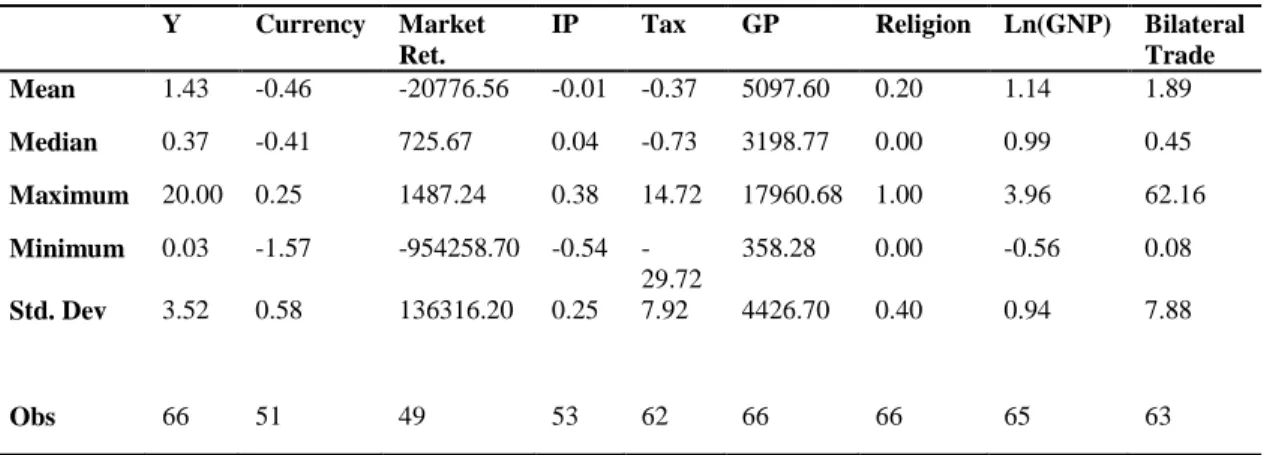
Table 2 shows correlations between the variables and Table 3 below shows the mean, median, minimum, maximum, standard deviation values. You can that there is a very high correlation between the dependent variable and the bilateral trade. None of the other variables have such high correlation.
Table 2: Correlations – Nordic Acquirers
1 2 3 4 5 6 7 8 1 Dependent 2 Currency 0.10 3 Market Ret. -0.02 0.06 4 IP 0.15 0.02 -0.004 5 Tax 0.10 0.05 -0.05 -0.0005 6 GD -0.28 0.24 0.05 -0.52 -0.27 7 Religion 0.35 -0.10 0.00 -0.17 -0.29 -0.05 8 Ln(GNP) -0.18 0.36 -0.02 -0.02 0.13 0.23 -0.33 9 Bilateral Trade 0.82 -0.07 0.02 0.07 0.02 -0.32 0.53 -0.29
IP – Investor protection. GD – Geographic distance
1%
8% 1%
78% 10%
2%
33 Table 3: Mean, Median, Maximum, Minimum & Standard Deviation - Nordic Acquirers
Y Currency Market Ret. IP Tax GP Religion Ln(GNP) Bilateral Trade Mean 1.03 -0.18 -22474.81 -0.06 0.49 4648.62 0.20 1.26 1.47 Median 0.32 -0.03 269.49 -0.01 0.20 2402.01 0.00 1.07 0.53 Maximum 20.00 1.42 1487.24 0.38 17.33 17960.68 1.00 9.87 62.16 Minimum 0.02 -1.97 -955131.50 -0.67 -30.00 0.48 -0.20 -0.77 0.02 Std. Dev 2.24 0.81 139148.10 0.25 8.15 4312.82 0.40 1.20 4.56 Obs 232 197 185 195 226 232 232 229 228
Y – Dependent variable and IP- Investor Protection.
To analyze the pattern and determinants of the cross-border M&A of Nordic acquirers and its target we run a least square methods test on the cross-sectional data. Our dependent variable is the number of cross-border deals with the target country where the acquiring country is any of the four Nordic countries as a percentage of the total number of deals (domestic and cross-border) undertaken by the target. Table 4 contains the estimate of our regression. Bilateral trade and Log (GNP per capita) are our control variables.
The results of our regression show that in column 2, the coefficient of investor protection is positive and highly significant. This result is similar to our expectation and shows the Nordic acquires as a whole target those countries whose investor protection levels are low in comparison to theirs. Log (GNP per capita) is significant as well, which means that the targets are from comparatively poorer countries than the acquirers.
In column 5, we see that currency is positive and significant, consistent with our expectations. This implies that Nordic acquirers on an average targeted the countries whose currencies have depreciated over the sample period. Next we can see that the coefficient of Market return is negative and highly significant. This shows that the targets are typically from countries whose stock market performance is better that than the acquirers’. The variables tax, geographic distance, religion and log of GNP per capita are not significant. Bilateral is significant throughout all the equations, highlighting its importance and impact on the volume of cross-border deals.