Nelson Figueiredo de Pinho
Designing Complex Services for Multiple Stakeholders: An
Application to Electronic Health Records
Dissertation submitted to Faculdade de Engenharia da Universidade do Porto to obtain the Doctoral Degree in Industrial Engineering and Management
Advisors:
Professor Lia Martins de Lima Patrício
Faculdade de Engenharia da Universidade do Porto 2015
ABSTRACT
In a world of accelerating change, people, organizations, resources and information are integrated in a complex network of interactions and value co-creation. People aim to improve their quality of life that depends on many service systems, such as healthcare, transportation, energy, education, security and others that serve other people and must be sustainable. Sustainability has also a systemic nature and relies on reducing waste, inefficiencies and expanding systems’ capabilities on its three pillars (economic, social and environmental) to guarantee that future generations also have the capability to achieve their goals. Designing sustainable services for such complex value networks requires new approaches. Healthcare is one of the most important service sectors that has strong impact on peoples’ quality of life and is currently affected by systemic inefficiencies. The application of new service design approaches in this sector can positively influence citizens’ wellbeing, while responding to the call for designing for sustainability and transformative service research.
The challenges described introduce the motivation for the dissertation research, which studied sustainability and its intrinsic relationship with complex value networks in the healthcare sector. This research aimed at contributing to understanding value co-creation in complex network realities and applying this knowledge to develop a new method for designing complex services in value network contexts. To attain these objectives, the research project comprised three stages: The first involved a qualitative study to understand organizations’ practices regarding service design and sustainability incorporation into their services. The second entailed a qualitative study to understand each actor service experience in the context of complex value networks, their role in the value co-creation with other actors and the impact of their actions in the value network. Finally, the third stage applied design science research to develop SD4VN – a new method for designing services in value network contexts.
Thus, the present dissertation contributes to: (1) better understanding sustainability and its application to services and service design processes. The second study allowed for (2) an evolution of previous conceptualizations of value-creation in network contexts involving multiple actors, with iterative and non-linear aspects. This second stage supported (3) the development of a new method for designing services for value networks. From a managerial perspective, this research dissertation also had a societal
impact by improving Portuguese healthcare through the collaboration in the design of a national EHR service system. This system allows patient and practitioners’ integrated access to patients’ healthcare information regardless of the time or locale of healthcare delivery.
RESUMO
Num mundo em constante e rápida mudança, pessoas, organizações, recursos e informação estão integrados numa rede complexa de interações e de cocriação de valor. As pessoas desejam melhorar a sua qualidade de vida que está sempre dependente de múltiplos sistemas de serviços: o sistema de saúde, os transportes, a energia, a educação, a segurança, entre outros, que servem também outras pessoas e têm que ser sustentáveis. A sustentabilidade é também de natureza sistémica e tem como objectivo reduzir os desperdícios e ineficiências, aumentando as capacidades dos sistemas nos seus três pilares (económico, social e ambiental) de forma a garantir que as futuras gerações também têm a possibilidade de atingir os seus objectivos. O desenho de serviços complexos no contexto de redes de valor que se desejam sustentáveis requer novas abordagens. A saúde é um dos principais sectores que afecta a qualidade de vida das pessoas e é atualmente afectado por uma ineficiência sistémica. A aplicação de novas abordagens de desenho de serviços neste sector, pode influenciar positivamente o bem-estar dos cidadãos e ao mesmo tempo responder à necessidade de desenhar serviços sustentáveis e transformativos.
Os desafios descritos são a grande motivação desta tese que investiga a sustentabilidade e a sua intrínseca relação com as redes de valor complexas, no contexto da saúde. Esta investigação tem como objectivo contribuir para o conhecimento profundo do processo de cocriação de valor em redes de valor complexas e aplicar este conhecimento no desenvolvimento de um novo método de desenho de serviços complexos no contexto de redes de valor. Para alcançar estes objectivos, o projeto de investigação compreendeu três etapas: A primeira envolveu o desenvolvimento de um estudo qualitativo para perceber como desenhar serviços sustentáveis e quais as práticas das organizações relativamente ao desenho de serviços e à incorporação da sustentabilidade nos seus serviços. A segunda compreendeu um estudo qualitativo para compreender a experiência de serviço de cada ator num contexto de rede de valor, o seu papel na cocriação de valor com outros atores e o impacto das suas ações na rede de valor. Finalmente, a terceira etapa aplicou a metodologia design science research no desenvolvimento do SD4VN – um novo método para o desenho de serviços em contextos de rede de valor.
Desta forma, a presente dissertação contribui para: (1) um melhor entendimento do conceito de sustentabilidade e da sua aplicação aos serviços e aos processos de desenho de serviços. O segundo estudo contribuiu para (2) evoluir as conceptualizações prévias do conceito de cocriação de valor em redes complexas envolvendo múltiplos atores, com aspectos iterativos e não-lineares. Esta segunda etapa suportou (3) o desenvolvimento de um novo método de desenho de serviços para redes de valor. Numa perspectiva prática, esta dissertação também teve um impacto social, proporcionando melhorias no sector da saúde em Portugal, através da colaboração no desenho do registo de saúde electrónico nacional. Este serviço de base tecnológica permite aos pacientes e profissionais de saúde um acesso integrado à informação de saúde do paciente, independentemente do local ou altura da prestação dos cuidados de saúde.
ACKNOWLEDGEMENTS
This dissertation was a long, challenging and hard journey, which could only finish with the support of many people. Without them I would not be here writing this final page. To all of them I would like to express my gratitude.
First and foremost, I am deeply grateful to Professor Lia Patrício. She was much more then my advisor, she was everyday an example of competence and professionalism. Lia always provided me thoughtful guidance through all research stages. She was always very rigorous and demanding, but at the same time, a huge source of encouragement and motivation.
Second, I am also very grateful to Professor Raymond P. Fisk, who was co-author in all my papers and a role model to follow, both personally and professionally. I promised Ray and Lia that I would finish my dissertation. That promise gave me the energy I needed in the hardest times. I kept my promise.
I would like to thank the Portuguese Foundation for Science and Technology (FCT), for funding the project through a doctoral grant [POPH/FSE Grant No. SFRH/BD/64907/2009], and the Portuguese Ministry of Health for actively collaborate in the research process and also funding the project.
I also would like to thank IBM Corporation for hosting me at IBM Almaden Research Center. That tour provided me important inspiration for the rest of the project and was a magnificent experience.
I am also grateful to my co-authors Professor Nuno Nunes, Professor Gabriela Beirão, and Jorge Teixeira, and to my research friends Rui, Teresa, Carla, Andreia, Fabrício and Thais, form whom I learned in every discussion.
I would like to especially thank Nuno Fernandes, who was always a great source of encouragement and perseverance. He is my trench mate and would never let me down.
Finally, I dedicate this dissertation to my Father, who always deeply cared for my success; to my Mother; to my brothers Valter and Vitor; to my sister Márcia; to my parents-in-law Manuel and Merínia; to my in-laws Mané and António; and especially to my wife Ana, who is my strongest pillar and the person with whom I shared the best and worst of this journey and with whom I decided to share my life. Her smile, intelligence, irreverence and will to succeed inspired me every day, and still do.
TABLE OF CONTENTS 1! Introduction+...+1! 1.1! Motivation+...+2! 1.1.1! Sustainability!...!2! 1.1.2! Complexity!and!Value!Networks!...!2! 1.1.3! Healthcare!...!3! 1.1.4! Value!Co@Creation!...!4! 1.1.5! Service!Design!...!4! 1.2! Research+objectives+...+5! 1.2.1! Objective!1:!Understanding!of!Sustainability!and!its’!incorporation!into!services!...!6! 1.2.2! Objective!2:!Understanding!value!co@creation!in!complex!services!with!many! actors! 7! 1.2.3! Objective!3:!Develop!a!new!method!for!designing!complex!services!in!value! network!contexts!...!7! 2! Research+design+...+9! 2.1! Stage+1+–+Qualitative+Study+to+understand+sustainability+and+its’+incorporation+into+ services+...+10! 2.2! Stage+2+–+Qualitative+Study+to+understand+value+coBcreation+in+complex+services+with+ many+actors+...+11! 2.3! Stage+3+–+Design+science+Research+approach+to+the+development+of+SD4VN+...+13! 3! Thesis+outline+...+19! 4! Papers+...+23! PAPER+I+...+25! PAPER+II+...+63! PAPER+III+...+103! 5! Discussion+and+research+contributions+...+157! 5.1! Understanding+of+Sustainability+and+its+incorporation+into+services+...+158! 5.2! Understanding+value+coBcreation+in+complex+services+with+many+actors+...+159! 5.2.1! Value!creation!factors!and!outcomes!...!159! 5.2.2! Value!creation!interdependencies!...!160! 5.3! A+new+method+for+designing+complex+services+in+value+network+contexts+...+161!
5.3.1! New!tools!for!designing!complex!services!...!162! 5.3.2! Integrated!design!of!the!service!concept!at!the!network!level!and!actor!level!...!162! 5.4! Managerial+Implications+...+163! 5.4.1! Values!resonance!as!a!driver!to!sustainability!...!163! 5.4.2! Value!as!a!result!of!a!dynamic!view!of!value!networks!...!164! 5.4.3! Application!of!SD4VN!in!organizations’!value!network!contexts!...!164! 6! Conclusions+and+future+research+...+165! 7! References+...+169!
1 Introduction
Services now represent the dominant economic activity in developed countries (OECD 2014) and keep growing, while traditional goods, manufacturing and agriculture sectors are declining. Today, the rapid expansion of human knowledge and technology has resulted in many new value-added services for individuals and organizations, now offered through complex service systems and value networks (Gummesson 2006). It is easy to take complexity for granted when we watch television, travel by jet, or receive a health care test. Such acts seem ordinary to us and we tend to forget the complex service systems that support them.
Simultaneously, sustainability became one of the major concerns for European leaders, who are defining more demanding environmental policies and are promoting new social inclusion initiatives, while trying to guarantee the financial equilibrium of European countries (Basch et al. 2011; Baumgartner 2009; Walshe et al. 2013). In other words, EU is nowadays focused on achieving the triple bottom line (Elkington 1997), which stands for the balance between the three pillars of sustainability.
Considering Vargo and Luch’s (2008) new service-dominant logic perspective, rather then a traditional goods perspective, value is no longer pre-produced. Instead, value is jointly co-created by customers and service providers at the time of the service delivery. This perspective can be a motivation factor for organizations to innovate their offerings moving from goods production to the development of innovative services. In this context, service design is essential to this innovation process, because it brings service organization’s strategy and innovative service ideas to life (Ostrom et al. 2010). Following this idea, designing new service offerings in today’s complex value networks requires systemic design to support each actor’s activities and the value co-creation interactions among actors. New service design methods are needed to support the design of complex services in value network contexts while addressing the challenges of sustainability and transformative service research (Anderson et al. 2013). The full potential of service design to address complex value networks and sustainability is yet to be achieved, and these areas still have important challenges ahead.
1.1 Motivation
1.1.1 Sustainability
Sustainability has become critical in modern society, and interest in the design community on sustainability is also growing (Ostrom et al. 2010). Sustainability is defined as the challenge of meeting the basic human needs, aspirations and desires of today’s generations, without compromising the ability of future generations to meet their own needs (United-Nations 1987). As sustainability becomes a major concern for modern society – the EU’s common policies for Horizon 2020, and the healthcare policy in particular, define sustainability as one of the major socio-economic transformations that Europe should lead (Basch et al. 2011; Walshe et al. 2013) – the need for designing sustainable services is getting more important day by day.
Sustainability is intrinsically related to the complexity phenomenon because it is systemic. In other words, every actor in a value network is integrated into a complex service ecosystem and their actions impact other actors, therefore making the sustainability of the service ecosystem dependent on the actions of each actor.
In this context, understanding how organizations can incorporate sustainability in their services become increasingly relevant and can provide further insights on how to positively influence citizens’ wellbeing, while responding to the call for sustainability and transformative service research (Anderson et al. 2013).
1.1.2 Complexity and Value Networks
Service offerings today are enabled by complex service systems, involving interdisciplinary areas, and are strongly supported by technology (Spohrer et al. 2007). This technology infusion and the increasing complexity of service systems poses new challenges to service design and innovation, requiring interdisciplinary competences, integrating computer science, engineering, service management, social sciences and arts (Fisk 2006; Forlizzi, Zimmerman and Evenson 2008). A service system can be defined as an arrangement of resources that “includes people, organizations, shared information, and technology, all connected internally and externally to other service systems by value propositions” (Maglio et al. 2009; Spohrer et al. 2007). This definition of service system is more focused on the organizational level, where one service provider develops offerings for its customers. However, customers increasingly co-create value through the
combination of service offerings from multiple firms. These constellations of service offerings constitute systems of service systems, where the multiple actors’ service systems develop many-to-many relationships thus forming a value network (Patrício et al. 2011). The evolution of the service environment and technology has led to the emergence of complex value networks with multiple actors, where supplier networks interact with customer networks (Gummesson and Mele 2010). Service research has recognized the importance and pervasiveness of value networks and it became a research priority (Ostrom et al. 2010).
Traditional approaches applied in complex systems suggest breaking it into small parts to reduce its complexity. However, doing that, there is a risk of loosing the sight of an holistic vision that comprehends the interconnections between the sub-systems (Gummesson 2007). Local optimization can be an undesired result of these approaches. Some approaches (Normann and Ramírez 1993; Patrício et al. 2011; Tax, Mccutcheon and Wilkinson 2013) already address such complex realities, but they still focus on designing a service for a specific customer or customer segment. New approaches are needed that take into account the active role of each actor in value co-creation and their interactions with other actors.
1.1.3 Healthcare
The health sector is a rich case of service complexity, as it comprises many value networks of multiple interdependent actors. Healthcare is a critical service sector in every society. According to information from the IBM Institute for Business Value, relative to the world’s other major systems, the global healthcare service system “is the least efficient and has the highest potential for improvement” (Korsten and Seider 2010), and is globally affected by systemic inefficiency, which wastes 2 trillion USD each year in USA only. In the current context, it is important to improve both efficiency and quality of health services and make them citizen centered. Healthcare is a rich example of a value network of interdependent actors (Vargo and Lusch 2011) involving doctors, nurses, pharmacists, managers and others, who interact and integrate resources so the patient can receive proper healthcare. Only with this perspective can the needs of every actor be fulfilled and the system as a whole be made sustainable. Healthcare is also an
important context for a variety of research priorities (Ostrom et al. 2010) and a fertile field for service research (Berry and Bendapudi 2007).
1.1.4 Value Co-Creation
Addressing the complexity of the service context requires an in-depth understanding of value creation processes in this new environment. The role of customers as co-creators of value is central to service research (Holbrook 1996; Lusch and Vargo 2006) and is changing from a passive to a proactive participation (McColl-Kennedy et al. 2012). According to Service-Dominant logic (Vargo and Lusch 2004), value is co-created through customer interactions with other actors in the value network integrating resources (Vargo and Lusch 2008). However, the process and dynamics of value co-creation in value network contexts still needs further research. Despite comprehensive conceptualizations of value co-creation in the service field, empirical applications showing the relationship and interaction phenomena from a multiple actor perspective are scarce (Payne, Storbacka and Frow 2008; Woodruff and Flint 2006). Previous research has mostly focused on dyadic relationships between customers and service providers (Tax, Mccutcheon and Wilkinson 2013). Further research is therefore needed to understand value co-creation in complex environments.
1.1.5 Service Design
The complexity of the service environment also requires the design of new services that enable firms to position their offerings in the context of value networks and to develop integrated solutions to the different network actors. Service design (SD) is a human-centered process based on a deep understanding of users and their context, service provider, market strategies and social practices (Holmlid and Evenson 2008). It is a discipline that attempts to blend the worlds of business, marketing, and design for a multidisciplinary approach to the sustainability of services (Saco and Goncalves 2008). As a growing field, SD methods and tools have been developed in different disciplines over 30 years. However, current service design methods and tools do not to support the creation of services that are specifically target to value networks. Existing methods consider the value network mostly as context, but still focus on the dyadic interaction between the service provider and the customer. Designing services for the value network requires a change of perspective where the service is provided to the value network as a
whole and to its interdependent actors. This requires shifting from a dyadic perspective between a customer and a supplier to a network perspective, where multiple actors contribute value and expect value in return (Gummesson and Mele 2010; McColl-Kennedy et al. 2012; Vargo, Maglio and Akaka 2008).
1.2 Research objectives
Taking into account the challenges of the service environment, the research objectives were threefold. The first objective was to understand how service organizations view sustainability and incorporate it in their practices. Pursuing this objective led to an understanding that sustainability is tightly linked with a value network approach that takes into account the value co-creating connections among actors and value co-creation for the network as a whole.
Based on these findings, the second objective was to gain a deeper understanding of value co-creation in network contexts, characterized by many-to-many service interactions, with an application to healthcare. Building upon this understanding, the third objective was to evolve service design methods for the creation of new services for value networks, with an application to the design of the Portuguese National Electronic Health Record. Figure 1 details the research framework objectives:
Figure 1 - Research Framework Objectives
1.2.1 Objective 1: Understanding of Sustainability and its’ incorporation into services
The first stage of the dissertation research was integrated in the Carnegie Mellon Portugal Sustainable Interaction with social Networks, context Awareness and Innovative Services (SINAIS) project, in the service design area (Project Reference: CMU- PT/CPS/0004/2008). The project aimed to study customers attitudes and sustainable behaviors as well as the organizations’ perspectives and practices towards sustainability.
To address and invert the current negative trends regarding sustainable practices, this research stage focused on developing an in-depth understanding of service providers’ views of sustainability and how they incorporate sustainability in their services. Sustainability is intrinsically related to value networks, due to its systemic nature. For an ecosystem to be sustainable, it must take into account the complete value network and not only the separated sub-systems (Ostrom 2009). Although the major focus of the thesis was service design for value networks, the initial understanding of sustainability incorporation in services was important to provide organizations and service researchers
Objectives of Stage 3
Development of a new method for designing complex services in value network contexts – SD4VN
Research Topic Research Context
Iterative Process
Complex Value
Networks Healthcare
Application of SD4VN to the design of the Portuguese Electronic Health Record
Objectives of Stage 1 Understanding Sustainability and its’ incorporation into services Inspiration Objectives of Stage 2
Understanding value co-creation in complex services with many actors
a reference model for classifying the different aspects of sustainability. Novel insights such as the incorporation of sustainability through values (as principles) or the need for sustainability incorporation in services at different levels (internal backstage processes, new service offerings, and value network initiatives) provide a foundation for further service research on how to design sustainable services.
1.2.2 Objective 2: Understanding value co-creation in complex services with many actors
The second stage of the research dissertation was integrated in the Portuguese Ministry of Health project for designing the national Electronic Health Record (EHR). This dissertation stage aimed at understanding the concept of value co-creation in the context of value networks and at responding to the call of service research for the operationalization of the value co-creation concept in empirical contexts (Payne, Storbacka and Frow 2008; Vargo and Lusch 2008; Woodruff 1997).
The Portuguese EHR service provided a rich empirical context needed for understanding value co-creation in value networks of multiple interconnected actors. The study contributed to service research by providing important insights on how actors participating in a value network integrate resources and interact to co-create value. The study identified a new type of value co-creation factors and outcomes that consider the contribution of the customer and of the other actors involved in the network, showing that value co-creation depends on a set of interactions and interdependencies between actors. The study also provided empirical evidence of the dynamic roles and activities different actors can assume over time. This knowledge was vital to fulfill the purpose of designing a service for the different needs and requirements of each actor in a complex value co-creation environment, taking into account a balanced centricity perspective (Gummesson 2007).
1.2.3 Objective 3: Develop a new method for designing complex services in value network contexts
Stage three of the dissertation was also integrated in the Portuguese Ministry of Health project for designing the national Electronic Health Record (EHR). This stage
comprehended the development and application of a new method for service design in value networks.
One of the main objectives of this research was to respond to the lack of methods for designing services in value network contexts (Ostrom et al. 2010), contributing to service research by expanding the service design methods beyond single customer segments to support the creation of new services in the network context. This objective was fulfilled by the development of a new method for Service Design For Value Networks (SD4VN) and applying it to the creation of the Portuguese Electronic Health Record. Stage three of the dissertation also contributed to service research showing how SD4VN can support the creation of integrated services for value networks where multiple actors’ service systems develop many-to-many relationships. The next chapter describes the research design process undertook to accomplish the dissertation.
2 Research design
To address the challenges defined in Chapter 1, the research design used a combination of methods through different stages to pursue the objectives mentioned in the previous section.
To gain a better understanding of sustainability incorporation in services, Stage 1 involved a qualitative study (Neuman 2006) using grounded theory (Charmaz 2006; Corbin and Strauss 2008). This method was considered adequate because it provides an in-depth understanding of the unexplored phenomenon of relating sustainability with service research. This study provided insights on how service providers view sustainability, what their practices towards sustainability are and how they incorporate it into their services and service design processes.
The research focus then moved to developing service design methods for value network contexts, comprising two stages. Stage 2 adopted a qualitative study to respond to the challenge of understanding each actor service experience in the context of complex value networks, their role in the value co-creation with other actors and the impact of their actions in the value network. Again, grounded theory was considered appropriate because co-creation in value network contexts was an underexplored phenomenon. The study results provided important insights for the design science research process for developing SD4VN that followed. The conceptual development of SD4VN was built iteratively as it will be explained later.
Finally, design science research (Aken 2004; Hevner et al. 2004) was applied in Stage 3 to respond to the dissertation objective of developing a service design method (SD4VN) applicable to complex service systems with many-to-may relationships between actors. Design science research methodology was selected because the objectives of Stage 3 regard the development of new or enhanced models, as well as a new method, which is aligned with design science research purpose (Hevner et al. 2004; March and Smith 1995). Figure 4 depicts the phases employed in the process of developing SD4VN method.
The following sections detail each stage of the dissertation research process and the applied methodologies.
2.1 Stage 1 – Qualitative Study to understand sustainability and its’
incorporation into services
In Stage 1 of the research design, a qualitative study of 16 service organizations from different service industries was undertaken with semi-structured interviews adopting grounded theory methodology (Charmaz 2006; Corbin and Strauss 1990). This strategy was chosen to pursue Objective 1 of understanding what service organizations mean by sustainability. The study also detailed organizations’ practices regarding sustainability and how they designed their services to include sustainability concerns.
Literature review was mostly undertaken after data analysis, but we did a moderate review of sustainability area to get a first understanding of the topic. Taking into account researchers were not totally free of knowledge and experience (Charmaz 2006) about the subject under study, grounded theory was applied as an abductive method (Charmaz 2006; Corbin and Strauss 1990), which entails an iterative process that builds upon previous knowledge. The in-depth understanding was as heterogeneous as possible, because the study involved diverse set of organizations with theoretical relevance, which provided diverse perspectives on service sustainability.
Figure 2 - Stage 1: Sample design, data collection and interview protocol
Semi-structured interviews were used to ensure that all the topics were addressed in a systematic manner. They followed a semi-structured protocol (Fontana and Frey 2000; Froddy 1993) divided into three main parts covering the main research questions (see Figure 2). To assign significance, coherence and meaning to the data collected, we completed a literal transcription of the recorded interviews to NVivo 9. Following grounded theory guidelines, the theory was built iteratively. Open coding and selective coding were used to classify categories and sub-categories, which provide the necessary
Stage 1
Qualitative Method to Understand Sustainability and its’ incorporation into services Qualitative Study – Grounded Theory (Charmaz 2006; Corbin and Strauss 1990)
Sample Design and Data Collection:
- 16 interviews with managers of organizations from different service sectors. Interview Protocol:
- How service providers view sustainability?
- How service providers incorporate sustainability in their services?
abstraction level so the research can produce theoretical concepts (Charmaz 2006; Corbin and Strauss 1990). This iterative process ended when no new themes or patterns emerged. We used axial coding whenever relations between categories and sub-categories became more visible. Here, we were able to make generalizations and create new theories.
Although in the beginning of the research dissertation, Stage 1 was not directly related with the development of SD4VN, the study results from Stage 1 provided important insights for Stage 2. These results showed that services provided in a value network context should be sustainable, and the complex systems nature of sustainability emerged as an important issue to take into account when designing sustainable services. In other words, in both addressing sustainability and value network contexts, one must view the service system as a hole, because actions of one actor impacts on others.
2.2 Stage 2 – Qualitative Study to understand value co-creation in
complex services with many actors
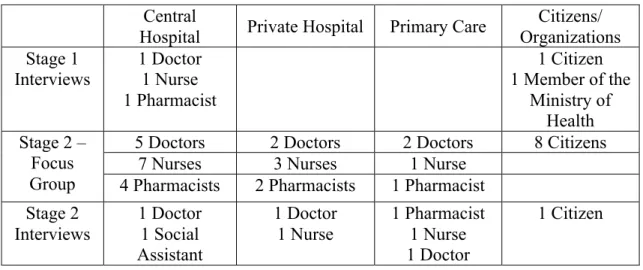
Stage 2 and 3 were both integrated in the Project for designing the Portuguese EHR. In Stage 2, a qualitative study involving 48 citizens and healthcare practitioners (doctors, nurses and pharmacists) was undertaken to accomplish the objective of understanding value co-creation in complex services with many actors.
Figure 3 - Stage 2: Sample design, data collection and interview protocol
Stage 2
Qualitative Method to understand the value co-creation in complex services with many actors Qualitative Study – Grounded Theory (Charmaz 2006; Corbin and Strauss 1990)
Sample Design and Data Collection:
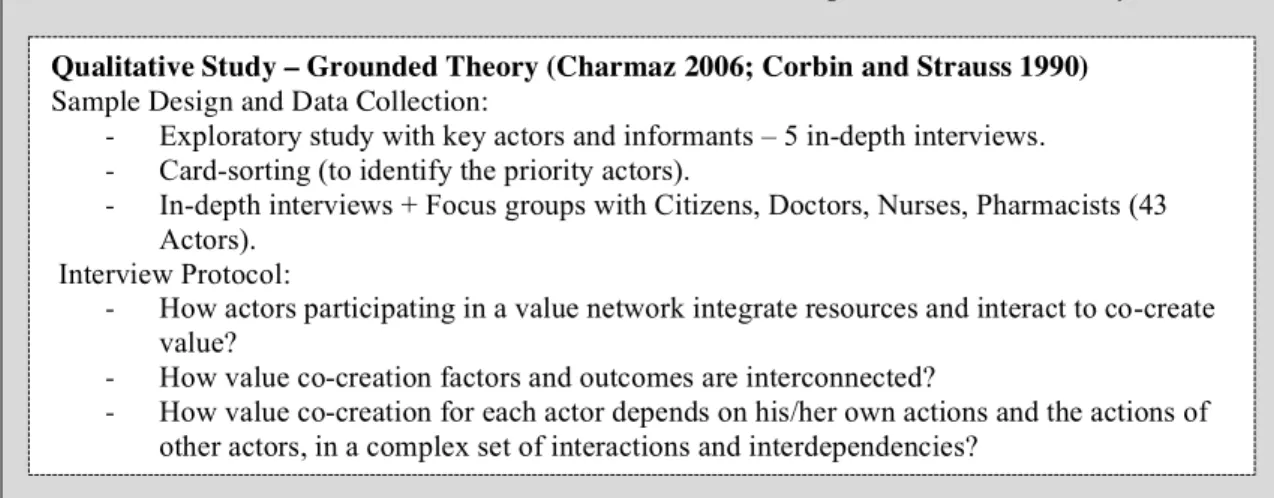
- Exploratory study with key actors and informants – 5 in-depth interviews. - Card-sorting (to identify the priority actors).
- In-depth interviews + Focus groups with Citizens, Doctors, Nurses, Pharmacists (43 Actors).
Interview Protocol:
- How actors participating in a value network integrate resources and interact to co-create value?
- How value co-creation factors and outcomes are interconnected?
- How value co-creation for each actor depends on his/her own actions and the actions of other actors, in a complex set of interactions and interdependencies?
Value co-creation is an understudied subject, especially regarding empirical studies in value network contexts (Payne, Storbacka and Frow 2008; Vargo and Lusch 2008), hence grounded theory was considered appropriate to apply in stage 2 of the research process.
The qualitative study involved citizens and healthcare practitioners from public and private health care organizations. To fine-tune the interview protocol (Froddy 1993), an exploratory study was undertaken involving five semi-structured interviews with the EHR national project manager, one Citizen, one Doctor, one Nurse and one Pharmacist. In order to systematize the interviews, card sorting (Nielsen 2004; Nielsen and Landauer 1993) was used through which interviewees were asked to identify and sort the actors involved in the EHR value network and identify the priority actors they related with. This allowed covering a diverse set of actors with theoretical relevance, which provided different perspectives on value co-creation in value network contexts due to the different interconnections between them.
Following the exploratory study, in-depth interviews and focus groups were conducted in a complementary way. While the interviews provided in-depth knowledge, the focus groups provided more discussion and group dynamics, enriching the data collected. Eight in-depth interviews and four focus groups with citizens, doctors, nurses and pharmacists were combined using theoretical sampling until saturation of results was reached (Corbin and Strauss, 2008). The same interview protocol was applied in both in-depth interview and focus goup sessions. All sessions were literally transcribed and analyzed using NVivo 9 software.
The results provided understanding of how value is co-created by multiple actors in complex environments. More specifically they allowed: (1) identifying value co-creation factors and outcomes; (2) understanding how value co-creation factors are interconnected; and (3) understanding how value co-creation for each actor depends on his/her own actions and the actions of other actors. This information enabled mapping the overall customer experience of each priority actor, their daily activities, the EHR service related tasks, and the elements of their surrounding context.
Stage 2 provided important insights for Stage 3 regarding, on the one hand, the development of new and enhanced tools to characterize the customer experience in contexts of many-to-many actors, and on the other hand, an holistic vision of the value
constellation experience at the network level (explained in detail on Paper III) expanding the knowledge regarding the Portuguese EHR Service System and its application.
2.3 Stage 3 – Design science Research approach to the development of
SD4VN
Stage 3 adopted a design science research approach to develop a new method for designing services for value networks. Design science research is a well-established methodology that has its roots on information systems research area (Gregor and Hevner 2013; Winter 2008), but it has been spreading to service research as well (Beloglazov et al. 2014). According to Merton (1968), Sutton and Staw (1995), in design science research contributions to knowledge can be partial theory, incomplete theory, or empirical generalizations in the form of a new design artifact. The artifacts may take the form of a construct, a model, a method or implementations that are innovative, valuable and solve problems (Hevner et al. 2004). Design theory formalizes knowledge providing prescriptions for design and action: it says how to do something (Gregor and Hevner 2013). In design science research, knowledge and understanding of the design context and the development of the proposed solutions are achieved in developing efficient and effective applications of the designed artifact in the real world (Aken 2004; Hevner et al. 2004; Lee 2007).
To address the objective of developing SD4VN, Stage 3 extended and evolved existing service design methods (the artifact) to a new method for the creation of services provided to multiple interdependent actors in a value network. As such, a design science research approach was considered adequate to develop and validate the SD4VN method. Given the complexity of designing the Portuguese EHR, design science research provided step-by-step guidance to evolve and validate the research process.
According to March and Smith (1995), design science consists on building an artifact for a specific purpose and evaluating how well the artifact performs. Methods for design science research are available in different forms (Hevner and Chatterjee 2010; Vaishnavi and Kuechler 2008). We followed Peffers et al. (2007), who propose a more detailed research process with five main steps that should be followed iteratively: (1) Problem and Motivation identification; (2) Objectives definition; (3) Design and Development of
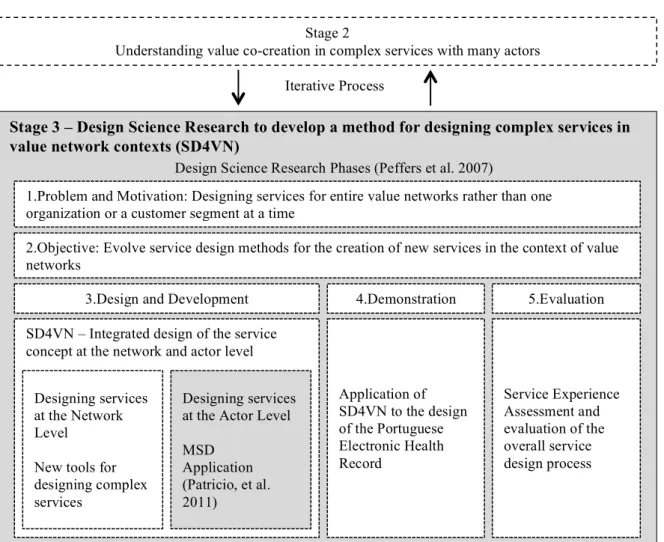
the artifact; (4) Demonstration through application of the artifact to solve the problem; and (5) Evaluation. These stages are not linear, and can be iterated between them. Figure 4 depicts the steps of the overall design science research approach adopted in the project.
Figure 4 - Process employed in the dissertation research - Stage 3
Following Peffers et al. (2007) approach, design science research process therefore comprises the research phases depicted in Figure 4 that will be explained as follows:
1. Problem and Motivation Identification: the first phase falls back on literature review in value networks and service design to formulate the problem and its motivation. As stated in Chapter 1, we focused on SD methods and tools that have been developed in different disciplines, but realized that they did not support the creation of services for network contexts. As such, we also covered relevant literature on complexity and value networks, value co-creation and healthcare (as the area of application of the artifact) to identify the challenge of creating an artifact to design services with a network perspective where multiple
Iterative Process Stage 2
Understanding value co-creation in complex services with many actors
Stage 3 – Design Science Research to develop a method for designing complex services in value network contexts (SD4VN)
SD4VN – Integrated design of the service concept at the network and actor level
Application of SD4VN to the design of the Portuguese Electronic Health Record Service Experience Assessment and evaluation of the overall service design process Designing services
at the Actor Level MSD Application (Patricio, et al. 2011) Designing services at the Network Level
New tools for designing complex services
3.Design and Development
Design Science Research Phases (Peffers et al. 2007)
4.Demonstration 5.Evaluation 1.Problem and Motivation: Designing services for entire value networks rather than one
organization or a customer segment at a time
2.Objective: Evolve service design methods for the creation of new services in the context of value networks
actors contribute value and expect value in return (Gummesson and Mele 2010; McColl-Kennedy et al. 2012; Vargo, Maglio and Akaka 2008).
2. Objectives Definition: Building upon Peffers et al. (2007), a qualitative objective was defined as a new artifact – method - that supports solutions to problems. Stage 3 therefore comprises developing a new method for designing services for value networks – SD4VN, which is an underexplored area.
3. Design and Development: this phase comprehended the development of SD4VN method, its integrated tools and implementation process.
Stage 2 of the dissertation provided important insights for the development of the method because designing services at the network and actor levels, requires deep understanding of the value co-creation experience of the different actors at both levels. Stage 2 therefore helped understanding the context of creating an integrated method for designing the service concept at the network and actor level.
The development and implementation of the method was made iteratively, through a constant dialogue between the literature review of service design methods and tools, and the feedback obtained by its integrated implementation. Based on this approach the method and models evolved iteratively through the application in the design of the Portuguese Electronic Health Record that is described in the next phase. This corroborates Hevner’s et al. (Hevner et al. 2004) recommendations to instantiate the artifact to demonstrate the feasibility and suitability to its intended purpose (defined in the phase 2).
4. Demonstration: this phase regards the implementation of SD4VN method with the Portuguese Ministry of Health Team, in the design of the Portuguese Electronic Healthcare Record. The implementation process involved weekly meetings with more than 20 different actors involved in the design team, and two participatory service design workshops were undertaken with 32 and 35 different actors respectively to evaluate if the design decisions were taking the right direction and get feedback on possible improvements.
The iterative cycles of participatory design sessions and meetings were also adopted to generate and test new service concepts, both at the network level and actor level. Participatory design (Schuler and Namioka 1993) involves the inclusion of the different service actors in the design team (Edvardsson et al. 2006) and assumes they are the true experts in their domains (Sanders 2008). By using engaged involvement and pluralistic techniques, participatory design helps operationalize the needs and desires of the different actors (Holmlid 2009). In the context of designing a complex service such the Portuguese EHR service, participatory design allowed the holistic understanding of different actors’ experiences, their interactions, priorities and conflicts of interest.
During the implementation phase, the research team accompanied the Ministry of Health, which was responsible for implementing the EHR in the field. The Portuguese EHR is online since 2014.
5. Evaluation: phase 5 verified how well the artifact supports the solution to the problem adopting four criteria (process, invention, relevance and extensibility) set by Forlizzi et al. (2008) to evaluate the contributions of new design methods. Literature review attests the uniqueness of the proposed method, as it addresses gaps regarding the inexistence of tools, models and a service design method to design services in value network contexts.
To evaluate the results of the application of SD4VN method, an additional qualitative study of the implementation was conducted to understand the experience of healthcare professionals with the new EHR in primary care and hospital care units, analyzing its impacts with 37 healthcare professionals in these different contexts. The follow-up study results showed that the Portuguese EHR was well received by healthcare professionals and contributed to the validation of the SD4VN approach as it showed that the method could be successfully applied to a large scale value network context.
The application of SD4VN in the design of the National Electronic Health Record demonstrates the contributions to the service design process that existing methods cannot offer. It is now possible for 41,000 healthcare practitioners (PDS 2014) to access accurate and meaningful information through the patient summary record provided by the system. The Portuguese EHR system is a foundation for huge improvements in patient safety, treatment effectiveness and
sustainable healthcare. This thorough application in a complex national project, suggest that these contributions can be extended to other contexts.
The contribution of Stage 3 is thoroughly described in Paper III so that the design process can be replicated and the rationale for the tools selection is understood.
The design science research process was evaluated according to Hevner‘s et al. (2004) guidelines for effective design science research. To ensure a comprehensive understanding of how design science research was applied in Stage 3 of this dissertation, we now detail how Hevner’s guidelines were followed.
Design science research requires the creation of a purposeful new artifact, being a construct, model, or method (Guideline 1). In this case, we developed a new service design method – Service Design for Value Networks (SD4VN) for a specific problem (Guideline 2) of designing services for contexts with multiple interdependent actors in value networks. The thorough development of the method (Guideline 3), first required a qualitative approach (Corbin and Strauss 2008) to gain an in-depth understanding of the value co-creation experience in complex services with many actors. Then, based on the study results and literature review, the method was iteratively developed through the application to designing the Portuguese EHR.
Taking into account Hevner’s et al. fourth Guideline, the SD4VN method is innovative because it supports one of the main challenges of this dissertation research: designing services for entire value networks rather than one organization or a customer segment. Research rigor (Guideline 5) was pursued through careful definition and application of Peffers et al. (2007) design science research process (see Figure 4) that supports the different process stages of developing SD4VN and its formal representation (see details on Paper III).
The method application to designing the Portuguese EHR enabled an iterative dialogue between conceptual development and empirical validation. The positive feedback obtained from the follow-up study confirmed SD4VN as an effective and valid service design method that can be a solution for the defined problem (Guideline 6). The SD4VN method and its application are detailed in the Paper III.
In summary, Stage 3 adopted a design science research approach following Peffers et al. (2007) approach and Hevner’s et al. (2004) guidelines, to attain the objective of developing a new method for designing services for value network contexts. The empirical ground of the research undertaken in the design of the Portuguese Electronic Health Record Service involved a multidisciplinary team of 138 persons (Citizens, Doctors, Nurses, Pharmacists and Healthcare Technicians) from public and private organizations, 7 Managers of the Ministry of Health, and 5 researchers from the University of Porto.
3 Thesis outline
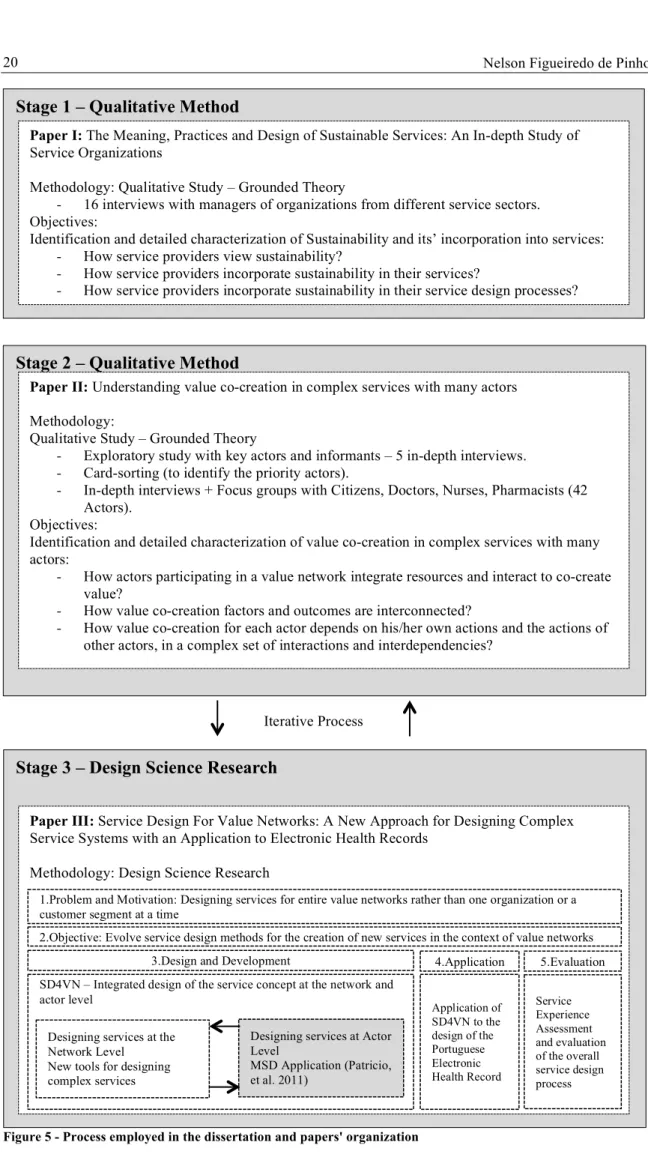
This section outlines the organization of the dissertation and summarizes the constituent chapters. The first chapter introduced the dissertation research, explained its main motivations and challenges, and overall objectives. The theoretical background was briefly discussed in order to introduce the most relevant topics and gaps associated to service design in the context of value networks. Chapter 2 described the research design undertaken, starting by the overall design science approach, which, following the dissertation rationale is divided in three major stages, as depicted in Figure 5.
The papers that are part of this dissertation are included in Chapter 4 and follow the three research stages. As shown in Figure 5, the first stage of research involved the study of sustainability, starting with a qualitative approach to understand the meaning and practices of designing services that incorporate sustainability concerns. Paper I was developed in this stage and the results explain how service providers view sustainability, and how they incorporate sustainability into their services and service design practices. Stage two of the research design involved a qualitative study to fill the gap of understanding value co-creation in the context of value networks. Paper II presents the results of this study to understand value co-creation in complex services with many actors. The third stage of research design entails a design science research approach to develop a new method for designing services for value networks involving a multidisciplinary team of 138 persons from public and private organizations (Citizens, Doctors, Nurses, Pharmacists, Healthcare Technicians). Paper III reports the process and results of the development of Service Design for Value Networks (SD4VN) method, and its application in the design of the Portuguese Electronic Health Record.
Figure 5 - Process employed in the dissertation and papers' organization
Stage 2 – Qualitative Method
Paper II: Understanding value co-creation in complex services with many actors
Methodology:
Qualitative Study – Grounded Theory
- Exploratory study with key actors and informants – 5 in-depth interviews. - Card-sorting (to identify the priority actors).
- In-depth interviews + Focus groups with Citizens, Doctors, Nurses, Pharmacists (42 Actors).
Objectives:
Identification and detailed characterization of value co-creation in complex services with many actors:
- How actors participating in a value network integrate resources and interact to co-create value?
- How value co-creation factors and outcomes are interconnected?
- How value co-creation for each actor depends on his/her own actions and the actions of other actors, in a complex set of interactions and interdependencies?
Paper III: Service Design For Value Networks: A New Approach for Designing Complex
Service Systems with an Application to Electronic Health Records Methodology: Design Science Research
Paper I: The Meaning, Practices and Design of Sustainable Services: An In-depth Study of
Service Organizations
Methodology: Qualitative Study – Grounded Theory
- 16 interviews with managers of organizations from different service sectors. Objectives:
Identification and detailed characterization of Sustainability and its’ incorporation into services: - How service providers view sustainability?
- How service providers incorporate sustainability in their services?
- How service providers incorporate sustainability in their service design processes?
Stage 1 – Qualitative Method
Stage 3 – Design Science Research
Iterative Process
SD4VN – Integrated design of the service concept at the network and actor level Application of SD4VN to the design of the Portuguese Electronic Health Record Service Experience Assessment and evaluation of the overall service design process
Designing services at Actor Level
MSD Application (Patricio, et al. 2011)
Designing services at the Network Level
New tools for designing complex services
3.Design and Development 4.Application 5.Evaluation
1.Problem and Motivation: Designing services for entire value networks rather than one organization or a customer segment at a time
The overall results and contributions of the dissertation are discussed in Chapter 5, taking in consideration the main objectives identified in Chapter 1. The research and managerial contributions are detailed, taking in consideration the understanding of sustainability and actor’s value co-creation processes in many-to-many contexts, and enabling its incorporation in the development of a new method for designing services for value networks (SD4VN). Managerial implications are also discussed taking into account value as a result of a dynamic view of value networks, and the application of SD4VN in the design of the Portuguese Electronic Health Record. Finally, dissertation conclusions, limitations and future research directions are presented in Chapter 6.
The Meaning, Practices and Design of Sustainable Services:
An In-depth Study of Service Organizations
ABSTRACT
Purpose – Sustainability has become quite important in modern society, but incorporating sustainability into services still needs substantial research. This paper contributes an in-depth study of what service organizations mean by sustainability, how they incorporate sustainability into their services and their practices regarding sustainable service design.
Design/methodology/approach – This paper presents a qualitative study of 16 service organizations from different industries using grounded theory methodology and semi-structured interviews.
Findings – The results showed that organizations have many different perspectives on what sustainability means, but they always included the temporal dimension. All organizations in the study believed that sustainability was already embedded in their mission and values. However, most organizations lacked perspectives and methods for specifically incorporating sustainability into their services. Furthermore, only a few organizations applied a systematic process for designing their services. Sustainability is not explicitly incorporated in service design, but is conveyed mostly through values statements. The complex systems nature of sustainability emerged as a key concern for designing complex service systems
Originality/value – This research provides a reference model for classifying different aspects of sustainability and offers service organizations a clearer understanding of the concepts of sustainability and sustainable service. Novel insights on developing sustainable services are also offered, which provide a foundation for further service design research.
INTRODUCTION
In the twenty first century, human societies worldwide face the daunting challenge of meeting the basic human needs, aspirations and desires of today’s generations, without compromising the ability of future generations to meet their own needs (United-Nations, 1987). Sustainability is a major concern for modern society and is one of three major socioeconomic transformations that Europe has proposed to lead (European-Commission, 2007).
The design community has been aware of the need for designing sustainable services for a long time (Crul and Diehl, 2006). With the cumulative effects of unsustainable behaviors, interest in sustainability is also growing for both customers and service providers (Edvardsson and Enquist, 2009). Moreover, design for sustainability has gained increased attention since research has shown that 80% to 90% of a product or service’s environmental impact is determined at the design stage (Crul and Diehl, 2006; Design-Council, 1997; Schvaneveldt, 2003). As such, service design can be a viable practice to incorporate sustainability into service organizations. However, there is no consensus about how to incorporate sustainability practices into services. There is some detachment between what organizations proclaim in their mission and values statements and the sustainability of their actual practices. Moreover, most sustainability research has focused on product design. The large size of modern service economies means that they generate significant pressure on the natural environment (Grove et al., 1996) and, therefore, demand more efforts on service design for sustainability.
We argue that to develop sustainable practices for service, it is important to start with an in-depth understanding of what service organizations mean by sustainability and what are their sustainability practices. This paper contributes an in-depth study of what service organizations mean by sustainability, their practices regarding sustainable service design and how they incorporate sustainability into their services.
A qualitative study of 16 service organizations investigated: 1. What do service organizations mean by sustainability?
2. How are organizations incorporating sustainability into their services? 3. How do organizations incorporate sustainability through service design?
With these objectives in mind, the first section of this paper presents the theoretical framework of sustainability and its incorporation into services and examines the relationship between sustainability and service design. The second section describes the research methodology with a qualitative study of 16 service organizations, using a grounded theory approach. The third section presents the results of the qualitative study with service organizations, structuring the findings according to the three research questions.
THEORETICAL FRAMEWORK
Sustainability and its three pillars
Sustainability is derived from the Latin sustinere (tenere, to hold; sus, up) (Hornby and Ruse, 1995). Sustainable development can be defined as meeting the needs of the present without compromising the ability of future generations to meet their own needs (United-Nations, 1987). Since the 1980s, the term sustainability has been used in the sense of human sustainability, and it has become associated with integration of economic (jobs, prosperity, wealth creation), social (social inclusion, communities) and environmental (natural and renewable resources) spheres (Adams, 2006). The three overlapping circles in Figure 1 are not mutually exclusive and can be mutually reinforcing (Adams, 2006; Blewitt, 2008; Buchenrieder and Göltenboth, 2003).
Figure 1 – The three pillars of sustainability, adapted from Forestry Commission (2009)
Vucetich and Nelson (2010) incorporated an ethics framework by defining sustainability as “meeting human needs in a socially just manner without depriving ecosystems of their health” (p. 539). Elkington argues that a business is sustainable when it reaches long-term financial stability by minimizing its environmental impact and meets the community’s social expectations, too. This definition is based on the Triple Bottom Line (TBL) principle, which emphasizes the importance of equilibrium among three pillars of sustainability: economic prosperity, social equity, and environmental regeneration (Elkington, 1997; Elkington, 2001). Achieving sustainability is one of the most important modern challenges that organizations face. However, we need to know how service organizations view sustainability as a first step to developing new methods to help them create sustainable services.
Incorporating sustainability in services
The concept of service have been defined in multiple ways (Quin et al., 1987; Vargo and Lusch, 2004). According to Lovelock, a service is an “act or performance that creates benefits for customers by bringing about a desired change in—or on behalf of—the recipient” (Lovelock and Wirtz, 2010, p. 6). The emerging service logic has challenged the distinction between products and services, and the service framework/mindset applies to every offering. In Service Dominant Logic, “service is defined as the
application of specialized competences (operant resources—knowledge and skills), through deeds, processes, and performances for the benefit of another entity or the entity itself’’ (Vargo and Lusch, 2008, p. 26).
Incorporating sustainability in services needs further research (Ostrom et al. 2010). Some authors propose incorporating sustainability through values, but do not provide specific guidelines regarding the concrete impact on new service development (NSD) (Edvardsson and Enquist, 2009; Edvardsson et al., 2007). NSD is the “overall process of developing new service offerings” (Johnson et al., 2000). NSD includes the complete set of stages from the idea generation to deployment and implementation (Edvardsson et al., 2000). NSD also includes the service design stage that is present in most of the NSD process models in the literature. These earlier NSD models presented a narrow view of service design as the concretization of the service idea in models, drawings or specifications (Gummesson, 1991). In this paper, we adopt a broader and more recent definition of service design as a human-centered process based on a deep understanding of users, service providers, market strategies and social practices (Holmlid and Evenson, 2008) that permeates the different stages of NSD (Patrício et al., 2011).
Sustainability has been studied in product design and there are several common concerns when designing a product or a service, such as the connection with customer values (values resonance), the customer experience, a solid understanding of the customer needs, identification of the SET factors (Social, Economic and Technology drivers), the choice of suppliers and materials (sustainability concerns), etc. (Cagan and Vogel, 2002). However, designing a service involves several design challenges due to the complexity of service systems that are not part of the product development process, such as different customer interactions and co-creation of experiences, the service encounter (Bitner, 1990), and the integration of multiple channels, people, processes and technologies. Coping with this complexity requires integrating multiple disciplines to create new services (Patrício and Fisk, 2013).
Sustainability has also been an important concern for Product Service Systems (PSS), which can be defined from different perspectives (Manzini and Vezzoli, 2002; Mont, 2002; Kang and Wimmer, 2009). We adopted Manzini and Vezzoli’s definition of PSS as “an innovation strategy, shifting the business focus from only designing (and selling)
physical products, to designing (and selling) a system of products and services that are jointly capable of fulfilling specific client demands.” This concept shows that people do not demand products or services, but what products and services enable them to achieve. Manzini and Vezzoli developed the concept of strategic design for sustainability, which is “the capability to create new stakeholder configurations and develop an integrated system of products, services and communication that is coherent with the medium-long term perspective of sustainability” (Manzini and Vezzoli, 2003). Although this concept helps develop tools for designing a sustainable PSS, there is still the need to develop service design methods that explicitly address sustainability concerns. In the following, we explore the literature related to sustainability through values and sustainability through design.
Sustainability through values
Values have a broad meaning across service marketing, service design and service management. One challenge to incorporating values into service design is that “value” and “values” (in plural) are used with different connotations. It is very important to distinguish between (1) value as the importance or preciousness of something (material concept) (Normann and Ramírez, 1993; Vargo and Lusch, 2004) and (2) and values as a person's principles or standards of behavior (ethics/morals meaning) (Hornby and Ruse, 1995).
Service design has made a strong argument around the incorporation of values (Edvardsson and Enquist, 2009; Edvardsson et al., 2007). The concept of values associated with services and service design has been gaining attention (Ostrom et al., 2010) and our findings corroborate that. As such, the focus of this paper is on incorporating sustainability through values (in plural).
Customer value includes not only economic value but also value that is linked to values (in the sense of ideals). According to Holbrook (2006), customer value rests on 4 pillars: is interactive, relativistic, refers to a judgment of performance or outcome; and resides in a consumption or use experience. This perspective enhances service as a value-creative endeavor and is consistent with Vargo and Lusch’s Service Dominant Logic (SDL) (2004; 2008). This paradigm posits that value (value in use) is co-created with the customer and is experienced and assessed when service is used within the customer's
own context. Therefore, organizations can only make value propositions that have the objective of supporting customers in their own value-creating activities.
Combining Service Dominant Logic (SDL) (Vargo and Lusch, 2004) with values-based business model facilitates a sustainable values-based service business (Edvardsson and Enquist, 2009). A values-based business is grounded in the paradigm of SDL and firmly based on core organizational values as well as social and environmental responsibility. Building upon SDL, Shirahada and Fisk (2011) created a broader conceptualization of service and value. They proposed a tripartite model of value co-creation that includes both human to human relationships and human to nature relationships. Their model includes a new value concept they call “Value in Keep” that goes beyond value in use, value in context, and value in exchange. Value in Keep means the long-term value achieved from preserving natural resources for the future.
According to Vucetich and Nelson (2010), sustainability requires “tending its ethical dimension across all levels of society, even though we cannot ever expect to arrive at a final determination of its meaning.” (p. 540). The incorporation of the ethical dimension in new business models can foster values resonance (Edvardsson and Enquist, 2009), which occurs when the values of customers and other stakeholders are in accordance with the core organizational values, the social and environmental values. The higher the congruence between customer’s values and the service provider’s values, the higher the customer loyalty (Mascarenhas et al., 2006). As such, organizations can co-create value with their customers by resonating with their values, and therefore supporting them in pursuing their values.
From the previous definitions we can conclude that a sustainable values-based service business model makes a long-term commitment and is values-driven (rather than short-term and financially-driven). It must also incorporate the ethical dimension and be in harmony with the sustainable development concept and the TBL principle. However, values-based service research does not provide guidelines on how to incorporate values into services. These guidelines should be developed to support organizations as they attempt to systematically incorporate sustainability values (as principles) into services. These guidelines should also establish a strong long-term commitment to enhancing and