Hedonic and Utilitarian Attitudes towards
Technology and Innovation:
Purchase Intentions of Audio Devices
The AirPods Case
-Marta Maria Rodrigues Pessoa de Amorim
152115130
Dissertation submitted in partial fulfillment of the requirements for the degree of MSc in Management with Specialization in Strategic Marketing at Católica-Lisbon School
of Business & Economics
Thesis written under the supervision of Prof. Nuno Crispim April 2017
2
“Technology is nothing. What’s important is that you have a faith in people,
that they’re basically good and smart, and if you give them tools, they’ll do
wonderful things with them.”
3
ABSTRACT
Title:
“Hedonic and Utilitarian Attitudes towards Technology and Innovation: Purchase Intentions of Audio Devices – The AirPods Case”Author:
Marta Pessoa de AmorimThe substantial technological growth that defines the era we are living in, involves not only improvement of current electronics features, but also launches of innovative products in the market, and both situations from the consumer electronics segment hold an uncertainty regarding the new product acceptance. As to minimize this uncertainty, brands must be aware of preferences and characteristics which drive consumers to their products, addressing properly the potential key target groups.
This dissertation relies on identifying relevant dissimilarities across hedonic and utilitarian behaviour profiles concerning the smartphone consumption, the attributes most valued in electronics, and assess whether these profiles influence the consumers’ attitudes towards technology and innovation in general. On a further analysis, the research is applied to the practical case of AirPods, the new wireless earbuds from Apple, limited to the Portuguese market.
From the outcomes of the study it was possible to properly differentiate two groups of smartphone users related to hedonic and utilitarian behaviours. The main findings suggest that these consumer profiles do not constitute the main driver in influencing attitudes towards technology and innovation, although they disclose a relative impact on purchase intentions of the innovative audio device from Apple. Nonetheless, demographic aspects, such as age and gender, are also highlighted due to the relatively influence they have in these attitudes.
The collected analyzed data might also contribute for brand managers to better communicate to their target groups, enhancing in their products the ‘emotional side’ for the hedonics and the ‘feature side’ for the utilitarians.
Keywords:
Consumer Behaviour; Hedonic and Utilitarian; Consumer Electronics; Technology; Innovation; AirPods; Purchase Intentions.4
SUMÁRIO
Título:
“Atitudes Hedónicas e Utilitárias perante Inovação e Tecnologia: Intenções de Compra de Dispositivos de Áudio – O Caso dos AirPods”Autora:
Marta Pessoa de AmorimO crescimento tecnológico substancial que define a era em que vivemos, envolve não só uma melhoria das atuais características eletrónicas, mas também lançamentos de produtos inovadores no mercado, tendo em conta que ambas as situações no segmento de produtos de eletrónica detêm uma incerteza associada à aceitação do novo produto. Para minimizar esta incerteza, as marcas devem estar atentas às preferências e características que levam os consumidores até aos seus produtos, de forma a atrair os potenciais grupos target desejados. Esta dissertação centra-se em identificar diferenças significativas entre os perfis de comportamento hedónico e utilitário relativamente a smartphones, os atributos mais valorizados em eletrónica, e verificar se estes perfis influenciam as atitudes dos consumidores perante tecnologia e inovação em geral. Numa análise mais profunda, o estudo é aplicado ao caso prático dos AirPods, os novos phones wireless da Apple, limitado ao mercado português. Dos resultados foi possível diferenciar dois grupos de utilizadores de smartphone relacionados com comportamentos hedónicos e utilitários. As principais conclusões sugerem que estes perfis comportamentais não constituem o fator principal em determinar atitudes perante tecnologia e inovação, apesar de revelarem um relativo impacto em intenções de compra do inovador acessório de áudio da Apple. No entanto, aspetos demográficos, como idade e género, destacam-se também devido ao seu relativo impacto nas atitudes em questão. A informação analisada poderá fornecer dados aos gestores de marca para comunicarem efetivamente aos seus grupos target, evidenciando nos seus produtos o ‘lado emocional’ para os hedónicos e o ‘lado técnico’ para os utilitários.
Palavras-Chave
: Comportamento do Consumidor; Hedónico e Utilitário; Produtos de Eletrónica; Tecnologia; Inovação; AirPods; Intenções de Compra.5
ACKNOWLEDGEMENTS
This dissertation concludes another essential part of my academic path, my Master degree. Throughout this journey there were inevitably some successes and failures, and overcoming them to develop the challenging final result would not have been easy without the support from some individuals that I consider as the main pillars and motivation of my life, which constitute my Father and my Brother, my closest Family and genuine Friends.
I also would like to express my thankfulness to my Thesis Supervisor, from the Consumer Electronics and Durable Products Marketing Seminar, whose contribution was crucial in taking all the steps in the dissertation progress, and to all my Professors that had an impact during my academic years.
Lastly I would also like to thank some Individuals that shared their knowledge with me, and along with their patience and availability gave me some fundamental inputs for the realization of this thesis.
6
TABLE OF CONTENTS
Chapter 1: INTRODUCTION ... 7 1.1 Background of AirPods ... 7 1.2 Problem Statement ... 9 1.3 Aim ... 9 1.4 Scope of Analysis ... 9 1.5 Research Methodology ... 101.6 Academic and Managerial Relevance ... 10
1.7 Dissertation Outline ... 11
Chapter 2: LITERATURE REVIEW ... 12
2.1 Conceptual Framework ... 12
2.2 Consumer Behaviour ... 12
2.3 Hedonic and Utilitarian Consumption Profiles ... 13
2.4 Attitudes towards Innovation... 14
2.4.1 Sustaining vs. Disruptive Innovation ... 15
2.4.2 Technology Acceptance and New Product Adoption ... 15
2.5 Influencing Purchase Intentions ... 17
2.5.1 Awareness ... 17
2.5.2 Loyalty ... 18
2.5.3 Lock-In ... 18
2.5.4 Network Externalities ... 18
2.6 Research Hypothesis Generation ... 19
Chapter 3: METHODOLOGY ... 20
3.1 Research Approach ... 20
3.2 Research Design ... 20
3.3 Qualitative Research: In-Depth Interviews ... 22
3.4 Quantitative Research: Online Survey ... 23
3.4.1 Population and Data Collection ... 23
3.4.2 Analysis ... 23
Chapter 4: RESULTS AND DISCUSSION ... 25
4.1 Qualitative Insights ... 25
4.2 Overall Characterization of the Quantitative Sample ... 26
4.3 Hedonic and Utilitarian Profiles ... 26
4.4 Impact on Technological Innovations ... 28
4.5 Impact in the Innovative Audio Device from Apple ... 29
4.5.1 Characterization of the Sample – Audio Segment ... 29
4.5.2 AirPods Purchase Intentions ... 30
Chapter 5: CONCLUSION ... 32 5.1 Main Findings ... 32 5.2 Limitations ... 35 5.3 Future Research ... 35 APPENDICES ... 37 BIBLIOGRAPHY ... 58 Other Sources ... 60
7
Chapter 1:
INTRODUCTION
1.1 Background of AirPods
Smartphones nowadays constitute an indispensable consumer electronic for most people, as well as a relevant technological tool to be updated and connected with the world through internet. In accordance to this aspect, the smartphone manufacturers, the top technological companies, in order to attract more customers have to bring some changes by improving current features according to needs and launching innovations in the market. With this lately substantial continuous technological growth and highly interconnected era that we are living in, it is becoming more important to develop a better understanding of what is driving the consumption of different types of consumers.
From the top manufacturers in the smartphone industry, Apple has been a pioneer in some technological innovations, and apart from the iconic iPhone the brand has been pursuing the leadership in the electronics segment. Although some recent Chinese manufacturers are becoming a threat due to their appealing low-cost prices with the same or high performance specifications as the top-seller smartphones, Apple has been disclosing positive aspects as the represented in the figure for the brand as a whole (from October until February 2017).
Fig. 1 – Apple’s Stock Indexes (in dollars)
Source: Há Vida na Apple para lá do iPhone? (2017, February 18). Expresso Digital: Economia.
Typically the brand publicly announces its newest products in an annual event every September. In this event, which constitutes their main products launch date, people tend to create a huge buzz, wondering what might be the novelties for the current year, ever since the announcement of the first iPhone in 2007. Following this pattern, last 7th September 2016 Apple launched the most recent iPhone 7 and their new earbuds under the name of AirPods.
8
The AirPods, which constitute a technological innovation in the audio accessories category, are a new concept of earphones similarly shaped and fabricated from hard plastic as the regular ones from the brand, only without the traditional wires (Appendix 1). This new audio product has the promise of giving consumers an ultimate high quality sound, due to an automatic and continuous connection with any Apple device (compatible with recent versions of the operative systems iOS 10 for iPhone or iPad, watchOS 3 for iWatch or macOS Sierra for iMac); allows up to 5 hours of audio playback autonomy; can be carried in a small white box which enables a practical recharge for a total 24 hours of listening time (each 15 minutes of charge allows for more 3 hours of music); and are incorporated with infrared sensors to start and pause playing while inserted in and out of ears, saving the battery.
As the AirPods connection is made through Bluetooth, they will also be able to be connected with any smartphone or other device, allowing other smartphone brand consumers to use them, as well as PC or tablet users. There is a limitation for audio only, as it requires an Apple device connection for further features through an accelerometer, such as making calls or talking to Siri (virtual personal assistant from Apple devices).
This innovative audio accessory created by Apple aims to solve the problem of the messy knots from their standard earphones, the EarPods, but simultaneously is being under a lot of criticism, mostly on social media, for the odd look they imply aesthetically due to the stem hanged below the earlobe. The main issue that is worrying consumers is that the wireless feature may lead to an easy loss of one or both pods, for instance by falling out from an ear. Recently Apple tried to overcome this problem by releasing a feature with the new operative system which enables users to locate the lost pods through “Find My AirPods”.
In addition to the AirPods innovation, Apple decided to remove the 3.5mm headphone jack from the iPhone, possibly as a sales strategy. This incites to a more exclusive consumption of products from the brand, especially audio accessories, since now if consumers do not want to use the EarPods, which are included in the iPhone purchase, through the alternative Lightning port, they have to insert an adaptor to 3.5mm jack which comes along with the purchase of the iPhone 7.
With a recent entry of AirPods in the Portuguese market, it might be interesting to study the differences on purchase intentions of Portuguese consumers, taking into consideration that their consumption profiles of electronics can be more hedonic or more utilitarian, and assess if these consumption behaviours have a an influence in their attitudes towards technological innovations. Portugal is one of the European countries that are facing a hard economic crisis which leads consumers to adapt themselves. The Portuguese population
9
had to change their consumption patterns in the past years, and consequently be aware of prices, as the buying power is not as high as some years ago. These facts constitute relevant tools for this study, while researching the behaviour of consumers in this specific market and to consider further plausible conclusions.
1.2 Problem Statement
This thesis will strive to assess the differences across hedonic and utilitarian consumption profiles on consumer behaviour and attitudes towards technology and innovative products, specifically in the consumer electronics category. The research study will be tested on the practical case of the AirPods sale in Portugal, in order to investigate if and how these hedonic and utilitarian patterns influence the Portuguese purchase intentions of these so called new and innovative earphones. Bearing in mind the goals of the study, I was able to define the main Problem Statement as:
“Do Hedonic and Utilitarian consumer profiles of Portuguese smartphone users influence their purchase intentions of the innovative AirPods?”
1.3 Aim
The aim of my thesis will rely on assessing if hedonic and utilitarian consumption dimensions influence the attitudes these consumers have towards technological innovations in the market. More precisely the focus will be on whether these consumers are receptive or hostile towards innovative products, such as the practical test on the AirPods. In order to better construct the conclusions for the problem statement, and to organize guidance for the aim of the study, I defined some research questions as the main objectives to be answered:
- RQ1: How can be defined the consumption profiles of hedonic and utilitarian
smartphone users?
- RQ2: Do hedonic and utilitarian consumption profiles influence attitudes towards
technology and innovation?
- RQ3: Are the hedonic and utilitarian consumer profiles a main driver to influence the
acceptance of the innovative AirPods?
1.4 Scope of Analysis
The analysis for the dissertation will cover only Portuguese smartphone consumers, from any age range, to shelter a diversity of respondents. In a further phase of the study the research will cover exclusively evaluations of consumers regarding Apple, particularly this brand’s technological innovation recently launched – the AirPods.
10
Portuguese consumers might not be a representative part of the worldwide share of smartphone consumers nonetheless the results from the study aim to reveal an interesting and new contribution for this area of field applied to the specific Portuguese market, as a small sample. Adding to this, most of these consumers use their smartphones for several tasks and activities, and listening to music can be one of the main ones, so assessing the usage of audio accessories is also a relevant part for this research study applied to AirPods.
1.5 Research Methodology
In this dissertation research was used mainly primary data, collected through both qualitative and quantitative researches (in-depth interviews and an online survey, respectively) from a sample in the Portuguese population, and it was supported by secondary data of previous investigation, constituting articles from past studies in the research field in question, to answer to the specific research objectives.
The in-depth interviews were directed to Portuguese smartphone consumers, being in an initial stage split as hedonic or utilitarian users in accordance to their psychographics and lifestyles, with the objective to understand deeply their technological innovation awareness and usage habits in audio matters.
Following this information gathered, I was then able to elaborate a survey with standardized questions, with the objective to identify patterns on consumer hedonic or utilitarian attitudes towards technological innovations and in a further phase assess their purchase intentions regarding the AirPods.
1.6 Academic and Managerial Relevance
From this dissertation I expect to provide insights on the perceptions that hedonic and utilitarian consumers have towards technological innovations, and whether their attitudes influence their purchase intentions. The insights provided will also contemplate the applicability in the case of AirPods sale in Portugal, assessing perceptions of Portuguese consumers concerning this new Apple product.
The conclusions of this research study hopefully might lead to a future class use with acknowledgement of the topics associated and some further research studies on the consumer behaviour and new product adoption fields. It might also help to improve marketing departments of technological companies by giving information on what drives certain types of consumers, in order to make more appropriate brand management decisions by addressing the right target groups.
11
1.7 Dissertation Outline
The following chapter 2 includes a literary review on theoretical topics associated to the research study of this dissertation, such as consumer behaviour, distinction between hedonic and utilitarian consumption dimensions and innovation, also supported by previous studies. This review led me to the formulation of research hypothesis on consumer behaviour towards technology and innovation, which were used in the statistical testing.
In chapter 3, the research methodology is extensively described with the followed procedures of collection and analysis of the data, which gave me insights to answer to the research questions.
Chapter 4 contemplates the discussion of the results obtained from the qualitative and quantitative researches, supported by the statistical analyses and hypothesis testing.
Chapter 5 finalizes with the presentation of conclusions, as well as some limitations and suggestions for further research studies on the field.
12
Chapter 2:
LITERATURE REVIEW
2.1
Conceptual Framework
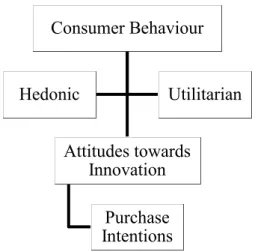
To introduce a theoretical background with a revision of some research studies on consumer behaviour and brand management, it was previously constructed a conceptual model, in the figure below, as a representation of the research aimed to be studied.
Fig. 2 – Dissertation Conceptual Framework
The behaviour of consumers can have a tendency to adopt either a more hedonic or utilitarian predisposition, depending on the product or service to be acquired, as well as the environment in question, affecting the overall decision making process of purchases. These two consumption profiles, which will be considered as the independent variables for the study, may have an influence and lead to certain attitudes towards innovation, which were considered the dependent variables.
Throughout this chapter are highlighted some main findings in the relevant fields for the research study, and in a further phase of the dissertation this framework will be applied to a practical case of its effects on purchase intentions of AirPods in the Portuguese market.
2.2 Consumer Behaviour
People purchase products in order to acquire some satisfaction of a need, and the choices they make in choosing certain products are a consequence of mainly their preferences throughout a purchase decision-making process. This defines their consumption behaviour.
Studies on consumer behaviour stated that the majority of people seek an experiential consumption that provides them with feelings, fantasies and fun, including “playful leisure
Consumer Behaviour Attitudes towards Innovation Purchase Intentions Hedonic Utilitarian
13
activities, sensory pleasures, daydreams, esthetic enjoyment, and emotional responses” (Hirschman et al., 1982), and smartphones can be a concrete example of this consumption perspective due to their characteristics of multitasking, since it enables users not only to do utilitarian tasks, as making phone calls, but also to do hedonic activities, such as playing games or editing photographs.
Regarding the purchase process itself, according to a study on Consumer Behaviour by Mckinsey (2009), consumers are nowadays changing the way of researching and purchasing their products, since they are emerging as well-informed customers, and this leads us to the concept of a new consumer decision journey. This new approach comprises four phases: 1) initial consideration; 2) active evaluation (research of potential purchases); 3) closure (moment of purchase); and 4) post purchase (moment of product experience). This decision-making process is crucial for brands to improve their marketing strategies and create awareness and visibility, as to highlight themselves amongst the competitive market in the technology segment. At the same time, marketers should adapt to this new journey and direct their communications towards touch points, in order to reach and achieve the highest number of consumers. In the electronics sector, more specifically in the smartphone purchasing process, consumers also follow this journey and there is a focus in the active evaluation, which comprises an information gathering. In other words, consumers currently might follow a more detailed decision-making process to assure they are making the best decision in the purchase.
Consumer’s satisfaction can be influenced not only by cognition and affect, but also by some previous experience accumulated from the product or service, as Homburg et al.’s (2006) research studies concluded. They also found that the early stages of consumption are the most influenced by affective factors, which tend to decrease over time.
2.3 Hedonic and Utilitarian Consumption Profiles
Consumers have a tendency to behave under a more hedonic or more utilitarian manner towards the purchase of certain products, and many studies in this field distinguish each consumption profile, as is described below.
Experiments on the consumption experience of shopping stated that it can be valued by these two kinds of perceptions, in hedonic or utilitarian behaviours (Babin et al., 1994). The main conclusions from these studies revealed that on one hand hedonic products are purchased mostly in a spontaneous decision and are associated with fun and emotions, while, on the other hand, utilitarian products are purchased with an intention to attend a specific need
14
and are related to its practicality. The consumption of hedonic or utilitarian products is also determined based on the ending goal that it leads to. If the goal is hedonic it means that the consumption is for “their own pleasure”, while if it is utilitarian then the result is “to achieve some higher level purpose” (Botti et al., 2011). The satisfaction of customers in one hand can be enhanced by attending utilitarian needs, but on another hand the delight of customers might also be enhanced by attending hedonic wishes (Chitturi et al., 2008).
Grohmann et al.’s studies (2003) found that hedonic and utilitarian dimensions of consumer behaviour comprise with distinct attitudes of consumers towards products and brands. In addition, when products are highly valued in hedonic terms, consumers are more receptive to price premiums from specific brands associated, but when they are valued as utilitarian, consumers do not express a high involvement in evaluating brands, but on their functionality.
The situation in question while deciding to purchase a product also influences the choice of hedonic or utilitarian goods, according to Dhar et al.’s (2000) experiments on this subject.
Concerning the justification of consumers for their hedonic or utilitarian choices, a research from Okada (2005) demonstrated that consuming hedonic goods, which is more difficult to explain over utilitarian options linked with practicality, are more valued in contexts where there is a relative flexibility for one to justify its consumption, for example when a hedonic and a utilitarian are exposed to consumers in separate and not bundled. Another conclusion from this research was the fact that people “are willing to pay more in time (effort) for hedonic goods” and more in money for utilitarian goods”, contrasting with some previous studies.
The communication of product benefits to consumers should take in consideration if they have a tendency to be more hedonic or utilitarian for them. Findings on research studies concluded that for utilitarian products in specific, companies should consider highlighting their potential hedonic benefits or positioning them as more fun, which “can increase not only consumers’ processing but also their purchase likelihood” (Klein et al., 2016).
2.4 Attitudes towards Innovation
Consumers can have different preferences on purchase choices according to their consumption profiles, whether hedonic or utilitarian, and this might affect the attitudes they reveal while in presence of innovations.
15
2.4.1 Sustaining vs. Disruptive Innovation
A disruptive innovation can be defined as “an innovation with radical functionality, discontinuous technical standards, and/or new forms of ownership that redefine marketplace expectations”, as proposed by Dubinsky et al. (2016). In addition to this definition, Behrens et al. (2005) stated that an innovation is considered to be extremely radical when it is a unique novelty with a probable impact in technology. For some consumers, AirPods can be perceived as a disruptive innovation in the audio segment since it revolutionizes an already existed product, the earphones; but for others it can be seen as merely a new option for wireless phones, entitled as a sustaining innovation.
Gill et al. (2015) investigated the consumer approval of new products and concluded that there is a higher intention to adopt a formerly new innovation as an independent accessory (peripheral component) instead of an innovation integrated with the product (core). For instance, it is expected to be a higher intention to adopt independent disruptive innovation products, like AirPods, instead of innovations which come integrated with a product, such as earphones with a Lightning port that come with the iPhone 7.
2.4.2 Technology Acceptance and New Product Adoption
When a new technological product is launched, consumers go through a process which can position them in either adopting it and accept the innovation or in an opposite direction.
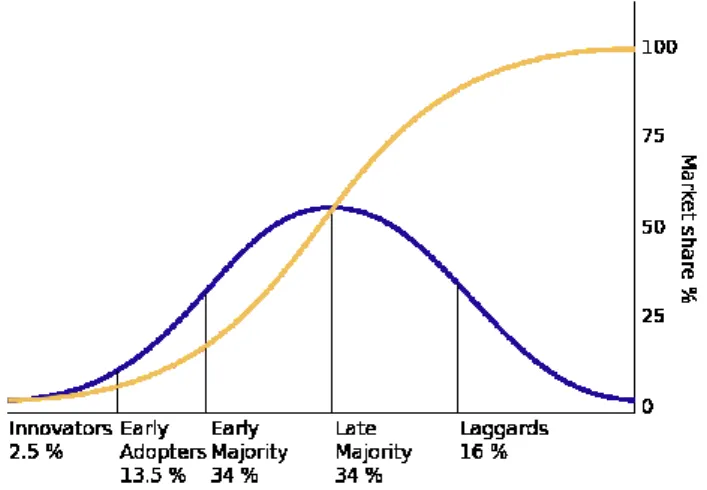
According to Rogers (1962), we can segment consumers in terms of their level of technology adoption, and it is stated in its theory of “Diffusion of Innovations”, graphically represented in the figure.
Fig. 3 – Customer Segments of Technology Adoption
Source: On Digital Marketing – https://ondigitalmarketing.com/learn/odm/foundations/5-customer-segments-technology-adoption/
16
The graph itself represents in blue the groups of consumers who adopt a technological innovation, and in yellow the market share of the new product, which is likely to reach a maturity level. It was identified that Innovators, Early Adopters and Early Majority are the group of consumers who, in an initial phase of the product life cycle, adopt the innovations while they only reached a very small market share; and in contrast, the Late Majority and Laggards are the group of consumers who only adopt the innovative products when they are reaching the mature phase of their life cycle, reaching a higher market share as they are no longer a novelty in the meantime.
Concerning some research studies on new product adoption of recent consumer electronic products precisely, it was found that age and income are the main drivers as personal characteristics, more relevant than consumers being innovative by nature (Bayus et al., 2003). In specific, the main findings from this research suggested that consumers which have higher incomes and younger ages, as well as predisposition to innovations, are more probable to be segments of consumers to adopt more new products, namely “innovators” and “late adopters”.
Word-of-mouth, as discussed before, is a type of promotion of a product or service in which customers expose to others their satisfaction or dissatisfaction about their consumption experience. Electronic word-of-mouth (e-wom), also known as Virtual word-of-mouth, which consists of another form of wom present in digital platforms such as online websites, during the digital era we are present in, is becoming to gain more relevance. Recent studies about the impact of virtual word-of-mouth on purchase intentions (or willingness to pay) of consumer electronic innovations stated that virtual word-of-mouth is perceived as a credible information about the innovation, and customers’ willingness to pay “is also positively correlated with an innovation’s perceived utilitarian and perceived hedonic value” (Kawakami et al., 2015). According to Kawakami et al.’s (2013) studies, also in this field, both personal and virtual word-of-mouth influence in different ways innovation use. The findings from the research established that personal word-of-mouth positively strongly impacts the intensity of use (perceptions of the number of local adopters) and the variety of use (perceptions of the complementary products available). In practice, these findings may suggest that personal wom has a stronger influence over virtual wom on making people adopt innovative products.
Some studies on technology acceptance indicate that both personal and virtual word-of-mouth influence positively the perceived ease of use (Kawakami et al., 2012). In more detail, in the smartphone industry, Parry et al. (2012) found that the virtual word-of-mouth is more related to perceived usefulness and has a higher influence in perceptions of innovation
17
attributes, such as the ease of use. In addition, these studies also found that a symbolic consumption of a certain product can boost word-of-mouth communications, making current adopters of innovative products to influence some other potential adopters.
The communication of innovations also have an impact in new product adoption, and studies on the willingness to try an innovation stated that consumers are more influenced to try innovations through a mixture of visual and verbal communication elements (Chaudhuri et al., 2014). More precisely, these studies found that a consumer’s willingness to try an innovation increases significantly when is added a picture to a hedonic verbal description of that specific innovation, and vice-versa for utilitarian verbal descriptions.
Accordingly to Griffith et al.’s (2014) studies on cross-cultural new product strategies, design innovations are preferred over technological innovations aiming to establish a social status differentiating from others. Adding to these findings, the results from the same study suggested that the positive relationship of technological innovations and market share declines in countries with higher uncertainty avoidance (meaning, in other words, less tolerance to ambiguity). The country to be under this research study, Portugal, is considered to have culturally high uncertainty avoidance, meaning that Portuguese consumers might not be receptive to AirPods as in other cultural environments.
Relatively to technology adoption in audio devices, Krause et al.’s (2016) studied everyday music-listening behaviour, more specifically the devices chosen by people for the purpose. Their conclusions found that music and technology are connected and they relate to the consumer’s identity, which is determined from psychological factors.
2.5 Influencing Purchase Intentions
Consumers can be influenced in their intention to purchase a product by many strategies applied by brands. It can be through the brand image which is considered attractive for one and creates awareness in the customer’s mind, and hence influences the consumer for a repeated purchase creating a loyalty in this process. Since the topic of this study is related to consumer electronics, it is also reasonable to discuss other strategies adopted by some technological brands to retain their customers and somehow “force” them not to purchase from other brands.
2.5.1 Awareness
Brand awareness consists of one aspect of the brand equity highlighted by its consumers, and comprises recognition and recall. Recognition is defined as a capability by
18
consumers to easily identify the brand when exposed to some sort of products, whereas recall is defined as a capacity of consumers to remember the brand when presented to some category of products.
2.5.2 Loyalty
Several definitions of brand loyalty leads to the notion that loyal consumers are the ones who develop a strong relationship with a brand of their preference, whether by purchasing repeatedly or making recommendations of products and services experienced by them to other potential customers.
Chaudhuri et al.’s (2001) studies on the role of brand loyalty found the effects that trust in the brand and affection for the brand have on the overall performance of the brand itself. They stated that focusing on purchase loyalty leads to more sales outcomes and consequently an increase in market share; while focusing on attitudinal loyalty leads to premium outcomes, meaning higher relative prices from the brand.
According to studies on consumer electronics products (Dawar et al., 1994), some aspects highlighted in marketing strategies, can become signals for consumers as quality, such as the brand name, the price and the physical appearance, perceived as the design. Specifying to the smartphone industry, studies on the brand loyalty found four main factors which positively influence the loyalty, which are the functional value, emotional value, social value and brand identification (Wang et al., 2016).
2.5.3 Lock-In
Brands want to retain their consumers through the concept of Lock-in, making them to be less likely to search and switch sellers after having an initial investment. Lock-in is mainly caused by a choice of immediate costs minimization and by a non-anticipation of future switching costs that may occur, as concluded by Zauberman (2003). Consumer electronics’ companies are therefore interested in keeping their costumers loyal to them by using this strategy, for instance through software incompatibilities between brands.
2.5.4 Network Externalities
Network externalities are considered to be an effect caused to increase the value of a product when there are a higher number of users. Kawakami et al.’s (2009) studies on technology acceptance revealed that consumer perceptions of these network externalities
19
variables influence their own perceptions of innovation attributes, as well as directly impact their purchase intentions.
2.6 Research Hypothesis Generation
To emphasize the linkage between the main topic of the dissertation and the insights acquired from this literary revision, it is conceivable to highlight some aspects. In the present time, it is becoming more relevant for companies from the electronics segment to identify and understand the main drivers that effectively attract consumers to acquire a technological innovation, whether it is disruptive or not and especially assessing the characteristics which define the Innovators, in order to appeal to more potential consumers. These technological companies, by some means, face a challenge in successfully targeting the correct groups of potential consumers after launching an innovation in the market.
Afterward this literature review and with the intention to test the variables previously stated in the proposed conceptual framework, I formulated the following research hypothesis:
H1: Hedonic consumers attribute a higher importance to the brand
Utilitarian behaviours are more related to practicality and to attend a specific need, so it is expectable that this type of consumers are not attached to a specific brand, becoming somewhat irrelevant in the purchase decision-making process of electronic products.
H2: Hedonic and utilitarian consumer profiles influence attitudes towards technology
and innovation
Since hedonic and utilitarian profiles determine some attitudes towards consumption, it becomes relevant to assess if these profiles influence as well attitudes that these typical consumers have towards technology and innovation in general.
H3: Hedonic and utilitarian consumers have different levels of purchase intentions of
AirPods
As the AirPods constitute a new product innovation in the market with a high price associated, it is expected for the hedonic consumers to be more receptive and willing to pay, with respective purchase intentions distinct from utilitarian consumers.
20
Chapter 3:
METHODOLOGY
3.1 Research Approach
The performance of research can be done through three types of methods - Exploratory, Descriptive or Explanatory (Saunders et al., 2009) – whose defining aspects provided insights for the structure of the dissertation methodology skeleton.
Exploratory research refers to the starting point of an investigation, the clarification of concepts and the generation of hypothesis for the problem or situation to study. Commonly this kind of research, which is mostly qualitative, is conducted by literature search to verify the existence of theories that can explain and support the understanding of different angles or focus group interviews to observe discussions about the subject in study (Saunders et al., 2009). Under these described goals, as a starting point for this dissertation was opted an exploratory approach.
Descriptive research focuses on a detailed description and explanation of characteristics of people, products or situations through a collection of samples from a population, constituting data for a qualitative or for a quantitative approach. This kind of research relies on a gathering of information as an alternative of elaborating hypothesis which might forecast future situations. Since this approach comprises a detailed information collection of people’s characteristics, it was also opted for one of phases of the methodology.
Finalizing, Explanatory research is related to a link between exploratory and descriptive methods, with the purpose to explain the occurrence of such phenomena in study and establish a causal relationship between variables. In practice, this kind of method consists on assessing how things interact (Saunders et al., 2009), constituting the final stage of this dissertation.
Concerning the collection of data for research purposes, Primary Data comprises a research made exclusively by the author of the study, whereas Secondary Data constitutes the collection of data obtained by other authors in previous studies. In detail, primary data is achieved through conduction of experiments and constructing conclusions on the main results, and it can have a qualitative or quantitative nature, being the main basis for this study. In this research study were used both types.
3.2 Research Design
Aiming to answer the research questions formulated in chapter 1 as the whole purpose of this study, and to achieve conclusions for the hypothesis proposed in chapter 2, were used
21
the three methods – exploratory, descriptive and explanatory research – with the support of both Qualitative and Quantitative types of primary data collected. Below is presented a figure indicating the research conducted throughout this dissertation.
Fig. 4 – Methodology Framework
The Exploratory part was developed on an initial point of the methodology, during the collection of information on the field, such as published data (academic articles and journals) and online published articles, as described previously in chapter 2; as well as a complementary brief research on online published data in order to obtain an overview and a better understanding of the material already approached by other authors.
For the Descriptive part, it began by conducting in-depth interviews to collect information on the consumption behaviour of smartphone users, their opinions on technological innovations and perceptions of AirPods aspects. This step was made with the main objective to discover different points of view on this field, to apply in a further phase on an online survey to identify possible patterns.
Proceeding to the Explanatory part, and with the insights provided from the interviews, was introduced an online survey launched through Qualtrics platform. This survey was created to test hypothesis on primary data, so it would be able to identify significant differences and patterns in the answers. According to the problem statement, what was being tested on the survey was if the sample could be significantly differentiated in typical hedonic and utilitarian profiles of smartphone consumers, supported by the literature review acknowledgements, further behaviours towards technology and innovations, and more precisely if these consumers were interested in purchasing the AirPods.
The main findings obtained would allow to an explanation of results and a further elaboration of conclusions, aiming to verify if hedonic and utilitarian dimensions affect the levels of adoption of technological innovations, which are later analyzed in chapter 4.
EXPLORATORY Research Literature Search DESCRIPTIVE Research Qualitative: In-Depth Interviews EXPLANATORY Research Quantitative: Online Survey Conclusions
22
3.3 Qualitative Research:
In-Depth InterviewsThe Qualitative Research consisted on conducting In-Depth Interviews, also known as unstructured interviews. They were chosen for this qualitative part due to their informal nature, allowing for the whole interview to be guided through the answers and line of reasoning of the interviewee, and although the interviewer does not have a predetermined list of questions, must have a clear idea about the subject and aspects intended to explore (Saunders et al., 2009).
The main goal on this stage was to determine hedonic and utilitarian insights on the usage of smartphones, as well as an initial insight on these consumers’ overall appreciation of AirPods, assembling a potential target group.
The interviews were conducted individually with the collaboration of six interviewees, not from a random sample, as they were under some defined criteria: Portuguese smartphone owners, currently users of headphones for audio listening. Nonetheless, there was no age or gender restriction, allowing to the collection of diversified data and complemented responses on hedonic and utilitarian behaviours, since they were from different backgrounds.
It was created a guide for these interviews, not with the objective to be strictly followed, but to monitor the informal conversation so there could be reached the main topics to assess, in the stipulated 20 minutes as a total duration. The guide had the structure below:
IN-DEPTH INTERVIEWS - List of Topics 1. Smartphone Experience
2. Attitudes towards Technology and Innovation 3. Audio / Music Habits
4. Presentation of Apple’s new device: AirPods 5. Overall Impression of AirPods
The chosen respondents were asked to start by providing information about their current smartphones, regarding the decision-making process of the whole acquisition, their preferences, the perceptions of the brand, the use experience and more relevant data on their psychographics and lifestyle. With these perceptions it was able to identify people in more hedonic or more utilitarian profiles. At the same time the respondents had to explain their behaviour towards technology and innovation, whether they were informed and aware of latest trends or non-receptive to adopting innovations. In a further phase was introduced the music listening part, in which respondents expressed their habits in audio listening using headphones. The ending of the interview covered a brief presentation of AirPods (Appendix
23
2), exposing its functioning and design, in order to collect first impressions, overall appreciation and intention to buy.
3.4 Quantitative Research:
Online SurveyFor the Quantitative Research was chosen a collection of data through a Survey in an online platform, as this constitutes the main relevant source for researchers to collect primary data to test the relationship between the variables under study. The main benefits of an Online Survey are the allowance to collect a great deal of data about one respondent at one time (Aaker et al., 2010), and its versatility to be implemented online in order to reach a higher number of respondents.
This part of the dissertation, which consists on the explanatory research, was undertaken to assess the impact of the hedonic and utilitarian profiles on the behaviour towards technology and innovation, and hence on the purchase intentions of AirPods. It will also allow for a definition of a potential target group of this Apple product.
3.4.1 Population and Data Collection
The quantitative part had the objective to gather some quantifiable data on the hedonic and utilitarian consumers’ experiences and habits on the smartphone consumption, how would they behave concerning technological innovation, as well as their appreciation of AirPods, taking into account that its structure was based on the perceptions initially collected from the qualitative part.
The online survey was drafted on an English version (Appendix 3), structured with 40 questions, divided in logical blocks, and was designed on Qualtrics platform (remained active from November 3rd to November 13th), although only available in a Portuguese version. This made sense since here was to be applied the same criteria for the target respondents as from the in-depth interviews, which consisted on Portuguese smartphone consumers, though now it could also contemplate the non-users of audio accessories.
3.4.2 Analysis
As mentioned before, the online survey was divided in logical blocks, and this would enable a structured analysis of the resulting answers. Concerning its structure, the first part was related to purchasing process, preferences on the smartphone industry and psychographics; the attitudes towards technology and innovation; the audio listening habits;
24
the final block, which involved a presentation of the AirPods functionalities and design, with pictures of the accessory itself, were asked the global appreciation, intentions to purchase and willingness to pay for them; and ended with some demographic-related questions.
To test the impact of hedonic and utilitarian profiles both on the attitudes that these consumers had in presence of technology and innovation, and on the purchase intentions of AirPods, were used some statistical analyses on the SPSS software. To be more precise, they consisted on a cluster analysis, as the K-means cluster is an appropriate method to segment and group consumers in homogeneous sides regarding their common behaviours or preferences, in a number defined in advance. To assess significant differences between the potential segmented groups (clusters) were used Independent Sample T-tests and Crosstabs, whether the nature of the variables were quantitative or qualitative, being metric or non-metric, respectively. On a final step of the statistical analysis, were chosen linear multiple regressions to test if the clustered consumer profiles had a strong influence in attitudes towards technology, innovation and the purchase intentions of the audio device under study.
25
Chapter 4:
RESULTS AND DISCUSSION
4.1 Qualitative Insights
From the In-Depth interviews conducted, which involved 6 required participants from diverse backgrounds as explained in section 3.3, were highlighted some insights on the smartphone usage and perceptions of AirPods, providing information for the development of the survey.
Considering the respondents’ answers, it was possible to find contrasts and differentiate some consumer behaviours.
The main findings revealed that some consumers, who own Apple, spent a significant amount on the purchase of the smartphone; preferred to buy a smartphone with a familiar software, for having other devices from the same brand, which can be related to the concept of lock-In, introduced by Zauberman (2003), and valued an appealing design; revealed some awareness of technological innovations but did not search hardly for news in the market; listened to music regularly with the phones from the brand, in many casual situations of the daily routine; found the AirPods fantastic and quite innovative, with a clean design characteristic of Apple, although disclosed a health concern for inserting a Bluetooth device inside the ears; revealed high intentions to purchase, but when presented the price it became a concern and lowered the willingness to pay. One of the respondents shared the opinion “I would definitely buy the AirPods, they are extremely useful and they appeal with their great design. From the presentation they are indeed expensive but it is not a surprise for me, since they are from Apple, and I would pay for the price to have ones.”
In contrast, other consumers who owned Samsung or other unfamiliar brands, such as OnePlus, did not spend high amounts on the purchase of the smartphone; preferred to buy a smartphone with specifications in accordance to needs and valued more high equipment not to be concerned about future technical problems; revealed high awareness of technological innovations and willingness to be among the first to acquire innovative electronics; listened to music on the smartphone regularly, with Bluetooth speakers or with wireless headphones; found the AirPods interesting and practical, with a good design and a solution to the messy nodes of the traditional wires, but did not reveal a high intention to purchase, especially when presented the price.
After these in-depth interviews, it was possible to relate some participants to have a tendency to behave more in a hedonic way, by propensity to pay premium prices, as
26
introduced by Grohmann et al.’s (2003), or more in a utilitarian way, as studied by Babin et al.’s (1994).
Following this qualitative information gathered, the next phase was the conduction of the online survey to investigate patterns in consumer behaviours from a specific sample collected.
4.2 Overall Characterization of the Quantitative Sample
After closing the online survey there were obtained 152 answers, being 103 valid for the analysis. The 49 answers discarded were due to their irrelevance for not being answered until the end of the survey.
The demographic profiles of the respondents are synthetized on Appendix 4. From the total 103 valid respondents, 36.9% are male and 63.1% are female. The age group of 20-34 (54.4%) constitutes the largest fraction of the sample, followed by 50-64 (17.5%) and 35-49 (16.5%). Regarding the education qualification, there is a larger amount of respondents with an undergraduate degree (55.3%), and concerning their current occupation, the respondents were mainly students (46.6%) and employed workers (37.9%). Lastly, the monthly household net income most frequent was above 3.000€ with 39.8% of the respondents. The brand of the smartphones owned by the majority is Apple (48.5%), followed by Samsung (18.4%) and Huawei (7.8%). According to these values obtained from the most owned smartphone brands, we can assess that it is relatively skewed from the actual Portuguese market, in which typically Samsung represents closely twice the market share of Apple in Portuguese smartphone sales.
4.3 Hedonic and Utilitarian Profiles
The two main consumption profiles relevant for the study in this dissertation consisted on Hedonic and Utilitarian, leading to a crucial distinction of the sample as a start on the analysis of the results obtained, from RQ1. As this differentiation constitutes a highly subjective division of the sample, several approaches could have been used, being followed a personal methodology based on the acknowledged concepts from the existing literary revision. This chosen path was to differentiate the 2 groups of consumers concerning the attributes most valued in a smartphone, as well as the amount spent purchasing it, and finalize with a comparison of these groups across preferences and behaviours, in order to assess a recognized match with characteristics determined from the literature review. The most suitable aspects identified to differentiate the consumers, after several attempts to clearly
27
detect coherent hedonic and utilitarian profiles, were 4 variables related to the amount spent on the purchase of the owned smartphone (Q.5), the importance attributed to the design (Q.17c), the brand (Q.17d) and to the status perceived (Q.17f). It was ran a cluster analysis, to segment the groups, in a K-Means Cluster, as explained in section 3.4.2, which allows for an earlier specification of the number of clusters to be formed, consisting in this case of 2 (Appendix 5). The resulting segmentation led us to 34 utilitarian and 69 hedonic respondents.
Observing the ANOVA table of this cluster analysis, we can determine the validity of the model, as the levels of significance concerning each variable are favorable, with sig. = 0.000 < 0.05 (reject H0), clarifying the existence of relevant differences between the groups.
Following the cluster segmentation, it was then possible to compare both groups and find supportive aspects in which they are distinct. Evaluating the means of the clusters, in cluster 1 we can confirm a low importance attributed to the status perceived of the smartphone (7,32), as well to its design (38,24) and to its brand (24,35); in cluster 2 there is attributed a higher importance to the status (32,19), to the design (74,61) and to the brand (71,07). Concerning the means of the amount spent purchasing the smartphone, cluster 2 (3,45) spent considerably more than cluster 1 (2,35), as respondents from cluster 2 spent closer to 400€, a higher amount compared to cluster 1. These differences in each cluster can lead us to the classification of cluster 2 more related to hedonic consumers, who value more social aspects of the smartphones, linked to emotions and own pleasure; whereas cluster 1 is more associated to utilitarian consumers, who do not value the same aspects as cluster 2, whose behaviour is more perceived as achieving practicality of a specific need, in accordance to Babin et al.’s (1994) studies. Regarding the amount spent, the results from the clusters is also in accordance to Grohmann et al.’s (2003) studies, as the cluster 2 spent more on average, related to hedonic consumers more receptive to higher prices, while the utilitarian consumers are more price-sensitive.
To identify relevant statistical differences in each cluster were conducted Crosstabs and Independent Samples T-tests.
In the Crosstabs test (Appendix 6), the main non-metric variable in SPSS, in which dissimilarities were apparent, consisted on the chosen brand of the owned smartphone (Q.3). We can realize that the Utilitarian group possesses smartphones mostly from other brands (47.1%) which were not listed on the top brands from the possible options on the survey; and the hedonic group has mainly an Apple smartphone (58%). Despite the sample bias, these results were expected since the utilitarian cluster does not attribute high importance to the
28
brand, being willing to purchase from unfamiliar brands in order to reach a higher level of purpose, as Botti et al.’s (2011) researches proved.
From the Independent Samples T-tests, the main differences found are contemplated as well on Appendix 6. Interpreting the values of sig. (2-tailed) on the T-tests, were found dissimilarities of the clusters within certain questions on the survey, when this sig. < 0.05, stating a significant difference between the means of the 2 groups. The hedonic group agreed more than the utilitarian group on a tendency to buy from the same brand (Q.12a); likeability in purchasing electronic products from top brand only (Q.12b); preference in purchasing smartphones that give a superior status level (Q.12g); preference in purchasing electronics that match with the own identity (Q.12h); agreement with smartphone being the main daily tool, and carrying it everywhere (Q.12i); preference in having fashionable technology for a personal expression (Q.13d); appreciation over owning design electronics (Q.13e); and lastly, enjoy possessing all the latest Apple products (Q.28b). In contrast, the utilitarian group had higher mean values merely on agreement of willingness to purchase from unfamiliar brand (Q.12c). The results are once again in accordance to the expected, as the hedonic behaviour perceives a consumption of products for own delight, linked to expression of the identity and emotional attachment, such as studied by Babin et al. (1994).
4.4 Impact on Technological Innovations
To evaluate the relationship of hedonic and utilitarian consumer profiles within certain attitudes towards innovation, from RQ2, were conducted several linear regression analyses, considering individually dependent variables. These dependent variables constituted questions from the survey considered as indicators of attitudes towards technological innovations. Such as the level of awareness that respondents tended to be about latest technological innovations in general (Q.8); level of comfortability with purchasing the ultimate technological novelty product (Q.12e); agreement with being among the first to try new products (Q.12j); interest in technology (Q.13a); agreement with consulting magazines/websites to get informed about latest technological news (Q.13b); and the appreciation of being surrounded by acquaintances and discuss latest technological innovation electronics (Q.13h). The independent variables considered were the consumer profiles (clusters) and the demographics of age (Q.34), gender (Q.33) and income (Q.40). These demographic variables were included as they were found by Bayus et al.’s (2003) studies to be relevant drivers in adoption of new electronic products. By assessing these personal characteristics of each respondent, it would enable to test which one influenced more specific attitudes towards technological innovations.
29
From the multiple regression analyses conducted, the results of two of them revealed to be statistically relevant.
Relatively to technological innovation awareness, the results (Appendix 7) disclosed a statistically significant model of the multiple regression, as sig. = 0.032 < 0.05 (reject H0).
Although the R square of the model (10.1%) represents a low influence, we can say that age and gender, which are the significant variables in the model (with sig. < 0.05), have a very low negative impact on technological innovation awareness levels (Std.Betas = 0.285; -0.211). The higher the age, the lower the awareness of technological innovations, and female gender tend to be as well less aware, as expected. Consumer profiles did not reveal significance in the model, and unexpectedly income did not as well (both with sig. > 0.05).
Assessing the results from technology interest levels (Appendix 8), the ANOVA table, with sig. = 0.003 < 0.05 (reject H0) reveals that this is measured as a worthy model to
represent the relationship between the variables tested. Interpreting the results from the R square (15.1%) and the coefficients table, it is possible to state that gender and age, once again, have a very low negative impact in technology interest levels (Std.Betas = 0.268; -0.224), opposed to consumer profiles and income which have no significance in the model (with sig. > 0.05). The higher the age, the lower the interest in technology, and female gender tend to be as well less interested.
From the regressions undertaken, we can state that consumer profiles of hedonic and utilitarian smartphone users do not have a significant influence in certain attitudes that they have facing technology and innovation electronics. However, it was found that demographics such as age and gender are determinant in such aspects.
4.5 Impact in the Innovative Audio Device from Apple
4.5.1 Characterization of the Sample – Audio Segment
The profile of the sample respondents, on the topic of audio segment, is synthetized on Appendix 9. The respondents which attribute a high and very high importance to music in their smartphone constitute, respectively 26.2% and 40.8% of the sample; but only 24.3% can be considered heavy users of audio on their smartphones (more than 10H/week listening to music). The most owned audio devices are the traditional ear phones with wires (82.5%) although some respondents also own traditional headphones with wires (10.7%). To finalize, the situations in which the respondents prefer to use phones are working/studying (41.7%), driving/public transportation (24.3%) and running/gym (18.4%). As Krause et al.’s (2016)
30
studies conclude music and technology are connected and this relationship might influence the behaviours of consumers towards the adoption of audio devices.
4.5.2 AirPods Purchase Intentions
Before analyzing a possible impact of consumer profiles on the purchase of AirPods, was elaborated a final synthesis of frequencies regarding the perceptions and attitudes towards this specific audio device (Appendix 10). Concerning the level of innovation perceived of the AirPods (Q.26), the respondents agreed with being innovative (35.9%) and totally agreed with this statement (29.1%), which can yield us to the fact that most consumers see this product as an innovation, in some perspectives adjacent to being disruptive. The purchase intentions of the sample (Q.27) revealed an acceptance of the product, in which 39.8% of the participants probably would buy it and 18.4% certainly would buy it. In disparity, the willingness to pay for the referenced price (Q.32) was merely 11.7% of the sample. These values can show us that despite the interest and intention to acquire an innovative product are favorable for the brand the pricing strategy associated becomes more important. The hedonic group was the expected to reveal higher willingness to pay, due to the high price of AirPods, but in Appendix 6, we can see that in the independent samples t-test there are no relevant differences found across the consumer profiles (sig. = 0.535 > 0.05, accept H0).
To investigate a relationship of the clustered consumer profiles with the intention to purchase a specific product as a technological innovation in the audio devices segment, from RQ3, was conducted a linear regression analysis (Appendix 11). This multiple regression included as independent variables the consumer profiles and demographics of age, gender, and income; and as dependent variable the purchase intentions of AirPods (Q.27). The resultant model summary constituted a statistically significant value since sig. = 0.006 < 0.05 (reject H0), in which 13.7% from the R Square explains the relationship between those variables. The values obtained from the Coefficients Table disclose that both age and consumer profiles (Std.Betas = 0.297; 0.216) have a very low positive impact on purchase intentions of this specific innovative device; while income and gender are not significant in the model (sig. > 0.05). In specific, the values obtained mean that the higher the age, the higher the purchase intentions of AirPods, and at the same time, the more hedonic the respondent tend to be, the increased interested in acquiring AirPods would be.
An analysis on the likeability of consumers to purchase AirPods at some referenced prices of 50€, 100€ and 150€, from Q.31 on the survey, the independent samples t-test results
31
(Appendix 6) reveal differences across the two types of consumers (with sig. < 0.05, reject H0). The hedonic cluster is more likely to pay for AirPods if they are referenced at 50€ or
100€.
To finalize, the results obtained to test a possible impact of consumer profiles in purchase intentions of AirPods provided the evidence that there is a relatively low influence, constituting with age drivers with a very low impact.
32
Chapter 5:
CONCLUSION
5.1 Main Findings
In this final chapter I try to answer to the proposed research questions and hypothesis formulated in an initial phase of this dissertation, with the support of the previous collection, testing and followed analysis of the data. The main focus of this dissertation was to assess the differences between hedonic and utilitarian groups of consumers towards technological innovations, as well as their purchase intentions of the AirPods, which became clear in some aspects throughout the investigation process.
Considering the research questions and their respective hypothesis, the main conclusions to state are the following:
- RQ1: How can be defined the consumption profiles of hedonic and utilitarian smartphone users?
H1: Hedonic consumers of smartphones attribute a higher importance to the brand H1.1: Utilitarian consumers of smartphones attribute a higher importance to the brand
The distinction of the 2 clusters of consumers leads us to confirm that, on one hand, the hedonic respondents valued more the design, the brand and the status of the smartphone, constituting attributes which enhance the emotions of the consumer, and spent a higher amount on the purchase of the smartphone, for being more receptive to price premiums. On another hand, the utilitarian respondents did not spend high amounts of money to purchase the smartphone, being as expected more price-sensitive. Under the followed segmentation of consumer profiles, we are able to prove hypothesis 1 to be true.
Complementary aspects of relevant differences found in behaviours towards technology across the consumer profiles, led us to conclude that hedonic consumers are highlighted for having a preference to buy electronic products from top of mind brands, who match with their identity, related to the emotional aspect of consumption once again. This same group of consumers also enhances the emotional aspect of the consumption by preferring as well fashionable technology to express their identity, which is explained by their appreciation for electronics with design and smartphones that provides them with a superior status level towards third parties. Utilitarian consumers do not perceive the consumption of electronics as an enhancement for their own pleasure, justified by their preference for products who merely allows them the achievement of a higher level of purpose.
Throughout the findings of this research question, from the main differences found between the groups, it was possible to identify key attributes and behaviours that may provide