LUSÍADAS
INTERNATIONALISATION
Work Project International Masters in Management
Student Paulo Pereira (2966/25210)
Professor
Emanuel Gomes
ABSTRACT
The objective of this Work Project is to present a suggestion for an internationalization opportunity for Lusíadas Saúde, which is a Portuguese private healthcare company. Countries of the European Union were analysed through quantitative methods at both macro and micro levels, and the resulting choices were analysed through other quantitative and qualitative methods in order to arrive at a final suggestion. Information was gathered through interviews with the company, literature research and official organizations. In the end it was concluded that Spain is the most attractive country for Lusíadas’ potential international expansion. Future research might focus on entry modes and/or partner selection.
Keywords: Country selection, internationalization, Lusíadas Saúde, healthcare
TABLE OF CONTENTS
Introduction _3 Literature Review _4 Methodology _6 Findings
_Understanding the Company _11 _Understanding the Situation _13 _Global Readiness _14
_Macro Analysis _15 _Micro Analysis _16 _Four Types of Risk _18 Conclusion _22
Next steps _24 References _24
INTRODUCTION
International expansion has been a hallmark of growth in recent decades. Mass-production, economies of scale and the fast spread of information among other things have paved the way for companies to develop a competitive advantage away from their home countries. Therefore, it comes as no surprise when companies successful in their domestic market look for international opportunities.
Lusíadas Saúde fits the profile. Operating in the Portuguese healthcare market, the company runs seven hospitals and five outpatient units (clinics). Even though it is outranked in size by two competitors, the company’s EBITDA has grown at a compounded average of 29% per year, for the last four years. In the past year the company acquired two healthcare groups which will help the company boost its presence in the national market. Competitors are also opening new hospitals and clinics in promising regions of Portugal, and the sector shows interesting levels of growth. Eventually this will slow down, and in an effort to be proactive and take advantage of having international parent companies that are intent on fostering growth, Lusíadas Saúde is looking for internationalization opportunities.
Therefore, the objective of this work project is to find the most suitable country for Lusíadas expansion. First, a literature review was conducted to present the state of academic work related to the topic. Then, the methodology of the analysis was explained and a more in-depth look at the national healthcare market and Lusíadas situation was done. Third, the results of the macro and micro analysis were studied which led to the four risks analysis. After gathering and analyzing all of the data collected, a country was proposed as the best opportunity for Lusíadas internationalization.
In the end, future steps and additional research were suggested in order to build upon the analysis conducted in this working paper.
LITERATURE REVIEW
International Market Selection (“IMS”) has stimulated plenty of research about the best ways to evaluate countries, methods of selection, best sources of data and weighting methods. The selection process depends on the cognitive limitations, time availability, market information, decision-making models and features of the decision makers (Papadopoulos & Martín Martín, 2011). Nonetheless, IMS is regarded as very important to the strategy of a company, and due to the big risks associated, it should be approached carefully.
There are two main approaches to IMS, the non-systematic and the systematic. The former is defined by not having a formal structure which makes it highly subjective, as stated by Cavusgil (1985). Contrastively, in the systematic approach the company makes an effort to follow a defined set of steps (Andersen & Buvik, 2002). The formality present in this approach suggests that its rationality is superior to the non-systematic approach, which in turn makes it a decisive factor of international success (Brouthers et al., 2009).
The systematic approach can subsequently be divided into the qualitative and the quantitative approaches (Papadopoulos & Denis, 1988). Qualitative approaches require more experience on the decision maker side, and are often less fact based than quantitative approaches, because of the subjectivity of the matter and the high “professional bias” in foreign market assessments (Piper, 1971). Quantitative approaches are based on secondary data and can be divided into “Market Grouping” (clustering) or “Market Estimation” (ranking) which, according to Papadopoulos (1971), should be considered separately, but as Cavusgil et al. (2003) proposed, should be complementary approaches. The clustering approach is the grouping of countries that are similar in commercial, economic, political and cultural factors, and in which the company should follow a similar expansion strategy (Kale & Sudharshan, 1987). The ranking approach, while more objective, usually suffers from a lack of product specificity in the indicators
(Papadopoulos & Denis, 1988). This approach has been widely studied and various methods of approaching country ranking have emerged.
Gaston-Breton and Martín Martín (2011) proposed a two-stage model, in which companies should first perform “Macro-segmentation” at country level, based on market size/potential and market development, and then do “Micro-segmentation” at the consumer level, by evaluating personal values and social values. Robertson & Wood (2001) proposed that country ranking should be based on six primary environmental dimensions, namely: politics, market potential, economics, culture, infrastructure and legal. Papadopoulos et al. (2001) suggest a trade-off model in which a company evaluates each country on its demand potential and trade barriers, eliminating some of the problems that other methods have, because it looks at total demand rather than import only demand.
While the systematic and nonsystematic approaches usually explain how companies start their international effort, Andersen and Buvik (2002) proposed a third alternative: relationship approach. This approach focuses on identifying the ideal partners to develop international presence, through a process with three main stages: awareness, exploration and choice. This approach is recommended in Business to Business (“B2B”) industries, when there’s high environmental uncertainty and high behavioral uncertainty, which requires commitment from both parts.
Research about IMS is varied and suggests that companies approach the process using very different methods. At a basic level, the companies either use a systematic, non-systematic or relationship approach. Under the systematic approach, research shows a range of methods that are typically based on secondary data regarding macro or micro factors of each country and can provide the company with valuable insights on which country to select. Country clustering and country ranking don’t necessarily need to be separate approaches and when used together, they can add value to the IMS process.
METHODOLOGY
In the Literature Review, an examination of the current trends of IMS research was made, covering the different methods of analysing foreign expansion opportunities. In order to correctly identify the best international opportunities for the company, a systematic approach was used, with the qualitative and quantitative approaches being complementarily applied. The first step in the selection of the best country for Lusíadas Saúde’s (“Lusíadas”) internationalization effort, was conducting a macro analysis (Appendix 2). Due to the company’s specific desire to internationalize within the European Union, this first level of analysis focused on the 27 member states (already excluding the UK). The Macro analysis’ main objective was to evaluate each country in regards its attractiveness to foreign companies. In order to have a complete macro analysis, Robertson & Wood’s (2001) approach was combined with input from the company in six groups of variables.
The first group was Market Potential, which measured the potential for a company to settle there. It was divided into Population, because a large customer base is attractive to companies; Population with 65 or more years due to their heavy usage of medical services (Smith, 2010); historical and forecasted Population Growth in order to asses variances in the customer base; in the interviews with the company (Appendix 1) it was mentioned that hospitals tend to serve the population that surrounds them and that private healthcare is used more by higher income population, therefore both Population density and Mean income were analysed; and finally the Ease of doing business index was used to measure how complicated it is to venture into each country.
The second group was Economics, which had the objective of measuring the level of economic development in each country. It was divided into Gross Domestic Product (“GDP”) 20 year growth and GDP per capita which allowed to compare the levels of production in each country. In order to evaluate inflation and consumer prices, the Harmonised Index of Consumer Prices
(“HICP”) was used. The next measure of economic development evaluated was the level of education of each country’s residents and how recent graduates can find work, therefore Tertiary education completed and Employment rate of recent graduates was used.
The third variable was Culture which was measured using Culture similarity to Portugal, which was computed using the differences between the country’s scores in Hofstede’s Cultural Dimensions and Portugal’s scores. Factors included in this index were: Power Distance, Individualism, Masculinity, Uncertainty Avoidance, Long Term Orientation and Indulgence. The Infrastructure and Geography variable tried to measure the general level of attractiveness geographical attractiveness of each country, while introducing infrastructure (which will be analysed in more detail in the Micro analysis). The Country area plays a part in the growth potential of an incumbent company, as does IT security, while the Capital distance to Lisbon can have an impact on the level of control that Lusíadas can have over a potential subsidiary. In order to measure each country’s Legal attractiveness, four levels were analysed. The first was Regulatory quality, which is the perceived ability of the government to formulate and implement policies that promote the private sector development. The second was the level of Corporate taxes, followed by the number of Tax payments. The last one was the number of Procedures required to start a business which reflects the complexity of each country’s law system regarding.
The last Macro analysis variable was Politics, which was aimed at measuring the governmental quality of each country. It was first evaluated on Government effectiveness, which is the perceived quality of public and civic services and its degree of independence from political pressures, followed by the level of Control of corruption and ending with Political stability. After gathering all the data, countries were given a score from 0 to 10 in each sub-variable. Each variable was then assigned a weight according to two factors (as can be seen in Figure 1): their mean importance, a value that came from Robertson & Wood (2001) survey; and the
interview with the company in which they identified the concentration of the population and their purchasing power as very important factors
in the country’s attractiveness. Therefore, a weight of 5% was given to Population density and Mean income, while the remaining 90% were distributed according to the mean importance of
each variable (sub-sequentially being distributed equally by the sub-variables).
From there a Final Score was calculated by adding the multiplication of each sub-variable with its respective weight. From the macro analysis, six countries arose as the most opportune for Lusíadas and subsequently a Micro analysis was conducted for each of them.
The micro analysis’ objective was to evaluate the company’s sector in the six selected countries (see Appendix 3). To do so, two main areas were analysed, mainly the State of the Healthcare Sector and the State of the Health. The objective of the first one was to measure each country’s level of medical offer, mainly through analysis of the Expenditure, Equipment and Infrastructure, and Personnel. The purpose of the analysis of the State of the Health was to evaluate the health of each country’s population and therefore determine its need of healthcare services. This second area was divided into Health Perception, Healthy Habits and Health Level Outcomes.
As mentioned before, the first subdivision of the State of the Healthcare Sector was Health Expenditure. The objective of this sub-variable was not only to see how much each country spends in healthcare, but how that money is spent and how vulnerable its population is to health procedures. To measure this the Total health expenditure was used, both in total value (current Bn. USD) and as a percentage of GDP. The next step was to measure how much of that health expenditure is financed privately (mostly through insurance companies and out-of-pocket) and therefore the Private health expenditure as a percentage of total health expenditure was used.
Initial required weight Mean importance (inversed) % of weight to be dist Number of remaining sub-variables % per variable Market Potential 10% 2,75 23% 5 4,6% Economics 0% 1,44 12% 5 2,4% Culture 0% 1,29 11% 1 10,8%
Infrast. & Geo. 0% 1,51 13% 3 4,2%
Legal 0% 2,02 17% 4 4,2%
Political 0% 1,73 14% 3 4,8%
Directly following that sub-variable comes the Out-of-pocket health expenditure as a percentage of total private expenditure. The last two sub-variables measure how vulnerable the population is to healthcare expenditure, namely Risk of catastrophic expenditure for surgical Care (catastrophic is defined as direct out of pocket payments for surgical and anesthesia care exceeding 10% of total income) and Risk of impoverishing expenditure for surgical care (impoverishing is defined as direct out of pocket payments for surgical and anesthesia care which drive people below a poverty threshold).
The second part of the State of the Healthcare Sector is the Equipment and Infrastructure. The first sub-variable is concerned with the usage of the infrastructure. Length of stay is the average number of days that a patient spends in services of curative care, and even though low numbers don’t necessarily correspond to higher efficiency levels, a high number means that a company moving into this country has a better chance of being more competitive. The last two sub-variables have the objective of measuring how well the country is equipped. Radiotherapy and Linear acceleration units are mostly used to treat cancer patients and are reflective of the overall state of the health equipment due to their cost and high tech level.
The last part of the State of the Healthcare Sector is the Personnel. Three main sub-variables were analysed: Physicians density, Nursing and midwifery personnel density and Specialist surgical force. Low values in these three sub-variables might indicate a low level of healthcare offer, which could present an opportunity for a company trying to enter the market.
The second part of the micro analysis is the State of the Health of the country, with the objective of measuring people’s health perception, their health related habits and outcomes of the population’s health levels.
Starting with Health Perception, three components were analysed. The first was the Population that perceives its health as being good or very good. The second sub-variable is the percentage of population with No unmet needs (unmet needs defined as healthcare that is too expensive,
too far to travel or long waiting lists). The last sub-variable is the same as the previous one, except it is specific to higher income population (the 20% richest).
The second part of the State of the Health is in regards to Unhealthy Habits, which relate to the need of medical services. The first one is Daily smokers, followed by the level of Alcohol consumption, ending with Obese population.
The third and last part of the State of the Health is the Health Level Outcomes. This part measures the consequences of healthy habits and healthcare quality. The first two sub-variables are Healthy life years for males and females (healthy condition is defined as one without limitation in functioning and without disability). The third sub-variable is percentage of People with long-term health issues. The last four sub-variables are related to the number of deaths caused by some of the main diseases or health conditions of the western world, namely Cancer deaths, Cardiovascular diseases, Diabetes deaths, and Chronic respiratory diseases.
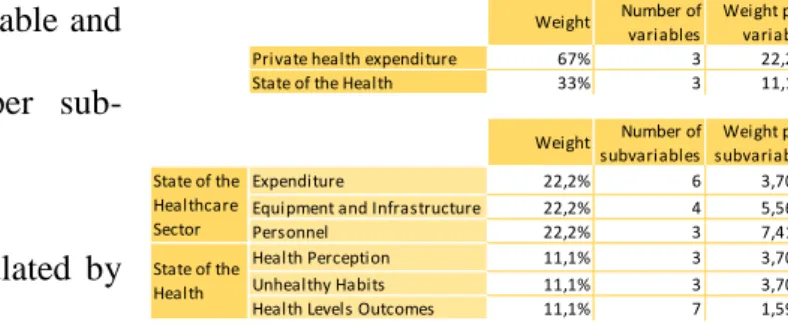
After gathering all the data, countries were given a score from 0 to 10 in each sub-variable. The weighting of the variables was done differently than in the Macro analysis. Due to the difficulty in quantifying how the health quality of a country directly relates to its expenditure in health, a bigger weight was given to the State of the Healthcare Sector (⅔) with the rest being given to State of the Health (⅓). Each weight was then
equally distributed between each variable and was in turn distributed equally per sub-variable, as can be seen in Figure 2.
From there, a Final Score was calculated by
adding the multiplication of each sub-variable with its respective weight. The two countries with the highest scores were selected for an in-depth analysis of the four risks of internationalization, namely cross-cultural, country, financial and commercial risks, as proposed by Cavusgil et al. (2016), which were more qualitative in nature than the Macro and
Weight Number of variables
Weight per variable Private health expenditure 67% 3 22,2% State of the Health 33% 3 11,1%
Weight Number of subvariables
Weight per subvariable Expenditure 22,2% 6 3,70% Equipment and Infrastructure 22,2% 4 5,56% Personnel 22,2% 3 7,41% Health Perception 11,1% 3 3,70% Unhealthy Habits 11,1% 3 3,70% Health Levels Outcomes 11,1% 7 1,59% State of the
Healthcare Sector State of the Health
Micro analysis. From this last level, one country was deemed the most interesting for Lusíadas internationalization effort.
On the qualitative side (which pertains to the experience and knowledge of the decision maker) data was gathered through two interviews with an employee from the company that chose to remain anonymous on October 3, 2016 and November 20, 2016, with an approximate duration of 45 minutes each, in the company’s Lisbon headquarters. The interviews were conducted in Portuguese but they were translated to English and an excerpt can be seen in Appendix 1. On the quantitative side, secondary data was gathered through international institutions databases, mainly Eurostat, World Bank, Organization for Economic Cooperation and Development (“OECD”), World Health Organization (“WHO”) and Geert-Hofstede database. Lusíadas also provided valuable information, primarily through the interviews and documents such as Annual Reports and Corporate Presentations. Additionally, the Global Marketing Management System Online v04 (“GMMSO4”) software was used to have a better understanding of the international expansion analysis and help with the overall organization of the various steps involved.
UNDERSTANDING THE COMPANY
Lusíadas is a Portuguese private healthcare company that manages 7 hospitals and 5 outpatient centers in the North, Lisbon and Algarve regions of Portugal. It’s the third largest health group in Portugal, competing with José de Mello Saúde and Luz Saúde.
The company was founded in 1998 as HPP Saúde, in Oporto. It grew at a steady pace throughout the years and opened its main hospitals in Lisbon and Oporto in 2008. In 2013 it was acquired by Amil, a Brazilian healthcare group with 1.929 hospitals (Amil, 2016). Amil is in turn owned by UnitedHealth Group (“UHG”), a publicly traded American healthcare group with a main focus on insurance and a revenue of 157 billion USD in 2015 (UnitedHealth Group SEC, 2015).
In 2014 the company rebranded to “Lusíadas Saúde” in order to create a stronger position in the mind of its customers.
Initially the company focused on organic growth by opening hospitals and outpatient centers, but recently it shifted to Mergers and Acquisitions
(“M&A”) growth, recently acquiring two hospitals and an outpatient center. Last year the company earned 221 million euros in sales, having grown at a compounded average rate of 4,6% per year for the last 4 years (Figure 3).
It is clear from this that Lusíadas is a strong company with solid financials. It isn’t involved internationally in the present, but the global reach of its parent companies makes internationalisation an attractive next step.
Using the Reduced SWOT (Figure 4) analysis we can better understand Lusíadas. Its main strengths are market recognition and service
quality since in 2015, Lusíadas enjoyed a 38% brand recognition and in regards to service quality, Lusíadas’ Oporto, Lisbon and Cascais hospitals are accredited by JCI (Joint Commission International), a renowned accreditation organization in the industry.
Its main weaknesses are price and a complex standardization process. Lusíadas price level means that only people with insurance or financial resources are able to use their services, which results in a large part of the population being unable to access its service. Complex standardization process limits the speed at which the company can integrate new units.
Figure 4 - Reduced SWOT
Figure 3 - Lusíadas' Financial Evolution
On the external level, the company’s main opportunities are an ageing population and an increased number of chronic diseases. Life expectancy in Portugal went from 67,1 years in 1970 to 80,4 in 2014, which combined with a strong emigration and a low birth rate have been increasing the proportion of elderly people. In the UK, people older than 60 years of age had more than three times as many hospital stays than people under 14 (Telegraph, 2010). Regarding chronic diseases, WHO predicts that deaths related to chronic diseases will go from 60% in 2015 to 75% in 2020 (World Health Organization, 2016).
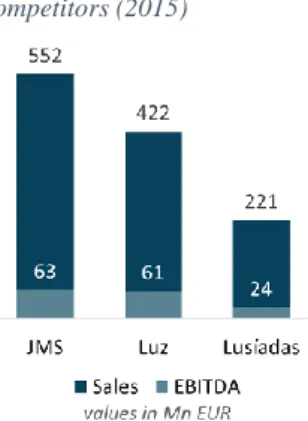
The main threats are a decreasing population and a very strong and growing competition. The Portuguese population is predicted to go from 10,5 million people in 2013 to 8,5 million people in 2060 (INE, 2014). In regards to the strong competition, JMS presented 552 million euros in sales in 2015, while Luz presented 422 million euros in sales. Further information on this topic will be continued in the next section.
Lusíadas’ Competitive Advantage comes from both its relationship with UnitedHealth Group (the parent company) that allows freedom in investment opportunities, and its growing network of accredited hospitals and outpatient centers that function complementarily.
UNDERSTANDING THE SITUATION
Lusíadas Saúde operates in the Portuguese healthcare market, more specifically in the hospital and outpatient center market. This market is divided into public and private sectors, with the first being managed by the Ministry of Health (“Ministério da
Saúde”). The Ministry provides citizens with subsidized healthcare through the National Health Service (“NHS”), which has its own hospitals and outpatient centers. The private sector has three main players, José de Mello Saúde (“JMS”), Luz Saúde (“Luz”) and Lusíadas. Its main clients are insurance companies, health subsystems (such as ADSE and SAMS) and private consumers.
Figure 5 - Lusíadas' Main Competitors (2015)
The private healthcare market has almost reached its maturity phase, with companies growing at a slower pace than before, but still very positive. José de Mello Saúde is the market leader, followed by Luz and Lusíadas (Figure 5).
To better understand the industry, Porter’s 5 Forces were analysed. As can be seen in Figure 6, the main force in the market is Competitive Rivalry.
GLOBAL READINESS
Lusíadas’ financial stability is of high importance when considering to expand abroad. The fact that the company is growing and that it is backed by a large multinational group that also wants to expand internationally makes it ideal to approach foreign expansion opportunities. The market in which the company operates is also open to internationalization as can be seen by the number of recent international acquisitions, such as the 5,76 billion euros acquisition of Spanish group Quíron by German group Fresenius (Burger, 2016) or the 1 billion euros acquisition of German group Median Kliniken by Dutch group Waterland Private Equity Investments (Scheutze and Huebner, 2014). The company’s size and the experience of its employees in the health market are also positive factors that contribute to its global readiness.
COUNTRY SELECTION
MACRO ANALYSIS
As explained in the Methodology section, six groups of variables were analysed in the Macro analysis (Appendix 2):
1\ Market Potential – Germany and France are the biggest countries of the group in terms of
Population (81,2 and 66,4 million people respectively), while Italy, Germany and Greece have the highest percentage of Population with 65 or more years. In terms of population growth, Luxembourg showed the highest values of both Historic and Projected population growth. Malta and Belgium have the highest population density (1 352 and 370 people per square km respectively), while Denmark and Luxembourg have the highest Mean income levels (31 and 39 thousand euros per year per person). The easiest country in the group to do business with, was Denmark, followed closely by Sweden and Finland.
2\ Economics – Luxembourg presented the highest GDP per capita (89 900 euros), with Ireland following in second place (55 100 euros). The GDP growth was dominated by the Baltic countries of Estonia, Lithuania and Latvia. The HICP was led by Austria, followed closely by Belgium and Italy. Malta, Spain and Italy, while out of the three only Malta topped the Employment rate of recent graduates variable (95,1% of recent graduates are employed).
3\ Culture – In terms of cultural proximity Spain, Greece, Croatia and Slovenia are the countries most culturally similar to Portugal.
4\ Infrastructure and Geography – France, Spain and Sweden are the largest countries of the group, with the first two countries also leading the Capital distance variable. In terms of IT security, Hungary reported the smallest percentage of incidents (only 4% of companies have reported security related IT incidents), followed by France and Austria.
5\ Legal - Finland, Ireland, Netherlands and Sweden show the best levels of Regulatory quality. The level of Corporate taxes is the lowest in Luxembourg and Croatia (20,1% and 20,0%
respectively). The number of Procedures required to start a business and the number of Tax payments were also measured, with Lithuania and Slovenia on top in the first sub-variable and Latvia, Malta, Poland and Sweden leading the second one.
6\ Politics - Denmark, Finland, Netherlands and Sweden score the highest in Governmental effectiveness. The second measure was the Control of corruption, in which Denmark, Sweden and Finland again topped the ranking. The last sub-variable was Political stability, in which Luxembourg was perceived as the most stable, followed by Austria.
In the end, the macro level analysis concluded that Luxembourg, Finland, France, Sweden, Germany and Spain were the six most attractive countries in the European Union for a Portuguese company looking for international expansion. After critically analysing these results and presenting them to the company (see Appendix 1), Netherlands replaced Luxembourg, due to the latter’s small size both in population and area, which limits the company’s future growth and overall potential of the venture.
MICRO ANALYSIS
As it was explained in the Methodology, two main areas were analysed in the Micro analysis (Appendix 3): State of the Healthcare Sector and State of the Health.
The first subdivision of the State of the Healthcare Sector was Health Expenditure. Even though Germany is the country that spends the most money in healthcare (437 Bn. USD), Sweden is the one that spends the highest percentage of its GDP (11,9%). Spain is the country that proportionally spends the most privately, with 29,1% of its health expenditure being made privately. Directly following that sub-variable comes the Out-of-pocket health expenditure , with Sweden leading the rank with 88,1% of total private health expenditure being out-of-pocket. In both Risk of catastrophic expenditure for surgical Care and Risk of
population being in risk of catastrophic expenditure and 0,6% being in risk of impoverishing expenditure.
The second part of the State of the Healthcare Sector is the Equipment and Infrastructure. The first sub-variable is concerned with the usage of the infrastructure. The country with the highest number of days of stay in Hospitals was Germany, with an average of 7,6 days, as opposed to Sweden which showed 5,4 days. The last two sub-variables have the objective of measuring how well the country is equipped. Spain is the country with the smaller amount of radiotherapy and linear acceleration units per million people which might indicate an opportunity for new players entering the market. On the other hand, France is the country that has the most radiotherapy units per million people, while Sweden is the country with the most linear acceleration units.
The last part of the State of the Healthcare Sector is the Personnel. Finland and Netherlands only have 2,9 physicians per thousand people, while Spain is the country with the lowest value of nursing and midwifery personnel, with only 6,0 professionals per thousand people. The last sub-variable, Specialist surgical force, again showed Spain with the lowest value, with only 0,4 surgeons per thousand people. Low values in these three sub-variables might indicate a low level of healthcare offer, which could present an opportunity for a company trying to enter the market.
Going for the State of the Health, in Health Perception, three components were analysed. The first was the Population that perceives its health as being good or very good, with Germany showing the lowest values at 65%. The second sub-variable is the percentage of population with
No unmet needs, in which Sweden showed the lowest value. The last sub-variable is the same
as the previous one, except it is specific to higher income population (the 20% richest). France shows the lowest value, with 95,5% of its higher income population reporting no unmet needs.
The second part of the State of the Health is in regards to Unhealthy Habits. Spain shows the highest number of Daily smokers with around 23% of its population of more than 15 years smoking daily. France presents an average annual consumption of 11,5 liters of alcohol per capita, leading the group. The last sub-variable is Obese population in which Finland lead the ranking, with 17,8% of its population being considered obese (BMI>29).
The third and last part of the State of the Health is the Health Level Outcomes. Looking at the data, it can be concluded that Germany has the lowest values of healthy life years, with 56,4 years for men and 56,5 years for women. The third sub-variable is percentage People with
long-term health issues, in which Finland leads the ranking with 45,9% of its population
presenting long-term health issues. The last four sub-variables are related to the number of deaths caused by some of the main diseases or health conditions of the western world, namely Cancer deaths (led by Netherlands); Cardiovascular diseases (led by Finland); Diabetes deaths (led by Germany); and Chronic respiratory diseases (led by Spain).
From the Micro analysis, it was concluded that Spain and Germany present the best scenarios for a Portuguese healthcare company trying to internationalize.
FOUR TYPES OF RISK
In order to conduct an in-depth analysis of the Spanish and the German market, four risks were analysed, as proposed by Cavusgil et al. (2016).
CROSS-CULTURAL RISKS
/ Cultural differences
In terms of cultural differences, Geert-Hofstede (2016) offers a comprehensive method to compare countries. As can be seen on Figure 7, Spain’s cultural values are much more in line with Portugal than Germany. This
cultural differences between the company and a potential branch in Germany due to their different ways of conducting business. The most problematic areas are: Individualism, in which Portugal shows a more collectivist level while Germany values more individualism; Masculinity, in which Germany is more driven by results, competition and success, while Portugal focuses more on caring for others; and the biggest difference between the two countries is Long Term Orientation, in which Portugal shows very low values compared to Germany.
/ Negotiation patterns
According to Lewis (Lewis, 2006), the difference in each country’s negotiation patterns is significant, as would be expected from the cultural differences identified in the previous section. While Germans keep a steady and cool flow and “Follow the Agenda” as can be seen in Figure 8, the Spanish are driven by emotion and relationships.
Conclusion Portugal is more culturally similar with Spain than with Germany. The different
ways of looking at the world and the different negotiation patterns might present difficulties in case the company wants to move to Germany. The similarities with Spanish culture on the other hand, give the company an advantage over other international competitors when trying to expand to that country.
COUNTRY RISK
/ Health system
The German and the Spanish health systems are quite different (MSSSI, 2016). Germany functions under model Bismark (social insurance system), which is financed by companies and
Figure 8 - Germany and Spain's Negotiation Patterns
their employees, and managed through Funds that then hire hospitals to give services to the population. Spain functions under model Beveridge (national health service), which is financed by the State which manages hospitals and provides universal access to healthcare .
/ Foreign Direct Investment (“FDI”) regulations
According to OECD’s FDI Regulatory Restrictiveness Index, both Germany and Spain are extremely open to foreign direct investment, both scoring 0,02 in the index (OECD, 2015).
Conclusion Spain and Germany are politically and economically stable countries, both of them
belong to the European Union and are generally considered good countries to do business with. They both have low FDI regulatory restrictiveness, and even though they function under different health systems, the company shouldn’t suffer any major shortcomings from either situation.
FINANCIAL RISK
/ Inflation
Inflation in Germany has a forecasted value of 0,4% for 2016, growing to 1,5% in 2017 (European Commission, 2016). For Spain, the forecasted value for 2016 is -0,4% but it’s predicted to grow to 1,6% in 2017 (European Commission 2, 2016).
/ Tax rates
In Germany, corporate tax rates are 29,72%, while in Spain they are 25% (KPMG, 2016). According to EY (2016), Spain has a Value Added Tax of 21% against 19% in Germany.
/ Foreign taxation
According to Deloitte (2016), the German government is very welcoming of foreign investment and has a double taxation agreement signed with Portugal, this means that no additional tax burden is set on the foreign company. Likewise, Spanish-Portuguese trade follows a system similar to German-Portuguese trade, according to Deloitte (2, 2016).
Conclusion Financial risk can be considered low in both countries because they are both open
to FDI (especially intra-EU) and have similar tax levels. A Portuguese company moving to each of these countries shouldn’t expect to find many barriers in this area.
COMMERCIAL RISK
/ Labor issues
As seen in the micro analysis, Spain has 5,1 physicians per thousand people while Germany has 3,7. Nursing and midwifery personnel number 6,0 per thousand people in Spain, against 11,4 in Germany. Specialist surgical force sees Germany at an advantage, with 1,13 per thousand people against 0,42 in Spain.
Regarding unions, in Germany 19% of workers are members of a trade union as of 2010 (Dribbusch & Birke, 2012). The last time doctors went on strike it was in 2012, with between 60.000 and 80.000 participants going to the streets asking for pay raises (Der Western, 2012). In Spain, only 16,4% of workers are members of a trade union as of 2010 (Kölher & Jiménez, 2013). The last strike in the healthcare sector happened in the summer of 2016, with doctors in Madrid asking for more working hours and higher salaries (Fernández, 2016).
/ Competitors
In terms of competition, Germany presents a more concerning environment than Spain. Its top 5 healthcare companies are Fresenius Helios (part of
Fresenius SE & Co.), MediClin, Asklepios Kliniken, Sana Kliniken and Rhön-Klinikum. As can be seen in Figure 9, the largest company is Fresenius, with sales of 5,7 billion euros in 2015. The next 4 main companies’ sales range from 5,6 to 1,1 billion euros, which show the strong competitive environment of the country.
Figure 9 - Top 5 Companies: Germany
Source(s): Fresenius, Mediclin, Asklepios, Sana Kliniken and Rhon Klinikum Annual Repports
Spain offers a more relaxed environment (Figure 10). With the top company Quirónsalud earning 1,6 billion euros in revenues in 2014. The other top five companies present more subtle results ranging from 285 to 197 million euros. It is important to point out that the main player in Germany (Fresenius) recently
acquired the main player in Spain (Quíronsalud), in a 5,76 billion euros deal (Armstrong, 2016). Both the German and the Spanish markets are now dominated by Fresenius, but while the German market still has very strong competitors, the Spanish market has one major player and a number of smaller companies. Competition is fiercer in Germany, even though the presence of a big player controlling the Spanish market shows a certain tendency to a monopolistic market.
Conclusion Both Spain and Germany present stable labor conditions, with available personnel
and unions that are not overly-active. The competition is the most worrying, with both countries showing different scenarios. In Germany, healthcare companies are extremely big and competition is heavy. In Spain, there is a single large healthcare provider (owned by a German company) and a number of smaller players, which shows a more concentrated market. Both scenarios present their difficulties, but the Spanish market has less competitive drive and therefore Germany’s commercial risk is higher than in Spain.
CONCLUSION
Lusíadas Saúde’s decision to go international will to be a huge step for the company. The analysis conducted throughout this work project evaluated various aspects of the decision, which started with the company’s desire to expand within the EU. The starting point was the Macro analysis, in which six macro variables were analysed, with special emphasis on the
Figure 10 - Top 5 Companies: Spain
Finland, Germany, Spain and the Netherlands showed the best scores, and subsequently were considered for the Micro analysis. In this second level, the State of the Healthcare and the State of the Health were evaluated in each of the six selected countries, with Spain and Germany scoring fairly low in each of those two variables, showing that there are opportunities for new healthcare companies to come and fill the gaps.
The 4 risks analysis (cross-cultural, country, financial and commercial risks) was conducted for Germany and Spain, and thus it was concluded that Spain is the most attractive country for Lusíadas’ international expansion. While Country and Financial risks are quite similar in both countries, the Commercial and Cross-cultural risk show a different scenario. As we’ve seen before, Cross-cultural risk is very high in Germany, because of the enormous differences between its culture and the Portuguese culture, a problem that doesn’t happen with Spain. But it’s the commercial risk that presents the main challenge. As seen previously, Germany has a highly competitive market, while Spain presents a more concentrated environment, with one company dominating the market. Under this context it would more attractive for Lusíadas to enter the Spanish market as the lack of competition would be favorable to the company and the cultural similarities could give an advantage over its competitors (mainly Fresenius, the owner of the largest Spanish health group, Quíronsalud).
Even though the Macro analysis showed that Germany is slightly more attractive than Spain, the Micro analysis is in line with the four risks analysis. Spain presents the highest percentage of Private health expenditure of the group (and the highest out of pocket health expenditure percentage) allied with the most costly healthcare and the lowest offer of radiotherapy and linear acceleration units. The country is also lacking in numbers of medical personnel and consistently scores high in unhealthy behavior.
A high market potential allied with a beneficial competitive environment make Spain the most attractive country for Lusíadas’ internationalization.
NEXT STEPS
A logical next step would be to choose the mode of entry. Either through M&A, Strategic Alliances or other modes, there are major gains that can be brought by choosing the right method. Also, in order to provide a better recommendation, the other four countries of the micro analysis could be evaluated in regards to the four risks to see if a better opportunity was present, because they all show positive levels of market attractiveness. It is also recommended that the company presents this report to its parent companies (Amil and UHG) because their level of financial muscle allows more expansion possibilities.
SOURCES
_Amil. 2016. Institutional website. Web. Sept. 2016.
https://www.amil.com.br/portal/web/institucional/market/sobre
_Andersen, O., and A. Buvik. 2001. “Firms’ internationalization and alternative approaches to the international
customer/market selection”. International Business Review 11, 347-363.
_Armstrong, D.. 2016. “Fresenius to Buy Quironsalud Hospitals for $6.42 Billion” Bloomberg. September 5.
Web. Oct. 2016. http://www.bloomberg.com/news/articles/2016-09-05/fresnius-to-buy-hospital-group-idc-salud-for-6-42-billion
_Brewer, P.. 2000. “International market selection: developing a model from Australian case studies”.
International Business Review 10, 155-174.
_Brouthers, L. E., S. Mukhopadhyay, T. J. WIlkinson, K. D. Brouthers. 2009. “International market
selection and subsidiary performance: a neural network approach”. Journal of World Business 44:3, 262-273.
_Bundesaerztekammer. 2016. The healthcare system in Germany. Web. Oct. 2016.
http://www.bundesaerztekammer.de/weitere-sprachen/english/healthcare-system/
_Burger, L.. 2016. “Fresenius buys Spanish hospital chain for 5.76 billion euro” Reuters. September 5. Web.
Oct. 2016. http://uk.reuters.com/article/uk-quironsalud-m-a-fresenius-idUKKCN11B2BK
_Cavusgil, S. T.. 1985. “Guidelines for export market research”. Business Horizons, 27-33.
_Cavusgil, S. T., G. Knight, J. R. Riesenberger, H. G. Rammal, E. L. Rose. 2014. “Foundation Concepts” In
International Business, 12-14. Pearson Australia.
_Cavusgil, S. T., T. Kiyak, S. Yeniyurt. 2003. “Complementary approaches to preliminary foreign market
opportunity assessment: Country clustering and country ranking”. Industrial Marketing Management 33, 607-617.
_Deloitte. 2016. International Tax: Spain Highlights 2016. Deloitte Spain.
_Deloitte. 2016. Taxation and Investment in Germany 2016: Reach, relevance and reliability. Deloitte Touche
Tohmatsu Limited.
_Der Western. 2012. “Streik der niedergelassenen Ärzte soll noch im September starten” Der Western.
September 13. Web. Nov. 2016. http://www.derwesten.de/gesundheit/streik-der-niedergelassenen-aerzte-soll-noch-im-september-starten-id7091811.html
_Dribbusch, H., and P. Birke. 2012. “Trade Unions in Germany: Organisation, Environment, Challenges”.
Friedrich Ebert Stiftung.
_European Commission. 2016. Economies of the member states: Germany. Web. Nov. 2016.
_European Commission. 2016. Economies of the member states: Spain. Web. Nov. 2016.
http://ec.europa.eu/economy_finance/eu/countries/germany_en.htm
_EY. 2016. 2016 Worldwide VAT, GST and Sales Tax Guide. Web. Nov. 2016.
http://www.ey.com/gl/en/services/tax/worldwide-vat--gst-and-sales-tax-guide---rates
_Fernández, D.. 2016. “Los 16.700 médicos madrileños empiezan hoy paros... para trabajar 2,5 horas más” El
Confidencial. June 8. Web. Sept. 2016.
http://www.elconfidencial.com/espana/madrid/2016-06-08/medicos-madrid-paros-trabajar-horas_1213456/
_Fresenius. 2016. Group Overview. Web. Sept. 2016. https://www.fresenius.com/Group-Overview
_Gaston-Breton, C., O. Martín Martín. 2011. “International market selection and segmentation: a two stage
model”. International Marketing Review 28:3, 267-290.
_INE. 2014. “Projeções de população residente 2012-2060”. Destaque. March 28.
_Kale, S. H., D. Sudharshan. 1987. “A strategic approach to international segmentation”. International
Marketing Review 4, 60-70.
_Kölher, H.-D., and J. P. C. Jiménez. 2013. “Trade Unions in Spain: Organisation, Environment and
Challenges”. Friedrich Ebert Stiftung.
_KPMG. 2016. Corporate tax rates table. Web. Nov. 2016.
https://home.kpmg.com/xx/en/home/services/tax/tax-tools-and-resources/tax-rates-online/corporate-tax-rates-table.html
_Lewis, R. D. 1996. 2006 (revised). “Communication patterns during meetings” In When Cultures Collide,
67-79. Nicolas Brealy Publishing.
_MSSSI. 2016. “Los sistemas sanitarios en los países de la UE”. Ministerio de Sanidad, Servicios Sociales e
Igualdad.
_OECD. 2016. FDI Regulatory Restrictiveness Index. Web. Nov. 2016.
http://www.oecd.org/investment/fdiindex.htm
_Papadopoulos, N., H. Chen, D. R. Thomas. 2001. “Toward a tradeoff model for international market
selection”. International Business Review 11, 165-192.
_Papadopoulos, N., and J.-E. Dennis. 1988. “Inventory, taxonomy and assessment of methods for international
market selection”. International Marketing Review 5:3, 38-51.
_Papadopoulos, N., and O. Martín Martín. 2011. “International market selection and segmentation:
perspectives and challenges”. International Marketing Review 28(2): 132-149.
_Piper Jr, J.R.. 1971. “How U.S. firms evaluate foreign investment opportunities”. MSU Business Topics,
11-20.
_Robertson, K. R., V. R. Wood. 2001. “The relative importance of types of information in the foreign market
selection process”. International Business Review 10, 363-379.
_Sakarya, S. , M. Eckman, K. H. Hyllegard. 2006. “Market selection for international expansion”.
International Marketing Review 24:2, 208-238.
_Schuetze, A., and A. Huebner. 2014. “Private equity firm Waterland buys Germany's Median Kliniken”
Reuters. October 16. Web. Aug. 2016.
http://www.reuters.com/article/median-waterland-idUSL6N0SB3HS20141016
_Smith, R.. 2010. "Number of Elderly People in Hospital Surges." The Telegraph. October 28. Web. June 2016.
http://www.telegraph.co.uk/news/health/news/8092501/Number-of-elderly-people-in-hospital-surges.html
_UnitedHealth Group. 2015. Form 10-K 2015. Retrieved from SEC EDGAR website
http://www.sec.gov/edgar.shtml
_World Health Organization. 2016. “The Global Burden of Chronic Diseases”. Web. Sept. 2016.