Challenging preservice teachers to produce varied
mathematical problem solving strategies
Ana Maria Boavida, Catarina Delgado, Fátima Mendes, Joana Brocardo
School of Education of the Polytechnic Institute of Setúbal Setúbal, Portugal
Abstract
This paper presents preliminary results of a research project that aims to investigate preservice teachers’ capacity to produce and analyse solution strategies to solve mathematical problems. From a methodological point of view, the study is of a qualitative nature and is being developed with future kindergarten and primary teachers who are enrolled in mathematical courses of a bachelor degree in elementary education at a public teacher education institute in central Portugal. The results suggest that although there has been an incipient progress concerning the production, by the future teachers, of more than one strategy to solve the same problems, reaching this goal is not an easy endeavour. It requires a deep and flexible knowledge about the mathematical content in order to be able to analyse problems from several points of view.
Key words: Problem solving, geometrical tasks, preservice elementary teacher
education. Introduction
In Portugal, preservice elementary teacher education is organized into two cycles of studies. The first one is a bachelor’s degree in elementary education that lasts for three years. The second one is a master’s degree that provides students with the professional qualifications to be pre-school educators (3-5 years old children) and/or elementary school teachers (6 -12 years old children). Under current legislation, the courses that integrate the first cycle plan of studies are organized around four training components and the most of them are focused on subject content areas of the Portuguese k-6 curriculum. One of these areas is Mathematics.
This paper stems from an ongoing research focused on preservice Mathematics Teachers Education and, particularly, on problem solving that is being developed at a public institution in central Portugal. Globally, with this research we intend to understand if the preservice teachers are able to solve problems using various strategies and to interpret strategies used by others as well to identify important issues that can contribute to foster their content knowledge and their pedagogical content knowledge concerning mathematics.
In the above-mentioned institution one of the courses of the bachelor’s degree in elementary education concerning the area of Mathematics is Geometry and Measurement (GM). In this paper we will present some preliminary results of a study, carried out with the participants of this course, that aimed to investigate preservice teachers’ capacity to produce and analyse strategies to solve mathematical problems, that is, tasks for which the solution method is not known in advance.
Theoretical framework
Preparing preservice teachers to teach having on the horizon the idea of learning mathematics with understanding is of unquestionable importance. This idea requires to place in the foreground the development of what Kilpatrick, Swafford and Findell (2001) designate by "mathematical proficiency", a term used to capture what they consider “it means for anyone to learn mathematics successfully” (p. 5). According to these authors, mathematical proficiency is an integrated attainment of five deeply connected strands: conceptual understanding, procedural fluency, strategic competence, adaptive reasoning and productive disposition. In particular, strategic competence includes “the ability to formulate, represent and solve mathematical problems” (idem, p. 116).
Teaching that foster the development of mathematical proficiency, that is, effective teaching, can take a variety of forms but, in any case, it is not an easy endeavour. The quality of instruction is the product of several interactions among the teachers’ knowledge (about mathematical content, students and pedagogy), a challenging and supportive classroom learning environment and students´ engagement in worthwhile problems, that is, problems that are intriguing, with a level of challenge that invites exploration and speculation and that serve as a means for learning important mathematical ideas and procedures (Cai, 2003; Kilpatrick, Swafford, & Findell, 2001; NCTM, 2000). As Kilpatrick, and colleagues point out “teaching is a complex activity and (…) just as mathematical proficiency itself involves interwoven strands, teaching for mathematical proficiency requires similar interrelated components” (2001, p. 380):
Conceptual understanding of the core knowledge required in the practice of teaching; fluency in carrying out basic instructional routines; strategic competence in planning effective instruction and solving problems that arise during instruction; adaptive reasoning in justifying and explaining one’s instructional practices and in reflecting on those practices so as to improve them; and a productive disposition towards mathematics, teaching, learning, and the improvement of practice. (idem, p. 380, emphasis on the original)
Concerning problem solving and teachers’ role, these components are deeply connected to the aspects that Lester (2013) emphasizes when he discusses what it means to be a proficient mathematics teacher. Among these aspects is the importance of making sense of students’ solutions, of keeping tasks appropriately problematic for them and of “paying attention to and being familiar with the methods students use to solve problems” (p. 262).
In this context, it is essential that the preservice teachers develop “the ability to see the mathematics possibilities in a task” (Kilpatrick, Swafford, & Findell, 2001, p. 370) as well as the capacity to implement tasks that promote reasoning and problem solving. In fact, recent recommendations for mathematics teaching claim that effective teaching of mathematics should engage students in “solving and discussing tasks that promote mathematical reasoning and problem solving and that allow multiple entry points and varied solution strategies” (NCTM, 2014, p.10).
they use to solve a problem (Kilpatrick, Swafford & Findell, 2001); and to take the appropriate action or to say the right thing at the right time, in order to support and foster mathematics learning. In truth some students' solutions are very difficult to understand, even by experienced teachers, either because they are not expecting them or because they do not look at them through the students’ eyes (Kraemer, 2008).
Methodology
Considering the goals of the study and that we intend to deepen our knowledge about a little-known phenomenon, we adopted an exploratory design framed by a qualitative methodology (Patton, 2012). The participants were 39 preservice kindergarten and primary teachers, organized within two classes, who were enrolled in the GM course (lasted one semester).
The main intended learning outcomes of the GM course are: to understand and mobilize concepts and procedures relating to the topics GM; to solve problems using visualization and spatial reasoning, geometric models and knowledge of shapes, their characteristics and properties; and to use properly concepts and procedures to determine measurements, by mobilizing knowledge about units, systems and processes of measurement and algebraic formulas. The lessons are guided by a problem solving pedagogy. This process includes: problem solving, produce and present reports; elaboration, in small groups, of short written tasks and its discussion. The work was focused on active students’ participation, either individually or in group, aiming to in depth their geometrical knowledge.
The study had three mains phases. At the beginning of the GM course, the preservice teachers were are asked to solve a diagnosis test, composed by six problems, using, if possible, more than one strategy to solve each problem. To solve the problems, they had to mobilize only geometrical contents of the mathematics curriculum of primary, upper primary and middle school. Their productions were collected and later analysed.
Throughout the GM course we selected problems that can be solved in several ways and the preservice teachers were challenged to solve them. The teacher encouraged them to use different strategies and promoted and supported a collective discussion of these strategies. Therefore, in this research, these moments of work that focused on the solutions of tasks, aimed to contribute to improve the capacity of preservice teachers to analyse, in the future, students’ problem solving strategies. To organize the collective discussions, was used the theoretical model of five practices, suggested by Stein, Engle, Smith and Hughes (2008), that helps the teacher to use student responses to the tasks more effectively in discussions: anticipating, monitoring, selecting, sequencing, and making connections between student responses.
At the end of the GM course, the preservice teachers were asked to solve another test with five problems. This test aimed to investigate preservice teachers’ capacity to produce and analyse solution strategies to solve geometrical problems. Due to time constraints related to pre-service teachers’ schedule, we decide to ask them to solve only some of the problems using more than one strategy.
The data include preservice teachers’ solutions of the proposed problems, field notes focused on the development of the GM course and transcriptions of excerpts of video-recorded collective discussions. In this paper we decide to present only the analysis of the data which correspond to the preservice teachers’ solutions of the problems.
These data were organized in three groups – one corresponding to the problems’ solutions of the diagnosis test, another corresponding to the problems’ solutions proposed during the GM course lessons and the last group with the problems’ solutions of the final test. These solutions were analysed considering the number of strategies that were presented by the preservice teachers in each problem and were classified according to the following items: two strategies, only one strategy, and not solved. After this, the preservice teachers’ productions were analysed to classify the strategies that were used and to identify those, which were correct and incorrect. In this study, there are considered different solutions’ strategies those that present different representations and/or mobilize different concepts related to geometry and measurement.
Results
In this section we present some results of the study, organized into four sections. The first three correspond to its phases described in the previous section; the fourth section includes a comparison between preservice teachers’ solutions of two problems: one proposed at the beginning and the other at the ending of the GM course.
Beginning of the GM course
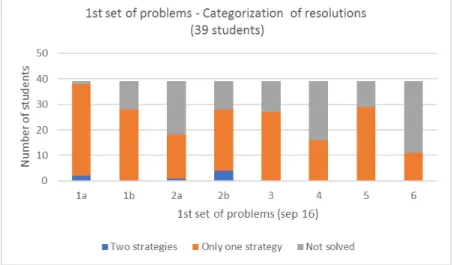
Figure 1 allows observing the number of preservice teachers who solved and did not solve the six problems included in the test proposed in the first lesson of the GM course. The analysis of the graph allows us to highlight two ideas. First, we can notice that many preservice teachers did not solve the problems. Second, we can conclude that the use of more than one strategy is almost residual.
Figure 1. First set of problems: Categorization of preservice teachers’ solutions
Let's analyse, in more detail, one of the problems included in the test (Figure 2) and some preservice teachers´ solutions.
Figure 2. The fifth problem of the test solved at the beginning of the GM course
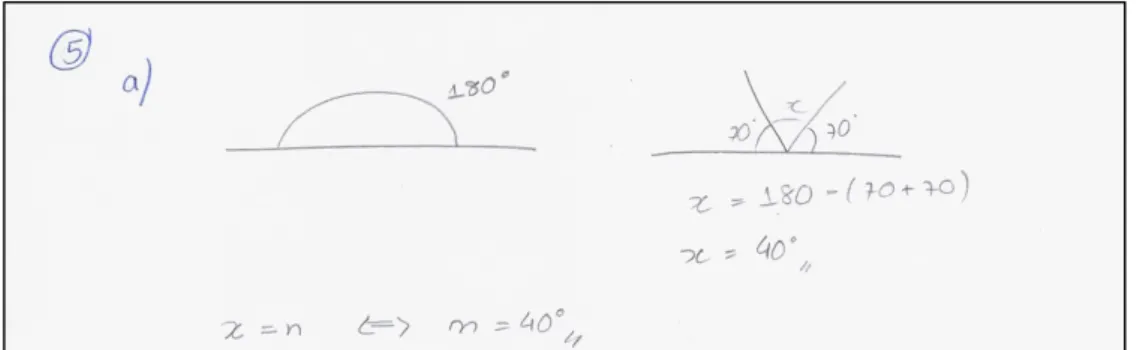
The problem “What is the magnitude of the angle n?” was solved by 29 of the preservice teachers. None of them used more than one strategy. Among these, 25 solved it correctly using one strategy similar, from a mathematical point of view, to the one presented by Catarina (Figure 3): an arithmetic strategy based on her knowledge about the magnitude of a full angle and arithmetical procedures.
Figure 3. Catarina’s solution: an example of a correct strategy
The other four preservice teachers solved it incorrectly. They assumed that if they added the magnitude of two angles of 70º with the magnitude of the angle n they would get a straight angle, which is not true. Figure 4 shows the resolution of a student (Sara) who used this incorrect strategy.
Figure 4. Sara’s solution: an example of an incorrect strategy
During the GM course
As mentioned before, throughout the GM course, the preservice teachers were asked to solve several geometric problems using more than one strategy. One of these problems was entitled “Squares and squares” (Figure 5).
magnitude of the shaded angle
Figure 5. During the GM Course: An example of a problem
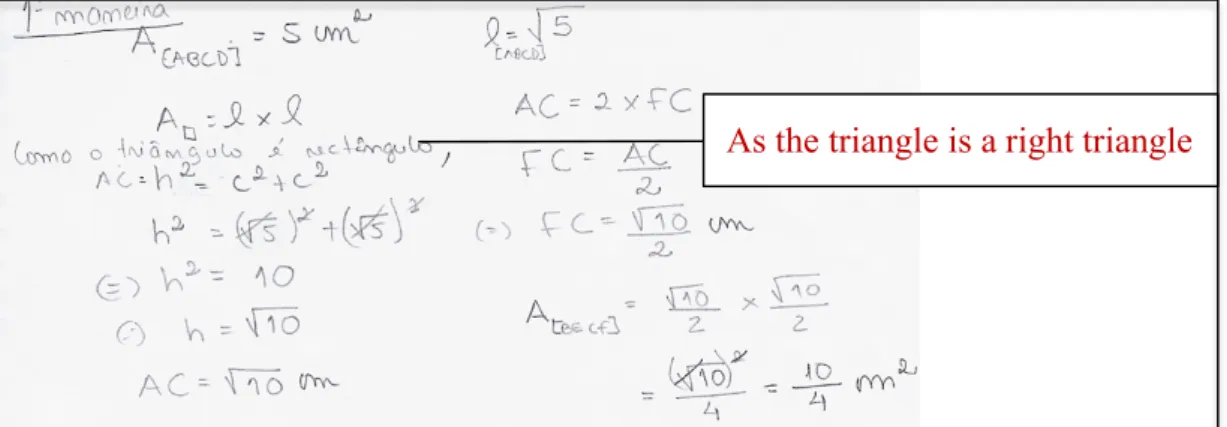
To solve the “Squares and squares” problem, the students used several strategies. Some of them are algebraic. Ana’s solution (Figure 6) is an example of this kind of strategy. The student’s reasoning is based on the formula to calculate the area of a square and on the Pythagoras’s theorem.
Figure 6. Ana’s solution: An example of an algebraic strategy to solve the problem “Squares
and squares”
Other solution strategies are mainly geometric. For instance, in Anita’s solution (Figure 7) the spatial sense plays an important role. She concludes that the area of the [FCEB] square (the blue one) is half of the area of the [ABCD] square (the green one) through the analysis of the figure and its properties.
Figure 7. Anita’s solution: An example of a geometric strategy to solve the problem “Squares
and squares”
As the triangle is a right triangle
Observing the square [BECF], we can see that is half of the square [ABCD], because
Another example of the problems proposed during the GM is entitled “Boxes of cookies” (Figure 8).
Figure 8. During the GM course: An example of another problem (adapted from Veloso &
Viana, 1994)
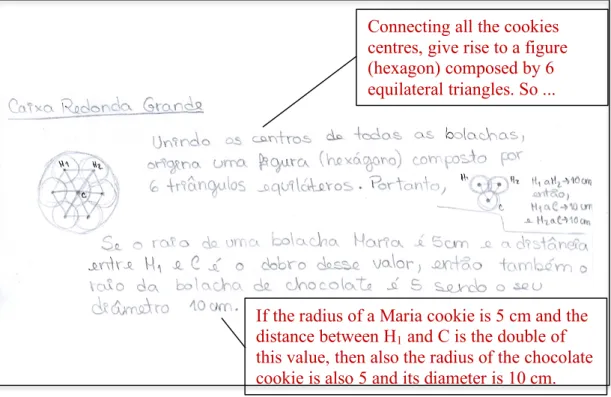
To solve the “Boxes of cookies” problem, the preservice teachers used several strategies. In figure 9 we can observe part of the solution used by Inês concerning the box with six Maria cookies (third box). Inês discovers that if she joins the centres of the six Maria cookies, she would get a regular hexagon that can be decomposed into six equilateral triangles. After, she concludes that the length of the triangle sides is 10 cm. From there, she calculates the radius and the diameter of the chocolate cookie.
Figure 9. Inês’ solution: An example of a strategy to solve the problem “Boxes and cookies”
Connecting all the cookies centres, give rise to a figure (hexagon) composed by 6 equilateral triangles. So ...
If the radius of a Maria cookie is 5 cm and the distance between H1 and C is the double of
this value, then also the radius of the chocolate cookie is also 5 and its diameter is 10 cm.
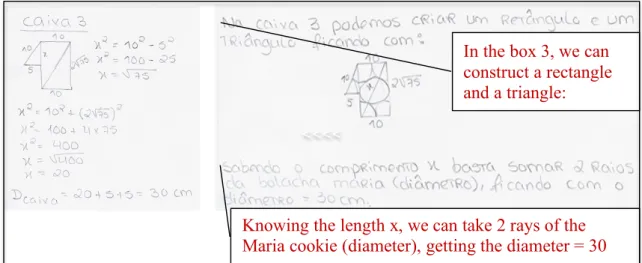
Sofia, another preservice teacher, thought differently. Through the analysis of the third box she identifies a right triangle and a rectangle. First, she uses the known measures of the sides of the right triangle to discover the length of one side of the rectangle. She concludes that this side is the double of the square root of 75 centimetres. Then she determines the length of the diagonal of this rectangle using Pythagoras's theorem and concludes that it is 20 cm. From there, she adds 20 centimetres to the length of the radius of two Maria’s cookies to obtain the diameter of the box.
Figure 10. Sofia’s solution: An example of a strategy to solve the problem “Boxes and cookies”
To better understand the strategy of Sofia, let us analyse the representation of the third box of cookies showed in figure 11. Sofia starts to identify a right triangle and a rectangle. After, she uses the known measures of the sides of the triangle to discover the length of one side of the rectangle ( 2 75cm). Then, she calculates the length of the diagonal of this rectangle (20 cm) and, finally, she determines the diameter of the box (20 cm +5 cm+ 5 cm).
Figure 11. A representation of the third box of cookies
Ending of the GM course
One of the five problems included in the test that the preservice teachers were asked to solve at the end of the GM course is presented in figure 12.
In the box 3, we can construct a rectangle and a triangle:
Knowing the length x, we can take 2 rays of the Maria cookie (diameter), getting the diameter = 30 cm. <<<<
•
•
•
•
•
10 5 20 2 75 75Figure 12. Ending of a GM course: An example of a problem
We present below the resolutions of Catarina and Filipa, two of the best students in relation to the GM course.
Catarina solved this problem using two different strategies. The figure 13 shows the first one.
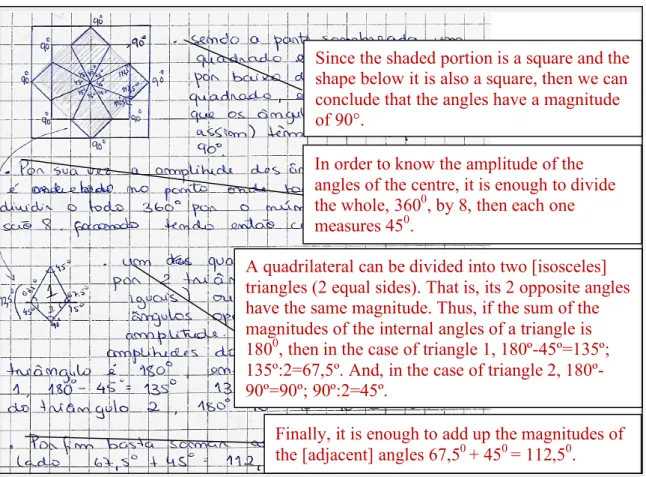
Figure 13. The first Catarina’s strategy to solve the problem “Thinking about angles” Since the shaded portion is a square and the shape below it is also a square, then we can conclude that the angles have a magnitude of 90°.
A quadrilateral can be divided into two [isosceles] triangles (2 equal sides). That is, its 2 opposite angles have the same magnitude. Thus, if the sum of the magnitudes of the internal angles of a triangle is 1800, then in the case of triangle 1, 180º-45º=135º; 135º:2=67,5º. And, in the case of triangle 2, 180º-90º=90º; 90º:2=45º.
In order to know the amplitude of the angles of the centre, it is enough to divide the whole, 3600, by 8, then each one measures 450.
Finally, it is enough to add up the magnitudes of the [adjacent] angles 67,50 + 450 = 112,50.
Catarina identifies the magnitude of the right angle in each quadrilateral. Then she identifies that the opposite angle is 1/8 of 360 degrees. After that, she divides the quadrilateral into two isosceles triangles. Subsequently, she calculates the two equal angles in each triangle. She concludes that the intended magnitude is the sum of the magnitudes that were calculated (67,5º + 45º = 112,5º).
The figure 14 shows the second strategy used by Catarina.
Figure 14. The second Catarina’s strategy to solve the problem “Thinking about angles”
In this strategy, Catarina also starts by identifying the magnitude of the right angle in each quadrilateral as well the magnitude of the opposite angle. After this, her reasoning goes in another direction. She divides the quadrilateral into two equal triangles. So, she identifies the magnitude of two of the angles of the triangle and after she calculates the magnitude of the third angle by subtraction. She calculates the intended magnitude subtracting the obtained number from 180º (the sum of the magnitudes of the internal angles in a triangle) (180º- 67,5º=112,5º).
Filipa also used two different strategies to solve the same problem. The figure 15 shows the first one.
Figure 15. The first Filipa’s strategy to solve the problem “Thinking about angles”
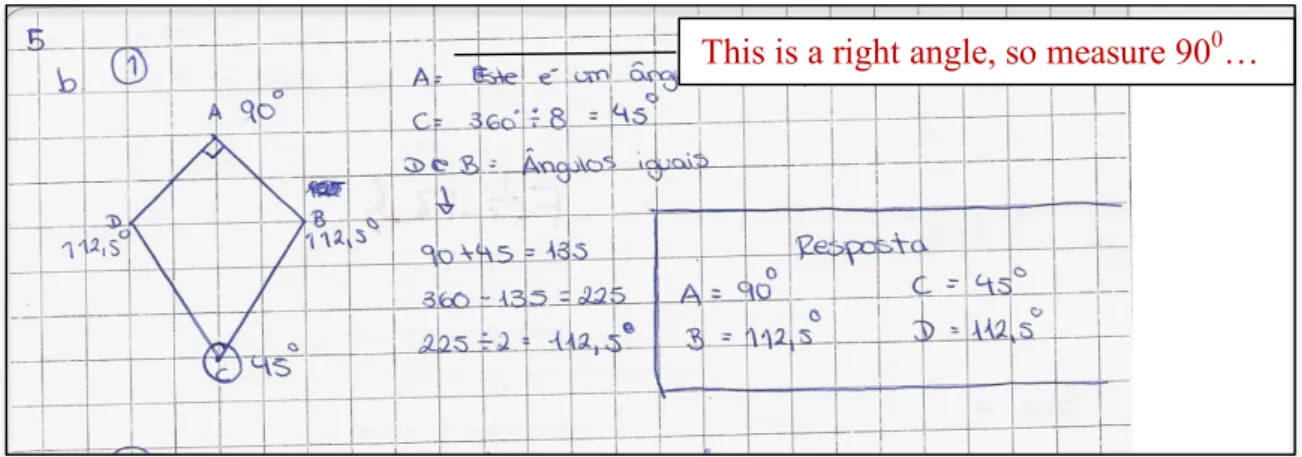
Filipa begins to solve the problem in the same way as her colleague. After that, she thinks differently. She identifies the magnitude of the right angle in each quadrilateral.
If the outside angles measure 900, as they belong to
a square and, in turn, the magnitude of two inside angles is also 900,each one measure 450. So, we imagine two equal triangles [1 e 2] like is in the figure. In a triangle, the sum of the magnitudes of the internal angles is 1800. So, ...
that the magnitude of the other two angles of the quadrilateral is equal to 225º. As she knows that these angles are equal, she concludes that the magnitude of each one is 112,5º.
The figure 16 shows the second strategy used by Filipa.
Figure 16. The second Filipa’s strategy to solve the problem “Thinking about angles”
Filipa, after identifying the right angle of the quadrilateral, decomposes this figure into four right triangles using diagonals. Then she represents the magnitude of all the right angles and after she calculates the magnitude of the remaining angles in each triangle. Finally, she concludes identifying the magnitudes of the four angles of the quadrilateral. Beginning and ending of the GM course: comparing two problems
To solve the problems "What is the magnitude of the angle n?" and "Thinking about angles..." it is necessary to reason about angles and geometric figures and their relations. As we said before, the first problem was proposed at the beginning of the GM course and the second at the end of this course.
Figure 17 allows comparing the percentage of preservice teachers who solved each one of these problems and, in this case, if they used one or two strategies. We can observe that 26% of preservice teachers did not solve the first problem and 74% used only one strategy (some of which were incorrect). In the second problem, 40% of preservice teachers were able to produce two different strategies to solve the problem and 49% of them used only one strategy. We also can notice that the percent of preservice teachers that did not solve this problem is substantially lower (11%).
When we compare the preservice teachers’ solutions of these two problems, we can infer some progress, even if it is incipient, concerning the production of more than one strategy – from 0% at the beginning, to 40% at the end. However, there is still a significant percentage of preservice teachers who are not able to produce more than one strategy to the problems (about 50%).
Besides, a preliminary analysis of all the productions of these pre-service teachers, shows that those who are successful, have a deep understanding of mathematical content regarding geometry and measurement and were able to look at the problems from several points taking advantage of connecting mathematical ideas, representations and types of reasoning.
Concluding remarks
With this project we intend to analyze the capacity of preservice elementary teachers to produce varied solution strategies to solve mathematical problems and, simultaneously, to understand how we can promote and support the development of this capacity during preservice education.
This study showed that the 39 preservice teachers initially revealed a great deal of difficulty in solving geometry problems and even more in to use more than one strategy to solve the same problem. It also showed that a GM course that included several experiences in solving problems and analyzing different strategies that can be used to solve each problem helped the participants to improve their problem solving performance and increased their ability to use different strategies to solve a problem. However, those findings suggest that the proposed problems, framed in an inquiry, collaborative learning context, were not enough to help all preservice teachers to improve their problem solving ability and to create more than one solution for one problem.
These conclusions lead us to change the used approach to problem solving, based on the experience and global discussion in class of solving problems using visualization and spatial reasoning. The new approach includes: (1) more attention to explicit analysis of problem solving heuristics that can be used to solve a specific problem, (2) rewriting the problem as a list of variables together with their original values in order to make an in-depth analysis of the structure of the problem and to focus more explicitly on structural relationships (Swan, 2014) and (3) selecting questions that can help to understand written problem solutions.
To finish, we emphasize that to foster and support preservice mathematics teachers’ capacity to produce varied problem solving strategies is a very demanding task to teachers’ educators. However, if we want to prepare them to teach for mathematical proficiency, it is also a task that we cannot avoid.
References
Cai, J. (2003). What research tells us about teaching mathematics through problem solving. In F. Lester Jr. (Ed.). Teaching mathematics through problem solving:
prekindergarten-grade 6 (241-254). Reston: NCTM.
Kilpatrick, J., Swafford, J., & Findell, B. (Eds). (2001). Adding It Up: Helping Children
Learning Mathematics. Washington: National Academy Press.
Kraemer, J-M. (2008). Desenvolvendo o sentido do número: cinco princípios para planificar. In J. Brocardo, L. Serrazina, & I. Rocha (Edits.), O sentido do número:
reflexões que entrecruzam teoria e prática (pp. 3-28). Lisboa: Escolar Editora.
Lester, F. K. Jr. (2013) Thoughts about research on mathematical problem-solving instruction, The Mathematics Enthusiast, 10 (1), 244-278.
NCTM (2000). Principles and Standards for School Mathematics. Reston, VA.: NCTM.
NCTM (2014). Principles to action: Ensuring mathematical success for all. Reston, VA.: NCTM.
Patton, M. Q. (2012). Qualitative Research & Evaluation Methods (3rd ed.). Thousands Oak: SAGE Publications.
Stein, M., Engle, R., Smith, M., & Hughes, E. (2008). Orchestrating productive mathematical discussions: Five practices for helping teachers move beyond show and tell. Mathematical Thinking and Learning 10 (4), 313-340.
Swan, M. (2014). Designing tasks and lessons that develop conceptual understanding, strategic competence, and critical awareness. In J. Brocardo, A. M. Boavida, C. Delgado, E. Santos, F. Mendes, J. Duarte, M. Baía & M. Figueiredo. (Eds)
Tarefas Matemáticas (pp.7-25). Lisboa: Sociedade Portuguesa de Investigação em
Educação Matemática.