Procedia - Social and Behavioral Sciences 217 ( 2016 ) 459 – 468
ScienceDirect
1877-0428 © 2016 Published by Elsevier Ltd. This is an open access article under the CC BY-NC-ND license (http://creativecommons.org/licenses/by-nc-nd/4.0/).
Peer-review under responsibility of Future Academy® Cognitive Trading doi: 10.1016/j.sbspro.2016.02.014
Future Academy®’s Multidisciplinary Conference
Organization of housework in heterosexual couples: systematic
review of the literature
Madalena Cunha
a*, Suzana André
a, Graça Aparício
a, Eduardo Santos
b, Celso Nunes
c& Students do 23ºCLE
aa
Instituto Politécnico de Viseu,CI&DETS, ESSV, Rua Don João Crisóstomo Gomes de Almeida, nº 102, Viseu 3500-843, Portugal
b
Centro Hospitalar de Coimbra, Portugal
c
Centro Hospitalar Tondela-Viseu,EPE, Av. Rei Don Duarte, s/n, Viseu 3509-504, Portugal
a
Estudantes do Curso de Licenciatura em Enfermagem, Instituto Politécnico de Viseu,CI&DETS, ESSV, Rua Don João Crisóstomo Gomes de Almeida, nº 102, Viseu 3500-843, Portugal
Abstract
Problem Statement: We currently live in a society where men are increasingly involved in domestic activities yet women continue to be primarily responsible for their execution.
Research Questions: Does the organisation of housework in heterosexual couples varies in frequency and time based on sex? Does the time spent performing household activities differ by gender? Which household chores are performed more often by women and by men? Which variables influence the division of domestic labour between women and men?
Purpose of the Study: The aim of this paper is to assess the fairness of the division of housework between men and women, how often men perform it as well as how much time they spend on it in accordance with sociodemographic variables.
Research Methods: The study was conducted based on the principles proposed by the Cochrane Handbook. A systematic review of the literature from September to November 2013 was carried out. A critical analysis was performed separately by two researchers.
Findings: The variable which most influences division of housework is income, and the one which most influences time spent on doing it is gender.
Conclusion: The division of housework between men and women is not equal, with women being overloaded. Sex should therefore be considered in planning children’s educational activities.
© 2016 The Authors. Published by Elsevier Ltd.
Peer-review under responsibility of Future Academy® Cognitive Trading.
* Corresponding author. Tel.: +351-232-419100; fax: +351-232-428343 E-mail address: [email protected]
© 2016 Published by Elsevier Ltd. This is an open access article under the CC BY-NC-ND license (http://creativecommons.org/licenses/by-nc-nd/4.0/).
Keywords: Housework, gender, heterosexual couples.
1. Introduction
Housework is an expressionless term often associated with “work done in the house” involving all unpaid activities related to the production and reproduction of the home (Grint, 2002). In today’s society men are increasingly involved in domestic activities, yet women continue to be primarily responsible for carrying out these tasks. Supporting this assumption, Monteiro (2005, cit. by Domingos, 2012, p. 12) states that ‘women when comparing their partners to those of previous generations, recognize that they “currently help out more.”’
As integrated members of a society, in living in a context where the domestic division of labour is not equitable, we accept the practice of this division as normal. In this context, Parsons (2002, cit. by Domingos, 2012, p. 4) states that men’s and women’s roles are very different, “in the family (conjugal and nuclear) there is a division of functions fundamental not only to families themselves but also to society: upon the man falls the instrumental role of the relationship with the outside world, ensuring the sustenance and satisfaction of family needs – breadwinner; the woman receives the expressive and affective function based on care ‘for others.’
Thus, there are tasks that men become more involved in such as administrative tasks and chores that are not urgent. Santos (2006, cit. by Schouten et al., 2012, p. 31) states that ‘Men can “help” women with a task, considering this as participation. But according to studies on the division of the couple’s tasks and the time spent on them, men generally do not participate on a regular basis. They participate even less in routine tasks or tasks in which both partners consider unpleasant. Women are generally responsible for time-dependent tasks, that is, those tasks that cannot wait, while men do less urgent chores, at whatever time is convenient to them. There are certain chores in which men engage more than others, such as administrative tasks, while treating laundry (washing, ironing, repairing and putting away clothing) in many households is the exclusive domain of women.
With the entry of women into the labour market, they have less time to perform household chores. It is, therefore, necessary to have an equitable division of domestic work between women and men. Copur et al. (2010) sustains this idea, stating that the entry of women into the labour market will interfere with the involvement of men in housework – increasing their participation, affecting also women’s involvement in caring for children – in this case observing a decrease in time spent. The entry of women in the labour market has not led to a significant increase in the men’s participation in housework (Hooff, 2011). In fact, several studies have reported that women still do most of the housework (Hooff, 2011), thereby increasing the workload assigned to women, since the number hours of work must be added to the hours spent carrying out housework (Copur et al., 2010).
The frequent lack of harmony between values and practices can be illustrated as previously described by the difference that remains between men and women, between ‘helping’ and ‘taking responsibility’ for performing household chores. In the European context, Portugal is differentiated by a more conservative ‘gender order,’ characteristic of southern countries. It is revealed in both values and practices and is in turn characterized by the inequality of time invested and work done in the domestic sphere, against a backdrop of high rate of full-time female participation in the labour market. (Nico & Rodrigues, 2011). These authors mention (p.97) ...that some research has drawn attention to the ‘double shift’ of Portuguese women (Torres, 2004), even when it has groups with high levels of education compared to the national average as a reference. This behaviour pattern cuts across other European countries, but the disparity between the sexes is more pronounced in Portugal. (Amâncio, 2007).
According to Sullivan and Gershuny (2013), women spend more time on housework than their husbands, but the proportion of time spent on them is similar and is not affected by resources or dependent children. Domestic activities seem to be related to opportunity of time (time at home).
Hiring a maid contributes to changing the lifestyle and consequently the reduction of time spent on household chores. Schouten (2012) supports this idea, advocating ‘whoever has financial resources at their disposal can obtain the services of a domestic employee (almost always a woman, a fact that contributes to the reproduction of gender roles), or resort to a variety of external services. Indeed, the provision of domestic activities and services sector has experienced a very intense development in recent years, attributed to changes in lifestyles and changes in the organisation of working time, but also to the active role of women in the formal labour market work.’ Also supporting this assumption, Abrantes (2012) states that ‘the growth of women’s employment rate and a partial
change of attitudes towards gender roles can coexist with a division of labour ideology that keeps the domestic sphere female and paid work male. When the family income level permits, hiring a domestic worker plays a decisive role and can simultaneously smooth over family conflict and preserve the traditionalism of gender relations… Among the six countries analysed...Portugal is one in which families register greater total working time (paid and unpaid). It is also the one in which the distribution between men and women of these two types of labour is more unequal.’ (Abrantes, 2012).
The aim of this systematic literature review was to assess whether there is equity in the division of domestic work between women and men and to classify how often they perform it. It also sought to evaluate the time spent on performing household chores in terms of sociodemographic variables.
2. Problem Statement
The aim of this systematic literature review was to determine the best available evidence about the division of housework between women and men, as well as how often the domestic activities are performed. The specific aims were to quantify the time taken by women and men in carrying out household activities, to determine which household activities were most commonly performed by women and men, to identify the variables that influence the division of domestic work between women and men.
3. Research Question
Does the organisation of housework in heterosexual couples vary in frequency and time based on sex? 4. Purpose of the Study
Purpose of the Study: The aim of this paper is to assess the fairness of the division of housework between men and women, the frequency and time which men perform it in accordance with sociodemographic variables.
5. Research Methods
Systematic literature review is a rigorous, systematic and organized research method which allows primary studies to be grouped extracting the best scientific evidence from them. It is a secondary study which accounts for the differences between primary studies investigating a given question.
The following terms were used in this review: work – the exercise of human, manual or intellectual productive activity, which implies effort for a task to performed, domestic – related to the home or family life, gender – the social differentiation between women and men.
Research Strategy
A systematic review was conducted from September to November 2013 with recourse to EBSCO, 6 online bibliographic databases, specifically: CINAHL® Plus with Full Text, Nursing & Allied Health, British Nursing Index, Cochrane Collection, Medic Latina™, MEDLINE® with Full Text, and through Web of Knowledge in 5 online bibliographic databases, specifically: WEB OF SCIENCE®, MEDLINE®, JOURNAL CITATION REPORTS®, CURRENT CONTENTS CONNECT®, DERWENT INNOVATIONS INDEXSM. A systematic process was followed from selecting research resources to the critical evaluation of the selected texts.
In addition to these databases, we a further search was carried out via the Google search engine and by consulting the Open Access Scientific Repository of Portugal (RCAAP), where more eligible articles were identified and selected for analysis of studies for this review.
In order to answer the research questions: 1. To what extent does the time spent on performing household activities differ by gender? 2. What household chores are performed more often by women and by men? 3. Which variables influence the division of domestic work between women and men?
In order to identify the main primary and secondary studies which would allow the questions above to be answered the principles proposed by the Cochrane Handbook (Higgins and Green, 2009) were adopted. The location
and selection of studies were performed by developing a research strategy that focused on various electronic databases.
The key words used were: domestic and gender, and as a descriptor: work, with the following research strategy adopted for the above databases: 1. Domestic* (Abstract) AND Gender (Abstract) AND Work* (Abstract; 2.Domestic* (Title) AND Gender (Title) AND Work*(Title). The same descriptors were translated from English into Portuguese in order to be used in the RCAAP.
The first sample of studies, according to research strategy 1 (via EBSCO) consisted of 807 studies. However, due to sample size research limiters were applied and studies that presented the following requirements were considered: Full Text (Full Text), Publication Date (2009 – to present), publication type (periodical), type of document (Article), Language (English/Portuguese).
The initial sample was then reduced to 104 studies, whose titles and abstracts were reviewed to refine the entire process undergone. 99 studies were excluded as they did not refer to the topic specifically studied and/or because they were repeated. Thus, the sample was reduced to 4 studies.
The second sample of studies, using the research strategy 2 (via EBSCO), applying the following research limiters: Publication Date (2009 to present) and Full Text, resulted in 29 studies. The final sample consisted of three studies and after consideration of titles and abstracts, one study was excluded because it was repeated. The rest were also excluded for not being suitable for the topic.
With research strategy 1, the Open Access Scientific Repository of Portugal (RCAAP) presented a sample of 809 studies, to which the following search limits were applied: Publication Date (2009 to present); Types of documents (Master’s Dissertation, Article, PhD theses); Subject (Family, Gender, Women, Men). Having applied these limiters, the initial sample was reduced to 35 studies and after careful analysis of titles and abstracts, a final sample of 12 studies was found.
Using research strategy 2, we obtained an initial sample of five studies, which, after applying the Publication Date limiter (2009 to present) and analysing the titles and abstracts, was reduced to two studies
Referring to the third and final database, Web of Knowledge, with research strategy 1, a sample of 1720 studies was presented. Due to the high number of sample studies, the following search limiters were used: Domains (Social Sciences); Area (Sociology, Women’s Studies, Family Studies); Types of documents (Articles, Reviews, Books); Publication date (2009 to present); Language (English, Portuguese).
From the initial sample, 1422 were excluded after careful analysis of titles and abstracts and by excluding repeated studies. 298 studies were considered valid and the final sample consisted of 13 studies. Applying research strategy 2, we obtained a total of 46 studies, and after applying the research limiters mentioned above, there were only 15 studies left. After careful examination of the title and summary of these, three studies were obtained.
Inclusion Criteria
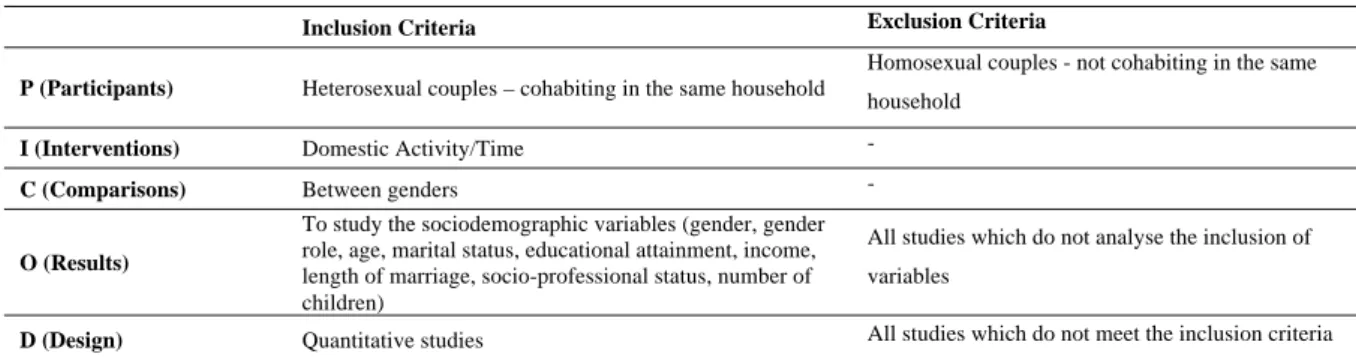
Table 1: Inclusion and exclusion criteria for selecting studies
Inclusion Criteria Exclusion Criteria
P (Participants) Heterosexual couples – cohabiting in the same household
Homosexual couples - not cohabiting in the same household
I (Interventions) Domestic Activity/Time -
C (Comparisons) Between genders -
O (Results)
To study the sociodemographic variables (gender, gender role, age, marital status, educational attainment, income, length of marriage, socio-professional status, number of children)
All studies which do not analyse the inclusion of variables
D (Design) Quantitative studies All studies which do not meet the inclusion criteria
Methodological Assessment
In this first organization, the kind of methodological design of the studies was considered, based on the classification proposed by Fortin (2009): descriptive studies (simple descriptive studies, case studies and surveys), correlational studies (descriptive and correlational study, correlational study and theoretical model verification
studies); experimental studies (experimental, quasi-experimental); non-systematic review, systematic review and meta-analysis. The selection of studies was carried out by two researchers. In the event of these researchers being unable to reach a consensus, a third researcher (tiebreaker) was included in the study selection. In order to obtain answers to previously defined research questions, based on the analysis and grouping of the corpus of the study, ‘evidence tables’ were elaborated.
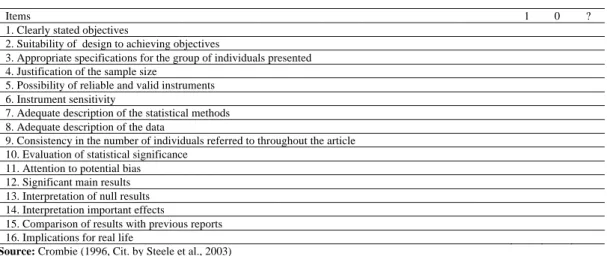
With regard to methodological assessment, as there are no ideal instruments to evaluate it in the different designs of studies in health (Katrak et al., 2004), and given that most of the selected studies are descriptive, we used the adapted version of Crombie (1996, cit. by Steele, Bialocerkowski & Grimmer, 2003), as shown in table 2. This instrument includes 16 items, scored with 1, when the item is present, with 0 when the item is not present or is unclear. The maximum score, indicating high quality is 16 and the lowest score is zero. The methodological quality of each study is listed as low, from zero to 5 points, moderate between 6 and 11 points and high from 12 to 16 points (Crombie, 1996, cit. By Steele et al., 2003). From the critical assessment instrument studies that enjoyed high methodological quality, presenting scores above 12 points, were considered and included.
Table 2: Critical Assessment Tool
Items 1 0 ?
1. Clearly stated objectives
2. Suitability of design to achieving objectives 3. Appropriate specifications for the group of individuals presented
4. Justification of the sample size
5. Possibility of reliable and valid instruments 6. Instrument sensitivity
7. Adequate description of the statistical methods 8. Adequate description of the data
9. Consistency in the number of individuals referred to throughout the article 10. Evaluation of statistical significance
11. Attention to potential bias 12. Significant main results 13. Interpretation of null results 14. Interpretation important effects
15. Comparison of results with previous reports 16. Implications for real life
Source: Crombie (1996, Cit. by Steele et al., 2003)
Hierarchy of evidence: To determine the level of evidence from selected studies, the scheme described by Sackett et
al. (2000) was used (Table 3).
Table 3: - Hierarchy of Evidence
Level 1 Meta-analyses of randomized and controlled clinical trials Level 2a Randomized and controlled clinical trials (RCT)
Level 2b Non-randomized and controlled clinical trials, or non-controlled, or non-blind Level 3 Observational studies
Level 4 Pre or post-test clinical trials Level 5 Descriptive studies Level 6 Insignificant evidence
Source: Sackett el al. (2000)
Extraction and data analysis: The data were extracted to a Word file, where the most important elements of each
study were included, specifically: author(s), year of publication, country, study design, sample characterisation, data collection tools, variable which influenced housework and results (table 6).
6. Findings
The search method and results are shown in Table 5. After searching the databases mentioned above, we were left with a sample of 34 studies. Following this, the full text of the studies in the sample and 25 studies were excluded. They are presented in table 4 along with the reason for their.
Table 4: Studies excluded after full reading
Title Author and year Reason for exclusion
Housework and social security deprotection in Brazil: issues under analysis
Lima, Rita Lourdes; Silva, Amanda Kelly Belo; Silva, Franciclézia Sousa; Medeiros, Milena Gomes 2010
It addresses paid domestic work. Domestic work: Challenges for decent work Sanches, Solange 2009 It addresses paid domestic work. The density of shadow
domestic work, gender and immigration
Abrantes, Manuel 2012 It addresses paid domestic work. The new labour dynamics and challenges of
articulation with family life
Casaca, Sara Falcão 2013 It does not address the topic under study. The Feminisation of Labour and
the Time-Use Gender Gap in Rural China
Chang, Hongqin; MacPhail, Fiona; Dong, Xiao-yuan 2011
It does not address the topic under study. Gender Equality and Gender Differences:
Parenting, Habitus, and Embodiment
Doucet, Andrea 2009 It does not address the topic under study. From Privacy to Public Space. Movements
Housework
Velez, António 2010 It addresses paid domestic work. Socius Working Papers
Revisiting theories about the sexual division of labour
Casaca, Sara Falcão 2009
It does not meet the stated objectives, as it addresses sociological theories, particularly feminist theories and analyses sexual segregation starting from the patriarchal and matriarchal system.
Researching the gender division of unpaid domestic work: practices, relationships, negotiations, and meanings
Warren, Tracy 2011 It does not address the topic under study. The Reproduction of Gender Inequality in
Sweden: A Causal Mechanism Approach
Rothstein, Bo 2012 It does not address the stated objectives. Shared or separate? Money management and
changing norms of gender equality among Norwegian couples
Knudsen, Knud; Waerness, Kari 2009 It does not address the topic under study, in that it refers to the couple’s money management. The discursive construction of ‘bounded
masculinity/unbounded femininity’
Charlebois, Justin 2012 It does not address the issue in question, since it only deals with the housework relative to the woman.
The Meanings and Experiences of Domestic Labour among Rural Women in Croatia
Micanic, Lynette 2011 It does not address the issue under study, because only women are dedicated to housework and men perform only paid work.
Domestic work in the newspaper “The Voice of Maids”
Maria, Alice Afonso, Tomás 2012
It does not address the issue under study. It addresses paid and unpaid domestic work only for women.
Gender Mobility and Domestic Service: Numbers and Trends in Women’s Immigration in Portugal
Dias, Nuno 2010 It does not address the issue under study; it refers to paid domestic work in immigrant women. Participation in the labour market and in
domestic work: do men and women have equal conditions?
Madalozzo, Regina; Martins, Sérgio; Shiratori, Ludmila 2010
It does not meet the stated objectives, as it includes married and unmarried people.
Relationship between sleeping on the night shift and recovery from work among nursing workers – the influence of domestic work
Silva-Costa, Aline; Lúcia, Rotenberg; Harter Griep, Rosane & Frida Marina Fischer
2010
It does not address the issue under study. Its aim is to determine the association between sleep patterns during work nights and performing domestic work in nurses.
Are the Real Time Costs of Children Equally Shared by Mothers and Fathers?
Ekert-Jaffe, Olivia 2010 It does not address the issue under study, as it compares real-time sharing of children between the couple (parents).
Rental generation: focus on poor women and the sexual division of labour
Carloto, Cássia Maria; Gomes, Anne Grace 2011
It does not address the issue under study, as it describes the discussion of disadvantaged women obtaining income, focusing on the Brazilian public policy on the possibilities this offers towards their financial autonomy and the breaking of patterns based on the traditional sexual division of labour
based on the false public-private dichotomy. Gender, generations and domestic
environment: work, home and family
Lago, Mara; Souza, Carolina; Kaszubowski, Erikson; Soares, Marina, 2009
It does not address the issue under study, insofar as it does not compare the housework between men and women.
‘Men have careers, women have babies’: unequal parental care among Irish entrepreneurs
Drew, Eileen; Humbert, Anne Laure 2010
It does not address the topic; it focuses on work strategies adopted by the couple to look after the children.
Using Gender: The personal, interpersonal, and emotional strategies of Domestic Labour
Johnson, Jennifer A., 2010 It does not address the topic. It focuses on the couple’s relationship and the emotional issues that it implies.
Parenthood, policy and work- family time in Australia 1992 – 2006
Craig, Lyn; Mullan, Killian; Blaxland, Megan, 2010
It does not address the topic. It, compares couples with and without children.
Attitudes toward housework and child care and the gendered division of labour
Lippe, Tanja Van Der; Poortman, Anne-Rigt, 2009
The study addresses the topic but does not analyse the variables in this study.
Domestic outsourcing and multitasking: How much do they really contribute?
Sullivan, Oriel; Gershuny, Jonathan, 2013
It does not meet the specific objectives of this review.
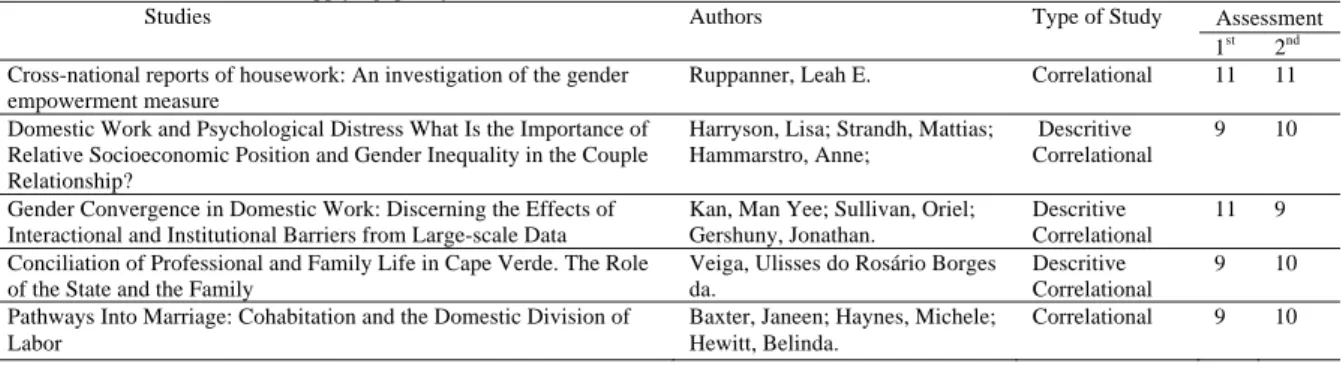
Applying the evaluation grids by two researchers to the different types of study, the study corpus was reduced to 4 which present high methodological quality. After applying the quality assessment scales, the studies presented in table 5 were excluded.
Table 5 - Studies excluded after applying quality scales
Studies Authors Type of Study Assessment
1st 2nd Cross-national reports of housework: An investigation of the gender
empowerment measure
Ruppanner, Leah E. Correlational 11 11 Domestic Work and Psychological Distress What Is the Importance of
Relative Socioeconomic Position and Gender Inequality in the Couple Relationship?
Harryson, Lisa; Strandh, Mattias; Hammarstro, Anne;
Descritive Correlational
9 10 Gender Convergence in Domestic Work: Discerning the Effects of
Interactional and Institutional Barriers from Large-scale Data
Kan, Man Yee; Sullivan, Oriel; Gershuny, Jonathan.
Descritive Correlational
11 9 Conciliation of Professional and Family Life in Cape Verde. The Role
of the State and the Family
Veiga, Ulisses do Rosário Borges da.
Descritive Correlational
9 10 Pathways Into Marriage: Cohabitation and the Domestic Division of
Labor
Baxter, Janeen; Haynes, Michele; Hewitt, Belinda.
Correlational 9 10
Hierarchy of evidence: The studies provide level 5 evidence (see table 3), including four correlational studies. Table 6- Description of the main methodological aspects and results of studies on the division of housework
Source/ Authors/Country Design/Sample/ Characterisation of the participants Data collection Variables that influence the division of housework Results A gender
approach for the Portuguese context (Schouten et al., 2012) Portugal Correlational study n=430 male =211 (49.1%) female =219 (50.9%) Age between 25-45 years Heterosexual couples; Portuguese nationality; Residents in the districts of Braga and Castelo Branco
Surveys Interviews - Education - Children - Time available - Age - Employment
Women spend 30 times longer than men ironing, 7 times longer cleaning and on laundry; 4 times longer in preparing meals and washing dishes and twice as long on the day-to-day shopping. Activities such as repairing and domestic services are male such that men spend 19 times longer on repairs and twice as long on administrative services Sharing and Spending time on domestic tasks (Copur et al, 2010) Turquia Correlational study n=600 male =405 (69%) female =195 (31%) Age between 21-66 years
Surveys/ Questionnaires Gender / - Age - No. of children - Income - Education - Gender Role
Women have a significant/superior responsibility in performing household chores and spend more time on them.
Family Strategies for meeting care and domestic Correlational study n=9958 male = 4979 (50%) Spanish time use survey - Education - Income -
Socio-The time spent on household chores, both by women and by men, is dependent on their socio-professional situation. There is a reduction in
work needs evidence from Spain (Carrasco; Domínguez, 2011) Espanha female =4979 (50%) Age <65 , >65 Heterosexual couples; Spanish nationality professional situation
performing household chores by women when there is an increased workload.
Income influences performing housework for women. The housework done by men does not change throughout life.
Gender equality and human resource management practices (Silva, 2012) Portugal Correlational study n=117 male =77 (65,8%) female =(34,2%) Age <years; 36-45;46-55; >55 Heterosexual couples; Workers in a firm; Residents in Grândola, Sines and Santiago do Cacém.
Surveys - Gender Women participate, on average, more regularly on household chores related to laundry (washing, hanging it out, ironing), cooking, cleaning and tidying the house. Men have greater participation in administrative matters (going to the bank, paying water, electricity and gas bills), and making home repairs and dealing with car maintenance.
Critical assessment of methodological quality: The value of the methodological quality of the studies are presented
in table 7. Taking the score obtained in the evaluation of the studies into account, 100% of the articles are high in quality. One of the selection criteria is to include only high quality items with a score from 12 to 16.
Table 7: Critical assessment of the quality of studies
1 2 3 4 5 6 7 8 9 10 11 12 13 14 15 16 Pt Qld
Silva; Rodrigues (2009) 1 1 1 0 1 1 1 1 1 1 ? 1 0 1 0 1 12/16 Alta
Copur et al. (2010) 1 1 1 0 1 1 0 1 1 1 0 1 0 1 1 1 12/16 Alta
Carrasco & Domínguez (2011) 1 1 1 1 1 ? 1 1 1 ? 1 1 0 1 1 1 13/16 Alta
Schouten et al. (2012) 1 1 1 1 1 ? 1 1 1 1 1 1 0 1 1 1 14/16 Alta
Population/sample: The target population in the studies analysed included heterosexual couples who are married or
in a civil union. The sample size ranged from 117 to 9958 individuals.
Data collection methods: Questionnaires, interviews and surveys were used as data collection methods. Surveys
were the most widely used method. However, the validity and reliability of these questionnaires is not always shown and confirmed.
7. Conclusions
There is a statistically significant association between gender and performing certain types of housework. It was concluded that women participate on average more regularly on household chores related to laundry (washing, hanging it out, ironing), cooking, cleaning and tidying the house. Men participate more in administrative matters (going to the bank, paying water, electricity and gas bills), home repairs and car maintenance. (Silva, 2012).
Some studies report that relative to the time spent on household chores, for couples who both work, there are significant differences between women and men including the task of ironing clothes in which women spend 30 times longer than men; 7 times longer on cleaning and clothes washing; 4 times more on preparing meals and washing the dishes and twice as long with the day-to-day shopping. Activities such as repairing and administrative services are male, and men spend 19 times longer on repairs and twice as long in administrative services. Women’s employment has repercussions in decreasing the intensity of their involvement in housework. For men, unemployment does not stimulate greater participation in it. The variations in average times depending on the couple’s employment are not significant. Men who wash the dishes ‘every day’ are mostly younger (under 40) have higher education and 70% belong to couples where both partners work. Although the differences are not significant for socio-professional class, education or age, reductions of time in washing dishes tend to be higher among those with lower education levels (without studies and basic studies). It is in the category with more economic resources and cultural capital that the sensation of lack of time is more strongly felt, both by women and men, but more so by women. The differences and gender inequalities are more significant among blue-collar and agricultural workers
than in higher socioeconomic groups; however, the latter group can compensate for their lack of time by paying for domestic services (Schouten et al, 2012).
Some authors found that participation in housework is influenced by the following factors (in order of influence): income of 1 or 2 partners, education, gender role, number of children, length of marriage and gender. The time spent on housework during the week varies according to the following variables (in order of influence): gender, gender roles, income of 1 or 2 partners and length of marriage. The time spent on housework at the weekend varies according to the following variables (in order of influence): gender, education and gender roles. (Copur et al, 2010). The time spent on household chores by both the woman and the man is dependent on their socio-professional situation. This has a more significant direct effect on domestic work performed by women compared to men. As the number of hours at work increases, the time spent on household chores decreases, with the decrease more pronounced in women. This decrease in time spent tends to be compensated by the spouse, and when the man’s benefits decrease due to an increase in the number of hours at work, the woman tends to spend more time on household chores to offset this situation. This does not happen when the roles are reversed, since the man does not offset this decrease and participates in a more reduced manner when the woman dedicates herself more to her profession. (Carrasco; Domínguez, 2011).
Household chores depend on income for women, which is not the case for men. As income increases, the women’s housework decreases and vice versa. In contrast, the housework done by men remains low or suffers minimal changes throughout their lives. The time women spend on carrying out household chores varies depending on their qualifications. (Carrasco; Domínguez, 2011).
In the literature review, it was found that housework was mostly done by women. Silva (2012) and Schouten (2012) also concluded that the household tasks performed depend on gender, and this distribution is not equal, since there are activities related more to each gender.
After analysing the studies herein, the variables that influence the division of housework were identified as gender, gender role, age, education, the couple’s, the existence of children and the socio-professional situation. The variables that most influence participation in domestic activities are the couple’s income and qualifications. Gender is the least important variable, in that it determines the amount of time spent on household chores (Copur et al, 2010).
The time spent on performing household chores and the amount performed vary inversely depending on education and employment status.
A higher prevalence of studies on this topic was found for homosexual couples. The existing information on the issue in heterosexual couples is scarce, so that conducting studies with higher levels of evidence is suggested. Acknowledgements
We appreciate the support of the ESSV, CI&DETS, Viseu Polytechnic Institute. References
Abrantes, M. (2012). A densidade da sombra: trabalho doméstico, género e imigração. Sociologia, Problemas e Práticas, 70, pp. 91-110. Amâncio, L. (2007). Género e divisão do trabalho doméstico: o caso português em Perspectiv. In Karin Wall e Lígia Amâncio (orgs.), Família e
Género em Portugal e na Europa, Lisboa, Imprensa de Ciências Sociais, colecção Atitudes Sociais dos Portugueses, 7, pp. 181-209. Carrasco, C., & Domínguez, M. (Outubro de 2011). Family Strategies for meeting care and domestic work needs: Evidence from Spain. Feminist
Economics, 17, pp. 159 - 188.
Copur, Z.; [et al.] (Janeiro de 2010). Sharing and Spending Time on Domestic Tasks: A Turkish Sample. Journal of Comparative Family Studies, 41, pp. 87-109.
Domingos, L. (Maio de 2012).Conceções e experiências de conciliações entre a vida profissional, familiar e pessoal: a perspetiva das pessoas que trabalham numa autarquia. Dissertação de mestrado, Universidade Católica Portuguesa, Viseu, Portugal.
Fortin, M. F. (2009). Fundamentos e Etapas do Processo de Investigação (1 ed.). Loures: Lusodidacta. Grint, K. (2002). Sociologia do Trabalho. In Glossário (2 ed., p. 416). Lisboa: Instituto Piaget.
Higgins JPT, Green S. (2009) Cochrane handbook for systematic reviews of interventions: version 5.0.2 [Em linha]. London: The Cochrane Collaboration, [Consult. 05 Nov. 2013] Disponível em: WWW:URL:http://www.cochrane-handbook.org
Hooff, J. H. (Março de 2011). Rationalising inequality heterosexual couples’ explanations and justifications for the division of housework along traditionally gendered lines. Jounal of Gender Studies, 20, pp. 19-30.
Katrak, P. [et al.] (2004). A systematic review of the content of critical tool. BMC Medical Research Methodology, Vol. 4, nº 22.
Nico, M., & Rodrigues, E. (2011). Organização do trabalho doméstico em casais do mesmo sexo. Sociologia, Problemas e Práticas, 65, pp. 95-118.
Sackett, D. [et al.] (2000). Evidence based medicine. Oxford: Churchill Livingstone.
Schouten, M. J. [et al.] (2012). Relatório Final do Projeto Tempo e Tecnologia: uma abordagem de género para o contexto português. Universidade da Beira Interior, Covilhã.
Silva, C. C. (2012). Igualdade de Género e Práticas de Gestão de Recursos Humanos. Dissertação de Mestrado, Instituto Politécnico de Setúbal, Setúbal, Portugal.
Steele, E.; Bialocerkowski, A.; Grimmer, K. (2003) – The postural effects of load carriage on young people: a systematic review. BMC Musculoskeletal Disorders. Vol. 4, nº 12, p. 1-7.
Sullivan, O., & Gershuny, J. (2013). Domestic outsourcing and multitasking: How much do they really contribute? Social Science Research, 42, pp. 1311 - 1324
Torres, A. (2004), Vida Conjugal e Trabalho. Uma Perspectiva Sociológica. Oeiras, Celta Editora.António, P. (2010). A psicologia e a doença crónica: intervenção em grupo de na diabetes mellitus. Psicologia, Saúde e Doenças, 11 (1), 15-27.