UNIVERSIDADE TÉCNICA DE LISBOA FACULDADE DE MOTRICIDADE HUMANA
CHANGES IN DEFENSIVE PLAYING METHOD INFLUENCE
THE COLLECTIVE BEHAVIOUR OF ASSOCIATION FOOTBALL
TEAMS
Dissertação elaborada com vista à obtenção do Grau de Mestre em Treino de Alto Rendimento
Orientador: Professor Doutor Duarte Fernando da Rosa Belo Patronilho de Araújo Co-orientador: Mestre Ricardo Filipe Lima Duarte
Júri:
Presidente
Professor Doutor Duarte Fernando da Rosa Belo Patronilho de Araújo Vogais
Professor Doutor António Paulo Pereira Ferreira Professor Doutor Pedro José Madaleno Passos Mestre Ricardo Filipe Lima Duarte
TELMO JOSÉ BIDARRA FRIAS 2012
1
Index
Resumo ... 2 Abstract ... 3 Introduction ... 4 Methods ... 8 Participants ... 8 Independent variables ... 9 Field procedures ... 10 Variables computations ... 11 Data Analysis ... 13 Results ... 14 Surface area ... 14 Stretch index ... 15Length per width ratio ... 16
Teams’ centres distance ... 17
Discussion... 18
Conclusion ... 23
Practical implications ... 24
Learning and training ... 24
Performance analysis ... 24
2 Resumo
A investigação no desporto tem vindo a considerar as equipas como sistemas dinâmicos complexos e tem procurado analisar o seu comportamento tendo em conta as relações complexas desenvolvidas pelos jogadores. Contudo, poucos estudos se têm focado na influência de constrangimentos no comportamento coletivo das equipas. O objectivo desta investigação foi analisar a influência do método de jogo defensivo (zona vs. homem-a-homem) no comportamento coletivo de equipas de futebol. Foram analisadas 2 equipas de 6 jogadores (5 de campo e um guarda-redes) em dois jogos reduzidos em que ambas utilizaram defesa à zona no primeiro jogo e defesa homem-a-homem no segundo. O comportamento das equipas foi analisado através de 4 variáveis coletivas encontradas na literatura – área da equipa, índice de dispersão, rácio de profundidade por largura e distância entre os centros. Os resultados confirmaram a hipótese de que o método de jogo defensivo influencia o comportamento coletivo das equipas. Quando utilizaram a defesa à zona as equipas apresentaram valores mais baixos de área da equipa (326±139 m2 vs. 360±172 m2 na equipa 1 e 195±111 m2 vs. 265±133 m2 na equipa 2) e de rácio de profundidade por largura (0.70±0.20 vs. 0.80±0.42 na equipa 1 e 0.47±0.21 vs. 0.58±0.24 na equipa 2) e apresentaram valores superiores na distância entre os centros das equipas (8.6±2.3 m vs. 5.4±1.6 m), comparando com a defesa homem-a-homem. Os resultados do índice de dispersão foram diferentes uma vez que a equipa 1 apresentou valores superiores na defesa à zona (15.7±2.8 m vs. 15.2±3.0 m) enquanto a equipa 2 apresentou valores inferiores na defesa à zona (10.9±2.8 m vs. 11.6±2.6 m). Os resultados da variabilidade seguem as mesmas tendências dos resultados das médias. Os valores do effect size sugerem que as alterações no comportamento impostas pela manipulação do método de jogo defensivo são menos influentes que a diferença entre as equipas. Os resultados realçam a importância de cada equipa ser considerada como uma entidade social única, com uma identidade e um comportamento peculiares.
3 Abstract
Sports investigations have increasingly considering teams as complex, dynamical systems and are starting to capture their collective behaviours respecting the complex relations developed by players. However, few studies have focused on the influence of specific performance constraints in the collective behaviours of teams. The aim of this investigation was to analyse the influence of defensive method (zone vs. man-to-man) in the collective performance of association football teams. We analysed two small-sided games played by two teams of 6 players (5 outfield players plus a goalkeeper) both using zone defence in the first experimental condition and man-to-man defence in the second one. Collective performance of teams was captured by 4 collective variables found in literature - surface area, stretch index, length per with ratio (lpwratio) and teams’ centres distance. Results clearly confirmed our hypothesis that the defensive method influences teams’ collective behaviours. Using zone defence, teams showed low values of surface area (326±139 m2 vs. 360±172 m2 for team 1 and 195±111 m2 vs. 265±133 m2 for team 2) and length per with ratio (0.70±0.20 vs. 0.80±0.42 for team 1 and 0.47±0.21 vs. 0.58±0.24 for team 2), and showed high values of geometrical centres distance (8.6±2.3 m vs. 5.4±1.6 m), when compared to man-to-man defence. Stretch index values were not similar for the two teams as team 1 showed high values for zone defence (15.7±2.8 m vs. 15.2±3.0 m) and team 2 showed low values for zone defence (10.9±2.8 m vs. 11.6±2.6 m). Analysing variability the results are consistent with mean values: lower values in zone defence for surface area and
lpwratio, higher values in zone defence for teams’ centres distance and inconsistent values
for stretch index. Effect size values suggested that changes in the collective behaviours of teams imposed by the manipulation of the defensive method resulted less strong than the own differences between the two teams. This finding highlighted the importance of each team to be considered as a social entity with an identity and peculiar behaviour.
4 Introduction
In the last years, research in sports performance has been considering team sports as complex, dynamical systems instead of breaking the system in smaller and simpler parts and study them in an isolated manner (Davids, Araújo & Shuttleworth, 2005; Duarte, Araújo, Gazimba et al., 2010). One of the main features of sport teams considered as complex systems is their capacity to spontaneously change from one state to another (i.e. self-organization) when system stability experiences perturbations, even small ones, caused by internal or external system constraints (McGarry, Anderson, Wallace, Hughes & Franks, 2002). This approach focus in the interactions developed between players from both teams in relation to the surrounding performance environment - where the game is played (McGarry, 2009; Passos et al., 2009). Thus, the behaviour of the complex systems should be captured by ecological variables or context-based measures (Araújo, Davids, & Hristovski, 2006; Duarte, Araújo, Fernandes, et al., 2010).
Previous investigations on sports as complex dynamical systems proposed player dyads as the basis for the identification of space-time patterns of coordination (McGarry et al., 2002). Those dyads could be intra-coupling dyads – interactions between two players from the same team – or inter-coupling dyads – interactions between two players from opposing teams (Travassos, Araújo, Correia, & Esteves, 2010). There are some examples of dynamic system based investigations analysing competing dyads on sports like squash (McGarry, Khan & Franks, 1999; McGarry, 2006; McGarry & Walter, 2007), tennis (Palut & Zanone, 2005; Lames, 2006), boxing (Hristovski, Davids & Araújo, 2006) and also in team sports such as basketball (Bourbousson, Séve & McGarry, 2010a), rugby union (Passos et al., 2009; Passos et al., 2008) or association football (Duarte, Araújo, Fernandes, et al., 2010; Duarte, Araújo, Gazimba et al., 2010).
5 Beyond the referred studies focused on competing dyads, others have been analyzing group-level behaviours using the same underlying principles of complex, dynamical systems. This approach can be justified by, and consistent with, the principle of universality for complex systems, which states that a complex system will subscribe to similar descriptions on different levels of analysis and time scales (Bourbousson, Séve & McGarry, 2010b; Sumpter, 2006). Therefore, group-level behaviours in team sports can follow similar research strategies as the employed to study dyadic relations at the level of individuals. However, it needs to find ecological group-motion variables suitable to synthesise the meaningful interactions among teammates during performance (Schölhorn, 2003).
Following this suggestion, Frencken and colleagues (Frencken & Lemmink, 2008; Frencken, Lemmink, Delleman & Visscher, 2011), investigated the collective behaviour of two sub-groups of football players during small-sided games practices using the surface area and teams’ centre positions as group-motion variables. Those investigations focused on describing group-level interactions emerging during the game, particularly during goal-scoring opportunities. The two collective measures used were (i) the geometrical or teams’ centres and, (ii) the surface area covered by teams – area of the convex hull formed by linking the external players’ positioned in the field and calculated using a modified Graham algorithm (Frencken et al., 2011). The authors suggested that the first variable can express ‘pressure’, stating that the shorter the distance between the two centres, the higher the pressure. High ‘pressure’ here means that the team without the ball has the initiative to seek the possession and perturb the team with the ball conceding less space to the team with ball possession. This pressure concept is easily understood however it is not quite acceptable that the distance between the team centres might express the notion of ‘pressure’. Many exemplar situations can be offered in which the distance between the centres is small and the pressure is low – a situation with the team without the ball wide open (e.g. occupying a large area of
6 the pitch) and the geometric centre very close to the centre of the opposing team will never represent a situation of collective pressure as the team with the possession has plenty of space to play. Frencken and colleagues also concludes at the end that the team centre distance, as a single variable, does not capture the collective ‘pressure’ because players can either be very close or far way off the team’s centre. For these reasons, we considered this variable captures the closeness of the teams’ centres. In the same research programme, the surface area is considered an accurate descriptor of ball possession since the authors state that the attacking team has a larger surface area when compared with the defending team. These investigations showed a correlated relation for teams’ centre positions, describing the natural rhythmic flow of attacking and defending phases. The counterphase relation expected for surface area was not clearly observed and investigators justified that with the small number of players involved in the experiment.
Trying to prove the previously cited ‘principle of universality for complex systems’, Bourbousson et al. (2010a, 2010b) had conducted an investigation on basketball game behaviours divided in two parts. In the first one the authors analysed player-player interactions – intra-coupling dyads (pairs of players from the same team) and inter-coupling dyads (pairs of players from opposing teams). Authors reported phase and anti-phase relations between dyads considering both longitudinal and lateral displacements. In the second part of the investigation, authors analysed game behaviours at a high level of complexity, moving to a team-team analysis. For that purpose, authors used two group-level variables that were expected to capture the collective behaviour of teams. The ‘spatial centre’ (previously referred as geometrical or teams’ centre) was used to capture the mean team positioning on the court and the ‘stretch index’ was used to capture team players’ dispersion around the spatial centre. According to authors stretch index measures the expansion or contraction of space in the longitudinal and lateral directions of a team during the game and
7 was calculated computing the mean of the distances between each player and the spatial centre of that team. The stretch index represents the mean deviation of each player in a team from the spatial centre. Data showed a predominant in-phase relation in both lateral and longitudinal directions (with more attraction in the longitudinal collective displacements) for the spatial centre analysis and also an in-phase relation for the lateral direction for the stretch index. For the relative stretch index – difference between stretch indexes of the two teams at any instant – data revealed phase transitions between two states. Authors concluded that these data were explained by the reciprocity between teams in their amounts of expansion and contraction when possession of the ball is won and lost. As expected, this study was consistent with the universality of complex system principles as it showed similar patterns of behaviour when analyzing the game at a dyadic or team level.
Following the same line of investigation, Folgado (2010) used small-sided games to examine collective behaviours of youth football teams (U9, U11 and U13 age levels). That study was based in the use of two collective variables: an intra-team variable, length per width ratio (lpwratio), and an inter-team variable, distance between the geometrical centres of the playing teams. Results showed that collective behaviours of teams were influenced by the players’ age level, as younger teams tend to present high length per low width relation in their positioning on the pitch and a low distance between teams’ centres. These findings were interpreted by a better collective tactical behaviour of older players associated to high tactical expertise.
From the studies reviewed it is clear that only the one conducted by Folgado (2010) treated the game as a continuous event. Frencken and colleagues (Frencken, & Lemmink, 2008; Frencken et al., 2011) and Bourbousson and colleagues (Bourbousson et al., 2010a; 2010b) opted to collect a set of random selected game sequences to examine the collective behaviour of teams during the game. In those cases the collective behaviours were analysed
8 and related with the emergence of critical incidents in the game (a goal-scoring opportunity or a basket). This kind of approach does not consider all match events in a continuum form, and the entire time-evolving dynamics of the game is something forgotten in those studies. This may lead to misunderstandings and precipitated conclusions based only in a few events or instants of the game. To our knowledge, no studies on group-level interactions in sport teams assessed the influence of changing relevant performance constraints in the teams’ collective behaviour. In this respect, a relevant performance constraint on team performance is the type of defensive playing method adopted by teams (i.e. man-to-man or zone defence, McGarry, 2009; Kim, 2004). For example, Kim (2004) proposed that using zone defence playing method a team will have smaller surface area (calculated using Voronoi algorithm) and using man-to-man defensive playing method a team will have higher variation of surface area. This kind of research approach can reveal the group-level adaptations of sports teams influenced by relevant performance constraints, with an important impact both at the theoretical and practice level.
The purpose of this investigation was to analyse the influence of varying the defensive playing method (man-to-man versus zone defence) on the collective performance of football teams. We hypothesised that the manipulation of the defensive playing method influences the collective behaviour of association football teams playing small-sided game formats.
Methods
Participants
Twelve youth football players, aged between 15 and 17 years old (16.2±0.6), with height 175.3±4.7 cm and weight 67.0±3.5 kg, participated in this study. The players were selected from an under-17 team of a Portuguese top club and presented about 6 years of
9 football practice at a competition level (5.6±1.5 years). Coach was asked to select the players based on the criteria to ensure balanced teams and to assign each player to its common field position. Participants were distributed between two teams of 5 outfield players plus a goalkeeper and played with regular association football rules. The goalkeepers were not monitored during the games but were included in order to maintain the representativeness of the ecological performance constraints. All the participants voluntarily agreed to participate in the study, assigning the written consent.
Independent variables
The control of the defensive method during the experimental task was guaranteed by the team’s coach instructions. In the first game both teams used zone defence and the coach explained that players should behave, without ball possession, just how they behave normally, because zone defence is the method adopted by the team at least since the beginning of the season. The ball and the team colleagues should be the players’ reference as soon as the team lost the ball possession. In the second game both teams were compelled to use man-to-man defence and before the game started the team’s coach had a conversation with the players and formed dyads (i.e., pairs of opposing players) that should work as references to individual marking (i.e., as soon as the team lost ball possession its players should mark the attributed opposite). The team’s coach was constantly giving feed back to both teams to assure that the principles of each defensive method were accomplished.
Each team was instructed to perform in a diamond shape formation with one central defender, three midfields and one central forward as it was usually in this team’s practice sessions. The players were chose by their field positions and assigned to a team randomly. The team as an independent variable was not controlled in the experimental design and assumes here an exploratory character.
10
Field procedures
The two teams played in 40 x 42m of pitch size, two games of 10 minutes duration with eight minutes of passive break between games, to ensure that fatigue did not influence the results. To guarantee that there was a sufficient rest time between the games, we monitored the heart rate of all players during the experiment. Minimum values of players’ heart rate observed during rest period were 104±11 beats/min. The games were played after a warm-up period of 10 minutes, consisting of general mobilization exercises involving lower and upper limb movements and short distance runs.
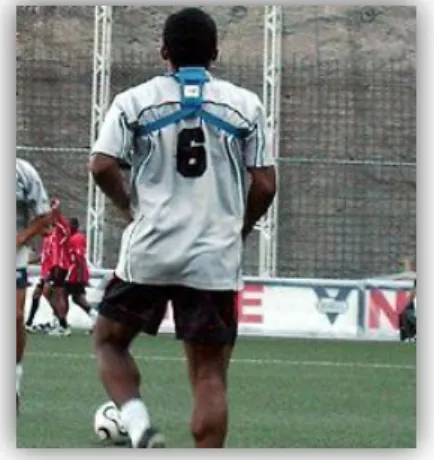
Players’ positional data (2D) were captured using a Global Positioning System (GPSports SPI Elite system, GPSports, Canberra, Australia) working at a 15Hz of sample rate. The system was composed by ten GPS devices (one per each outfield player) that were firmly attached to a custom-made vest secured to the participant’s upper back (level of the scapula) according to manufacturer’s specifications (see Figure 1).
Figure 1 GPS device attached to custom-made vest at players back.
All devices were previously calibrated to avoid satellite connection problems as suggested by the manufacturer and were therefore placed on individuals’ backs just before the start of the warm-up, so to the players be familiarised with the use of the devices. After the training session, positional data were transferred to excel files using the software Team
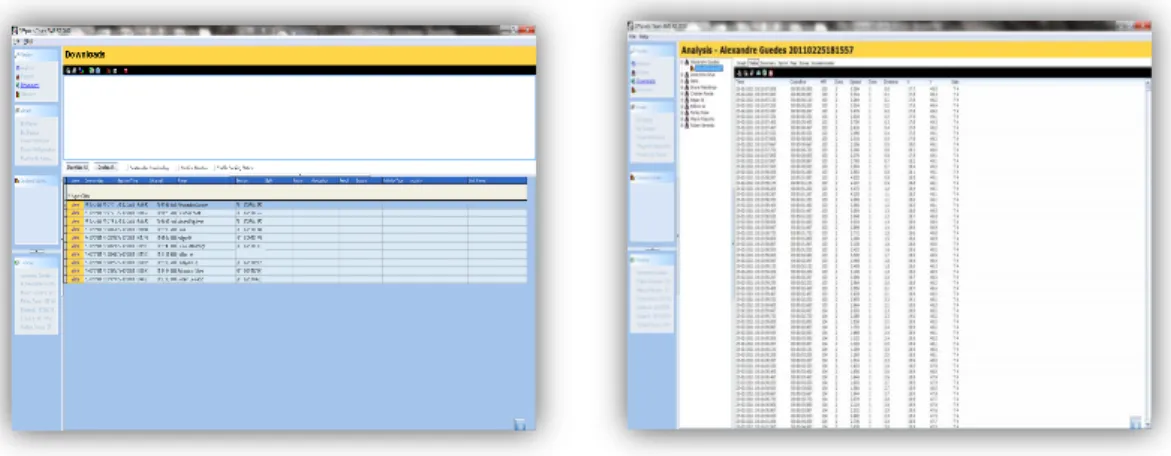
11 AMS R2 2010 (GPSports, Canberra, Australia) that connects to each of GPS devices to download the players coordinates (see Figure 2). Each game resulted in 9000 data points for each player in the x- and y-component of motion.
Figure 2 Team AMS software application: a) Download module view, where device data is gathered; b) Analysis module view, where each player information was displayed and exported to .txt files.
Validity and reliability studies of these GPS system were verified in literature (Barbero-Álvarez, Coutts, Granda, Barbero-Álvarez & Castagna, 2010; Gray, Jenkins, Andrews, Taagge, & Glover, 2010). Gray et al. (2010) found measurements errors (maximum error found was 9.8% in a sprint trial on a non-linear path) to capture the positioning, speed and distances covered by team players, showing that GPS devices are suitable under most conditions for the measurement of movement displacements trajectories in field-based team sports. The mentioned studies used 1 Hz GPS devices. However, we used 15 Hz GPS devices in our study which is considered to improve measurement accuracy and smooth the inherent errors.
Variables computations
In order to assess the collective behaviour of teams, we created a Matlab Application – TeamSense – able to calculate relevant group-motion variables at the level of the team. This
12 software application (see Figure 3a) uses individuals’ raw positional data as input file and returns the group-level variables as outputs presented in time-plots (Figure 3b) and 2D video stream (Figure 3c). TeamSense is still evolving and some new features and variables will be included for future investigations. However, it was already used to calculate all the variables utilised in the current study.
Figure 3 TeamSense software application developed in Matlab: a) TeamSense entry point view; b) Example of a time-plot variable output (e.g. surface area); c) Exemplar photogram from a variable 2D video animation (e.g. surface area).
The group-motion variables included the surface area, stretch index, length per width ratio and distance between teams’ centres.
13
Surface area was calculated using a Matlab function (convhull) that creates a convex
polygon from a given number of points (in this case we used a maximum number of 5 points corresponding to the 5 outfield players of each team) and returns the sorted points that compose the polygon and the polygonal surface area for each time frame (Frencken, & Lemmink, 2008; Frencken et al., 2011). This variable expresses the relation between the covered spaces of both teams and how they behave over the playing time.
The stretch index was calculated using the mean distance from each player position to the geometrical centre of the corresponding team centre (Yue, Broich, Seifriz & Mester, 2008). This variable expresses the dispersion of all team players around its geometrical centre.
The length per width ratio (lpwratio) was calculated for each team as the ratio between length and width (lpwratio = length/width). Length and width were obtained as the difference between the maximum and minimum values from y-axis and the x-component of motion, respectively (Folgado, 2010). Lpwratio captures the shape through the relation between the length and the width of the team (i.e., longer and thinner teams have higher
lpwratio values than shorter and larger teams).
The distance between teams’ centres was calculated as the distance between the geometrical centres of both teams. The geometrical centre of each team was calculated using the average positions (x and y) of the players in each time frame (Frencken, & Lemmink, 2008; Frencken et al., 2011; Folgado, 2010). This variable was used as an indicator of teams’ closeness during the match.
Data Analysis
Variations in the three group-motion variables that characterize the collective behaviour of each team – surface area, stretch index and length per width ratio - as a
14 function of the defensive playing method were analysed using Mixed-Model ANOVA, while
teams’ centres distance was analysed using One-way Repeated Measures ANOVA. Bar charts
with mean and standard deviation were used to inspect data. Effect sizes were reported as eta partial squared (η2). Analyses were performed using SPSS 19.0 (SPSS Inc., Chicago, USA). Significance level was set at 5% for all statistical procedures.
Results
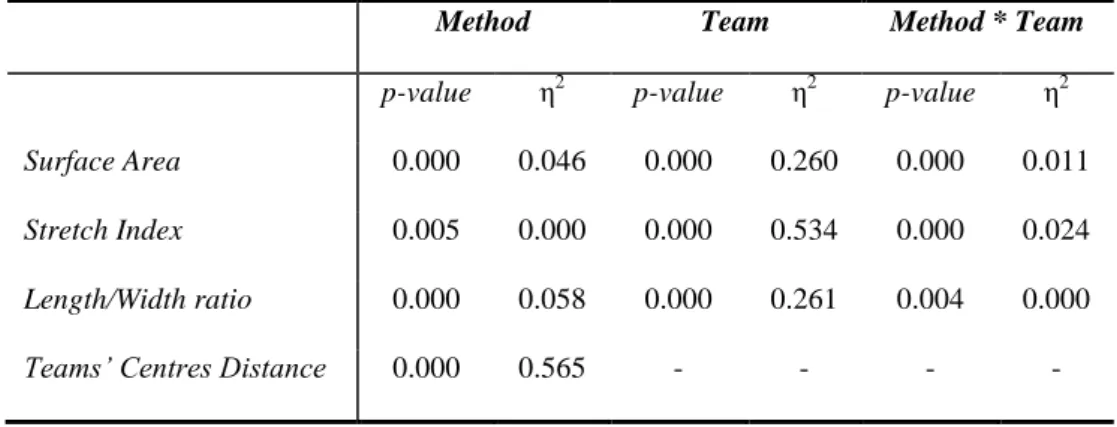
Table 1 presents the statistical values for the four collective variables: surface area, stretch index, length per width ratio and teams’ centre distance. There are statistically significant variations (p < 0.05) on the four variables between the two analysed conditions.
Table 1 Statistical significance and effect size values of the Method, Team and Method*Team effects in the group-motion variables.
Method Team Method * Team
p-value η2 p-value η2 p-value η2 Surface Area 0.000 0.046 0.000 0.260 0.000 0.011
Stretch Index 0.005 0.000 0.000 0.534 0.000 0.024
Length/Width ratio 0.000 0.058 0.000 0.261 0.004 0.000
Teams’ Centres Distance 0.000 0.565 - - - -
Surface area
Mean data of surface area revealed that both teams presented large covered areas using man-to-man defensive method – 360±172 m2 for team 1 and 265±133 m2 for team 2 – when comparing to zone defence – 326±139 m2 and 195±111 m2, respectively (see Figure 4). Significant differences were observed also between teams.
15
Figure 4 Mean and standard deviation values of surface area per team and defensive playing method.
Analyses also showed high variability for man-to-man defensive method when compared to zone defence demonstrated by the superior values of standard deviations.
Stretch index
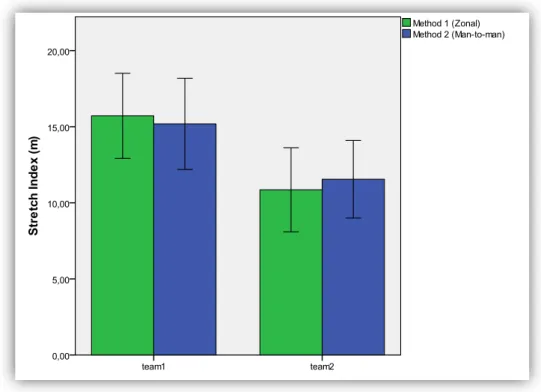
For the stretch index, the mean data showed significant differences between the defensive playing methods and also between the two teams. The first team achieved high values for zone defence (15.7±2.8 m) than for man-to-man defence (15.2±3.0 m). Contrary, the second team achieved low values for zone defence (10.9±2.8 m) than for man-to-man defence (11.6±2.6 m) (see Figure 5).
16
Figure 5 Mean and standard deviation values of stretch index per team and defensive playing method.
Regarding the magnitude of variability, each team presented a different trend in standard deviation values. Team 1 had high variability for man-to-man defence than for zone defence while team 2 revealed the opposite trend.
Length per width ratio
Lpwratio mean data revealed significant high values for man-to-man defence –
0.80±0.42 for team 1 and 0.58±0.24 for team 2 - than for zone defence – 0.70±0.20 and 0.47±0.21. Both teams show the same trend concerning this variable (see Figure 6).
17
Figure 6 Mean and standard deviation values of lpwratio per team and defensive playing method.
Analyses also showed high variability for man-to-man defensive method when compared to zone defence in both teams, as demonstrated by the superior values of standard deviation (see Figure 6).
Teams’ centres distance
For the teams’ centres distance variable, mean data showed significant high values for zone defence (8.6±2.3 m) than for man-to-man defence (5.4±1.6 m) (see Figure 7).
18
Figure 7 Mean and standard deviation values of teams’ centres distance per defensive playing method.
Standard deviation values also showed that there was high variability for zone defence (2.3 m) than for man-to-man defence (1.6 m).
Discussion
The purpose of this investigation was to identify how the collective behaviours of association football teams are influenced by changes in the defensive playing method. The collective behaviours were measured with the use of four group-motion variables suggested in literature - surface area, stretch index, length per width ratio and teams’ centres distance – and the defensive playing method (zone vs. man-to-man defence) was modified in two small-sided games conditions.
The current study showed that changes in the defensive playing method influenced the collective behaviours under analysis. All the variables used to capture the collective
19 behaviours of teams demonstrated significant differences when players practised under different constraints – zone defence vs. man-to-man defence. However, regarding the effect size values, the Team independent variable seems to have a superior influence in the collective behaviours than the Method independent variable. This can be explained by the particular characteristics of individuals and the idiosyncratic modes of coordination they develop when playing together. Former investigations argued that teams should be regarded as complex collective entities (Marsh, Richardson, Baron & Schmidt, 2006) in which the collective behaviours reveal the emergent patterns of coordination or a kind of ‘collective intelligence’ that teams put in action which expresses their own identities (or a ‘team fingerprint’) (Duarte & Frias, 2011). Our results suggest that besides the manipulation of the defensive playing method, the collective behaviour of teams expressed characteristics that went beyond the individual characteristics of players, showing patterns of coordination developed during the match.
Regarding the surface area measure, data demonstrated an increase in the covered areas when teams used man-to-man defence compared to zone defence. This can be explained by the fact that when teams played using man-to-man method, players follow their direct opposite’s displacements closer in the field. As the attacking team usually covers more space to find appropriate conditions to circulate the ball (Bourbousson et al., 2010b), the defending team was more dispersed in the field when using man-to-man defence. In a former investigation, Frencken et al. (2011) tried to prove that there is a negative correlation between surface area for the two competing teams, arguing that the team in ball possession should enlarge its covered area and simultaneously the team without ball possession should short its covered area. That relation was not proven (i.e., correlation values around 0) and the authors pointed to experimental constraints such as the reduced number of players or the available space to play (due the use of small-sided games). However, our results suggested that
20 Frencken et al. (2011) assumptions could be correct because the superior values of surface area in man-to-man defence may be caused by the enlargement of the area covered by the attacking team and the responsiveness of defending players in this type of defensive behaviours. In the current study, the standard deviation values of surface area also identified high variability for teams using man-to-man defence when compared to zone defence method. This may suggest that using zone defence teams remain more stable in the amount of covered area - less willing to structure disorganization because team shape is more stable - and more economic (physically and psychologically) due players experience less changes/variations when defending.
The same pattern was not found in stretch index measures because the two teams presented a different trend when the defensive playing method was manipulated. The results presented high stretch index for man-to-man defence in team 2, but the same did not occur in team 1 (stretch index is slightly high for zone defence compared to man-to-man defence). Bourbousson et al. (2010b) observed that, basketball teams using man-to-man defence demonstrated stretch index values to be small for the defending team and large for the attacking team. However, considering zone defensive method as a more compact playing organisation, with players closer to each other (i.e., low interpersonal distances between teammates) to decrease the available space for attackers, stretch index results did not completely correspond to that expectation, at least for one of the teams. Our expectations were that stretch index should be similar to surface area results (also a team dispersion measure) but, interestingly, data showed that the two measures capture different peculiarities of the contraction/expansion behaviours of teams. These unexpected different patterns observed between teams may be explained by the specific features of team players interactions that compose each team. In fact, when analysing effect size values, the Team factor had a strong and higher influence on stretch index values than the Method.
21 In a study with young football players, Folgado (2010) found a decrease in lpwratio for the teams with more experienced players (i.e., with more years of practice). This decrease was believed to due to the evolution in the collective tactical behaviour, meaning that experienced teams tended to have more similar values of width and length, while the younger players develop a type of game with more length than width (i.e., players use predominantly the length dimension of the pitch). Our results demonstrated that teams had more width than depth in the two experimental conditions (values of lpwratio less than 1). This can be due to pitch size as it was not proportional with regular football field (width size bigger than length size) as previously explained. Although, teams using zone defence demonstrated low values of lpwratio when compared to man-to-man defence. This may suggest that, according to Folgado (2010) in zone defence we can assist to an emergence of more evolved collective tactical behaviours with a more balanced occupation of the field space since teams presented similar values of width and length. Standard deviation data also suggested that teams using man-to-man defence tended to be less stable. The high values of variability for this experimental condition (i.e., man-to-man defence) may be influenced by greater instability of the defensive structure and by the continuous changes in the team shape (in depth and width) caused by the individual behaviour of the defending players who have to follow the opposites and mark them individually in the entire pitch.
Another type of collective behaviour, the closeness between teams’ centres, has been analysed in team sports performance. Frencken and Lemmink (2008), Frencken et al. (2011) and Bourbousson et al. (2010b) all concur in the fact that there is an in-phase relationship between the centres of opposing teams. This relationship is considered by these authors as an expression of the natural rhythmic flow of attacking and defending during competition. However, none of these studies has considered the influence of specific performance constraints such as the manipulated defensive playing method in teams’ centres proximity.
22 Although opposing teams’ centres move coordinated during attacking and defending phases, our data showed that the distance between teams’ centres were clearly influenced by the defensive playing method adopted by teams’. Thus, these distances were larger for zone defence than for man-to-man defence. The constraints imposed in man-to-man marking force defending players to follow their opposites individually in the pitch, so defending team positioning would be similar to attacking team position and their geometrical centres would be closer. Contrariwise, in the zone defensive method the defending players’ positioning would function collectively as a compact block between the ball and the goal, wherever the attacking team is positioned. So, their geometrical centres would be further. In the same way, Folgado (2010) concluded that younger and less experienced team players showed low geometrical centres distance when compared to older and more experienced players. The author proposed that the youngest players tend to solve game tasks using individual-centred performance rather than a collective-centred work based on a balanced spatial distribution and a coherent/coordinated behaviour of players. Analysing teams’ centres distance variability can also reinforce our thoughts. Standard deviation data showed that for zone defence there was higher variability than for man-to-man defence. As we stated before, this can be explained by the own features of each defensive methods. If the teams open and close the spaces according to exchanges in ball possession (Frencken and Lemmink, 2008; Frencken et al., 2011; Bourbousson et al., 2010b), it is expectable that they present superior variability of their teams’ centres distances when compared with teams that follow their opposing players along the entire pitch in which the geometrical centre of each team remains close to the centre of the other team.
23 Conclusion
Strategic options and tactical behaviours such as the defensive playing method adopted by teams seemed to have an influence in the collective behaviours of association football teams, at least when playing small-sided games. In this investigation we have found how zone and man-to-man defensive methods influenced the collective behaviours captured by the surface area, stretch index, lpwratio and distance between the centres of teams. Only the stretch index results did not demonstrated a common trend between the two teams when defensive playing method was modified. The current study have analysed two teams of six players each (goalkeeper plus five outfield players) and we assume that there can be some differences considering the 11-a-side game format, with high number of inter and intra-coupling relations and increased complexity. The playing field (42x40m) was not proportional to normal football field size because we opted to maintain the field dimensions typically used in the practices of the selected team. We hypothesise that using different shapes and sizes of field, there can emerge different collective behaviours as players adapt their behaviour to environmental and task constraints. However, the influence of the defensive playing method adopted by teams demonstrated to exert an important influence in their collective behaviours during small-sided games practices. Interestingly, besides that influence of the defensive playing method, the Team considered as an independent variable revealed superior effect size values. This means that the changes imposed in the collective behaviour of a team by the adoption of a different defensive method can be less strong than the own differences between the two teams. This finding highlights the importance of each team (even a small-group of players like in the current study) to be considered as a social entity with a peculiar and idiosyncratic behaviour.
24 Practical implications
Learning and training
Our investigation results showed that environmental constraints, like defensive playing method, influence the collective behaviour of teams, though it is advisable that team coaches uses this type of constraints when creating training tasks so teams could be prepared and aware of the possible emerging patterns caused by tactical constraints manipulation. Concerning zone and man-to-man defensive playing methods our results showed that zone defence appeared to be a more organized and less willing to opposing team initiatives. Also, lower variability gives zone defence an economic character that can result important in practice. Resuming, if properly used and trained, our results suggest that zone defence can be a good tactical approach for association football teams.
Performance analysis
Collective team variables analysis seems to be a useful framework to improve coaches and investigators understanding of tactical implications in small-sided games (Folgado, 2010; Frencken and Lemmink, 2008, Frencken et al., 2011). Our investigation corroborates those ideas and gives some more variables and concepts to work with. To help collective variables analysis we have created TeamSense application, referenced before in this document. TeamSense can be a useful tool to analyse static and dynamic behaviour of collective variables as it uses positional data of players to build variable reports, as well as graphical displays and 2D video animations. With the technology development of tracking systems it’s now easily possible to have this type of collective analysis and graphical data in real time with TeamSense.
25 References
Araújo, D., Davids, K., & Hristovski, R. (2006). The ecological dynamics of decision making in sport.
Psychology of Sport and Exercise, 7, 653-676.
Bourbousson, J., Sève, C., & McGarry, T. (2010a). Space-time coordination dynamics in basketball: Part 1. Intra- and inter-couplings among player dyads. Journal of Sports Sciences,28, 339–347. Bourbousson, J., Sève, C., & McGarry, T. (2010b). Space–time coordination dynamics in basketball:
Part 2. The interaction between the two teams. Journal of Sports Sciences, 28, 349–358.
Davids, K., Araújo, D. & Shuttleworth, R. (2005). Applications of Dynamical Systems Theory to Football. In T.Reilly, J.Cabri & D.Araújo (Eds.), Science and Football V, pp.537- 550. London: Routledge, Taylor & Francis.
Duarte, R., Araújo, D., Fernandes, O., Fonseca, C., Correia, V., Gazimba, V. et al. (2010). Capturing complex human behaviors in representative sports contexts with a single camera. Medicina
(Kaunas), 46(6), 408-14.
Duarte, R., Araújo, D., Gazimba, V., Fernandes, O., Folgado, H., Marmeleira, J.& Davids, K. (2010). The Ecological Dynamics of 1v1 Sub-Phases in Association Football. The Open
Sports Sciences Journal, 3, 16-18.
Duarte, R., & Frias, T. (2011). Collective intelligence: An incursion into the tactical performance of football teams. In: Jemni M, Bianco A, Palma A, editors. Proceedings of the First
International Conference in Science and Football (pp. 23-28); Palermo.
Folgado, H. (2010). Towards an understanding of youth football teams tactical performance by analysis of collective positional variables during small-sided games. (Unpublished master
thesis dissertation). Universidade de Trás-os-Montes e Alto Douro, Vila Real.
Frencken, W., & Lemmink, K. (2008). Team kinematics of small-sided soccer games: a systematic approach. In: Reilly T, Korkusuz F, editors. Science and Soccer VI (pp. 161-6). London: Routledge.
26
Frencken, W., Lemmink, K., Delleman, N., & Visscher C. (2011). Oscillations of centroid position and surface area of soccer teams in small-sided games. European Journal of Sport Science, 11(4), 215-223.
Hristovski, R., Davids, K., & Araújo, D. (2006). Affordance-controlled bifurcations of action patterns in martial arts. Nonlinear Dynamics, Psychology and Life Sciences, 10, 409-449.
Kim, S. (2004). Voronoi Analysis of a Soccer Game. Nonlinear Analysis: Modelling and Control, 9, 233–240.
Lames, M. (2006). Modeling the interaction in game sports – relative phase and moving correlations.
Journal of Sports Science and Medicine, 5, 556-560.
Marsh, K. L., Richardson, M. J., Baron, R. M., & Schmidt, R. C. (2006). Contrasting approaches to perceiving and acting with others. Ecological Psychology, 18, 1-37.
McGarry, T. (2006). Identifying patterns in squash contests using dynamical analysis and human perception. International Journal of Performance Analysis in Sport, 6, 134–147.
McGarry, T. (2009). Applied and theoretical perspectives of performance analysis in sport: Scientific issues and challenges. International Journal of Performance Analysis in Sport, 9, 128-40. McGarry, T., Anderson, D., Wallace, S., Hughes, M., & Franks, I. (2002). Sport competition as a
dynamical self-organizing system. Journal of Sports Sciences, 15, 171-81.
McGarry, T., Khan, M.A., & Franks, I.M. (1999). On the presence and absence of behavioural traits in sport: an example from championship squash match-play. Journal of Sports Sciences, 17, 297-311.
McGarry, T., & Walter, F. (2007). On the detection of space–time patterns in squash using dynamical analysis. International Journal of Computer Science in Sport, 6, 42–49.
Palut, Y., & Zanone, P.-G. (2005). A dynamical analysis of tennis: Concepts and data. Journal of
Sports Sciences, 23, 1021–1032.
Passos, P., Araújo, D., Davids, K., Gouveia, L., Milho, J., & Serpa, S. (2008). Information governing dynamics of attacker-defender interactions in youth rugby union. Journal of Sports Sciences, 26(13), 1421-1429.
27
Passos, P., Araujo, D., Davids, K., Gouveia, L., Serpa, S., Milho, J., et al. (2009). Interpersonal Pattern Dynamics and Adaptive Behavior in Multiagent Neurobiological Systems: Conceptual Model and Data. Journal of Motor Behavior, 41(5), 445-459.
Schollhorn, W. (2003). Coordination dynamics and its consequences on sports. International Journal
of Computer Science in Sport, 2(2), 40-46.
Sumpter, D.J. (2006). The principles of collective animal behaviour. Philosophical Transactions of
the Royal Society of London: Series B, 361, 5-22.
Travassos, B., Araújo, D., Correia, V., & Esteves, P. (2010). Eco-Dynamics Approach to the study of Team Sports Performance. The Open Sports Sciences Journal, 3, 56-57.
Yue, Z., Broich, H., Seifriz, F., & Mester, J. (2008). Mathematical analysis of a soccer game, Part I,