after Hegemony of the New Public
Management: a literature review
Pedro Luiz Cavalcante Instituto de Pesquisa Econômica Aplicada (Ipea)
The paper’s goal is to advance at understanding of the public management framework after decades of administrative reform under the New Public Management (NPM) hegemony. Based on a broad literature review, the paper maps trends in terms of principles and guidelines and indicates that post-NPM is a process of continuity rather than a disruption with the previous paradigm. The implementation processes of the management trends, as well as in the NPM, are presented in different ways, varying according to the context and institutional framework of each government. The article also concludes that the most emblematic characteristic of the contemporary public administration is the prevalence of the governance phenomenon that, in different formats, encompasses most of the post-NPM principles and guidelines discussed in the literature. In this sense, the return of the State and the bureaucracy as protagonists is emphasized, however, far from the traditional hierarchical standard. The current role of the civil service focus on the direction of interdisciplinary skills, collaborative capacities, increasing accountability to society, as well as leadership with interactive components.
Key words: New Public Management, governance, innovation, administrative reforms
Tendências na Administração Pública após a hegemonia da New Public Management: uma revisão de literatura
O objetivo do artigo é avançar na compreensão do funcionamento da administração pública após décadas de reformas sob a égide da Nova Gestão Pública (ou New Public Management - NPM). Com base em uma ampla revisão da literatura, o documento descreve as tendências em termos de princípios e diretrizes e indica que o pós-NPM é um processo de continuidade e não uma interrupção do paradigma anterior. Os processos de implementação das tendências de gestão, bem como no NPM, são apresentados de diferentes maneiras, variando de acordo com o contexto e o quadro institucional de cada governo. O artigo também conclui que a característica mais emblemática da administração pública contemporânea é a prevalência do fenômeno de governança que, em diferentes formatos, abrange a maioria dos princípios e diretrizes do pós-NPM discutidos na literatura. Nesse sentido, o retorno do Estado e da burocracia pública como protagonistas são enfatizados, no entanto, longe do padrão hierárquico tradicional. O papel atual do serviço público no é direcionado ao desenvolvimento de habilidades interdisciplinares, capacidades colaborativas, aumento da responsabilidade para a sociedade, bem como liderança com componentes interativos.
Palavras-chave: nova administração pública, governança, inovação, reforma
administrativa.
Tendencias en la administración pública después de la hegemonía de New Public Management: una revisión de la literatura
El objetivo del artículo es avanzar en la comprensión del marco de administración pública después de décadas de reformas bajo la hegemonía de la Nueva Gestión Pública (o New Public Management - NPM). Con base en una amplia revisión de la literatura, el trabajo mapea las tendencias en términos de principios y directrices e indica que el post-NPM es un proceso de continuidad en lugar de una interrupción con el paradigma anterior. Los procesos de implementación de las tendencias de gestión, así como en el NPM, se presentan de diferentes maneras, variando según el contexto y el marco institucional de cada gobierno. El artículo también concluye que la característica más emblemática de la administración pública contemporánea es la prevalencia del fenómeno de la gobernanza que, en diferentes formatos, abarca la mayoría de los principios y directrices posteriores a la NPM discutidos en la literatura. En este sentido, se destaca el retorno del Estado y la burocracia publica como protagonistas, sin embargo, lejos del estándar jerárquico tradicional. El papel del servicio civil actual está dirigido al desarrollo de habilidades interdisciplinarias, capacidades de colaboración, aumento de la responsabilidad ante la sociedad, así como liderazgo con componentes interactivos.
Introduction
The last decades have been marked by intense and constant changes in the State and in society. As in other areas of the social sciences, studies on management and public policies have also sought to understand to what extent complex changes of a social, economic, political and technological nature have impacted the way the government functions and its results.
Issues related to State reform and public management have spread throughout the field of study and government organizations. What are the causes of administrative reforms? What role should the government play in the face of constant structural modifications? What are the practical effects of providing public services? What tendencies are observed in the public administration after these processes of change? The purpose of this article is to contribute to this debate, especially by exploring this last question.
Based on a literature review on the evolution of public administration after the hegemony of New Public Management (NPM), the article maps the trends in terms of management principles and guidelines, as well as the transformations that have permeated the public administration in recent decades. Although, assessments and interpretations of the reformist processes implemented worldwide are not the paper’s main goal, it is inevitable to discuss it in order to comprehend the current period. From the recent academic production, central issues are analyzed to understand the changes in the public sector as so to contribute to the theoretical debate and to subsidize future empirical investigations based on analytical parameters on the public sector framework. The article considers the management trends in two dimensions: principles and guidelines. The first implies the reason that underlies the action, while the management guideline involves the orientation or indication of a path to follow. Naturally, they are dimensions not so trivial of framing and understanding. For instance, in the classical theory of bureaucracy, the principles would be the hierarchy of authority and meritocracy, while the guidelines consist of the rules of subordination and control of officials and the application of universal and impersonal criteria of selection and promotion of employees.
Public management reforms, understood as "a set of deliberate changes in the structures and processes of public sector organizations with the aim of making them work (in some sense) better" (Pollit; Buckaert, 2011a, p. 2) have remained on the agenda of governments and research for nearly four decades, yet the complexity and dynamics of these phenomena and therefore the different implementation strategies and their results remain the subject of study that still lacks scientifically valid information and knowledge.
In this sense, the present work is a descriptive effort, that is, an exploratory attempt to examine what has been occurring and to identify aspects that can be considered convergent in the specific literature. Good descriptions, based on information and systematized knowledge, are fundamental to understand complex and dynamic phenomena, as well as to serve as subsidies for prescribed proposals and norms for improving public administration. Reform projects also demand the interaction between theoretical analysis and the empirical world in order to generate qualified reflections that create cognitive conditions and resources to promote substantial change.
To do so, a bibliographic survey was conducted to make the literature review results transparent and replicable. Therefore, the following parameters were used in the review:
• Temporal cutback: studies were restricted to those published from January 2007 to March 2017, which does not necessarily limit the approach to previous reformist models and experiences. These processes consist of medium and long-term phenomena, and therefore much of the literature normally incorporates relevant aspects from previous years;
• Languages: articles in English, Spanish and Portuguese were considered; • Publication status: books published by renowned publishers in the field of public administration1, and international2 academic journals with major impact factors in
the area were considered;
• Search strategy: the searched descriptors were "new public management"; "public service reform"; "post new public management"; "administrative reform" and "public management reform". Descriptors were searched for titles, keywords and summaries of articles and books.
As a result, twenty-seven (27) books and seventy-one (71) articles were selected of international journals. This diversity in the literature reinforces the perception of the importance of the subject in the recent academic production.
Until the late 1970s, the prevailing discourse consisted in structuring public administration based on the standard criteria of bureaucratic functioning, along the lines of Max Weber's historical categorization, which included a focus on rationality, hierarchy, and cost-benefit analyzes (Pollit; Bouckaert, 2011a). Exactly after the 1970s the reformist processes of the State apparatus intensified. Despite
1 The bases for the research of the books were the electronic site of Capes (Coordination of Improvement of Personnel of Superior Level) and Google books.
2 The journals researched were Journal of Public Administration Research and Theory; Public Administration Review; Governance; International Public Management Journal; Public Administration.
the different perspectives and visions about the size and role of the State, a point that draws attention is the reflection about its centrality in the debate, whether as a direct provider of public policies or indirectly for the development or social welfare and equity of nations, in which the focus on improving public management continues to this day on the agenda.
In addition to this introduction, the paper is organized in three more sections. The following discusses the evolution of the managerial movement or New Public Management - NPM, as well as its results in public administration after the reforms. In the third part, perceptions about what post-NPM would consist are discernible, followed by a synthesis of the trends that permeated and continue to orbit the public sector. Finally, the article reflects on the limitations in addressing the theme, main conclusions and outlines the future research agenda.
The New Public Management and the Managerial Movement
Understanding the changes in public management presupposes a comprehensive and dynamic look at the context in which public policies operate. Obviously, it is a question of recognizing that the functioning of the public sector is constantly influenced by a set of factors of multiple orders. In this sense, the last century provided a very fertile ground for the field of study, since it was characterized by intense transformations, mainly political, social and economic. Such changes have, to a large extent, impacted processes of reorganization of the role of the State and of the structure of public administration.
In the mid-70s, however, the notorious fiscal crisis began to affect the major economies of the capitalist world. The hegemonic discourse, especially in developed countries, was that the government had become overloaded and financially unsustainable. In particular, the Organization for Economic Co-operation and Development (OECD) countries come to question the bases of the legitimacy of the public service from the representative model and the State apparatus. In other words, the responsiveness of elected officials and of bureaucracy, as well as the government priorities, become the target of debate (Manning; Shepherd; Bum; Laudares, 2009). Therefore, with a strong political, ideological, and mainly economic component, a broad movement of administrative reforms aimed at changing the role and functioning of the State began in the late 70s and early 80s. With intense sponsorship of multilateral organizations such as the OECD, the International Monetary Fund, and the World Bank (Evans, 2009; Greve, 2006), the reforms have not only spread across developed nations, but have also been experienced in developing nations in all parts of the world.
If these were the contextual factors that led to a comprehensive and thorough process of administrative reform, initiated by the so-called New Public Management (NPM), logically, the next question is: What does this model or paradigm mean and represent?
The NPM emerges with greater emphasis on the Anglo-Saxon nations, strongly based on a narrative or even ideology that agglomerates assumptions of the public choice theory and the theory of organizational economics to ground a set of ideas about the deficiencies of the dominant classical bureaucratic model in western governments, and, in this way, proposes reforms based on neoclassical or neoliberal doctrines in the field of economic sciences. In other words, changes aimed at reconfiguring the role of the State (Christensen; Lægreid, 2007; Ferlie; McGivern, 2013; Hood; Dixon, 2015).
The New Public Management, also called the managerial public administration, consisted of a broad reform movement in the State apparatus which, in general, propagated a set of deliberate changes of structures and processes in public sector organizations with the goal of obtaining better performance. It is a prescriptive, post-bureaucratic model for structuring and managing the public machine based on the principles and guidelines of efficiency, effectiveness and competitiveness and on management tools from private organizations (Christensen; Lægreid, 2007; Goldfinch; Wallis, 2009; Ongaro, 2009).
This character of narrative comes precisely from the fact that the managerial movement possesses a strong normative component in its prescriptions, most of them without valid empirical basis applicable to the public sector, and that it had a strong sponsorship from the multilateral organizations in the diffusion process around the world. Per Lægreid and Tom Christensen (2007) argue that this process of diffusion was enhanced by the elements of institutional isomorphism, more specifically of the coercive type (Powell; DiMaggio, 1991), since there was strong pressure from the need to "modernize" the State apparatus. In the case of Latin America, some of these precepts were embedded, for example, in the Washington Consensus3.
Notwithstanding this dissemination, it is important to emphasize that the way the managerialist movement embarked and, above all, was assimilated in Latin American countries and the 'Asian tigers', for example, is not only related to the liberal wave that predominated in Western Europe and in the other countries
3 The Washington Consensus consists of a set of major measures (ten basic rules), formulated in late 1989 by economists from Washington-based (EUA) financial institutions such as the IMF, the World Bank, and the US Treasury. The proposals, endorsed by the International Monetary Fund in the following decade, constituted a liberal prescription of macroeconomic adjustments to the developing countries.
Anglo-Saxons. In those specific cases, although the literature examined hardly addresses these countries, the characteristics, trajectories and dilemmas of their public administrations may also represent a complement to the explanation of the incorporation attempts of the NPM premises starting from the 80s.
Given its complexity and metamorphosis over the years, the literature tends to separate the NPM into generations. The first, which began in the late 70s and proliferated from the following decade, had as its central perspective the need for public sector organizations to adapt and function in the molds of private initiative. In other words, the privatization logic or commodification and the reduced regulation should be the guiding principles for improving service delivery and generating better results in terms of public policy. Having as reference the competitiveness and efficiency of private activity, the macro reformist strategy involved extensive processes of privatization of companies and organizations, outsourcing of employees and services, within a doctrine of reducing the size and role of the State in the economy.
In contrast to the traditional management model - characterized by homogeneity, close links to formal rules and process-driven - public organizations under managerialism would be results-driven, with special attention to the provision of public services with more efficient costs (Goldfinch; Wallis, 2009). The focus on performance would lead governments to increase productivity, as well as to optimize cost-effectiveness in service delivery (Carter et al., 2013). In addition, the introduction of competitive mechanisms among government agencies, as well as the instruments of managerial flexibility, especially of the labor relations in the public administration, were seen as incentives and means for management improvement. These premises would constitute the great rupture of modern public management with the traditional bureaucratic model.
Pollitt and Bouckaert (2011a) argue that the NPM consists of a two-level phenomenon. In the superior or political level, the theory or doctrine propagates the improvement of public services by importing concepts, techniques and principles of private initiative. While at the lower or technical level, the set of concepts and specific practices includes emphasis on performance by measuring costs, processes, and outcomes / impacts indicators; preference for leaner and more specialized organizational forms to the detriment of the idea of large multifunctional organizations; widespread introduction of typical market mechanisms such as openness to competition, performance pay, and the focus on treating services users as clients.
A recurrent categorization in the literature of the last decade is that developed by Dunleavy, Margetts, Bastow and Tinkler (2006), which condenses the managerialist movement into three major directives:
1. Disaggregation: division of the public sector into broader and internally flatter hierarchies, as well as the construction of management and information systems to facilitate control, generating a strong flexibility of practices in the areas of personnel, information technology (IT), purchasing, etc;
2. Competition: introduction of buyer / supplier separation into government structures with a view to promoting multiple different forms of service provision and creating (more) competition between potential providers, in particular by financial resources. The "central" areas of public administration and public provision were shrunk, and the suppliers were diversified;
3. Encouragement: the focus on the motivation of managers and teams is restricted to the pecuniary incentives of performance.
There is a consensus in the literature, however, that these changes not only vary from government to government but have also undergone constant changes in the course of the reform processes. In a second moment, the NPM is characterized by the fact that the focus of the reform initiatives by the search for efficiency and expenditure reduction is also complemented by the prioritization of the quality of the services provided; citizen empowerment in the process of choosing services through competition among the organs; accountability and transparency.
Pawson and Jacobs (2010), when analyzing this transformation, claim that it was in the British Labor government, under the leadership of Prime Minister Tony Blair, that the redesign of the reform movement materializes from four central components: i) top down performance management; ii) increased competition and disputes in the provision of public services; iii) increasing citizen pressure - including through choice and "voice"; and iv) measures to strengthen the capacity and resources of public servants.
That feature of greater societal involvement in management and policymaking also reflects the diversification of the participation not only of civil society but also of the private sector, which resulted in innovative strategies for conducting public services beyond execution, privatization and contracting (third sector). Pérez-López, Prior and Zafra-Gómez (2015) highlight the proliferation of alternative forms of public-private collaboration, called mixed firms, in the provision of public services, especially by local governments. In objective terms, these are companies created and owned by the public sector but managed by private initiative by means of management contracts.
In an attempt to synthesize, the OECD (2010) recognizes the prevalence of variations of the ideas and proposals of the New Public Management, but argues that some central axes unify the model/paradigm, including: separation between execution (agencies financed based on the model of buyers and suppliers) and
development of public policies (ministries); more autonomy to the operational managers in budget management, personnel, procurement, IT, etc. ("let managers manage"); direction and control of the executive agencies on the basis of measurable performance (performance management); performance budgeting and accountability system; and outsourcing of intermediate production by the market.
The efforts of researchers in trying to agglomerate or synthesize the evolution of the New Public Management are varied and without convergent methodologies. In practice, they try to capture central elements from, mainly, comparative analysis. Undoubtedly, a dynamic movement such as the managerial wave logically suffers with limitations to simplification. For this reason, the analysis to understand the evolution of quite complex, ambiguous and dynamic reform processes go more towards a look over the multiple dimensions or tendencies of principles and guidelines, as well as their effective applications (management tools), than towards a static and well-defined model.
As for its results, after more than three decades of the beginning of the movement for performance, to a good extent, it is consensual the perception that NPM consisted in a myriad of concepts and initiatives that despite having similar principles, in practice, promoted quite different impacts in terms of changes in public administration. Such configurations may vary both between countries and at certain moments over time.
Literature analysis points to a diversity of approaches ranging from case studies to broad comparative approaches. Logically, while the former suffers from the capacity constraints to generalize its results, the second analytical strategy faces difficulties in comparing such distinct and complex processes (Borrás; Seabrooke, 2015; Christensen; Lægreid, 2007).
In general, the results of the reforms were quite different, which can be explained by the diversity and complexity of the objectives, as well as by the pre-existing institutional framework in the countries that influence the entire reform process in the public sector (Pollitt; Bouckaert, 2011a). It is a difficult and problematic scientific exercise, since the units of analysis - levels of government - are different, with specific instruments and processes; the organizational characterization, as an agency, for example, is not always uniform; absence and low data quality prevail (rare are the time series available); and there is the multiplicity of criteria for defining the reform.
In the same direction, Lægreid and Christensen (2007), in an analysis of five reforms in developed nations, conclude that the main tendency was the increase of horizontal and vertical specialization, generating a more fragmented public administration. The effects in terms of effective implementation, however, were different among
nations: while some focused on themes called "rigid NPM" (accounting, auditing, and performance measurement), others emphasized "light NPM", (human factors, user orientation, quality improvement and individual development).
In an evaluative approach to the effects of implementing the NPM proposals, Hood and Dixon (2015) systematically analyze the results of the managerial reform in the British local governments over the last thirty years in terms of quality improvements and reduced public administration costs. The main finding is that in the United Kingdom there is not "a government that works better and costs less."
In a comparative effort, however, based on a meta-analysis of 519 studies on the outputs and outcomes of the NPM reforms in Europe, Pollitt and Dan (2013) conclude that the knowledge on the effects is generally low. Most examine outputs and few focus on the outcomes of reforms. The results of the changes in different countries and political sectors show a mixed pattern that varies according to the contextual characteristics, such as the time horizon, the scope of the reforms, and the degree of political relevance of the theme in the governmental agenda. Also in an attempt to analyze the literature on NPM results, Greve, Lægreid and Rykkja (2016) conclude that the findings mostly support more skepticism than advocacy of advances in the implementation of the New Public Management.
Although the results have not been as expected, which to a certain extent can be explained by the excessive normative nature of the proposals, this does not mean that the NPM reforms, their principles and guidelines have not led to changes in the functioning of public administration around the world. Such as evaluative studies, discussions on the relevance of the New Public Management have occupied much of the theoretical debate. However, this assertion is far from being consensual among researchers (Goldfinch; Wallis, 2010; Pollit; Bouckaert, 2011). First, there is the difficulty of isolating its central components from the short-term analysis of the public administration functioning, mainly due to its constant changes over the last decades. Second, the fact that much of the agenda after New Public Management is based precisely on incremental changes to NPM's own principles and guidelines already indicates its centrality in the debate.
Therefore, as we will see in the next topic, the most correct is to interpret the reforms and their results from a continuous time perspective in which many premises of the New Public Management are still alive in several countries, since managerial reforms have generally not been replaced by new reforms but rather revised and / or complemented by post-NPM reforms.
The Post New Public Management Trends
The literature that examines the results and consequences of the period of administrative reforms, to a large extent, converges on some points. The first of these, mentioned above, is the vision of gradualism and continuity post-NPM rather than overcoming. Lægreid and Christensen (2007) argue that New Public Management has a restrictive effect on the following reforms. In general, what is observed are neither convergent nor divergent processes in the reforms in which each trajectory is restricted by the specific internal and external contexts, legacies and administrative traditions of each government. Reformist experiences are even difficult to analyze from a single perspective approach, since variations are the rule rather than the exception.
In a comparative analysis of the reforms in the Scandinavian countries, Greve, Lægreid and Rykkja (2016) argue that the new post-NPM trends do not mean that the characteristics of the NPM are disappearing. As examples, performance management and focus on results / impacts remain prominent in these nations. The third generation of reforms in effect, in practice, reflects the successes and failures of the reforms of the previous decades. To examine it, the authors suggest that the best way is to use a historical institutional lens, that is, that is based on an approach of institutional "layers" emphasizing the set of "solutions" developed gradually and over time depending on the context.
It is not by chance that the option for major reform efforts has fallen into disuse because of the high transactional cost that the most radical changes tend to generate. The obstacles and resistances inherent to reform processes tend to produce results that are usually less than planned. Hence, the path of governments has been through small and constant improvements, which Pollitt and Bouckaert (2011a) call micro-improvements and their effects instead of simply considering them as part of more general and abstract concepts of both NPM and post-NPM.
The State reforms include distinct models that converge in the advancement of NPM premises, but emphasize differently assumptions and management mechanisms that, in some cases, are repeated in the models or paradigms, that is, there are overlaps between them when they seek to explain the differences in the guidelines undertaken and the results achieved. It is from this premise that based on a broad comparative study Pollitt and Bouckaert (2011a) argue that the model closest to the basic assumptions of the NPM was implanted by the Anglo-Saxon nations. On the other hand, the countries of continental Europe and Scandinavia opted for variations that these authors defined as Neoweberian State and Public Governance, respectively.
It is precisely this diffuse and ambiguous process that makes many of the characteristics of New Public Management end up being incorporated into the great models / paradigms mentioned above, as well as what should be called post-NPM (Greve; Lægreid; Rykkja, 2016). It is worth noting that the complexity of the development of such models / paradigms tends to generate, obviously, difficulties and skepticism in the simplifying analytical capabilities, as Goldfinch and Wallis (2010, p.1108) assert in their article on the myths of convergence of reforms: "... where NPM has not been adopted substantively ... it is problematic to propose a shift to a post-NPM world, when there has never been one of NPM."
Undoubtedly, this is not a trivial exercise, but it is consensual that there have been significant changes in the way the public sector has been operating in the last decades, which differ greatly from the principles and management guidelines propagated in the late 1970s and early 80s. Therefore, since we have already discussed the characteristics of the NPM reforms, it is now important to proceed in the attempt to identify what the post-NPM would look like. In this direction, table 1 summarizes the trends of principles and guidelines of public management characterized as part of the post-NPM. The ordering follows the frequency of recurrence in the articles and books mapped in this literature review.
Table 1 – Post-NPM Trends
Principles and
Guidelines Meaning Authors
Collaboration and Partnerships
Collaborative processes and partnerships in a variety of ways - within the public sector, with the private sector and third sector.
Christensen and Lægreid (2007); Birrel (2008); Evans (2009); Currie, Grubnic and Hodges (2011); Shaw (2013); Kippin, Stoker and Griffiths (2013); Schiavo-Campo (2014); O’Flynn, Blackman and Halligan (2014); Bryson, Crosby and Bloomberg (2014); Dubnick and Frederickson (2015); Fossestøl, Breit,
Andreassen and Klemsdal (2015); Greve, Lægreid and Rykkja (2016) and Menicucci and Gontijo (2016)
Networks Networking in the provision of public services (formulation, implementation and control).
Christensen and Lægreid (2007); Evans (2009); Goldfinch and Wallis (2010); Lodge and Gill (2010); Currie, Grubnic and Hodges (2011); Perez et al. (2011); Meynhardt and Diefenbach (2012); Bryson, Crosby and Bloomberg (2014); O’Flynn, Blackman and Halligan (2014); Fossestøl, Breit,
Andreassen and Klemsdal (2015); Greve, Lægreid and Lise (2016); Esmark (2016) Integrated and Holistic View of Public Management Integrated public service premise and administrative perspective as a whole - cohesive and coherent (not fragmented or competitive) - idea of joined-up government and whole of government. Dunleavy et al., (2006); Christensen and Lægreid (2007); Birrel (2008); Goldfinch and Wallis (2010); Pierre and Ingraham (2010); Lodge and Gill (2010); Perez et al. (2011); Kippin, Stoker and Griffiths (2013); Schiavo-Campo and McFerson (2014); O’Flynn, Blackman and Halligan (2014); Fossestøl, Breit, Andreassen and Klemsdal (2015); Greve, Lægreid and Rykkja (2016) Accountability and Responsiveness Processes to increase accountability and responsiveness of public administration to society.
Dunleavy et al., (2006); Goldfinch and Wallis (2010); Pierre and Ingraham (2010); Shaw (2013); Bryson, Crosby and Bloomberg (2014); Schiavo-Campo and McFerson (2014); Dommett and Flinders (2014); Dubnick and Frederickson (2015); Menicucci and Gontijo (2016) Participation and Engagement Expansion of social participation channels in policymaking and fostering the involvement of society in public management as a value and source of legitimacy.
Goldfinch and Wallis (2010); Pierre and Ingraham (2010); Perez et al. (2011); Fenwick and McMillan (2012); Shaw (2013); Bryson, Crosby and Bloomberg (2014); Dommett and Flinders (2014); Greve, Lægreid and Rykkja (2016); Menicucci and Gontijo (2016)
Leadership
Importance of the role of the leader (political, administrative or citizen) in public management, especially in entrepreneurial processes.
Goldfinch and Wallis (2009); Goldfinch and Wallis (2010); Pierre and Ingraham (2010); O’reilly and Reed (2010); Currie, Grubnic and Hodges (2011); O’Flynn, Blackman and Halligan (2014); Menicucci and Gontijo (2016)
Coordination and Control
Strengthening of administrative
coordination and control capacities as a way of generating coherence and cohesion in the provision of public services.
Christensen and Lægreid (2007); Goldfinch and Wallis (2010); Lodge and Gill (2010); Perez et al. (2011); Dommett and Flinders (2014); Greve, Lægreid and Rykkja (2016) E-government and Information Technology and Communication (ICT) Frequent incorporation of the use of information technologies to increase the transparency of the public sector, as well as access and involvement of citizens with the public administration.
Dunleavy et al., (2006); Goldfinch and Wallis (2009); Goldfinch and Wallis (2010); Bryson, Crosby and Bloomberg (2014); Dubnick and Frederickson (2015); Greve, Lægreid and Rykkja (2016)
Strengthening of Public Bureaucracy
Professionalization and appreciation of the State’s staff with a view to making it more efficient, interdisciplinary and responsive to society.
Dunleavy et al., (2006); Goldfinch and Wallis (2009); Lodge and Gill (2010); Perez et al. (2011); Kippin, Stoker and Griffiths, (2013); Bryson, Crosby and Bloomberg (2014); Esmark (2016); Boushey and Mcgrath (2016)
Source: Own elaboration.
It is important to point out that the studies analyzed address other principles and guidelines other than those listed in Table 1, such as: efficiency and quality of public services, equity, decentralization, citizen focus, among others. However, their references are much less recurrent. Most of them are closely associated with the first and second generations of the NPM, which does not suggest that they are not important or are outdated, they remain on the public agenda, but they are no longer innovative trends and therefore do not play a role in the current public management debates.
Attention is also drawn to the recurrence of several principles / guidelines in the studies, which was also expected, since the complexity of the public administration
demands that the public sector functions by meeting different perspectives and needs. This characteristic of aggregation of trends is not new, since they also coexisted even in the traditional (bureaucratic) paradigms and in the original version of the New Public Management. Therefore, it is natural that they should be analyzed even in a jointly manner. As an example, thinking about a holistic and integrated vision in public administration largely presupposes the emphasis on processes of coordination and control of government activities. Similarly, public service delivery based on collaboration and partnerships can usually involve the constitution of networks between actors from different backgrounds, both within and outside the government. Such a finding converges with Greve, Lægreid and Rykkja's (2016:157) statement that "Like the NPM, the post-NPM can to some extent be seen as a 'shopping basket' of different methods.” Therefore, it is expected that changes of an innovative character in public management be in processes and / or services, stem from the mix of these tendencies and not necessarily from the restricted focus on one of them.
Another relevant aspect is the inevitable comparison between NPM and post-NPM, already discussed earlier. In synthesis, what can be observed in the mapping of tendencies is that, undoubtedly, it is a process marked by continuity and gradualism rather than by rupture. Logically, it is very complicated to measure precisely how much each of them, as well as the New Public Management, can have proven its full implementation in a determined level of government. However, the breadth and overlap of the principles / guidelines of the most recent reform trends in public administration reinforces the prevalence of a more incremental character of discourse construction rather than revolution in the debate.
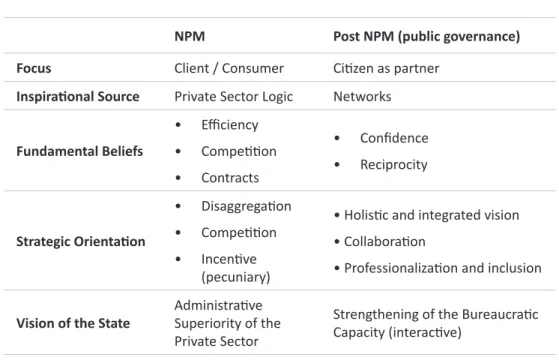
Despite the limitations of this comparison, many of these principles / guidelines approach the premises of the latest NPM reforms, such as accountability, participation and engagement, as well as the use of ICT strategies to improve management. Likewise, the changes identified in the literature as post-NPM also have differentiated trajectories according to the context and institutional framework of the countries (Christensen; Lægreid, 2007). Nevertheless, if we compare the post-NPM configuration with the start of the performance-based or managerialist movement, the differences are more evident. Table 2 aims to synthesize such differences:
Table 2 – Differences from Original NPM x Post NPM
NPM Post NPM (public governance)
Focus Client / Consumer Citizen as partner
Inspirational Source Private Sector Logic Networks
Fundamental Beliefs • Efficiency • Competition • Contracts • Confidence • Reciprocity Strategic Orientation • Disaggregation • Competition • Incentive (pecuniary)
• Holistic and integrated vision • Collaboration
• Professionalization and inclusion
Vision of the State Administrative Superiority of the Private Sector
Strengthening of the Bureaucratic Capacity (interactive)
Source: Own elaboration.
First, the inspirational source of traditional public administration, within the perspective of the bureaucratic model, is hierarchy. With New Public Management, this source comes mainly from the logic of the market - what has been applied in private companies and adapted to the public sector, however, in the post-NPM the inspiration is neither hierarchy nor market, but the networks, in which the management and provision of public policies are based (Rhodes, 2016; Ayres; Marsh, 2014; Ferlie; McGivern, 2013). Therefore, while in NPM the fundamental beliefs involved efficiency, competition, and contracts, in post-NPM public management, they tend to be trust and reciprocity.
Still in a comparative effort, if we use the categorization of the NPM based on the three great strategic orientations listed by Dunleavy et al. (2006) it is also possible to find significant differences. If in essence the NPM reforms advocated the breakdown of public organizations, intragovernmental competition, and the focus on performance-related pecuniary incentives, the main line of current administrative change is moving in a rather disparate sense. As presented in table 2, the guidelines involve a holistic and integrated view of public management, collaboration and networking, an emphasis on incentives that include not only payment but also the valuing of other factors, including interdisciplinarity and responsiveness of employees to society, as well as involvement and engagement of society as a
prominent actor in the operation of public management. In other words, rather than disaggregation, integration; instead of competition, emphasis on collaboration, and finally, substitution of pecuniary motivation by professionalization of bureaucracy and inclusion of social actors in policymaking.
The convergence of these tendencies with the concept of governance in public sector organizations is also highlighted, since they presuppose the performance of complex and pluralistic societies such as the present ones, based on the networks of partnerships and collaborations. As stated by Menicucci and Gontijo (2016, p.17):
The theme of governance has become a commonplace in the contemporary debate on public management and public policy and a keyword during the 1990s, defining a new role for the state in society [...] the term has a very heterogeneous form, entrepreneurial governance, cooperative governance, good governance, participatory governance, local governance, and sociopolitical governance, among others [...] in general, governance refers to the redefinition and expansion of the forms of relationship between the State and society or between government, private agents and society, having as a distinct aspect the relational dimension, as such it marks a decentralization of the decision-making process and the public action for outside the limits of the formal institutions of the State.
This diversified expansion of the forms of state relationship can be materialized by sharing activities and functions for private agents, primarily seeking efficiency and performance objectives, as in the first generation of the managerialist movement or with objectives of democracy and accountability, close to the most recent initiatives. This is the so-called transition from government to governance (Ayres, 2014) as the connecting axis of all or a good part of the principles and guidelines identified in the contemporary literature.
The idea of governance has a myriad of concepts and adjectives that accompany it – public governance, in networks, interactive, participatory, collaborative, etc. Nevertheless, the most important is to emphasize two factors that distinguish the new governance movement in the post-NPM context: its focus and the role of the State. While the traditional public administration turned to the user and the emphasis of the NPM oscillated from client to consumer, in the logic of governance the focus is the citizen as a partner in the process of formulating and implementing public policies. The citizen not only as final beneficiary of the public service, but also an important player in the process of building public value. According to Bryson, Crosby and Bloomberg (2014), this new movement is a response to the challenges of a multisector, networked world with no exclusive State responsibility, as well as to the gaps in previous public administration approaches.
Thus, in relation to the role of the State, instead of valuing the isolation of bureaucracy, along the lines of the traditional model, or the supremacy of the market in the provision of public services, the focus is on strengthening the bureaucracy's ability to lead this process, but with a more interactive relationship with society. This more hybrid conception of public administration reinforces the relevance of the state apparatus in the provision of public services, but from the recognition that bureaucratic capacity tends to broaden when articulated with social actors, both in deliberative processes and in the implementation and control.
In summary, if on the one hand the trends reflect an incremental character in the configuration of the management principles and guidelines, on the other hand, the comparative effort between the NPM differences and the more contemporary configuration of the public administration emphasizes more expressive changes. In this context, it is evident that the functioning of the current public machine presupposes in the political and ideological dimension a more realistic and balanced view between public and private sector and civil society, in contrast to the hegemonic perspective in the 70s and 80s of market exaltation and the application of its instruments in public administration. Therefore, this harmony tends to reflect in the achievement of the principles and guidelines of the post-NPM, as well as in its management tools and innovative processes/services.
Final Remarks
The main objective of this article was to advance the understanding of the functioning of public management after decades of significant transformations in the structures and forms of action of the public sector. This effort aims to present theoretical parameters to qualify the public administration debate, as well as to support future empirical research that analyzes the functioning of the State.
The quantitative and the diversity of the analyzed literature reinforced the perception of the relevance of the theme in the field of social sciences. It is important to recognize that the article does not include all the literature, however, for reasons of operational feasibility a literature review was developed with pre-established criteria. As expected, the studies highlight the leadership of the Anglo-Saxon and Scandinavian countries in academic practice and debate.
Understanding what has actually occurred and is happening in the public administration tends not only to contribute to the construction of future research agenda, but, mainly, to subsidize the debate about the changes and the decision-making process on the current and future proposals of management improvement. In the same way, it is necessary to recognize the limitations and relative lack of
empirically valid knowledge about reform processes and the current functioning of public management. Such a scenario is due to some major reasons. First, methodological constraints hamper the ability of analysts to compare reforms in public management through orthodox research methods (Pollitt, 2014). In addition, the analysis is affected by the governments' reduced interest in generating reliable information and data on these processes. It is not by chance that the debate on public management is often tainted by simplistic and stereotyped views. Likewise, the weaknesses of knowledge about the phenomenon also tend to generate problems of excessive normativism in the proposals for changes, as well as inadequate adaptations to quite different realities.
Despite such limitations, this literature review has been able to expose essential reflections for the understanding of the functioning of the current public administration. First, in spite of the difficulties of characterizing and condensing the reforms in generations or movements, the analysis of the literature that is intended to discuss the post-NPM converges to the perception that its principles and management guidelines constitute a more continuous process/incrementalism rather than a rupture with the previous paradigm. This finding is due to the fact that most trends are also to be found in recent reform experiences based on the New Public Management. However, when compared to the original assumptions of the Movement, in the dimensions of focus, inspirational source, strategic orientation, fundamental beliefs, among others, the post-NPM differs quite categorically.
In addition, the implementation of trends, as in the NPM, are also presented in different ways, varying according to the context and institutional framework of each government. That is, institutions and history, constructed endogenously, matter to the understanding of the configuration and functioning of the public machine.
It should be noted that the most emblematic feature of current public management is the prevalence of the governance phenomenon, which in different formats can aggregate significant part of post-NPM principles and guidelines mapped in the literature. In this sense, the resumption of the relevance of the State and the public bureaucracy is emphasized, but not in the traditional hierarchical pattern. The role of the staff in the contemporary public sector is directed towards the development of interdisciplinary capacities, constant responsiveness to society, as well as leadership with interactive components.
Finally, another central aspect of the debate is the incongruity of the vision of pure and complete overcoming of management models, be it between the NPM and the traditional bureaucracy or between the post-managerial models and the new public management. The literature suggests a much more incremental and disorderly process than was found in the original proposals, regardless of the
country or historical moment analyzed. As well exposed by Goldfinch and Wallis (2010, p.1099) "as the convergence of new public management, the post-NPM may also be a myth."
Therefore, it seems more advisable for the future research agenda on the operation of public management in the twenty-first century to dissociate from the full framework of the models or paradigms and to emphasize precisely the principles and guidelines of public administration. Above all, given the perception of the high costs and great resistance that the reformist processes usually face (Pollitt; Bouckaert, 2011a). Targeting efforts for small and steady improvements, micro-improvements, in public processes and services, converges to the debate on innovations in public management that are increasingly gaining a strategic dimension in the public sector. Despite the myriad concepts, innovation is usually linked to the improvement of organizational processes, the implementation of new products, procedures, services, policies or systems.
This theme has become, at the same time, the practice of governments and the future research agenda in the area. Innovations naturally constitute the application of the principles and guidelines identified in the literature and, above all, the mix of them. Government innovations presuppose a hybrid arrangement in which characteristics of traditional public administration, NPM and post-NPM coexist. In this sense, recent studies, applied to the Brazilian public administration context, have shown that majority of the initiatives awarded by the Federal Prize for Public Management Innovation4 aggregates many of these trends through the
years, regardless of administrative reforms or top-down political parties directives (Cavalcante; Camoes, 2017; Cavalcante, 2018).
More recently, the most innovative in the public sector involves the use of collaborative analytic tools from design thinking, gamification, open innovation strategies – such as crowdsourcing platforms and practices based on behavioral economics. In sum, such innovative efforts are aimed not only at improving the delivery of public services but above all, at engaging and empowering social actors to generate public value in governmental actions.
References
Ayres, Sarah (Ed). Rethinking policy and politics: reflections on contemporary debates in policy studies. Policy Press, 2014.
Birrell, Derek. The final outcomes of the review of public administration in Northern Ireland. Tensions and compatibility with devolution, parity and modernization. Public
Administration 86.3779-793, 2008.
Borrás, Susana; Seabrooke, Leonard; Schmidt, Vivien. Sensemaking, politics, ideas, and discourses in institutional change. Sources of National Institutional
Competitiveness: Sensemaking in Institutional Change 148, 2015.
Boushey, Graeme T.; McGrath, Robert J. Experts, amateurs, and bureaucratic influence in the American states. Journal of Public Administration Research and
Theory, v. 27, n.1, p. 85-103, 2016.
Bryson, John M.; Crosby, Barbara C.; Bloomberg, Laura. Public value governance: moving beyond traditional public administration and the new public management. Public Administration Review, v. 74, n. 4, p. 445-456, 2014.
Carter, Bob, et al. Taxing times: lean working and the creation of (in) efficiencies in HM Revenue and Customs. Public Administration, v. 91, n. 1, p. 83-97, 2013. Cavalcante, P; Camoes, M. R. S. Do the Brazilian innovations in public management constitute a new model? RAI: Revista de Administração e Inovação, v. 14, p. 90-96, 2017.
Cavalcante, P. Innovations in the federal government during the post-New Public Management Era. RAC. Revista de Administração Contemporânea (Online), v. 22, p. 885-902, 2018.
Christensen, Tom; Lægreid, Per. The whole-of-government approach to public sector reform. Public administration review, v. 67, n. 6, p. 1059-1066, 2007.
Currie, Graeme; Grubnic, Suzana; Hodges, Ron. Leadership in public services networks: antecedents, process and outcome. Public Administration, v. 89, n. 2, p. 242-264, 2011.
Dommett, Katharine; Flinders, Matthew. The politics of quangocide. Policy &
Politics, v. 43, n. 1, p. 3-25, 2015.
Dunleavy, Patrick, et al. New public management is dead—long live digital-era governance. Journal of public administration research and theory, v. 16, n. 3, p. 467-494, 2006.
Esmark, Anders. Maybe it is time to rediscover technocracy? An old framework for a new analysis of administrative reforms in the governance era. Journal of Public
Administration Research and Theory, v. 27, n. 3, p. 501-516, 2016.
Evans, Mark. Gordon Brown and public management reform–a project in search of a ‘big idea’? Policy studies, v. 30, n. 1, p. 33-51, 2009.
Fenwick, John; McMillan, Janice. Public participation and public service modernization: learning from new labor? International Journal of Public
Administration, v. 35, n. 6, p. 367-378, 2012.
management scholarship: the case of evidence-based medicine in UK health care.
Journal of Public Administration Research and Theory, v. 24, n. 1, p. 59-83, 2013. Fossestøl, Knut, et al. Managing institutional complexity. In: Public sector reform: hybridization in front-line service organizations. Public Administration, v. 93, n. 2, p. 290-306, 2015.
Goldfinch, Shaun; Wallis, Joe (Ed.). International handbook of public management
reform. Edward Elgar Publishing, 2009.
_________ Two myths of convergence in public management reform. Public
Administration, v. 88, n. 4, p. 1099-1115, 2010.
Greve, Carsten. Public management reform in Denmark. Public management
review, v. 8, n. 1, p. 161-169, 2006.
Greve, Carsten; Lægreid, Per; Rykkja, Lise H. The Nordic model revisited: active reformers and high performing public administrations. Nordic Administrative
Reforms. Palgrave Macmillan UK, p. 189-212, 2016.
Häikiö, Liisa. The diversity of citizenship and democracy in local public management reform. Public Management Review, v. 12, n. 3, p. 363-384, 2010.
Hood, Christopher; Dixon, Ruth. A government that worked better and cost less. Evaluating Three Decades of Reform, 2015.
Kippin, Henry; Stoker, Gerry; Griffiths, Simon (Ed.). Public services: a new reform agenda. A&C Black, 2013.
Lægreid, Per; Christensen, Tom (Ed.). Transcending new public management: the transformation of public sector reforms. Ashgate Publishing, Ltd., 2013.
Lodge, Martin; Gill, Derek. Toward a new era of administrative reform? The myth of post-NPM in New Zealand. Governance, v. 24, n. 1, p. 141-166, 2011.
Manning, Nick, et al. Reformas de gestão pública: o que a América Latina tem a aprender com a OCDE. Novos caminhos da gestão pública: olhares e dilemas. Rio de Janeiro: Qualitymark. p. 97-148, 2009.
Menicucci, Telma; Gontijo, José Geraldo Leandro. Gestão e políticas públicas no
cenário contemporâneo: tendências nacionais e internacionais. Rio de Janeiro: Editora Fiocruz; 2016.
Meynhardt, Timo; Diefenbach, Fabian E. What drives entrepreneurial orientation in the public sector? Evidence from Germany’s federal labor agency. Journal of Public
Administration Research and Theory, v. 22, n. 4, p. 761-792, 2012.
O'Flynn, Janine; Blackman, Deborah; Halligan, John (Ed.). Crossing boundaries in
public management and policy: the international experience. v. 15. Routledge, 2013. O'Reilly, Dermot; Reed, Mike. ‘Leaderism’: an evolution of managerialism in UK public service reform. Public Administration, v. 88, n. 4, p. 960-978, 2010.
Pawson, Hal; Jacobs, Keith. Policy intervention and its impact: analysing New Labour's public service reform model as applied to local authority housing in England. Housing, Theory and Society, v. 27, n. 1, p. 76-94, 2010.
management delivery forms and efficiency: long-term effects in Spanish local government. Journal of Public Administration Research and Theory, v. 25, n. 4, p. 1157-1183, 2015.
Pierre, Jon; Ingraham, Patricia W. Comparative administration change: lessons learned. McGill-Queen's Press-MQUP, 2010.
Pollitt, Christopher. Forty years of public management reform in UK central government: promises, promises…. Rethinking Policy and Politics: Reflections on Contemporary Debates in Policy Studies. p. 7-27, 2014.
Pollitt, Christopher; Bouckaert, Geert. Public management reform: a comparative
analysis-new public management, governance, and the Neo-Weberian state. Oxford University Press, 2011a.
_________. Continuity and change in public policy and management, Cheltenham & Northampton MA, USA, Edward Elgar, 2011b
Pollitt, Christopher; Dan, Sorin. Searching for impacts in performance-oriented management reform: a review of the European literature. Public Performance &
Management Review, v. 37, n. 1, p. 7-32, 2013.
Powell, Walter W.; Dimaggio, Paul J. (Ed.). The new institutionalism in organizational
analysis. University of Chicago Press, 1991.
Rhodes, Roderick AW. Recovering the craft of public administration. Public
Administration Review, v. 76, n. 4, p. 638-647, 2016.
Schiavo-Campo, Salvatore; McFerson, Hazel M. Public management in global
perspective. Routledge, 2014.
Pedro Luiz Cavalcante
Doutor em Ciência Política pela Universidade de Brasília (UnB). Atualmente é Coordenador de Estudos e Políticas de Estado e Democracia no Instituto de Pesquisa Econômica Aplicada (Ipea). Contato: [email protected]