UNIDADE ACADÊMICA DE PESQUISA E PÓS-GRADUAÇÃO PROGRAMA DE PÓS-GRADUAÇÃO EM COMPUTAÇÃO APLICADA
NÍVEL MESTRADO
ISMAEL MESSIAS GOMES CARDOSO
VULCONT: A RECOMMENDER SYSTEM BASED ON CONTEXTS HISTORY ONTOLOGY
VULCONT: A RECOMMENDER SYSTEM BASED ON CONTEXTS HISTORY ONTOLOGY
Dissertação apresentada como requisito parcial para a obtenção do título de Mestre pelo Programa de Pós-Graduação em Computação Aplicada da Universidade do Vale do Rio dos Sinos — UNISINOS
Advisor:
Prof. Dr. Jorge Luis Victória Barbosa
DADOS INTERNACIONAIS DE CATALOGAÇÃO NA PUBLICAÇÃO (CIP)
Cardoso, Ismael Messias Gomes
Vulcont: A Recommender System based on Contexts History Ontology / Ismael Messias Gomes Cardoso — 2017.
81 f.: il.; 30 cm.
Dissertação (mestrado) — Universidade do Vale do Rio dos Sinos, Programa de Pós-Graduação em Computação Aplicada, São Leopoldo, 2017.
“Advisor: Prof. Dr. Jorge Luis Victória Barbosa, Unidade Acadêmica de Pesquisa e Pós-Graduação”.
1. Recommender Systems. 2. Ontology. 3. Contexts History. 4. Collaborative Filtering. I. Título.
• Thanks to my family for unconditional support. • Thanks to my friends for my comprehensible missing.
• Thanks to Prof. Barbosa to motivate me to be a better person everyday.
• Thanks to my colleagues Leandro D’Avila, Daniel Dupont, Fábio Dias, and Rodrigo Remor for all the teamwork.
• Thanks to my all workmates at SAP, specially Roger Stein for technical and non-technical mind-blowing conversations.
• Thanks to everyone that, directly or indirectly, helped me to reach this point and conclude this step of my journey.
“Choice is the act of hesitation that we make before making a decision.
It is a mental wobbling, and so we are always in a dither of doubt as to whether we are behav-ing the right way, dobehav-ing the right thbehav-ing, and so on and so forth, and lack a certain kind of self confidence.
And if you see you lack self confidence, you will make mistakes through sheer fumbling. If you do have self confidence you may get carried away doing the entirely the wrong thing. You have to regard yourself as a cloud, in the flesh, because you see clouds never makes mis-takes.
Did you ever see a cloud that was misshapen? Did you ever see a badly designed wave? Heh, no they always do the right thing!
But if will treat yourself for awhile as a cloud, a wave, and realize that you can’t make a mis-take, whatever you do.
Because even if you do something that seems to be totally disastrous, it all come out in the wash somehow or other.
Then through this capacity you will develop a kind of confidence, and through confidence you will be able to trust your own intuition.
This is the middle way, of knowing it has nothing to do with your decision to do this or not, whether you decide you can’t make a mistake or don’t decide it, it is true anyway, that you are like cloud and water.
And through that realization without overcompensating in the other direction, you will come to the point of where you begin to be on good terms with your own being and to be able to trust your own brain”.
The use of recommender systems is already widespread. Everyday people are exposed to different items’ offering that infer their interest and anticipate decisions. The context informa-tion (such as locainforma-tion, goals, and entities around a context) plays a key role in the recommenda-tion’s accuracy. Extending contexts snapshots into contexts histories enables that information to be exploit. It is possible to identify context’s sequences, similar contexts histories and even predict future contexts. In this work we present Vulcont, a recommender system based on a con-texts history ontology. Vulcont merges the benefits of ontology reasoning with concon-texts histo-ries in order to measure contexts history similarity, based on semantic and ontology’s properties provided by context’s domain. Vulcont considers synonymous and classes’ relations to mea-sure similarity. After that, a collaborative filtering approach identifies sequences’ frequency to identify potential items for recommendation. We evaluated and discussed the Vulcont’s recom-mendation in four scenarios in an offline experiment, which presents Vulcont’s recomrecom-mendation power, due the exploit of semantic value of contexts history.
O uso de sistemas de recomendação já é amplamente difundido. Diariamente pessoas são expostas a ofertas de itens que inferem seus interesses e antecipam decisões. As informações de contexto (como localização, objetivos, e entidades que cercam um contexto) tem um papel chave na acurácia da recomendação. Ampliando o uso de contextos para histórico de contextos, essa informação pode ser explorada ainda mais. É possível identificar sequências de contex-tos, similaridade entre histórico de contexcontex-tos, e até prever contextos futuros. Neste trabalho é apresentado o Vulcont, um sistema de recomendação baseado numa ontologia de histórico de contextos. Vulcont une os benefícios do raciocínio da ontologia com o uso de histórico de contextos para quantificar a similaridade entre histórico de contextos, com base na semântica e outras propriedades da ontologia definidas pelo domínio do contexto. Vulcont considera sinô-nimos e relações de classes para calcular a similaridade. Por seguinte, um filtro colaborativo identifica a frequência de sequências para estimar items em potencial de recomendação. As recomendações do Vulcont foram avaliadas e discutidas em quatro cenários num experimento offline. O experimento apresentou o poder de recomendação do Vulcont, que é devido a explo-ração do valor semântico de histórico de contextos.
Figure 1 – Representation of ontology components and their relationships. . . 31
Figure 2 – Ontology classification based on structured scope. . . 33
Figure 3 – Ontology classification based on content scope. . . 34
Figure 4 – Partial view of ontology in SigTur/E-Destination. . . 38
Figure 5 – Recommendation component of Protus. . . 42
Figure 6 – SituationReport representing an airport scenario. . . 48
Figure 7 – Contexts history ontology for recommendation. . . 50
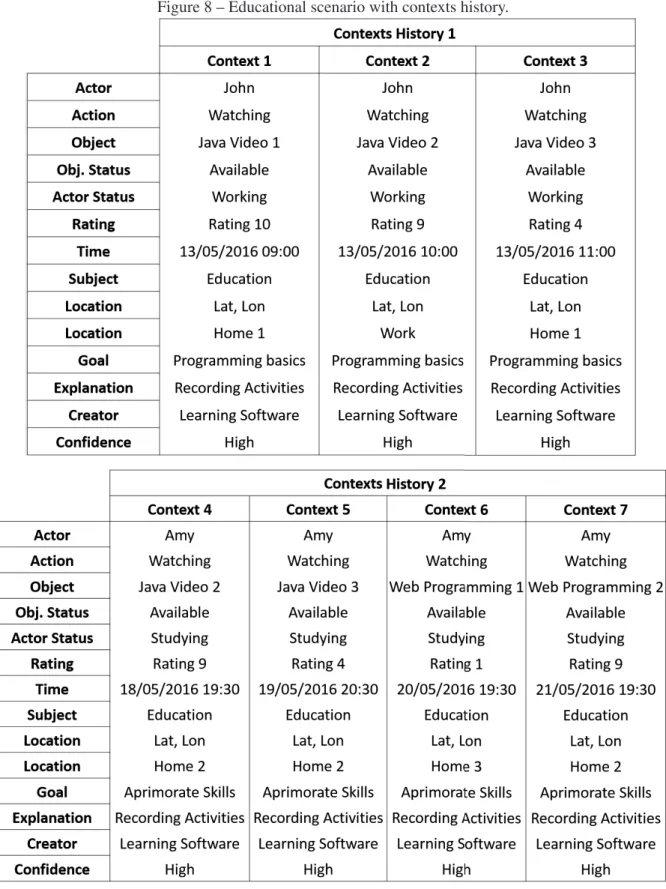
Figure 8 – Educational scenario with contexts history. . . 52
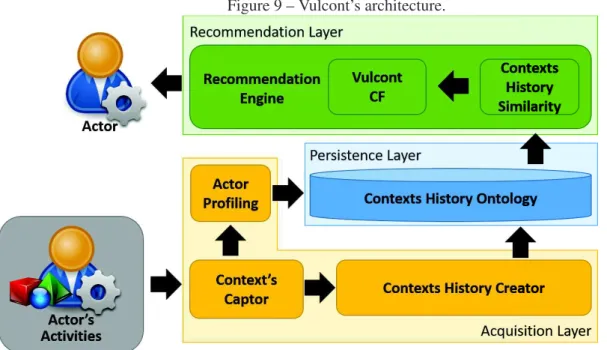
Figure 9 – Vulcont’s architecture. . . 54
Figure 10 – Contexts history partial comparison. . . 57
Figure 11 – Contexts histories with highlighted positive feedback. . . 60
Figure 12 – Genders of Movies organized by taxonomy and synonymy. . . 63
Figure 13 – Scenario 1 - (a) Word cloud for genres in Contexts History A. (b) Word cloud for genres in found movies. . . 65
Table 1 – Comparison of related works based on ontology and recommendation crite-ria. . . 43 Table 2 – Information regarding scenario 1. . . 64 Table 3 – Scenario 2 - Top 5 Objects recommended by its similarity and relevance. . . 66 Table 4 – Scenario 3 - List of movies with positive feedback from most similar contexts
API Application Programming Interface CBR Case-Based Reasoning
CF Collaborative Filtering GUI Graphical User Interface JSON JavaScript Object Notation OMDb Open Movie Database OWL Web Ontology Language POI Points Of Interest
RS Recommender System
1 INTRODUCTION . . . 19
1.1 Motivation . . . 20
1.2 Problems and Research Questions . . . 21
1.3 Objectives . . . 21
1.4 Methodology . . . 22
1.5 Outline. . . 22
2 BACKGROUND AND BASIC CONCEPTS . . . 23
2.1 Recommender Systems . . . 23
2.1.1 Collaborative Filtering . . . 24
2.1.2 Based on content . . . 26
2.1.3 Based on knowledge . . . 27
2.1.4 Based on context . . . 28
2.2 Ontology . . . 29
2.2.1 Ontologies Classification . . . 30
2.3 Contexts History . . . 34
3 RELATED WORKS . . . 37
3.1 SigTur/E-Destination . . . 37
3.2 Ontology-Based Method for Personalized Recommendation . . . 37
3.3 Generic Ontology for CBR-Based Recommender System . . . 38
3.4 A Semantic Similarity Measure for Recommender Systems . . . 39
3.5 Multi-model Ontology-based Hybrid Recommender System in E-learning Do-main . . . 40
3.6 Protus E-Learning . . . 40
3.7 Comparative Analysis of Related Works . . . 42
4 VULCONT MODEL. . . 45
4.1 Vulcont Contexts History Ontology . . . 45
4.1.1 Background for Contexts History Ontology . . . 46
4.1.2 Contexts History Ontology Development . . . 47
4.1.3 Ontology’s Consistency Validation . . . 53
4.2 Vulcont Architecture . . . 53
4.2.1 Vulcont Layers and Components . . . 55
5 EVALUATION EXPERIMENTS AND APPLICATION SCENARIOS . . . 61
5.1 Implementation and Prototype Aspects . . . 61
5.2 Evaluations Scenarios . . . 62
5.2.1 Scenario 1 . . . 62
5.2.2 Scenario 2 . . . 64
5.2.3 Scenario 3 . . . 65
5.2.4 Scenario 4 . . . 67
6 FINAL CONSIDERATIONS . . . 69
6.1 Contributions . . . 69
6.2 Future works . . . 70
1 INTRODUCTION
The world is currently in thebig dataera (CHEN; MAO; LIU, 2014). Information is gath-ered in large scale, and even in excess (HILBERT; LOPEZ, 2011). Among all this information, it is now more difficult to make choices or to decide between a huge variety of options. Some decades ago, the recommender systems (RSs) (BOBADILLA et al., 2013) arose as an option to solve that problem. Their purpose is to provide customized services in several different applica-tions. Nowadays, the RSs are already a consolidated solution as information filtering systems. They have changed the way applications offer different services to end users. It is not hard to identify RSs in daily life, there are different computing areas which use them to provide per-sonalized recommendations with a high level of quality and accuracy (JANNACH et al., 2009). To create these personalized services, the RSs need to estimate the personal taste of users, and propose them a service or item which, based on some kind of knowledge, the RS consid-ers to be relevant for the usconsid-ers’ intentions. Often the RSs take advantage from user’s context information gathered from interactions within the system. They use that information to predict user’s goals and preferences. This approach is also known as implicit data collecting (ADO-MAVICIUS; TUZHILIN, 2005) (OARD; KIM, 1998).
The use of context information (DEY, 2001) is widely spread in many applications from ubiquitous computing (ubicomp) (WEISER, 1999). Some of these applications use RSs to improve services offerings. According to Dey (2001), context is: “any information that can be used to characterize the situation of entities (i.e., whether a person, place, or object) that are considered relevant to the interaction between a user and an application, including the user and the application themselves”. For example, the context information can be related to a physical context (location and time), environmental context (weather, luminosity and noise), personal context (social and group activities), application context (emails, web history), among others.
Contexts history information might be also used in some approaches of RSs, such as col-laborative filtering (CF). This information can support RSs to estimate items of interest for a specific user based on previous experiences. The chronological collection of context infor-mation, known as contexts history(SMITH, 2008) (ROSA et al., 2015) (ROSA; BARBOSA; RIBEIRO, 2016), also calledtrail(LEVENE; PETERSON, 2002) (DRIVER; CLARKE, 2008) (SILVA et al., 2010) (CARDOSO et al., 2016) (BARBOSA et al., 2016), stores the user’s ac-tivity among visited contexts. Using contexts history, RSs can recommend content and services based on the user’s past experiences. Dey, Abowd and Salber (2001) already mentioned the importance of using contexts history for decision-making systems, which is the case of RSs. Also, Silva et al. (2010) used contexts histories to improve services offering in context-aware systems. In other words, the past activities of the user were stored as contexts history; such as performed activities, used applications, accessed contents, and any other possible information; so the applications used a source of information more complete.
de-20
veloped in order the improve the efficiency of recommendations. In one of these approaches, the use of ontologies became an ally with the benefits of formal languages. Ontologies came up with the goal of representing a shared background knowledge for a specific domain (GRU-BER, 1995). Adding ontologies in RSs allowed knowledge-based approaches to be combined with classical machine learning algorithms. So far, ontologies have been frequently used in RSs along with machine learning, statistical correlations, user profiling and domain specific heuristics (PAIVA; COSTA; SILVA, 2013).
In this work we propose Vulcont, a recommender system based on a contexts history on-tology. Using ontology reasoning, Vulcont is able to explore the semantic value (taxonomy and synonymy) of contexts history, that compares the contexts history of an Actor (the entity which is the recommendation’s target), with other contexts histories from a community. With that comparison, Vulcont can leverage contexts history similarity, identifying the most similar contexts histories that can provide Objects (recommendation’s items) which are suggested to Actorsas personalized recommendations, according to their preferences.
1.1 Motivation
In last decades, the data gathering and data flow have increased considerably. How to extract relevant information from a huge data volume is a question that motivated and still motivates studies from several areas, such as Bayesian networks, decision trees, support vector machines, neural networks, among others. These research fields that extract useful information from a huge data volume are been increasingly required.
As another subclass of information filtering systems, the recommender systems arise as a solution for the data volume problem. They came up in order to help people to handle high information flow, providing personalized recommendations of items and services for a potential interest. Among all RSs’ approaches, we can highlight the CF which works based on informa-tion gathered from a users’ community. This type of RS is widely used and had been studied over the last fifteen years.
1.2 Problems and Research Questions
In this proposed approach for RS, Vulcont uses contexts history ontology to leverage con-texts history similarity exploring semantic relations. Hence, there are several questions that arise regarding this research. Some of these questions are:
• How to perform personalized recommendation based on contexts history ontology? • How to calculate contexts history similarity from contexts history ontology?
• How effective is the use of ontology to model contexts histories and reasoning user’s experiences from it?
• How to model an ontology to cover contexts history domain as generic as possible? • How to specify the quality of recommendation in order to compare with common
ap-proaches?
In this work, we look for the answers of above questions. We would like to investigate the use of ontology for contexts history domain, and also its reasoning to explore contexts history knowledge as information source for personalized recommendations.
1.3 Objectives
This study aims to explore contexts history ontology to provide personalized recommenda-tions. Vulcont uses ontology reasoning to calculate the similarity between two contexts histo-ries, which is a source information to elaborate recommendations. So according to the contexts history that every user has, we are able to calculate the similarity with other contexts history from community. With the most similar ones, Vulcont can offerObjectsas personalized recom-mendations. In order to achieve this major goal, we list the objectives as follows:
• To analyze the theoretical foundation of areas involved, clearly defining the concepts used in the study.
• To identify relevant related works, and compare them based on clear criteria.
• To model and implement the contexts history ontology, considering also reuse of existent ontologies
• To specify the recommendation system that using contexts history ontology is going to provide its recommendations
• To develop a functional prototype based on Vulcont model’s definitions.
22
1.4 Methodology
Initially, we researched about the use of ontologies in the area of recommender systems. We leverage the scenarios and advantages of using ontologies to generate recommendations. We researched the context-aware computing area to identify main studies related to user’s contexts, and the use of contexts histories. Then we merged both areas, identifying study proposals of recommender systems based on contexts history.
After that, we searched about related works, elaborating the problems’ definition. Once the problems were defined, we identified a clear possibility for contribution. In the sequence, we defined the contexts history ontology, as well as Vulcont’s model. We developed and tested the contexts history ontology that is used by Vulcont. The following steps for the research were: to describe evaluation scenarios, to implement Vulcont’s prototype, and then evaluate Vulcont’s model.
1.5 Outline
2 BACKGROUND AND BASIC CONCEPTS
In this chapter we are going to present several definitions and concepts from areas involved in this study. Firstly we will present the recommender system concept, its classifications and characteristics. Then we will introduce ontology, its definition, why to use it, and some classi-fications as well. Following, it is presented the concept of contexts history, also known in other studies as trails.
2.1 Recommender Systems
Every software tool or technique which has the major goal to provide items for a user is con-sidered a recommendation system (MAHMOOD; RICCI, 2009) (RESNICK; VARIAN, 1997) (BURKE, 2007). Those suggestions can be related to many different decision-making process, for instance: Which item to buy? Which music to listen? Which news to read?
The generic termitemdirectly refers to what the system recommends to the user. Therefore, the RS is usually designed considering the kind of item that is going to be recommended, such as movies, books, news, products, and so on. The items are recommended according also to the graphical user interface (GUI) and the main recommendation technique. All that to provide recommendations to users, helping their decision-making process.
From beginning, the RSs are designed for inexperienced users or users which have difficulty to evaluate a huge diversity of items that a website is able to provide (RESNICK; VARIAN, 1997). Nowadays, many web systems from e-commerce (Electronic commerce) are using RSs. One example is the websiteAmazon.com, which customizes its online store according to every user. Since the recommendations are dynamically generated, different users have different rec-ommendations. However, still exists recommendations which are non-customized, and hence do not identify needs and preferences of user (SAMPAIO, 2006). This approach of recom-mendation is simple and widely used by magazines, newspapers, and news websites. A typical example is the Top 10 most viewed news. Although this approach is effective in certain cir-cumstances, this non-customized recommendation is not attractive for studies in RS research field.
In order to elaborate customized recommendations, the RS requires information related to every user. Therefore, it is necessary the RS to manage users’ profile (JANNACH et al., 2009). Although the existence of user profiles in RSs is totally essential, there are many approaches to consume that information, once it depends on recommendation technique used in the specific system. The user preferences can be obtained implicitly or explicitly, for instance monitoring the user’s behavior, or explicitly asking the preferences and needs to the user.
24
you can use your recommendation letter to improve your chances to get the job; you can read a movie review to check if it does worth watching it.
Intending to imitate this specific behavior, the firsts RSs have algorithms that generate rec-ommendations to a specific user based on users community. The items’ recommendation is performed according to similarity of users’ tastes. This approach is known as Collaborative Filtering (CF). It considers that if two users are similar, then future recommendations for these users will be relevant for both of them. So unevaluated or unknown items can be recommended to a user based on previous evaluation of another user with similar taste/opinion.
The researches in RS field are relatively new if compared with another classic system tools (such as databases and search tools). The RSs arose as a research field in the middle of 90s (GOLDBERG et al., 1992) (MAHMOOD; RICCI, 2009) (MCSHERRY; MIRONOV, 2009) (ANAND; MOBASHER, 2005). Since past years, the interest in this field is growing accord-ingly. For example, the Netflix, a service of online streaming of movies and TV series, promoted a competition to significantly optimize their RS. The reward for the winner was 1 million dollars (KOREN; BELL; VOLINSKY, 2009).
Among all recommendation approaches, we can highlight some of them, which have several studies in their areas along past years. This is the case for CF, recommendation based on content, based on knowledge, and hybrid approaches. It is also possible to highlight some new approaches, which is the case of RS based on context. The description of these approaches will be discussed in following subsections.
2.1.1 Collaborative Filtering
According to Jannach et al. (2009), the main idea in CF approaches is to explore historic information from users, or the opinion of a users community, in order to predict items that the user might be interested or can help user to achieve a certain goal. Nowadays, this kind of RS approach is already spread into several industry fields, mainly as a tool in commerce websites. This tool is able to customize the entire website according to user needs or preferences, promote additional items, and hence sales increasing.
Considering an academical perspective, this RS approach has been explored in a long term. Hence its advantages, performance, and limitations are already well-known. Along the years, several algorithms and techniques were proposed, implemented, and tested by simulation or real data cases. The purely CF approaches usually have an input matrix with user-item classification, and with that, two outputs can be generated: (1) a value, which indicates how much the user is willing to like the item; and (2) a list of several recommended items, for example a Top-10, which obviously exclude items already known by the user.
have similar past evaluations with the active user. Therefore, for every item which the user does not know, we can estimate the interest for that specific item according to nearest neighbors evaluation. The method has two assumptions: (1) users with similar interests in the past, will still have similar interests in future; and (2) the user preferences remain statics and consistent along the time.
The success of CF is real, so are the other challenges that arise with virtual commerce. In that particular scenario, it is complicated to identify in real time the nearest neighbors to perform recommendations. In this case, we use a different approach which is based on items. In that technique, it is possible to perform offline pre-processing, which allows recommendations from a large-scale matrix of evaluations (SARWAR et al., 2001). This different approach uses similarity of items, not of users as in CF.
There are several ways to get an item evaluation from the user. Explicitly asking the user is probably the most accurate one (JANNACH et al., 2009). In most cases, scales with 5 or 7 points are used. The scales approach has a low complexity once they can be converted into values and hence used in similarity calculations. The study of Cosley et al. (2003) explored the use of different evaluation scales and changes in the evaluation behavior of user. The scale’s size is also important, which changes according to application area. One example is the study of Goldberg et al. (2001) which uses a scale from -10 to 10 in a RS for humorous domain. It is important to identify that the scales should change according to the application they are designed for, and the precision required. This way, it is possible to correctly evaluate without losing information related to user preferences. Some interesting topics related to scales, such as how the recommendation precision is affected by scale, or how to determine the optimal number of scales, are still open fields, as the study of Cosley et al. (2003) refers.
The main drawback of explicit evaluation is the additional effort that the user has to perform. Sometimes the user is not willing to provide it, or just refuses to do it. Therefore, the number of obtained evaluations will considerably decrease, which can also affect the quality of recom-mendations. At the same time, the study of Schafer et al. (2007) comments that this problem is not critical, once it is only necessary a few pioneer users. These pioneer users provide many items evaluations after starting the system, which will be stabilized after that.
In other hand, the implicit evaluations are collected by an application which is integrated with the RS. For example, if the user buys an item, this could be considered a positive evalua-tion. The system can also monitor the search history of user. If the user stays in website page long enough, the system could also estimate it as a positive feedback related to the item.
26
even result in generated user models more accurate than explicit evaluations.
2.1.2 Based on content
RSs based on content use an approach to recommend similar items from the ones which the user showed interest in past. That way, the RS based on content compares the information from profile user, getting user’s preferences and interests previously stored, based on item’s attributes. After that, the system estimates similar items which the user could be interest, providing the recommendation (JANNACH et al., 2009).
The systems which provide recommendations based on content analyze a set of documents and/or items’ descriptions which were already evaluated by the user, and then generate the user model/profile based on attributes of those items (MLADENIC, 1999). This generated profile represents the structured interests of the user, which will be posteriorly used by the RS to recommend new items. If the profile matches the user preferences, the information processing is significantly increased. For example, this information can be used to filter search results, determining if the user has interest in certain item, displaying only the interested ones.
Using the based on content approach, there are some advantages comparing with the collab-orative approaches (RICCI; ROKACH; SHAPIRA, 2010):
• User independence - Recommendations based on content are able to generate user profile through evaluations provided by the user. While in CF, it is necessary several different users’ evaluations so the system is able to provide recommendations.
• Transparency - Explanations of how the RS provides its recommendations can be explicit, showing the content which induced the recommendation of certain item. This can also indicate if the recommendation is trustful or not. In an opposite way, CF approach is considered a “black-box” once the explanation of a recommendation is not provided, since it is based on unknown users with similar interests.
• New item - RSs based on content are able to provide recommendation of an item, even if the item was never evaluated before. So this approach is not impacted by the problem of “first evaluator”, which occurs in CF approach. The “first evaluator” problem occurs when the item was not evaluated, and therefore can not be recommended.
However, there are still some drawbacks to be considered in the approach based on content, as shows the study of Ricci, Rokach and Shapira (2010):
• Excess of specialization - RSs based on content do not have a method to recommend unusual items. The systems suggests item which matches the profile user, then only similar items are recommended. Thereby, there is a tendency to the system to produce recommendations with a low innovation to the user.
• New user - A significantly evaluation quantity should be collected before the system com-prehend the users preferences and interests, to then provide accurate recommendations. Therefore, in cases where the user has a few performed evaluations (such as a new user), the system will not be able to perform trustful suggestions.
For the problems reported above, there are studies which minimize them. For example, the study ofWordNet (MILLER et al., 1990) explored the limited content analysis problem, while the study of Sheth and Maes (1993) checked the issue regarding the excess of specialization.
2.1.3 Based on knowledge
While RSs which use CF techniques rely on community evaluation as knowledge source for generating recommendations, RSs based on content use different sources of information to determine if the user would like certain item. Both systems have advantages when it comes to knowledge acquisition and maintenance, which have a low cost.
Both presented approaches have pros and cons, but there are also scenarios where these approaches will not have the desired performance. For example, some of these scenarios are the housing, cars and computers market. These items are not frequently bought by the same user. In such scenarios, a purely collaborative RS would not be able to recommend due the low number of available evaluations (BURKE, 2000). Furthermore, the time has a key role since past evaluations might already be outdated (mainly in computers scenario). Hence the item’s evaluation can not help in RSs based on content. The use of specific requirements is also unusual in RSs that use CF or based on content approaches.
For that mentioned problems, there is new category of RSs, which is based on knowledge. The main advantage of these RSs is the fact they do not use evaluations as source for estimating recommendations. The recommendations are generated independently of individual evaluations of users. Instead, the RSs based on knowledge are focused on information filtering (KONSTAN et al., 1997) (PAZZANI, 1999), listing the most probable items that the user might be interested. The recommendation process in RSs based on knowledge is highly interactive. This inter-active aspect changed the interpretation of filtering systems into a broader one, which we define today as RS (BURKE, 2000). The recommendations performed by RSs based on knowledge rely on any knowledge sources which are not explored by CF or based on content approaches (BURKE, 2000) (FELFERNIG; BURKE, 2008).
28
2010) and RSs based on case (BRIDGE et al., 2005) (BURKE, 2000). Both approaches are similar in recommendation process, where the user specifies requirements and the system looks for items which matches the specification. If no item is found, the user should change his/her requirements. The difference between the two approaches rely on how the knowledge is pro-vided. While the one based on case focus on similar items using different similarity measures, the RSs based on restriction depends on a specific set of defined restrictions.
In RSs based on restrictions, the recommended set of items is determined by items which fit the defined restrictions. In other way, RSs based on case use similarity to quantify the difference between two items, the one required by the user, and the possible items available for recommendations.
2.1.4 Based on context
The study of Ranganathan and Campbell (2003) defines context as “any information about circumstances, objects or conditions that surround the user, which are relevant for the interaction between user and ubiquitous environment”. Therefore, the context becomes an additional infor-mation when compared to traditional inforinfor-mation in user profiles (as demographics or interests), and can refer to information in several contexts such as physical (location, time), environmental (weather, light, sounds levels), informatives (stock exchange, games score), personal (health, humor, agenda, activities), social (group activities, social activities), applications (emails, web history), and systems (network traffic load, printer status) (RANGANATHAN; CAMPBELL, 2003).
Most of existent approaches in RSs are focused on recommend most relevant items to a specific user, not considering context information, such as time, location, or user’s company. Hence, traditionally RSs handle applications with only two distinct entities with context associ-ation: users and items. However, in many applications (for instance tourism and adaptive web areas) considering only user and item might be enough. It is also important to consider context information in recommendation process to suggest items to user under specific circumstances.
To consider context information in RSs already is a requirement, inherited from ubiquitous computing. The work of Schilit, Adams and Want (1994) revealed the most important aspects to be considered: where you are?; who is with you?; which are the resources close to you?. The current user’s location, user’s companies, and the resources availability next to user, if properly explored, can increase recommendation accuracy in mobile applications. We can notice that the boundary between user model and context model is not quite defined. Particularly, differing user’s interest in short or long term is a research point explored by studies related to user’s profile modeling and personalization.
area has the majority of studies. However, is it not huge the quantity of applications which were evaluated in various research fields (JANNACH et al., 2009). Considering only the point of view of recommendation technology, in most practical cases the application only handles context awareness as a filter, where the inadequate items are removed according to context parameters (for instance, the location information). Consequently, this requires more studies related to RSs with context awareness.
2.2 Ontology
Over the past few years, the ontology’s use has become widely spread. Several different areas are interested in its use and retrieve the best from its benefits. These areas such as web technologies, expert systems, and artificial intelligence are requiring the use of semantic mean-ing and relations to infer information from a huge knowledge base. The technology is currently inbig dataera, where information is abundant and even gathered in excess. The ontologies are now a relevant solution option when it comes to efficient and effective information gathering.
The recommender systems (RSs) has also emerged along the huge gathering of information. Recommender systems are now a vital solution, widely used in manifold areas that want a personalized offering of service. Simple examples are easily identified in normal day life: you access a shopping website, several items are offered; you want a movie to watch based on your personal taste, most relevant films are available to you; you need some tips to find best place for your vacations, you can count on many tourist systems that can offer you such information. The use of ontology in RSs has started in last decade and until now it is a research field with high growth potential. This occurs due the current importance of recommender systems, which are widely used by big and small companies that want to offer a personalized service to every user; due the quantity of studies that approach new techniques and architectures for different domains; due problem’s complexity, which remains open since there is not a best approach that fits all.
The term ontologyhas many different meanings. The term is originally related to philos-ophy, already been studied for over two thousand years, where it is a systematic account of existence. In computing science, the term became relevant in 90s, mainly related to Knowledge Acquisition (GUARINO; OBERLE; STAAB, 2009). In that time, Gruber (1995) set the basic definition as following: “An ontology is an explicit specification of a conceptualization”. Later in 1997, Borst (1997) defined ontology as a “formal specification of a shared conceptualiza-tion”. Finally in 1998, Studer, Benjamins and Fensel (1998) merged both definitions into “An ontology is a formal, explicit specification of a shared conceptualization”. But still after that definition, the concept of every statement’s element is ambiguous. So also the elements need their definitions as follows:
30
conceptualization: the objects, concepts, and other entities that are assumed to exist in some area of interest and the relationships that hold among them. A conceptualization is an abstract, simplified view of the world that we wish to represent for some purpose. Every knowledge base, knowledge-based system, or knowledge-level agent is committed to some conceptualization, explicitly or implicitly”.
• Formal and explicit specification - A explicit specification is related to specify the exten-sion of every relation in the described world. The relation can not have an ambiguous comprehension, this is difficult since we humans do this specification implicitly. While the formal refers to expressions that a machine can read, so natural language is removed. • Shared - Even though the conceptualization can not be exactly shared, since it depends on conceptualization of every individual, it is possible to share an approximation of con-ceptualization. A non-shared ontology will be less effective then a shared one, since the stakeholders need to know all primitive terms that the ontology represents.
In 1999, Amann and Fundulaki (1999) defined Ontology in a mathematical way, where the ontology is a triple O = (C, S, isa) where:
1. C is a set of classes, where every class refers to a set of real world objects, which are instances.
2. Sis a set of slots, where every slot can refer to a property of class, or a relation between two classes.
3. isais a set of inheritance relationships between classes. These relationships have subset semantics, and organize the classes in tree structures.
In 2001, Noy, McGuinness et al. (2001) defined ontology as a formal explicit description of concepts, or classes in a domain of discourse. The slots of classes are properties such as attributes and relation between two classes. There are also restrictions on slots (also called as facets or role restrictions), which maintain and guarantee the ontology’s semantic integrity.
2.2.1 Ontologies Classification
According to the evolution of ontology’s concept, there are still different variations of ontology. An ontology can represent different computer science objects according to needs (ROUSSEY et al., 2011). Every variation of ontology has a specific application for use, since their content differ. For instance, an ontology can be:
• a thesaurus for information retrieval
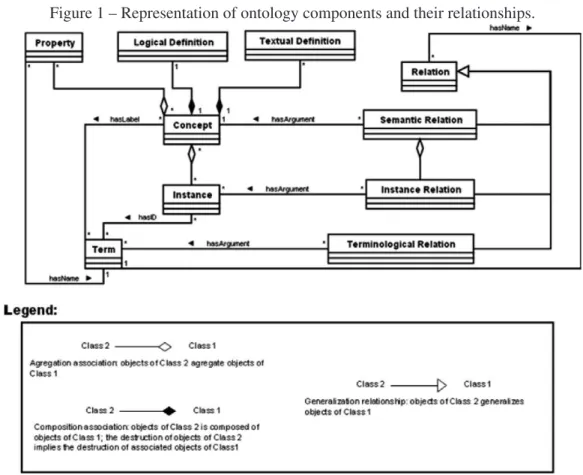
Figure 1 – Representation of ontology components and their relationships.
Source: (ROUSSEY et al., 2011)
• a XML (eXtensible Markup Language) schema for database contexts
There are specific works that focus on ontology’s classification (LASSILA; MCGUINESS, 2001), (GÓMEZ-PÉREZ; FERNÁNDEZ-LÓPEZ; CORCHO, 2006), (BORGO, 2007), (ROUSSEY et al., 2011). These studies classify ontologies, but each one considers a different perspective. There is the ontology’s classification based on expressivity and formality of language used (nat-ural, formal, etc.), and also based on the scope of the objects’ description.
The ontology’s expressivity relies on the components used. These components can be con-cepts, properties, instances, axioms, among others. Roussey et al. (2011) represented these components as shown in Figure 1, where the ontology’s classification is based on language ex-pressivity. The expressivity can be aTextual Definition of aConcept, or a set ofProperties, or even a Logical Definition, these three are known as intentional definitions. Also, the Concept can be defined by a set of Instances, called extensional definition. Concepts, Instances and PropertiesuseTermsso humans can understand by just reading. The ontology’s component are linked byRelations:
• Semantic Relation- Connect onlyConceptstogether.
32
• Terminological Relation- Express the relationships that terms can have, for example syn-onyms, antsyn-onyms, etc.
The work of Lassila and McGuiness (2001), also cited in Gómez-Pérez, Fernández-López and Corcho (2006), presents a classification of ontology based on expressivity and how the information is internally structured. The classification can be summarized as shows Figure 2. The main categories are listed as follows:
• Catalogs - The simplest notion of ontology can be a controlled vocabulary, a simple catalog with a finite list of terms.
• Glossaries- Beyond a list of terms, they also contain their meanings in natural language. • Thesauris- They provide additional semantics in relations between terms, for example
synonym relation. However, they do not use hierarchy structure.
• Informal is-a hierarchies - They share informal is-a hierarchies below a concept. Such hierarchies are not strictly subclasses or “is-a” relations.
• Formal is-a hierarchies- It contains subclasses relation. These type of hierarchy is nec-essary to exploit inheritance.
• Formal is-a hierarchies with instances- Beyond is-a hierarchy features, it also contains instances of the domain.
• Frames- These ontologies have classes with properties, that can be inherited according to formal is-a taxonomy.
• Ontologies with value restriction- Similar to frames, but they can have value’s restriction for a property.
• Ontologies with logical constraints- Most expressive ontologies, where it is possible to express first-order logic constraints among terms using expressive ontology languages.
According to the usage of these components, Roussey et al. (2011) presented four types of ontology as follows. The classification started from the less formal languages to the more formal one.
Figure 2 – Ontology classification based on structured scope.
Source: (LASSILA; MCGUINESS, 2001)
2. Linguistic Ontologies - They can be glossaries, dictionaries, controlled vocabularies, tax-onomies, folkstax-onomies, thesauri, or lexical databases. Focus on terms and their relation-ships. They are normally used to present and define the domain’s vocabulary, but also it is the definition of a terminology agreement that a community has over certain domain. This is necessary in order to avoid ambiguity.
3. Software Ontologies - Focus on data storage and data manipulation. Concepts are defined by a set of properties, and also by relations between them. These ontologies provide conceptual schemata and models.
4. Formal Ontologies - They use formal logic to obtain clear semantics for concept’s defi-nition, clear motivations for differences between concepts, and strict rules regarding con-cepts and relationships definitions. Knowledge Bases are formal systems that use logical definitions to get the meaning of a domain’s vocabulary. The logical definition of a con-cept is composed by logical formulas. These logical formulas (also called axioms) are combinations of concepts and semantic relations. Beside retrieval and storage of data, they also have data reasoning by inference engine due formal definitions and rules. Another classification’s criteria considers the scope that ontology is designed to cover. The narrowest scope is a Local Ontology, while the opposite are Foundational Ontologies, which can be interpreted as meta ontologies that describe concepts in highest level. Based on Roussey et al. (2011), the classification specifies six types of ontologies by their scope, as shown in Figure 3, and their definitions are the following:
1. Local/Application Ontologies - Specializations of Domain ontologies. Represents a spe-cific model of domain for a single point of view.
2. Domain Ontologies - Represents a domain for a certain point of view. The view is defined by a group of people, so there is a consensus about its definition.
34
Figure 3 – Ontology classification based on content scope.
Source: (ROUSSEY et al., 2011)
4. Core Reference Ontologies - Standard ontology used by distinct users groups. Integrates different points of view for a specific domain, usually aggregates domain ontologies. 5. General Ontologies - These ontologies are not designed for specific domain. They have
general knowledge regarding a huge area.
6. Top Level/Foundational Ontologies - Generic ontologies for very general concepts, even representation of world assumption. They usually define objects, relations, events, proce-dures, etc.
Based on the presented classifications of ontologies, the ontology used by Vulcont is a formal ontology. Vulcont’s ontology uses formal logic to obtain semantic relations. These relations are expressed by strict rules or relations between concepts. They rely on domain knowledge, therefore the rules need to be defined or revised by a domain expert. Based on the scope, Vulcont’s ontology is a domain ontology designed for recommendations.
2.3 Contexts History
According to Clarke and Driver (2004) a trail is a collection of locations with associated information in a recommended visitation order. The authors use the term trailto express the caption of daily user’s activities, which will be used to adapt how mobile application with context awareness works. The mobile application can then consider the user history, as well as the previously visited locations. Applications with trail awareness use these sets of con-text information, such as the traffic in different highways, transportation facilities and weather conditions. Hence they are able to provide services as suggestion of alternates routes, or also manage logistics for transportation companies.
related to how the user used suggestedtrails. Including information regarding the originaltrail recommended by application, the reorganization oftrailsthat happened, the current user’strail, and also additional information related to the context; all this information can indicate why the user did not follow the original recommendedtrail.
Posteriorly, the work Driver and Clarke (2008) definestrailas a set of activities to be per-formed by a user, similarly as a to-do list, with an organized sequence to be followed according context information and user’s preference. The authors argue that the trail can be used as a generic model, attending requirements of time managing applications with context awareness. Thetrailscan even overcome traditional techniques from this kind of application, that instead of using static lists, uses dynamically ordered lists according to user’s context. From this, Driver and Clarke (2008) presents a framework able to provide functionalities to generatetrails according to changes in current user’s context.
An analysis of this data could support the applications’ development of collaborative con-texts. In the study, the authors define collaborative context as the data sharing between devices in ubiquitous computing environments. From the trails history analysis, it is possible to im-prove some features of this kind of application. Some examples are: To avoid the generation of unnecessary trails, the hypothesis verification, and also adaptation according to user’s feedback. In the doctors thesis of Smith (2008), storing user’s activities along with context information generatescontexts historyvisited by the user. Thesecontexts historiescan also be calledtrails, term used in work of Driver and Clarke (2008). The work Silva et al. (2010) proposes a trail management model which uses a service architecture available for client applications. In more recent studies, such as Li, Eickhoff and Vries (2012),trailsare defined as a sequence of points of interest (POI) which the user daily have. The authors propose a prediction model, which identifies locations types which will compose the trail according to visited locations already stored in atrail.
3 RELATED WORKS
In this chapter, we are going to analyze and compare the related works of Vulcont’s study that were found. The main search criteria for related works was based on studies which involve recommender systems based on ontologies. Moreover, we filtered by recent works that used a hybrid approach in its recommendation system, since hybrid approaches can have a better performance with fewer of the drawbacks of a single approach (BURKE, 2002). The related works were evaluated based on ontology’s usage and recommendation aspects. For the first topic, the scope reveals the ontology’s wideness; how the ontology is created, if manually or in an automatic way; and if the ontology has user profiling. For the recommendation aspects, the discovery and recommendation algorithms are evaluated, and also if the recommender system uses contexts histories in its recommendations.
3.1 SigTur/E-Destination
The work of Moreno et al. (2013) presents SigTur/E-Destination, which is a web recom-mender system for tourism in Spain, specifically for the region of Tarragona. The study men-tions several ontologies created for tourism domain. The most recent was cDOTT ontology (BARTA et al., 2009), a core domain ontology which is based on Harmonise ontology and de-fines common ontology to support interoperability of agents in low-level operation. Harmonise (FODOR; WERTHNER, 2005) was one of first ontologies aimed for tourism, designed to cover four topics from the domain: attractions, events, food and drink, and accommodation.
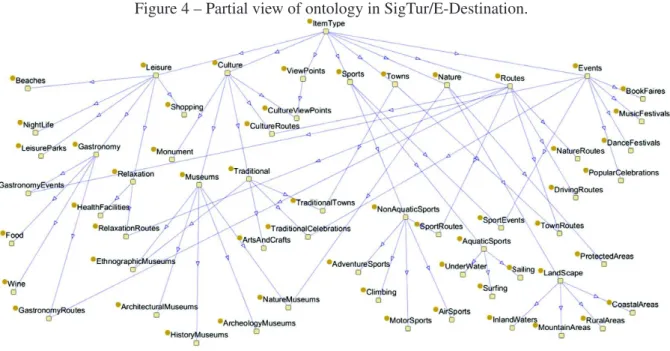
The ontology created for the recommender system was designed according to territorial aspects of the “Camp de Tarragona and Terres de l’Ebre”. The Figure 4 shows a partial view of ontology, with its classes and relationships. The ontology follows main concepts of thesaurus of the World Tourism Organization (UNWTO). The ontology’s details level depends on set of activities in a particular area, where some concepts can be more explored than others. It contains up to 203 connected concepts, in 5 hierarchy levels. The proposed ontology is not a purely taxonomy, since it also contains multiple inheritance between concepts. It was developed using Protégé, represented in OWL Language, using Jena as Semantic Web Framework to manage the ontology and apply inference based on defined rules.
3.2 Ontology-Based Method for Personalized Recommendation
38
Figure 4 – Partial view of ontology in SigTur/E-Destination.
Source: (MORENO et al., 2013)
ontologies are built from three main types of sources: unstructured text documents, structured relational data sources, and semi-structured data sources in XML files.
For the structured case, the local ontologies are generated using RDB2OWL ( ˇCER ¯ANS; B ¯UMANS, 2010) and XML2OWL (LACOSTE; SAWANT; ROY, 2011) mapping specification languages. Also, the mappings rules are defined according to schema and the query language. However, the study does not indicate what kind of rules can be extracted from data sources. Since the ontologies are created from different data sources, their domains can be considered as generic once it relies on data sources content.
For the recommendation, the system uses three ontologies: Reference ontology, that is used by the wrappers for filtering the results and discarding coordinates that does not relate to the terms in the query; Domain ontology, which is built from local ontologies; and User’s interest ontology, generated by analyzing user’s demographic characteristics (such as civil status, age or studies, identify the user in a social group or domain) and personal preferences information.
3.3 Generic Ontology for CBR-Based Recommender System
domain, thecomponentsare described according to domain knowledge. For that, they used two generic OWL properties in every component: GenericObjectProperty and GenericDataType-Property.
In order to get the most similar cases, two different types of similarity measure were used: (1) Local Similarity, that measures the similarity of each feature’s value of case; (2) Global Similarity, that compares the new problem with the existing cases. For the CBR engine devel-opment, the jCOLIBRI Java framework (DÍAZ-AGUDO et al., 2007) was used. It provides a reusable and extensible architecture. The work did not perform any evaluation regarding the recommendation, since the focus was how to represent the case in a generic way, and also the integration with CBR system.
In a new work of Karim et al. (2015), the authors continued the research and presented a merge of CF with CBR recommendation for cross-domain applications. Differently from the first work, this new work presented a section to evaluate the provided recommendation. The evaluation used scenarios to analyze the generated recommendations according to three different user personal preferences. For future works, they proposed more complex scenarios, using recommendation of compounded items.
3.4 A Semantic Similarity Measure for Recommender Systems
The work of Lémdani et al. (2011) presented a semantic similarity that compares the rela-tions between two individuals of an ontology, which can be used in recommender systems. This semantic similarity was designed to ontologies, regardless the domain of scope. They use a dif-ferent approach and consider an item as being defined not only by its surrounding individuals (by means of properties), but also by neighborhood.
That similarity works iteratively as in the study Melnik, Garcia-Molina and Rahm (2002). However, in Lémdani et al. (2011), the similarity measure is adapted to generate recommenda-tions. Beyond the recommendation itself, the similarity measure can also be used to enhance user profile management. This semantic similarity is also presented in work Lemdani et al. (2010). When comparing two instances, the relations are considered, and also other instances that are related to the pair which is being compared.
40
3.5 Multi-model Ontology-based Hybrid Recommender System in E-learning Domain
The work of Leyla et al. (2009) developed a hybrid recommender system, for e-learning domain, that merges two types of recommendation: content-based and rule-based. The first uses a domain ontology to represent learning materials. While the rule-based uses ontology to represent user’s interest, so a cluster recommendation is added as an extra semantic recommen-dation.
The content-based recommends items (in this case Webpages) based on previous activities of users, in other words, their interests. While the rule-based recommends based on rules that precisely enable the recommended items to those with particular conditions (LEYLA et al., 2009). For the search engine, the authors used cosine-distance similarity that composes a query vector, and compares it with documents. For the cluster recommendation, a graph partitioning algorithm was developed from previous work Zhuhadar and Nasraoui (2008).
The work also approaches interest-based recommendations using rules. This recommen-dation allows the user to navigate through the semantic structure of his/her query, and select recommended terms. This approach is discussed in more details in previous work Zhuhadar, Nasraoui and Wyatt (2009).
For validation proposes, the authors used Top-n-Recall and Top-n-Precision to measure the effectiveness of re-ranking based on user’s semantic profile. Ten different user profiles were selected for comparing the semantic search engine with the normal search. At conclusion, both personalization and semantic enrichment are potential elements to improve an E-learning Information Retrieval System.
3.6 Protus E-Learning
The study of Protus (PRogramming TUtoring System) (VESIN et al., 2013) proposes a new approach of RS in e-learning research field. The proposed RS is able to automatically adapt according to interests and knowledge level of every learner. The Protus RS is able to recognize different patterns and habits in learning style of users. The algorithm uses clustering techniques in order to group users with similar learning style. Then the habits and interests of users are analyzed by AprioriAll algorithm (PI-LIAN; TONG, 2005), which mines the sequence frequency. Finally, the system presents a recommendation based on rating of these frequent sequences. The Protus was tested in an experimental group, and the results were compared with a different group which learned same content in classical way.
prefer-ences and how material and activities are offered to them will improve the learning adaptation (COFFIELD, 2004). The system was originally designed and implemented as a generic tutor system for distinct programming languages, the first implementation and testing was performed for a Java programming course (VESIN et al., 2008).
The Protus system is composed of five modules. The module’s functions are described bellow:
• Domain Module - This module is in charge of storage all necessary learning material, tutorials, and tests. It basically defines how information content is structured.
• Learner Model - It is a collection formed by static and dynamic information about the learner. This information is used by Protus in order to predict learner’s behavior, hence adapting the content according to learner’s personal taste and needs.
• Application Module - It is responsible for performing the adaptation. It changes the content provided to learner based on learning style.
• Adaptation Module - It follows instructional directions determined by the Application Module. Application and Adaptation modules are separated because adding new clus-ters of content becomes easier. There are two ways to provide personalized content for learners: based on adaptive hypermedia, and the recommendation itself.
• Session Monitor - It is responsible for re-build the learner model along the user’s session. It keeps track of learners’ progress, correcting their errors, and redirect the session if necessary. After finishing the session, learners’ preferences are properly stored on learner model. If the learner does not agree with the proposed learning style, it is possible to change that information at any time, directly editing the learning style.
Beyond the five modules already described, the system has a framework which determines and generates the recommendations. This framework is composed of following three modules:
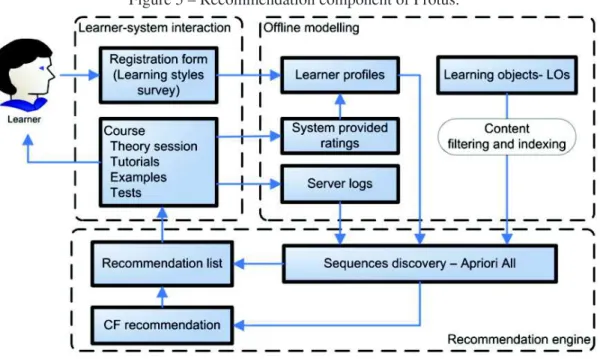
• Learner-system interaction Module - It performs the first steps to built learner models. The information related to learner behavior is gathered here. This data is composed of sequential patterns, visited pages, test results, and earned grades. All content provided to the learner, such as theory sessions, tutorials, examples and tests; considers the input data for the processing.
42
Figure 5 – Recommendation component of Protus.
Source: (VESIN et al., 2013)
• Recommendation Engine - It generates the recommendation list based on filtered learning content and also discovered sequence patterns. For the output, a list of actions and courses are recommended. It will accordingly be used by learner-system interaction in a new session.
The recommendation in designed according to Figure 5. The new learner fills up a registra-tion form for profile’s crearegistra-tion. The profile contains static informaregistra-tion (for example first name, last name, knowledge, preferences, etc.) and dynamic information (interests, dominant mean-ing words, behavior, among others.) The static information is editable. For new users, another survey is filled up in order to generate the first version of learning style. The learning style changes the way content is provided to the learner. In the recommendation system approach, the data is grouped by clustering techniques. So groups of learners are formed by their similar learning styles. The clusters are used as reference for choices in frequent sequences of learning activities. A rating is calculated by the system, creating a recommendation list.
3.7 Comparative Analysis of Related Works
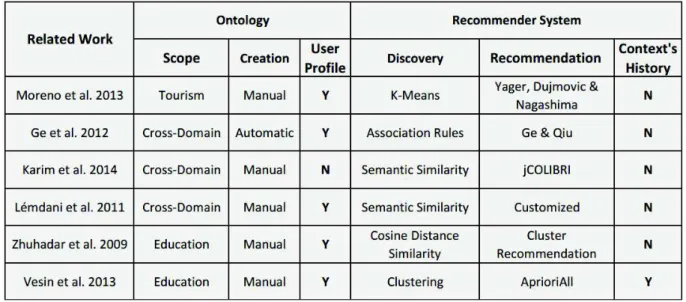
Table 1 compares the related works based on ontology and recommendation aspects. For the ontology criteria, we compared the scope, creation method, and user profile usage. While for the recommendations the relevant aspects are the discovery approach, recommendation algorithm, and the usage of contexts histories.
Table 1 – Comparison of related works based on ontology and recommendation criteria.
Source: Made by the author.
have a wider approach handling cross-domain ontologies. The creation of ontologies is usually performed manually by the related works. The exception is Ge et al. (2012) which creates the ontologies based on a source data. For the user profile usage, all related works have a profile handling except Karim et al. (2014).
Checking the recommendations aspects, for discovery criteria only Karim et al. (2014) and Lémdani et al. (2011) have a semantic similarity approach. While Moreno et al. (2013) uses K-means, Ge et al. (2012) has association rules. Leyla et al. (2009) has cosine distance similarity, and Vesin et al. (2013) utilizes a clustering method for its recommendation discovery. For the recommendation itself, every work has a different method to perform it. Moreno et al. (2013) uses studies Yager (1998) and Dujmovi´c and Nagashima (2006); Ge et al. (2012) refers to its previous work Ge and Qiu (2008) for concept’s semantic distance; Karim et al. (2014) uses jCOLIBRI (DÍAZ-AGUDO et al., 2007); Lémdani et al. (2011) uses a semantic similarity measure based on neighborhood; Leyla et al. (2009) has a clustering recommendation presented on Zhuhadar and Nasraoui (2008); and Vesin et al. (2013) uses Apriori All algorithm (PI-LIAN; TONG, 2005). For contexts history usage, the only study that has this approach is Vesin et al. (2013).
Ob-44
4 VULCONT MODEL
This chapter describes how Vulcont was modeled, and also provides details about its fea-tures. The first section details the contexts history ontology which was designed for Vulcont. The second section provides information regarding the architecture of Vulcont. Furthermore, we explain details about how Vulcont calculates the similarity of contexts histories and performs the recommendations.
4.1 Vulcont Contexts History Ontology
In last years, in computing research area, there were several advances in technologies for Pervasive Computing (SATYANARAYANAN, 2001). Among these acknowledged technolo-gies, we can highlight the use of context information in different applications, also known as context-aware systems. The use of context information was a key factor for further technologies and studies in many different domains, such as education (WIEDMANN et al., 2016), logistics (OLIVEIRA et al., 2015), health (VIANNA; BARBOSA, 2014), and accessibility (CARDOSO et al., 2016).
The use of context information helped for the conceptualization of contexts history. The definition of contexts history, also known in other studies as trails, is provided in works of Driver and Clarke (2008) and Levene and Peterson (2002) as a historical collection of contexts’ data within a certain period of time. A contexts history stores several contexts, in a chronolog-ical way. The location, performed action, and any other information considered relevant, are stored compounding acontexts history element, a kind of context “snapshot”. A chronological collection of these elements compose then a contexts history. Using contexts history, we can explore context’s patterns, similar contexts histories and even predict future contexts (ROSA; BARBOSA; RIBEIRO, 2016).
Besides context-aware systems, another relevant topic discussed in computing researches is regarding how the knowledge can be represented and stored, in order to be comprehensible by humans, but also in a computational way. In theFormal Languageresearch field, the ontologies came up with shared conceptualizations of a specific domain, that are composed by different objects, such as entities, relations, functions, instances, among others.
46
4.1.1 Background for Contexts History Ontology
Before searching for works related to contexts history or context ontology modeling, we explored the widest definition of context information. Since the concept of context is simpler than contexts history (basically a chronological collection of contexts), we focused on context’s definition, so the modeled ontology could cover most scenarios as possible where contexts are used in different domain’s applications.
There are several works that define context information. The work of Gwizdka (2000) elab-orates a compilation of different definitions for the context concept. For example, the definition of context-aware applications by Schilit, Adams and Want (1994), as a “software that examines and reacts to an individual’s changing context”. Furthermore, the same work lists three different kinds of context information: location, nearby people, and accessible computing devices.
There are also differences between internal and external context information. This distinc-tion is defined in study of Schmidt, Beigl and Gellersen (1999), where the proposed model includes human factors, as well as physical environment. Generally, internal context informa-tion is used to describe user state, goals or tasks, user’s work context, busyness, personal events, user’s cognitive, emotional, and physical states. For external context, the environmental infor-mation is used. Such as location, proximity of other objects (people or devices), temperature, and time.
In work of Debes, Lewandowska and Seitz (2005), the definitions of context are listed based on several studies. Some of those works are Brown, Bovey and Chen (1997), Ryan, Pascoe and Morse (1998), and Schmidt et al. (1999). Nevertheless, the definition of Dey (2001) seems as the most appropriate and widely used by researchers community. Following his definition, context involves physical and conceptual status, this information is from interest to a specific entity. Dey (2001) states the following definition: “Context is any information that can be used to characterize the situation of entities (i.e. whether a person, place or object) that are considered relevant to the interaction between a user and an application, including the user and the application themselves. Context is typically the location, identity and state of people, groups and computational and physical objects”.
Following the conceptual idea of entities, Dey, Abowd and Salber (2001) defined three of them as Places (geographical spaces), People (individuals or groups), and Things (physical objects or software components). To describe these three entities, four categories were defined: Identity, Location, Status, and Time. In work of Dey et al. (1997), the necessary context’s information is classified in three categories: Physical context,Action-based context,Emotional context.
differ-ent requiremdiffer-ents. The proposal is specifically to define the most generic context as possible. With that, the ontology can be modeled and implemented, representing the originally required contexts history knowledge for recommendation.
In order to cover a context as widest as possible, we reviewed the existing formal represen-tations of contexts. One of the most known context formalizations is Heckmann (2006) which presents the SituationML. The SituationML is not a formal ontology, but a XML-based tech-nological realization of the abstract model called SituationReports ans SituationalStatements. The “ML” at the end of the term stands for Markup Language. The SituationalStatements rep-resents partial description of situations, such as user model entries, context information, or even low-level sensor data. The SituationReports is composed by several SituationalStatements. The SituationML organizes the information in a predefined hierarchy of meta-levels wrapped around the mainpart. The information in the meta-levels can be interpreted as a collection of slots or attributes arranged in fives layers, which are: mainpart, situation, explanation, privacy, and administration; as illustrated by Figure 6. This Figure also presents how data is stored in every layer, and how the SituationalStatements are organized compounding a SituationReport for an airport scenario.
We also checked different ontology’s studies, such as GUMO Ontology (HECKMANN et al., 2005) and UbisWorld Ontology (STAHL; HECKMANN, 2004). GUMO Ontology has a similar structure to SituationML. Both use the schema “Subject User Model Dimensions -Object”, where the User Model Dimensions has three parts: Auxiliary, Predicate, and Range. Different from the two contexts history representations presented, the UbisWorld can be used to represent parts of real world, for example an office, a shopping mall, an airport. It represents people, objects, locations, events, time, all of that with properties and features. UbisWorld is composed by partial ontologies rather than one for all aspects. The partial ontologies are the following: Physical, Spatial, Temporal, Activity, Situation, and Inference.
4.1.2 Contexts History Ontology Development
In order to have an ontology which represents contexts histories for recommendation in a most reliable way, there is certain knowledge that the ontology should be able to represent. In other words, there are queries (competency questions) which the represented knowledge in the ontology should be able to answer. These knowledge can be found in two different bases: terminological (T Box) composed by concepts definition and axioms; and assertional (A Box) with concepts and roles assertions. Specifying the competency questions, we defined them as the following list:
• What is a contexts history?
48
Figure 6 – SituationReport representing an airport scenario.
• What composes a context?
• What are the contexts associated to an actor? • What are the contexts associated to a object? • What action did the actor perform?
• What is the actor’s goal by performing the action? • Does the actor have a feedback after the action?
• Did the actor get closer to the goal by performing the action? • What is the actor’s status in a context?
• What is the object’s status in a context? • Who captured the context?
• Where the context where captured? • When the context was captured?
With the context’s definition as any relevant information which describes a situation of en-tities, and the definition of contexts history as a chronological collection of context’s snapshots, we propose an ontology ofcontexts historiesfor recommendation. With that, the contexts his-tories and contexts can be modeled and implemented to become in fact an ontology which represents the required knowledge. The ontology was designed using Protégé (KNUBLAUCH et al., 2004), which is an open-source ontology editor.
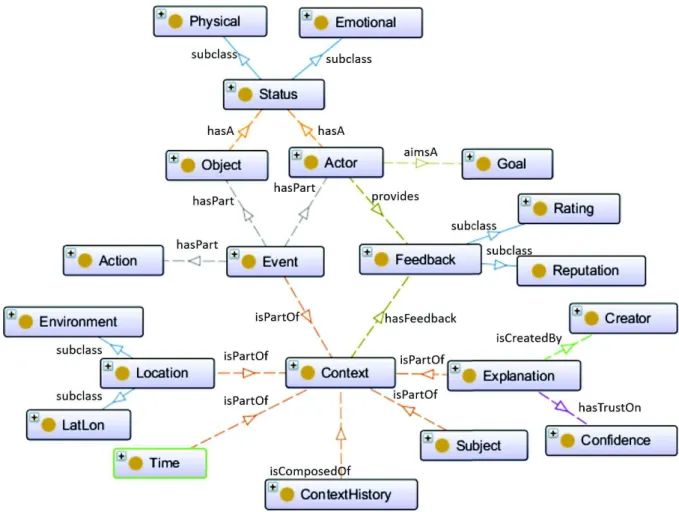
Figure 7 presents a graphical representation of the developed ontology, where all classes and object’s properties are shown. A brief description of every class and its properties are presented as follows:
• Contexts History - It is the main concept that the ontology represents. It has property isComposedOf linked withContexts, since the contexts histories are a chronological col-lection of contexts.
• Context - The key concept of the ontology has a property isPartOf, so other dimensions are part of a Context. A Context has five optional dimensions: Time, Event, Location, Subject, Explanation; and also aFeedback.
50
Figure 7 – Contexts history ontology for recommendation.