GikiCLEF: Crosscultural issues in multilingual information access
Diana Santos*, Lu´ıs Miguel Cabral*, Corina Forascu**, Pamela Forner***, Fredric Gey****
Katrin Lamm*****, Thomas Mandl*****, Petya Osenova£, Anselmo Pe ˜nas$,
´
Alvaro Rodrigo$, Julia Schulz*****, Yvonne Skalban&, Erik Tjong Kim Sang%
*SINTEF ICT, **UAIC, ***CELCT, ****Univ. Berkeley, *****Univ. Hildesheim £BTB group, IPOI, BAS, $UNED, &Univ. Wolverhampton, %Univ. Groningen
[email protected], [email protected], [email protected], [email protected], [email protected] [email protected], [email protected], [email protected], [email protected] [email protected], [email protected], [email protected], [email protected]
Abstract
In this paper we describe GikiCLEF, the first evaluation contest that, to our knowledge, was specifically designed to expose and investigate cultural and linguistic issues involved in multimedia collections and searching, and which was organized under the scope of CLEF 2009. We present the task, its motivation, the results of the participants and the GIRA resource that is offered to the community for training and further evaluating systems with the topics gathered. We end the paper with some discussion of what we learned and possible ways to reuse the data.
1.
Introduction
In this paper we describe the first evaluation contest that, to our knowledge, was specifically designed to expose and investigate cultural and linguistic issues involved in struc-tured multimedia collections and searching, and which was organized under the scope of CLEF 20091.
In a nutshell, GikiCLEF2 provided 50 topics developed with non-English users in mind, to evaluate systems that should answer open3 natural language questions to Wikipedia, using the multilingual and crosslingual prop-erties of this resource. Languages dealt with were: Bul-garian, Dutch, English, German, Italian, Norwegian (both Bokm˚al and Nynorsk writing standards, since they consti-tute distinct Wikipedia collections), Portuguese, Romanian, and Spanish.
GikiCLEF was a follow-up from the GikiP pilot (Santos et al., 2009), organized the previous year as a pilot under GeoCLEF (Mandl et al., 2009), and which addressed 15 questions to the German, English and Portuguese collec-tions (snapshots of Wikipedia created in 2006).
While some features of GikiP were retained, namely pro-viding (manually created or translated parallel) questions in all languages, and rewarding answers in more than one language, there were a number of important and interesting innovations in GikiCLEF (which actually warrant the name change), in addition to a larger number of topics, more lan-guages and larger collections:
• a multilingual, multicultural committee (the authors of the present paper) was set up to come up with dis-tinctly hard, and culturally-relevant, topics;
• a complex support system, SIGA, was deployed to al-low for cooperatively managing many subtasks – the
1http://www.clef-campaign.org/ 2http://www.linguateca.pt/GikiCLEF/
3Open in the sense of not knowing the number of right answers
in advance.
system is open source and available for the commu-nity, and its development largely benefited from user input and extensive use, specially during assessment; • a different evaluation measure was introduced to deal
with the ten collections and not requiring, although preferring, answers in all languages;
• provision for inter-assessor validation, which resulted in a much higher quality of the final evaluation re-sources created;
• the possibility to address justification issues that re-quired more than one page/document to be returned. All these matters will be described in turn. But first we present the task itself with complex examples, and delve into its motivation.
2.
The task
2.1. Basics
The task in which we wanted to evaluate systems’ per-formance was that of using Wikipedia to answer open list questions, that is, questions that have a variable number of answers not known in advance to the questioner.
The answers, in addition, to obey a realistic requirement from real life, had to be justified – in the sense that a human user should be able to confirm the answer correcteness by simply visiting a set of Wikipedia pages.4 In order to sim-plify the issue of result presentation, answers would have to be themselves entries in Wikipedia.5
It should be emphasized that the proposed task was hard for both men and machines because it requires browsing
4
In addition we should stress that – as is the rule in evaluation contests – we consider correct an answer grounded in the collec-tion, we are not after absolute truth.
5
So, technically, the task was a merge of question answering and information retrieval because both the short answer and a doc-ument (or more) would be retrieved.
EX01 pt/s/a/r/Saramago.xml {pt/j/o/s/Categoria Jos´e Saramago 8b43} EX01 ro/j/o/s/Jos´e Saramago f8ad.html {}
EX01 ro/j/o/s/Jos´e Saramago f8ad.html {}
EX01 de/j/o/s/Jos´e Maria Ec¸a de Queiroz 3766.html {}
LI13 en/o/t/o/Otocinclus cocama.xml {en/c/o/c/Cocama language.xml }
EX09 pt/g/u/a/Guaranis.xml {pt/l/´ı/n/L´ınguas ind´ıgenas.xml, pt/l/´ı/n/L´ıngua guarani.xml} EX09 pt/c/o/c/Cocamas.xml {}
EX09 pt/c/o/c/Cocamas.html {pt/l/´ı/n/L´ıngua cocama.html}
EX09 en/o/t/o/Otocinclus cocama.xml {en/c/o/c/Cocama language.xml } EX09 it/c/o/c/Cocama-Cocamilla 24dc {}
Figure 1: Example format of a GikiCLEF submission: topic id, collection-id, justification inside brackets
and reading of a large number of documents and subsequent filtering for finding the only ones applicable.
The task, in addition, was weakly “multimedia” (joining textual and visual clues) because it was designed for sat-isfying people, which means that questions could be eval-uated and accepted as useful by looking at maps, photos6 or even making some use of common sense. That is, the information had not necessarily to be presented (only) by textual means, since the context of the task was user access / interaction with Wikipedia.7
In order to make systems invest on multilinguality, the eval-uation score favoured (in fact, overemphasized) the exis-tence of answers in more than one language. Provision was made not to harm systems if there were no answers in other languages. Here is how the score was defined:
• C: number of correct (that is, justified in at least one language) answers for the set of the 50 topics
• N: total number of answers provided by the system for the set of the 50 topics
• GikiCLEF score per language: C*C/N (so one has a score for de, pt, etc, as Cde∗ Cde/Nde, Cpt∗ Cpt/Npt,
etc.)
The final score was computed by adding every language score.
2.2. Motivation
As explained in some detail in previous papers (Santos and Rocha, 2005; Santos and Cardoso, 2005; Santos and Costa, 2007), we organizers were often unhappy with the tasks used for system evaluation, for various reasons: be-cause these tasks tend to be artificial, have no concrete user model, and their rationale seems too often associated with a concrete system or research project, lacking a clear con-nection with real tasks.
So, for example, question answering evaluation contests of-ten ask questions which are too easy or too difficult. In addition, this kind of task is often hard to understand with-out having a user context. While an evaluation setup has obviously to be always an approximation of (random or av-erage) user behaviour, the lack of realistic evaluation re-sources is also a problem that we wished to address.
6Examples are: to assess left afluents of a river, to check
whether mountains had snow, or to find out the colour of a flag.
7In fact, during human assessment, justifications were also
found, for example, in one page’s reference list...
Asking Wikipedia, which is one the most visited sites on the Web according to (Alexa, 2010), appealed to us organizers, since it seems to be a natural everyday task.
As to multilinguality, an additional problem arises for eval-uation. Namely, how to devise task(s) or goals that make sense to be done multilingually or crosslingually instead of just doing things in parallel for different languages. There have been several ingenuous proposals – see for ex-ample WebCLEF (Balog et al., 2007), WiQA (Jijkoun and de Rijke, 2007) and iCLEF (Artiles et al., 2007) – but we believe one has always to make a choice between either (i) the same content in several languages, or (ii) different con-tent in different languages.
While the first choice is obviously best for comparing per-formance across systems that work for different natural lan-guages, the second offers a far more realistic motivation to go multilingual in the first place: For, if one had all content in one’s own language, why would one need to process the other languages? So in GikiCLEF we chose a setup where we expected that different languages would be able to pro-vide added value (and information) to a user question. Now, this is seeing the world from the point of view of a shared task organizer. Commercial companies may be happy in doing everything in parallel to satisfy their cus-tomers in different languages if there is a market for it, or translate the entire content to one particular language. But our wish with GikiCLEF was to devise a truly multilin-gual/crosslingual task with clear advantages in processing different languages. And, in fact, another argument for this can be adduced: at least in an European context, the possi-bility of the users being themselves profficient to a greater or lesser extent in many languages is a real one, and there-fore it makes sense to have a GikiCLEF-like system pro-viding an answer list in several languages.8
The full topic list and the example topics are available from the website and were also published in (Santos and Cabral, 2009). (Cardoso, 2010; Santos et al., 2010) presented some preliminary analysis of the topics, focussing on number of answers, language bias, type of answer required, and po-tential relationship with geographic information retrieval.
8Note that corresponding articles in different languages are far
from verbatim equivalents of each other: For example, while the German article on the (German) river Pader is very elaborate, the English one consists of only two sentences. So an English user who could read German would have a definite advantage if inter-ested in that river.
In order to comply with the requirement of a task which would benefit from harvesting answers in different lan-guages, and also because we expected different language Wikipedias to correspond to different cultural on-line com-munities in different languages9, we were looking for a set
of topics which should reflect different tastes and subject matters in different languages.
In addition, and since some of us at least do not adhere to the assumption that everything is equally well translat-able, or conveytranslat-able, in every language, we have tried to elicit really culturally-laden topics, hence hard to trans-late, explain or even understand in other cultures or lan-guages. For concreteness’s sake, let us provide some exam-ples of the difficulties involved: For example, Spanish gui-taris a technical term in music that is probably not the best way to translate viol˜ao, the Brazilian Portuguese (original) term. Translation from the English translation into other languages would probably add a spurious Spanish adjec-tive. Another case: to render the Norwegian oppvekstro-manrequires the clarification that this is close, but not ex-actly the same as what, in English, literature experts use the German (!) term Bildungsroman to express. Similarly, Romanian balade is probably a false friend with Spanish balada, and had to be translated by romance. Interestingly, this is again a false friend with Portuguese romance, which denotes what in English is called a novel... which, to com-pletely close the circle, is not what is called novela in Por-tuguese!
Language is just one facet of culture. We are of course aware that there are cultural differences also between peo-ple interacting in the same language, see e.g. (Gumperz, 1996), and that there are other elements of culture which are not primarily visible in language, such as those stud-ied in (Mandl, 2010). We nevertheless believe that the use of the adjective “crosscultural” for GikiCLEF is warranted because the topics chosen often made more sense to some cultures than others – or at least this was one of the criteria for their choice.
2.3. Examples of the reasoning behind topic choice As an information consumer, we often find interesting facts about which we would like to learn more. Three of the Dutch topics were proposed with this scenario in mind. First, for example, a Dutch music fan might discover that in 1979 young Dutchman Jaap van Zweden (19) became con-certmaster of the Royal Concertgebouw Orchestra in Am-sterdam. He might wonder if any other Dutch people held this position in the previous century.10
Second, a historian might be surprised to discover that while province capital The Hague obtained city rights in 1806, other province capitals like Haarlem (1245) and Leeuwarden (1285) obtained these rights much earlier. He could like to know if there were other province capitals that obtained these rights before 1300.
9
In addition to Veale’s remark that the global Wikipedia has an obvious bias on science fiction and imaginary worlds due to the cultural preferences of its contributers mass (Veale, 2007).
10
Interestingly, the topic owner’s original hypothesis was that there would be few Dutchmen in this position, which turned out not to be the case.
Third, a cycling fan learns that the record number of wins in the Tour of Flanders race is three times. He might wonder if there were cyclists that won the race twice, and who they were.
Yet another Dutch topic was created with a user in mind that is planning a trip to Flanders for a small group of people. She wants to include in the trip a dinner at an exclusive restaurant. Hence she wants to know which Flemish cities host exclusive restaurants (with two or three Michelin stars) since the restaurant location will have an influence on the city they will visit during the trip.
On the other hand, the choice of Bulgarian topics was made on the basis of cultural issues that had a big impact outside Bulgaria, and so were in fact often concerned with this im-pact (Beinsa Duno’s ideas in a “outside Bulgaria” context, a fighter with the Diamond belt, a football player so famous that there are bands named after him, etc.). So, for these topics, a criterion was to have them well covered in other Wikipedias. It is relevant to note that this was not necessar-ily the case for other topic language(s), and corresponds to the individual choice of the researchers, and how they saw the GikiCLEF task.
Still in other cases, question choice was in fact due to prac-tical experience with a particular user group, as happened with two widely different German topics:
Canoeists often go on weekend trips and, because time is limited, they prefer not to travel very far to get to the river; and they do not want the trip to take too long (hence a plau-sible river length restriction).
Students of literature, on the other hand, and given the hy-pothesis that Goethe used his own experiences for charac-ters in his books, may plausibly want to visit, or at least read more about, the places where Goethe fell in love, in order to understand better the works and their settings. Finally, two of the Italian topics have been created with a user in mind being a tourist visiting Italy and having some interest in knowing and tasting Italian food and specialties. The cassata, for example, is a typical, traditional cake from Sicily, and one might be interested in knowing how it is prepared and which are its ingredients. Likewise, a wine connoisseur coming to Italy will undoubtedly have heard about Chianti, a famous red wine produced in Tuscany, and may want to visit the places where it is actually produced. 2.4. From a participant point of view
The Wikipedia snapshots – henceforth referred to as the Gi-kiCLEF collection – were made available December 2008, both in HTML and in XML, to cater for different partici-pants preferences.
Participants had to fetch the topic set in XML format (the 50 topics were made available in all ten languages), from 15 May 2009 12:00 GMT until 31 May 2009, and had exactly five days to upload the result runs (maximum of three runs). The run format is illustrated in Figure 1.
Participants knew that only justified answers would be counted as correct, but that it was enough that justification were found in one language only. So, once a correct as well as justified answer was found in one language, to return all other aligned answers in different languages would be an obvious way of improving the system’s score, which seems
Name Institution System name Langs. NL Ray Larson University of California, Berkeley cheshire all en Sven Hartrumpf & FernUniversit¨at in Hagen & GIRSA-WP all de & Johannes Leveling & Dublin City University
Iustin Dornescu University of Wolverhampton EQUAL all en TALP Research Center Universitat Polit´ecnica de Catalunya GikiTALP en,es en,es Gosse Bouma & Information Science, JoostER du,es du,es & Sergio Duarte University of Groningen
Nuno Cardoso et al. GREASE/XLDB, Univ. Lisbon GreP all pt Adrian Iftene et al. Alexandru Ioan Cuza University UAICGIKI09 all all Richard Flemmings et al. Birkbeck College (UK) & bbk-ufrgs pt pt
UF Rio Grande do Sul (Brazil)
Table 1: Participants in GikiCLEF 2009: Langs. stands for languages of participation, NL stands for native language of the system, if not all equally treated.
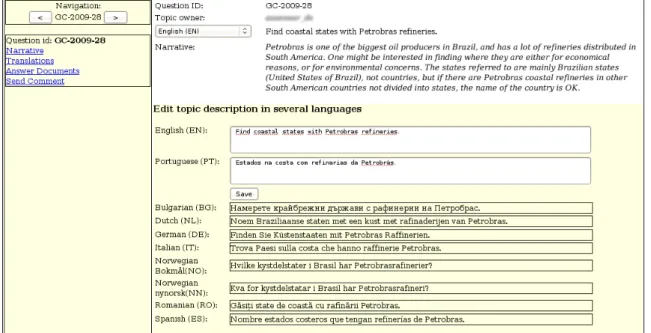
Figure 2: SIGA interface for creating topics: The screenshot was taken after the topic had been translated, which is of course artificial in that during creation the other language slots are void. (Reprinted from (Santos and Cabral, 2009).)
to have been what most people did.
However, there were only two participants who provided justification pages, which means that the correct answers, when found, were in the vast majority of cases self-justified. This fact made GikiCLEF more akin to pure in-formation retrieval than we had presumed.11
Although almost thirty interested parties enrolled in the be-ginning, we had only eight participants that actually sub-mitted seventeen runs for the task (see Table 1).
3.
Description of SIGA
Although (Santos and Cabral, 2009) already offers a thor-ough description of the work behind the scenes, we provide here a sketch of the many tasks that had to be organized. Since there was a considerable number of people creating topics in different languages, and an even larger set of as-sessors (30) after submissions had been sent in, there was a
11
In any case, it is important to note that an answer could be self-justified in one language and not in another, since the infor-mation of “parallel” pages often differed widely.
need for a computational environment to manage the large amounts of data, and also to provide an inspection facility against the collections, for both topic owners and assessors. So, SIGA, standing for SIstema de Gest˜ao e Avaliac¸˜ao do GIKICLEF12in Portuguese, was developed, offering
differ-ent actions for five separate roles: manager, topic developer (owner or other), participant, assessor (basic or conflict re-solver), and simple observer. SIGA was in charge of sev-eral procedures, such as validation of runs, pool creation, assessment distribution, conflict detection, scores compu-tation, and display of comparative results.
Details on the topic creation mode and the possibility of viewing the collection for checking the existence of an-swer candidates can be found in (Santos and Cabral, 2009); see also Figure 2. Note that, after topics had been cre-ated and translcre-ated into English, together with the “user model”/narrative in English, they had to be translated into each of the other eight languages, and possible answers in
12
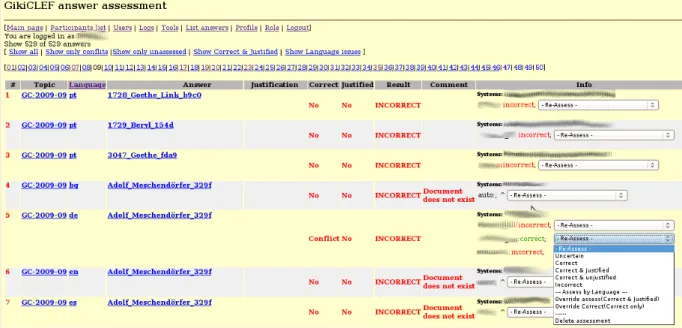
Figure 3: Solving conflicts about assessement of the same topic in the same language
other languages had to be added to the “expected answer pool”, tagged as self-justified or not.
The process of (monolingual) assessment was also de-scribed and discussed in (Santos and Cabral, 2009). Prior to it, answers not in the collection or corresponding to a filetype not accepted (such as disambiguation list or image) were automatically discarded. Also, answers already oc-curring in the expected answer pool and which had been considered by the topic owners as self-justified were auto-matically judged correct, while those which were not self-justified were marked as correct and not self-justified. This en-tailed a significant reduction in assessment work, as can be appreciated from the numbers of Table 2.
Answers received 21,251
Different answers 18,152
Different answers with complex justification 215 Different manually assessed answers 6,974
Manual assessments 10,332
Automatically assessed answers as incorrect 10,588 Automatically assessed answers as correct 283 Answers resulting in conflicts 383 Correct and justified answers 1,327 Correct but not justified answers 1,415
Table 2: Numbers on the assessment process. After the simple assessment was concluded, and since a large percentage of answers had been assigned to more than one assessor, automatic discovery of conflicts took place, and conflict resolution was performed. The conflict resolu-tion mode of SIGA can be seen in Figure 3.
We believe that, at least within CLEF, this was the first case where multiple assessments were used, and in fact the number of initial conflicts was so large that we found out that the assessment guidelines (and the task itself) were not clear enough: for example, the type checking that we took for granted while devising topics was not accepted or
un-derstood by many participants and assessors, and this led to a massive reassessment. We discuss in the final section the consequences this has for the task definition and to the possibility of actually devising a reliable and realistic eval-uation set.
After monolingual conflict resolution had finished, align-ment between answers in different languages was per-formed, and a second kind of conflict resolution had to be carried out, namely between cases where different assessors had concluded different things based on material in differ-ent languages.
This had to be specially tailored to have two kinds of cases as exceptions:
• those where different languages Wikipedias actually contradicted each other: in that case, no propagation, alignment, or other-language justification was possi-ble;
• one case where by mistake there was a different re-quirement (for river length) in one language: then ob-viously answers in different languages were not com-parable.
The results were then finally computed. Only correct and justified answers were considered for the systems’ scores, although there were several cases of correct but not justified answers.
We repeat that, once justified in one language, an answer would be considered correct and justified in all the others. From a score computation point of view, this means that the very same unjustified answer in one language (Wikipedia) could be considered correct and justified for one run (and thus getting full score) and not correct (because no justifi-cation was provided) for another (and thus not bewing re-warded by our score), depending on the set of multilingual answers returned by that run. We did not consider, how-ever, cases of cross-language justification, in the sense of
having the justification on one language to be provided in another language: a justification (set) was a set of pages in one Wikipedia that together provided an answer, as can be seen in Figure 1.
4.
Results
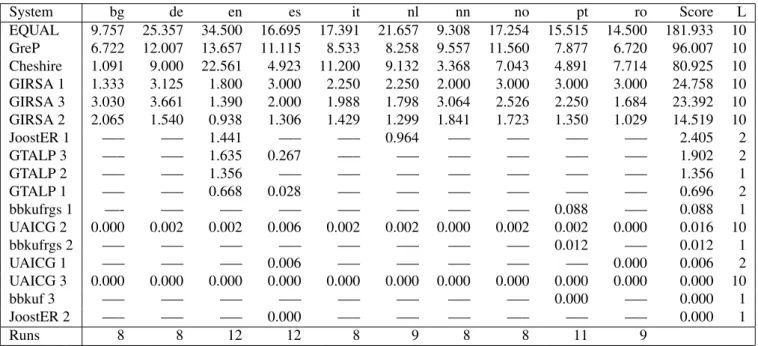
The results obtained by the participants are shown in Ta-ble 3.
The resulting resource (a sizeable number of correct an-swers to each topic, in many languages) was made pub-licly available in November 2009 from http://www. linguateca.pt/GikiCLEF/GIRA/.
In short it contains the collections, the topics, the assess-ments, the results, the programs, and a number of docu-mentation issues related to the particular topics and their assessment.
Table 2 shows a quantitative description of the most impor-tant data regarding the assessment effort which have an ob-vious bearing on the resource size. By “different answers” we mean answers together with justification lists that are unique.
As to language variety, Figure 4 displays the different num-ber of answers per language in the pool.
Figure 4: Answers per language returned by the set of all systems
Figure 5 represents the correct answers in GikiCLEF per language.
Figure 5: Correct answers per language returned by the set of all systems
The two figures show that the material gathered in Giki-CLEF can be used to train, deploy or at least evaluate IR
and question answering systems in the ten languages. In addition, it should be easy to augment the data / pool for each language and customize the SIGA system for particu-lar domains, languages or tasks, and we hope to be able to do this in the future.
5.
What was learned
Let us now provide a critical assessment of GikiCLEF, touching upon what could have been improved, and what can be considered design flaws.
As discussed in detail in (Santos and Cabral, 2010), the fact that English was a pivot language, both in the GikiCLEF team and in Wikipedia in general, caused a tremendous bias towards English, which became the language with by far more justified answers. This made it possible to to reach a relatively high score at GikiCLEF by just processing En-glish, which is no doubt a clear design flaw of GikiCLEF: In fact, we produced, by juxtaposition of different (and hope-fully) realistic users, a “non-existent” multi-cultural user who was equally well versed (and interested) in Bulgarian religious leaders and American museums featuring Picas-sos.
So, our current conclusion is that further organization of GikiCLEF-like contests has to give more weight to one or two cultures and not to ten or more.
We also observed that there were hardly any current sys-tems – at least among the participants – which were able to do the task. So, probably not much was gained by organiz-ing GikiCLEF with such high stakes.
Another problem with the topic choice was the quality of the related Wikipedia pages. Even though the topics were carefully selected by us organizers, and so there was good material on the particular subjects at least on the language of the topic owner (and probably in English as well), the fact that none of us was multilingual in the other nine lan-guages – and, of course, had not enough in-depth knowl-edge of all the subjects – prevented real quality control of all the possible answers/Wikipedia entries. So, pages in languages other than the topic owners’ were often of bad quality or had wrong data. The fact that this happened to a level of contradiction for three of the 50 topics (6%) is something that is also relevant: there is still a lot of rubbish in Wikipedia.
Another interesting issue came up during assessment, that made us reflect on the task definition itself: how important or relevant for a natural language processing task is strict type checking or type correctness? In other words, a useful answer for a user, although not exactly to the point (accord-ing to logically strict principles), seems to be preferable to a perfectly logically correct answer which is however redun-dant with a previous one. And so many participants (and some assessors) complained that an answer such as “flag of Argentina” should have been considered correct, or almost correct, if one issued a question such as “Which countries have flags such and such?”, instead of considering it incor-rect because the type required was “country”.
Also, it was obvious that some answers were much eas-ier to justify than others, and that some answers were ”di-rect” while others required a number of complex cycles of indirection. A thorough study of the difficulty of each
System bg de en es it nl nn no pt ro Score L EQUAL 9.757 25.357 34.500 16.695 17.391 21.657 9.308 17.254 15.515 14.500 181.933 10 GreP 6.722 12.007 13.657 11.115 8.533 8.258 9.557 11.560 7.877 6.720 96.007 10 Cheshire 1.091 9.000 22.561 4.923 11.200 9.132 3.368 7.043 4.891 7.714 80.925 10 GIRSA 1 1.333 3.125 1.800 3.000 2.250 2.250 2.000 3.000 3.000 3.000 24.758 10 GIRSA 3 3.030 3.661 1.390 2.000 1.988 1.798 3.064 2.526 2.250 1.684 23.392 10 GIRSA 2 2.065 1.540 0.938 1.306 1.429 1.299 1.841 1.723 1.350 1.029 14.519 10 JoostER 1 —– —– 1.441 —– —– 0.964 —– —– —– —– 2.405 2 GTALP 3 —– —– 1.635 0.267 —– —– —– —– —– —– 1.902 2 GTALP 2 —– —– 1.356 —– —– —– —– —– —– —– 1.356 1 GTALP 1 —– —– 0.668 0.028 —– —– —– —– —– —– 0.696 2 bbkufrgs 1 —- —– —– —– —– —– —– —– 0.088 —– 0.088 1 UAICG 2 0.000 0.002 0.002 0.006 0.002 0.002 0.000 0.002 0.002 0.000 0.016 10 bbkufrgs 2 —– —– —– —– —– —– —– —– 0.012 —– 0.012 1 UAICG 1 —– —– —– 0.006 —– —– —– —– —– 0.000 0.006 2 UAICG 3 0.000 0.000 0.000 0.000 0.000 0.000 0.000 0.000 0.000 0.000 0.000 10 bbkuf 3 —– —– —– —– —– —– —– —– 0.000 —– 0.000 1 JoostER 2 —– —– —– 0.000 —– —– —– —– —– —– 0.000 1 Runs 8 8 12 12 8 9 8 8 11 9
Table 3: Scores per language and total score. The last row indicates how many participants per language, and the last column the number of languages tried in that run. Eight runs opted for all (10) languages, four tried solely 2 languages, and five one only.
topic given the collection is thus needed to understand more closely the reasons and the requirements for system be-haviour.
We intend to annotate the resources (topics and answers in each language) with this information, in order to see whether they correlate in any way with system’s behaviour and whether these are relevant features to assign in future evaluations.
Finally, we have requested from prospective and actual GikiCLEF participants an answer regarding whether they wanted also to address within GikiCLEF the following is-sues:
• Improve presentation of the results: To devise user-friendly systems, an unordered list of answers is often not enough, especially when multiple answers can be related. So, from the point of view of the scoring pro-cedure, one might reward ordered lists (for instance by granularity given a particular ontology, or by time if the question concerns a particular temporal journey). • Investigate geographical diversity: Another subject
that is now receiving some attention is how to take ge-ographical diversity into account: depending on the kind of topic, one might want to boost diversity in-stead of mere quantity. In fact, for some users and uses, returning too (geographically) close hits may be considered annoying instead of relevant.
Although no system was prepared to work in either regard, we still believe they are interesting alleys to explore. Another related subject on which we are aware a lot can be done to improve a contest of the GikiCLEF kind is de-vising more appropriate and complex evaluation measures, also taking into account recall-oriented measures, and dif-ficulty estimates for different kinds of topics. We believe that experimentation with other measures is made easy by
the availability of the GIRA resource, where different scor-ing procedures can be implemented and its impact evalu-ated on the actual runs. Although we have no space here to provide a full overview of the participants’ approaches, we would like to state that they have shown a wide va-riety of different methods and priorities, as had already been the case in GikiP even with only three participants. So both semi-interactive approaches, using a human-in-the-loop, semantic-oriented QA systems, and IR traditional methods were used to try to get at the answers in GikiCLEF 2009.
Our conclusion is therefore a positive one: although we might have been too ambitious for the state of the art, Gi-kiCLEF has shown that it is possible to implement systems that answer in many languages, by using a multilingual col-lection. Also, our work has produced a resource that can be further used in the development of Wikipedia-based infor-mation access systems in the years to come.
Acknowledgements
We thank the remaining GikiCLEF organizers, S¨oren Auer, Gosse Bouma, Iustin Dornescu, Danilo Giampiccolo, Sven Hartrumpf, Ray Larson, Johannes Leveling, and Con-stantin Orasan; the other assessors, Anabela Barreiro, Leda Casanova, Lu´ıs Costa, Ana Engh, Laska Laskova, Cristina Mota, Ros´ario Silva, and Kiril Simov; Paula Carvalho and Christian-Emil Ore for help on Portuguese and Norwegian topics respectively; and of course the participants, without whom GikiCLEF would not have existed.
Linguateca has throughout the years been jointly funded by the Portuguese Government, the European Union (FEDER and FSE), under contract ref. POSC/339/1.3/C/NAC, MCTES, UMIC and FCCN.
We also gratefully acknowledge support of the Treble-CLEF Coordination Action. ICT-1-4-1 Digital libraries and
technology-enhanced learning (Grant agreement: 215231) for GikiCLEF assessment.
´
Alvaro Rodrigo has been partially supported by the Edu-cation Council of the Regional Government of Madrid and the European Social Fund.
6.
References
Alexa. 2010. Alexa top 500 sites. http: //www.alexa.com/site/ds/top sites? ts mode=global.
Javier Artiles, Julio Gonzalo, Fernando L´opez-Ostenero, and V´ıctor Peinado. 2007. Are Users Willing to Search Cross-Language? An Experiment with the Flickr Im-age Sharing Repository. In Carol Peters, Paul Clough, Fredric C. Gey, Jussi Karlgren, Bernardo Magnini, Douglas W. Oard, Maarten de Rijke, and Maximilian Stempfhuber, editors, Evaluation of Multilingual and Multi-modal Information Retrieval: 7th Workshop of the Cross-Language Evaluation Forum, CLEF 2006. Re-vised selected papers, volume 4730 of LNCS, pages 195– 204, Berlin. Springer.
Krisztian Balog, Leif Azzopardi, Jaap Kamps, and Maarten de Rijke. 2007. Overview of WebCLEF 2006. In Carol Peters, Paul Clough, Fredric C. Gey, Jussi Karlgren, Bernardo Magnini, Douglas W. Oard, Maarten de Ri-jke, and Maximilian Stempfhuber, editors, Evaluation of Multilingual and Multi-modal Information Retrieval: 7th Workshop of the Cross-Language Evaluation Forum, CLEF 2006. Revised selected papers, volume 4730 of LNCS, pages 803–819, Berlin. Springer.
Nuno Cardoso. 2010. GikiCLEF topics and Wikipedia ar-ticles: Did they blend? In Carol Peters et al, editor, Mul-tilingual Information Access Evaluation, VOL I: Text Re-trieval Experiments. Springer, Setembro.
John J. Gumperz. 1996. The linguistic and cultural relativ-ity of conversational inference. In J. Gumperz and S. C. Levinson, editors, Rethinking linguistic relativity, pages 374–406, Cambridge. Cambridge University Press. Valentin Jijkoun and Maarten de Rijke. 2007. Overview
of the WiQA Task at CLEF 2006. In Carol Peters, Paul Clough, Fredric C. Gey, Jussi Karlgren, Bernardo Magnini, Douglas W. Oard, Maarten de Rijke, and Max-imilian Stempfhuber, editors, Evaluation of Multilingual and Multi-modal Information Retrieval: 7th Workshop of the Cross-Language Evaluation Forum, CLEF 2006. Revised selected papers, volume 4730 of LNCS, pages 265–274. Springer, Berlin.
Thomas Mandl, Paula Carvalho, Fredric Gey, Ray Lar-son, Diana Santos, and Christa Womser-Hacker. 2009. GeoCLEF 2008: the CLEF 2008 Cross-Language Ge-ographic Information Retrieval Track Overview. In Carol Peters, Tomas Deselaers, Nicola Ferro, Julio Gon-zalo, Gareth J.F.Jones, Mikko Kurimo, Thomas Mandl, Anselmo Pe˜nas, and Viviane Petras, editors, Evaluat-ing Systems for MultilEvaluat-ingual and Multimodal Informa-tion Access 9th Workshop of the Cross-Language Evalu-ation Forum, CLEF 2008, Aarhus, Denmark, September 17-19, 2008, Revised Selected Papers, pages 808–821. Springer.
Thomas Mandl. 2010. Cultural and International Aspects of Social Media. In Panagiotis Papadopoulou, Panagio-taand Kanellis and Drakoulis Martakos, editors, Hand-book of Research on Social Computing Theory and Prac-tice Interdisciplinary Approaches. Idea Group Refer-ence.
Diana Santos and Lu´ıs Miguel Cabral. 2009. GikiCLEF: Crosscultural issues in an international setting: ask-ing non-English-centered questions to Wikipedia. In Francesca Borri, Alessandro Nardi, and Carol Peters, ed-itors, Cross Language Evaluation Forum: Working notes for CLEF 2009, 30 September - 2 October.
Diana Santos and Lu´ıs Miguel Cabral. 2010. GikiCLEF : Expectations and lessons learned. In Carol Peters et al, editor, Multilingual Information Access Evaluation, VOL I: Text Retrieval Experiments. Springer, September. Diana Santos and Nuno Cardoso. 2005. Portuguese at
CLEF 2005: Reflections and Challenges. In Carol Pe-ters, editor, Cross Language Evaluation Forum: Work-ing Notes for the CLEF 2005 Workshop (CLEF 2005), Vienna, Austria, 21-23 September. Centromedia. Diana Santos and Lu´ıs Costa. 2007. QolA: fostering
col-laboration within QA. In Carol Peters, Paul Clough, Fredric C. Gey, Jussi Karlgren, Bernardo Magnini, Douglas W. Oard, Maarten de Rijke, and Maximilian Stempfhuber, editors, Evaluation of Multilingual and Multi-modal Information Retrieval - 7th Workshop of the Cross-Language Evaluation Forum, CLEF 2006. Al-icante, Spain, September, 2006. Revised Selected papers, pages 569–578, Berlin / Heidelberg. Springer.
Diana Santos and Paulo Rocha. 2005. The key to the first CLEF in Portuguese: Topics, questions and answers in CHAVE. In Carol Peters, Paul Clough, Julio Gon-zalo, Gareth J. F. Jones, Michael Kluck, and Bernardo Magnini, editors, Multilingual Information Access for Text, Speech and Images, 5th Workshop of the Cross-Language Evaluation Forum, CLEF 2004, Bath, UK, September 15-17, 2004, Revised Selected Papers, pages 821–832. Springer, Berlin/Heidelberg.
Diana Santos, Nuno Cardoso, Paula Carvalho, Iustin Dor-nescu, Sven Hartrumpf, Johannes Leveling, and Yvonne Skalban. 2009. GikiP at GeoCLEF 2008: Joining GIR and QA forces for querying Wikipedia. In Carol Peters, Tomas Deselaers, Nicola Ferro, Julio Gonzalo, Gareth J.F.Jones, Mikko Kurimo, Thomas Mandl, Anselmo Pe˜nas, and Viviane Petras, editors, Evaluating Systems for Multilingual and Multimodal Information Access 9th Workshop of the Cross-Language Evaluation Forum, CLEF 2008, Aarhus, Denmark, September 17-19, 2008, Revised Selected Papers, pages 894–905. Springer. Diana Santos, Nuno Cardoso, and Lu´ıs Miguel Cabral.
2010. How geographical was GikiCLEF? A GIR-critical review. In 6th Workshop on Geographic Information Re-trieval (GIR’10), 18-19 February.
Tony Veale. 2007. Enriched Lexical Ontologies: Adding new knowledge and new scope to old linguistic re-sources. In European Summer School on Language, Logic and Information (ESSLLI 2007).