in Minas Gerais (Brazil)
ARILDO H. OLIVEIRA and MAURÍCIO A. CARNEIRO
Departamento de Geologia da Escola de Minas da Universidade Federal de Ouro Preto (DEGEO/EM/UFOP), Morro do Cruzeiro / Campus Universitário
Manuscript received on August 30, 2000; accepted for publication on April 17, 2001; presented byWilson Teixeira
ABSTRACT
Systematic geological studies performed in the study area allowed the characterization of six lithodemic units: three gneissic, one amphibolitic, one supracrustal and one fissure mafic. The mineral assemblage and the structural record of these lithodemic units indicate that the study area was affected by five tectonothermal events. The structural pattern of the first and oldest event occurred under granulite facies conditions and reveals essentially a sinistral kinematic pattern. The second event, showing dominant extensional characteristics, is related to the generation of an ensialic basin filled by the volcano-sedimentary sequence of the supracrustal lithodemic unit. The third event, which is the most expressive in the study region, is characterized by a vigorous regional migmatization process and by the generation of the Claudio Shear Zone, presenting dextral kinematic movement. The fourth event is represented by a fissure mafic magmatism (probably two different mafic dike swarms) and finally, the fifth event is a regional metamorphic re-equilibration that reached the greenschist facies, closing the main processes of the tectonic evolution of the Campo Belo Metamorphic Complex.
Key words:Craton, Archean, tectonic evolution, lithodemic units, metamorphic complex.
INTRODUCTION
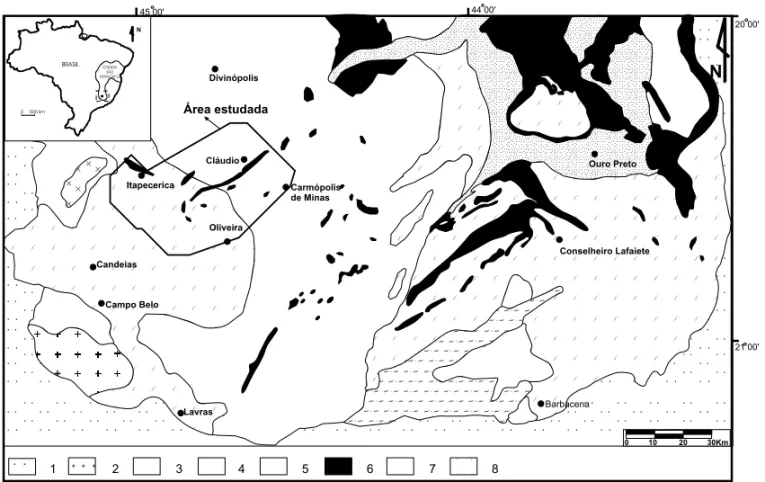
The São Francisco Craton is a vast Precambrian plat-form (Alkmim et al. 1993, Almeida 1977), which encompasses part of Minas Gerais and Bahia States (Fig. 1). Its southern portion (Fig. 1) presents sig-nificant expositions of Neoarchean granite-green-stone terranes; its tectonic evolution started in the Mesoarchean (Carneiro et al. 1998a, Teixeira et al. 1996a, Teixeira et al. 1998). From that period on the first sialic crusts and supracrustal sequences were generated by means of successive accretion/
Correspondence to: Maurício Antônio Carneiro
E-mail: [email protected] / [email protected]
differentiation stages associated with crustal re-working processes (Carneiro et al. 1996a, Carneiro et al. 1997a,b, Carneiro et al. 1998a,b, Noce 1995, Pinese 1997, Teixeira 1993, Teixeira and Silva 1993, Teixeira and Canzian 1994, Teixeira et al. 1996a,b, Teixeira et al. 1997, Teixeira et al. 1999).
Fig. 1 – Geologic map of southern São Francisco Craton (modified from Machado Filho et al. 1983). 1) Undivided marginal belts; 2) Porto dos Mendes Granite; 3) São João del Rey Supergroup; 4) Minas Supergroup; 5) Formiga Granite; 6) Rio das Velhas Supergroup;
7) Divinópolis Metamorphic Complex, and 8) Barbacena Metamorphic Complex.
Ga, (Noce 1995)]; a fissure mafic magmatism event [2.658 Ga, (Pinese 1997)] and a felsic magmatism event [2.65 Ga, (Noce 1995)]. Due to this succes-sion of events, the tectonic relationships between the generated (or reworked) units were progressively masked. Therefore, a complex structural pattern was imprinted in the lithodemic units that consti-tute the metamorphic complex, their supracrustal sequences and intrusive bodies that crop out in the study area. Recent research, involving regional (1:200,000) and detailed (1:10,000) mapping per-formed in the Campo Belo, Oliveira, Itapecerica, Cláudio, Carmópolis de Minas regions has charac-terized new lithodemic units and presented new facts to the tectonic evolution of the southern São Fran-cisco Craton (Carneiro et al. 1996a,b, Carneiro et al. 1997a,b,c, Carneiro et al. 1998a,b, Carvalho Júnior et al. 1997, Carvalho Júnior et al. 1998,
Corrêa da Costa et al. 1998, Corrêa da Costa 1999, Fernandes et al. 1997, Fernandes et al. 1998, Fer-nandes and Carneiro 2001, Oliveira et al. 1998a,b, Oliveira 1999, Oliveira and Carneiro 1999, Oliveira et al 1999). In this work the results of one of these studies (Oliveira 1999) are presented, carried out in the Cláudio, Itapecerica, São Francisco de Paula, Oliveira and Carmópolis de Minas region, involving lithostructural mapping at the 1:200,000 scale (Figs. 1 and 2).
GEOLOGIC CONTEXT
Fig. 2 – Geologic map of the study area (modified from Oliveira 1999), showing the different lithodemic units: 1) Fissure Mafic Unit; 2) Supracrustal Unit; 3) Candeias Gneissic Unit; 4) Itapecerica Gneissic Unit; 5) Cláudio Gneissic Unit; 6) Inferred Contact; 7) Foliation;
8) Cláudio Shear Zone, and 9) Key Outcrops: A – Fernão Dias road; B – Corumbá dimension stone quarry; C – Kinawa dimension stone quarry; D – Morro da antena; E – Vista Bela farm; F – Carmo da Mata dimension stones quarry; G – Marilan dimension stones quarry; H – Lila dimension stones quarry; I – Alemão dimension stones quarry; J – Oliveira dimension stones quarry.
sequences are found, correlated with the Rio das Velhas or Minas Supergroups. The geographic dis-tribution of the Divinópolis Metamorphic Complex, according to (Machado Filho et al. 1983), occurs in the vicinity of Divinópolis, Itaúna, Formiga and Passa Tempo cities (Fig. 1). In the remaining re-gion, rocks from the Barbacena Metamorphic Com-plex would predominate. However, Teixeira et al. (1996b) consider these two complexes in the Campo Belo region (Fig. 1) as a single unit, naming it Campo Belo Metamorphic Complex. According to Machado Filho et al. (1983), the majority of the
TABLE I
General characteristics of the rocks types of the study area and their probable ages and tectonothermal events.
Unit Lithology Rock-forming Ages
Tectono-minerals thermal
events Fissure Mafic gabbronorite plagioclase, ortho- and Ages for the E4 and E5
clinopyroxenes intrusions: gabbro Plagioclase, 2.658 Ga3
clinopyroxene and 1.875 Ga3.
Supracrustal Rio Banded iron Quartz and Probable ages E3, (E4)? das Velhas formation opaque minerals for the mafic- and E5 Supergroup quartzite Quartz, sillimanite ultramafic
and garnet magmatism, schist Sillimanite, quartz, followed by mica and garnet sedimentation
(2.8 Ga2). amphibolite Clinoamphibole,
plagioclase and quartz ultramafic Orthopyroxene,
olivine, clinoamphibole
Amphibolitic amphibolite Hornblende, Probable age: E1, (E2?), plagioclase and 3,38-3,0 Ga1 E3, (E4?)
quartz (?) and E5.
Candeias Gneiss of grano- Plagioclase, Probable age E1, (E2?), Gneiss dioritic to granitic microcline, quartz for the E3, E4
composition and hypersthene protolith and E5 Itapecerica Gneiss of granitic Microcline, (3.38-3.0 Ga1)
Gneiss composition plagioclase and and probable quartz age for the
migmatization (2.75-2.72Ga2). Cláudio Gneiss of grano- Plagioclase,
Gneiss dioritic composition microcline and quartz
São Francisco Craton.
GEOLOGY OF THE AREA
Using satellite imagery and aeromagnetometric map interpretation and by means of regional geologic sections (Oliveira 1999) it was possible to charac-terize six lithodemic units (Table I and Fig. 2). The older three of these units are gneissic, the fourth is amphibolitic (cannot be mapped at the scale adopted), the fifth is a supracrustal sequence (of greenstone belt type), and the youngest is a mafic dike swarm.
Gneissic Units
The petrographic distinction of the gneissic units (Fig. 2) was mainly based on their color and com-position. The Cláudio Unit rocks are gray and their composition is predominantly granodioritic. Those from the Itapecerica Unit are light pink and their composition is predominantly granitic. Finally, the Candeias Unit rocks are green and their composi-tion is granitic to granodioritic. The geologic con-tacts between the gneissic units are masked by the thick weathering mantle and by the superposition of tectonothermal processes taking place since the Mesoarchean. However, the gneissic units have dis-tinct outcrop domains. As an example, the Itapecer-ica Gneissic Unit, with rocks cropping out in the surroundings of the city it borrows the name from, is characterized by intense migmatization, which imprinted an average mineralogic composition of granitic nature. This migmatization is more pro-nounced in the western portion of its geographic occurrence. Three pegmatite vein families are as-sociated with the gneissic units. The first family is formed by mobilizates concordant with the gneissic foliation and presents centimetric thicknesses and variable (centimetric to metric) lengths. These mo-bilizates are essentially composed of feldspars and small quantities of mica. The mobilizates are usu-ally light pink and sometimes white. The second pegmatite family is discordant from the gneissic fo-liation and is centimetre- to metre-thick, with veins
reaching some meters in length. It is in general coarse-grained and light pink, formed by feldspar phenocrysts and less abundant centimetric mica flakes. The third family is represented by pegmatite veins that crosscut either the gneissic foliation or the other two families. These are centimetre-thick and metre-long veins. They are fine- to medium-grained and fill NS-trending fracture planes.
Cláudio Gneissic Unit
Itapecerica Gneissic Unit
The rocks from the Itapecerica Gneissic Unit crop out in the NW portion of the area and present granitic composition, are light pink, migmatized and show inequigranular to equigranular textures and are medium- to fine-grained. In some outcrops closer to the contact with the Candeias Gneissic Unit (Fig. 2), the rocks are greenish. In other localities the gneiss is grayish, as the outcrops located east of Itapecerica city. Pegmatitic or amphibolitic dikes constituting boudins are common features. The texture of the Itapecerica Gneissic Unit rocks is granoblastic to granolepidoblastic with subidioblastic to idioblas-tic, fine- to medium-grained crystals. Microcline is the predominating mineral (30-40%), plagioclase second in abundance (15-30%) and quartz is sub-ordinated to feldspar(±20%). Biotite(<10%)is a varietal mineral and presents dark brown to greenish pleochroism, locally altering to pale-green chlorite. Amphibole is rarer, fine-grained and alters to biotite. Common accessories are zircon, apatite and opaque minerals. Sericite, chlorite, carbonate and epidote are secondary minerals.
Candeias Gneissic Unit
The gneisses of this unit crop out in the SW por-tion of the area (Fig. 2). In the most deformed do-mains the rocks present granodioritic composition (opdalites). However, in the more homogeneous do-mains the composition is granitic (charnockites). In general, these rocks are green, slightly migmatized, deformed and medium- to coarse-grained. The min-eralogic banding, in some places, is difficult to be observed due to the great homogeneity of the bodies, except for the hyperstene-gneiss and biotite-gneiss where the biotite planar orientation is more enhanced. Close to the contact with the Itapecerica Gneissic Unit, light pink pegmatitic mobilizates are found. The texture of the Candeias-type gneisses varies from granolepidoblastic to granoblastic and they are subdioblastic to idioblastic, predominating granoblastic. Antiperthitic plagioclase (30-45%) is
the main constituent, quartz (20-25%) and the mi-crocline content (15-20%) varies from sample to sample but can reach up to 40%. Hyperstene, when present, is medium-grained, has low birefringence and pleochroism varying from light pink to pale green. It alters to amphibole, biotite and chlorite. Biotite, sometimes showing symplectitic inter-growth with quartz, presents light brown, sometimes greenish, pleochroism. In general, this mineral de-fines the banding of the rock. Locally, biotite alters to chlorite. Opaque minerals, zircon and apatite are the commonest accessories of the rock. Chlorite is the commonest secondary mineral, overgrowing bi-otite and pyroxene.
Amphibolitic Unit
The rocks of this unit are fine-grained, melanocratic, dense, phaneritic, black and strongly foliated. In most places, the amphibolites are found in the form of disrupted thin boudins, representing disrupted and metamorphosed dikes emplaced in the rocks of the gneissic units. The texture of the amphi-bolites varies from nematoblastic to granolepido-nematoblastic. The crystals are fine- to medium-grained, strongly oriented and altered. Green horn-blende(±50%), sometimes altered to biotite, is a main mineral. Locally, biotite schist (or biotitite) results from retrograde metamorphism and shear-ing. Plagioclase is the second constituent in volume (20-30%). Quartz appears subordinated to the other minerals and its content varies from 5 to 10% of the rock volume. Biotite, sometimes chloritized, is the product of amphibole transformation. Pale yel-low clinopyroxene, present in some rocks, can reach 10% of the volume and alters to amphibole. Acces-sory minerals are zircon, opaque minerals and ap-atite. Besides biotite, secondary minerals are chlo-rite and amphibole, epidote and sericite.
Supracrustal Unit
banded iron formation were characterized in the study area. Regionally, the Supracrustal Unit (Fig. 2) can be correlated with the Rio das Velhas Super-group, which crops out in the Quadrilátero Ferrífero in Minas Gerais. In some places, they are strongly deformed, metamorphosed and sometimes cataclas-tic. In the field, the domain of the ultramafic rocks is marked by positive magnetic anomalies as can be observed in aeromagnetometric maps (Oliveira 1999). Themetaperidotiteis a holocrystalline rock with inequigranular, anhedral to subhedral crystals and grain-size varying from fine to coarse. It shows cumulatic and/or mesh texture. Enstatite makes up 50% to 60% of the total volume of the rock. An-hedral clinopyroxene and olivine crystals can reach up to 20% of the rock volume. The hornblende per-centage varies from 20% to 50%. Spinel can reach 10% of the rock volume and appears as granular crystals of high relief and color varying from green to greenish-brown. Serpentine, rare in the major-ity of the thin sections, is found as fibro-lamelar aggregates, resultant from the alteration of olivine and pyroxenes. The opaque minerals can reach 5 to 10% of the rock. They are isotropic and gen-erally result from spinel transformation. Chlorite is sometimes present as secondary mineral. The chlorite-amphibole-schistis a greenish rock with porphyroblastic texture. Chlorite sums up 30% of volume and appears as poikilitic porphyroblasts em-bedded in a fine hornblende mass(±70%). A small amount of opaque minerals represents the acces-sory minerals. Thehornblenditeis composed of predominantly medium-grained granonematoblas-tic hornblende crystals (±95%) and opaque min-erals. The amphibolite is a fine- to medium-grained rock, melanocratic, dense, phaneritic, black and strongly foliated. Theamphibolite is, in general, found in contact with ultramafic rocks, mainly in the surroundings of Cláudio, in the supracrustal unit domain (Fig. 2). The main foliation trend is NE/ SW, accompanying the direction of the magnetic anomaly observed in the aeromagnetometric maps (Oliveira 1999). The rock texture varies from
white mica. Opaque minerals, zircon and rutile are common accessories. White mica is the secondary mineral in the rock and it is the alteration product after sillimanite and biotite. Finally, the banded iron formationis a magnetic rock, of predominantly fine grain-size, composed of magnetic minerals and quartz. This rock presents granoblastic texture and the contact between grains is elongated due to de-formation. Quartz(±60%)is the main constituent of the rock, with elongated crystals in the form of ribbons; it is fine- to medium-grained and strongly recrystallized. Magnetite contents vary from 30 to 40% in terms of modal composition.
Fissure Mafic Unit
This unit is represented by NW/SE-trending dikes (Fig. 2). These dikes have varied thickness, from metric to dozens of meters and their length can reach dozens of kilometers. The dikes are subvertical and commonly develop ramifications involving the gneissic massifs. Compositionally, the dikes are composed of gabbronorite, gabbro and diabase. The gabbronorite and the gabbro are medium- and coarse-grained, possibly representing variations of crustal emplacement during magmatic crystalliza-tion. These rocks are in general dark-colored to greenish, and present massive structure and phaner-itic texture. However, when very fine-grained, they can be aphanitic. Along the same lineament small diabase dikes can be observed as a dark, dense and fine-grained rock. Thegabbronoriteshows ophitic, subophitic to intergranular textures, with subhedral to euhedral crystals, and is medium- to fine-grained. Plagioclase is the most abundant mineral in vol-ume (40-60%). (Clino- and ortho-) pyroxene con-tents vary from 20 to 35% in volume. In general, augite predominates over hyperstene and is predom-inantly medium-grained, presents variable polariza-tion color (from high to low), the crystals are poikilitic, altering to amphibole. Hyperstene is light pink, pleochroic, from medium- to fine-grained. Hornblende with green pleochroism is the alteration product of pyroxenes (uralitization), reaching up to
5% of the rock. Quartz appears in small quantities, with clean, anhedral, fine-grained crystals. Biotite is rare and reddish, pleochroic. Zircon and opaque minerals are accessory minerals. White mica, epi-dote, carbonate and chlorite are secondary miner-als. Thegabbropresents ophitic, subophitic or in-tergranular textures. The medium- to fine-grained crystals vary from subhedral to euhedral. Plagio-clase is the most abundant mineral in volume, vary-ing from 30-50%. Augite contents, second compo-nent in volume, vary from 20 to 30%. The crystals are poikilitic and alter to amphibole. Hornblende is the uralitization product after pyroxene, being its content in volume variable between 5 and 15%. When present, microcline is rare, showing cross-hatch twinning and is associated with myrmekite. Quartz appears in small quantities. Biotite is also rare, reddish and pleochroic. Zircon, opaque miner-als and apatite are accessory minerminer-als. White mica, epidote and chlorite are secondary minerals ob-served in some of the rocks.
METAMORPHISM
en-closed in these gneissic units, also presents high-grade paragenesis, with the presence of hyperstene, and retrograde metamorphic features of the green-schist facies, characterized by the presence of chlo-rite. However, Supracrustal Unit rocks show slightly different parageneses. Except for the Supracrustal Unit ultramafic rocks, where green Al2O3-richer spinels would indicate metamorphic conditions compatible with the amphibolite-granulite fa-cies (Pactunç 1984), the mineral assemblages of the schists (quartz±plagioclase±sillimanite±garnet) and quartzites (quartz±sillimanite±garnet± bi-otite) indicate that the metamorphism in these rocks reached at most the lower granulite facies. After-wards, as show the processes of sillimanite alteration to white mica and plagioclase sericitization, these assemblages were re-equilibrated to greenschist fa-cies conditions. However, if in the Supracrustal Unit rocks metamorphism reached the amphibolite or even granulite facies, this was not the case in the Fissure Mafic Unit rocks. These rocks have preserved igneous textures, showing only metamor-phic re-equilibration in the greenschist facies that, in fact, is common to all units described in this paper. So, two significant considerations can be expressed: a) the chronostratigraphic character of the Fissure Mafic Unit that, due to its igneous textures and meta-morphic parageneses at most of the greenschist fa-cies, indicates their crustal emplacement after the tectonothermal events of higher metamorphic facies that affected the older units; b) the metamorphic fa-cies variation between rocks of the Gneissic, Amphi-bolitic and the Supracrustal Units. Two hypotheses can be put forward to explain this variation. The first hypothesis would imply in the existence of two tectonothermal events. The first one, of the gran-ulite facies, would be previous to the generation of the Supracrustal Unit rocks and the second one, lo-cally reaching the granulite facies, would follow the generation of the Supracrustal Unit rocks. The sec-ond hypothesis would favor the existence of a single event of the granulite facies that occurred after the generation of the Supracrustal Unit rocks. Isotopic
evidence supports the first hypothesis (Carneiro et al. 1998b, Teixeira et al. 1996b, Teixeira et al. 1998). These authors, respectively, defend a metamorphic event of the granulite facies in the Mesoarchean and another of amphibolite facies in the Neoarchean (Rio das Velhas Tectonothermal Event). Therefore, it is believed that the first possibility is more realistic to explain the tectonic evolution of the region, accord-ing to the reasons exposed in the followaccord-ing items.
STRUCTURAL ANALYSIS
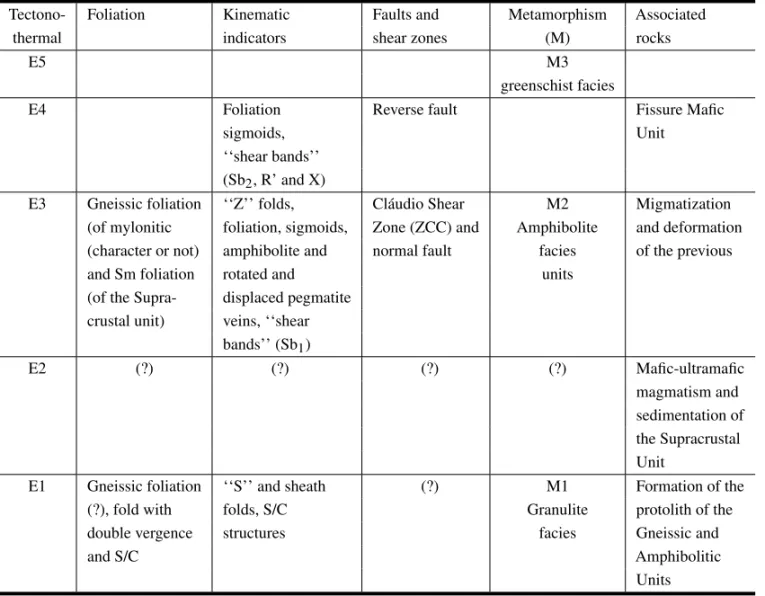
The rocks of the study region present distinct struc-tural features (Fig. 3, Fig. 4, Table II). For in-stance, the following features were observed in the supracrustal unit rocks: 1) a mylonitic foliation (Sm) of anastomosing character; 2) structures S/C; 3) S and Z intrafolial folds, tight and/or isoclinal sheath mesofolds; 4) foliation sigmoids; 5) rotated quartz veins, and 6) tension gashes. The gneissic unit rocks present, besides the structural features described above, the following ones: 7) a gneissic foliation (Sg) of (local) mylonitic character and anastomos-ing pattern; 8) shear bands(Sb1 and Sb2); 9) peg-matitic vein folds and rotated amphibolite boudins. Local normal and reverse faults and a regional mega-structure here named Cláudio Shear Zone were char-acterized. The area also shows intense NW-SE-trending crustal fracturing along which mafic dike swarms were emplaced (Fig. 2).
0.5 % 1.0 % 1.5 % 2.1 % 2.6 % 3.1 % 3.6 % 4.1 %
1.2 % 2.4% 3.7 % 4.9 % 6.1 %
4.5 % 9.1 % 13.6% 18.2% 22.7% 27.3% 31.8 % 5.9 %
11.8 % 17.6 % 23.5 % 29.4 % 35.3 % 41.2 %
11.1 %
22.2 %
33.3 %
44.4 %
A
B
C
D
E
F
4.3 % 8.7 % 13.0% 17.4 % 21.7 %
X
R'
Sb2
A B
D
F
H
S 150/70 C (130/75)
''Sb ''2
110 290
Anf. Sb2
0 10cm
PH
PH
0 20cm
0 20cm
0 4m
PV
E
60 250
Peg. Diab.
0 5m
PV
N
280 100
PH
C
Anf.
Peg.
''Sb ''=140/752
PH
0 20cm
PH
Sg=140/70
0 10cm
PH
Sg=150/63
C S
G
T
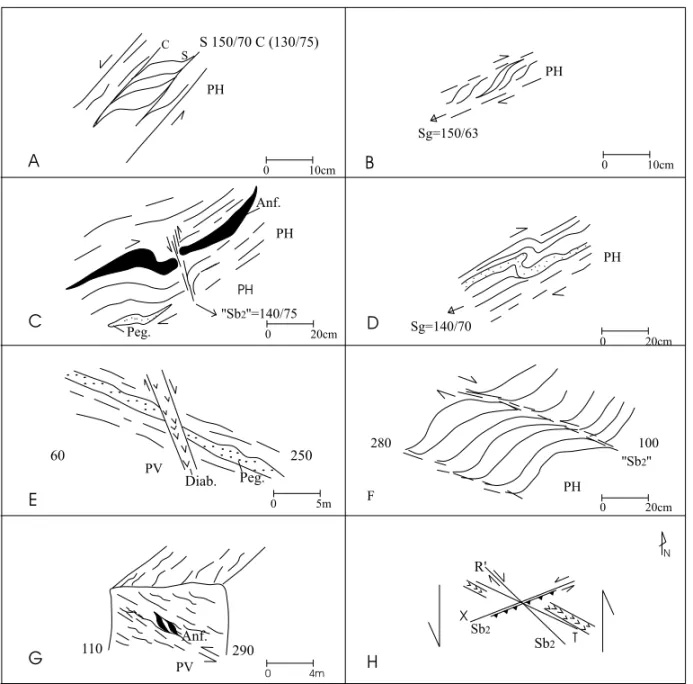
Fig. 4 – Kinematic indicators (A-G) and schematic models explaining one of the events active in the study area (H). A) Structure S/C in gneiss of Cláudio Unit, with Event 1 sinistral movement; B) Sigmoidal foliations of the Supracrustal Unit schists with dextral movement; C) Amphibolite boudin rotated clockwise and broken by shear zones (shear bands Sb2, X); D) Asymmetric folded pegmatite vein, Z-shaped, with dextral movement in the gneisses; E) (Brecciated) diabase dike in Cláudio Unit gneisses, displacing pegmatite vein and the gneissic foliation, denoting Event 3 Phase 2 normal movements; F) Shear bands(Sb2,R’); G) Rotated amphibolite boudins, vertical plane view, with reverse movements; H) Schematic model representing Event 4, sinistral, indicating shear bands(Sb2), reverse faults and the intrusion of the Fissure Mafic Unit. Symbology: PH –
Horizontal plane; PV – Vertical plane; Peg. – Pegmatite; Anf. – Amphibolite; Diab. – Diabase, and R’ and X (anti-Riedel and secondary).
the same deformation phase. Sg and Sm foliations present inflections along the study area so that the main trend is NE-SW (Figs. 3A and B). Locally, a change in the foliation direction is observed (from
TABLE II
Simplified table of the structural elements associated with the tectonothermal events.
Tectono- Foliation Kinematic Faults and Metamorphism Associated
thermal indicators shear zones (M) rocks
E5 M3
greenschist facies
E4 Foliation Reverse fault Fissure Mafic
sigmoids, Unit
‘‘shear bands’’ (Sb2, R’ and X)
E3 Gneissic foliation ‘‘Z’’ folds, Cláudio Shear M2 Migmatization (of mylonitic foliation, sigmoids, Zone (ZCC) and Amphibolite and deformation (character or not) amphibolite and normal fault facies of the previous
and Sm foliation rotated and units
(of the Supra- displaced pegmatite crustal unit) veins, ‘‘shear
bands’’ (Sb1)
E2 (?) (?) (?) (?) Mafic-ultramafic
magmatism and sedimentation of the Supracrustal Unit
E1 Gneissic foliation ‘‘S’’ and sheath (?) M1 Formation of the (?), fold with folds, S/C Granulite protolith of the
double vergence structures facies Gneissic and
and S/C Amphibolitic
Units
the predominant foliation (NE-SW) is folded and its trajectory in folds inflects to NS and NW-SE. The last trend represents one of flanks of folds of 2 to 3 meters of amplitude. Thus the several trends char-acterized in the region as a whole reflect the prin-cipal foliation inflection (NE/SW). In general the foliation dip is steep(70◦to 80◦), mainly along the Cláudio Shear Zone (Fig. 2). However, outside the Cláudio Shear Zone domain medium to low-angle dips(50◦ to 20◦)are observed. The mineral lin-eation(lm)also presents a certain variation: from strike (Kinawa quarry, point 9C, Fig. 2) to oblique (Corumbá quarry, point 9B; Fig 2) and dip (in the quartzites, point 9D). In these three cases, the folia-tion planes present NE-SW trends.
two foliations were interpreted as a pair R’ and X (anti-Riedel and secondary, Fig. 4H, Sanderson and Marchini 1984). Shear bands Sb1and Sb2are differ-ent in the following aspects: the first group presdiffer-ents pegmatitic mobilizates along its planes, lacking in the second group. Besides, the kinematic trends of both groups are opposite (Figs. 3C; 3D; 3E and 3F).
Structures S/C –Structures S/C [S150/70 C(130/ 75), seen in the horizontal planeAC] can be observed at restricted points in the area (points 9C and 9B; Fig 2). Their dimensions are centimetric and the kinematics indicate sinistral movements (Figs 4A).
Folds –Folds are observed locally and can be de-scribed as: intrafolial and tight, with S and Z asym-metries; sheath mesofolds (rare) and tight and/or iso-clinal symmetric (with flanks inverted or not). The most common folds have S and Z asymmetries (the latter being more prominent). The S and Z intrafo-lial folds are important in the characterization of two of the phases of tectonic evolution of the study area.
Foliation Sigmoids – Foliation Sigmoids are observed both in schists and gneisses and charac-terize movements with dextral directional compo-nents (seen on the AC plane), where the foliation dip is steep and of high strain [e.g. 130/80(lm = 225/40)]. Locally, sigmoids indicative of normal movements with an oblique component are observed (seen on vertical AC plane).
Pegmatites –In the gneissic unit domain Z-folded pegmatitic mobilizates are observed indicating dex-tral movement seen on the AC plane. Locally appear veins denoting normal movements.
Quartz Veins –Both in the supracrustal unit rocks and the gneissic unit domains, rotated centimetric quartz veins are observed. These veins indicate dex-tral movement, seen on the AC plane. Locally, veins indicating reverse movement occur.
Amphibolite Boudins –In the domains of the three gneissic units centimetric to metric amphibolite boudins occur disrupted, strongly deformed and ro-tated, in general showing dextral movement.
Lo-cally there are boudins indicating sinistral move-ment.
Faults –Faulting systems can be observed in sev-eral key outcrops (points 9A, 9C, 9D, 9G, 9H and 9J; Fig. 2). At the sides of the Fernão Dias highway, a NW/SE fault plane is intruded by volcanic material that precedes or is coeval to the fault generation, ap-pearing as a breccia. The fault plane cuts the gneis-sic banding, is subvertical and displaces pegmatite veins, indicating normal movement (Fig. 4E). In the Montueira Ridge, close to Carmópolis de Minas, a fault with the same trend is observed, yielding a steep slope. The reverse faulting of local nature does not present regional correlation of major magnitude. The indicators for this movement are the (sinistral) Sb2foliation, seen in the vertical plane, and the fo-liation sigmoids seen in the gneisses, schists and quartzites.
Finally, the mega-structure that characterizes the Cláudio Shear Zone, firstly revealed by aero-magnetometric images (Oliveira 1999), describes a roughly NE-SW alignment (Fig. 2). Along the Cláudio Shear Zone are observed migmatized gneisses, ultramafites, amphibolites, quartzites and schists showing high strain. The foliation inside the mega-structure shows medium- to high-angle dips and mylonitic character. Its fabric describes NE/SW (Fig. 3B) and subordinately NS and NW/SE trajectories (Fig. 3A), characterizing regional fold-ing. The general fabric is represented by ‘‘S’’ tec-tonites composed of pegmatitic mobilizates concor-dant with the foliation. Other features presented by this mega-structure are: Z intrafolial folds, folia-tion sigmoids, amphibolite boudins, pegmatite and rotated quartz veins with dextral movement. The meaning of the variation of the different (strike, oblique or dip) mineral lineation trends, contained in the foliation planes is still an open issue in the regional context.
TECTONIC EVOLUTION
granite-greenstone terranes, with their apex around 3.0-2.6 Ga (e.g. Byerly et al. 1996, Collerson and Macdonald 1998, Friend et al. 1996, Goodwin 1991, Hamilton et al. 1979, Hamilton 1998, Kröner et al. 1996, Myers 1993, Sarkar et al. 1993, Tankard et al. 1982, Windley 1976, Worden et al. 1995). In the case of the southern São Francisco Craton, it was in the Neoarchean (from 2.78 to 2.70 Ga) that this crustal segment had its main accretion stage and crustal reworking (e.g. Carneiro et al. 1998a, Machado et al. 1996, Noce 1995). Considering that in the southwestern portion of the study area in the Campo Belo region the gneissic units present zir-con U-Pb ages of the order of 3.2 Ga (Teixeira et al. 1996a, Teixeira et al. 1998), it is possible to in-fer that the beginning of the crustal evolution of the studied segment started in the Mesoarchean. Thus, on a primordial sialic crust formed by the protoliths of the gneissic and amphibolitic units, a tectonother-mal event took place, preserving some kinematic and petrologic records that characterize Event 1.
Event 1 – It is the oldest event or the event that was not totally obliterated by the successive events imprinted in the rocks of the study region. Its deformational structures are foliations of S/C-type, sinistral-rotated amphibolitic boudins and centimet-ric intrafolial S folds that are observed locally (Fig. 4). Systematically, the rocks that were affected by this event have relic parageneses of the granulite fa-cies. Later migmatization processes related to Event 3 developed on this fabric.
Event 2 – Similarly to the Quadrilátero Ferrífero, where the Rio das Velhas Supergroup crops out, the study area also presents remmants of the greenstone-belt type supracrustal sequences, with ultramafic and clastic-pelitic rocks (Fig. 2). In the case of the Quadrilátero Ferrífero, Carneiro et al. (1998b) consider that the sedimentation and magmatism re-sponsible for the formation of the Rio das Velhas Supergroup rocks would be in operation around 2.8 Ga, in an ensialic-type basin. This would be, in prin-ciple, the situation of the study area where, during
Event 2, of essentially extensional characteristics, the ensialic basin would be installed for sedimen-tation and magmatism of the Supracrustal Unit (or Rio das Velhas Supergroup).
sinistral component. To Event 3, Phase 2 would correspond a crustal relaxation phase with the gen-eration of faults with normal movement, observed in the Supracrustal Unit quartzites that crop out south of Cláudio and in the gneissic rocks at the sides of the Fernão Dias highway, north of Carmópolis de Mi-nas. The lineation contained by the foliation planes is steep (parallel to the dip to slightly oblique) and the kinematic indicators associated with this phase are rotated pegmatite veins and fault planes contain-ing volcanic material breccia (Fig. 4G). This phase is not expressive, does not obliterate the previous one and its kinematics do not have regional signifi-cance.
Event 4 –The initial phase of this event had a brittle-ductile flow character, and produced Sb2 foliations (shear bands, Figs. 3E and 3F), forming a pair R’ and X (R’ anti-riedel and secondary, Fig. 4H) of NE/SW and NW/SE directions and high-angle dips. These foliations crosscut the mylonitic gneissic foli-ation (points 9B, 9C, 9F, 9G and 9H; Fig 2). Seen on the XZ plane, these foliations indicate reverse move-ments. With the final phase the emplacement of the 2.658 Ga old, NW/SE-trending fissure mafic mag-matism could be correlated (e.g. Pinese et al. 1995, Pinese 1997) and the 2.612 Ga granitic magmatism, interpreted as the final stage of the Archean plat-form consolidation (Noce 1995). Regionally this event can be correlated to the Rio das Velhas Event 2, with sinistral component (Endo 1997).
Event 5 –The fifth event is a regional metamorphic re-equilibration to the greenschist facies, later than the fissure mafic magmatism. Lacking more precise chronostratigraphic indicators to limit its minimum age, it is suggested that Event 5 be of Transamazo-nian age or younger.
CONCLUSIONS
From the geologic results discussed above and geochronologic data of the southern São Francis-co Craton, the following Francis-conclusions can be formu-lated: 1) the protoliths of the gneisses from the three
lithodemic units and the amphibolitic unit were em-placed in the crust in the Mesoarchean and reworked in this period and mainly in the Neoarchean; 2) the volcano-sedimentary sequence of the supracrustal unit was deposited before Event 3, which is the main migmatization event in the area; 3) the main defor-mational events in the area essentially occurred in the Neoarchean. This conclusion is based on Sm-Nd geochronologic data (Pinese 1997), obtained from dikes of gabbronoritic composition that crystallized 2,658 ± 44 Ma ago. These dikes are not deformed and only present the original magmatic paragenesis re-equilibrated to the greenschist facies. Thus, as in the study area, similar dikes are found intrusive in the gneissic and supracrustal units that have relic high-grade metamorphic parageneses, showing that the fissure mafic unit was a placed in the crust af-ter the main Archean tectonothermal events of the Campo Belo Metamorphic Complex.
ACKNOWLEDGEMENTS
The authors wish to thank FONTEX/SA – Orna-mental Rocks Mining Company and FAPEMIG (CRA-827/97; 2220/96) for the financial support during field work; Drs. Issamu Endo, Hermínio A. Nalini Júnior, Mônica Heilbron and Caroline J. Sousa for careful reading and suggestions to this work; CAPES for the M.Sc. scholarship and two anonymous reviewers for their valuable comments and suggestions.
RESUMO
unidade supracrustal. O terceiro evento, que é o mais ex-pressivo na região estudada, é o responsável por um in-tenso processo de migmatização regional e pela geração da Zona de Cisalhamento Cláudio (de cinemática dex-tral). O quarto evento é representado por um magmatismo máfico fissural (provavelmente dois tipos diferentes de enxames de diques máficos) e, finalmente o quinto evento é um retrometamorfismo regional que atingiu a fácies xisto verde, finalizando os principais processos de evolução tec-tônica do Complexo Metamórfico Campo Belo.
Palavras-chave: Cráton, Arqueano, evolução tectônica, unidades litodêmicas, Complexo Metamórfico.
REFERENCES
Alkmim FF, Brito Neves BB and Alves JAC.1993. Arcabouço tectônico do Cráton São Francisco – Uma revisão. In: Simpósio sobre o Cráton do São Francisco, 1., Salvador. Anais..., Salvador, 1993. p. 45-62.
Almeida FFM de. 1977. O Cráton São Francisco. Rev Bras Geo 7: 349-364.
Byerly GR, Kröner A, Lowe DR, Todt W and Walsh MM.1996. Prolonged magmatism and time constraints for sediment deposition in the early Archean Barberton greenstone belt: evidence from the Upper Onverwacht and Figura Tree groups. Pre-cam Research 78: 125-138.
Carneiro MA, Teixeira W, Nalini Júnior A, Oli-veira AH de and Carvalho Júnior IM de. 1996a. Archean ultramafic-mafic magmatism in the southern São Francisco Craton Campo Belo Com-plex): Preliminary petrographic and geochemical re-sults. In: Simpósio de Terrenos Arqueanos da Plataforma Sul-Americana, Brasília. Anais..., Brasília, 1996. p. 32-33.
Carneiro MA, Teixeira W, Noce CM and Fernan-des RA. 1996b. Archean growth processes in the Quadrilátero Ferrífero: A geochronological U-Pb and Sm-Nd approach to the Rio das Velhas Event (2780-2700 Ma). In: Simpósio de Terrenos Ar-queanos da Plataforma Sul-Americana, Brasí-lia. Anais..., Brasília, 1996. p. 59-60.
Carneiro MA, Teixeira W, Carvalho Júnior IM de, Oliveira AH de and Fernandes RA.1997a. Archean Sm/Nd isochron age from the Ribeirão dos Motas layered rocks sequence, southern São Fran-cisco Craton, Brazil. In: South-American Sym-posium on Isotope Geology, Campos do Jordão. Anais..., Campos do Jordão, 1997. p. 63-64.
Carneiro MA, Teixeira W, Nalini Júnior HA, Car-valho Júnior IM de, Oliveira AH de, Fernan-des RA and Moutte J.1997b. A seqüência aca-madada de Ribeirão dos Motas. In: Simpósio Sul-Americano de Geologia Isotópica, Campos do Jordão, Guia de excursões..., Campos do Jordão, 1997. p. 83-86.
Carneiro MA, Carvalho Júnior IM de, Fernandes RA and Teixeira W.1997c. Geologia da parte do segmento crustal situado entre as cidades de Oliveira, Campo Belo e Santana do Jacaré, MG. In:Simpósio de Geologia de Minas Gerais, 9., Ouro Preto. Bo-letim..., Ouro Preto, 1999. p. 36-37.
Carneiro MA, Carvalho Júnior IM de and Teixeira W.1998a. Petrologia, Geoquímica e Geocronolo-gia dos diques máficos do Complexo Metamórfico Bonfim Setentrional (Quadrilátero Ferrífero) e suas implicações na evolução crustal do Craton do São Francisco Meridional. Rev Bras Geo 28(1): 29-44.
Carneiro MA, Carvalho Júnior IM de and Teixeira W.1998b. Ensialic tectonic setting of the archeaen Rio das Velhas greenstone belt: Nd and Pb isotopic evidence from the Bonfim Metamorphic Complex, Quadrilatero Ferrífero, Brasil. Rev Bras Geo 28(2): 189-200.
Carvalho Júnior IM de, Carneiro MA, Suita MT de F and Teixeira W.1997. Anfibólio intercúmulus na seqüência acamadada do Ribeirão dos Motas: um modelo petrogenético para sua origem. In: Simpó-sio de Geologia de Minas Gerais, 9., Ouro Preto. Anais..., Ouro Preto, 1997. p. 38-39.
Hori-zonte. Anais..., Belo Horizonte, 1998. p. 67.
Collerson KD and MacDonald GD.1998. Crustal evolution of the north Australian Craton: A Re-view of field, tectonic, isotopc and metallogenic constraints. In: International Conference on Basement Tectonics, 14., Ouro Preto. Anais..., Ouro Preto, 1998. p. 96-101.
Corrêa da Costa PC.1999. Episódios de formação de crosta continental arqueana no Cráton do São Fran-cisco Meridional: Um exemplo a partir da região de Candeias – Campo Belo, MG. Unpublished MSc. Thesis, DEGEO/UFOP, Fed. Univ. of Ouro Preto, 132p.
Corrêa da Costa PC, Carneiro MA and Nalini Júnior HA. 1998. Quartzitos da região de Can-deias – Campo Belo: Metassedimentos do Super-grupo Rio das Velhas ou do SuperSuper-grupo Minas? In: Congresso Brasileiro de Geologia, 40., Belo Ho-rizonte. Anais..., Belo Horizonte, 1998. p.8.
Endo I.1997. Regimes Tectônicos do Arqueano e Pro-terozóico no Interior da Placa Sanfranciscana: Qua-drilátero Ferrífero e Áreas adjacentes, Minas Gerais. Unpublished PhD Thesis, Inst. of Geosciences/USP, Univ. of São Paulo, 243 p.
Fernandes RA and Carneiro MA.2001. O com-plexo metamórfico Campo Belo (Cráton São Fran-cisco Meridional): unidades litodêmicas e evolução tectônica. Rev Bras Geo, in press.
Fernandes RA, Carneiro MA and Teixeira W.1997. O metamorfismo das rochas da região de Santana do Jacaré, MG. In: Simpósio de Geologia de Minas Gerais, 9., Ouro Preto. Anais..., Ouro Preto, 1997. p. 45-46.
Fernandes RA, Carneiro MA, Carvalho Júnior IM de, Carneiro MA, Teixeira W and Nalini Júnior HA.1998. Eventos de superimposição metamórfi-ca nas rochas do Complexo Metamórfico de Campo Belo. In: Congresso Brasileiro de Geologia, 40., Belo Horizonte. Anais..., Belo Horizonte, 1998. p. 58.
Friend CRL, Nutman AP, Baadsgaard H, Kinny PD and Mcgregor VR.1996. Timing of late archeas terrane assembly, crustal thickening and granite
em-placement in the Nuuk region, southern West Green-land. Earth and Planetary Sci Letters 142: 353-365.
Goodwin AM.1991. Precambrian Geology. London: Acad Press, p. 666.
Hamilton WB.1998. Archean Tectonics and Magma-tism. International Geology Review 40: 1-39.
Hamilton PJ, Evensen NM, O’Nions RK, Smith HS and Erlank AJ.1979. Sm-Nd dating of Onverwacht Group volcanics, Southern Africa. Nature 279: 298-300.
Kröner A, Hegner E, Wendt JI and Byerly GR. 1996. The oldest part of the Barberton granitoid-greenstone terrain, South Africa: evidence for crust formation between 3.5 and 3.7 Ga. Precam Research 78: 105-124.
Machado Filho L, Ribeiro MW, Gonzalez SR, Schenini CA, Santos Neto AS, Barros Pal-meira RC, Pires JL, Teixeira W and Castro HEF. 1983. Geologia. In: Projeto Radambrasil, Folhas SF.23/24 Rio de Janeiro/Vitória 32: 36-45.
Machado N and Carneiro MA.1992. U-Pb evidence of Late Archean tectonothermal activity in southern São Francisco shield, Brazil. Can J of Earth Sci 29: 2341-2346
Machado N, Schrank A, Noce CM and Gauthier G. 1996. Ages of detrital zircon from Archaean-Paleoproterozoic sequences: Implications for Gren-stone Belt setting and evolucion of a Transamazonian foreland basin in Quadrilátero Ferrífero, southeast Brazil. Earth and Planet Sci Letters 141(1-4): 259-276.
Myers JS.1993. Precambrian History of the west Aus-tralian Craton and adjacent orogens. Annu Ver Earth Planet Sci 21: 453-485.
Noce CM.1995. Geocronologia dos eventos magmáti-cos, sedimentares e metamórficos na região do Qua-drilátero Ferrífero, Minas Gerais. Unpublished PhD Thesis, Inst. of Geosciences/USP, Univ. of São Paulo, 128 p.
UFOP, Fed. Univ. of Ouro Preto, 104 p.
Oliveira AH de and Carneiro MA. 1999. Petro-grafia do Complexo Metamórfico Campo Belo e das Unidades Supracrustais de um segmento siálico do Cráton São Francisco Meridional. In: Anais do 7◦Simpósio de Geologia do Centro-Oeste e10◦ Simpósio de Geologia de Minas Gerais, 10., Bra-sília. Anais..., Brasília, 1999. p. 5
Oliveira AH de, Carneiro MA and Nalini Júnior HA.1998a. Compartimentação litoestrutural de um segmento crustal arqueano do Cráton São Francisco Meridional. In:Congresso Brasileiro de Geolo-gia, 40., Belo Horizonte. Anais..., Belo Horizonte, 1998. p. 54.
Oliveira AH de, Corrêa da Costa PCC, Carneiro MA and Nalini Junior HA.1998b. Feições Li-neares e suas implicações em um segmento crustal Arqueano do Cráton São Francisco Meridional. In: Congresso Brasileiro de Geologia, 40., Belo Ho-rizonte. Anais..., Belo Horizonte, 1998. p.58.
Oliveira AH de, Carneiro MA and Endo I.1999. Evolução tectônica de um segmento crustalArqueano do Cráton São Francisco Meridional. In: Anais do7◦Simpósio de Geologia do Centro-Oeste e 10◦Simpósio de Geologia de Minas Gerais, 10.,
Brasília. Anais..., Brasília, 1999. p. 73.
Pactunç AD.1984. Metamorphism of the Ultramafic Rocks of the Thompson Mine, Thompson Nickel Belt, Northeern Manitoba. Can Mineralogist 22: 77-91.
Pinese JPP.1997. Geoquímica, Geologia Isotópica e As-pectos Petrológicos dos Diques Máficos Pré-Cambri-anos da Região de Lavras (MG) Porção Sul do Crá-ton São Francisco. Unpublished PhD Thesis, Inst. of Geosciences/USP, Univ. of São Paulo, 178 p.
Pinese JPP, Teixeira W, Piccirillo EM, Queménéur JJG and Bellieni G.1995. The Precambrian Lavras mafic dykes, southern São Francisco Craton, Brazil: preliminary geochemical and geochronological re-sults. In: Baer G and Heimann A(eds); Physics and chemistry of dykes. Rotterdam: Balkema, p. 205-218.
Sanderson DJand Marchini WRD.1984.
Transpres-sion. Journ. of Struct. Geol. 6(5): 449-458.
Sarkar G, Corfu F, Paul DK, Mcnaughton NJ, Gupta SN and Bishui PK. 1993. Early Archean crust in Bastar Craton, Central India-geochemical and isotopic study. Precam Research 62: 127-137.
Tankard AJ, Jackson MPA, Ericksson KA, Hobday DK, Hunter DR and Minter WEL.1982. Crustal evolution of southern Africa. New York: Springer Verlag, p. 523.
Teixeira W.1993. Avaliação do acervo de dados Geo-cronológicos e isotópicos do Cráton do São Fran-cisco – Implicações Tectônicas. In:Simpósio sobre o Cráton do São Francisco, 1., Salvador. Anais..., Salvador, 1993. p. 11-33.
Teixeira W and Canzian FS. 1994. A Evolução tectonotermal Proterozóica do Cráton do São Fran-cisco com base em interpretações geocronológicas K-Ar em rochas de seu embasamento. Boletim IG-USP 25: 61-80
Teixeira W and Silva FC. 1993. A evolução tectonotermal proterozóica do Cráton do São Fran-cisco, com base em interpretações geocronológicas K-Ar. In:Simpósio sobre o Cráton do São Fran-cisco, 2., Salvador. Anais..., Salvador, 1993. p. 18-20.
Teixeira W, Carneiro MA, Noce CM, Machado N, Sato K and Taylor PN.1996a. Pb, Sr and Nd iso-tope constraints on theArchean evolution of gneissic-granitoid complexes in the southern São Francisco Craton, Brazil. Precam Reasearch 78: 151-164.
Teixeira W, Cordani UG, Nutman AP and Sato K. 1996b. Polyphase crustal evolution in the late Archean: The case of the Campo Belo Metamor-phic Complex, In: Simpósio de Terrenos Arque-anos da Plataforma Sul-Americana, Brasília. Anais..., Brasília, 1996. p. 63-64.
Teixeira W, Onstott TC, Makenya M and Szabó GAJ.1997. Proterozoic Thermochronology implica-tions from40Ar/39Ar and K-Ar dating of the Campo
Belo Metamorphic Complex, Southern São Francis-co Craton. Brasil. An Acad Bras Ci 69(1): 559-575.
1998. Polyphase Archean evolution in the Campo Belo Metamorphic Complex, Southern São Francis-co Craton, Brasil: SHRIMP U-Pb zirFrancis-con evidence. J South American Sci 11: 279-289.
Teixeira W, Carneiro MA, Queménéur JJ, Pinese JP and Oliveira AH de. 1999. A história policíclica arqueana e paleoproterozóica do cinturão granulítico meridional do Cráton São Francisco. In: Anais do7◦Simpósio de Geologia do Centro-Oeste e
10◦Simpósio de Geologia de Minas Gerais, 10.,
Brasília. Anais..., Brasília, 1999. p. 8
WIndley BF.1976. The early history of the Earth. New York: John Wiley & Sons, p. 526.