
Ricardo Alexandre Peixoto de Queir´
os
A framework for practice-based learning
applied to computer programming
Departamento de Ciˆencia de Computadores Faculdade de Ciˆencias da Universidade do Porto
Ricardo Alexandre Peixoto de Queir´
os
A framework for practice-based learning
applied to computer programming
Tese submetida `a Faculdade de Ciˆencias da Universidade do Porto
para obten¸c˜ao do grau de Doutor em Ciˆencia de Computadores
Departamento de Ciˆencia de Computadores
Faculdade de Ciˆencias da Universidade do Porto
Resumo
Aprender atrav´es da pr´atica ´e fundamental para alcan¸car um melhor desempenho em dom´ınios
complexos. No entanto, a aprendizagem s´o ´e eficaz se os estudantes tiverem `a sua disposi¸c˜ao
uma grande variedade de exerc´ıcios que cubram todo o programa do curso e se as suas
solu¸c˜oes s˜ao prontamente avaliadas e se ´e dado o feedback apropriado.
Atualmente, o processo de ensino-aprendizagem em dom´ınios complexos, tais como a
pro-grama¸c˜ao de computadores, ´e caracterizado por turmas grandes e curr´ıculos extensos. Esta
situa¸c˜ao representa uma carga de trabalho grande para os professores respons´aveis pela
cria¸c˜ao, entrega e avalia¸c˜ao dos exerc´ıcios.
O objetivo principal deste trabalho ´e promover a aprendizagem baseada na pr´atica em
dom´ınios complexos. Este objectivo ´e conseguido atrav´es do desenho de uma framework
de e-learning - chamada de Ensemble - caracterizada como uma ferramenta concetual para
facilitar a interoperabilidade t´ecnica entre os sistemas e servi¸cos em dom´ınios com avalia¸c˜ao
complexa. Estes dom´ınios precisam de uma diversidade de ferramentas, desde os ambientes
onde os exerc´ıcios s˜ao resolvidos, at´e aos avaliadores autom´aticos fornecendo feedback sobre
as tentativas dos alunos, n˜ao esquecendo a cria¸c˜ao, gest˜ao e sequencia¸c˜ao de exerc´ıcios.
A framework Ensemble ´e usada num dom´ınio espec´ıfico - programa¸c˜ao de computadores.
Uma instˆancia dessa framework aborda as quest˜oes relacionadas com a interoperabilidade
do conte´udo e da comunica¸c˜ao. As quest˜oes de conte´udo s˜ao resolvidas com um formato
padr˜ao para descrever exerc´ıcios de programa¸c˜ao como objetos de aprendizagem. A
co-munica¸c˜ao ´e alcan¸cada com a extens˜ao das especifica¸c˜oes existentes para a intera¸c˜ao dos
sistemas tipicamente encontrados num ambiente de e-learning como os sistemas de gest˜ao de
aprendizagem, reposit´orios de objetos aprendizagem e sistemas de avalia¸c˜ao. Alguns desses
sistemas e servi¸cos foram criados de raiz e outros foram adaptados para suportar as novas
especifica¸c˜oes de conte´udo e comunica¸c˜ao.
A fim de avaliar a aceita¸c˜ao da solu¸c˜ao proposta uma instˆancia da framework Ensemble
foi validada numa experiˆencia em sala de aula com resultados animadores. Os resultados
permitem concluir que o uso desta framework tem um impacto positivo sobre a aquisi¸c˜ao de
habilidades complexas, tais como a programa¸c˜ao de computadores.
Abstract
Learning through practice is crucial to acquire a complex skill. Nevertheless, learning is only effective if students have at their disposal a wide range of exercises that cover all the course syllabus and if their solutions are promptly evaluated and given the appropriate feedback. Currently the teaching-learning process in complex domains, such as computer programming, is characterized by an extensive curricula and a high enrolment of students. This poses a great workload for faculty and teaching assistants responsible for the creation, delivering and assessment of student exercises.
The main goal of this work is to foster practice-based learning in complex domains. This objective is attained with an e-learning framework - called Ensemble - as a conceptual tool to organize and facilitate technical interoperability among systems and services in domains that use complex evaluation. These domains need a diversity of tools, from the environments where exercises are solved, to automatic evaluators providing feedback on the attempts of students, not forgetting the authoring, management and sequencing of exercises.
The Ensemble framework is used on a specific domain - computer programming. A framework instance addresses the content and communication interoperability issues typically found in this domain. Content issues are tacked with a standard format to describe programming exercises as learning objects. Communication is achieved with the extension of existing specifications for the interoperation with several systems typically found in an e-learning environment such as learning management systems, learning objects repositories and assess-ment systems. Some of these systems were created from scratch and others were adapted to support the new content and communication specifications.
In order to evaluate the acceptability of the proposed solution an Ensemble instance was validated on a classroom experiment with encouraging results. They support the conclusion that the use of this e-learning framework for the practice-based learning has a positive impact on the acquisition of complex skills, such as computer programming.
R´
esum´
e
L’apprentissage par la pratique est essentielle pour r´ealiser de meilleures performances dans
des domaines complexes. N´eanmoins, l’apprentissage n’est efficace que si les ´el`eves ont `a leur
disposition un large ´eventail d’exercices qui couvrent tous les syllabus de cours et si leurs
r´esolutions sont rapidement ´evalu´es et ˆetre un feedback appropri´e.
Actuellement, le processus d’enseignement-apprentissage dans des domaines complexes, comme
la programmation informatique, est caract´eris´e par le programme d’enseignement exhaustif
et par le taux ´elev´e d’inscriptions des ´etudiants. Cela pose une charge de travail id´eal pour
les enseignants et des assistants responsables de la cr´eation, la prestation et l’´evaluation des
exercices des ´el`eves.
L’objectif principal de ce travail est de favoriser l’apprentissage bas´e sur la pratique dans
des domaines complexes. Cet objectif est atteint par la conception d’un cadre d’eLearning
-appel´e Ensemble - comme un outil conceptuel pour faciliter l’interop´erabilit´e technique entre
les syst`emes et services dans les domaines qui utilisent l’´evaluation complexe. Ces domaines
ont besoin d’une diversit´e d’outils, des environnements o`u les exercices sont r´esolus, les
´
evaluateurs automatiques fournissent une r´etroaction sur les tentatives d’´etudiants, sans
oublier la cr´eation, la gestion et le s´equen¸cage d’exercices.
Le cadre Ensemble est utilis´e sur un domaine sp´ecifique - la programmation informatique.
Une instance de cadre porte sur le contenu et les questions d’interop´erabilit´e de
commu-nication on trouve habituellement dans ce domaine. Questions de contenu sont clou´es
avec un format standard pour d´ecrire les exercices de programmation comme des objets
d’apprentissage. L’interop´erabilit´e est r´ealis´ee avec le d´eveloppement ou l’adaptation des
syst`emes et services pour la gestion du cycle de vie des exercices, `a savoir leur cr´eation, de
stockage, de conversion et d’´evaluation.
Afin d’´evaluer l’utilit´e et la convivialit´e de la solution propos´ee une instance Ensemble a ´et´e
valid´e sur une exp´erience en classe avec des r´esultats prometteurs. Ces r´esultats appuient la
conclusion que l’utilisation de ce cadre met en place les fondations de l’apprentissage fond´ee
sur la pratique avec un impact positif sur l’acquisition de comp´etences complexes.
to M´arcia and Gabriela
Acknowledgments
First of all, I would like to thanks my supervisor Prof. Jos´e Paulo Leal for his support over
time. Throughout this thesis he helps me by sharing his knowledge, his competence, his availability and, most important, his friendship. I hope he maintains his confidence in me and we can embrace new projects soon.
I would like to add further thanks to Prof. Cristina Ribeiro for the suggestions and feedback provided in the annual meetings.
My acknowledgements to my friend Alberto Sim˜oes for helping me mostly in the LaTeX
issues.
A word of appreciation goes also to my friend M´ario Pinto for aiding me in the experiment
conducted at ESEIG.
I would like to express my deep gratitude to my family for their love and support over time.
Last but not least, I want to thank my lovely wife M´arcia for all the support that she gave
me during the years I have been working on this thesis. These years were special with the birth of our beautiful daughter Gabriela. To both my endless love!
Contents
1 Introduction 1 1.1 Motivation . . . 2 1.2 Challenge . . . 4 1.3 Approach . . . 5 1.4 Contributions . . . 6 1.5 Thesis structure . . . 7 I State of Art 9 2 E-Learning systems 11 2.1 E-Learning evolution . . . 12 2.1.1 Early systems . . . 122.1.2 Component based systems . . . 12
2.1.3 E-Learning services . . . 13
2.1.4 Specialised E-Learning Services . . . 16
2.2 Learning Management Systems . . . 17
2.2.1 Categories . . . 17
2.2.2 LMS Interoperability . . . 19
2.2.2.1 LMS selection . . . 20
2.2.2.2 Interoperability Facets . . . 21 xi
2.2.3 Conclusions . . . 25
2.3 Repository Systems . . . 26
2.3.1 Categories . . . 27
2.3.2 Repository Interoperability . . . 27
2.3.2.1 Software for Digital Libraries . . . 28
2.3.2.2 Software for Learning Objects Repositories . . . 29
2.4 Assessment Systems . . . 31
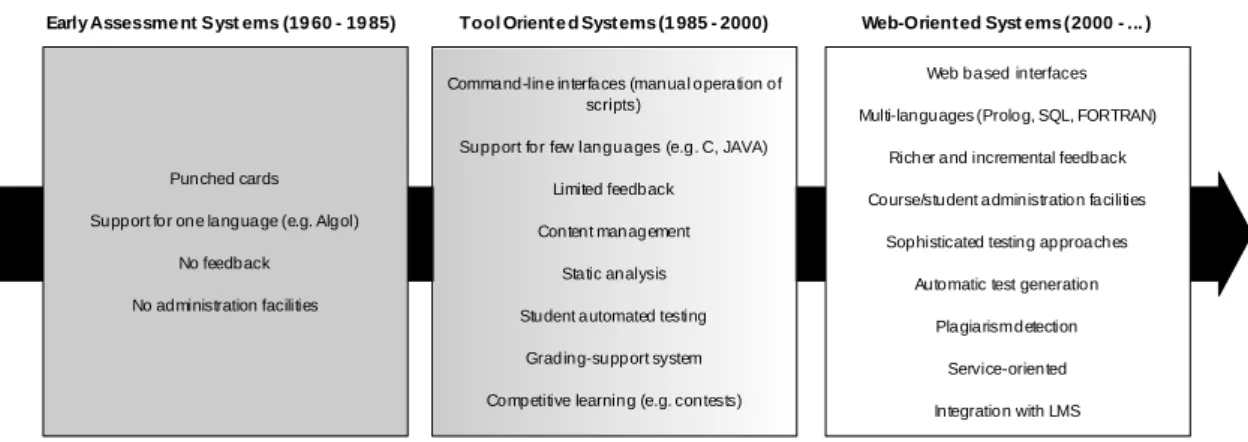
2.4.1 Evolution of Assessment Systems . . . 32
2.4.2 Recent Surveys . . . 33
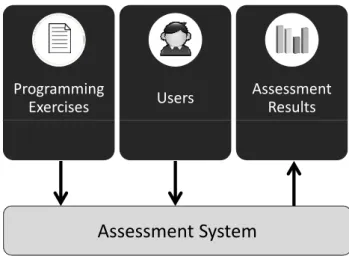
2.4.3 Assessment System Interoperability . . . 35
2.4.3.1 Programming Exercises . . . 36 2.4.3.2 Users . . . 38 2.4.3.3 Assessment results . . . 40 2.4.4 Conclusions . . . 41 2.5 Summary . . . 42 3 E-Learning standards 45 3.1 Frameworks . . . 47 3.1.1 Abstract Frameworks . . . 49
3.1.1.1 IEEE Learning Technology Systems Architecture . . . 50
3.1.1.2 Open Knowledge Initiative . . . 51
3.1.1.3 IMS Abstract Framework . . . 51
3.1.2 Concrete Frameworks . . . 52
3.1.2.1 Open University Support System . . . 53
3.1.2.2 Schools Interoperability Framework . . . 53
3.1.2.3 E-Framework . . . 54
CONTENTS xiii 3.2 Content . . . 57 3.2.1 Metadata . . . 58 3.2.1.1 Dublin Core . . . 58 3.2.1.2 IEEE LOM . . . 60 3.2.1.3 ISO/IEC MLR . . . 63
3.2.1.4 Other Metadata Specifications . . . 64
3.2.2 Packaging . . . 65
3.2.2.1 IMS Content Packaging . . . 65
3.2.2.2 ADL SCORM . . . 67
3.2.2.3 IMS Common Cartridge . . . 67
3.2.2.4 Other specifications . . . 70
3.2.3 Assessment . . . 71
3.2.3.1 Quiz based assessments . . . 71
3.2.3.2 Text file based assessments . . . 72
3.3 Communication . . . 77
3.3.1 Learning Management Systems . . . 77
3.3.1.1 Data Integration . . . 78
3.3.1.2 API Integration . . . 78
3.3.1.3 Tool Integration . . . 79
3.3.1.4 Comparison of the integration strategies . . . 81
3.3.2 Repositories . . . 82
3.3.2.1 Data push . . . 83
3.3.2.2 Data pull . . . 84
II Architecture 87
4 The Ensemble E-Learning Framework 89
4.1 Architectural model . . . 90
4.1.1 Axial systems . . . 91
4.1.2 Core and Secondary services . . . 92
4.2 Data Model . . . 93
4.3 Integration Model . . . 94
4.3.1 Text File Evaluation Service Genre . . . 95
4.3.1.1 The ListCapabilities function . . . 96
4.3.1.2 The EvaluateSubmission function . . . 97
4.3.1.3 The GetReport function . . . 98
4.3.2 Digital Repositories Interoperability . . . 98
4.3.3 Learning Tools Interoperability . . . 99
4.4 Summary . . . 101
5 Specializing Ensemble to computer programming 103 5.1 Architecture . . . 103
5.2 Data model . . . 104
5.2.1 The life-cycle of a programming exercise . . . 106
5.2.2 PExIL . . . 106 5.2.2.1 Textual Elements . . . 108 5.2.2.2 Specification Elements . . . 109 5.2.2.3 Program Elements . . . 113 5.2.3 Evaluating PExIL . . . 115 5.3 Integration model . . . 116
CONTENTS xv
5.3.1.1 Interface definition . . . 117
5.3.1.2 XML binding . . . 120
5.3.2 Learning Tools Interoperability . . . 120
5.3.3 Evaluation service . . . 122 5.3.3.1 Interface definition . . . 123 5.3.3.2 XML binding . . . 125 5.3.4 Workflow . . . 127 5.4 Tools selection . . . 129 5.5 Summary . . . 130 III Implementation 131 6 Learning objects repository 133 6.1 Architecture . . . 133 6.2 Implementation details . . . 135 6.2.1 Storage . . . 136 6.2.2 Validation . . . 136 6.2.3 Security . . . 139 6.2.4 User Interface . . . 139 6.2.5 Tests . . . 142
6.3 Case Study: using crimsonHex as a LMS plug-in . . . 143
6.4 Summary . . . 145
7 Programming exercises converter 147 7.1 Exercise format conversion . . . 147
7.1.1 Approach . . . 148
7.1.3 Abstract functions . . . 149
7.2 The BabeLO service . . . 150
7.3 Evaluation results . . . 152
7.3.1 Case study 1: repositories exchange . . . 153
7.3.2 Case study 2: automatic assessment . . . 154
7.4 Summary . . . 155
8 Programming Teaching Assistant 157 8.1 Use Cases . . . 158 8.1.1 Teacher . . . 159 8.1.2 Student . . . 160 8.2 Design . . . 161 8.2.1 Class TeachingAssistantLauncher . . . 162 8.2.2 Class TeachingAssistant . . . 163 8.2.2.1 Class ExerciseManager . . . 163 8.2.2.2 Interface ProjectCreator . . . 164 8.2.2.3 Interface ExerciseUtils . . . 164 8.3 Summary . . . 171 IV Validation 173 9 Ensemble evaluation 175 9.1 Evaluation Model . . . 175 9.2 Experiment Design . . . 176 9.2.1 Methodology . . . 176 9.2.2 Infrastructure . . . 177
CONTENTS xvii
9.3 Results and discussion . . . 179
9.3.1 Usefulness . . . 180 9.3.2 Reliability . . . 183 9.3.3 Interoperability . . . 184 9.4 Summary . . . 185 10 Thesis validation 187 10.1 Hypothesis . . . 187
10.2 Data collection and validation . . . 188
10.3 Results and discussion . . . 189
10.3.1 Exercises solving . . . 189 10.3.2 Feedback . . . 193 10.3.3 Attendance . . . 195 10.3.4 Grades . . . 197 10.4 Summary . . . 198 11 Conclusions 199 11.1 Contributions . . . 200
11.2 Opportunities for future work . . . 201
11.2.1 Framework validation . . . 201
11.2.2 Framework extension . . . 202
11.2.3 Ensemble instance improvements . . . 202
A Nielsen’s heuristics 205 B Session survey 207 C Petcha’s user manual 223 C.1 Teacher’s user manual . . . 223
C.1.1 Launching Petcha . . . 223
C.1.2 Creating a project . . . 223
C.1.3 Writing a program solution . . . 224
C.1.4 Defining the exercise statement . . . 225
C.1.5 Defining and generating the test cases . . . 228
C.1.6 Defining the feedback types . . . 234
C.1.7 Packaging and deploying the exercise . . . 236
C.2 Student manual (distributed to the students - PT) . . . 237
C.2.1 Execu¸c˜ao do Petcha . . . 237
C.2.2 Cria¸c˜ao de um projeto . . . 238
C.2.3 Resolvendo um exerc´ıcio . . . 240
C.2.4 Testando . . . 241
C.2.5 Submetendo uma solu¸c˜ao . . . 243
D crimsonHex Core Functions 247
D.1 Register function . . . 247 D.2 Submit function . . . 248 D.3 Request and RequestAsset functions . . . 248 D.4 Search function . . . 248 D.5 Report function . . . 250 D.6 Alert function . . . 250 D.7 Create function . . . 251 D.8 Remove function . . . 251 D.9 Status function . . . 252 References 256
List of Tables
2.1 Features of CMS, LMS and LCMS. . . 18
2.2 LMS support of content standards. . . 23
2.3 Integration API in reference LMS. . . 24
2.4 Digital library software. . . 29
2.5 Learning Objects Repositories software. . . 29
2.6 Learning Objects Repositories. . . 31
2.7 Programming exercise facet (P-partial and F-full) . . . 37
2.8 Users facet (P-partial and F-full) . . . 39
2.9 Assessment results facet (P-partial and F-full) . . . 41
3.1 E-Learning frameworks survey. . . 56
3.2 Profiling Types of existing LOM APs. . . 62
3.3 QTI compliance. . . 72
3.4 Textual information facet. . . 75
3.5 Data files facet. . . 75
3.6 Configuration and recommendation parameters facet. . . 76
3.7 Tools facet. . . 76
3.8 Metadata facet. . . 77
3.9 Comparison of e-Portfolio integration strategies . . . 81
5.1 Textual elements. . . 108
5.2 Specification elements. . . 109
5.3 Program elements. . . 113
5.4 Core and extension functions of DRI. . . 117
5.5 Student’s attempt general data. . . 119
5.6 Student’s characteristics particular data. . . 119
5.7 LTI functions. . . 121
5.8 LTI launch parameters . . . 121
5.9 Core functions of the Evaluation Engine. . . 123
5.10 REST request and response for the ListCapabilities function. . . 124 5.11 REST request and response for the Evaluate function. . . 124 5.12 REST request and response for the GetReport function. . . 125
6.1 Average function execution times per interface (in seconds). . . 142
7.1 PExIL coverage based on the Verhoeff model. . . 149
7.2 BabeLO REST API. . . 151
7.3 Download time (ms) and overhead of BabeLO . . . 153
8.1 ProjectCreator interface methods. . . 164
8.2 ExerciseUtils interface methods. . . 165
8.3 Generation of input data of test cases (R=random). . . 168
8.4 Binding PExIL to IEEE LOM. . . 171
9.1 The ESEIG experiment schedule . . . 177
9.2 Network selected systems . . . 178
9.3 Statistical data on interoperability of the network components . . . 184
10.1 Hypothesis on Ensemble usage. . . 188 10.2 Survey results averages. . . 189
LIST OF TABLES xxi 10.3 Statistics on student participation. . . 190 10.4 Statistics on student participation. . . 194 10.5 Statistics on student attendance. . . 196 10.6 Statistics on student participation. . . 198
List of Figures
1.1 Noteflight application. . . 2
1.2 Thesis structure. . . 7
2.1 The evolution of e-learning systems. . . 12
2.2 Integration classic models. . . 13
2.3 SOA components. . . 15
2.4 E-Learning system types. . . 18
2.5 Timeline of development of major LMSs. . . 20
2.6 LMS usage in Portuguese higher education institutions. . . 21
2.7 LMS interoperability facets. . . 22
2.8 AMS usage. . . 25
2.9 Evolution of software and specifications for repositories. . . 28
2.10 Usage of digital library software worldwide. . . 30
2.11 Generations of the Assessment Systems. . . 34
2.12 Interoperability facets of Assessment Systems. . . 36
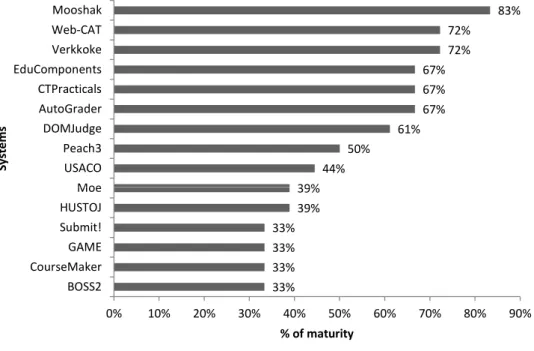
2.13 Interoperability maturity percentage level of Assessment Systems. . . 42
2.14 Coverage of Assessment Systems interoperability features. . . 43
3.1 Steps for establishing e-learning standards [VA06]. . . 46
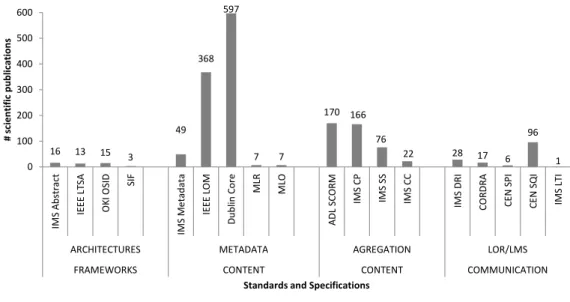
3.2 E-learning specifications and standards publications (1980-2010). . . 47
3.3 Simple Framework model [WBR04]. . . 49
3.4 Learning Technology System Architecture [FT99]. . . 50
3.5 OKI architecture. . . 51
3.6 IAF layered model. . . 52
3.7 SIF architecture. . . 54
3.8 E-Framework. . . 55
3.9 Evolution of e-learning Frameworks. . . 55
3.10 The hierarchy of elements in the LOM data model. . . 60
3.11 IMS CP package structure. . . 66
3.12 Common Cartridge Content Hierarchy. . . 67
3.13 IMS Common Cartridge package. . . 69
3.14 Data Integration. . . 78
3.15 API Integration. . . 79
3.16 IMS Full LTI. . . 80
4.1 EeF architectural model. . . 91
4.2 Structure of an IMS CC package. . . 94
4.3 Trends on the use of SOAP and REST web services. . . 95
4.4 The ListCapabilities function. . . 96
4.5 The EvaluateSubmission function. . . 97
4.6 The GetReport function. . . 98
4.7 The IMS DRI Specification. . . 99
4.8 The IMS Basic LTI Specification. . . 100
4.9 The IMS LTI Specification v.1.1 - integration with LIS services. . . 100
5.1 Overall architecture of the Ensemble instance. . . 104
5.2 Ensemble instance data model. . . 105
LIST OF FIGURES xxv
5.4 The specification element. . . 110
5.5 The program element. . . 113
5.6 Evaluation of PExIL expressiveness. . . 115
5.7 Network component diagram. . . 116
5.8 Response specification schema. . . 120
5.9 The reply type on the ERL specification. . . 126
5.10 The report type on the ERL specification. . . 127 5.11 Sequence diagram of the Ensemble instance. . . 128 5.12 The deployment architecture of the EeF. . . 129
6.1 UML components diagram of the crimsonHex repository. . . 134
6.2 Validation of XML files by a W3C XML Schema with Schematron rules [Rob02].138
6.3 Schematron processing [Rob02]. . . 138
6.4 crimsonHex WebManager. . . 140
6.5 crimsonHex plugin interface. . . 144
7.1 Exercise formats conversion using both approaches. . . 148
7.2 BabeLO architecture. . . 151
7.3 The Convert function. . . 152
7.4 Case study 1 - exchanging exercises between repositories . . . 153
7.5 Case study 2 - automatic assessment. . . 154
8.1 Petcha use cases. . . 158
8.2 The GUI of Petcha with teacher and student modes. . . 159
8.3 The UML class diagram of Petcha. . . 161
8.4 Generation of the exercise descriptions. . . 166
8.5 An example of an exercise description. . . 167
8.7 Structure of the IMS CC manifest file. . . 170
9.1 System acceptability. Adapted from Nielsen [Nie94]. . . 176
9.2 UML deployment diagram for the Ensemble instance. . . 178
9.3 Results of each heuristic in the student’s profile. . . 180
9.4 Evaluation of Petcha’s flexibility. . . 181
9.5 Evaluation of Petcha’s freedom. . . 181
9.6 Results of each heuristic in the student profile. . . 181
9.7 Classification of Pectha by students. . . 182
9.8 Results of each heuristic in the teacher profile. . . 182
9.9 Results of the Ease of Use heuristic in the teacher profile. . . 183
9.10 Reliability of Petcha. . . 183
10.1 Average and standard deviation of exercises solving by student participation. 190 10.2 Evolution in started exercises. . . 191 10.3 Evolution of completed/solved exercises. . . 193 10.4 Average of feedback received by exercise and its helpfulness. . . 194 10.5 Evolution of feedback and its helpfulness. . . 195
10.6 Overall attendance of students of both groups. . . 196
10.7 Evolution of attendance. . . 197 10.8 Average grades from both groups of students. . . 197
C.1 New project. . . 224
C.2 Confirmation of the creation of the project. . . 224 C.3 Coding the program solution in VSE. . . 225 C.4 Matrix transposition code. . . 226
C.5 User interface areas of Petcha. . . 226
LIST OF FIGURES xxvii C.7 Exercise statement. . . 227 C.8 Data about the program solution. . . 228 C.9 Test cases management. . . 229 C.10 Description of the input data. . . 230 C.11 Definition of a test case (input part). . . 231 C.12 Definition of a test case (input part). . . 232 C.13 Automatic generation of test cases. . . 233 C.14 Test case update. . . 233 C.15 Invalid test case. . . 234 C.16 Public test case with feedback. . . 234 C.17 Feedback levels definition. . . 235 C.18 Exercise packaging. . . 236 C.19 Exercise deploy in crimsonHex repository. . . 237 C.20 crimsonHex repository. . . 237
C.21 Ecr˜a inicial do Petcha (modo aluno). . . 238
C.22 Cria¸c˜ao de projeto. . . 239
C.23 Gest˜ao da resolu¸c˜ao de exerc´ıcios. . . 240
C.24 Enunciado do exerc´ıcio. . . 240
C.25 Codifica¸c˜ao da solu¸c˜ao por parte do Aluno. . . 241
C.26 Gest˜ao de testes. . . 241
C.27 Novo teste. . . 242
C.28 Execu¸c˜ao local de testes. . . 243
C.29 Feedback autom´atico providenciado pelo Avaliador. . . 243
C.30 Feedback autom´atico providenciado pelo Avaliador. . . 244
C.31 Solu¸c˜ao correta. . . 244
C.33 Estat´ısticas do exerc´ıcio. . . 245
List of Acronyms
ACM Association for Computing Machinery. ADL Advanced Distributed Learning.
AMS Academic Management Systems. API Application Programming Interface. AS Assessment Systems.
CEN European Committee for Standardization. CMS Content Management Systems.
DC Dublin Core. DL Digital Libraries. E-F E-Framework. EE Evaluation Engine.
EeF Ensemble E-Learning Framework. GLC Global Learning Consortium. HTTP Hypertext Transfer Protocol. IAF IMS Abstract Framework.
ICPC International Collegiate Programming Contests. ICT Information Communication Technology.
IDE Integrated Development Environments. IEC International Electrotechnical Commission.
IEEE Institute of Electrical and Electronics Engineers. ILOX Information for Learning Object eXchange. IMS CC IMS Common Cartridge.
IMS CP IMS Content Packaging. IMS LD IMS Learning Design.
IMS LODE IMS Learning Object Discovery & Exchange. IMS SS IMS Simple Sequencing.
IOI International Olympiad in Informatics.
ISO International Organization for Standardization. JAR Java ARchive.
JAWS Java Web Start.
JAXB Java Architecture for XML Binding. LAO Learning Application Objects.
LCMS Learning Content Management Systems. LDAP Lightweight Directory Access Protocol. LIP Learner Information Package.
LIS Learner Information Services. LMS Learning Management Systems. LO Learning Object.
LOM Learning Object Metadata. LOR Learning Objects Repository. LTI Learning Tools Interoperability.
LTSA Learning Technology Systems Architecture. LTSC Learning Technology Standards Committee. MLE Managed Learning Environment.
Glossary xxxi OAI-PMH Open Archives Initiative Protocol for Metadata Harvesting.
OJ Online Judge.
OKI Open Knowledge Initiative.
OpenUSS Open Source University Support System. OSID Open Service Interface Definition.
PCMS Programming Contests Management Systems. QTI Question and Test Interoperability.
SCORM Sharable Content Object Reference Model. SIF Schools Interoperability Framework.
SMTP Simple Mail Transfer Protocol. SOA Service-Oriented Architecture. SOAP Simple Object Access Protocol. SWT Standard Widget Toolkit. TA Teaching Assistant.
URI Uniform Resource Identifier. VLE Virtual Learning Environment. WCR Web Content Resources.
WS-BPEL Web Services Business Process Execution Language. WSDL Web Service Description Language.
Chapter 1
Introduction
”I practice until I have my life in my fingers” Pianists’ expression
For someone to acquire, improve or even maintain a complex skill it is necessary to practice it on a regular basis [GP05, Eck09]. The amount of practice required depends on the nature of the activity and on each individual. How well an individual improves with practice is directly related with its inherent capabilities, its previous know-how about the domain and the type of feedback that is available for improvement. If feedback is either non-existent or inappropriate, then the practice tends to be ineffective or even detrimental to learning. An apt example of a complex skill is music. Learning music requires discipline and perse-verance while acquiring the concept of reading scores, practising an instrument or playing with a group. In order to enhance these skills and motivate young students, instructors use e-learning, mainly in introductory courses, to make the learning of music more appealing.
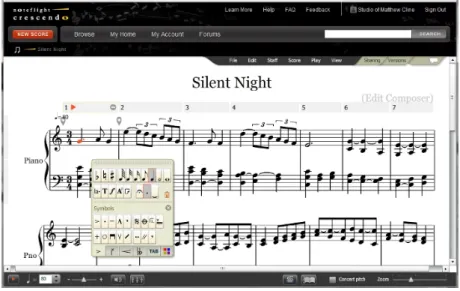
One good example is the NoteFlight1 web application (Figure 1.1), a tool designed to teach
music by creating, viewing, printing and hearing music notation. The tool was recently
integrated2 with Moodle, a popular Learning Management Systems (LMS). This integration
enables instructors to create assignments (e.g. giving students a partial composition to be completed), to manually grade the student submissions and to give them feedback promptly. Besides music, there are other areas where evaluation is a key component in practice such as management, health sciences, electronics. Playing business games in management courses, or simulating a human patient in life sciences courses, or simulating an electronic circuit in electronics courses are examples of learning processes that require the use of special
1
NoteFlight web site: http://www.noteflight.com
2NoteFlight demo with Moodle integration: http://videos.noteflight.com/MoodleBasicLTI.mov
Figure 1.1: Noteflight application.
authoring, rendering and assessment tools. These tools should be integrated in instructional environments in order to provide a better learning experience. However, these tools would be too specific to incorporate in an e-learning platform. Even if they could be provided as pluggable components, the burden of maintaining them would be prohibitive to institutions with few courses in those domains.
1.1
Motivation
The motivation for this thesis comes from yet another domain with complex evaluation: computer programming. Introductory programming courses are generally regarded as dif-ficult and often have high failure and dropout rates [AM05, OG06, RRR03]. Researchers pointed out several causes for these rates [EFMM10]. The most consensual are:
Teaching methods - lectures and programming language syntaxes [LAMJ05, SB06]; Subject complexity - learning how to program means to integrate knowledge of a wide
variety of conceptual domains such as computer science and mathematics while devel-oping expertise in problem understanding, problem-solving, unit testing and others. Additionally, students petered out when they need to understand and apply abstract programming concepts like control structures or to create algorithms that solve concrete problems [EFMM10].
Student motivation - the public image of a ”programmer” as a socially inadequate ”nerd” [Jen02] and the reputation of programming courses as being extremely difficult affects negatively the motivation of the students [GM07].
1.1. MOTIVATION 3 Many educators claim that ”learning through practice” is by far the best way to learn computer programming and to engage novice students [GP05, Eck09]. Practice in this area boils down to solving programming exercises. Nevertheless, solving exercises is only effective if students receive an assessment on their work. An exercise solved wrong will consolidate a false belief, and without feedback many students will not be able to overcome their difficulties. Assessment plays a vital role in learning [AM05]. However, automatic assessment of ex-ercises other than multiple choice can be a rather complex task. This kind of evaluation differs significantly from evaluations supported by most LMSs, encoded in the IMS Question
and Test Interoperability (QTI) specification3. The data model of QTI was designed for
questions with a set of pre-defined answers and cannot handle evaluation domains with specialized requirements such as the computer programming. For instance, the assessment of programming exercises requires tests cases, program solutions, compilation lines and other data that cannot be encoded in QTI. Besides the lack of a formal description for programming exercises, the interaction of assessment tools with other systems is not mature enough since there is no communication specifications as stated in several surveys [LQ10a, QL11c]. Automatic assessment in computer programming domains can be applied in two distinct learning contexts: curricular and competitive learning.
Introductory programming courses are part of the curricula of many engineering and sciences programs. These courses rely on programming exercises, assignments and practical exam-inations to consolidate knowledge and evaluate students. The enrolment in these courses is usually very high, resulting in a great workload for the faculty and teaching assistants responsible for assessing student programs.
While the concept of ”winners and losers” can hinder the motivation of students [VD03], competitive learning is a learning paradigm that relies on the competitiveness of students to increase their programming skills [Bur10, SKA08]. This is the common goal of several programming contests where students at different levels compete such as: the International
Olympiad in Informatics (IOI)4, for secondary school students; the ACM International
Collegiate Programming Contests (ICPC)5, for university students; and the IEEExtreme6,
for IEEE student members. In this context, several tools are used to allows students to train or participate in programming contests. These tools such as Programming Contests Management Systems (PCMS) and Online Judges (OJ) rely also on the assessment of programming exercises.
In both scenarios the manual assessment of programming assignments poses significant
demands on the time of teachers [DLO05]. Apart from being time-consuming, manual
3
IMS QTI Web site: http://www.imsglobal.org/question/ 4IOI Web site: http://ioinformatics.org
5
ICPC Web site: http://icpc.baylor.edu/
assessment hinders the consistency and accuracy of assessment results as well as it allows un-intended biases and a diverse standard of marking schemes [RSZ10]. This demand stimulated the development of automated learning and assessment systems in many universities [AM05] as a means for grading the programming exercises of students as well as giving feedback on
the quality of their solutions [TGPS08, SHP+06]. This feedback support is crucial for the
computer programming learning [WW08, Mor07], especially for first year students that need to be adequately engaged in order to learn programming [Jen02]. Furthermore, immediate feedback motivates students to continue practising [Dal99, Tru07].
Beyond the automatic assessment other relevant topic in this domain is the availability of programming exercises. It is important that an e-learning system provides a collection of exercises covering a course syllabus and with different levels of difficulty. It has been shown that this can improve the performance of students and their satisfaction levels [WW08]. Students with lower computer skills can begin by solving easier problems in order to learn progressively and to stay motivated to solve the harder problems later [lLH00]. At the same time this gives them experience that is one of the factors that has a greater influence on the student success in learning programming [WLK04]. In recent years, a large number of programming exercises have been developed and published mostly for use in programming contests. These exercises are generally stored in proprietary systems (e.g. Online Judges) for their own use. Despite some efforts [QL12b] to define a common format to describe programming exercises, each of these systems has its own exercise format, making it difficult to share among instructors and students. This poses several issues on the interoperability of the assessment systems with other e-learning systems.
A number of learning tools and environments have been built to assist both teachers and students in introductory programming courses. Rongas, Kaarna, and Kalviainen [RKK04] established a classification for these tools dividing them into four categories: 1) integrated development interfaces, 2) visualization tools, 3) virtual learning environments, and 4) sys-tems for submitting, managing, and testing exercises. To the best of the author’s knowledge,
no e-learning environment described in the literature integrates all these facets [VRV+11,
GM07, EFMM10]. Several systems [Jen08, VRV+11, XC11, GG08] try to address this issue
allowing the integration of automatic assessment tools with course management systems but these approaches rely on ad hoc solutions or proprietary plug-ins rather on widely accepted international specifications for content description and communication among systems.
1.2
Challenge
Assessing the work of students and providing individualised feedback to all students is time-consuming for teachers and frequently involves a time delay. The existent tools prove to be insufficient in complex evaluation domains where there is a greater need to practice [RKK04].
1.3. APPROACH 5 This dissertation addresses the following problem:
Student practice in domains with complex evaluation using e-learning is currently unsatisfactory.
The main goal of this research is to foster the practice-based learning in domains with complex evaluation. The essential tasks required by a practice-based learning environment are already available in a profusion of e-learning systems. There are already systems to manage instructions [LQ11a], to author and archive content [QL12a] and even to evaluate exercises [QL12c]. The challenge is to bind them together in a network that enhances their individual strengths and creates an environment for practising a complex skill. This insight led to the following research question:
In domains with complex evaluation
is there an increase of effectiveness in practice-based learning through the use of a network of best-of-bread e-learning systems?
1.3
Approach
The novel approach of this research is to network the best-of-breed tools for a specific domain, rather than use the traditional approach of integrating components into a single system. The cornerstone of this approach is an e-learning framework - called Ensemble - that acts as a conceptual tool in the definition and deployment of such kind of e-learning network. This framework relies on interoperability standards and specifications, thus several studies and surveys were conducted to select the most relevant.
Based on this framework a network of systems and services was created and deployed for a specific domain - the computer programming domain. This framework instance comprises several systems and services and their integration poses interoperability issues on two levels: content and communication. Content issues are tacked with a standard format to describe programming exercises as learning objects. Communication is achieved with the extension of existing specifications for the interoperation with several systems typically found in an e-learning environment such as learning management systems, learning objects repositories and assessment systems. Some of these systems were created from scratch and others were adapted to support the new content and communication specifications.
Having in mind this approach the research question stated in the previous section leads to the following hypotheses:
H1. Exercises solving - In a practical class students that use Ensemble start, complete and effectively solve more exercises and this advantage is maintained or improved over time;
H2. Feedback - In a practical class students that use Ensemble receive more feedback and this feedback is effective in overcoming their difficulties;
H3. Attendance - Practical classes have more attendance when students use Ensemble and this attendance is maintained or improved over time;
H4. Grades - Students that use Ensemble get better grades in the subject taught within the network and in the programming course.
In chapter 10 this set of observable assertions is tested to validate the dissertation objectives.
1.4
Contributions
This dissertation includes several contributions that can be divided in two facets: conceptual and concrete. Conceptual contributions are related with abstract concepts such as ideas, algorithms, studies, surveys and theoretical frameworks. The conceptual contributions are:
Studies and surveys - e-learning frameworks [LQ10a]; LMS interoperability [LQ11a]; Pro-gramming Exercises Assessment Systems [QL12c] and e-learning standardization [QL11c, LQ10b, QL09].
Theoretical frameworks - a conceptual framework for the development of networks in complex evaluation domains [QL11a, LQ11c];
Concrete contributions are related with the implementation of tools and specifications. The concrete contributions are:
Frameworks - An Ensemble framework instance applied to computer programming7[LQ11e,
LQ11b, LQ10f, LQF10];
Specifications, systems and services : PExIL8 - a standard format for the description
of programming exercises [QL11e, QL11d, QL11b, LQ09e, LQ09c]; CrimsonHex9
-a progr-amming exercises repository [LQ10c, LQ10e, LQ09-a, LQ09d, LQ09b, LQ10e];
7http://ensemble.dcc.fc.up.pt 8
http://ensemble.dcc.fc.up.pt/Pexil 9http://ensemble.dcc.fc.up.pt/CrimsonHex
1.5. THESIS STRUCTURE 7
Moodle plug-in for crimsonHex10[LQ10d]; BabeLO11- a programming exercises format
conversion service; Evaluate12 - a programming exercises evaluation service [LQ11d,
LQ10h, LQ10g]; Petcha13 - a teaching assistant system [QL12b].
1.5
Thesis structure
The organization of this dissertation is depicted in Figure 1.2.
E-Learning Systems STATE OF ART 2 E-Learning Standards ARCHITECTURE
Ensemble EnsembleInstance
based on Data Mo del Integratio n Mo del Architectural Mo del extend s IMPLEMENTATION imp lements BabeLO EVALUATION crimsonHex Petcha Data Mo del Integratio n Mo del imp lements valid ates Ensemble Thesis 3 4 5 6 7 8 9 10
Figure 1.2: Thesis structure.
This dissertation is composed by nine chapters (gray rectangles) plus the introduction and conclusions. These chapters are organized in logical parts (black rectangles). Each part is described as follows.
Part 1 (State of Art) - gathers information on e-learning systems and standards. It
is composed by two chapters: e-learning systems and e-learning standards. The
former starts by tracing the evolution of e-learning systems from monolithic systems to specialized services and stresses the interoperability features of three systems typi-cally founded in introductory programming learning environments [RKK04]: Learning Management Systems, Repositories and Assessment Systems. The latter gathers in-formation on e-learning standards in order to choose the most suitable for the domain of automatic evaluation of exercises. The organization of this chapter is based on several studies found in the literature [JBK05, VA06]. In these studies the outcomes of the standardization efforts on e-learning interoperability are divided in two levels (content and communication). The chapter adds a new level (Frameworks) due to its
10 http://ensemble.dcc.fc.up.pt/ChMoodlePlugin 11http://ensemble.dcc.fc.up.pt/BabeLO 12 http://ensemble.dcc.fc.up.pt/Evaluate 13http://ensemble.dcc.fc.up.pt/Petcha
relevance in the last years on the development of new e-learning systems based on Service-Oriented Architecture (SOA).
Part 2 (Architecture) - comprises two chapters. The first one presents the design of the Ensemble e-learning framework as a conceptual tool to organize a network of e-learning
systems and services that use complex evaluation. The chapter details the three
framework models (architectural, data and integration). The second chapter presents the use of the Ensemble framework in a specific domain: the computer programming
domain. The presentation comprises the following topics: 1) the architecture of
an Ensemble instance for the computer programming domain; 2) the data model based on an interoperability language for programming exercises; 3) the integration model of the systems and services involved through the creation and extension of existent communication specifications; 4) selection of tools that comprises a deployable Ensemble instance.
Part 3 (Implementation) - details the implementation from the scratch of three systems and services. The crimsonHex repository is a specialized and extensible repository of programming exercises described as learning objects. The BabeLO service handles the conversion between different programming exercises formats. The Petcha system acts as an automated teaching assistant in computer programming courses helping both teachers to author programming exercises and students to solve them. It also coordinates a network of heterogeneous systems, integrating assessment systems, learn-ing management systems, learnlearn-ing object repositories and integrated programmlearn-ing environments.
Part 4 (Evaluation) - includes two chapters. Firstly, an Ensemble acceptability evaluation is performed focusing on the usefulness, reliability and interoperability of a network of systems and services for the computer programming domain. Then, the thesis is validated by proving the Ensemble effectiveness to achieve the thesis goals. These evaluations rely on a classroom experiment made in a Polytechnic Superior school in Porto. Although both chapters share the experiment conditions, the characterization of the experiment is made on the first chapter. It includes the design of the controlled experiment, the instruments used in this study and how the data was collected.
The last chapter resumes this dissertation pointing out the major contributions and future work perspectives. Finally, four appendices are included at the end of the document. The first two appendices include a list of heuristics and the usability survey (based on these heuristics) answered by the students at the final of the experiment, respectively. The third appendix is the user manual of Petcha for both teachers and students. The last appendix is dedicated to the crimsonHex Application Programming Interface (API).
Part I
State of Art
Chapter 2
E-Learning systems
”There are two fundamental equalizers in life -the Internet and education.” John Chambers, CEO, Cisco Systems Inc. 1999
Nowadays, the learning experience is no longer confined within the four walls of a classroom. Computers and the Internet have broadened this horizon by creating a way of delivering education known as e-learning. E-learning or Electronic Learning can be defined as the delivery of educational content via any electronic media, including the Internet, satellite broadcast, audio/video tape, interactive TV, CD-Rom and others [TS05]. However there are other activities such as practising, evaluating, assessing and giving feedback, that are undertaken by teachers and students and goes beyond content delivery even though they may operate on content that has been delivered. In this context e-learning systems play a relevant role in the teaching-learning process facilitating the dissemination of knowledge by teachers and its absorption by students.
This chapter starts by tracing the evolution of e-learning systems from monolithic systems to specialized services. These services can be easily recombined in different learning processes. This chapter focuses on learning processes within domains with complex evaluation. In this domain there are several candidates to offer services such as those referred by Rongas, Kaarna, and Kalviainen [RKK04], namely: Learning Management Systems, Learning Ob-jects Repositories and Assessment Systems. These three types of system are detailed in the remainder sections.
2.1
E-Learning evolution
The evolution of e-learning in the last decades has been astonishing. In fact, e-learning seems to be constantly reinventing itself, finding new uses for technology, creating new tools, discovering new concepts. Platforms for supporting e-learning have been evolving for some years, exploring many approaches and producing a great variety of solutions. In spite of their number, these platforms can be grouped according to their characteristics and their ability to interact with each other. Thus, a good a way to understand them is by studying both their architectural features and the standards they support.
2.1.1 Early systems
The genesis of e-learning, despite some efforts to foster remote education [Har06], coincides with the development of network communication in the late 1960s, more precisely, with the invention of e-mail and computer conferencing (1971). These innovations contribute to the collaboration between teachers and students and initiate a new education paradigm shift [Wil05]. During the 1980s and 1990s, there was a significant growth in the number of part-time students and also in non-traditional learners, such as women’s returning to the workforce after child rearing [Wil05]. The growth in lifelong learning market made the educational institutions eager to accommodate the needs of these non-traditional students and to offer them e-learning courses based on the Internet.
2.1.2 Component based systems
In their first generation e-learning systems (Figure 2.1) were developed for a specific learning
domain and had a monolithic architecture [DOL+07].
Monolithic Single Domain No Interoperability No Standards Component Based Multiple Domains Content Sharing Learner Management Emerging Standards (LO)
Basic Interoperability Service Based Specialized Domains Service Sharing Semantic Aware LO Sequencing/Adapatability Standards Based Total Interoperability Cloud E-Learning Services
1st Generation 2nd Generation Future
2.1. E-LEARNING EVOLUTION 13 Gradually, these systems evolved and became domain-independent, featuring reusable tools that can be used virtually in any e-learning course. The systems that reach this level of maturity usually follow a component oriented architecture in order to facilitate tool intgration. Different kinds of component based learning systems target specific aspects of e-learning such as student or course management. This architectural model structures software around pluggable and interchangeable components, thus enabling the development of larger
systems, resulting from the collaboration of different teams. In some cases component
oriented architectures led to oversized systems that are difficult to reconvert to changing roles and new demands. This is particularly true in e-learning. A criticism to this approach is that it reduced e-learning to the use of one-size-fits-all systems, i.e., systems that 1) can be used on any learning subject but fails to address specific needs of each of them, and 2) can be used by any student but is not able to adapt to unique characteristics of individuals
[DOL+07].
2.1.3 E-Learning services
Component based integrated environments became the corner stone of e-learning. Although they tend to incorporate a growing number of tools, they cannot afford to be isolated from
other software systems operating in academic institutions. There are several strategies
routinely used to achieve this integration. The most common are depicted in Figure 2.2. Integration usually includes at least one Web application, and this is typically designed based on the well known three-tier architectural pattern [Eck95]. There is a potential for integration in any the three classical tiers: presentation, logic and data.
Portals Features Share Database Replication
Figure 2.2: Integration classic models.
The portal strategy aggregates content from multiple sources with a common presentation layer. It integrates at the presentation tier, providing an unified web interface to a number of independent subsystems, including e-learning systems. The major advantage of this strategy is the fact that it gives users a sense of unity, sometimes at the cost of compromising consistency.
In the feature sharing approach the presentation is independent while sharing some fea-tures. The integration is at the logic tier and is becoming increasingly popular as more systems expose their functionality using web services. User authentication based in directory services, such as Lightweight Directory Access Protocol (LDAP), is an apt example of this type of integration. It should be noted that the use of web services for feature sharing is not a remedy for this problem. Although service oriented architectures typical (but not necessarily) use web services, using web services does not automatically qualify a system as SOA.
Finally, integration may occur at the data tier where different applications share the same content. In this context the partial database replication is arguably the most common example. For instance a LMS may import data on students, courses and student enrolments in courses from administrative systems to avoid the burden of entering this data manually. These integration models are usually combined. For instance, a portal that provides an unified presentation may also adhere to a single sign-on mechanism shared with other services.
These approaches to system integration are a collection of pragmatic solutions that raises their own problems. In fact, integration on specific points creates the same kind of entangle-ment found in monolithic systems. Since integration is not driven by architecture, there is no coherence among a disparate set of connections that ties up the system and compromises future changes. This problem is not specific of e-learning systems and is generally approached using SOA.
SOA [Erl05] is already a mature architectural pattern with established principles and tech-nologies and can be defined as a systematic approach to system development and integration. Instead of point-to-point integration, SOA proposes the development of systems around the concept of interoperable services. These services must be loosely coupled, allowing them to be easily recombined in different processes (typically business processes).
Figure 2.3 shows the SOA components and their relations, namely: contract - collection of all the messages supported by the service; service - implementation of the functionality promised by the contracts it exposes; message - unit of communication; service consumer - software that interacts with a service through the exchange of messages; and end point - an Uniform Resource Identifier (URI) that specifies where the service can be found and consumed.
The communication between these components is generally based on Web services. The Web Service Description Language (WSDL) provides a description of how to use a service. The definition of how several Web services cooperate to achieve a given goal cannot be handled by the WSDL specification and, in this case, the use of coordination models (e.g. orchestration, choreography) is needed to define an interoperable integration model. This model facilitates
2.1. E-LEARNING EVOLUTION 15 End-Po int Co ntracts Messages Service Co nsumer Service binds to sends/receives understands exposes sends/receives implements serves describes
Figure 2.3: SOA components.
the expansion of automated process integration and the management of the workflow within services.
This architectural pattern is appropriate in contexts where components (services) participate in several processes, and process configuration needs to be flexible. This concept of process is applicable to learning: flexible learning processes can be used to congregate the best e-learning services available for each particular domain and create an instructional environment more adapted to the student needs and requirements. As this type of architectures became mainstream, a few initiatives to adapt SOA to e-learning emerged [LQ10a]. These new frameworks and APIs contributed with the identification of service usage models and are
generally grouped into logical clusters according to their functionality [ASQ+06].
Service oriented architectures cannot be seen as a silver bullet for all e-learning system integration problems. The adoption of SOA creates new challenges such as 1) the integration of heterogeneous services based on semantic information, 2) the automatic adaptation of services to users (both learners and teachers), and 3) the lack of a critical mass of services to supply the demand of e-learning projects.
1) Web services do standardize communication but they do not ensure that every service assigns the same meaning to what is being communicated. This is a general problem with heterogeneous services and affects particularly e-learning since what is being communicated involves complex data (e.g. learning objects) and complex functions (e.g. automatic assess-ment).
2) Other criticism to integrated e-learning systems is the lack of focus on the student and on the learning domain. Tools tend to be too common to all learning domains and the same contents are presented to all students enrolled in a same course. On its own, the adoption of SOA will not address this problem and there is a risk that it may actually increase it, if it is not driven by pedagogical concerns. For instance, if the same course content is offered to
a wider range of students with different backgrounds then it will be actually be less focused on students. However, the use of services creates a possibility for a systematic approach to use adaptability in e-learning. On one hand, a service contract is a good place to ensure that the data on which to base adaptability can be effectively gathered. On the other hand, adaptability in itself may be provided as a service that can be configured in a learning process.
3) Last but not least, the number of e-learning services is still very small. Before reaching a critical mass of e-learning services, available to participate in reconfigurable pedagogical processes, it will be difficult to support the claims of SOA in the e-learning context. Surely, many infrastructural services are common to any SOA service, but there are few truly pedagogical services available.
2.1.4 Specialised E-Learning Services
The pressure to adopt SOA in e-learning is mostly fuelled by managerial needs of academic institutions, rather than pedagogical concerns of teachers. In some cases is an internal need, of combining infrastructures of autonomous departments with different responsibilities within an academic institution. In other cases results from external pressure, of linking with other institutions in order to offer join e-learning programs. In these cases the resulting platform typically relies on an LMS, thus having the same problems of component based systems, especially from an educational viewpoint.
Traditionally, features are added to LMS by integration of new components. These compo-nents are specific to an LMS and tend to be very general, in order to be reusable in as many courses as possible. By contrast, a service may be reused on different systems, thus making more sense to specialize it to a specific purpose. Moreover, a service can make use of certain hardware or software; for instance a specific program available only on a particular platform. Last but not least, specialized e-learning services are able to participate in multiple and easily reconfigurable learning processes. A learning process is a collection of related and structured activities. In this context, each activity is implemented by a specialized e-learning service. Services may participate in several learning processes and new processes can be created or reconfigured.
This dissertation emphasis the learning processes in domains with complex evaluation. These learning processes involve several learning systems such as those referred by Rongas, Kaarna, and Kalviainen [RKK04], namely:
Learning Management System - to manage and retrieve the exercises to the learners; Learning Objects Repository - to persist exercises and related meta-information;
2.2. LEARNING MANAGEMENT SYSTEMS 17 Assessment System - to evaluate and produce feedback on learners’ attempts.
These types of services are very different in nature. The LMS is not in strict sense a
specialized service. It is a system designed to be a complete and generic e-learning solution rather than a service. Nevertheless, since a typical LMS is a component based system, it may be extended to incorporate the features it lacks to communicate with other services, and provide a front-end both for learners and teachers. The LMS possess a user interface and learners can interact directly with it. The other two, the repository and the assessment systems, provide truly specialized services.
In the following sections each of these systems are detailed with emphasis on their interop-erability support.
2.2
Learning Management Systems
Nowadays, an LMS plays a central role in any e-learning architecture and can be defined as a software application for the administration, documentation, tracking, and reporting of training programs, classroom and on-line events [Ell09].
2.2.1 Categories
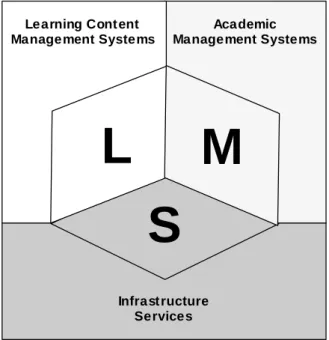
Several designations and respective acronyms are used to typify LMSs (Figure 2.4). The following list includes the most common: Content Management Systems (CMS) , Learning Management Systems (LMS), Learning Content Management Systems (LCMS) , Managed Learning Environment (MLE) and Virtual Learning Environment (VLE). These five types of e-learning systems have a considerable overlap and they are difficult to differentiate. For the sake of simplicity only the first three will be considered as representative of the main categories of e-learning systems.
While these three categories still share common characteristics, they also have some distinc-tive features that justify distinguishes among them. The CMS was introduced in the mid-1990s mostly in the on-line publishing industry. This type of system can be defined as a data repository that also includes tools for authoring, aggregating and sequencing content. The main goal of these tools is to ”simplify the creation and administration of on-line content” [Nic01]. CMSs are focused on content with the main purpose to store information and provide access to it. CMS content is organized in small self-contained pieces of information to improve reusability at the content component level. These content components when used in the learning domain are called Learning Objects (LOs).
or-MLE VLE
CMS
LMS LCMS
Figure 2.4: E-Learning system types.
ganization [HK06]. Two usage scenarios are relevant: learners can use the LMS to plan their learning experience and to collaborate with their colleagues; teachers can deliver educational content and track, analyse and report the learner evolution within an organization. Most LMSs are structured around courses rather than content, thus they are only reusable at the course level. LMS also do not support the creation of instructional content and teachers must resort to third party content creation tools. A LCMS combines the administrative and management features of a LMS with the content creation of a CMS. In a LCMS, you would have libraries of LOs that can be used either independently, or as a part of larger instruction sets. For instance, one LO can be used in several courses with several learners.
Table 2.1 relates the three categories of applications based on several main features [HK06, Don02]. Each feature may have a robust (R) or limited (L) support in these categories or, simply, no support.
Table 2.1: Features of CMS, LMS and LCMS.
Features CMS LMS LCMS
Manage learners - R L
Manage content R L R
Create content R - R
Launch and track e-learning - R L
Assessment and feedback - R R
Nevertheless, the trend in e-learning systems is integration, therefore most of them evolved to the same set of standard features and many of these acronyms are recurrently used as synonyms. In the course of this section the LMS is taken as the representative of e-learning systems since the term LMS is often used to refer to both LMS and LCMS, although the LCMS is a further development of the LMS.
2.2. LEARNING MANAGEMENT SYSTEMS 19 As every kind of software, LMSs continue to evolve to meet market demands, namely:
SOA - in these architectures LMSs expose their functions as services and consume services from their operational environments, improving their interoperability with other
e-learning systems [DOL+07];
Web 2.0 - with the recent appearance of Web 2.0 tools and the popularity of social net-working tools like Facebook and Twitter, there has been a great demand to use similar tools in the LMS to enhance the communication among teachers and students; Talent Management - Talent Management software systems are an extension of
tradi-tional human resource management systems. Some researches [Ber09] shows that in 2009 more than 70% of large companies have an LMS already and almost 1/3 of these companies are considering replacing or upgrading these systems with integrated talent management systems [LL10];
Mobile Learning - with more students working at distance, there has been also a strong demand to make e-learning applications accessible through mobile devices (e.g. Smart-phones, Tablets) know as Mobile Learning or m-learning;
”Software as a Service” - with Software as a Service (SaaS) schools can relieve the fi-nancial burden of maintaining their LMSs by outsourcing the hosting service;
Open Source Software - commercial LMS (e.g. Blackboard, WebCT) have dominated the education market in previous years, but as costs increase, schools and companies are now looking for other options such as open-source solutions (e.g. Moodle, Sakai) that are financially more attractive.
2.2.2 LMS Interoperability
Interoperability is the ability of different computer systems, applications or services to communicate, share and exchange data, information and knowledge in a precise, effective and consistent way. In the e-learning field this topic is extremely important since there is the need for all systems that typically compose an e-learning environment to communicate and share data consistently. In this context, several organizations have been developing specifications and standards in the last years focusing on the content and communication
interoperability [Reh03, DOL+07].
In the following sub-subsections an LMS interoperability comparative study is conducted. Several studies have been conducted to analyse and evaluate LMSs from pedagogical and institutional perspectives [Bri98]. However, the author is not aware of any study to evaluate the interoperability of LMSs with other systems typically found in an educational institution.
This study is part of an effort to select an LMS on which to base the development of e-learning systems integrating heterogeneous components. Given the number of LMS vendors it would be impracticable to study them all. Therefore, two LMS vendors are chosen and their interoperability features are analysed.
2.2.2.1 LMS selection
A good number of LMSs that were developed in the past fifteen years are still in use and under active development. For the purpose of this study the focus is on a few systems that are representative of the LMS universe in terms of their characteristics and market share. A simple categorization of this type of systems is according to their development models. There are fundamentally two: open source systems, such as Moodle, Sakai, .LRN or Dokeos; and commercial systems such as WebCT/Blackboard or Desire2Learn. Figure 2.5 presents a timeline of several initiatives grouped by their development model. In these two categories the most popular systems were selected taking as reference the available data on global LMS usage [DW09]. Mo odle v.1.9 Sakai Do keo s aTuto r .LRN v.2.7 v.1.8 v.1.6 v.2.5 WebCT Blackbo ard Desire2Learn Info rmetica eCo llege v.9.1 v.3.0 v.3.5 v.2.1 Open Source Systems Comme rcial Systems 2000 2005 2010 1995
Figure 2.5: Timeline of development of major LMSs.
The Figure 2.5 shows that the first major LMSs adopted a commercial development model but since the beginning of this century there has been a shift towards open source systems. In fact, this shift was already recognized as a trend in LMS development [DW09]. In spite of the
2.2. LEARNING MANAGEMENT SYSTEMS 21 growing popularity of open source, commercial systems are still relevant and they must be included in any representative sample of LMSs. As part of this study a survey was conducted in 2011 on e-learning systems usage in Portuguese higher education institutions. About 20 different institutions responded and the results for LMS usage are shown in Figure 2.6.
10% 5% (Sakai) 10% (Others) 5% (Not Exist) 70% (Moodle) 10% (Blackboard)
Figure 2.6: LMS usage in Portuguese higher education institutions.
The selection of the LMSs for this interoperability study was based on the two most popular LMS - Moodle and Blackboard. They represent the two main development models used by LMS vendors (open source and commercial); and combined they have a significant share on the LMS market (33.2% on the international market [DW09] in 2009 and 80% on this recent survey in Portuguese institutions). The following paragraphs provide an overview of the selected systems.
Moodle (version 1.9.9 - 8th June 2010) is a free and open-source LMS written in PHP and created by Martin Dougiamas. Its name is an acronym for Modular Object-Oriented Dynamic Learning Environment. In early January of 2010, Moodle had a user-base of 46,624 registered sites with 32,464,992 users in 3,161,291 courses in 209 countries and in more than 75 languages [CF07].
Blackboard (version 9.1 - 1th April 2010) was developed by Blackboard Inc. in 1997 and is an on-line proprietary LMS that is used by over 3700 educational institutions in more than 60 countries. In February 2006, the virtual learning environment called WebCT (Course Tools) was acquired by Blackboard Inc. (Blackboard, 2005) and, as part of the acquisition terms, the Blackboard brand was assumed until now.
2.2.2.2 Interoperability Facets
The interoperability features of a system reflect the operational environment where it is expected to be deployed. The operational environment of an LMS includes different systems
![Table 2.1 relates the three categories of applications based on several main features [HK06, Don02]](https://thumb-eu.123doks.com/thumbv2/123dok_br/18254312.879644/54.892.246.634.800.962/table-relates-categories-applications-based-main-features-don.webp)
![Figure 3.4: Learning Technology System Architecture [FT99].](https://thumb-eu.123doks.com/thumbv2/123dok_br/18254312.879644/86.892.203.674.478.798/figure-learning-technology-system-architecture-ft.webp)
