Universidade de Lisboa
Faculdade de Ciências
Departamento de Biologia Vegetal
Antimicrobial activity of essential oils
against multiresistant
aeromonads and enterococci
Ana Patrícia Páscoa Quendera
Dissertação
MESTRADO EM MICROBIOLOGIA APLICADA
ii
Universidade de Lisboa
Faculdade de Ciências
Departamento de Biologia Vegetal
Antimicrobial activity of essential oils
against multiresistant
aeromonads and enterococci
Ana Patrícia Páscoa Quendera
Dissertação
MESTRADO EM MICROBIOLOGIA APLICADA
Dissertação orientada pela Doutora Teresa Maria Leitão Semedo-Lemsaddek e pela
Professora Doutora Ana Maria Gonçalves Reis
iii
Antimicrobial activity of essential oils
against multiresistant
aeromonads and enterococci
Ana Patrícia Páscoa Quendera
2014
This thesis was fully performed at the Department of Animal Production and Food Safety, Faculty of Veterinary Medicine of the University of Lisbon, under the direct supervision of Dr. Teresa Maria Leitão Semedo-Lemsaddek in the scope of the Master in Applied Microbiology of the Faculty of Sciences of the University of Lisbon.
Prof. Dr. Ana Maria Gonçalves Reis was the internal designated supervisor in the scope of the Master in Applied Microbiology of the Faculty of Sciences of the University of Lisbon.
iv
Agradecimentos
Em primeiro lugar, agradeço à minha orientadora, a Doutora Teresa Semedo-Lemsaddek, pela partilha de valiosos conhecimentos, pelo apoio, pelas críticas construtivas, pela paciência e pelo incentivo;
À Professora Doutora Ana Maria Reis, pela disponibilidade, pelo apoio, pela motivação e pelo pensamento positivo;
À Zé e à Lena, por todo o carinho e apoio que deram diariamente, por nos ouvirem e por nos incentivarem;
À Mariana, à Clenira, ao Ângelo, à Cynthia, à Ana, à Cláudia e à Mónica, por fazerem do 3.99 o gabinete mais divertido daquele piso, pela amizade, pela disponibilidade, pela ajuda e (como não podia deixar de ser) pelos bolos;
A todos os meus amigos pelo apoio e pensamento positivo, em particular, à Ana Catarina, à Ema e à Vanessa, pela força e motivação e por acreditarem em mim;
Ao Filipe, pela enorme paciência, pelos conselhos, pela motivação, pelas discussões/trocas de ideias, pelo grande apoio, pelo carinho e por não me deixar desistir;
Aos meus gatos, Yoshi e Luna, por terem sido os meus companheiros durante a escrita da dissertação e por serem boas distrações;
Por último, agradeço imenso ao meu irmão e aos meus pais por acreditarem em mim, por todos os esforços feitos e por me apoiarem sempre. Em especial, agradeço à minha mãe toda a paciência que teve para ouvir as minhas “queixas” e desabafos, mesmo quando não percebia tudo o que eu fazia.
v
Abstract
Aeromonas and Enterococcus are ubiquitous microorganisms associated with
infections in humans and animals. The emergence of multiresistant strains and biofilm formation in clinical and food industry settings are major problems to public health worldwide.
In the present study, in order to contribute to the evaluation of alternatives to antibiotics/disinfectants, eleven commercial essential oils were assessed for their antimicrobial and anti-biofilm activity against four aeromonads and four enterococci, sampled from clinical and environmental settings, all of which presented a multiresistant phenotype.
Evaluation of the antimicrobial activity by the disc diffusion method, led to the selection of lemongrass and thyme essential oils as the compounds presenting the highest inhibitory activities. Then, broth microdilution was used to assess minimum inhibitory concentrations for both essential oils, which were lower for aeromonads (0.05-0.20%) than for enterococci (0.20-1.56%), suggesting that the Gram negative bacteria under analysis must harbor a cellular mechanism, or target, highly susceptible to the action of the aforementioned essential oils.
The effect of lemongrass and thyme essential oils was also tested on previously formed biofilms using an adaptation of the Calgari Biofilm Device. The biofilms were subjected to 30 minutes or 1 hour of exposure to each essential oil and the results were assessed by colony counting. The essential oils showed high levels of eradication-ability against Aeromonas biofilms, but were unable to successfully eradicate enterococcal biofilms in the tested concentrations. Thus, biofilms formed by the bacteria under analysis (Aeromonas - Gram negative and Enterococcus - Gram positive) must possess distinct characteristics which could help explain the different biofilm-eradication outcomes.
In conclusion, essential oils applicability as antimicrobial agents was assessed against multiresistant bacteria and in the future they should be regarded as potential alternatives for antibiotics, disinfectants or detergents used in the clinical and food industry settings. Moreover, studies should be directed towards a better understanding of the mechanism of action of essential oils against bacteria and their toxicity to human cell lines.
vi
Resumo
Os membros dos géneros Aeromonas e Enterococcus são microrganismos ubíquos, presentes em variados ambientes, como água, solo, animais e plantas. Inicialmente, aeromonas foram caracterizadas como bactérias patogénicas de seres aquáticos, contudo, hoje em dia, são também consideradas como bactérias patogénicas emergentes que provocam infeções em humanos. Por seu lado, enterococos eram bactérias consideradas inofensivas e benéficas para os humanos, sendo muitas vezes utilizadas na indústria alimentar. Porém, tal como aeromonas, nas últimas décadas, emergiram como microrganismos causadores de graves infeções associadas aos cuidados de saúde.
A problemática associada a estes dois géneros deve-se ao facto de estarem altamente disseminados no ambiente, existindo em elevados números na água e em alimentos, bem como com a sua capacidade de produzir fatores de virulência, de adquirir genes de resistência a antibióticos e de formar biofilmes.
A produção de fatores de virulência com propriedades/ações distintas é de extrema importância durante o processo infecioso, uma vez que estes vão permitir a invasão das células do hospedeiro e a evasão às suas defesas.
Nos últimos anos, o uso inadequado e abusivo de antibióticos em meio clínico, em veterinária, na agricultura e na produção animal provocou a emergência de estirpes resistentes a uma variada gama de antibióticos. Estudos de programas de controlo e vigilância de saúde pública concluíram que a maioria das infeções associadas aos cuidados de saúde é causada por estirpes multirresistentes a antibióticos, como por exemplo, enterococos resistentes à vancomicina.
Adicionalmente, os membros destes dois géneros têm a capacidade de formar biofilmes, comunidades de microrganismos agregadas a superfícies e envolvidas por uma matriz polissacarídica. Estas comunidades conferem proteção acrescida contra condições ambientais desfavoráveis, como falta de nutrientes, stress oxidativo e mecanismos de defesa do hospedeiro, e além disso a matriz impede ou dificulta a entrada de agentes antimicrobianos. Assim, a presença de biofilmes em superfícies e/ou instrumentos utilizados tanto na indústria alimentar como nos hospitais, pode ser considerada como uma das proveniências de bactérias patogénicas responsáveis por contaminações cruzadas e/ou infeções em humanos.
Atualmente, os processos de higiene e sanitização não são suficientes para eliminar os biofilmes. Este facto, aliado à ocorrência de microrganismos multirresistentes a antibióticos/desinfetantes, levou a uma crescente necessidade de encontrar estratégias para combater estes problemas de saúde pública.
vii Desde a antiguidade que os produtos naturais extraídos de plantas têm sido usados pelos humanos com variados propósitos. Nomeadamente, os óleos essenciais, sendo compostos aromáticos, são utilizados na indústria alimentar como aditivos de sabor, em cosméticos, em medicamentos e até mesmo em detergentes. Para além disso, as suas propriedades antibacterianas, antifúngicas e antivirais são conhecidas há muitas décadas, sendo utilizados com esse fim em medicina tradicional por todo o mundo. Como os óleos essenciais são misturas de vários compostos, as suas propriedades antimicrobianas podem dever-se à interação destes compostos com múltiplos alvos celulares, tornando mais complexo para os microrganismos o desenvolvimento de mecanismos de resistência.
Desta forma, no presente estudo, quatro isolados de aeromonas e quatro isolados de enterococos foram escolhidos com base no seu fenótipo de multirresistência, a partir de coleções bacterianas pré-existentes compostas por isolados provenientes de amostras clínicas e ambientais.
Inicialmente, a atividade antimicrobiana de onze óleos essenciais (alecrim, alfazema, alho, artemísia, árvore do chá, coentros, curcuma, erva limeira, gengibre, poejo e tomilho) foi avaliada contra os isolados ambientais e clínicos multirresistentes de Aeromonas e
Enterococcus, utilizando o método da difusão em disco. Os óleos essenciais com maior
atividade inibitória contra os dois grupos bacterianos foram a erva limeira, o tomilho e a árvore do chá. Os diâmetros das zonas de inibição com enterococos foram relativamente menores (máximo: 26.7 mm) do que os das zonas de inibição obtidos para aeromonas (que atingiram os 42 mm), mas em ambos os casos, os óleos essenciais erva limeira e tomilho foram selecionados como os óleos mais promissores, sendo escolhidos para utilização nos ensaios subsequentes.
De seguida, o método das microdiluições foi utilizado para determinar as concentrações mínimas inibitórias (CMI) e as concentrações mínimas bactericidas (CMB) dos dois óleos essenciais selecionados. Uma vez que os óleos não se misturam de forma homogénea com o meio de cultura, foi necessário utilizar um solvente para que a interação entre o óleo e os microrganismos fosse potenciada. O solvente escolhido foi agar 0.15% (v/v), uma vez que permitiu a obtenção de uma mistura homogénea e não apresenta toxicidade para o crescimento bacteriano.
De uma forma geral, as concentrações mínimas de erva limeira e de tomilho necessárias para inibir o crescimento bacteriano foram menores para aeromonas (0.05-0.20%) do que para enterococos (0.20-1.56%). Assim, apesar de terem a dupla camada membranar característica das bactérias Gram-negativas que lhes poderia conferir maior resistência a estes compostos, deverá existir outro mecanismo ou outro alvo nos isolados de
Aeromonas que os torna mais suscetíveis à atividade antimicrobiana dos dois óleos
viii Por último, foi avaliada a capacidade de erradicação de biofilmes por parte dos óleos essenciais de erva limeira e de tomilho, tendo sido utilizada uma adaptação do Calgari Biofilm Device que consistiu na utilização de tampas de microplacas com pinos onde os biofilmes se formaram. Após 24 horas para estabelecimento dos biofilmes, os mesmos foram colocados em contacto com diferentes concentrações de óleos essenciais (0.20-3.13%) e foram testados dois tempos de erradicação (30 minutos e 1 hora). Mais uma vez, os isolados de Aeromonas foram mais suscetíveis à ação dos óleos essenciais, apresentando elevados níveis de erradicação de biofilme a 3.13 e a 1.78% com 30 minutos de tempo de contacto, demonstrando que este período é suficiente para erradicar o biofilme. O isolado A206 foi o mais sensível, sendo que 0.78% de cada um dos óleos foi suficiente para a remoção de biofilme previamente formado. Os biofilmes de Enterococcus não foram erradicados quando submetidos ao contacto com o óleo essencial de erva limeira e apresentaram níveis muito baixos de erradicação sob tratamento com tomilho, independentemente do tempo de erradicação. Estes resultados podem dever-se às diferentes características dos biofilmes produzidos por estes dois géneros bacterianos, de modo que os primeiros sejam mais facilmente removidos pelos óleos, resultado a necessitar de comprovação futura.
No geral, é importante realçar que uma das grandes desvantagens do presente estudo tem a ver com a inexistência de normalização para testes dirigidos à análise da atividade antimicrobiana de compostos naturais, o que dificulta a comparação e a confirmação da veracidade dos dados de forma inequívoca, como acontece com os testes de suscetibilidade aos antibióticos.
Assim, apesar de os óleos essenciais não terem sido igualmente eficazes em biofilmes de Enterococcus em comparação com os de Aeromonas, os resultados obtidos demonstraram que os óleos essenciais são alternativas promissoras aos agentes antimicrobianos usados atualmente, em meio clínico e na indústria alimentar. No entanto, uma melhor compreensão dos mecanismos antimicrobianos envolvidos na atuação dos óleos essenciais sobre as bactérias e qual a sua toxicidade em linhas celulares humanas, são assuntos a necessitar de ser aprofundados em estudos futuros.
Palavras-chave: Aeromonas spp., Enterococcus spp., óleos essenciais, multirresistência, biofilmes
ix
Index
1. Introduction...1
1.1. General characteristics of Aeromonas spp. and Enterococcus spp. ...1
1.1.1. Taxonomy ...2
1.1.2. Ecology and epidemiology...2
1.1.3. Virulence factors ...3
1.1.4. Susceptibility to antibiotics...4
1.1.5. Biofilm formation ...5
1.2. Alternatives to antibiotics and disinfectants: essential oils ...7
1.3. Aims of the study ...9
2. Materials and Methods ...10
2.1. Bacterial strains ...10
2.2. Essential oils ...10
2.3. Disc diffusion method ...10
2.4. Broth microdilution method ...11
2.5. Biofilm eradication assay ...11
3. Results and Discussion ...14
3.1. Antimicrobial activity of essential oils against planktonic cells ...14
3.2. Biofilm eradication by essential oils ...19
4. Concluding remarks ...23
x
Index of Figures
Figure 1 – Biofilm formation as a five-stage process ...5 Figure 2 – Scheme of a microplate lid with pegs. ...11 Figure 3 - Representative scheme of biofilm eradication microplates. ...12
Index of Tables
Table 1 – Aeromonads and enterococci chosen for this study. ...14 Table 2 – Antimicrobial activity of EOs by disc diffusion method for Aeromonas isolates. ....16 Table 3 – Antimicrobial activity of EOs by disc diffusion method for Enterococcus isolates. .16 Table 4 – MICs and MBCs of lemongrass and thyme EOs against aeromonads and enterococci by broth microdilution method. ...17 Table 5 - Aeromonads decimal log reduction achieved by lemongrass and thyme EOs. ...20 Table 6 - Enterococci decimal log reduction achieved by lemongrass and thyme EOs. ...21
1
1. Introduction
Over the past decades, Aeromonas and Enterococcus species have received increased attention due to their association with many human diseases and to their ubiquitous worldwide distribution. The misuse and abuse of antibiotics in clinical, agricultural, veterinary and animal production settings provides favorable conditions for the selection and spread of antibiotic resistance, a problem that continues to challenge the healthcare sector. Results of WHO surveillance program (2014) indicate that an elevated percentage of healthcare-associated infections are caused by multiresistant strains, such as vancomycin-resistant enterococci.
Additionally, both aeromonads and enterococci have the ability to produce biofilm, a complex microbial structure difficult to eradicate by antimicrobial agents and a source of bacterial infections, both in the clinical and food industry contexts.
New and viable antimicrobial products are needed to address these challenges. Plants natural products, in particular essential oils, have been used since antiquity due to their aromatic properties in several areas, such as cosmetics, pharmaceutics, food industry and detergents. Hence, in the past years, essential oils have emerged as promising alternatives to antibiotics/disinfectants, due to their effects on the inhibition of bacterial growth and biofilm eradication.
1.1. General characteristics of Aeromonas spp. and Enterococcus spp.
Aeromonas spp. are Gram-negative, rod-shaped, chemoorganotrophic and facultative
anaerobic bacteria. Their growth temperature ranges from 0 to 45ºC with the optimum growth varying between 22ºC and 37ºC, although some species are unable to grow at 35ºC (Martin-Carnahan and Joseph, 2005). Aeromonads were first characterized as pathogens of several aquatic organisms, but nowadays, they are also considered emerging pathogens associated with human infection (Igbinosa et al., 2012; Janda and Abbott, 2010).
Enterococci are Gram-positive, oval cocci, facultative anaerobic bacteria and belong to the group of lactic acid bacteria. Most species are resilient and versatile, being able to survive at 6.5% NaCl, at pH 9.6 and at a wide range of temperatures (10 to 45ºC), with the optimum growth at 35-37ºC (Ludwig et al., 2009). Initially, Enterococcus spp. were considered as harmless commensal inhabitants of the gastrointestinal tract of humans, widely used in the food industry as probiotic or starter cultures (Moreno et al., 2006). However, for the last two decades, enterococci became one of the most common pathogens to be associated with healthcare-associated infections.
2 1.1.1. Taxonomy
Originally included in the Pseudomonadaceae family, Aeromonas genus was transferred to the Vibrionaceae family in 1974. Phylogenetic studies based on 16S rRNA sequence analysis showed differences between vibrio and aeromonads, leading to the formation of a new taxonomic family, Aeromonadaceae, as part of the subclass Gamma-Proteobacteria (Martínez-Murcia et al., 1992 in Martin-Carnahan and Joseph, 2005).
During the past decade, the number of species assigned to the genus has increased, but in many cases their validity is not universally accepted, since debates regarding species delineation still remain (Martin-Carnahan and Joseph, 2005; Nhung et al., 2007). Currently there are thirty one recognized Aeromonas species and twelve subspecies
(http://www.bacterio.cict.fr/a/aeromonas.html, on 14th August 2014).
On the other hand, Enterococcus was first described in 1899, when it was identified as an intestinal organism and included in the streptococci group (Stiles and Holzapfel, 1997). In 1984, results of DNA-DNA and rDNA-DNA hybridization studies transferred the species
Streptococcus faecium and S. faecalis from the genus Streptococcus to the genus Enterococcus (Schleifer and Kilpper-Balz, 1984 in Ludwig et al., 2009), hence creating a new
family, Enterococcaceae, as part of the order Lactobacillales. According to J. P. Euzéby, there are currently fifty three recognized Enterococcus species and two subspecies (http://www.bacterio.net/enterococcus.html, on 14th August 2014).
1.1.2. Ecology and epidemiology
Aeromonas have been isolated from various environments worldwide, including
surface, drinking and sewage waters, soil, plants and animals (Janda and Abbott, 2010). As it was previously mentioned, aeromonads are responsible for a wide range of infectious diseases in humans, in both immunocompromised and immunocompetent patients, gastroenteritis being the most frequently associated disease (Parker and Shaw, 2011). Aeromonas species are known to cause severe diarrheal disease in children, in the elderly and in immunocompromised individuals and they have also been implicated in travelers’ diarrhea (Igbinosa et al., 2012). Moreover, these microorganisms can cause septicemia, wound, eye, respiratory tract and urogenital tract infections (Parker and Shaw, 2011). Although rare, there are reports of hemolytic-uremic syndrome (Figueras et al., 2007) and necrotizing fasciitis (Abuhammour, et al., 2006; Angel et al., 2002) associated with aeromonads.
Colonization of the human gastrointestinal tract by Aeromonas occurs most likely through ingestion of contaminated drinking water (Scoaris et al., 2008; Sen and Rodgers,
3 2004) or food (Nagar et al., 2011; Shakir et al., 2012), animal feces being probably the major source of food contamination (Igbinosa et al., 2012). Infections may be caused by exposure of skin wounds to contaminated water, soil and/or animal bites, in particular, reptile bites (Angel et al., 2002).
Enterococci, like aeromonads, are widespread in nature. Most species are part of the intestinal microbiota of mammals and birds, but being ubiquitous, they can also be isolated from food, plants, soil and water (Ludwig et al., 2009). Enterococci are common in food products of animal origin, such as dairy products, meat and fermented sausages, and certain strains are beneficial and influence the taste and aroma of some cheeses (Franz et al., 2011; Moreno et al., 2006).
These bacteria are also recognized as human and animal opportunistic pathogens. Enterococci are responsible for several infections in immunocompromised patients, such as urinary tract infections, endocarditis, surgical wound infection, bacteremia and neonatal sepsis (Billington et al., 2014; Fisher and Phillips, 2009a; Heintz et al., 2010; Reyes and Zervos, 2013). Studies have shown that most infecting strains appear to be exogenously acquired, usually by strains endemic in a hospital where the patient is being hospitalized. These strains can come from other patients, from the hospital personnel or from the hospital settings and they possess one or more virulence traits and/or antibiotic resistances (Kayser, 2003).
1.1.3. Virulence factors
The pathogenicity of aeromonads is a complex and yet not well understood mechanism and their virulence is considered to be multifactorial (Senderovich et al., 2012). The production of flagella, pili and adhesins allows the attachment and invasion of host cells, while enterotoxins, proteases, phospholipases and hemolysins cause damages to host cells, leading to cell death, which allows the multiplication and proliferation of the microorganism (Gavin et al., 2003 in Igbinosa et al., 2012). Several virulence factors have been identified in both clinical (Senderovich et al., 2012) and environmental strains, namely from drinking water (Carvalho et al., 2012; Sen and Rodgers, 2004) and retail food (Ottaviani et al., 2011).
Regarding enterococcal virulence factors, these features are known to play a role in pathogenicity, since they are associated with colonization and invasion of host tissues, resistance to host defense mechanisms and production of pathological changes, such as toxin production or inflammation (Franz et al., 2011). Major virulence determinants include the enterococcal hemolysin/cytolysin, adhesins, gelatinase, lipase, surface carbohydrates, superoxide production and hyaluronidase (Jett et al., 1994; Mundy et al., 2000). Various studies show the presence of virulence factors not only in clinical strains (Medeiros et al.,
4 2014; Soheili et al., 2014), but also in environmental isolates, being found in food (Hammad
et al., 2014; Medeiros et al., 2014), animals (Novais et al., 2013; Semedo-Lemsaddek et al.,
2013) and untreated waters (Macedo et al., 2011).
1.1.4. Susceptibility to antibiotics
Aeromonas species are intrinsically resistant to penicillins (e.g. penicillin, ampicillin,
carbenecillin and ticarcillin) and to first and second-generation cephalosporins due to the expression of chromosomally encoded β-lactamases (Jones and Wilcox, 1995). In general, most strains are susceptible to third and fourth-generation cephalosporins, aminoglycosides, tetracycline, chloramphenicol, quinolones and trimethoprim-sulfamethoxazole (Martin-Carnahan and Joseph, 2005) however, many investigators have already found strains resistant to these antibiotics.
Enterococcus species may present intrinsic resistance to several antibiotics; namely
β-lactams, lincosamides, streptogramins, trimethoprim-sulfamethoxazole and low concentrations of aminoglycosides (Hollenbeck and Rice, 2012; Ludwig et al., 2009). Acquired resistance has already been reported and may include high concentrations of aminoglycosides, glycopeptides, macrolides, tetracyclines, chloramphenicol and quinolones (Hollenbeck and Rice, 2012).
Nowadays, emergence of acquired resistance to several antimicrobial agents has become a significant public health issue. The worldwide excessive use in human/veterinary medicine and in agriculture helps explains the increasing number of resistant bacteria, probably due to elimination of susceptible strains and selection of resistant variants (Davies and Davies, 2010). Presently, resistant aeromonads and enterococci can be found not only in the clinical settings (Aravena-Roman et al., 2012; Esteve et al., 2014; Lins et al., 2013), but also in food (Hammad et al., 2014; Jahan et al., 2013; Nagar et al., 2011; Shakir et al., 2012), animals (Agersø et al., 2007; Esteve et al., 2014; Novais et al., 2013; Semedo-Lemsaddek et al., 2013) and water (Khanjanchi et al., 2010; Scoaris et al., 2008). Likewise, many multiresistant bacteria are being found on these sources (Esteve et al., 2014; Jahan et
al., 2013; Kaskhedikar and Chhabra, 2010; Novais et al., 2013), due to the dissemination of
resistance genes by horizontal gene transfer events, facilitated by mobile genetic elements, like plasmids and/or transposons (Agersø et al., 2007; Arias and Murray, 2012).
In this context, vancomycin-resistant enterococci (VRE) represent a major problem since this antibiotic is used as last-resort for the treatment of severe enterococcal infections, due to limited therapeutic options. Vancomycin-resistance is growing and VRE are becoming endemic in an increasing number of intensive care facilities worldwide (Arias and Murray, 2012; Cattoir and Leclerq 2013). The percentage of vancomycin-resistance in E. faecium
5 from invasive isolates (blood and cerebrospinal fluid) shows large inter-country variations in Europe. During recent years, most countries reported resistance percentages of less than 5% and only six out of twenty-nine reported estimates above 10%, being Portugal one of them with 23.3% of vancomycin-resistant E. faecium invasive isolates (ECDC, 2013).
1.1.5. Biofilm formation
Biofilms are defined as communities of microorganisms of one or more species irreversibly attached to a surface, which are enclosed in hydrated extracellular polymeric substances (EPS), like proteins, polysaccharides, phospholipids and nucleic acids, and show different growth rate and gene transcription from planktonic cells (Donlan and Costerton, 2002; Lindsay and von Holy, 2006; Shi and Zhu, 2009).
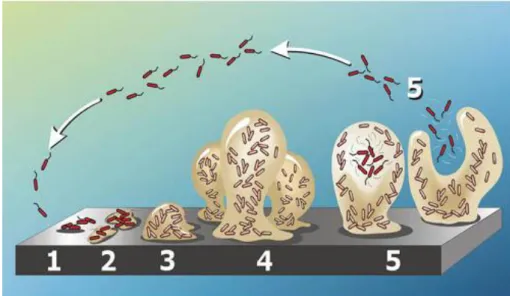
Biofilm formation is a complex developmental process involving attachment and immobilization on a surface, cell-to-cell interaction, microcolony formation, formation of a confluent biofilm and developmental of a three-dimensional biofilm structure (Figure 1) (Mohamed and Huang, 2007).
Figure 1 – Biofilm formation as a five-stage process.
1) Initial attachment; 2) Irreversible attachment; 3) Proliferation; 4) Maturation; 5) Dispersion. (Image credit: D. Davis (http://www.binghamton.edu/biology/faculty/davies/research.htm))
Various factors influence the formation and development of biofilms. Physiochemical properties of the bacterial cell and surface materials are strongly correlated with bacterial initial attachment. For example, porous surfaces entrap more bacteria than smoother materials and surfaces with a layer of macromolecules will enhance the attachment of cells. Environmental parameters like pH, nutrient levels, temperature, oxygen levels and the
6 presence of other bacterial species also play an important role in the initial attachment (Shi and Zhu, 2009; Srey et al., 2013).
Biofilm structure shows to be advantageous to bacteria in their natural habitat, as it allows protection from stressful environmental conditions, improves the competition for available nutrients in a delimited area, enhances the acquisition of new phenotypic traits by gene transfer and augments metabolic interactions between distinct microbial species (Giaouris et al., 2013). Furthermore, sessile cells show more resistance to antimicrobial agents (O’Toole and Kaplan, 2000) and withstand nutrient depravation, pH changes, oxidative stress and immune defense mechanisms better than planktonic microorganisms (Jefferson, 2004). Additionally, biofilm cells are highly resistant to exposure to ultraviolet light, acid exposure, metal toxicity, dehydration and phagocytosis (Hall-Stoodley and Stoodley, 2005). Hence, biofilms are remarkably difficult to eradicate.
The barrier properties of the slime matrix prevent the entrance of many antimicrobial agents. Still, although many antibiotics can penetrate the EPS, bacterial cells are protected due to the stationary phase dormant zones in biofilms, since the mechanisms of action of antibiotics usually involve disruption of microbial processes (Donlan and Costerton, 2002; Hall-Stoodley et al., 2004). Also, some resistance mechanisms can be horizontally transferred among biofilm cells (Giaouris et al., 2013).
Within the industrial context, mixed-species biofilms are useful in bioremediation processes of wastes. However, biofilm formation by foodborne spoilage and pathogenic bacteria on food contact surfaces can lead to product contamination during food processing, which lowers product shelf-life or results in human foodborne illness (Lindsay and von Holy, 2006). In addition, biofilms are recognized as one of the main sources of bacterial pathogens in hospital settings, in particular on medical devices like catheters, being responsible for many human infections like cystic fibrosis and otitis media (Donlan and Costerton, 2002).
The ability of Aeromonas to form biofilms is mainly attributed to the presence of polar and lateral flagella (Gavín et al., 2002; Kirov et al., 2004). Aeromonads biofilms grow and persist in water distribution systems, where it shows resistance to chlorination treatment, except when elevated concentrations of chlorine are used (Chauret et al., 2001; Sen and Rodgers, 2004). Besides, aeromonads biofilms are also found on food-processing systems and on water-dwelling plants and animals, like fish, leeches and frogs (Scoaris et al., 2008).
Biofilm production is considered a significant factor in the pathogenesis of enterococcal infections, once these bacteria are able to produce biofilms in medical devices, such as catheters and surgical prostheses, which may cause endodontic and urinary infections, as well as endocarditis (Fisher and Phillips, 2009a). Several studies also reported enterococci isolated from food with the ability to form biofilms, being potential sources of contamination
7 that might lead to food spoilage and/or transmission of diseases (Jahan and Holley, 2014; Medeiros et al., 2014; Marinho et al., 2013).
1.2. Alternatives to antibiotics and disinfectants: essential oils
Essential oils (EOs) and other plant extracts have been screened as potential sources of new antimicrobial compounds, alternatively to current antibiotics/disinfectants; or as agents used to promote food conservation (Kon and Rai, 2012; Rios and Recio, 2005; Seow
et al., 2014).
Complex mixtures of volatile compounds produced by plants, EOs are characterized by a strong odor and are formed as secondary metabolites (Bakkali et al., 2008). In nature, they can act as internal messengers, as defensive substances against herbivores or as volatiles to attract pollinating insects to their host (Harrejin et al., 2001 in Franz and Novak 2010).
Essential oils are soluble in lipids and organic solvents, presenting lower density than water. They can be synthesized by all plant organs (e.g. flowers, leaves, buds, stems, seeds, fruits, roots, twigs or wood) and are stored in secretory cells, cavities, epidermic cells and glandular trichomes (Bakkali et al., 2008). Steam or water distillation is the most commonly used method for commercial production of EOs (Van de Braak and Leijten, 1999 in Burt, 2004).
These oils harbor two or three major components, which make up to 20-70% of the composition, but other elements may be present in vestigial amounts. The main components generally determine the biological properties of the EOs and can be divided into two groups: terpenes and aromatic compounds (Bakkali et al., 2008).
The antibacterial properties of EOs have been known for a long time (Guenther, 1948 in Burt, 2004). Basil, cinnamon, clove, mint, oregano, salvia, tea tree and thyme EOs have been found to possess relevant antibacterial properties, being the most studied (Burt, 2004; Rios and Recio, 2005). The broad activity of EOs can make them a valued weapon against multiresistant strains. Especially considering that, until now, there has been no evidence of emergence of resistance against these compounds; but also due to their low mammalian toxicity and easy biodegradability in water and soil, making them relatively environmentally friendly (Isman, 2000).
In several studies performed in recent years, Aeromonas spp. have been considered highly vulnerable to EOs. Iturriaga et al. (2012) showed A. hydrophila/caviae was more susceptible to oregano and thyme than Pseudomonas fluorescens and Listeria innocua. Likewise, Klein et al. (2013) reported A. hydrophila susceptibility towards six EOs components, in comparison with Escherichia coli and Brochothrix thermosphacta. In addition, oregano and rosemary EOs, used singly and in combination at sub-inhibitory concentrations,
8 inhibited the cell viability of A. hydrophila, leading to the release of cytoplasmic material and altering cellular morphology (Azerêdo et al., 2012).
Concerning enterococci, EOs from Eucalyptus globules, Kadsura longipenduculata and
Sideritis erythrantha showed marked in vitro inhibition against VRE (Solórzano-Santos and
Miranda-Novales, 2012). Fisher and Phillips (2009b) showed that a blend of orange and bergamot EOs (1:1 v/v) affected the cell membrane and homeostasis of E. faecium and E.
faecalis strains, resulting in inhibition of growth or cell death. Thyme showed a very strong
activity against Enterococcus reference and multiresistant clinical strains (Sienkiewicz et al., 2012) as well as lemongrass against VRE and MRSA strains (Warnke et al., 2013).
Although EOs antibacterial properties have been studied in the past years, their mechanism of action is yet to be fully known. However, since EOs are lipophilic they are likely to surpass the cell wall and cytoplasmic membrane, disrupting and permeabilizing the structure. Extensive leakage of critical molecules and ions disrupts cell homeostasis, resulting in cell death (Burt, 2004). Moreover, EOs can coagulate the cytoplasm (Gustafson
et al., 1998) and damage lipids and proteins (Burt, 2004). Hence, considering the variety of
compounds present in EOs, it is most likely that their antibacterial activity is not due to one specific mechanism but they should target many cellular mechanisms (Carson et al., 2002 in Burt, 2004).
Essential oils also exhibit antiviral (Astani et al., 2011; Elaissi et al., 2012; Ocazionez et
al., 2010), antifungal (Dias Ferreira et al., 2013; Martins et al., 2014; Pinto et al., 2013),
antiparasitic (Echeverrigaray et al., 2010; Silva et al., 2014) and insecticidal (Bossou et al., 2013; Chu et al., 2012) properties, which are probably related with their function in the producing plants. Recently, studies showed new properties, such as antioxidant (Amorati et
al., 2013; Martins et al., 2014), anticancer (Formagio et al., 2013; Sharma et al., 2009) and
anti-inflammatory (Formagio et al., 2013; Silva et al., 2012).
Additionally, foodborne illnesses are still a problem in public health, despite increasing improvements in food production and food safety. Nowadays, due to concerns related to chemical preservatives, food industries are developing natural preservatives as safer alternatives, being widely available and better biodegradable. As a consequence, there has been an increase of studies related to the use of EOs in food products and/or packaging, since they could be useful in preventing the proliferation of foodborne pathogens and also increasing shelf life (Dussault et al., 2014; Moore-Neibel et al., 2013; Oliveira et al., 2013; Seow et al., 2014).
Sanitization processes are often insufficient to eradicate biofilms, hence effective elimination and biofilm control strategies are still needed. Moreover, due to negative impacts of detergents and sanitizers on the environment, there is a growing interest in natural antimicrobial compounds, like essential oils, as viable alternatives against sessile cells (Burt,
9 2004; Rhoades et al., 2013). Several examples of this effective role of natural compounds against biofilms have already been reported. Husain et al. (2013) showed that the biofilm forming capability of A. hydrophila WAF-79 was considerably reduced by clove oil. The use of sanitizing detergents containing thyme (Thymus vulgaris) and lemongrass (Cymbopogon
citratus) essential oils diminished the biofilm formed by A. hydrophila on stainless steel
coupons (Millezi et al., 2013). Citrus vapour, a vaporized blend of citrus essential oils (orange:bergamot, 1:1 (v/v)), reduced surface contamination by VRE and methicilin-resistant
Staphylococcus aureus (MRSA) and has a potential application in clinical settings (Laird et al., 2012). Other study showed that Myrcia ovata essential oil was effective against E. faecalis biofilm after 5, 10 and 30 min of exposure (Cândido et al., 2010). Veras et al. (2014)
reported in vitro enterococcal biofilm reduction with Lippia sidoides essential oil, as a basis for the possible utilization as adjuvant in the treatment of root canals colonized by E. faecalis.
1.3. Aims of the study
Aeromonas spp. and Enterococcus spp. are both recognized as emergent pathogens,
responsible for many serious infections on humans. Thus, the increasing incidence of drug-resistant aeromonads/enterococci in both clinical and food-related settings can be considered a threat to public health worldwide. Moreover, these bacteria are able to form biofilms in various surfaces (e.g. indwelling medical device, food-contact surfaces), which turn microbial eradication a complex process.
Recently, various strategies have been implemented to control the spread of drug-resistant pathogens and to prevent and/or eradicate biofilm formation, including the research of alternative antimicrobial compounds, such as essential oils.
Hence, the present study aimed to screen for the antimicrobial activity of eleven commercial EOs against environmental and clinical multiresistant aeromonads and enterococci. Furthermore, after selection of the most promising compounds, their MICs and MBCs were assessed, as well as their eradicating action on already established biofilm.
10
2. Materials and Methods
2.1. Bacterial strains
The aeromonads and enterococci used in this study belong to collections gathered by Barroco (2013) and by Santos (2011), respectively. Additional bacteria were included as reference strains: E. faecalis V583 and A. hydrophila DSMZ 30187T (R5). All strains were stored at -80ºC in Brain Heart Infusion (BHI; Scharlau, Barcelona, Spain) broth with 20% (v/v) glycerol and routinely grown on BHI agar at 30ºC for aeromonads and 37ºC for enterococci.
2.2. Essential oils
The essential oils used in this study were purchased from New Directions Aromatics, Portugal: artemisia (Artemisia alba), coriander (Coriandrum sativum), curcuma (Curcuma
aromaticum), garlic (Allium sativum), ginger (Zingiber officinalis), lavender (Lavandula angustifolia), lemongrass (Cymbopogon flexuosus), pennyroyal (Mentha pulegium),
rosemary (Rosmarinus officinalis), tea tree (Melaleuca alternifolia) and thyme (Thymus
vulgaris).
2.3. Disc diffusion method
Disc diffusion assays were carried out following the methodology outlined in the Clinical and Laboratory Standard Institute’s guideline (CLSI, 2012). For each isolate, the inoculum was prepared by making a bacterial suspension in 0.1 M phosphate buffer (PB) in order to achieve a turbidity equivalent to a 0.5 McFarland standard, containing approximately 1-2x10⁸ CFU/mL. The suspension was spread with a sterile cotton swab onto Mueller-Hinton agar (MHA; Scharlau, Barcelona, Spain). Subsequently, sterile filter paper discs (5 mm diameter) were placed on the surface of the agar and impregnated with 10 µL of essential oils, without dilution. Plates, after remaining at 4ºC for 2 h to facilitate the EO diffusion into the medium (Alim et al., 2009), were incubated at 30ºC for aeromonads and at 37ºC for enterococci for 24 h. After incubation, the diameters of inhibition zones were measured with a ruler and recorded in mm. All assays were performed in triplicate. The two EOs showing higher inhibition zones for both aeromonads and enterococci were selected for further analysis.
11
2.4. Broth microdilution method
Minimum inhibitory concentrations (MICs) were determined in liquid culture using 96-well microplate assays. Stock solutions of the two selected EOs were prepared in 0.15% (v/v) agar (Agar-Agar; Scharlau, Barcelona, Spain) to a concentration of 3.13% (v/v) and two-fold serially diluted in 96-well plates in 90 µL of BHI broth. Inoculum was prepared as described by CLSI (2012). Briefly: a loopfull of bacterial culture was suspended in 0.1 M PB, in order to achieve a turbidity equivalent to a 0.5 McFarland standard, diluted 1:20 in PB and 10 µL of the suspension used to inoculate the wells, resulting in a final bacterial concentration of 5x10⁵ CFU/mL. The microplates were incubated at 30ºC for aeromonads and at 37ºC for enterococci for 24 h. MICs were determined as the lowest concentration of EO at which no visible growth could be observed. Triplicates were performed for each EO and for each microplate the following controls were added: growth control (bacteria and BHI broth), sterility control (non-inoculated BHI broth) and solvent control (bacteria and BHI broth with 0.15% (v/v) agar).
To determine the minimum bactericidal concentrations (MBCs), 10 µL of inoculum was taken aseptically from three consecutive wells without visible turbidity, spot inoculated onto BHI plates, and incubated at 30/37ºC overnight. In parallel, 10 µL of positive control wells were also inoculated in BHI plates. After incubation, the number of colonies was assessed and MBC determined as the lowest concentration of EO which reduced the viability of the initial bacterial inoculum by ≥ 99.9% (corresponding to the absence of growth in BHI plates).
2.5. Biofilm eradication assay
To evaluate biofilm eradication capability of the two selected EOs, an adaptation of the Calgary Biofilm Device (Ceri et al., 1999) was applied in this study, corresponding to the use of sterile lids with pegs (Nunc™ Immunoassay Transferable Solid Phases, Thermo Fisher Scientific Inc, USA), represented in Figure 2.
Figure 2 – Scheme of a microplate lid with pegs.
12 The methodology was performed as follows: an overnight culture of each isolate was grown in 5 mL of BHI broth at 30/37ºC. The optical density (OD) was measured at 600 nm to ensure initial cellular concentration of 109 CFU/mL on each well. The corresponding volume was centrifuged for 5 min at 13 200 rpm, supernatant discarded, pellet resuspended in 1 mL of PB, washed by centrifugation for 5 min at 13 200 rpm (this step was repeated twice), followed by bacterial resuspension in 100 µL of PB. Each well of two sterile 96-well microplates (growth microplates) containing 150 μL of BHI broth was inoculated with 3 μL of bacterial suspension, in triplicate. The growth microplates were covered with lids harboring pegs and incubated at 30/37ºC for 24 h. For each growth microplate the following controls were added: growth control for each strain (bacteria and BHI broth) and sterility control (non-inoculated BHI broth).
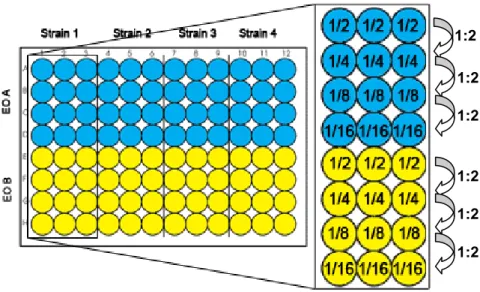
After incubation, pegs were washed twice by immersion in washing microplates containing 150 μL of PB. Then, pegs were immersed in the eradication microplates with EOs (previously diluted in 0.15% (v/v) agar) at different concentrations (always in triplicates), for 30 min and for 1 h at 25ºC. For a more detailed visualization, microplates prepared for the biofilm eradication assays are shown on Figure 3.
Figure 3 - Representative scheme of biofilm eradication microplates.
Note: 1/2, 1/4, 1/8 and 1/16 represent the final concentration on each well, in relation to the stock concentration; blue – EO A; yellow – EO B.
Subsequently the pegs were rinsed in washing microplates with PB and placed in the recovery microplates containing 150 μL of 0.1 M PB with 0.1% Tween-80 (v/v), followed by sonication for 20 minutes in an ultrasonic bath (Grant Instruments Ltd, Cambridge, England) in order to disrupt the formed biofilms (Extremina et al., 2011). Afterwards, tenfold serial dilutions were performed from the sonicated wells on PB. A 5/10 μL drop (for aeromonads and enterococci, respectively) of each dilution was plated on BHI and incubated at 30/37ºC
1:2 1:2 1:2 1:2 1:2 1:2
13 overnight. After incubation, biofilm cell survival was assessed by colony counting and calculation of colonies forming units (CFU) per mL.
Decimal log reduction was calculated using the following equation: logR = logN0 – logNA (R - reduction; N0 - number of CFU per mL in the biofilm (growth control); NA – number of surviving CFU per mL). EOs were categorized into three groups in terms of their level of biofilm eradication: 1 to 3-logR: low level; 4 to 5-logR: medium level; ≥6-logR: high level.
For a better visualization the protocol is summarized in Figure 4.
Figure 4 - Biofilm eradication assay.
(Scheme adapted from Harrison et al., 2008)
14
3. Results and Discussion
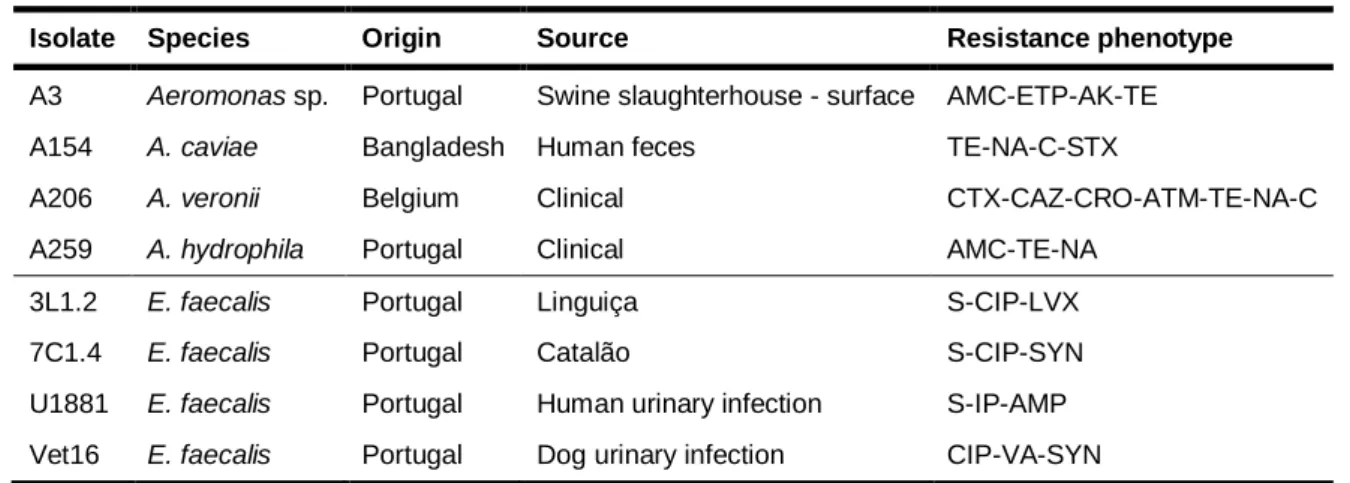
Infections caused by bacterial pathogens are a significant problem worldwide. In this context, enterococci and aeromonads, the bacteria selected for the present study, share important common features, since both are ubiquitous in nature, exist in high numbers in water/food, are able to produce biofilms and are responsible for numerous human/animal infections. Furthermore, the isolates chosen for this analysis also share a multiresistant phenotype, which according to Magiorakos et al. (2011) means they presented a resistance phenotype to at least one antibiotic from three or more categories with different bacterial cellular targets. Thus, for this investigation centered on the antimicrobial effects of essential oils against multiresistant bacteria, four enterococci and four aeromonads were selected from a larger collection (Barroco, 2013; Santos, 2011); representing distinct countries and sources of origin (environmental versus clinical), as well as dissimilar antibiotic resistance phenotypes. Their main features are presented in Table 1.
Table 1 – Aeromonads and enterococci chosen for this study.
Isolate Species Origin Source Resistance phenotype
A3 Aeromonas sp. Portugal Swine slaughterhouse - surface AMC-ETP-AK-TE
A154 A. caviae Bangladesh Human feces TE-NA-C-STX
A206 A. veronii Belgium Clinical CTX-CAZ-CRO-ATM-TE-NA-C
A259 A. hydrophila Portugal Clinical AMC-TE-NA
3L1.2 E. faecalis Portugal Linguiça S-CIP-LVX
7C1.4 E. faecalis Portugal Catalão S-CIP-SYN
U1881 E. faecalis Portugal Human urinary infection S-IP-AMP
Vet16 E. faecalis Portugal Dog urinary infection CIP-VA-SYN
Legend: AK – amikacin; AMC – amoxicillin/clavulanic acid; AMP – ampicillin; ATM – aztreonam; C –
chloramphenicol; CAZ – ceftazidime; CIP – ciprofloxacin; CRO – ceftriaxone; CTX – cefotaxime; ETP –
ertapenem; IP - imipenem; LVX - levofloxacin; NA – nalidixic acid; SYN – quinupristin/dalfopristin; STX –
trimethoprim/sulfamethoxazole; TE – tetracycline; VA – vancomycin.
3.1. Antimicrobial activity of essential oils against planktonic cells
A variety of methodologies have been reported for evaluating the antimicrobial activity of essential oils (EOs). Agar disc diffusion and broth dilution being the two most used and universally accepted methods, because compatible data have been obtained when these techniques were performed for the same EO (Seow, et al., 2014). Hence, these were the chosen methodologies for the present study.
15 Disc diffusion assay is a simple and rapid method which requires small amounts of the EOs. It is regularly used as a preliminary test for the antimicrobial activity of a large number of compounds, in order to select the ones with the highest inhibitory activity, i.e., larger inhibitory zones (Burt, 2004). However, disc diffusion methods present certain disadvantages. First, using volatile EOs could lead to reduced zones of inhibition, since they evaporate very quickly. Also, poorly soluble compounds do not diffuse uniformly through the agar medium plates (Seow et al., 2014). Therefore, the convenience of disc diffusion method is limited to the attainment of preliminary and qualitative data, turning essential the performance of other complementary methodologies.
Broth microdilution can be used to further evaluate the antimicrobial activity of the most efficient EOs and is commonly used to determine the extent of inhibitory activity, namely by determining MIC (minimum inhibitory concentration) and MBC (minimum bactericidal concentration). Nonetheless, broth dilution assays also present problems, mainly due to the hydrophobic nature of EOs, which result in immiscibility with broth media. For instance, surfactants, emulsifiers or solvents are usually applied to ensure even contact between the test organism and the agent during the experiment. The most commonly used are Tween-20, Tween-80, DMSO (dimethyl sulfoxide) and ethanol (Burt, 2004).
In the present study, DMSO and Tween-20 were used in preliminary assays in order to test which concentrations could prevent the immiscibility of the EOs with the aqueous bacterial growth media. When broth medium was added to the mixture of 0.5% Tween-20:EO, micelles were formed and the oil-water mixture would separate within few minutes. Using EOs in a concentration of 20% (v/v) in DMSO prevented the separation of the aqueous phase from the oil for a longer period of time and the mixture appeared to be translucent. However, these agents are known to be responsible for changes in the interactions between EO and bacteria, resulting in either increase or reduction of the antimicrobial activity, and DMSO cytotoxicity could be a problem in subsequent applications (e.g. direct contact with the human skin). So, in order to overcome these problems, Mann and Markham (1998) suggested the use of 0.15% bacteriological agar, previously sterilized by autoclaving, as a stabilizer.
Regarding the disc diffusion assay, in general, the majority of the EOs under analysis showed inhibitory zones larger than 10 mm on aeromonads, with the exception of curcuma, garlic and ginger, which showed few or none antimicrobial activity, since the inhibitory zones had diameters lower than 10 mm (Table 2). Lemongrass (34-42 mm), thyme (29.7-37 mm), tea tree (30.3-36 mm) and pennyroyal (21.7-36 mm) EOs showed the highest inhibitory zones against Aeromonas spp.
16
Table 2 – Antimicrobial activity of EOs by disc diffusion method for Aeromonas isolates. EOs Tested aeromonads (diameter of inhibitory zone in mm)
A3 A154 A206 A259 R5 Artemisia 14.7 ± 4.7 15.3 ± 4.5 12.0 ± 2.7 15.3 ± 1.5 14.0 ± 0 Coriander 19.0 ± 1.7 25.7 ± 7.8 17.3 ± 7.5 32.0 ± 14.0 36.0 ± 0 Curcuma NA NA NA NA NA Garlic 6.0 ± 5.2 5.3 ± 4.6 6.7 ± 5.8 6.7 ± 5.8 10.0 ± 8.7 Ginger 2.7 ± 4.6 5.3 ± 4.6 7.0 ± 6.1 6.3 ± 5.5 NA Lavender 18.7 ± 1.2 16.0 ± 2.0 16.0 ± 4.0 22.0 ± 3.6 27.5 ± 14.9 Lemongrass 42.0 ± 2.0 34.0 ± 6.0 36.0 ± 6.0 38.7 ± 4.2 34.0 ± 0 Pennyroyal 29.0 ± 7.0 26.0 ± 5.3 21.7 ± 12.4 28.7 ± 3.1 36.0 ± 0 Rosemary 28.3 ± 6.4 23.0 ± 2.0 19.7 ± 2.1 26.7 ± 6.8 31.7 ± 10.4 Tea tree 34.3 ± 11.6 36.0 ± 8.7 30.3 ± 1.5 36.0 ± 5.3 36.0 ± 11.3 Thyme 37.0 ± 5.6 29.7 ± 1.5 23.7 ± 7.2 34.0 ± 4.0 35.3 ± 4.6
Legend: Each value represents the mean of triplicate experiments ± standard deviation; NA: no activity
On the other hand, EOs were less inhibitory against enterococci, having in most cases inhibitory zones smaller than 10 mm (Table 3). Lemongrass (13.3-22.3 mm), thyme (16.3-26.7 mm) and tea tree (12.7-14.7 mm) showed the largest inhibitory zones against the
Enterococcus isolates. Also, Warnke et al. (2013), using a very similar method, reported
lemongrass inhibition zones from 13 to 18 mm against VRE (vancomycin-resistant enterococci), comparable to the results obtained in the present study.
Table 3 – Antimicrobial activity of EOs by disc diffusion method for Enterococcus isolates. EOs Tested enterococci (diameter of inhibitory zone in mm)
3L1.2 7C1.4 U1881 Vet16 V583 Artemisia 6.0 ± 5.3 2.3 ± 4.0 5.7 ± 4.9 6.0 ± 5.2 6.3 ± 5.5 Coriander 10.7 ± 1.2 11.7 ±2.1 5.7 ± 5.1 7.7 ± 1.2 5.7 ± 4.9 Curcuma NA NA NA NA NA Garlic NA 6.7 ± 1.2 7.7 ± 0.6 6.7 ± 1.2 7.3 ± 0.6 Ginger 2.7 ± 4.6 4.3 ± 3.8 7.3 ± 0.6 7.0 ± 0 4.7 ± 4.0 Lavender 7.7 ± 0.6 3.3 ± 5.8 10.0 ± 1.0 8.3 ± 2.1 8.7 ± 0.6 Lemongrass 17.7 ± 2.9 22.3 ± 4.9 15.7 ± 3.1 13.3 ± 11.6 16.7 ± 2.1 Pennyroyal 8.7 ± 1.2 10.7 ±1.2 9.7 ± 0.6 6.7 ± 5.8 9.7 ± 1.5 Rosemary 6.3 ± 5.5 NA 5.0 ± 4.4 4.7 ± 4.0 6.3 ± 5.5 Tea tree 12.7 ± 4.0 14.3 ± 3.1 14.7 ± 4.9 12.7 ± 5.8 14.0 ± 5.2 Thyme 20.0 ± 1.7 26.7 ± 1.2 16.3 ± 1.5 16.7 ± 0.6 16.7 ± 2.1
17 Overall, comparison between inhibition of bacterial growth observed for aeromonads and enterococci, led to the selection of lemongrass and thyme for subsequent assays of broth microdilution and biofilm eradication.
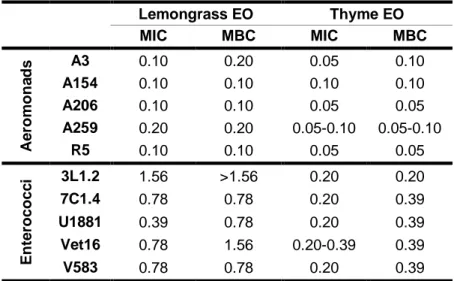
Broth microdilution method was performed in this study to further evaluate the antimicrobial activity of lemongrass and thyme EOs. The two EOs were solubilized in 0.15% agar to a concentration of 3.13% (v/v), followed by 15 min of agitation by vortex and two-fold serial dilutions in 90 μL of BHI broth on 96-well microplates The range of concentrations of the studied oils was between 0.012% and 1.56%. Table 4 presents MICs and MBCs of lemongrass and thyme EOs.
Table 4 – MICs and MBCs of lemongrass and thyme EOs against aeromonads and enterococci by broth microdilution method.
Lemongrass EO Thyme EO MIC MBC MIC MBC A e ro m o n a d s A3 0.10 0.20 0.05 0.10 A154 0.10 0.10 0.10 0.10 A206 0.10 0.10 0.05 0.05 A259 0.20 0.20 0.05-0.10 0.05-0.10 R5 0.10 0.10 0.05 0.05 En te ro c o c c i 3L1.2 1.56 >1.56 0.20 0.20 7C1.4 0.78 0.78 0.20 0.39 U1881 0.39 0.78 0.20 0.39 Vet16 0.78 1.56 0.20-0.39 0.39 V583 0.78 0.78 0.20 0.39
Legend: MIC (minimum inhibitory concentration) and MBC (minimum bactericidal concentration) values in % (v/v); range of concentrations was 0.012-1.56% (v/v)
In general, MICs observed for thyme (0.05-0.39%) were lower than for lemongrass (0.10-1.56%), in both aeromonads and enterococci. Hence, thyme showed higher antimicrobial activity against both bacterial groups.
Curiously, in the previous disc diffusion assay, lemongrass showed the highest inhibitory effect of the tested oils against Aeromonas, while in the microdilution assay it presented MICs between 0.10 and 0.20%, a superior value in comparison with thyme (0.05-0.10%). These results could indicate lemongrass diffuses better on Muller Hinton agar than on BHI broth, due to their different characteristics.
Furthermore, aeromonads inhibition required lower MICs for both EOs (<0.20% for lemongrass; <0.10% for thyme), whereas higher MICs were required to inhibit the
18 studies reported that Gram-negative bacteria are more resistant to EOs (Delaquis et al., 2002; Lambert et al., 2001; Martins et al., 2014; Pintore et al., 2002), while few claim the same for Gram-positive bacteria (Kim et al., 1995; Tassou et al., 1995); interestingly, studies showing no significant differences between the two bacterial groups can also be found (Prabuseenivasan et al., 2006; Teixeira et al., 2013).
The resistance of Gram-negative bacteria against EOs has already been attributed to the complexity of their double layer cell membrane (Teixeira et al., 2013), but in the present study, enterococci were found to be more resistant, meaning there should be another property or mechanism responsible for the observed resistance and/or another cellular target in aeromonads which turns them more susceptible to EO action; further analyses being needed to determine which.
Overall, these results showed that within the Aeromonas genus, there were no major differences between MICs for each EO. On the other hand, enterococci showed more differences between MICs obtained for lemongrass, with a food strain (3L1.2) presenting higher MIC than clinical strains (U1881 and Vet16). This example could be considered very problematic, because, since isolate 3L1.2 could be a source of food contamination, a bigger concentration than 1.56% of lemongrass would be necessary to inhibit its growth. Further assays should be performed in order to assess the effects of using that concentration of lemongrass as a disinfectant on a surface or a food-industry device, or of including the EO as a food preserver in the food package. Hence, the use of thyme would be preferable since its MICs against Enterococcus isolates were lower.
Regarding MBCs determination, lemongrass showed bactericidal effect from 0.10 to 0.20% on Aeromonas isolates and from 0.78 to 1.56% (or above) for Enterococcus isolates. MBCs of thyme ranged from 0.05 to 0.10% and from 0.20 to 0.39% on aeromonads and enterococci, respectively (Table 4). In some cases MICs were the same as MBCs, which could mean at that concentration the EO had a bactericidal effect instead of a bacteriostatic one on those isolates. Another possibility could be that the MIC was between the obtained value and the lower concentration. For example, isolate A154 had equal MIC and MBC for lemongrass (0.10%), so the actual MIC could be between 0.05 and 0.10%, further tests being necessary.
The antimicrobial activity of these two essential oils has been evaluated in previous studies referred bellow. However, comparing published data is complicated since experimental results of EOs antimicrobial tests depend on several factors, such as composition, physical and chemical properties, the method and culture conditions applied, species and strain of the microorganisms under analysis. Temperature, time of incubation, type and volume of broth and even concentration and age of inoculums are also factors with a great influence on the EO strength and overall outcome (Seow et al., 2014). Hence, it is
19 peremptory the standardization of the methodologies used to assess the antimicrobial activity of EOs and natural products in general, similarly to what already occurs with antibiotic susceptibility tests.
No studies could be found regarding lemongrass (Cympogon flexuosus) effect on aeromonads or enterococci, though the following studies reported lemongrass antimicrobial activity against other bacterial species. Oussalah et al. (2007) found that this EO showed antibacterial effect against Listeria monocytogenes, E. coli O157:H7, S. aureus and
Salmonella Typhimurium. Likewise, Oliveira et al. (2012) found that lemongrass EO had
inhibitory effect against L. monocytogenes (MIC=0.12%) and E. coli (MIC=0.25%). According to Adukwu et al. (2012), MIC for lemongrass against S. aureus strains (susceptible or resistant to methicillin) was 0.06%, while at concentrations of 0.125% the effect was bactericidal.
According to Ahmad et al. (2014), thyme MIC against E. faecalis was 0.125 mg mL-1, while against E. coli and S. aureus was 0.500 mg mL-1. Uyttendaele et al. (2004) showed that MIC of thyme towards Aeromonas ranged from 0.025 to 0.040% (v/v). Sienkiewicz et al. (2012) used the agar diffusion method to study the inhibitory effect of thyme on clinical multiresistant strains of Enterococcus and Pseudomonas aeruginosa. They obtained MICs ranging from 0.25 to 1.25 μL/mL for enterococci and from 0.5 to 2.5 μL/mL for pseudomonads. Although they both belong to the Gammaproteobacteria class,
Pseudomonas susceptibility to EOs is different from aeromonads, being the latter one of the
most sensible bacteria to EOs (Iturriaga et al., 2012), which could explain why their MICs were lower than the enterococcal ones.
In conclusion, low concentrations of lemongrass and thyme were sufficient to inhibit aeromonads planktonic growth, while thyme was more effective against enterococci than lemongrass.
3.2. Biofilm eradication by essential oils
The ability of bacteria to produce biofilms poses a major problem in various industrial and medical settings. Eradicating biofilms is very difficult since sessile cells are protected and more resistant to external aggressions, in particular to the entrance of antimicrobial agents (Jefferson, 2004). So, nowadays, new and effective agents against biofilms are of great interest.
As previously mentioned, an adaptation of the Calgari Biofilm Device was used to assess if lemongrass and thyme EOs would be capable of eradicating biofilms formed by aeromonads and enterococci. This device represents a rapid and less laborious way of analyzing biofilm formation, since it establishes on the pegs of the lids of the microplates
20 instead of on the bottom of the wells, facilitating the exchange between microplates with growth medium and microplates with EOs for eradication. However, biofilm assays have inherent problems related to the difficulty to obtain reproducible data, since biofilm development is a stochastic process (Heydorn et al., 2000) due to the fact that, as complex living beings, microorganisms may not always show the same behavior, i.e., each peg may not have the same initial biofilm growth as the growth control. Moreover, the small area of the pegs can complicate the biofilm attachment to their surface and less biofilm is formed on the pegs.
In the present study aeromonads and enterococcal biofilms, formed over a 24-hour-period of incubation, were subjected to concentrations ranging from 0.20 to 3.13% for both EOs. These concentrations were chosen based on the fact that sessile cells are more resistant to antibacterial agents than planktonic cells (O’Toole and Kaplan, 2000). Preliminary biofilm eradication tests performed using the selected EOs against isolates A3 and R5, evaluated four exposure times (15 min, 30 min, 1 h and 24 h) and led to the following conclusions: 15 min of exposure showed less decimal log reduction than 30 min and 1 h periods, while after 24 h of exposure there were no colonies formed on BHI plates, except for growth controls (data not shown). Thus, 30 min and 1 h were the selected times of exposure to the EOs. Results obtained during the present study are presented in Table 5 and Table 6.
Table 5 - Aeromonads decimal log reduction achieved by lemongrass and thyme EOs. Aeromonads
EOs Time Concentration A3 A154 A206 A259 R5 Average
L e m o n g ra s s E O 1 h 3.13 7 6 6 7 7 7 1.56 5 6 6 5 7 6 0.78 5 2 6 3 5 4 0.39 2 2 2 2 2 2 30 min 3.13 7 7 7 7 7 7 1.56 7 7 7 7 7 7 0.78 3 5 7 5 5 5 0.39 2 2 2 2 2 2 T h y m e E O 1 h 3.13 5 6 6 6 7 6 1.56 5 4 6 6 5 5 0.78 3 3 6 4 4 4 0.39 2 2 5 2 4 3 30 min 3.13 8 7 7 7 7 7 1.56 8 6 7 7 7 7 0.78 2 3 7 4 6 4 0.39 2 2 3 3 2 2
Legend: Concentration values in % (v/v); logR = logN0 - logNA (R - reduction; N0 - number of CFU per mL in the
21 According to Table 5, both lemongrass and thyme showed high levels of eradication of aeromonads biofilms at 3.13 and 1.78%, except for 1 h treatment with thyme, which showed medium levels. At 0.78% the levels of eradication were medium, while at 0.39% were low. These results indicate that EOs could be used as disinfectants in food industry and indwelling medical devices contaminated with pre-formed aeromonads biofilms. Also, there were slight differences between the two exposure times, namely at higher concentrations. These results could mean that 30 min was sufficient time for eradication and 1 h in contact with the EO could enhance the bacterial biofilm resistance mechanisms and prevent the entrance and/or removal by the EO.
Regarding the aeromonads under analysis, A206 biofilm was the most susceptible to both lemongrass and thyme, as no colonies were observed at the majority of the tested concentrations, exception being 0.39%, which could mean that concentrations above 0.78% of EOs efficiently remove pre-formed biofilm. The susceptibility of this isolate is curious because this clinical isolate presented a resistance phenotype against six antibiotics from different classes. This indicates that even the most resistant isolates can be susceptible to the eradicating action of EOs.
Table 6 - Enterococci decimal log reduction achieved by lemongrass and thyme EOs. Enterococci
EOs Time Concentration 3L1.2 7C1.4 U1881 Vet16 V583 Average
L e m o n g ra s s E O 1 h 3.13 1 1 0 0 0 0 1.56 0 1 0 0 0 0 0.78 0 1 0 0 0 0 0.39 0 1 0 0 0 0 30 min 3.13 0 1 0 0 0 0 1.56 0 1 0 0 0 0 0.78 0 1 0 0 0 0 0.39 0 1 0 0 0 0 T h y m e E O 1 h 0.78 1 3 1 1 0 1 0.39 1 2 1 1 0 1 0.20 1 1 1 1 0 1 30 min 0.78 1 1 1 0 0 1 0.39 1 3 1 0 0 1 0.20 1 1 1 0 0 1
Legend: Concentration values in % (v/v); logR = logN0 - logNA (R - reduction; N0 - number of CFU per mL in the
biofilm (growth control); NA – number of surviving CFU per mL)
According to Table 6, lemongrass showed no eradication effect on biofilms produced by the enterococcal isolates 3L1.2, U1881, Vet16 and V583. In fact, 7C1.4 was the only