Article
Printed in Brazil - ©2018 Sociedade Brasileira de Química*e-mail: [email protected]
Effect of Selenite and Selenate Application on Mineral Composition of Lettuce
Plants Cultivated Under Hydroponic Conditions: Nutritional Balance Overview
Using a Multifaceted Study
Emanueli do Nascimento da Silva,a Mirla Cidade,b Gabriel Heerdt,a Rafael L. Ribessi,a
Nelson H. Morgona and Solange Cadore*,a
aInstituto de Química, Universidade Estadual de Campinas, CP 6154, 13083-970 Campinas-SP, Brazil
bDepartamento de Química, Univesidade Federal de Roraima, 69304-000 Boa Vista-RR, Brazil
The effect of selenate and selenite enrichment on mineral composition of a red type of lettuce cv. “Veneza roxa” was evaluated using inductively coupled plasma-optical emission spectroscopy (ICP OES), molecular modeling and principal component analysis (PCA). Both Se species did not show toxicity, while selenate promoted the greatest Se accumulation by the plant. There was an increase of 886 µg of Se per 100 g of fresh sample at different concentrations of selenate, but for selenite the maximum variation was only of 114 µg per 100 g. Selenate promoted the absorption
of Mo and S and the reduction of K, Mn and P, meanwhile selenite increased Mn and decreased Mo accumulation. Copper and Fe absorption was negatively affected, Ca and Mg showed a slight increase, and Na and Zn were not affected by Se species. Despite the changes in the nutritional balance, Se-enriched lettuce can still be considered a potential dietary source of this essential element.
Keywords: ICP OES, selenium-enriched lettuce, mineral composition, PCA, DFT
Introduction
Selenium is not an essential element for plants, but its nutritional character for mammalians has already been described by several authors.1-7 After being absorbed by
the gut this element plays an important anti-oxidant role, primarily as selenomethionine (SeMet), acting in the treatment and prevention of cancer and cardiac diseases. Despite its relevant characteristics, Se is not present in appropriate levels in most types of food and this low ingestion level has been associated with a massive list of direct and indirect negative health effects.6,8-11
About half of the world population suffers from the malnutrition of Fe, Zn, Ca, I and Se.8 Hence, increasing
the concentration of bioavailable elements in edible crop tissues (biofortification) has become a promising strategy to increase the intake of some micronutrients. Regarding selenium, Thavarajah and Thavarajah12 carried
out a study to determine the potential for Se, Fe, Zn, Ca, Mg, K, Cu and P biofortification of chickpea to improve human micronutrient nutrition. The results showed that the
fortified chickpeas are a good source of a range of mineral micronutrients, are low in antinutrients, have moderate levels of carotenes, and are a rich source of phenolic compounds; Rahman et al.6 evaluated lentils produced in
farms of Bangladesh, which were grown with the addition of Se containing fertilizers. The authors concluded that Se biofortification in lentil are possible to increase Se intake for Se deficient populations. Funes-Collado et al.13 considered
the selenite and selenate biofortification in alfalfa, lentils and soybeans sprouts hydroponically cultivated. The results showed that the high Se fortification can damage or inhibit plant growth and that the Se content increases with the Se added and part of the inorganic Se was converted mainly to SeMet. Sanmartín et al.14 evaluated the role of arbuscular
transpiration rate, photochemical efficiency of PSII, or electron transport system activity. Thus, the selenium enriched cabbage could be used in human nutrition. Businelli et al.16 proposed a new method for the fortification
of crop plants with Se, based on the use of Se-enriched peat during the pre-transplanting stage of cucumber, lettuce and tomato. The results showed that fortified plants did not show any negative effects in terms of yield level and quality with respect to non fortified plants. Additionally, a slightly higher shelf-life for the lettuce and an increased level of vitamin A for tomato were noted in fortified plants. Matich et al.17 identified some selenoglucosinolates in
broccoli and cauliflower after the treatment with selenate. It was noticed that the Se biofortification slightly reduced (methylthio)glucosinolates and aglycons in the roots, but increased them in the florets, the leaves, and sometimes the stems. Lazo-Vélez et al.5 optimized the production of wheat sprouting with the addition of selenite considering the selenomethionine content and the amylase activity. The generated models with desirability methodology could be useful to optimize selenomethionine content and alpha amylase activity in Se-enriched sprouted wheat. The authors concluded that sprouted wheat with high levels of selenomethionine for bread-making should contain relatively low amylase activity. Egressy-Molnár et al.9 evaluated the analogy in Se enrichment and Se speciation between selenized yeast and lion’s mane mushroom. The results showed that the high selenomethionine content and the presence of Se-adenosyl compounds in fortified mushroom opened the possibility for a functional food alternative to selenized yeast based dietary supplements.
Vegetables are largely used in biofortification studies, mainly lettuce, because it is the leafy crop more produced and consumed in the world.18,19 Moreover, it is easily
cultivated in soil or hydroponic system becoming an interesting option to be used in Se biofortification programs allowing the intake of this element by people living in regions where the amount of Se in food is lower than the levels recommended by health agencies.18
Several physical and chemical factors may affect the plant growth and its composition. Considering biofortification experiments, variations of plant size and composition may affect the production and its nutritional value. Depending on the final product intended, several effects of Se supplementation can be evaluated. For example, Gasecka et al.3 evaluated the effect of selenium
on phenolics and flavonoids in selected edible white rot fungi. Carvalho et al.20 studied the differences in
appearance, production, and fresh weights of the vegetable produced. Hawrylak-Nowak18 investigated the effects of
Se supplementation on biomass production, leaf area, and
concentrations of photosynthetic pigments in lettuce plants. Malorgio et al.21 evaluated the production of ethylene
and phenylalanine ammonia lyase (PAL) activity in leafy vegetables. Ríos et al.22 controlled the production and
detoxification of H2O2 in lettuce plants exposed to Se.
Additionally, to understand and verify the transformations that occur in the plant when biofortification experiments are developed it is possible to control the concentration of some nutrients, monitoring the treatment efficiency and the best condition for the crop.23-25 Sulfur is an essential element
to the plant, serving as constituent of proteins and nucleic acids.24,26,27 It has been reported that selenate and sulfate
have an antagonistic relationship, because Se metabolism follows the same pattern as S due to the chemical similarity of these two atoms, and the presence of Se can provoke a decline in the S concentration in the plant.28,29 However,
other researchers18,23-25 suggested that there is a synergism
between Se and S, resulting in an accumulation of S and Se in lettuce, as has already been observed before by Mikkelsen and Wan,30 Pilon-Smits et al.29 and Lyons et al.31
Other macronutrients such as P, N, K, Ca and Mg, as well as some micronutrients, such as Fe, Zn, Cu, Mn, Cl and B have also been evaluated by some authors aiming controlling yield and the mineral nutrition of the plant in the presence of Se.23,25,32 Thus, an adequate nutritional balance
of plants can provide information on the functional state of a plant under different growth conditions. Because of the differences observed in the relationships between Se and essential elements in different lettuces, it is important to use adequate statistic tools to compare all elements and treatments in the same time, as well as to include theoretical calculation in this type of work to elucidate the process occurring during biofortification assays.
The use of molecular modeling in analytical chemistry is almost inexistent, although some theoretical calculations have already been used to better understand the results obtained in bioaccessibility studies.33 On the other hand,
exploratory analysis and principal component analysis (PCA) have been widely used to evaluate samples from different geographical origin or submitted to different treatments.34-37 This type of chemometric analysis facilitates
the visualization and interpretation of complex data.38,39
Considering the importance of obtaining an adequate crop yield with suitable nutrient concentration, the objective of this work was to carry out the Se biofortification and to evaluate mineral composition and the Se influence on main nutrients accumulation by a red type of lettuce (Lactuca Sativa L. cv. “Veneza Roxa”).
Experimental
Reagents and standards
All materials used were previously decontaminated in a 10% (v/v) HNO3 bath for 24 h and then washed with
deionized water. All reagents used were of analytical purity grade, and deionized water with 18 MΩ cm resistivity, obtained from a Milli-Q system (Millipore, USA), was used throughout the experiments. The purity of argon (White Martins, Brazil) used for the analysis was 99.996%. Concentrated nitric and chloridric acid, sodium hydroxide and 30% (v/v) H2O2 were also used (Merck, Germany).
The standard solutions for the elemental determinations by ICP OES were prepared from 1000 mg L-1 (Merck,
Germany) stock solutions, and the dilutions were performed with deionized water. For biofortification studies, sodium selenate (Na2SeO4) and sodium selenite (Na2SeO3,
Sigma-Aldrich, USA) were used. The hydroponic nutrient solutions for cultivating lettuce plants were made with two mixtures of salts (called “prepared”) that were commercially purchased (Hidrogood, Brazil).
Procedures
Se biofortification of lettuce
The experiments were conducted inside a greenhouse at the School of Agricultural Engineering of the University of Campinas, Campinas, São Paulo, Brazil. The red lettuce seedlings (Lactuca sativa L., red lettuce leaves cv. “Veneza Roxa”) were acquired and maintained on hydroponics systems (Hidrogood, Brazil) during the period of September 23 to October 20 of 2014. Fortification solutions were prepared to contain specific concentrations of sodium selenate and sodium selenite corresponding to 0, 10, 25 and 40 µmol L-1 of each Se species. The hydroponic
system had four channels comprising 3 or 4 control or fortified plants, and each channel was fed by a vessel with 10 L of nutrient solution and its corresponding concentration
of Se. The nutrient solutions were obtained by adding 15 g of each “prepared” (Hidrogood, Brazil) and then solubilized in 10 L of tap water. Two “prepared” were used: one containing the main nutrients required for the growth of lettuce and another containing only Fe. Table 1 shows the nutrients and their concentrations in the nutrient solution.
During cultivation the solutions were subjected to constant aeration and the pH was daily monitored (using pH indicator strips, MColorpHastΤΜ/Merck, Germany)
and adjusted between 5.5-6.5 by adding 6 mol L-1 NaOH
or 6 mol L-1 HCl, if necessary. The conductivity was
maintained in the range of 2.5-3.5 mS cm-1 (model HI8733,
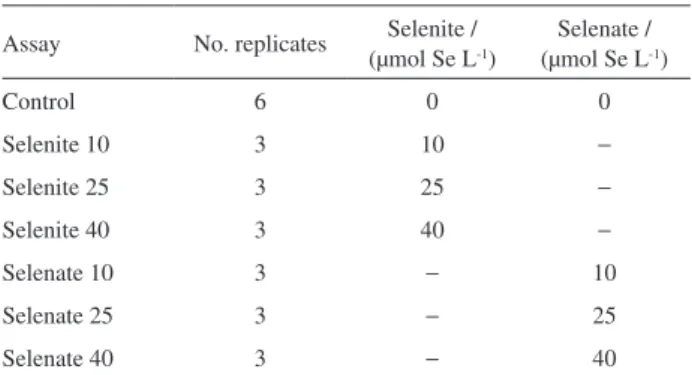
Hanna Instruments, USA) and when the value was out of this range the solution was replaced (it occurs after the 6th and 17th days). Table 2 summarizes the experiments of
fortification of lettuce with selenium. After 28 days, the plants were harvested, washed with tap and deionized water, and dried in an oven, at 60 °C, for 72 h.
Determination of analytes
The oxidative digestion was carried out in a microwave oven (model Ethos 1600, Milestone, Italy). For total analytes content in lettuce, approximately 0.5 g of dried sample were weighed into a Teflon® flask and 5 mL of
HNO3 (concentrated, ultrapure) and 3 mL of 30% (v/v)
H2O2 were added and the mineralization was performed
using a heating program previously established for lettuce samples.33 The mineralized samples were made up to 25 mL
with deionized water and analyzed using an ICP OES 8300DV instrument (PerkinElmer, USA). The ICP OES parameters used were: radio frequency power of 1400 W; plasma argon flow rate of 15 L min-1; auxiliary argon
flow rate of 0.7 L min-1; and nebulization gas flow rate of Table 1. Nutrients and the concentrations in the nutrient solution
Nutrient N P K Mg S B Cu Mn Mo Zn Fe Ca
Concentration / (mg L-1) 150 60 300 50 60 0.90 0.15 0.75 1.10 0.30 3.0 210
Table 2. Assays carried out for the biofortification of lettuce with selenium species
Assay No. replicates Selenite / (µmol Se L-1)
Selenate / (µmol Se L-1)
Control 6 0 0
Selenite 10 3 10 −
Selenite 25 3 25 −
Selenite 40 3 40 −
Selenate 10 3 − 10
Selenate 25 3 − 25
0.7 L min-1. The measurements were made in triplicate
and because of the matrix interference for Se that is quite pronounced in ICP OES analysis, it was corrected by matrix matching technique (calibration curves were obtained using a pool of the mineralized samples). The same procedure, including the mineralization, the matrix matching technique and the ICP OES analysis, was carried out for samples of standard reference materials (SRM), apple leaves (NIST 1515), peach leaves (NIST 1547), tomato leaves (NIST 1573a) and spinach leaves (NIST 1570a).
Theoretical calculations
Calculations were based on the density functional theory (DFT) using Gaussian 09 suite of programs.41 All
molecules were fully optimized with the local functional exchange-correlation M06-L, suitable for description of organometallic compounds.42 The standard 6-31G+(2d,p)
basis set was adopted for lighter atoms, while the basis set with effective core potential LANL2DZ was used for the metallic elements.43 Frequencies calculations were also
performed at the same level of theory in order to verify the nature of minima.44-46 Solvent effects were introduced
in all the calculations through the SMD47 continuum
solvation method. Binding energies were estimated among the ethylendiamine di(2-hydroxy-4-methylphenylacetic) acid (EDDHMA), selenite (SeO32-) and selenate (SeO42-)
anions and each of the metallic elements. For EDDHMA the configurations rac and meso were evaluated.
Statistics
The results were expressed as the mean and standard deviation. Comparisons were made using the one-way analysis of variance (ANOVA) and Tukey’s test for comparison of the masses obtained for each plant and the concentration of the elements in different samples. Student’s t-test was employed to compare the results obtained for Se concentration by different methods. The concentration values for all minerals obtained by ICP OES were auto scaled and centered in the middle. It was built an array with 24 samples (row) and 11 elements (columns), with 6 control samples, 9 samples fortified with selenate and 9 samples fortified with selenite consisting in at least three plants for each level of fortification. The PCA was done using the NIPALS algorithms and leave-one-out cross validation.
Results and Discussion
Lettuce plants
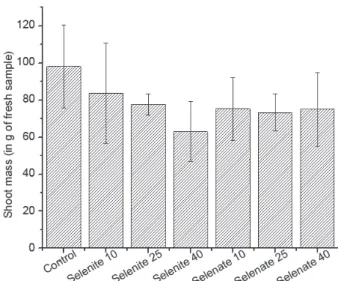
After the cultivation period of 28 days the plants were harvested and weighted, and the masses obtained are
presented in Figure 1. For the mass comparison one-way ANOVA (5% significance level) and Tukey’s tests were employed and, although it is possible to notice a tendency of selenite in reducing the plant mass, the results indicated that there was no difference between the lettuce masses obtained in different Se treatments (p > 0.05). Thus, there was no toxic effect due to selenate and selenite application to the plant at the Se concentration levels studied. These results were expected, since the levels used were chosen according to previous study of selenized lettuce,25 which
showed that the plant tolerated up to 80 µmol L-1 of
selenate with no growth reduction, although in all doses above 5 µmol L-1 of selenite the growth of the plant was
progressively stunted.
Minerals accumulation, PCA and theoretical calculations
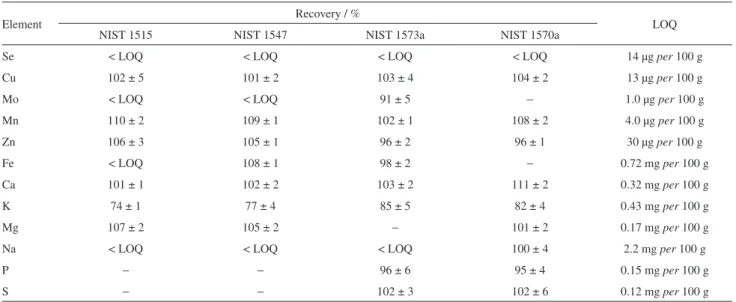
To evaluate the influence of Se in the absorption of Ca, Cu, Fe, K, Mg, Mn, Mo, Na, P, S, and Zn by “Veneza roxa”, these elements were determined by ICP OES and the results were evaluated by PCA. The experimental conditions for evaluating the analytes in the lettuce plants were optimized by recovery studies of four certified reference materials. Table 3 shows the recoveries obtained for all analytes, and the limit of quantification (LOQ). Suitable recoveries were obtained, as well as adequate relative standard deviation, lower than 10% for all analytes. Because of Se in these SRM samples is below LOQ obtained for the proposed method, the trueness for Se quantification was established by the comparison with a validated method. The Se concentration in these biofortified samples was previously quantified by inductively coupled plasma-mass spectrometry (ICP-MS)48
and the t-test showed no significant differences (p > 0.05) between the values obtained by ICP OES and ICP-MS.
The total concentrations of the elements in lettuce plants for each assay performed are shown in Table 4. In this type of Se biofortification programs, the uptake and accumulation of this element are fundamental and the results showed that the biofortification with selenate leads to a larger Se absorption by the plant. This fact is explained by different absorption mechanisms and Se metabolism in the plant, that means, while selenate is very mobile in the plant xylem, selenite is rapidly converted to organic forms, which have low mobility and is less translocated
to the shoot.1,27,28,48,49 It is worth highlighting that although
the lettuce plant is not a Se hyperaccumulator, the element concentration in the shoot for the selenate-enriched plant at the highest Se concentration is almost 0.1% of dried weight, a characteristic of hyperaccumulating plants.2
In addition, under the same growing and biofortification conditions, lettuce showed to accumulate higher Se concentrations in the edible portion than radish, tomato, rice and strawberry. On the other hand, considering alfalfa, chicory and cucumber, the Se concentration levels were
Table 3. Recovery values for Ca, Cu, Fe, K, Mg, Mn, Mo, Na, P, S and Zn from the SRMs evaluated and the LOQ (in µg and mg per 100 g of fresh sample) values for each element (n ≥ 3)
Element Recovery / % LOQ
NIST 1515 NIST 1547 NIST 1573a NIST 1570a
Se < LOQ < LOQ < LOQ < LOQ 14 µg per 100 g
Cu 102 ± 5 101 ± 2 103 ± 4 104 ± 2 13 µg per 100 g
Mo < LOQ < LOQ 91 ± 5 − 1.0 µg per 100 g
Mn 110 ± 2 109 ± 1 102 ± 1 108 ± 2 4.0 µg per 100 g
Zn 106 ± 3 105 ± 1 96 ± 2 96 ± 1 30 µg per 100 g
Fe < LOQ 108 ± 1 98 ± 2 − 0.72 mg per 100 g
Ca 101 ± 1 102 ± 2 103 ± 2 111 ± 2 0.32 mg per 100 g
K 74 ± 1 77 ± 4 85 ± 5 82 ± 4 0.43 mg per 100 g
Mg 107 ± 2 105 ± 2 − 101 ± 2 0.17 mg per 100 g
Na < LOQ < LOQ < LOQ 100 ± 4 2.2 mg per 100 g
P − − 96 ± 6 95 ± 4 0.15 mg per 100 g
S − − 102 ± 3 102 ± 6 0.12 mg per 100 g
(−) Not informed in the material. LOQ: limit of quantification.
Table 4. Concentration of Se, Ca, Cu, Fe, K, Mg, Mn, Mo, Na, P, S and Zn in lettuce plants related to the different biofortification assays (n ≥ 3)
Element Concentration / (µg per 100 g of fresh sample)
Control Selenite 10 Selenite 25 Selenite 40 Selenate 10 Selenate 25 Selenate 40
Se < LOQ 106 ± 4 172 ± 5 220 ± 10 271 ± 1 1157 ± 25 2551 ± 27
Cu 58 ± 3 51 ± 2a 44 ± 1b 45 ± 4b 49 ± 2ab 47 ± 2ab 52 ± 3a
Mn 508 ± 15de 677 ± 23 723 ± 25 618 ± 25 539 ± 22d 493 ± 11e 467 ± 17e
Mo 145 ± 5 91 ± 1 117 ± 3f 109 ± 13f 321 ± 4g 316 ± 6g 477 ± 5
Zn 400 ± 34h 489 ± 16i 427 ± 13hj 394 ± 33h 439 ± 15hij 466 ± 1ij 462 ± 4ij
Element Concentration / (mg per 100 g of fresh sample)
Control Selenite 10 Selenite 25 Selenite 40 Selenate 10 Selenate 25 Selenate 40
Fe 3.2 ± 0.2l 2.4 ± 0.1 2.5 ± 0.1 2.5 ± 0.2 3.3 ± 0.1l 3.2 ± 0.1l 1.7 ± 0.1
Ca 72 ± 2m 79 ± 1n 81 ± 2n 79 ± 1n 81 ± 2n 72 ± 1m 83 ± 2n
K 259 ± 11op 249 ± 8op 234 ± 4o 205 ± 15 244 ± 7o 250 ± 5op 273 ± 8p
Mg 17 ± 1 18 ± 1r 20 ± 1s 19 ± 1rs 19 ± 1rs 19 ± 1rs 18 ± 1r
Na 25 ± 2t 20 ± 1u 22 ± 1u 19 ± 1u 21 ± 1u 19 ± 1u 25 ± 1t
P 30 ± 2v 34 ± 1 33 ± 1 29 ± 1v 28 ± 1vw 28 ± 1vw 26 ± 1w
S 16 ± 1x 17 ± 1x 16 ± 1x 17 ± 3x 42 ± 1 51 ± 1 70 ± 1
comparable.13,16,20,21,50 However, the larger the Se uptake the
greater may be its influence in other nutrient absorption and it may upset the nutritional balance of the plant. Thus, for a better understanding of this influence, the results obtained for the nutrient concentrations were also evaluated by principal components analysis.
Figure 2 shows the PCA for Se biofortification (treatment without Se, with selenate or selenite), where an apparent separation among the groups of each Se treatment is observed (Figure 2a). Additionally, Figure 2b shows the loadings, which indicate the influence of each element on the construction of the PCs. Thus, when the score and loading graphics are observed together, a correlation can be made between the element concentrations, showing that for some elements the accumulation was affected by the presence of different Se forms. For example, Mo and S had a high accumulation in the plant of selenate assays, while for Mn and P greater accumulation was given for selenite. For Cu and Fe, the presence of any Se specie leads to a reduction of the plant uptake. On the other hand, the accumulation of Na, Mg, K, Ca and Zn was not strongly influenced by the presence of Se. The results for S, K and Zn are in agreement with the literature,25,32,51 but for the
other elements, the results are slightly different from those reported by Ríos et al.,25 corroborating the results obtained by He et al.32 and Wu and Huang.51 Taking into account
that different species, varieties and cultivars were evaluated in each work, and also that the plants were subjected to different climatic conditions and amounts of each nutrient, these differences are acceptable.
Although different studies related to Se effect in mineral plants nutrition described that selenate could decrease the S uptake by the plant and also reduce the shoot mass,28,52,53
i.e., an antagonistic relationship between Se and S, several works found a synergic effect of Se on S accumulation
because the adenosine triphosphate (ATP)-sulfurylase enzyme is stimulated in the presence of Se and it may cause better assimilation of both elements (S and Se).25,30,51 These
not consistent data are due to the Se rates applied in the culture medium, because in a higher sulfur/selenium ratio, the sulfur accumulation is promoted, but for lower ratios, the S concentration is depressed, suggesting a possible antagonistic behavior between these elements. Considering phosphorus, Broyer et al.54 reported thata positive growth response for Se fortification is due to alleviation of P toxicity, since it was much less pronounced when plants were grown at lower phosphorus levels.53 It means that at
low P levels the antagonistic relationship between selenite and P is much less pronounced. Afterwards, the present study shows that selenate promotes the S absorption by the plant while selenite may lead to a much more modest increase in P concentration in the shoot.
Concerning the macronutrients Ca, K, Mg and Na, there was a little increase in the Ca and Mg concentration for fortified plants, and for K and Na a decrease was observed. Again, these results for Ca and Mg differ somewhat from those reported by Ríos et al.,25 but agree
with Hawrylak-Nowak,18 Ramos et al.23 and Wu and
Huang.51 On the other hand no information is available
about the effect of Se application for Na accumulation in plants. These macronutrients are very important for the maintenance of membrane integrity and if the plant is under stress, such as the lack or excess of water, the concentration of the elements may have a significant variation to the adjustments needed. For example, the uptake of K by plant cells, and its accumulation in vacuoles, is the primary driver for their osmotic expansion, and the plant transpiration is a very important issue for Ca and Mg concentration.26,55-57 In this study, lettuce
plants were cultivated in a very dry period and in a year
that the temperatures reached record highs (38 °C in the cultivation period out and 43 °C inside of the greenhouse). Because of this the high rate of plant transpiration had affected the accumulation of the elements for the lettuce cultivar studied in the present work.
For the micronutrients, selenate and selenite uptake by lettuce reduced the Fe and Cu content in the plant leaves and no difference was observed for Zn concentration. On the other hand, selenite promotes the absorption of Mn while selenate leads to a greater Mo absorption by the plant and a little reduction for manganese. Molybdenum also appears to move through the first step of the S assimilation pathway and due to the similarity between the oxyanions (sulfate/selenate/molybdate), Mo may also interact with certain Se binding proteins and is rapidly accumulated in selenate-enriched plants.2,58 Thus, this increase in
uptake and assimilation of Se, S, and Mo may confirm the supposition that selenate hyperaccumulation capacity may also facilitate Mo accumulation.
In general, these results are in agreement with the assumption that the absorption of micronutrients tends to be inhibited by increasing selenate and selenite levels,14,32,51,56
although Ríos et al.25 had found that the Fe concentration increased in the selenized lettuce.
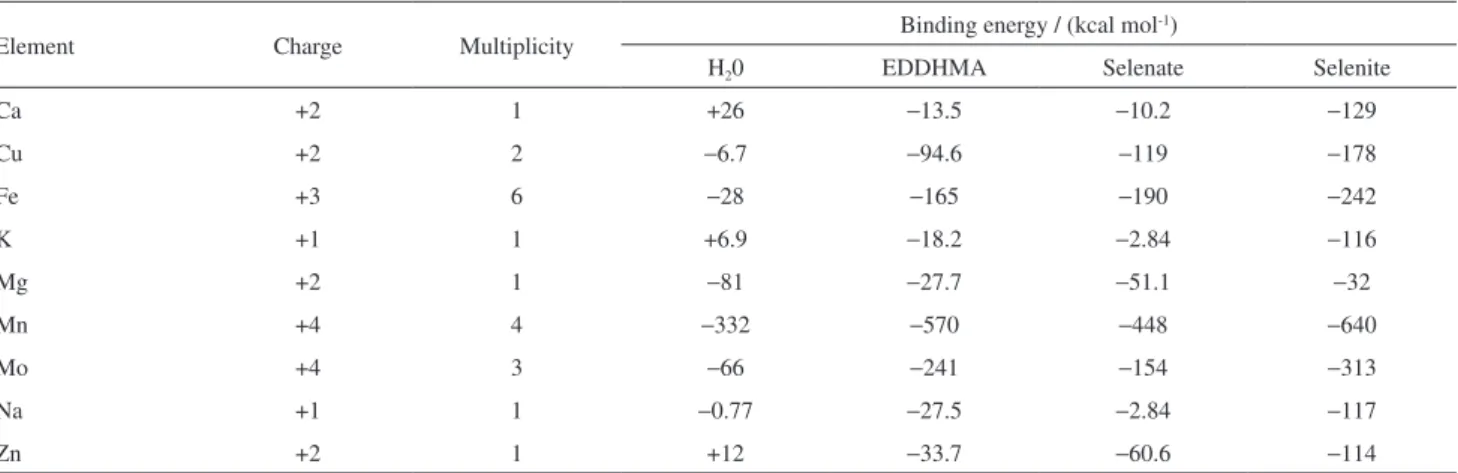
Additionally, theoretical calculations were made to provide a better understanding of the events that may occur in solution when Se is added as selenite or selenate and to clarify the effect of the presence of both Se species in the absorption and accumulation of metallic ions by the lettuce plant. The binding energies between the metal ions and molecules in solution were evaluated and the calculations were carried out with water molecule, selenite and selenate ions, as well as the EDDHMA ligand, whose presence in the nutrient solution was known. The EDDHMA was studied because the Fe salt used to prepare the nutrient solution
was in the Fe-EDDHMA form that is more described as bioavailable to the plant.59 Table 5 shows the binding
energies obtained through the calculations.
The results showed that the interaction with the water molecules is smaller than with other species evaluated, for all elements. This fact was expected, since the species studied (excluding H2O) are anionic, and may
have a strong interaction with the cations. In general, the metal-molecule interactions follow the ascending order: H2O < EDDHMA < SeO42- < SeO32-, i.e., the
interaction with selenite and selenate are stronger than the interaction with the other molecules. Moreover, the selenite or selenate concentrations are nearly the sum of the metallic micronutrients (Cu, Fe, Mn, Mo and Zn) in the nutrient solution and the probability of an ion-molecule complex to be found also follows this order showed before. Additionally, the elements interaction with selenite follows the ascending order Mg < Ca = K < Na < Zn < Cu < Fe < Mo < Mn; and for selenate the order is K < Na < Mg < Ca < Zn < Cu < Mo < Fe < Mn. Thus, it is reasonable to conclude that the presence of these Se species may affect most significantly the accumulation of tri and tetravalent cations and in minor extension the accumulation of mono and bivalent cations, because of the binding energies observed in Table 5.
It is known that small molecules, such as ions (metal-H2O), are absorbed through the transcellular (by
passive via) and paracellular pathways.26 Therefore, when
metals bind with selenate and selenite, these molecules should be less absorbed by these two routes, thereby decreasing the element bioavailability to the plant, and as consequence, its accumulation by the plant. However, a higher accumulation of certain metals by the plant in the presence of selenate or selenite was observed, probably because some metals can be absorbed by other routes with
Table 5. Metallic elements with the respective charges and multiplicities (used in the theoretical calculations) and the binding energies for the interaction metal-molecules
Element Charge Multiplicity Binding energy / (kcal mol
-1)
H20 EDDHMA Selenate Selenite
Ca +2 1 +26 −13.5 −10.2 −129
Cu +2 2 −6.7 −94.6 −119 −178
Fe +3 6 −28 −165 −190 −242
K +1 1 +6.9 −18.2 −2.84 −116
Mg +2 1 −81 −27.7 −51.1 −32
Mn +4 4 −332 −570 −448 −640
Mo +4 3 −66 −241 −154 −313
Na +1 1 −0.77 −27.5 −2.84 −117
Se, or even some sites may be stimulated in the presence of different Se species, increasing the absorption of some elements, as observed for sulfur.
Conclusions
In conclusion, selenate and selenite-enriched lettuce plants were evaluated regarding the form and amount of Se added in the culture medium for hydroponic plants. Additionally, it was possible to optimize a method to determine several elements by ICP OES and through PCA and theoretical calculations, the mineral composition was evaluated and an overview about the Se influence in the accumulation of the main nutrients was given.
In general, supplementation with Se affected the plant nutritional state. Selenate-biofortified lettuce showed that Se has a synergic effect with S and Mo, thus, this Se form could promote high uptake levels by the plant. However, selenate diminished the concentrations of P, Cu, Fe and Mn in the shoot. For selenite-biofortified plants, a synergic effect was noticed for Mn, P, Mg and Ca.
In summary, this study showed the importance of Se biofortification programs to provide an increase in the intake of this element by the population. The Se-enriched lettuce can be used as a potential dietary source of this essential element, which is not present in appropriate levels in most types of foods. However, this strategy can influence the macro and micronutrients and may change the plant nutritional balance.
Acknowledgments
The authors gratefully acknowledge the Fundação de Amparo à Pesquisa do Estado de São Paulo (FAPESP Process 2013/26855-2, 2012/15020-4 and 2014/15425-0), the Conselho Nacional de Desenvolvimento Científico e Tecnológico (CNPq) and National Institute of Advanced Analytical Science and Technology (INCTAA) (CNPq process No. 573894/ 2008-6 and FAPESP process No. 2008/57808-1) for their financial support. The authors also acknowledge Prof Dr Sylvio Luis Honorio by providing the greenhouse where the plants were cultivated and the help on the cultivating processes.
References
1. Combs Jr., G. F.; Combs, S. B.; Annu. Rev. Nutr. 1984, 4, 257. 2. DeTar, R. A.; Alford, E. R.; Pilon-Smits, E. A.; J. Plant Physiol.
2015, 183, 32.
3. Gasecka, M.; Mleczek, M.; Siwulski, M.; Niedzielski, P.; Kozak, L.; LWT - Food Sci. Technol. 2015, 63, 726.
4. Kohlmeier, M.; Nutrient Metabolism, 1st ed.; Online Academic Press: Saunders, Philadelphia, 2003.
5. Lazo-Vélez. M. A.; Avilés-González, J.; Serna-Saldivar, S. O.; Temblador-Pérez, M. C.; LWT - Food Sci. Technol. 2016, 65,
1080.
6. Rahman, M. M.; Erskine, W.; Zaman, M. S.; Thavarajah, P.; Thavarajah, D.; Siddique, K. H. M.; Food Res. Int. 2013, 54, 1596.
7. Rolandelli, R. H.; Clinical Nutrition, Enteral and Tube Feeding, 4th ed.; Online Academic Press: Saunders, Philadelphia, 2005. 8. Carvalho, M. P.; Vasconcelos, M. W.; Food Res. Int. 2013, 54,
961.
9. Egressy-Molnár, O.; Ouerdane, L.; Gyorfi, J.; Dernovics, M.;
LWT - Food Sci. Technol. 2016, 68, 306.
10. Rayman, M. P.; Lancet 2012, 379, 1256.
11. Stoffaneller, R.; Morse, N. L.; Nutrients 2015, 7, 1494.
12. Thavarajah, D.; Thavarajah, P.; Food Res. Int. 2012, 49, 99. 13. Funes-Collado, V.; Morell-Garcia, A.; Rubio, R.; López-Sánchez,
J. F.; Food Chem. 2013, 141, 3738.
14. Sanmartín, C.; Garmendia, I.; Romano, B.; Díaz, M.; Palop, J. A.; Goicoechea, N.; Sci. Hortic. 2014, 180, 40.
15. Mechora, S.; Stibilj, V.; Kreft, I.; Germ, M.; J. Plant Nutr. 2014, 37, 2157.
16. Businelli, D.; D’Amato, R.; Onofri, A.; Tedeschini, E.; Tei, F.;
Sci. Hortic. 2015, 197, 697.
17. Matich, A. J.; McKenzie, M. J.; Lill, R. E.; McGhie, T. K.; Chen, R. K. Y.; Rowan, D. D.; J. Agric. Food Chem. 2015, 63, 1896. 18. Hawrylak-Nowak, B.; Plant Growth Regul. 2013, 70, 149.
19. Li, Z.; Zhao, X.; Sandhu, A. K.; Gu, L.; J. Agric. Food Chem.
2010, 58, 6503.
20. Carvalho, K. M.; Gallardo-Williams, M. T.; Benson, R. F.;
J.Agric. Food Chem. 2003, 51, 704.
21. Malorgio, F.; Diaz, K. E.; Ferrante, A.; Mensuali-Sodi, A.; Pezzarossa, B.; J. Sci. Food Agric. 2009, 89, 2243.
22. Ríos, J. J.; Blasco, B.; Cervilla, L. M.; Rosales, M. A.; Sanchez-Rodriguez, E.; Romero, L.; Ruiz, J. M.; Ann. Appl. Biol. 2009, 154, 107.
23. Ramos, S. J.; Faquin, V.; de Almeida, H. J.; Ávila, F. W.; Guilherme, L. R. G.; Bastos, C. E. A.; Ávila, P. A.; Rev. Bras. Cienc. Solo 2011, 35, 1347.
24. Ríos, J. J.; Blasco, B.; Cervilla, L. M.; Rubio-Wilhelmi, M. M.; Ruiz, J. M.; Romero, L.; Plant Growth Regul. 2008, 56, 43.
25. Ríos, J. J.; Blasco, B.; Leyva, R.; Sanchez-Rodriguez, E.; Rubio-Wilhelmi, M. M.; Romero, L.; Ruiz, J. M.; J. Plant Nutr.
2013, 36, 1344.
26. Marschner, H.; Mineral Nutrition of Higher Plants; Academic
Press: London, 1995.
27. Sors, T. G.; Ellis, D. R.; Salt, D. E.; Photosynth. Res. 2005, 86,
373.
Regulatory Agricultural and Environmental Aspects; SPB Academic Publishing: The Hague, 1993.
29. Pilon-Smits, E. A. H.; Hwang, S.; Lytle, C. M.; Zhu, Y.; Tai, J. C.; Bravo, C. R.; Chen, Y.; Leustek, T.; Terry, N.; Plant Physiol. 1999, 119, 123.
30. Mikkelsen, R. L.; Wan, H. F.; Plant Soil 1990, 121, 151.
31. Lyons, G.; Ortiz-Monasterio, I.; Stangoulis, J.; Graham, R.;
Plant Soil 2005, 269, 369.
32. He, P. P.; Lv, X. Z.; Wang, G. Y.; Environ. Int. 2004, 30, 167. 33. do Nascimento da Silva, E.; Heerdt, G.; Cidade, M.; Pereira, C.
D.; Morgon, N. H.; Cadore, S.; Microchem. J. 2015, 119, 152. 34. Bilge, G.; Sezer, B.; Eseller, K. E.; Berberoglu, H.; Topcu, A.;
Boyaci, I. H.; Food Chem. 2016, 212, 183.
35. Habte, G. H.; Hwang, I. M.; Kim, J. S.; Hong, J. H.; Hong, Y. S.; Choi, J. Y.; Nho, E. Y.; Jamila, N.; Khan, N.; Kim, K. S.;
Food Chem. 2016, 212, 512.
36. Hidalgo, M. J.; Fechner, D. C.; Marchevsky, E. J.; Pellerano, R. G.; Food Chem. 2016, 210, 228.
37. Kholodov, V. A.; Yaroslavtseva, N. V.; Lazarev, V. I.; Frid, A. S.;
Eurasian Soil Sci. 2016, 49, 1026.
38. Jolliffe, I. T.; J. R. Stat. Soc. Ser. C (Appl. Stat.) 1982, 31, 300. 39. Ringnér, M.; Nat. Biotechnol. 2008, 26, 303.
40. Freitas, C. A. B.; Silva, A. S.; Alves, C. N.; Nascimento, W. M. O.; Lopes, A. S.; Lima, M. O.; Müllera, R. C. S.; J. Braz. Chem. Soc. 2016, 27, 1838.
41. Frisch, M. J.; Trucks, G. W.; Schlegel, H. B.; Scuseria, G. E.; Robb, M. A.; Cheeseman, J. R.; Scalmani, G.; Barone, V.; Mennucci, B.; Petersson, G. A.; Nakatsuji, H.; Caricato, M.; Li, X.; Hratchian, H. P.; Izmaylov, A. F.; Bloino, J.; Zheng, G.; Sonnenberg, J. L.; Hada, M.; Ehara, M.; Toyota, K.; Fukuda, R.; Hasegawa, J.; Ishida, M.; Nakajima, T.; Honda, Y.; Kitao, O.; Nakai, H.; Vreven, T.; Montgomery Jr., J. A.; Peralta, J. E.; Ogliaro, F.; Bearpark, M.; Heyd, J. J.; Brothers, E.; Kudin, K. N.; Staroverov, V. N.; Kobayashi, R.; Normand, J.; Raghavachari, K.; Rendell, A.; Burant, J. C.; Iyengar, S. S.; Tomasi, J.; Cossi, M.; Rega, N.; Millam, J. M.; Klene, M.; Knox, J. E.; Cross, J. B.; Bakken, V.; Adamo, C.; Jaramillo, J.; Gomperts, R.; Stratmann, R. E.; Yazyev, O.; Austin, A.
J.; Cammi, R.; Pomelli, C.; Ochterski, J. W.; Martin, R. L.; Morokuma, K.; Zakrzewski, V. G.; Voth, G. A.; Salvador, P.; Dannenberg, J. J.; Dapprich, S.; Daniels, A. D.; Farkas, Ö.; Foresman, J. B.; Ortiz, J. V.; Cioslowski J.; Fox, D. J.; Gaussian 09, Revision D.01.;Gaussian, Inc., Wallingford, CT, 2009. 42. Zhao, Y.; Truhlar, D. G.; J. Chem. Phys. 2006, 125, 194101.
43. Dunning Jr., T. H.; Hay, P. J.; Modern Theoretical Chemistry; Plenum: New York, 1977.
44. Heerdt, G.; Morgon, N. H.; Quim. Nova 2011, 34, 868. 45. Heerdt, G.; Morgon, N. H.; J.Braz. Chem. Soc. 2012, 23, 1741.
46. Heerdt, G.; Pereira, D. H.; Custodio, R.; Morgon, N. H.;
Comput. Theor. Chem. 2015, 1067, 84.
47. Marenich, A. V.; Cramer, C. J.; Truhlar, D. G. J.; J. Phys. Chem. B 2009, 113, 6378.
48. do Nascimento da Silva, E.; Aureli, F.; D’Amato, M.; Raggi, A.; Cadore, S.; Cubadda, F.; J. Agric. Food Chem. 2017, 65,
3031.
49. Pilon-Smits, E. A. H.; Quinn, C. F.; Plant Cell Monogr. 2010, 17, 225.
50. Wang, Y.; Wang, X.; Wong, Y.; Food Chem. 2013, 141, 2385.
51. Wu, L.; Huang, Z.; J. Exp. Bot. 1992, 43, 549.
52. Barack, P.; Goldman, I. L.; J. Agric. Food Chem. 1997,45,
1290.
53. Ferrari, G.; Renosto, F.; Plant Physiol. 1972, 49, 114.
54. Broyer, T. C.; Huston, R. P.; Johnson, C. M.; Plant Soil 1972,
36, 635.
55. Batistic, O.; Kudla, J.; Plant Cell Monogr. 2010, 17, 17. 56. Kostopoulou, P.; Kyriazopoulos, A. P.; Abraham, E. M.; Parissi,
Z. M.; Karatassiou, M.; Barbayannis, N.; Not. Bot. Horti Agrobot. Cluj-Napoca 2015, 43, 447.
57. White, P. J.; Karley, A. J.; Plant Cell Monogr. 2010, 17, 199. 58. Schiavon, M.; Pilon-Smits, E. A. H.; Wirtz, M.; Hell, R.;
Malagoli, M.; Environ. Exp. Bot. 2012, 75, 41.
59. Álvarez-Fernández, A.; Garcia-Marco, S.; Lucena, J. J.; Eur. J. Agron. 2005, 22, 119.
Submitted: June 28, 2017
Published online: August 17, 2017