Influence of advanced age on postoperative outcomes and total
loss following breast reconstruction: a critical assessment of 560
cases
Influência da idade avançada sobre a evolução pós-operatória e a perda total da
reconstrução mamária: análise crítica de 560 reconstruções
Walter Koiti MatsuMoto1; alexandre Mendonça Munhoz1,2,3; alberto oKada3,4; eduardo Montag3,4; eduardo gustavo arruda3,4; alexandre Fonseca3,4; orlando Ferrari4; José augusto brasil1; lia Pretti4; José roberto Filassi2,3,5; rolF geMPerli, tcbc-sP4.
INTRODUCTION
B
reast reconstruction is a well established procedure and is considered the standard treatment for pa-tients with breast cancer who wish to repair the on-cologic defect1. The choice of the reconstruction te-chnique depends on the individual characteristics of each patient and is also influenced by the analysis of the surgical risk profile by the plastic surgeon2,3. Data from the Brazilian Institute of Geography and Statistics (IBGE) show that the elderly population is the one with the highest growth rates in Brazil, and similar demo-graphic patterns can be found in other countries4,5. At the same time, the incidence of breast cancer increa-ses with age, with 50% of caincrea-ses occurring in women over 65 years of age6. The technological advances inmedical treatment, among other factors, led to an in-crease in life expectancy, suggesting that the elderly population will require an increasing number of surgi-cal procedures7. With advancing age, the decrease in the efficiency of the healing process and the reduction of cardiovascular function may represent an increase in the perioperative risk of this subgroup of cancer pa-tients7-9. In addition, advanced age is often referred to as an independent risk factor for complications in ge-neral surgery patients9,10. However, few studies have evaluated the influence of age on the complications rates and on the disadvantages and benefits of breast reconstruction7,8,11-13. Some clinical series that evalua-ted the impact of age on complications in specific re-construction techniques demonstrated greater clinical and surgical morbidity11-13.
1 - Sírio-Libanês Hospital, Plastic Surgery, São Paulo, SP, Brazil. 2 - Faculty of Medicine, University of São Paulo, Mammary Reconstruction Group, São Paulo, SP, Brazil. 3 - University of São Paulo, Cancer Institute of the State of São Paulo, São Paulo, SP, Brazil. 4 - Faculty of Medicine, University of São Paulo, Division of Plastic Surgery, São Paulo, SP, Brazil. 5 - Sírio-Libanês Hospital, Mastology, São Paulo, SP, Brazil.
A B S T R A C T
Objective: to evaluate the role of age in the risk of postoperative complications in patients submitted to unilateral breast reconstruction after mastectomy, with emphasis on total reconstruction loss. Methods: we conducted a retrospective study of patients submitted to breast reconstruction, whose variables included: oncological and reconstruction data, postoperative complications, including loss of reconstruction and complications of surgical wound. We divided the patients into two groups, according to the classification of the Brazilian National Elderly Policy and the Statute of the Elderly: young (age <60 years) and elderly (60 years or more). We also grouped them according to the World Health Organization classification: young people (age <44 years), middle age (45-59 years); elderly (age 60-89 years) and extreme advanced age (90 years or older). We applied the surgical risk classification of the American Society of Anesthesiologists to investigate the role of the preoperative physical state as a possible predictor of complications. Results: of the 560 patients operated on, 94 (16.8%) were 60 years of age or older. We observed a local complication rate of 49.8%, the majority being self-limited. The incidences of necrosis, infec-tion and dehiscence were 15.5%, 10.9% and 9.3%, respectively. Patients older than 60 years presented a chance of complicainfec-tion 1.606 times greater than the younger ones. Forty-five (8%) patients had loss of the reconstruction; there was no statistically significant difference in the mean age of the patients who presented this result or not (p=0.321). Conclusion: in selected patients, breast reconstruction can be considered safe; most documented complications were limited and could be treated conservatively.
Considering that data on breast reconstruc-tion in the Brazilian elderly populareconstruc-tion are limited, this study sought to investigate the postoperative complica-tions in this specific patients’ group. The main objective of the study was to globally quantify the effect of age on postoperative complications. We also sought to in-vestigate the relationship between age and total loss of the breast reconstruction.
METHODS
We carried out a retrospective cohort that identified all patients submitted to unilateral breast re-construction at the Cancer Institute of the State of São Paulo (ICESP) and at the Sírio-Libanês Hospital (HSL). We conducted this study in accordance with the ethical guidelines of the Declaration of Helsinki, and it was approved by the Ethics and Research Committees of the respective institutions (approval protocols 474/13 and 714.543).
We analyzed the database of each institution (ICESP/HSL) for information on clinical complications associated with breast reconstruction. We excluded pa-tients with incomplete information. The variables inclu-ded were: oncological data, reconstruction data (tech-nique), postoperative complications, including loss of reconstruction, surgical wound complications (recons-truction site and donor area), early infection (during hospitalization for reconstruction), late infection, se-roma, dehiscence, hematoma. We divided the patients according to the classification of the Brazilian National Elderly Policy and the Statute of the Elderly (NEP)14 in two groups: young people (age <60 years) and elderly (60 years or more). We also divided them into groups according to the World Health Organization (WHO) classification15: group I, young people (age <44 years); group II, middle age (age 45-59 years); group III, elder-ly (age 60-89 years), and group IV, extreme old age (90 years or more). We applied the American Society of Anesthesiologists (ASA) classification to investigate the role of preoperative physical status as a possible pre-dictor of complications: Class 1 (healthy patient), Class 2 (mild or moderate systemic disease), Class 3 (severe systemic disease), Class 4 (severe systemic disease with constant risk of life), and Class 5 (patient to die within
24 hours despite surgical treatment).
We compared demographic and comorbidity data between age groups based on the NEP and WHO classifications. As the oldest patient in the sample was 88 years old, we grouped all patients older than 60 ye-ars for statistical analysis. To compare the continuous variables for the occurrence of complications (yes or no) or by any other categorical variable with two ca-tegories, we used the Student’s t-test. To compare the continuous variables with more than two categories, we used the analysis of variance (ANOVA) model. To compare the categorical variables for the occurrence of complications (yes or no) or by any other categorical variable with two or more categories, we used the chi -square test. We used the Fisher’s exact test or the Like-lihood Ratio when necessary. We also used the simple logistic regression model to verify which variables, in-dividually, related to the occurrence of complications, to obtain the Odds Ratio (OR) for the occurrence of the mentioned outcomes for each variable. After the logistic regression analysis for each clinical risk factor and for the complications, we conducted a multivaria-te logistic regression analysis. However, some of the variables were significantly correlated with the others, and it was not possible to include all variables in the same model. Therefore, we chose to construct new va-riables with the combination of vava-riables considered as risk factors. The new variables, combined two to two, were part of a simple logistic regression model. The value of p=0.05 was considered statistically significant. We used the SPSS software for Windows 7.0 (SPSS Inc. Chicago, Illinois) for all statistical analysis.
RESULTS
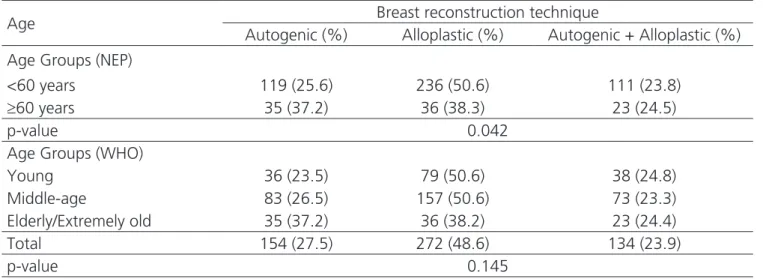
Table 1. Distribution of reconstruction techniques by age groups.
Age Breast reconstruction technique
Autogenic (%) Alloplastic (%) Autogenic + Alloplastic (%) Age Groups (NEP)
<60 years 119 (25.6) 236 (50.6) 111 (23.8)
≥60 years 35 (37.2) 36 (38.3) 23 (24.5)
p-value 0.042
Age Groups (WHO)
Young 36 (23.5) 79 (50.6) 38 (24.8) Middle-age 83 (26.5) 157 (50.6) 73 (23.3) Elderly/Extremely old 35 (37.2) 36 (38.2) 23 (24.4) Total 154 (27.5) 272 (48.6) 134 (23.9)
p-value 0.145
NEP: National Policy for the Elderly and the Elderly Statute; WHO: World Health Organization. of 94), reconstruction with alloplastic materials was the
most common reconstruction modality. Table 1 shows the distribution of reconstruction techniques in the dif-ferent age groups.
With respect to the oncological characteristics, 141 (25%) patients were classified as T1, 186 (33.2%), as T2, 95 (17%), as T3, 36 (4%), as T4, 63 (11.3 %), as
a tumor in situ, and 26 (4.6%), as T0. In this sample, 215 (38.4%) patients underwent neoadjuvant chemo-therapy, 249 (44.5%), adjuvant chemochemo-therapy, three (0.7%) received neoadjuvant radiotherapy, and 335 (59.9%), adjuvant radiotherapy. The local recurrence rate was 6.6% and the incidence of distant metastases was 4.1%.
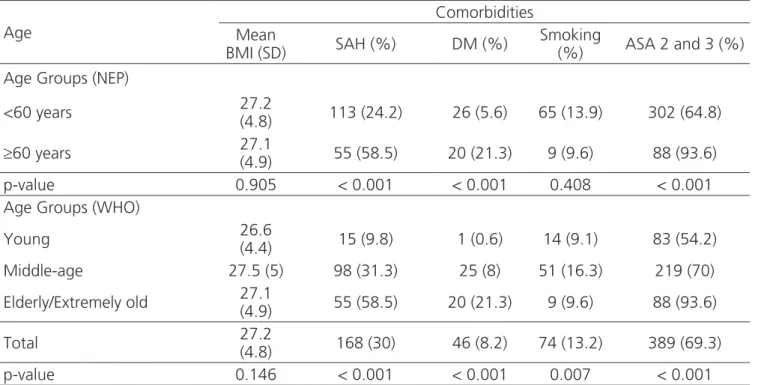
The comparison of the different age groups (NEP and WHO classifications) showed no relation be-tween age and Body Mass Index (BMI, p=0.217). Patients with diabetes mellitus (DM) had a significantly higher mean age (58 years) than non-diabetic ones (49.4 years, p<0.001). Advanced age was an independent risk factor for DM (OR 4.57, p<0.001). Similarly, we found a sig-nificant relationship between age and systemic arterial hypertension (SAH, p<0.001). The comparison between non-hypertensive and hypertensive patients showed a significant increase in the proportion of elderly patients in the second group (p<0.001). Among the elderly patients, 71 (75.5%) were non-smokers, 14 (14.9%) were former smokers and nine (9.6%) were smokers. In relation to smoking, the groups of young and old (NEP classification) were statistically similar (p=0.408). However, considering the WHO classification, there was a significant difference (p=0.007), with a higher percentage of young patients in the nonsmoking contingent compared to smokers and former smokers. ASA 1 patients represented 30.7%
(172/560) of the sample, while those ASA 2 and 3 ac-counted for 69.3%. No patient had an ASA 4 or 5 status (Table 2).
whole sample) and the variables BMI, seroma, infection and necrosis. Patients who presented a loss of recons-truction had significantly higher mean BMI (30.2kg/m2)
than those without it (27.8kg/m2, p=0.002). The ASA score did not show a significant correlation with the inci-dence of complications (p=0.139).
Table 2. Distribution of Comorbidities by age groups.
Age
Comorbidities Mean
BMI (SD) SAH (%) DM (%)
Smoking
(%) ASA 2 and 3 (%) Age Groups (NEP)
<60 years 27.2
(4.8) 113 (24.2) 26 (5.6) 65 (13.9) 302 (64.8)
≥60 years 27.1
(4.9) 55 (58.5) 20 (21.3) 9 (9.6) 88 (93.6) p-value 0.905 < 0.001 < 0.001 0.408 < 0.001 Age Groups (WHO)
Young 26.6
(4.4) 15 (9.8) 1 (0.6) 14 (9.1) 83 (54.2) Middle-age 27.5 (5) 98 (31.3) 25 (8) 51 (16.3) 219 (70)
Elderly/Extremely old 27.1
(4.9) 55 (58.5) 20 (21.3) 9 (9.6) 88 (93.6)
Total 27.2
(4.8) 168 (30) 46 (8.2) 74 (13.2) 389 (69.3) p-value 0.146 < 0.001 < 0.001 0.007 < 0.001
SD: standard deviation; SAH: Systemic Arterial Hypertension; DM: Diabetes Mellitus; NEP: National Policy for the Elderly and the Elderly Statute; WHO: World Health Organization; BMI: body mass index.
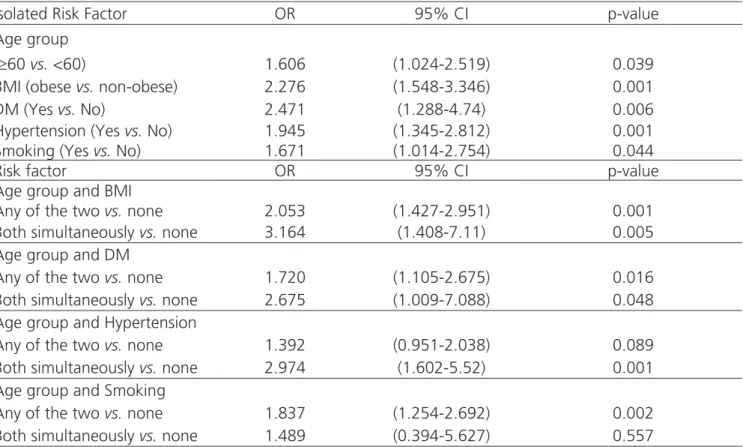
Patients who did not present complications had a mean age of 48.8 years, while the mean age of those who presented them was 51.4 years (Table 3). Considering only those who developed complications, 20.1% (56/279) were elderly. Patients 60 years of age or older presented a 1.606-fold greater risk of complica-tions than did patients younger than 60. Obese patients had a 2,276-fold greater risk of complications when compared to non-obese patients (Table 4). Patients both elderly and obese presented a 3.16-fold higher risk of complications than did patients without any of these risk factors (p=0.005), as shown in Table 4. Patients with dia-betes presented a risk of complications 2.471 times the risk of complications without DM. Elderly and diabetic patients presented a 2.67-fold greater risk of complica-tion than non-diabetic young women (p=0.048). We ob-served a significant increase in complication rates in the advanced age groups (p=0.015) (Table 3); each one-year
increment corresponded to a 2.4% increase in the risk of complications, as demonstrated by the logistic regres-sion analysis. The same analysis showed that the elderly/ extremely old patients presented a complication chance 2.1 times higher when compared to the younger age groups.
DISCUSSION
Advanced age is recognized as a risk factor for cancer, and 60% of new cases are diagnosed in
pa-tients over 60 years16,17. Moreover, the increase in life expectancy has increased the number of elderly patients who require surgeries for oncologic resections and re-constructions18. Despite the evolution of breast cancer
Table 3. Distribution of age groups with averages, standard deviations, medians and range in the groups with and without complications and with or without total loss of reconstruction.
Age
Groups
p-value Without
complications With complications
Average (SD) 48.8 (10.5) 51.4 (10.2) 0.003 Median (range) 48 (23-83) 51 (23-88)
Age Group (NEP)
<60 years – n (%) 243 (86.5) 223 (79.9) 0.05
≥60 years – n (%) 38 (13.5) 56 (20.1) Age Group (WHO)
Young – n (%) 90 (32) 63 (22.6) 0.015 Middle-age – n (%) 153 (54.4) 160 (57.3)
Elderly/Extremely old – n (%) 38 (13.5) 56 (20.1)
Age (years) Without total loss of reconstruction
With total loss of
reconstruction p-value Average (SD) 51.4 (10.2) 49.7 (9.8) 0.321 Median (range) 51 (23-88) 50 (23-70)
SD = standard deviation; NEP: National Policy for the Elderly and the Elderly Statute; WHO: World Health Organization.
Table 4. Correlation of risk factors versus age groups and complications (singly, one by one, and two by two). Results of the logistic regression analysis.
Isolated Risk Factor OR 95% CI p-value Age group
(≥60 vs. <60) 1.606 (1.024-2.519) 0.039 BMI (obese vs. non-obese) 2.276 (1.548-3.346) 0.001 DM (Yes vs. No) 2.471 (1.288-4.74) 0.006 Hypertension (Yes vs. No) 1.945 (1.345-2.812) 0.001 Smoking (Yes vs. No) 1.671 (1.014-2.754) 0.044 Risk factor OR 95% CI p-value Age group and BMI
Any of the two vs. none 2.053 (1.427-2.951) 0.001 Both simultaneously vs. none 3.164 (1.408-7.11) 0.005 Age group and DM
Any of the two vs. none 1.720 (1.105-2.675) 0.016 Both simultaneously vs. none 2.675 (1.009-7.088) 0.048 Age group and Hypertension
Any of the two vs. none 1.392 (0.951-2.038) 0.089 Both simultaneously vs. none 2.974 (1.602-5.52) 0.001 Age group and Smoking
Any of the two vs. none 1.837 (1.254-2.692) 0.002 Both simultaneously vs. none 1.489 (0.394-5.627) 0.557
treatment and the aging process of the female popula-tion, treatment protocols in the elderly population are still based on studies with limited levels of evidence19. Due to the scarcity of studies with sufficient evidence to define the risks and benefits for this population segment, elderly patients tend to receive incomplete treatment for breast cancer19,20. In fact, some studies have shown dis-crepancies in relation to breast reconstruction rates in the different age groups, and only a minority of the el-derly patients with breast neoplasia choose to undergo reconstruction21.
Another important point is the controversy in establishing the age limits between the different age groups and the lack of uniformity in the definition of the term elderly. Some studies used the age of 50 as a refe-rence22, while others used 55 years23, 6024, or 65 years25. In the present study, we defined the age of 60 years as the limit between young and old, as recommended by the Brazilian National Elderly Policy14. This classification proved useful and clinically relevant, since the great re-duction in breast reconstruction rates is observed after the fifth and sixth decades of life. We also used the WHO classification to include an international categorization usually employed in public health worldwide15.
In breast reconstruction, it is essential to de-termine the anthropometric and clinical factors as-sociated with higher complication rates25-27. Age13,23, smoking22,25,28, obesity22,23,25,27,28, SAH24,25,27 and DM24 are frequently mentioned as potential risk factors. In this scenario, there is no consensus regarding the role of age on complications in patients with breast neoplasms undergoing reconstruction13-17. In this sample, patients with DM had a significantly higher mean age than non-diabetics, and there was also a significant relationship between age and SAH. Similarly, the mean age for ASA 1 patients was significantly lower than for patients classi-fied as ASA 2 or 3. We found no significant relationship between smoking and obesity in elderly patients. Despite this, considering the WHO classification, we observed a greater percentage of young patients in the non-smoke-rs group in relation to smokenon-smoke-rs and former smokenon-smoke-rs.
Regarding breast reconstruction, some studies have compared the rates of complications among young and old patients7,8,11-13. In this study, the comparison of complication rates among age groups according to NEP
classification showed a higher incidence of complications in the advanced age group, although this difference oc-curred at the limit of significance (p=0.05). When we used WHO classification, we observed a significantly hi-gher incidence of complications in the elderly/extremely old. Moreover, the overall rate of surgical complications in young and old patients was 47.8% and 59.6%, res-pectively, higher than those reported in other published series7,8,11-13,29. This is due to the inclusion of minor com-plications, such as mild to moderate seromas, which exhibited a total incidence of 22% and accounted for almost 45% of all complications. In spite of the high in-cidence of seromas when compared to other studies, we must be emphasize some points. Some studies with large samples are based on the American College of Surgeons National Surgical Quality Improvement Program (ACS -NSQIP), which does not include some adverse events (such as seroma) in the list of complications22,23. Thus, if the seroma were excluded from the list of complications in this study, the results would become comparable to previously published clinical series7,8,11-13.
Considering all types of adverse events, there was no significant difference in the mean age among patients who presented complications. In addition, the comparison of young and elderly patients did not show a significant difference in the isolated incidence of each type of complication, with the exception of hematoma. And although there is no consensus to characterize age as a risk factor for breast reconstruction, some studies have demonstrated ASA classification as a predictor for perioperative complications7,30. In this series, patients classified as ASA 2 or 3 accounted for almost 70% of the entire sample. In contrast to observations from other stu-dies7,30, the ASA classification did not demonstrate a sig-nificant correlation with the incidence of complications. At this point, we believe that this aspect should not con-traindicate reconstruction, although one should take ad-ditional care in patients with a higher surgical risk.
other studies have observed that age greater than 5022 and 55 years23 were independent predictive factors for reconstruction loss. In a paradoxal way, the incidence of reconstruction loss was lower in patients who had pre-sented seroma and necrosis than in patients who did not present such outcomes. One hypothesis to explain this finding is that the diagnosis of these two events motiva-ted a rapid treatment by the medical team with intensive follow-up, re-hospitalization, drainage of collections, de-bridement of devitalized tissues and antibiotic therapy, which resulted, in the end, in lower reconstruction loss rates when compared to patients with subclinical infec-tions.
Regarding reconstruction techniques, almost 50% of the patients underwent reconstruction with alloplastic materials, 27% with autogenous tissues and 24% with a combination of alloplastics and autogenous tissues. Both young and elderly patients underwent allo-plastic reconstruction more frequently. Like other au-thors, we did not find a correlation between age and the incidence of complications when performing the analysis of the alloplastic, autogenous and alloplastic / autoge-nous groups separately7,13,22,23,25,31. One of the obvious limitations of this study is the relatively small sample size in each subgroup of reconstruction technique. Future studies with a larger number of patients may reveal whe-ther current findings are due to inadequate sample size or are a valid consideration.
Other limitations of the present study require attention. First, we collected the data prospectively but evaluated them retrospectively. In addition, the study was observational and non-randomized. There is,
there-fore, a selection bias that cannot be excluded. Although the sample size of this series is significant, the notable low incidence of some types of complication and some reconstruction modalities may have prevented the analy-sis from achieving the desired statistical power. In addi-tion, we could not perform comparisons of the results in patients with extreme old age, smoking and diabetics, as well as subgroups of different surgical techniques, so that the clinical relevance of the type of breast recons-truction in these groups remains controversial. Prospec-tive studies will be needed to clarify this issue and to define which operative techniques are most appropriate for elderly patients. Second, questions about quality of life and the analysis of treatment costs were not part of the objectives of this study, but will be relevant to future research. Finally, although the postoperative complica-tions reported by the medical team may be criticized for possible underreporting, the data in the present study re-flect the unique experience of a single team in a tertiary hospital dedicated to the Brazilian population.
We conclude that breast reconstruction is a valid option for adequately selected patients. This study showed that age is an independent risk factor for sur-gical complications, although the vast majority of these complications have been limited and could be treated conservatively. However, patients who are candidates for immediate reconstruction should be advised that age will not necessarily imply a greater risk of loss of truction. Thus, it is appropriate to indicate breast recons-truction in elderly patients and this procedure should be considered in counseling patients under treatment for breast cancer.
Objetivo: avaliar o papel da idade no risco de complicações pós-operatórias de pacientes submetidas à reconstrução mamária unilateral pós-mastectomia, com ênfase na perda total da reconstrução. Métodos: estudo retrospectivo de pacientes submetidas à reconstrução mamária, cujas variáveis incluídas foram: dados oncológicos e da técnica de reconstrução, complicações pós-operatórias, incluindo perda da reconstrução e complicações da ferida operatória. As pacientes foram divididas de acordo com a classificação da Política Nacional do Idoso e Estatuto do Idoso em dois grupos: jovens (idade <60 anos) e idosas (60 anos ou mais). Também foram agrupadas de acordo com a classificação da Organização Mundial da Saúde: jovens (idade <44 anos); meia-idade (idade 45-59 anos); idosas (idade 60-89 anos) e velhice extrema (90 anos ou mais). A classificação do risco cirúrgico da Sociedade Americana de Anestesiologistas foi aplicada para investigar o papel do estado físico pré-operatório como possível preditor de complicações. Resultados: das 560 pacientes operadas, 94 (16,8%) apresentavam 60 anos ou mais. Observou-se taxa de complicações locais de 49,8%, a maioria, limitadas. As incidências de necrose, infecção e deiscência foram de 15,5%, 10,9% e 9,3%, respectivamente. Pacientes com 60 anos ou mais apresentaram chance de complicação 1,606 vezes maior do que as jovens. Quarenta e cinco (8%) pacientes apresentaram perda da reconstrução e não houve diferença estatisticamente significante na média de idade das pacientes que apresentaram ou não esse desfecho (p=0,321). Conclusão: em pacientes selecionadas, a reconstrução mamária pode ser considerada segura; a maioria das complicações documentadas foi limitada e pode ser tratada conservadoramente.
Descritores: Procedimentos Cirúrgicos Reconstrutivos. Mastectomia. Grupos Etários. Complicações Pós-Operatórias. Neoplasias da Mama.
REFERENCES
1. McKenna RJ Sr, Greene T, Hang-Fu LC, Hayes DF, Scanlon EF, Schweitzer RJ, et al. Implications for clinical management in patients with breast cancer. Long-term effects of reconstruction surgery. Cancer. 1991;68(5 Suppl):1182-3. 2. Lu SM, Nelson JA, Fischer JP, Fosnot J, Goldstein
J, Selber JC, et al. The impact of complications on function, health, and satisfaction following abdominally based autologous breast reconstruction: a prospective evaluation. J Plast Reconstr Aesthet Surg. 2014;67(5):682-92. 3. Munhoz AM, Montag E, Filassi JR, Gemperli R.
Immediate nipple-areola-sparing mastectomy reconstruction: an update on oncological and reconstruction techniques. World J Clin Oncol. 2014;5(3):478-94.
4. Anderson GF, Hussey PS. Population aging: a comparison among industrialized countries. Health Aff (Millwood). 2000;19(3):191-203. 5. Ramos LR, Veras RP, Kalache A. Envelhecimento
populacional: uma realidade brasileira. Rev Saúde Pública. 1987;21(3):211-24.
6. Ogunbiyi SO, Lee S, Mathew J, Cheung KL. Primary breast cancer in the elderly: a systematic literature review on histological type and clinical outcome. Future Oncol. 2015;11(2):259-65. 7. Chang EI, Vaca L, DaLio AL, Festekjian JH, Crisera
CA. Assessment of advanced age as a risk factor in microvascular breast reconstruction. Ann Plast Surg. 2011;67(3):255-9.
8. Girotto JA, Schreiber J, Nahabedian MY. Breast reconstruction in the elderly: preserving excellent quality of life. Ann Plast Surg. 2003;50(6):572-8. 9. Yanquez FJ, Clements JM, Grauf D, Merchant
AM. Synergistic effect of age and body mass index on mortality and morbidity in general surgery. J Surg Res. 2013;184(1):89-100.
10. Gajdos C, Kile D, Hawn MT, Finlayson E, Henderson WG, Robinson TN. Advancing age and 30-day adverse outcomes after nonemergent general surgeries. J Am Geriatrics Soc. 2013;61(9):1608-14.
11. Butz DR, Lapin B, Yao K, Wang E, Song DH,
Johnson D, et al. Advanced age is a predictor of 30-day complications after autologous but not implant-based postmastectomy breast reconstruction. Plast Reconstr Surg. 2015;135(2):253e-61e.
12. Lipa JE, Youssef AA, Kuerer HM, Robb GL, Chang DW. Breast reconstruction in older women: advantages of autogenous tissue. Plast Reconstr Surg. 2003;111(3): 1110-21.
13. Selber JC, Burgey M, Sonned SS, Kovach S, Wu L, Serletti JM. Free flap breast reconstruction in advanced age: is it safe? Plast Reconstr Surg. 2009;124(4):1015-22.
14. Küchemann BA. Envelhecimento populacional, cuidado e cidadania: velhos dilemas e novos desafios. Soc. Estado. 2012;27(1):165-80.
15. Ahmad OB, Boschi-Pinto C, Lopez AD, Murray CJ, Lozano R, Inoue M. Age Standardization of Rates: a new WHO standard [Internet]. Geneva: World Health Organization; 2001- [cited 2017 Feb 10]. Available from: http://www.who.int/ healthinfo/paper31.pdf
16. Ries LAG, Eisner MP, Kosary CL, Hankey BF, Miller BA, Clegg L, Edwards BK, editors. SEER Cancer Statistics Review, 1973-1998. Bethesda: National Cancer Institute. 2001 – [cited 2017 Feb 10]. Available from: https://seer.cancer.gov/ archive/csr/1973_1998.
17. Berger NA, Savvides P, Koroukian SM, Kahana EF, Deimling GT, Rose JH, et al. Cancer in the elderly. Trans Am Clin Climatol Assoc. 2006;117:147-55; discussion 155-6.
18. Korc-Grodzicki B, Downey RJ, Shahrokni A, Kingham TP, Patel SG, Audisio RA. Surgical considerations in older adults with cancer. J Clin Oncol. 2014;32(24):2647-53.
20. Bouchardy C, Rapiti E, Fioretta G, Laissue P, Neyroud-Caspar I, Schäfer P, et al. Undertreatment strongly decreases prognosis of breast cancer in elderly women. J Clin Oncol. 2003;21(19):3580-7.
21. James R, McCulley SJ, Macmillan RD. Oncoplastic and reconstructive breast surgery in the elderly. Br J Surg. 2015;102(5):480-8.
22. Hanwright PJ, Davila AA, Mioton LM, Fine NA, Bilimoria KY, Kim JY. A predictive model of risk and outcomes in tissue expander reconstruction: a multivariate analysis of 9786 patients. J Plast Surg Hand Surg. 2013;47(6):513-8.
23. Fischer JP, Nelson JA, Serletti JM, Wu LC. Peri-operative risk factors associated with early tissue expander (TE) loss following immediate breast reconstruction (IBR): a review of 9305 patients from the 2005-2010 ACS-NSQIP datasets. J Plast Reconstr Aesthetic Surg. 2013;66(11):1504-12. 24. Miller AP, Falcone RE. Breast reconstruction:
systemic factors influencing local complications. Ann Plast Surg. 1991;27(2):115-20.
25. McCarthy CM, Mehrara BJ, Riedel E, Davidge K, Hinson A, Disa JJ, et al. Predicting complications following expander/implant breast reconstruction: an outcomes analysis based on preoperative clinical risk. Plast Reconstr Surg. 2008;121(6):1886-92.
26. Munhoz AM, Montag E, Arruda E, Pellarin L, Filassi JR, Piato JR, et al. Assessment of immediate conservative breast surgery reconstruction: a classification system of defects revisited and an algorithm for selecting the appropriate technique. Plast Reconstr Surg. 2008;121(3):716-27. 27. Munhoz AM, Aldrighi CM, Montag E, Arruda EG,
Aldrighi JM, Gemperli R, et al. Clinical outcomes following nipple-areola-sparing mastectomy with
immediate implant-based breast reconstruction: a 12-year experience with an analysis of patient and breast-related factors for complications. Breast Cancer Res Treat. 2013;140(3):545-55. 28. Ducic I, Spear SL, Cuoco F, Hannan C. Safety
and risk factors for breast reconstruction with pedicled transverse rectus abdominis musculocutaneous flaps: a 10-year analysis. Ann Plast Surg. 2005;55(6):559-64.
29. Randolph LC, Barone J, Angelats J, Dado DV, Vandevender DK, Shoup M. Prediction of postoperative seroma after latissimus dorsi breast reconstruction. Plast Reconstr Surg. 2005;116(5):1287-90.
30. Serletti JM, Higgins JP, Moran S, Orlando GS. Factors affecting outcome in free-tissue transfer in the elderly. Plast Reconstr Surg. 2000;106(1):66-70.
31. Woerdeman LA, van Schijndel AW, Hage JJ, Smeulders MJ. Verifying surgical results and risk factors of the lateral thoracodorsal flap. Plast Reconstr Surg. 2004;113(1):196-203; discussion 204-5.
Received in: 27/11/2017
Accepted for publication: 04/01/2018
Conflict of interest: Dr. Alexandre Mendonça Munhoz is a consultant at Allergan Corporations and Establishment Labs. None of the other authors has a potential conflict of interest.
Source of funding: none.
Mailing address:
Alexandre Mendonça Munhoz