of Chemical
Engineering
www.scielo.br/bjcePrinted in BrazilVol. 35, No. 01, pp. 43 – 49, January – March, 2018
*Corresponding author: Pablo Dias. E-mail: [email protected] dx.doi.org/10.1590/0104-6632.20180351s20160367
LEAD HAZARD EVALUATION FOR CATHODE RAY
TUBE MONITORS IN BRAZIL
Pablo Dias
1,*, Erich de Oliveira
1and Hugo Veit
11 Programa de Pós-Graduação em Engenharia de Minas, Metalúrgica e de Materiais (PPGE3M), Universidade Federal do Rio Grande do Sul (UFRGS), Av. Bento Gonçalves, 9500, 91509-900 Porto Alegre, RS, Brazil.
[email protected]; [email protected]; [email protected]
(Submitted: June 10, 2016; Revised: September 26, 2016; Accepted: October 31, 2016)
Abstract – Cathode ray tube (CRT) monitors are electronic equipment mainly made of glass, polymers and metals. These devices became obsolete because of emerging technologies such as LCD, LED and plasma; thus generating a huge stockpile of e-waste worldwide. In this CRT study, a natural leaching simulation (NBR10005) was performed to determine the toxicity of this e-waste. The standard NBR 10005 procedure was performed for 7 different monitors. The results show all samples are hazardous according to local environmental law (NBR 10004) due to lead leaching. The CRT panel is lead free, while the CRT funnel and neck have about 20% of lead oxide in their composition. Moreover, six optimum thermal lead removal procedures were performed and the NBR 10005 procedure was repeated. The results reveal that vacuum atmosphere and the addition of 5% carbon graphite as reducing agent are optimum conditions to turn the CRT into a non-hazardous waste. Three out of six parameters were capable of satisfactorily removing the lead and turning the post-procedure waste lead-leaching safe.
Keywords: cathode ray tube, computer monitor, lead removal, recycling, WEEE
INTRODUCTION
WEEE
Electrical and Electronic Equipment (EEE) is – but is not limited to - equipment which is dependent on electric currents or electromagnetic fields in order to work properly. Waste of electric and electronic equipment (WEEE) includes not only the equipment itself, but also all the components, subassemblies and consumables which are part of the product at the time of discarding (European Union, 2002). WEEE contains a significant number of precious metals, many of which are being recovered through different studies: examples include the recovery of copper (Kasper et al., 2011), silver (Dias et al., 2016), gold (Bigum et al., 2012) and palladium (Duygana & Meylan, 2015). Improper WEEE handling and recycling may lead to health problems as these equipment contain harmful
substances such as toxic metals and flame retardants (Lecler et al., 2015). In 2005, Brazil was ranked third in the world in the generation of e-waste from computers, only behind the USA and China (Gerbase & Oliveira, 2012). The 2008 estimate is that 710,000 tons of e-waste were generated in Brazil, meaning almost 20% of the Brazilian e-waste is waste from CRT monitors (Araújo et al., 2012). Despite having proper landfills for the disposal of CRT monitors, most of them end up in improper landfills or in no landfill at all (Oliveira, 2013)
Cathode ray tube monitors
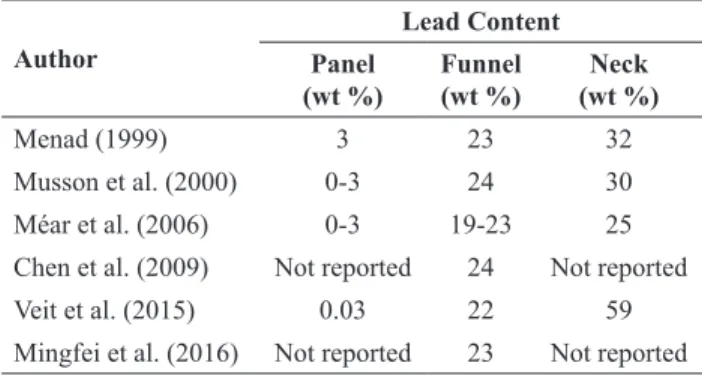
works (Table 1). According to Menad (1999), the lead in the CRTs is responsible for the radiation shielding and for stabilizing the glass.
Recycling CRTs
As stated by Okada (2015), a material containing lead may scatter and result in oral intake of the dispersed lead by humans, which ultimately results in health problems. Lead is also toxic for other animal cells and plants (Menad, 1999).This statement encourages researches that aim to remove the lead from the waste CRT. Veit et al. (2015) studied various thermal parameters to extract the lead from the funnel glass; their optimum result removed 92% of the lead. Okada (2015) extracted lead from the glass of CRT by using hydrochloric acid and by melting the glass under different oxidizing conditions. Minfei et al. (2016) studied the detoxification and reutilization of CRT funnel glass by using a thermal reduction aided with acid leaching; which was able to remove up to 95% of the lead from the glass.
It is clear that recycling waste of CRT is important not only for mitigating environmental issues, but also for maximizing the value of the waste (Zhang et al., 2016).As reported in several international publications, waste of CRT monitors represents an environmental threat and yet it has not been classified under Brazilian law. This study ranks waste of CRT monitors according to Brazilian NBR 10004 (ABNT, 2004) norm and performs different detoxification methods to evaluate their efficiency in downgrading a hazardous waste to a non-hazardous waste.
goggles, gloves and trousers. The monitors were weighed and their parts were separated and sorted into four categories: external frame, printed circuit boards (PCBs), cathode ray tube (CRT) and other components (wires, bobbins, bolts). In order to open the vacuum sealed tubes, the monitors were placed behind a wooden shield and the metallic threads were removed using a set of pliers. The parts dismantled from the CRT monitors are shown in Fig. 2.
The CRTs were split into three, according to the previous delimitation (Fig. 1). Neck, funnel and panel parts (Fig 3.) from several CRTs were separately milled in an A4R hammer mill (Tigre, São Paulo, Brazil), then in a ball mill (Groschopp, Iowa, USA). In order to make sure the monitor samples used in this work had similar lead distribution to the ones from previous studies (Table 1), the three milled glass parts were analyzed by X-ray fluorescence (XRF) using an Axios Advanced (PANalytical, Almelo, Netherlands). The obtained results encouraged a study regarding the hazard potential of CRT monitors.
Lead Hazard Evaluation
Seven CRTs monitors were submitted to the Brazilian standard leaching procedure to evaluate their hazard potential. The procedure followed the Brazilian norm NBR 10004 (ABNT, 2004), which determines the limit of lead that can be leached from any solid waste and NBR 10005 (ABNT, 2004), which determines the leaching procedure for the waste. The NBR 10004 displays a list of known
Figure 1. Illustration of a CRT highlighting the three different glass
components on the right.
Table 1. Summary of lead content in waste CRT for different stu -dies
Author
Lead Content
Panel (wt %)
Funnel (wt %)
Neck (wt %)
Menad (1999) 3 23 32
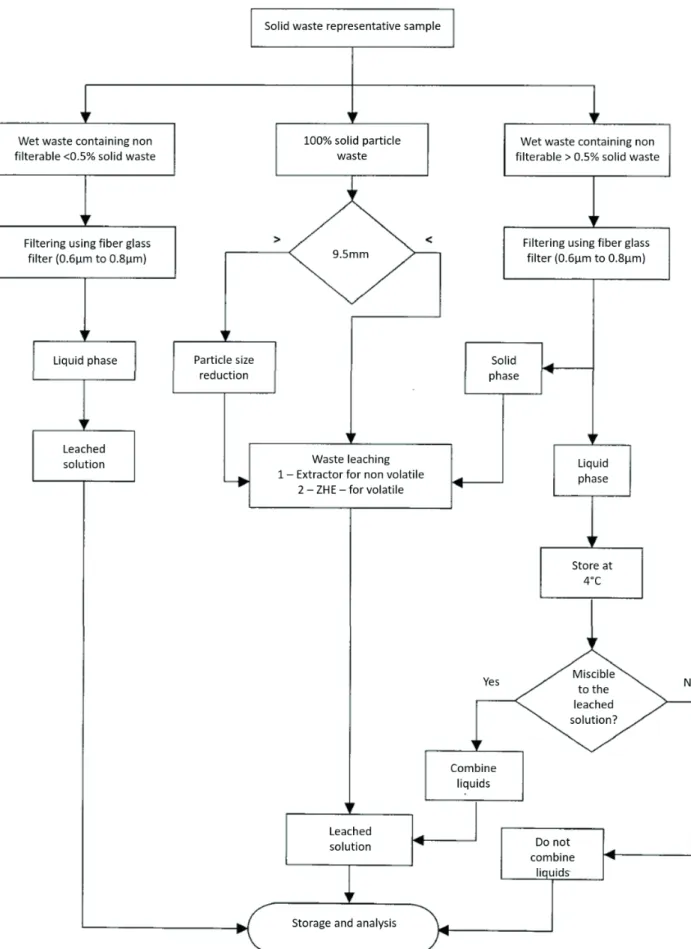
hazardous materials and their characteristics and can be related to the Code of Federal Regulations title 40, subtitle 260-265 of the United States (40 C.F.R. § 260-265). Wastes that are not characterized in the NBR 10004 should be classified according to their leaching potential, which is evaluated using the NBR 10005. The procedures presented the NBR 10005 simulate the leaching that may occur to a non-sheltered waste; a flowchart of the norm is presented in Fig. 4. The solutions obtained from the 7 monitor samples were analyzed by atomic absorption spectroscopy (AAS) using a FS240 equipment (Varian, California, USA).
Lead Removal and Evaluation
The next step in this study was the removal of lead from the CRT by thermal processes. The chosen glass component for this procedure was the funnel glass because it presented high lead concentration. A tube furnace structure was assembled to control the process (Fig. 5).
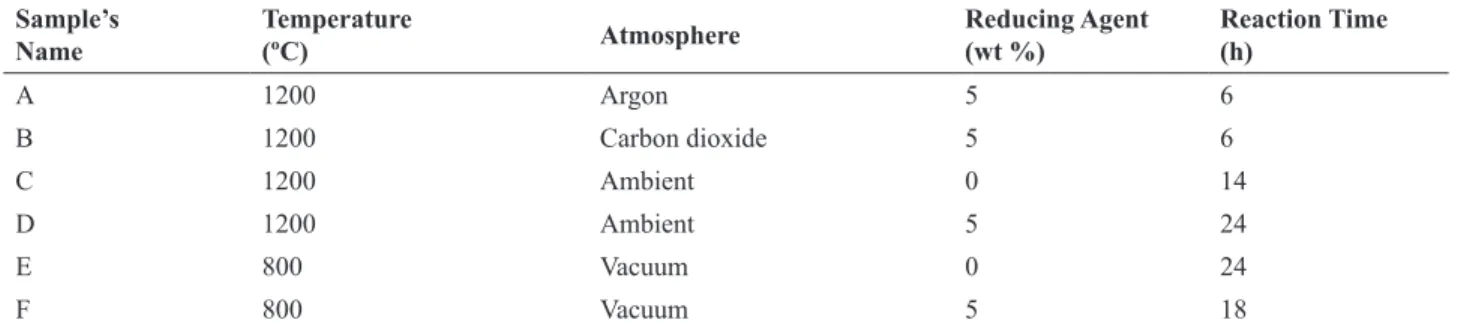
The funnel glasses from different CRT were all mixed together. A sample name (A, B, C, D, E and F) was assigned for each set of parameters used in the furnace procedure (Table 2). Samples A, B, D and F were put into the furnace with carbon graphite (99.9% grade) as a reducing agent. Samples C and E were placed in the furnace with no reducing agent. The gas flow for samples A and B was set at 10 L/ min. The pressure inside the tube for samples E and F was set at 1.3 kPa. All samples weighed 20g (glass + reducing agent). The samples were placed inside alumina crucibles, which were then placed inside the furnace. The choice of the parameters used in the procedure was based on the work of Veit et al. (2015), that optimized the conditions for removing lead from CRT monitors (Table 2). The possible redox reactions are as follows (Veit, et al., 2015):
Figure 2. Dismantled parts from a CRT monitor. a) External Frame b) PCBs and other components c) CRT.
Figure 3. The division of the cathode ray tube. CRT illustration (above) and a photograph of an actual CRT used in our experiments (below).
PbO
(s)+ C
(s)
CO
(g)+ Pb
(g)2PbO
(s)+ C
(s)
CO
2(g)+ 2Pb
(s)The next step was intended to evaluate whether the lead removal had been able to convert the CRT from a hazardous waste to a non-hazardous waste according to the Brazilian regulation. Thus, the standard Brazilian NBR 10005 procedure was repeated with the samples that had been submitted to the thermal process (A, B, C, D, E and F). The solutions obtained from the procedures were analyzed by atomic absorption spectroscopy and the results were compared to the limits shown in NBR 10004.
RESULTS
Characterization
The weights obtained from the dismantling demonstrate that the glass represents the majority of the monitor’s mass (Table 3). Fig. 6 shows the funnel glass after the milling procedure.
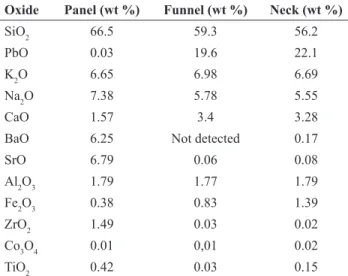
The XRF results from CRT parts confi rmed that lead is present in the funnel and in the neck while the panel is lead free, as shown in Table 4. These XRF results show
that the lead concentration reaches about 20% in the funnel glass and in the neck glass. It also shows that, apart from the concentration of lead, barium, zirconium and strontium (in panel), the three glass parts have similar composition. It should be noted that XRF determines the atoms present in the sample and not the compounds. However, given that the sample was glass, the XRF equipment assumes the atoms are in their most oxidized state – resulting in the chemical compounds shown in Table 4.
Figure 5. Schematic illustration of the furnace setup for diff erent atmosphere conditions.
Table 2. Parameters used to remove lead from the CRT funnel glass (Veit et al., 2015). Sample’s
Name
Temperature
(ºC) Atmosphere
Reducing Agent (wt %)
Reaction Time (h)
A 1200 Argon 5 6
B 1200 Carbon dioxide 5 6
C 1200 Ambient 0 14
D 1200 Ambient 5 24
E 800 Vacuum 0 24
F 800 Vacuum 5 18
Figure 6. Milled funnel glass sample Table 3. Mass distribution of the dismantled components of the
CRT monitor.
Component Mass (kg) Weight %
External frame 2.40 20.00
PCBs 0.95 8.00
CRT (glass) 7.10 59.00
Other components 1.55 13.00
Lead Hazard Evaluation
The results regarding the hazardousness of the 7 CRTs leached according to the NBR 10005 procedures and analyzed by AAS are displayed in Table 5. The results show that all 7 samples are above the permitted standard (NBR 10004), 1 mg/L. This indicates that CRT monitors are a dangerous waste and that they should not be discarded in non-controlled landfills; particular attention is drawn to the values 347 mg/L and 174 mg/L (funnels from samples 1 and 7, respectively).
that had undergone the thermal process are displayed in Table 6. Samples A, B and C are still above the permitted standard according to NBR 10004. Thus, the lead removal conditions were not effective to downgrade the hazardousness of the waste. On the other hand, samples D, E and F are below the standard. The next step was intended to evaluate whether the lead removal had been able to convert the CRT from a hazardous waste to a non-hazardous waste according to the Brazilian regulation. Thus, the standard Brazilian NBR 10005 procedure was repeated with the samples that had been submitted to the thermal process (A, B, C, D, E and F). The solutions obtained from the procedures were analyzed by atomic absorption spectroscopy and the results were compared to the limits shown in NBR 10004.
Thus, these three procedures detailed in Table 2 are effective in removing lead from the glass of the CRT to the point where it becomes a non-hazardous waste.Vacuum atmosphere is ideal for the removal of lead from CRT glass as samples E and F performed better than sample D. Vacuum, however, is not necessary when adding 5% reducing agent and allowing a 24 h reaction time in an ambient atmosphere (sample D). Sample F displayed the best results as it was able to reduce the lead in the glass to a minimum in comparison to the other 5 samples.
CONCLUSIONS
The key conclusions from this study are as follows:
• The standard Brazilian procedure (NBR 10005) showed that lead can be leached from the CRT monitors. The lead concentration in the leached solution demonstrates that CRT monitors are a hazardous waste to the environment and are classified as Class I – Dangerous Waste according to NBR 10004.
• The lead removal evaluation showed that parameters from samples D, E and F can remove the lead from CRT monitors to an environmentally safe level. Best results were observed in sample F that was processed with the following parameters: temperature of 800ºC, vacuum atmosphere, addition of 5% carbon graphite as reducing agent and reaction time of 18h.
BaO 6.25 Not detected 0.17
SrO 6.79 0.06 0.08
Al2O3 1.79 1.77 1.79
Fe2O3 0.38 0.83 1.39
ZrO2 1.49 0.03 0.02
Co3O4 0.01 0,01 0.02
TiO2 0.42 0.03 0.15
Table 5. AAS results from the leached samples obtained from the NBR 10005 standard procedure.
Sample Lead concentration (mg/L)
Neck Funnel Panel
1 9.5 347.3 Not detected
2 4.2 58.0 Not detected
3 25.2 81.2 Not detected
4 6.5 6.6 Not detected
5 14.9 9.2 Not detected
6 12.8 174.5 Not detected
Table 6. AAS results from the leached samples obtained from the NBR 10005 standard procedure after the lead removal procedure.
Sample Lead concentration (mg/L)
Hazardous? (NBR 10004)
A 5.84 Yes
B 2.51 Yes
C 1.13 Yes
D 0.68 No
E 0.32 No
Future studies should evaluate the hazardousness potential of other elements such as barium and strontium.
ACKNOWLEDGMENTS
The authors are grateful to Capes, CNPq and FAPERGS (Brazil) for their financial support.
REFERENCES
ABNT, NBR 10004, Solid Waste - Classification (2004), On line at: http://aslaa.com.br/legislacoes/NBR%20n%2010004-2004.pdf.
ABNT, NBR 10005, Solid Waste - Procedure for obtaining leaching solition (2004), On line at: http://aslaa.com.br/ legislacoes/NBR%20n%2010004-2004.pdf.
Araújo, M. G., Magrini, A., Mahler, C. F., and Bilitewski, B., A model for estimation of potential generation of waste electrical and electronic equipment in Brazil, Waste Management, 32, 335–342 (2012),.
Bigum, M., Brogaard, L., and Christensen, T. H., Metal recovery from high-grade WEEE: a life cycle assessment, Journal of Hazardous Materials, 207, 8-14 (2012),.
Chen, M., Zhang, F. S., and Zhu, J., Lead recovery and the feasibility of foam glass production from funnel glass of dismantled cathode ray tube through pyrovacuum process, Journal of Hazardous Materials, 161 1109–1113 (2009),. Dias, P. R., Javimczik, S., Benevit, M., Veit, H., and Bernardes, A.
M., Recycling WEEE: Extraction and concentration of silver from waste crystalline silicon photovoltaic modules, Waste Management, 57, 220-225 (2016), On line at:10.1016/j. wasman.2016.03.016.
Duygan, M., and Meylan, G., Strategic management of WEEE in Switzerland-combining material flow analysis with structural analysis, Resources, Conservation and Recycling, 103, 98-109 (2015).
European Union Directive, Directive 2002/96/EC. European Parliament and of the Council of 27 January 2003, on waste electrical and electronic equipment (WEEE), UNU, Bonn (2002). On line at: http://eur-lex.europa.eu/legal-content/GA/ TXT/?uri=CELEX:32002L0096
Gerbase, A., and Oliveira, C., Recycling of e-waste: an opportunity for chemistry, Química Nova, 35(7), 1486-1492 (2012).
Kasper, A. C., Berselli, G. B., Freitas, B. D., Tenório, J. A., Bernardes, A. M., Veit, H. M., Printed wiring boards for mobile phones: characterization and recycling of copper, Waste Management, 31(12), 2536-2545 (2011).
Lairaksa, N., Moon, A. R., and Makul, N., Utilization of cathode ray tube waste: encapsulation of PbO-containing funnel glass in Portland cement clinker, Journal of Environmental Management, 117, 180-186 (2013).
Lecler, M. T., Zimmermann, F., Silvente, E., Clerc, F., Chollot, A., and Grosjean, J., Exposure to hazardous substances in cathode ray tube (CRT) recycling sites in France, Waste Management, 39, 226-235 (2015).
Materials for the Future Foundation, CRT Glass to CRT Glass Recycling, The monitor of electronic recycling issues, 1 (2001).
Méar, F., P. Yot, Cambon, M., and Ribes, M., The characterization of waste cathode-ray tube glass, Waste Management, 26(12), 1468-1476 (2006).
Menad, N., Cathode ray tube recycling, Resources, Conservation and Recycling, 26(3), 143-154 (1999).
Mingfei, X., Yaping, W., Jun, L., and Hua, X., Lead recovery and glass microspheres synthesis from waste CRT funnel glasses through carbon thermal reduction enhanced acid leaching process, Journal of Hazardous Materials, 305, 51-58 (2016). Musson, S. E., Jang, Y., Townsend, T. G., and Chung, H.,
Characterization of lead leachability from cathode ray tubes using the toxicity characteristic leaching procedure, Environmental Science & Technology, 34(20), 4376-4381 (2000).
Okada, T., Lead extraction from cathode ray tube funnel glass melted under different oxidizing conditions, Journal of Hazardous Materials, 292, 188-196 (2015).
Oliveira, E., The Removal of Lead from Cathode Ray Tube Monitors, M.Sc. Thesis, UFRGS, Porto Alegre, Brazil (2013). On line at: http://hdl.handle.net/10183/79841.
Veit, H. M., Oliveira, E., and Richter, G., Thermal processes for lead removal from the funnel glass of CRT monitors, Rem: Revista Escola de Minas, 68(3), 287-294 (2015).
Webster, J., The measurement, instrumentation, and sensors Handbook, CRC Press,1st Edition, Boca Radon, 2422-2423 (1999).