Review Article
High-Intensity Interval Training in Heart Transplant Recipients:
A Systematic Review with Meta-Analysis
Raphael José Perrier-Melo,
1Fernando Augusto Marinho dos Santos Figueira,
2Guilherme Veiga Guimarães,
3Manoel da Cunha Costa
4Universidade de Pernambuco (UPE);1 Instituto de Medicina Integral Professor Fernando Figueira,2 Recife, PE; Universidade de São Paulo,3 São Paulo, SP; Universidade de Pernambuco (UPE),4 Recife, PE – Brazil
Keywords
Exercise; Heart Failure/physiopathology; Life Style; Cardiac Rehabilitation; Meta-Analysis as Topic.
Mailing Address: Raphael José Perrier-Melo • Escola Superior de Educação Física
Rua Arnóbio Marques, 310, Recife, PE – Brazil E-mail: [email protected], [email protected]
Manuscript received May 29, 2017, revised manuscript August 11, 2017, accepted September 14, 2017
DOI: 10.5935/abc.20180017
Abstract
Heart transplantation (HTx) is considered an efficient and gold-standard procedure for patients with end-stage heart failure. After surgery, patients have lower aerobic power
(VO2max) and compensatory hemodynamic responses.
The aim of the present study was to assess through a systematic review with meta-analysis whether high-intensity interval training (HIIT) can provide benefits for those parameters. This is a systematic review with meta-analysis, which searched the databases and data portals PubMed, Web of Science, Scopus, Science Direct and Wiley until December 2016 (pairs). The following terms and descriptors were
used: “heart recipient” OR “heart transplant recipient” OR
”hearttransplant” OR “cardiac transplant” OR “heart graft”.
Descriptors via DeCS and Mesh were: “heart transplantation’’
OR “cardiac transplantation”. The words used in combination
(AND) were: “exercise training” OR “interval training” OR
“high intensity interval training” OR “high intensity training” OR “anaerobic training” OR “intermittent training” OR “sprint training”. The initial search identified 1064 studies. Then, only those studies assessing the influence of HIIT on the post-HTx period were added, resulting in three studies analyzed. The significance level adopted was 0.05. Heart transplant
recipients showed significant improvement in VO2peak, heart
rate and peak blood pressure in 8 to 12 weeks of intervention.
Introduction
Heart transplant (HTx) is considered the gold-standard treatment for patients with heart failure refractory to clinical
therapy and/or intervention procedure.1,2 The bicaval
technique is currently used in surgical centers, consisting in cardiac denervation via complete dissection of the right atrial appendage and interauricular septum, saving a small portion
of the left atrial appendage containing the pulmonary veins.3
The major advantage of that technique over the others is atrial geometry preservation, lower transpulmonary gradient and
lower incidence of post-surgical tricuspid regurgitation.4
Cardiac denervation causes cardiorespiratory (maximum
oxygen uptake - VO2max) and hemodynamic (heart rate -
HR, cardiac output - CO and blood pressure – BP) controls
to depend initially on the Frank-Starlingmechanism (the law
states that preload depends on venous return) and, later, on the concentrations of circulating catecholamines and ejection fraction, because of the lack of sympathetic and parasympathetic
stimulation and baroreflex.5–7 Therefore, transplant recipients
have a lower VO2max(70-80% of the value predicted for age
as compared to healthy individuals),8 high levels of HR, BP
and vascular resistance at rest. However, physical exercise causes depressed increase in HR and BP, accompanied by
an increase in vascular resistance.9 This behavior is similar in
conditions of submaximal and close-to-peak efforts, causing lower peak HR (HRpeak) and peak BP (BPpeak), with good
reproducibility for VO2peak. In addition, the post-exercise
recovery is slow compared to that of healthy individuals of the
same age group.10,11
The physiological changes previously mentioned and the immunosuppressive therapy cause cardiorespiratory and hemodynamic damage over time, and transplant recipients often develop diseases, such as systemic arterial hypertension (95%), hyperlipidemia (81%), vasculopathy (50%), kidney failure (33%) and type 2 diabetes mellitus
(32%).12,13 Thus, cardiac rehabilitation programs have been
recommended since the first guidelines of the American Heart Association and American College of Sports Medicine. The major objective of such programs is to re-establish the patients’ daily activities and to change their lifestyle, by adding activities that improve their physical, psychological and social conditions. Those activities should be structurally and continuously performed, focussing on developing the
patient’s major deficient variables.14 The current guideline
recommends that cardiac rehabilitation be composed partially of physical training, consisting of three to five sessions of continuous exercise (walking, jogging, cycling) per week, at mild to moderate intensity, for at least
30 minutes daily.15,16 The sessions should begin and end
with short warm-up and cool-down periods (5-10 minutes) at low intensity, respectively. Post-HTx physical exercise is safe and effective to promote significant improvement in cardiorespiratory, metabolic, hemodynamic, endothelial
and morphological variables.14,15
However, studies of systematic review with meta-analysis
conducted in patients with coronary artery disease,16,17 type
2 diabetes mellitus18 and metabolic syndrome19 have shown
that, in contrast to moderate-intensity continuous training (MICT), high-intensity interval training (HIIT) enables patients to reach similar and/or superior benefits regarding the
variables decompensated by those diseases.20 The HIIT is
Table 1 – Strategy of the bibliographic search in data bases and portals.
#1 “heart recipient”[tiab], OR “heart transplant recipient”[tiab], OR ”heart transplant” [tiab], OR “cardiac transplant” [tiab], OR “heart graft” [tiab], OR”heart
transplantation’’[Mesh], OR “cardiac transplantation” [Mesh]
#2 “exercise training” [tiab], OR “interval training” [tiab], OR “high intensity interval training” [tiab], OR “high intensity training” [tiab], OR “anaerobic training” [tiab], OR
“intermittent training” [tiab], OR “sprint training” [tiab] #1 AND #2
Mesh: Medical Subject Headings
characterized by sets of short- or long-lasting exertion periods
(30s – 4min) at high intensity (> 85% VO2max), followed
by short- or long-lasting recovery periods (30s – 4 min).21
Although some studies have shown greater progress with
HIITpractice as compared to MICT, HIIT is still cautiously
prescribed for individuals diagnosed with cardiovascular and metabolic diseases or those who underwent an organ transplantation. In addition, little is known about the dose-response ratio of the improvement in cardiorespiratory, endothelial and hemodynamic parameters caused by HIIT in HTx recipients. Thus, this study was aimed at assessing by use of a systematic review with meta-analysis whether HIIT can benefit those parameters.
Methods
A systematic review was conducted following the recommendations and meeting the criteria determined by the Preferred Reporting Items for Systematic Reviews and
Meta-Analysis guideline (PRISMA).
Search strategy
The search for articles in English was conduct in the PubMed, Web of Science, Scopus, Science Direct e Wiley databases up to December 2016. The terms and descriptors used in the searching process were selected based on the
keywords available in previous studies and via DeCS and Mesh,
respectively (Table 1). The terms identified in the literature
were: “heart recipient” OR “heart transplant recipient” OR
“hearttransplant” OR “cardiac transplant” OR “heart graft”.
The descriptors of DeCS and Mesh were: “heart transplantation’’
OR “cardiac transplantation”. The words used in combination
(AND) were “exercise training” OR “interval training” OR
“high intensity interval training” OR “high intensity training” OR “anaerobic training” OR “intermittent training” OR “sprint training”. Data extraction and all processes of search, selection and assessment of articles were performed in pairs.
Selection criteria
The inclusion criteria were as follows: a) randomized
studies assessing VO2peak (based on a maximum incremental
test) and/or HRpeak as primary outcome; b) sample comprised exclusively of HTx recipients; c) studies assessing the HIIT effect; and d) studies with an intervention period longer than 4 weeks.
The exclusion criteria were as follows: a) studies without a control group; b) studies with acute analysis; and c) case studies.
Identification and selection of studies
Initially the references were reviewed based on the titles and abstracts. Then, the relevant articles according to the selection criteria were fully read and assessed regarding their
methodological quality by use of the Testex scale.22
Data analysis
The variables analyzed (VO2peak and HRpeak) were
classified as continuous, and data were presented as mean and standard deviation. Data were combined to obtain the size of the general effect, 95% confidence interval (CI) and significance level, using the Review Manager (RevMan) software, version 5.3, Copenhagen: The Nordic Cochrane Centre. The HIIT group was compared with the control group (post-entrance) by use of weighted mean difference (WMD). For each result,
heterogeneity (I2) was calculated, adopting the fixed effects
model. The significance level adopted was p < 0.05.
Results
Figure 1 shows the flowchart of the search and selection process of the articles included in this review.
In the initial electronic search, 1064 potentially relevant studies were identified. After reading their titles, 994 articles were ruled out because they did not have a primary outcome related to the objective of the present review. Then, after reading the abstracts of the remaining studies, 14 were excluded because they did not meet the selection criteria of this study. Three articles with a mean score regarding methodological quality of 10 points, according to the Testex scale, were included in the final analysis.
Major information regarding sample characteristics, methodology, qualitative analysis and results from the studies on HTx recipients are shown in chronological order in Tables 2 and 3. A total of 118 patients (90 men and 28 women) who had undergone HTx 5.3 ± 3.7 years before were included in the analysis of this systematic review, 60 in the HIIT group (49.3 ± 12.7 years) and 58 in the control group (53 ± 14.3 years), maintaining their usual activities.
The HIIT sessions were conducted on cycle ergometers23,24
and treadmills,25 reaching an intensity of 80-100% of VO
2peak or 85-95% of HRmax. Such training sessions were performed three to five times per week for 8 and 12 weeks.
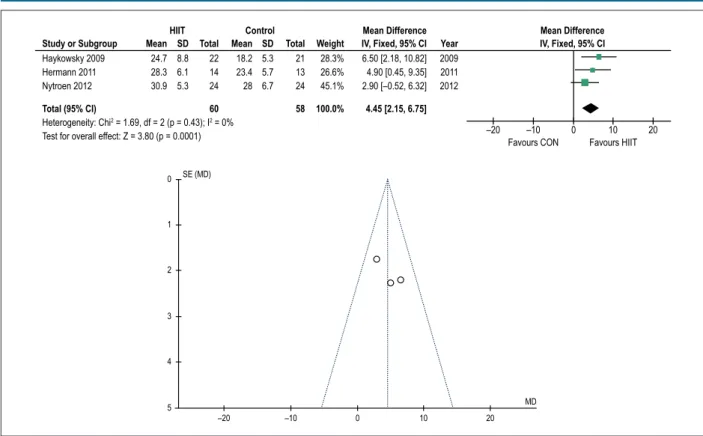
All studies included had VO2peak as the major outcome of
the analysis. Figure 2 shows the increased effect on VO2peak
Review Article
Perrier-Melo et al Interval exercise in heart transplant recipientsArq Bras Cardiol. 2018; 110(2):188-194
Figure 1 – Flowchart of the search and selection process of the articles included in this review.
Number of articles found
(1064)
994 articles excluded for not meeting the
selection criteria
70 eligible
articles 53 duplicates
17 studies selected for qualitative analysis
14 articles excluded: 3 review articles, 3 case
studies and 8 studies for not reporting on HIIT
3 studies included
Regarding HRpeak, based on the comparative analysis of the groups, two studies reported a favorable effect [95%CI: 0.74 (0.31 - 1.16) p = 0.0007, N = 46] in the HIIT group (Figure 3).
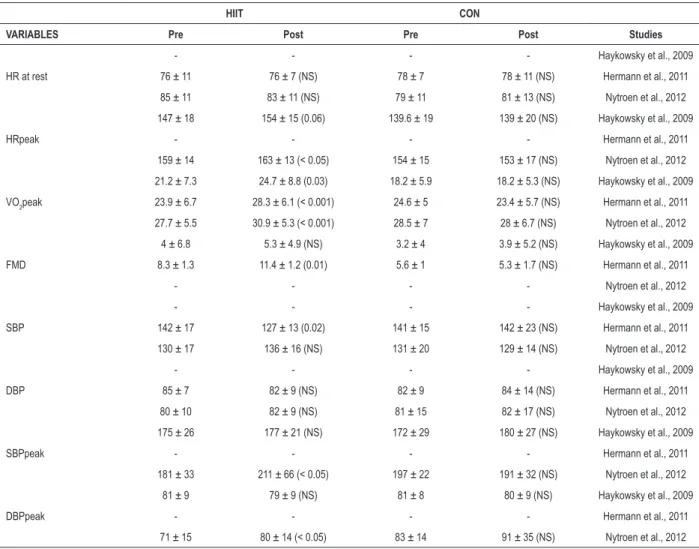
The studies that were not statistically analyzed (forest plot) showed, in the HIIT group, a positive effect on BP at rest and BPpeak (systolic and diastolic), brachial flow velocity, maximal muscle strength (1 RM), lean mass maintenance, and inflammatory markers. Some of those results are shown in Table 3. In addition, none of the studies reported a cardiovascular event and/or mortality associated with training, showing it to be a safe practice to be included in cardiac rehabilitation programs.
Discussion
The present systematic review with meta-analysis is the first to analyze the effect of HIIT on some health-related parameters of HTx recipients. The three studies included showed that HIIT
improved VO2peak by 15%. Such increase is greater than that
found in two systematic reviews with meta-analysis that assessed
the effect of different types of exercise26 and of MICT27 on the
VO2peak of those patients.
Although HIIT improves VO2peak, sometimes it is not
indicated for HTx recipients because they have chronotropic
insufficiency developed from cardiac denervation.28
That incompetence hinders HR at rest (increase) and during close-to-peak exercise (decrease - HRpeak), decreasing the chronotropic reserve values. Thus, according to the studies assessed in this review, 8 to 12 weeks of HIIT intervention can decrease HR at rest and increase HRpeak.
High-intensity exercise (> 80%VO2peakor > 85%HRmax)
might have improved the cardiocirculatory function, stimulating the sinus node faster, facilitating faster and better
responses on HR at rest and HRpeak.29
Although the literature shows an insufficient number of studies on HIIT and HTx recipients, that type of training can provide significant central and peripheral benefits to improve the clinical
findings after surgery.30 In addition, recent studies comparing
the contribution of HIIT and MICT to the deficient variables
of HTx recipients have shown the superior effect of HIIT.31,32
Such results can indicate a possible change in paradigm regarding the recommendation of exercise prescription for HTx recipients. Thus, further studies are required to identify which training protocol better improves the deficient variables of those patients.
Conclusion
Our results showed that 8 to 12 weeks of cardiac rehabilitation with HIIT were sufficient to significantly increase HRpeak and aerobic power of HTx recipients (men and women).
Author contributions
Conception and design of the research and Analysis and interpretation of the data: Perrier-Melo RJ, Costa MC; Acquisition of data, Statistical analysis and Obtaining financing: Perrier-Melo RJ; Writing of the manuscript and Critical revision of the manuscript for intellectual content: Perrier-Melo RJ, Figueira FAMS, Guimarães GV, Costa MC.
Potential Conflict of Interest
No potential conflict of interest relevant to this article was reported.
Sources of Funding
There were no external funding sources for this study.
Study Association
This article is part of the thesis of Doctoral submitted by Raphael José Perrier-Melo, from Universidade de Pernambuco.
Ethics approval and consent to participate
This article does not contain any studies with human participants or animals performed by any of the authors.
Review Article
P
errier
-Melo et al
Interval exercise in heart transplant recipients
Arq Bras Cardiol. 2018; 110(2):188-194
Haykowsky et al., 2009
N = 22 17M/5F 57 ± 10 Post-HTx time = 5.4 ± 4.9 years
N = 21 18M/3F 59 ± 11 Post-HTx time = 4.4 ± 3.3 years
1-8 weeks
5x/week 30-45 min: 60-80%VO2peak
5x/week 12 weeks
12 weeks of training significantly increased VO2peak (21.2 ± 7.3 - 24.7 ± 8.8 mL/kg/min, p = 0.003) of HTx recipients
+ + + + + + + + + +
9-12 weeks
3x/weeks 30-45 min: 60-80%VO2peak 2x/weeks 20-25x (30s: 90-100% VO2peak/1 min)
Hermann et al., 2011
N = 14 12M/2F 53 ± 11 Post-HTx time = 6.8 ± 4.0 years
N = 13 10M/3F 47 ± 18 Post-HTx time = 7.0 ± 5.5 years
Cycle ergometer and staircase running 4 min: 80% VO2peak/ ½ min 2 min: 85% VO2peak/ ½ min 30 s: 90% VO2peak/ ½ min
3x/week 8 weeks
The 8-week HIIT program significantly reduced SBP (p = 0.02) and significantly increased VO2peak (p < 0.001) and endothelial action
+ + + + + + + + + +
Nytroen et al., 2012
N = 24 16M/8F 48 ± 17 Post-HTx time = 4.3 ± 2.4 years
N = 24 17M/7F 53 ± 14 Post-HTx time = 3.8 ± 2.1 years
Treadmill
4 min (85-95% HRmax) / 3 min (11-13 Borg SEP)
3x/week 8 weeks
HIIT significantly improved VO2peak (p < 0.001) after 8 weeks of training
+ + + + + + + + + +
Review Article
Perrier-Melo et al Interval exercise in heart transplant recipientsArq Bras Cardiol. 2018; 110(2):188-194 Table 3 – Major results of the hemodynamic and cardiorespiratory variables found in the studies
HIIT CON
VARIABLES Pre Post Pre Post Studies
HR at rest
- - - - Haykowsky et al., 2009
76 ± 11 76 ± 7 (NS) 78 ± 7 78 ± 11 (NS) Hermann et al., 2011 85 ± 11 83 ± 11 (NS) 79 ± 11 81 ± 13 (NS) Nytroen et al., 2012
HRpeak
147 ± 18 154 ± 15 (0.06) 139.6 ± 19 139 ± 20 (NS) Haykowsky et al., 2009
- - - - Hermann et al., 2011
159 ± 14 163 ± 13 (< 0.05) 154 ± 15 153 ± 17 (NS) Nytroen et al., 2012
VO2peak
21.2 ± 7.3 24.7 ± 8.8 (0.03) 18.2 ± 5.9 18.2 ± 5.3 (NS) Haykowsky et al., 2009 23.9 ± 6.7 28.3 ± 6.1 (< 0.001) 24.6 ± 5 23.4 ± 5.7 (NS) Hermann et al., 2011 27.7 ± 5.5 30.9 ± 5.3 (< 0.001) 28.5 ± 7 28 ± 6.7 (NS) Nytroen et al., 2012
FMD
4 ± 6.8 5.3 ± 4.9 (NS) 3.2 ± 4 3.9 ± 5.2 (NS) Haykowsky et al., 2009 8.3 ± 1.3 11.4 ± 1.2 (0.01) 5.6 ± 1 5.3 ± 1.7 (NS) Hermann et al., 2011
- - - - Nytroen et al., 2012
SBP
- - - - Haykowsky et al., 2009
142 ± 17 127 ± 13 (0.02) 141 ± 15 142 ± 23 (NS) Hermann et al., 2011 130 ± 17 136 ± 16 (NS) 131 ± 20 129 ± 14 (NS) Nytroen et al., 2012
DBP
- - - - Haykowsky et al., 2009
85 ± 7 82 ± 9 (NS) 82 ± 9 84 ± 14 (NS) Hermann et al., 2011 80 ± 10 82 ± 9 (NS) 81 ± 15 82 ± 17 (NS) Nytroen et al., 2012
SBPpeak
175 ± 26 177 ± 21 (NS) 172 ± 29 180 ± 27 (NS) Haykowsky et al., 2009
- - - - Hermann et al., 2011
181 ± 33 211 ± 66 (< 0.05) 197 ± 22 191 ± 32 (NS) Nytroen et al., 2012
DBPpeak
81 ± 9 79 ± 9 (NS) 81 ± 8 80 ± 9 (NS) Haykowsky et al., 2009
- - - - Hermann et al., 2011
71 ± 15 80 ± 14 (< 0.05) 83 ± 14 91 ± 35 (NS) Nytroen et al., 2012
HIIT: high-intensity interval training; HR: heart rate; FMD: flow mediated dilation of the brachial artery; SBP: systolic blood pressure; DBP: diastolic blood pressure; NS: nonsignificant.
Figure 2 – Forest plot (A) AND funnel plot (B) showing information about the effect of high-intensity interval training (HIIT) on VO2peak.
Heterogeneity: Chi2 = 1.69, df = 2 (p = 0.43); I2 = 0% Test for overall effect: Z = 3.80 (p = 0.0001)
Haykowsky 2009 24.7 8.8 22 18.2 5.3 21 28.3% 6.50 [2.18, 10.82] 2009
Hermann 2011 28.3 6.1 14 23.4 5.7 13 26.6% 4.90 [0.45, 9.35] 2011
Nytroen 2012 30.9 5.3 24 28 6.7 24 45.1% 2.90 [–0.52, 6.32] 2012
Total (95% CI) 60 58 100.0% 4.45 [2.15, 6.75]
Study or Subgroup Mean SD Mean SD
HIIT Control Mean Difference Mean Difference
Total Total Weight IV, Fixed, 95% CI Year IV, Fixed, 95% CI
Favours CON Favours HIIT
–20 –10 0 10 20
0
1
2
3
4
5
–20 –10 0 10 20
SE (MD)
MD
Figure 3 – Forest plot (A) AND funnel plot (B) showing information about the effect of high-intensity interval training (HIIT) on peak heart rate.
Heterogeneity: Chi2 = 0.52, df = 1 (p = 0.47); I2 = 0% Test for overall effect: Z = 3.52 (p = 0.0004)
Haykowsky 2009 154 15 22 139 20 21 39.5% 15.00 [4.40, 25.60]
Nytroen 2012 163 13 24 153 17 24 60.5% 10.00 [1.44, 18.56]
Total (95% CI) 46 45 100.0% 11.97 [5.31, 18.63]
HIIT Control Mean Difference Mean Difference
Study or Subgroup Mean SD Total Mean SD Total Weight IV, Fixed, 95% CI IV, Fixed, 95% CI
Favours CON Favours HIIT
–20 –10 0 10 20
0
2
4
6
8
10
–20 –10 0 10 20
SE (MD)
Review Article
Perrier-Melo et al Interval exercise in heart transplant recipientsArq Bras Cardiol. 2018; 110(2):188-194 1. McMurray JJ, Adamopoulos S, Anker SD, Auricchio A, Bohm M, Dickstein
K, et al; ESC Committee for Practice Guidelines. ESC guidelines for the diagnosis and treatment of acute and chronic heart failure 2012: The Task Force for the Diagnosis and Treatment of Acute and Chronic Heart Failure 2012 of the European Society of Cardiology. Developed in collaboration with the Heart. Eur Heart J. 2012;14(8):803-69. doi: 10.1093/eurjhf/hfs105. No abstract available. Erratum in: Eur J Heart Fail. 2013;15(3):361-2.
2. Wilhelm MJ. Long-term outcome following heart transplantation: Current perspective. J Thorac Dis. 2015;7(3):549-51. doi: 10.3978/j.issn.2072-1439.2015.01.46.
3. Grande AM, Rinaldi M, D’Armini AM, Campana C, Traversi E, Pederzolli C, et al. Orthotopic heart transplantation: standard versus bicaval technique. Am J Cardiol. 2000;85(11):1329-33. doi: http://dx.doi.org/10.1016/S0002-9149(00)00765-7.
4. Schnoor M, Schafer T, Luhmann D, Sievers HH. Bicaval versus standard technique in orthotopic heart transplantation: a systematic review and meta-analysis. J Thorac Cardiovasc Surg. 2007;134(5):1322-31. doi: 10.1016/j. jtcvs.2007.05.037.
5. Grupper A, Gewirtz H, Kushwaha S. Reinnervation post-Heart transplantation. Eur Heart J. 2017 Jan 12. pii: ehw604. doi: 10.1093/ eurheartj/ehw604. [Epub ahead of print].
6. Quigg RJ, Rocco MB, Gauthier DF, Creager MA, Howard Hartley L, Colucci WS. Mechanism of the attenuated peak heart rate response to exercise after orthotopic cardiac transplantation. J Am Coll Cardiol. 1989;14(2):338-44. doi: https://doi.org/10.1016/0735-1097(89)90183-6.
7. Kao AC, Van Trigt P 3rd, Shaeffer-McCall GS, Shaw JP, Kuzil BB, Page RD, et
al. Central and peripheral limitations to upright exercise in untrained cardiac transplant recipients. Circulation. 1994;89(6):2605-15. doi: https://doi. org/10.1161/01.CIR.89.6.2605.
8. Oliveira Carvalho V, Guimaraes GV, Vieira ML, Catai AM, Oliveira-Carvalho V, Ayub-Ferreira SM, et al. Determinants of peak VO2 in heart transplant recipients. Rev Bras Cir Cardiovasc. 2015;30(1):9-15. doi: 10.5935/1678-9741.20140055.
9. Heinz G, Radosztics S, Kratochwill C, Kreiner G, Buxbaum P, Grimm M, et al. Exercise chronotropy in patients with normal and impaired sinus node function after cardiac transplantation. Pacing Clin Electrophysiol. 1993;16(9):1793-9. doi: 10.1111/j.1540-8159.1993.tb01813.x.
10. Scott CD, Dark JH, McComb JM. Evolution of the chronotropic response to exercise after cardiac transplantation. Am J Cardiol. 1995;76(17):1292-6. Doi: https://doi.org/10.1016/S0002-9149(99)80358-0
11. Squires RW, Leung T, Cyr NS, Allison TG, Johnson BD, Ballman KV, et al. Partial normalization of the heart rate response to exercise after cardiac transplantation: frequency and relationship to exercise capacity. Mayo Clin Proc. 2002;77(12):1295-300. doi: 10.4065/77.12.1295.
12. Lindenfeld J, Page RL, Zolty R, Shakar SF, Levi M, Lowes B, et al. Drug therapy in the heart transplant recipient - Part III: Common medical problems. Circulation. 2005;111(1):113-7. doi: 10.1161/01. CIR.0000151609.60618.3C.
13. Alba AC, Bain E, Ng N, Stein M, Brien KO, Ross H. Complications after Heart Transplantation : Hope for the Best , but Prepare for the Worst. Int J Transplant Res Med. 2016;2(2):2-22.
14. Nytrøen K, Gullestad L. Exercise after heart transplantation: an overview. World J Transplant. 2013;3(4):78-90. doi: 10.5500/wjt.v3.i4.78.
15. Guimarães GV, D’Avila VM, Chizzola PR, Bacal F, Stolf N. Physical rehabilitation in heart transplantation. Rev Bras Med Esporte. 2 0 0 4 ; 1 0 ( 5 ) : 4 1 2 5 . d o i : h t t p : / / d x . d o i . o r g / 1 0 . 1 5 9 0 / S 1 5 1 7 -86922004000500008.
16. JCS Joint Working Group. Guidelines for rehabilitation in patients with cardiovascular disease (JCS 2012). Circ J. 2014;78(8)2022–93. doi: https:// doi.org/10.1253/circj.CJ-66-0094.
17. Elliott AD, Rajopadhyaya K, Bentley DJ, Beltrame JF, Aromataris EC. Interval training versus continuous exercise in patients with coronary artery disease: a meta-analysis. Heart Lung Circ. 2015;24(2):149-57. doi: 10.1016/j. hlc.2014.09.001.
18. Jelleyman C, Yates T, O’Donovan G, Gray LJ, King JA, Khunti K, et al. The effects of high-intensity interval training on glucose regulation and insulin resistance: a meta-analysis. Obes Rev. 2015;16(11):942-61. doi: 10.1111/obr.12317.
19. Tjønna AE, Lee SJ, Rognmo Ø, Stølen TO, Bye A, Haram PM, et al. Aerobic interval training versus continuous moderate exercise as a treatment for the metabolic syndrome: a pilot study. Circulation. 2008;118(4):346-54. doi: 10.1161/CIRCULATIONAHA.108.772822.
20. Batacan RB, Duncan MJ, Dalbo VJ, Tucker PS, Fenning AS. Effects of high-intensity interval training on cardiometabolic health: a systematic review and meta-analysis of intervention studies. Br J Sports Med. 2017;51(6):494-503. doi: 10.1136/bjsports-2015-095841.
21. Buchheit M, Laursen PB. High-intensity interval training, solutions to the programming puzzle. Sport Med. 2013;43(10):927-54. doi: 10.1007/ s40279-013-0066-5.
22. Smart NA, Waldron M, Ismail H, Giallauria F, Vigorito C, Cornelissen V, et al. Validation of a new tool for the assessment of study quality and reporting in exercise training studies : TESTEX. Int J Evid Based Healthc. 2015;13(1):9-18. doi: 10.1097/XEB.0000000000000020.
23. Haykowsky M, Taylor D, Kim D, Tymchak W. Exercise training improves aerobic capacity and skeletal muscle function in heart transplant recipients. Am J Transplant. 2009;9(4):734-9. doi: 10.1111/j.1600-6143.2008.02531.x.
24. Hermann TS, Dall CH, Christensen SB, Goetze JP, Prescott E, Gustafsson F. Effect of high intensity exercise on peak oxygen uptake and endothelial function in long-term heart transplant recipients. Am J Transplant. 2011;11(3):536-41. doi: 10.1111/j.1600-6143.2010.03403.x.
25. Nytroen K, Rustad LA, Aukrust P, Ueland T, Hallén J, Holm I, et al. High-intensity interval training improves peak oxygen uptake and muscular exercise capacity in heart transplant recipients. Am J Transplant. 2012;12(11):3134-42. doi: 10.1111/j.1600-6143.2012.04221.x.
26. Hsieh PL, Wu YT, Chao WJ. Effects of exercise training in heart transplant recipients: a meta-analysis. Cardiology. 2011;120(1):27-35. doi: 10.1159/000332998
27. Didsbury M, McGee RG, Tong A, Craig JC, Chapman JR, Chadban S, et al. Exercise training in solid organ transplant recipients: a systematic review and meta-analysis. Transplantation. 2013;95(5):679-87. doi: 10.1097/ TP.0b013e31827a3d3e.
28. Nytroen K, Myers J, Chan KN, Geiran OR, Gullestad L. Chronotropic responses to exercise in heart transplant recipients: 1-yr follow-up. Am J Phys Med Rehabil. 2011;90(7):579-88. doi: 10.1097/PHM.0b013e31821f711d.
29. Wilson RF, Johnson TH, Haidet GC, Kubo SH, Mianuelli M. Sympathetic reinnervation of the sinus node and exercise hemodynamics after cardiac transplantation. Circulation. 2000;101(23):2727-33. doi: https://doi. org/10.1161/01.CIR.101.23.2727.
30. Nytrøen K, Rustad LA, Gude E, Hallén J, Fiane AE, Rolid K, et al. Muscular exercise capacity and body fat predict VO2peak in heart transplant recipients.
Eur J Prev Cardiol. 2014;21(1):21-9. doi: 10.1177/2047487312450540.
31. Christensen SB, Dall CH, Prescott E, Pedersen SS, Gustafsson F. A high-intensity exercise program improves exercise capacity, self-perceived health, anxiety and depression in heart transplant recipients: a randomized, controlled trial. J Heart Lung Transplant. 2012;31(1):106-7. doi: 10.1016/j. healun.2011.10.014.
32. Dall CH, Snoer M, Christensen S, Monk-Hansen T, Frederiksen M, Gustafsson F, et al. Effect of high-intensity training versus moderate training on peak oxygen uptake and chronotropic response in heart transplant recipients: a randomized crossover trial. Am J Transplant. 2014;14(10):2391-9. doi: 10.1111/ajt.12873.
References
This is an open-access article distributed under the terms of the Creative Commons Attribution License