Durability to marine environment of innovative products for
consolidation and chromatic reintegration of historical renders
MATOS MARGARIDA
1, BORSOI GIOVANNI
2, VEIGA ROSÁRIO
3, FARIA PAULINA
4,
SANTOS-SILVA ANTÓNIO
5ABSTRACT:
A common degradation phenomenon in historical renders is the cohesion loss of the binder:aggregate system, which is often linked to the presence of soluble salts. Cohesion is recovered through the application of consolidant products, being inorganics preferred due to their compatibility and durability. The aesthetic function can be restored by chromatic reintegration.The aim of this paper is the assessment of the durability of consolidation and chromatic reintegration treatments applied on renders when exposed to marine environment.
Mortar specimens with a simulated loss of cohesion were consolidated with commercial nanolimes, which were considered due to their stability and compatibility. Their combined application with ethyl silicate guarantees some benefits. Chromatic reintegration treatments were obtained by mixing pigments in the consolidant products. After treatments, dissolution-crystallization cycles were performed with a sodium chloride solution.
Consolidation effects were monitored. Physical characterization was performed on specimens before and after contamination and the results were discussed.
Keywords: Historical renders, consolidation, nanostructured products, chromatic reintegration, salt
crystallization cycles
NOTATION
NS1 Nanolime 1 + Ethyl Silicate;
N2 Nanolime 2;
Y Yellow Ochre;
R Red Ochre;
RH Relative Humidity;
NaCl Sodium Chloride;
1 INTRODUCTION
Ancient renders widely demonstrate to be durable building materials [1] but become vulnerable when constantly exposed to weathering. Renders’ main function is usually the protection of structural elements such as brick or stone masonry walls, but they usually also have great relevance in the
1) MSc, NOVA University of Lisbon, Department of Civil Engineering, [email protected] 2) PhD student, Technical University of Delft, Faculty of Architecture, [email protected]
3) Senior Researcher, National Laboratory for Civil Engineering, Buildings Department, [email protected]
image of the building. Therefore renders must be as durable as possible and have to be conserved when necessary [2].
One of the main anomalies of ancient renders is the cohesion loss, characterized as the weakening of the links between mortar’s constituents, leading to decrease of mechanical strength. Cohesion loss is usually connected to chemical and biological phenomena that change the binder structure and properties.
Cohesion is recovered through the application of consolidant products, which ought to be physico-chemically and aesthetically compatible with the pre-existing renders, in order to ensure their stability and durability [3].
Consolidant products, used to prevent cohesion loss, can be organic or inorganic nature [4]. The use of limewater as mineral consolidant product is proved since Roman times. In the 19th century, mineral consolidant products based on silicates, fluorides and barite were introduced; organic consolidant products such as acrylic and epoxy resins, derived from the heavy chemical industry, were then introduced in the 20th century [5, 6, 7].
Organic products have better adhesiveness and are easily applied. However, due to their physical and chemical incompatibility with the substrate, low durability, drastic changes in the material properties, and irreversibility, these products are nowadays no longer considered as a proper solution for consolidation [8, 9].
On the other hand, inorganic consolidant products are recommended because they have usually higher chemical compatibility, stability and durability. The integration of the original binder ensures the re-connection of binder:aggregate network. The most known consolidant product is limewater, nevertheless the reduced solubility of calcium in water (1.7 g/L at 20°C) allows a limited mechanical strength improvement. Due to this low effectiveness, new alternatives have been explored over the last years, as in the case of alcoholic dispersions of calcium hydroxide nanoparticles [8], known as
nanolimes.
Nanolimes are colloidal alcoholic dispersions (usually in ethanol or propanol) with high stability and a considerable higher amount of dispersed lime, compared to aqueous solutions, allowing thereby an improvement of the consolidation action. The dispersions in alcohol ensure a good result with a few applications, avoiding the introduction of a large amount of water in the treated render, which can result in other defects. Recent studies show that the combined use of these products with ethyl silicate promotes the increase of mechanical strength and properties of nanolimes [5, 6, 10].
In order to recover the aesthetic function of coloured old renders, the addition of inorganic mineral pigments to consolidant products is also taken into account in this work, in order to verify simultaneously chromatic reintegration techniques and consolidation of the treated mortars. The mineral pigments are those with better resistance and durability when introduced in a strongly alkaline environment, as the case of lime aqueous solutions [11].
Soluble salts are considered one of the main causes of ancient buildings degradation, leading to materials deterioration and, in particular, also to mortars cohesion loss [12]. In materials contaminated with hygroscopic salts, changes in temperature and relative humidity (RH) can lead to cyclic salt dissolution-crystallization processes; the crystallization and precipitation of soluble salts can cause mechanical tensions that cause materials deterioration, thus leading to further damage.
In the specific case of sodium chloride (NaCl), the variation of temperature is not harmful since the solubility of this salt does not vary significantly with temperature. The damage caused by salts crystallization is rarely induced by a single crystallization event, but often connected to repeated crystallization cycles, creating gradients of stress, which gradually weaken the material [13, 14]. A better understanding of salt degradation phenomena helps to prevent degradation of buildings, to develop more durable materials and to the design high-performance engineered materials [15].
2 MATERIALS
2.1. Specimens
–
Mortar samples preparation
In order to simulate a mortar with loss of cohesion, different mortar specimens were prepared; the binder:aggregate ratio of 1:4 (in volume) was chosen in order to get the desired effect of a low-cohesion mortar, without significant loss of material. The aggregate was a siliceous sand obtained from a mixture of three different calibrated sands with mean particle sizes <2 mm. After the optimization of the mortar composition, ceramic brick samples, with 28 cm × 19 cm of area, were prepared with a single mortar layer of 1.5 cm thickness.
Samples were then stored in a controlled environment at T=20±2°C and 50±5% RH for 90 days to reach a complete carbonation.
2.2. Properties and application of the consolidant products on lime mortar
specimens
The effectiveness of the limewater, considered the most traditional consolidant product, is known and previous studies provided good results [16, 17], beyond the economic advantage and full compatibility. However, limewater usually contains not more than 2 g/L of calcium hydroxide, which only guarantees a low consolidation effect [7], unless it is applied in a large number of cycles.
In this study the efficiency of a commercial nanolime, mixed also with a commercial ethyl silicate (Estel 1000® CTS) was explored. Nanolime dispersions of calcium hydroxide are white-to-opal solutions containing stable calcium hydroxide nanoparticles dispersed in an alcoholic medium. The nanoparticles have a hexagonal-shaped form and a size range between 50 nm and 600 nm [9]; the reduced dimension of Ca(OH)2 particles guarantees a deeper penetration inside the smaller pores. The application of ethyl silicate causes the formation of amorphous silica gels, which act as a consolidant, ensuring an increase of the mechanical resistance [17].
Two different commercial available nanolimes were used. The first nanolime (NS1) has a concentration of 5 g/L of calcium hydroxide and was mixed with a low concentration of ethyl silicate (5%), in order to moderately increase the mechanical strength [5, 6].The second nanolime (N2) has a concentration of 25 g/L of calcium hydroxide and was used alone.
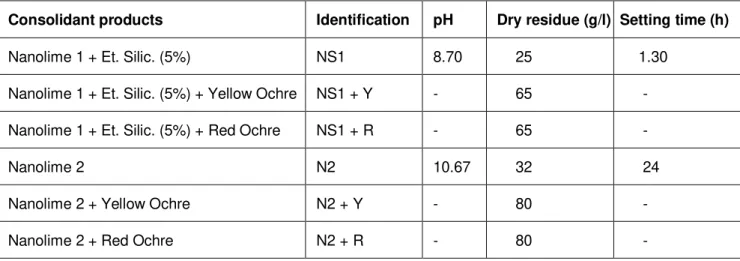
Recent studies had evidenced the improved properties of nanolime dispersions such as high penetration depth, full compatibility, high stability and reactivity [6, 7, 18, 19]. These products can moreover avoid problems related to low binder content (due to the lime´s low solubility) and incomplete carbonation process (free portlandite particles on the surface). An analysis of the selected consolidant products was done considering important characteristics linked to an optimal application, including pH, setting time and dry residue (Table 1).
Table 1. Main characteristics of the consolidant products.
Consolidant products Identification pH Dry residue (g/l) Setting time (h)
Nanolime 1 + Et. Silic. (5%) NS1 8.70 25 1.30
Nanolime 1 + Et. Silic. (5%) + Yellow Ochre NS1 + Y - 65 -
Nanolime 1 + Et. Silic. (5%) + Red Ochre NS1 + R - 65 -
Nanolime 2 N2 10.67 32 24
Nanolime 2 + Yellow Ochre N2 + Y - 80 -
Reintegration treatments were obtained by mixing the consolidant products with two iron-oxide pigments. Pigments are chosen from the group of ochre iron minerals with yellow and red colours, respectively goethite and hematite. The identification of these consolidant products is also included in Table 1.
Consolidant products´ application was carried out in a conditioned room, at T=20±2°C and 50±5% RH, using a manual spraying technique at a distance of 20-30 cm [17]. Each consolidant product was nebulised with ten consecutive applications on the specimen’s surface (Figure 1).
Figure 1. Application of consolidant product by nebulization on a mortar specimen.
3 METHODS
3.1. Characterization of the consolidant treatments
The evaluation of the efficacy of the consolidant treatments was carried out through the use of different tests, made before and after treatments (28 and 90 days after the consolidant product´ application) and after salt contamination.
The mechanical strength was checked by the durometer hardness Shore A, PCE Group (ISO 7619:1997 and ASTM D 2240) [20, 21] and the water behaviour was checked by a water absorption test with Karsten pipes [22] (Figure 2).
After dissolution-crystallization cycles the mechanical strength and the water behaviour was checked too, in order to evaluate the mortars and the consolidant products´ resistance to salts. Visual observations were also performed.
3.2. Performance of dissolution-crystallization cycles
The methodology of the dissolution-crystallization cycles was carried out according to methods used at LNEC [14, 23, 24].
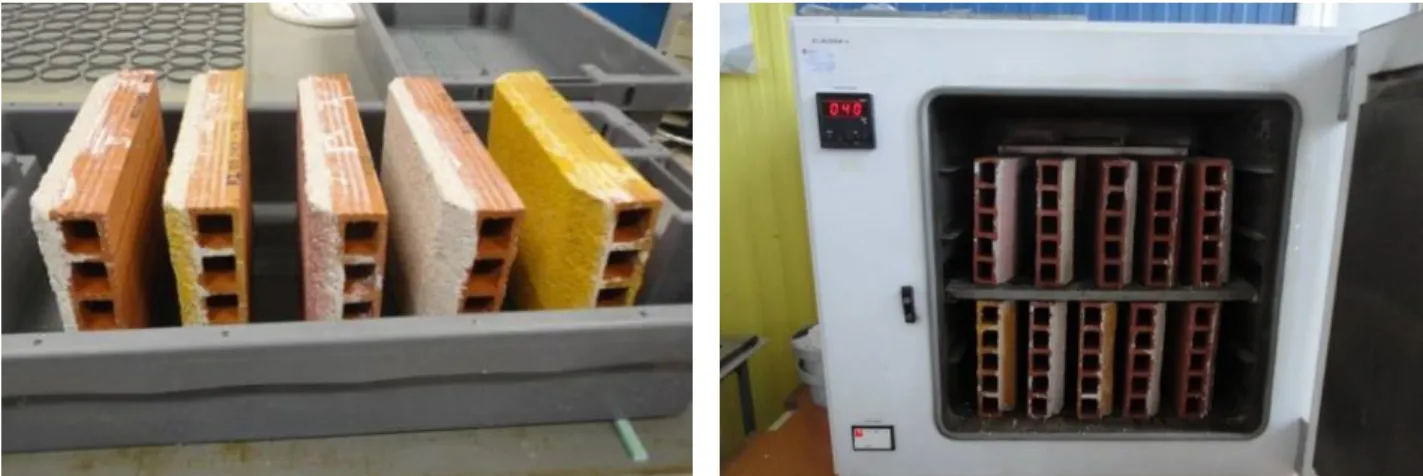
After consolidation treatment, five dissolution-crystallization cycles were carried out over a total period of 5 weeks (Figure 3). The samples were partially immersed in NaCl solution (27g/L – similar to sea content) to allow capillary rise through them, reproducing in the laboratory severe conditions of rising damp. After each wetting cycle the samples were dried at 40ºC in a ventilated oven. The samples were not brushed between cycles. Salt crystallization was evaluated by visual monitoring and by weighing the specimens daily. The wetting and drying phases in each cycle were prolonged until reaching constant mass.
Figure 3. Dissolution-crystallization cycles: a) partial immersion of mortar samples in sodium chloride solution; b) drying of mortar samples.
4 RESULTS AND DISCUSSION
4.1. Durometer hardness (Shore A)
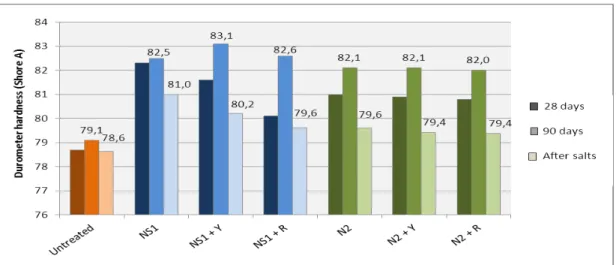
The surface hardness of mortars can be evaluated with a durometer, which measures the resistance to penetration of a pin pressed against the material under study. In this case a durometer Shore A was used, suitable for soft materials, and usually used for testing mortars.
This test aims to assess the increase of mortars´ surface hardness achieved with the application of the various consolidation solutions under study, compared with the untreated specimen. It also intends to evaluate the changes in surface hardness after cycles of dissolution-crystallization. Measurements were repeated up to 12 times in different spots of each treated mortar, and 3 samples per treatment were analysed.
Figure 4. Evaluation of durometer hardness with ageing and after NaCl crystallization cycles.
4.2. Water absorption test
–
Karsten pipes
Water absorption test at low pressure is used to verify possible water permeability variations in treated mortar, by comparison with the values of untreated mortar. Karsten pipes, that simulate wind dynamic pressure equivalent to about 140 km/h [24], are used. In each specimen two pipes were placed and fixed with mastic. The time required for total absorption of water (4 ml) into each Karsten pipe was measured.
Figure 5. Evaluation of water absorption time with ageing and after NaCl crystallization cycles. Consolidant treatments must induce just a moderate variation of water permeability, avoiding hydrophobic treatment that modifies the hygrothermal equilibrium of the treated mortar.
Figure 5 presents the results obtained after consolidation treatments and after salt dissolution-crystallization cycles. Compared to the untreated mortar, not all treatments provide a reduction of water permeability. At 90 days after treatments, the application of NS1 does not provide an increase of water absorption values, meanwhile NS1 + Y illustrates an increased in water absorption of above 5 times. Regarding N2, all results are higher than the untreated mortar, with average water absorption of 6 times. After contamination with NaCl and due to the presence of salts, permeability is reduced for almost all treatments, with greater variation with NS1 + Y treatment. However mortars treated with N2 are those with greater water permeability reduction in the presence of NaCl, with absorption times higher than the NS1. It is also remarked that N2 is the consolidant product that presents the greatest
28 days 90 days
4.3. Salt crystallization
–
visual observations
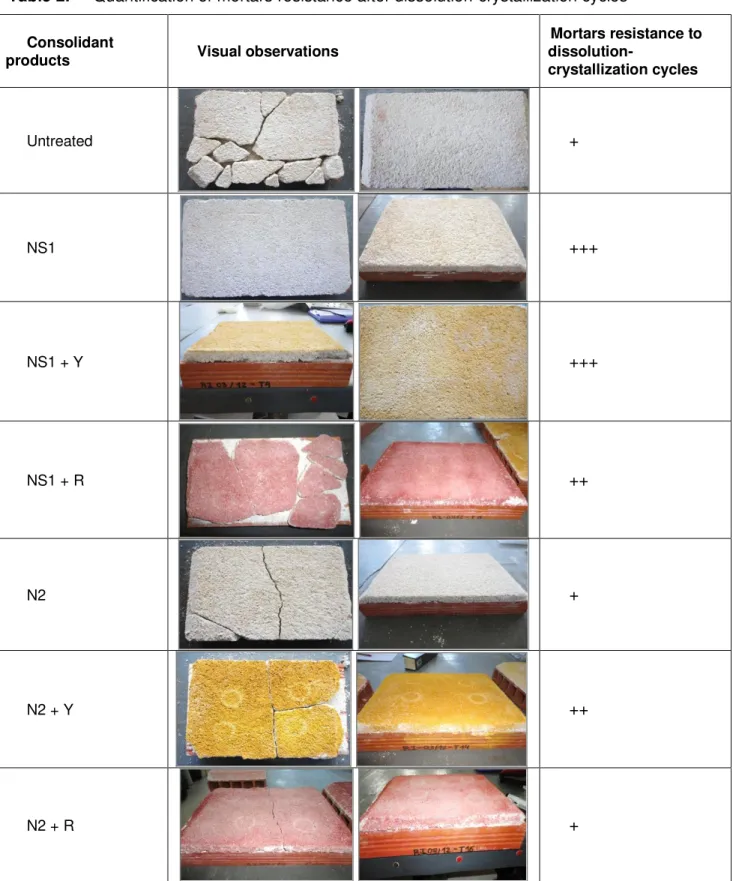
Visual observations of NaCl crystallization were registered at the end of the 5th dissolution-crystallization cycle (Table 2).
Table 2. Quantification of mortars resistance after dissolution-crystallization cycles
Consolidant
products Visual observations
Mortars resistance to
dissolution-crystallization cycles
Untreated +
NS1 +++
NS1 + Y +++
NS1 + R ++
N2 +
N2 + Y ++
N2 + R +
These observations allow to understand which consolidant product presents more resistance to salts and how consolidated mortars behave in the presence of sodium chloride.
Generally mortars present damage due to the mechanical stresses induced by salt crystallization; some of the specimens present a good conservation state, other ones evidence fractures and cracks. Mortars consolidated with NS1 present the greatest durability and have not suffered any type of damage. On the other hand mortars treated with N2 have lower resistance with wide cracks and detachment from the support. Untreated mortars show the weakest resistance and highest salt concentration on the surface. Another interesting observation was the presence of white spots on the
mortars‘ surface, more pronounced in pigmented treatments. This could be justified with the partial phase separation of iron-based pigments, which, having a higher molecular weight compared to nanolime, tend to deposit in depth.
Chromatic reintegration was just slightly affected by salt deposition; salts are almost visually absent on the surface in most of the treatments.
5 CONCLUSIONS
Two consolidant products (NS1 and N2), the first being a nanolime dispersion with the addition of ethyl silicate and the second a different and more concentrated nanolime (N2), were selected and applied on weak lime mortar specimens. Both nanolimes are commercial colloidal dispersions of nanostructured calcium hydroxide with full physical-chemical compatibility with lime-based mortars,
Mechanical results, evaluated through durometer hardness, evidenced some differences between the two products; the highest mechanical increase was obtained with NS1, which however presented a slightly increase in water permeability. Instead N2, probably due to higher concentration of the nanostructured calcium hydroxide, guarantees a moderate water permeability reduction.
All consolidation treatments were effective after contamination with salts. Even in the presence of salts, NS1 presented the highest superficial hardness and N2 showed the greatest water permeability reduction. Moreover visual observations showed that mortars consolidated with NS1 are those with the greatest durability compared to the untreated mortar and to mortars treated with N2. N2 is furthermore the more stable pigmented consolidant product, with physical-mechanical values similar to those of unpigmented treatments. Even in the presence of NaCl, the inorganic iron pigments remain stable, with a slight surface whitening due to the presence of salts. In general, the addition of these pigments does not change the behavior of the consolidation treatment or affect the resistance of treatments. It is possible to conclude that consolidation and chromatic re-integration can simultaneously be achieved with successful results being an advantage for intervention on historical pigmented renders.
Future prospective concerns the resistance evaluation of consolidant products and mortars durability to other salt types, namely sulfate-based.
ACKNOWLEDGEMENTS
This study was developed within project Limecontech – Conservation and durability of historical renders: compatible techniques and materials, financed by FCT – Fundação para a Ciência e
Tecnologia (Portugal).
REFERENCES
[1] Margalha, M. G.: Mineral air binders. Hydration processes and the factor time for quality (in
Portuguese). Lisbon: UTL, 2010. PhD thesis.
[2] Velosa, A.; Veiga, R.: Development of artificial ageing tests for renders – application to
[3] Veiga, R.: Conservation and repair of old building wall´s renders. Methods and materials (in
Portuguese). Lisbon: LNEC, 2011 (2ª edição). Thesis and research programs.
[4] Toniolo, L; Paradisi, A; Goidanich, S; Pennati, G.: Mechanical behavior of lime based mortars
after surface consolidation. Construction and Building Materials, 25 (2010) 4, 1553-1559.
[5] Borsoi, G.; Tavares, M.; Veiga, R.; Santos-Silva, A.: Studies of the performance of
nanostructured and other compatible consolidation products for historical renders. IV
International Materials Symposium 2011, April 2011, Guimarães, Portugal.
[6] Borsoi, G.; Tavares, M.; Veiga, R.; Santos-Silva, A.: Microstructural and physical-mechanical analysis of the performance of nanostructured and other compatible consolidation products for historical renders. 13th Euroseminar on Microscopy applied to Building Materials, 14-18 June
2011, Ljubliana, Slovenia. (2011).
[7] Hansen, E; Doehne, E; Fidler, J; Larson, J; Martin, B; Matteini, M; Rodrigues-Navarro, C; Sebastian Pardo, E; Price, P; de Tagle, A; Teutonico, J. M.; Weiss, N.: A review of selected
inorganic consolidants and protective treatment for porous calcareous materials, Reviews in
Conservation, (2003) 4, 13-25.
[8] Giorgi, R.; Dei, L.; Baglioni, P.: A new method for consolidating wall paintings based on
dispersions of lime in alcohol. Studies in Conservation, 45 (2000), 154-161.
[9] Dei, L; Salvadori, B.: Nanotechnology in cultural heritage conservation: nanometric slaked lime
saves architectonic and artistic surface from decay. Journal of cultural Heritage, 7 (2006),
110-115.
[10] Miliani, C; Velo-Simpson, M.L.; Scherer, G.W.: Particle-modified consolidants: a study on the effect of particles on sol–gel properties and consolidation effectiveness. Journal of Cultural
Heritage, 8 (2007), 1-6.
[11] Pascoal, P.; Borsoi, G.; Veiga, R.; Faria, P.: Consolidation and chromatic reintegration of
historic renders – Influence of the addiction of pigments (in Portuguese). Congresso Construção
2012. Coimbra: Universidade de Coimbra, 18-20 Dezembro 2012 (cd).
[12] Groot, C.; Van Hees, R.; Wijffels, T.: Selection of plasters and renders for salt laden masonry
substrates. Construction and Building Materials, 23 (2009), 1743-1750.
[13] Lubelli, B.: Sodium chloride damage to porous building materials. PhD-thesis, Technical
University of Delft, 2006. Delft University Press: Delft 2006.
[14] Fragata, A.; Veiga, R.; Velosa, A.: Salt crystallization in substitution renders for historical
constructions, Proceeding of 2nd Historical Mortars Conference HMC10 and RILEM 203 RHM
Final Workshop – Characterization, Diagnosis, Conservation, Repair and Compatibility, Prague 2010, 1301-1310.
[15] Lubelli, B.; Rooij, M. R.: NaCl crystallization in restoration plasters. Construction and building
Materials, 23 (2009), 1736-1742.
[16] Tavares, M.; Veiga, R.; Fragata, A.: Conservation of old renderings - The consolidation of
renders with loss of cohesion. Proceeding of 1st Historical Mortars Conference HMC08
Characterization, Diagnosis, Conservation, Repair and Compatibility, Lisbon, 2008.
[17] Drdacky, M.; Slizkova, Z.: Calcium hydroxide based consolidation of lime mortars and stone.
Proceeding of 1st Historical Mortars Conference HMC08 – Characterization, Diagnosis, Conservation, Repair and Compatibility, Lisbon, 2008.
[
18] Moreau, C.; Slíkova, Z.; Drdácký, M.: Strengthening of pure lime mortars with nanoparticles ofcalcium hydroxides. Proceeding of 2nd Historic Mortars Conference HMC10 and RILEM TC
203-RHM Final Workshop, Prague 2010, 1113-1122.
[19] Ziegenbalg, G.; Brümmer, K.; Pianski, J.: Nano-Lime – a new material for the consolidation and
conservation for historical mortars. Proceeding of 2nd Historic Mortars Conference HMC10 and
RILEM 203 RHM Final Workshop, Prague 2010, 1301-1310.
[20] ASTM D2240-00: Standard test method for rubber property – durometer hardness, United
[21] ISO Standard 7619, Rubber: Determination of indention hardness by means of pocket hardness
meters, ISO Standards, 1997.
[22] Rilem: Water absorption under low pressure. Pipe method. Test n.ºII.4. Recommandations provisoires. Paris: 1980.
[23] Velosa, A.: Lime mortars with pozzolans for rendering of old walls (in Portuguese). PhD thesis.
Aveiro: Universidade de Aveiro, 2006.