CUIDADO É FUNDAMENTAL
UNIVERSIDADE FEDERALDO ESTADODO RIODE JANEIRO. ESCOLADE ENFERMAGEM ALFREDO PINTO
PESQUISA DOI: 10.9789/2175-5361.2017.v9i4.1040-1047
DOI: 10.9789/2175-5361.2017.v9i4.1040-1047 | Vieira GM; Morais TB; Lima EFA; et al. | Nursing protocol for assistance to women in lactation process
CUIDADO É FUNDAMENTAL
UNIVERSIDADE FEDERALDO ESTADODO RIODE JANEIRO. ESCOLADE ENFERMAGEM ALFREDO PINTO
R E V I S T A O N L I N E D E P E S Q U I S A
Nursing protocol for assistance to women in lactation process
Protocolo de enfermagem para assistência à mulher em processo de lactação
Protocolo de enfermería para asistencia a mujeres en proceso de lactancia
Giovana Meriguete Vieira1,Thyara Benedito Morais2, Eliane de Fátima Almeida Lima3, Mônica Barros de Pontes4,Marcos Antônio Gomes Brandão5, Cândida Caniçali Primo6 How to quote this article:
Vieira GM, Morais TB, Lima EFA, Pontes MB, Brandão MAG, Primo CC. Nursing protocol for assistance to women in lactation process. Rev Fun Care Online. 2017 out/dez; 9(4): 1040-1047. DOI: http://dx.doi. org/10.9789/2175-5361.2017.v9i4.1040-1047
ABSTRACT
Objective: To develop a nursing protocol for assistance to women in lactation process containing the diagnoses,
outcomes and nursing interventions. Method: a descriptive study based on the terms of the Seven-Axis Model of the International Classification for Nursing Practice, complemented with the literature of this field. Results: seven diagnoses were developed: “adequate lactation, decresead lactation, increased lactation, no lactation, risk for decreased lactation, risk for increased lactation, risk for no lactation”, and 87 nursing interventions related to these diagnoses. Conclusion: the protocol of diagnoses, outcomes and interventions presents a wide range of the nursing role in regards to the assistance of women in the lactation period and it is compatible with the comprehensive and interactive view of the Interactive Theory of Breastfeeding and the nurse has multiple dimensions at his/her service.
Descriptors: Breastfeeding, Nursing process, Nursing diagnosis, Classification, Nursing Theory. RESUMO
Objetivo: elaborar um protocolo para a assistência à mulher em processo de lactação contendo diagnósticos, resultados e
intervenções de enfermagem. Método: Trata-se de um estudo descritivo, desenvolvido com base nos termos do Modelo de Sete Eixos da Classificação Internacional para a Prática de Enfermagem, complementados com os da literatura da área. Resultado: Elaborou-se sete diagnósticos: “lactação adequada, lactação diminuída, lactação aumentada, lactação ausente, risco para lactação diminuída, risco para lactação aumentada, risco para lactação ausente”, e 87 intervenções de enfermagem referentes a esses diagnósticos. Conclusão: Conclui-se que o protocolo de diagnósticos, resultados e intervenções apresenta um alcance amplo do papel da enfermagem junto à
1 Nurse, graduated from the Federal University of Espírito Santo, Vitória (ES), Brazil. E-mail: [email protected] 2 Nurse, graduated from the Federal University of Espírito Santo, Vitória (ES), Brazil. E-mail: [email protected]
3 Nurse, PhD in Nursing. Professor of the Undergraduate and Postgraduate Course in Nursing at the Federal University of Espírito
Santo, Vitória (ES), Brazil. E-mail: [email protected]
4 Nurse, PhD in Nursing. Coordinator of the Human Milk Bank of the Cassiano Antônio de Moraes University Hospital, Federal
University of Espírito Santo, Vitória (ES), Brazil. E-mail: [email protected].
5 Nurse, PhD in Nursing. Professor of the Undergraduate and Postgraduate Course in Nursing, Federal University of Rio de Janeiro,
Rio de Janeiro (RJ), Brazil. E-mail: [email protected]
6 Nurse, PhD in Nursing. Professor of the Undergraduate and Postgraduate Course in Nursing at the Federal University of Espírito
mulher no período da lactação, sendo compatível com a visão integral e interativa da Teoria Interativa de Amamentação e o enfermeiro tem multidimensões para o seu agir.
Descritores: Amamentação, Processos de enfermagem, Diagnóstico de
enfermagem, Classificação, Teoria de Enfermagem.
RESUMEN
Objetivo: Desarrollar un protocolo para la asistencia a las mujeres
en el proceso de lactancia que contiene diagnósticos, resultados e intervenciones de enfermería. Método: Estudio descriptivo desarrollado con base en los términos del Modelo de Siete Ejes de la Clasificación Internacional para la Práctica de Enfermería, complementadas con el área de la literatura. Resultados: Se desarrollaron siete diagnósticos: “lactancia adecuada, lactancia disminuida, lactancia aumentada, sin lactancia, riesgo de lactancia disminuida, riesgo de lactancia aumentada, riesgo de sin lactancia”, y 87 intervenciones de enfermería relacionados con estos diagnósticos. Conclusión: el protocolo de diagnóstico, resultados e intervenciones presenta una amplia gama de funciones de la enfermería con la mujer en el período de lactancia, y es compatible con la vista integral e interactiva de la Teoría interactiva of lactancia materna y la enfermera tiene múltiples dimensiones a su acto.
Descriptores: Lactancia materna, Proceso de enfermería, Diagnóstico de
enfermería, Clasificación, Teoría de Enfermería.
INTRODUCTION
Breastfeeding is the first-choice method for newborn nutrition, protecting him against infections, favoring its growth and physical and mental development. In addition, breastfeeding is not only about nutrition, but an interactive process between mother and child and that develops an affective bond between them, providing a better quality of life for both the child and the woman.1-2
The process of breastfeeding is influenced by the historical, social and cultural factors of the puerpera and her relatives, as well as conditions precedent to the puerperal period and that will ensure that the woman has an adequate production of human milk. One of the most important antecedent conditions is the lactation process that, when not addressed, may cause problems such as hypogalactia or hyperlactation.3-4
This article aims to address nursing care for breastfeeding women, focusing on the phenomena and nursing interventions linked to the lactation process. Being the nurse an active professional in breastfeeding assistance and with a role in the education of the mother and family, it is of the utmost importance that the mother has clinical knowledge about the lactation process.4-5
The nurse, during her clinical practice, applies the Nursing Process by developing the following steps: data collection, diagnosis, planning, implementation and evaluation; and for that, it uses nursing terminologies in the accomplishment of its registries. In spite of the several classifications existing internationally, in 2008, the International Classification for the Practice of Nursing (ICNP®) was approved in the family of classifications of
In addition to using a classification system, the nurse should base the actions of the Nursing Process in a theoretical framework and, in this study, the Interactive Theory of Breastfeeding was developed deductively, based on Imogene King’s Conceptual Model of Interactive Open Systems (1981) and based on evidence from the scientific literature. This theory describes, explains, predicts and prescribes the phenomenon of breastfeeding by examining the factors that precede and influence in the breastfeeding process, as well as its and consequences, and is classified as a medium-range theory.2
In the context of the Interactive Theory of Breastfeeding, the concepts are the factors or events that influence the breastfeeding process and therefore are necessary for its occurence.2 The concepts proposed in the
theory are: biological conditions of the woman and the child; perception of the woman and the child; woman’s body image; space for breastfeeding; mother’s role; organizational systems for the protection, promotion and support of breastfeeding; family and social authority; and woman’s decision making.
Therefore, the lactation process is part of the concept “biological conditions of the woman”, and thus lactation is one of the necessary biological conditions that precedes the critical attribute of the dynamic interaction between mother and child, allowing the accomplishment of breastfeeding under the theory. Faced with all these questions of justification and theoretical representation of the lactation process and its relation with breastfeeding, the present study has as objective to elaborate a protocol for the assistance to women in the lactation process containing diagnoses, results and nursing interventions.
METHOD
This is a descriptive study, which covered three stages. The first stage being the review of the literature on nursing and lactation care through textbooks from the obstetrics field, breastfeeding, manuals from the Ministry of Health and the World Health Organization and scientific articles extracted from the database: Latin American and Caribbean Literature in Health Sciences (LILACS) and Medical Literature Analysis and Retrieval System Online (MEDLINE) with the descriptors: “lactation” and “lactation disorders”, in the Portuguese, English and Spanish languages, published in the period from 2010 to 2014. Papers presented at conferences, letters to the editor, dissertations and theses were excluded from this review. To orient the research, we used the guiding question: what are the phenomena and nursing care related to women in the lactation process?
There were 182 articles in LILACS and 252 in MEDLINE. Of the 434 articles, 47 were selected and used for consultation, since 17 were repeated and 370 did not respond to the guiding question of this study.
the elaboration of the nursing protocol containing the diagnoses/results and nursing interventions related to the assistance to women in lactation process and guided by the Interactive Theory of Breastfeeding.2 For the construction
of nursing diagnoses / results, it is mandatory to include a Focus axis term (area of attention that is relevant for nursing); and a Judgment axis term (clinical judgment or determination related to the focus of the practice); Including additional terms from the other axes as needed. And to compose the affirmations of nursing interventions, it is recommended to include a term from the Action axis and the Target axis (it can be any of the axes, except from the Judgment axis). Consideration should also be given to ISO 18.104: 2014 Health Informatics - Categorical structures for representation of nursing diagnoses and nursing actions in terminology systems.6-7
In this study, the lactation process and its disorders, involving newborns and postpartum women in the neonatal period, will be addressed, up to 28 days.
RESULTS AND DISCUSSION
In the Interactive Theory of Breastfeeding, the concept “biological conditions of woman” is defined as “the biological characteristics and functions of women appropriate to breastfeeding. They occur at levels of cellular, molecular and behavioral activities and include the anatomy of a woman’s breasts and the production of breast milk.” In this sense, the lactation process is essential for the woman to provide human milk for the child and to accomplish breastfeeding.2
According to ICNP® version 2015.7, lactation is defined as: [...] “process of the synthesis and secretion of human milk by the mammary glands of the adult woman’s breasts containing carbohydrate, proteins, suspended fat, vitamins and minerals; human milk serves as the staple food for nurturing infants and children”.
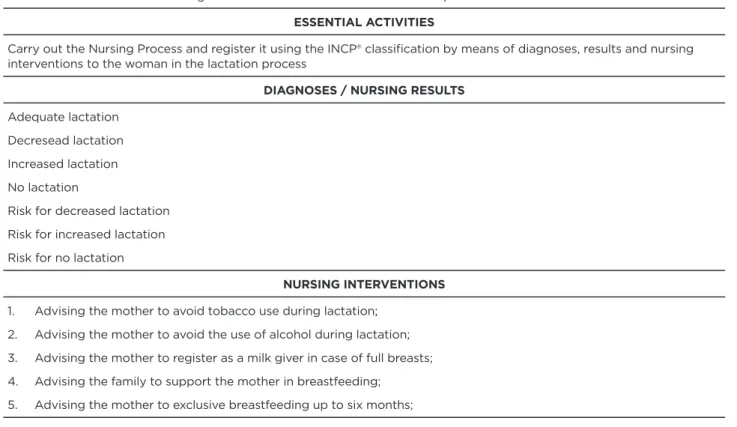
After analyzing the literature, it was found that cases of adequate, diminished and increased lactation could be found and thus the terms of the “judgment” axis were included for the elaboration of the diagnoses / results for the “lactation” focus. Considering the changes in the biological conditions of lactating women, 7 nursing diagnoses/results and 87 nursing interventions were elaborated, using the ICNP® that are presented in Table 1.
Table 1 - Protocol of nursing care for women in the lactation process. Vitória, ES, Brazil, 2015. OBJECTIVE
To standardize the clinical nursing behaviors to the woman in the lactation process
ESSENTIAL ACTIVITIES
Carry out the Nursing Process and register it using the INCP® classification by means of diagnoses, results and nursing interventions to the woman in the lactation process
DIAGNOSES / NURSING RESULTS
Adequate lactation Decresead lactation Increased lactation No lactation
Risk for decreased lactation Risk for increased lactation Risk for no lactation
NURSING INTERVENTIONS
1. Advising the mother to avoid tobacco use during lactation; 2. Advising the mother to avoid the use of alcohol during lactation; 3. Advising the mother to register as a milk giver in case of full breasts; 4. Advising the family to support the mother in breastfeeding;
5. Advising the mother to exclusive breastfeeding up to six months;
NURSING INTERVENTIONS
6. Advising the mother not to interrupt breastfeeding;
7. Advising the mother to start breastfeeding within the first half hour after birth; 8. Evaluating breastfeeding;
9. Evaluating the interaction between mother and newborn; 10. Evaluating lactation;
11. Evaluating the mother extracting milk after breastfeeding; 12. Evaluating the position of the mother during breastfeeding; 13. Evaluating the position of the newborn during breastfeeding; 14. Evaluating the sucking reflex of the newborn;
15. Evaluating the mother’s breasts and nipples; 16. Evaluating emptying of the breasts;
17. Evaluating the psychomotor development of the newborn; 18. Evaluating the sucking reflex of the newborn;
19. Demonstrating how to use the warm compress pad;
20. Demonstrating different positions of the newborn for breastfeeding; 21. Demonstrating how to extract milk from breasts;
22. Demonstrating how to massage the breasts;
23. Demonstrating technique of milk supplementation by urethral catheter during breastfeeding (translactation);
24. Demonstrating technique of milk supplementation by means of a finger-feeding urethral catheter attached to the finger; 25. Praising the mother during breastfeeding;
26. Praising the milk-giving mother;
27. Stimulating breastfeeding at various times, including at night; 28. Stimulating the mother to extract the milk when breasts are too full; 29. Stimulating the mother to massage the breasts before breastfeeding; 30. Stimulating the mother to massage her breasts when they are very full; 31. Stimulating the mother to complete the emptying of the breasts; 32. Stimulating use of warm compress cushion when breasts are very empty; 33. Stimulating the mother to maintain lactation when separated from the newborn; 34. Stimulating breast exchange;
35. Explaining mother the importance of maintaining lactation; 36. Explaining mother the importance of frequent fluid intake; 37. Explaining mother the importance of proper food intake; 38. Explaining mother the importance of breast replacement;
39. Explaining mother the importance of complete emptying of the breasts;
40. Explaining mother the importance of using warm compress pads to empty breasts; 41. Explaining mother the importance of breastfeeding schedules;
42. Explaining mother the signs of hunger and satiety of the child; 43. Explaining mother the lactation process;
44. Explaining mother about the sucking reflex of the newborn; 45. Explaining mother about the importance of milk donation;
46. Explaining family the importance of their support to the mother during breastfeeding; (Continuation)
NURSING INTERVENTIONS
49. Identifying adequate lactation;
50. Informing types of medicines for milk production and their use; 51. Massaging the breasts;
52. Monitoring breastfeeding;
53. Monitoring suckling capacity of the newborn; 54. Monitoring descent reflex of milk;
55. Milking when breasts are too full;
56. Teachig the mother to open the mouth of the newborn well to breastfeed; 57. Teaching the mother to have an adequate food intake;
58. Teaching the mother in the maintenance of lactation; 59. Teaching the correct way to use the warm compress pad; 60. Teaching the increase of water intake;
61. Teaching the use of medicines;
62. Teaching complete emptying of the breasts;
63. Teaching the mother to start breastfeeding within the first half hour after birth; 64. Teaching the factors that hinder or favor the production of milk;
65. Listening mother's complaints; 66. Reinforcing breast replacement;
67. Reinforcing the mother's importance in frequent fluid intake;
68. Reinforcing importance of the mother to the intake of adequate food; 69. Reinforcing importance of the mother's position during breastfeeding; 70. Reinforcing importance of milking the breasts;
71. Reinforcing importance of complete emptying of the breasts;
72. Reinforcing the mother's importance of the handle and correct position of the newborn; 73. Reinforcing benefits of breastfeeding;
74. Reinforcing breast and nipple care;
75. Reinforcing importance of maintaining lactation;
76. Reinforcing use of warm compress cushion when empty breasts; 77. Reinforcing guidelines on factors that favor or hinder lactation; 78. Reinforcing correct breastfeeding times for the mother; 79. Reinforcing correct technique for breastfeeding; 80. Supervising mother to perform massage in the breasts; 81. Supervising mother milking the breasts;
82. Supervising mother in the use of warm compress cushion; 83. Supervising sucking reflex of the newborn;
84. Supervising the position of the mother and the newborn during breastfeeding;
85. Supervising mother during milk supplementation technique by urethral catheter during breastfeeding (translactation); 86. Supervising mother during milk supplementation technique by means of a finger-feeding urethral catheter attached
to the finger;
87. Supervising correct technique for breastfeeding. Source: authors
Regarding the diagnosis “adequate lactation”, it is known that the production of milk happens through a sequence of hormonal events that are represented by Mammogenesis, Lactogenesis I, Lactogenesis II and Galactopoiesis. For the breast to fulfill its function adequately, in the period of gestation the mammary gland grows and undergoes transformations before and after the childbirth, in order to become able to synthesize, store and release the milk components (proteins, carbohydrates, lipids, minerals and vitamins), a process known as mammogenesis.8-9
During the feeding, most of the milk produced is through the stimulation of prolactin. In addition, another hormone that is also released during sucking is oxytocin, which can be made available through responses to stimuli such as newborn crying, vision, emotional factors, and tranquility. On the other hand, factors such as: pain, stress, anxiety and fear can inhibit milk ejection.10
Success in adequate lactation depends on an interaction between mother-child, family, professional, and society, and it is important that everyone is prepared to provide support / assistance to the mother in lactation / breastfeeding management. The preparation of the woman and her family during prenatal care, by knowing the benefits of breastfeeding, will contribute to this success.2,5,11
For proper milk production, it is necessary to empty the breast, stable hormone levels, correct suction and suckling of the baby, comfortable mother-child positioning and the woman also needs to ingest calories and liquids beyond the usual. Thus, during the period of breastfeeding, a woman tends to increase her appetite and thirst, in addition to having some food preferences. The extra consumption of 500 calories per day is enough because there is a storage during pregnancy, normally from 2kg to 4kg, that is used in lactation. The food plan of each nurse mother should cater to their preferences, cultural habits and accessibility to food. It is important to emphasize that all women produce milk, even if they consume diets with low nutritional value.1,9-10
Regarding the nursing diagnosis “risk for decreased lactation “, there are factors that can affect lactation, triggering a risk for a decrease in milk production, being: removal of the mother during the hospitalization of the baby/mother; maternal work, dietary beliefs, lack of knowledge about the benefits of breastfeeding, stress, nipple traumas and also the age of the mother.8,12-13
Other factors that cause a delay in lactogenesis are: placental retention, prolactin deficiency and / or resistance, ovarian cysts, structural changes in the breasts, as well as surgical interventions (mammoplasty of reduction or increased), obesity, primiparity, prolonged labor and delivery, cesarean section, hypotension and systemic arterial hypertension. These factors may cause a
after breastfeeding, so some signs and symptoms are observed such as: excessive crying, very long and frequent feedings, inadequate weight gain (<20g / day), urination and infrequent bowel movements (<6 to 8 episodes per day), dry, hard stools, signs of dehydration.1,9
The diagnosis of nursing “decreased lactation” may be related to hypogalactia, which is the decrease in milk secretion, which may be caused by failure in the mother-child interaction, due to maternal or newborn problems. It is considered one of the main causes of early weaning, which can result in the premature introduction of supplementation, with bottles and other foods in the newborn’s diet, reducing lactation. Saying that she have little milk or that the milk is weak is one of the most alleged justifications by women for early weaning.11,14,17
It is known that, for the woman to produce milk in an adequate quantity, a complete breast structure is necessary (alveoli, ducts and ampoules lactating), allowing a stimulus to the production and its consequent excretion. Thus, the diagnosis of nursing “no lactation” can be observed in women submitted to breast plastic surgerybecause, depending on the surgical technique used, they alter this condition of integrity and functioning, hindering or even preventing breastfeeding.15
Maternal obesity, diabetes, epidural anesthesia during labor and the effects of stress delay the onset of lactation. It is likely that an altered maternal endocrine environment and proinflammatory cytokines are partially responsible for lactation deficiency, and more detailed investigation is needed to assess maternal obesity and the roles of insulin and prolactin.16,18
Regarding the nursing diagnosis “risk for increased lactation,” it can be observed more commonly when there is inadequate emptying of the breasts, which causes the woman to have signs of tingling and pain in the nipples due to non-release of milk. The accumulation of milk signals the body to stop milk production by making the breasts engorged and hardened with flattened nipples, preventing the infant from having an adequate handle. In response to engorgement, the body suspends milk production, a process called feedback from the neuroendocrine-pituitary system.8-10
However, it is noted that some puerperal women in the postpartum period present an excessive production of human milk after an adequate emptying of the breast, becoming potential milk donors. In addition, some women may observe the persistence of milk production after weaning, even without breast stimulation. This occurs rarely, due to hormonal dysfunctions or prolonged breastfeeding1
and, in these situations, the nursing diagnosis “increased lactation” can be found, but it should be emphasized that, when searching the literature, there were few studies
milk or hyperlactation. As clinical characteristics, it is observed that the nursing woman often experiences a constant sensation of fullness, engorgement and tension in the breasts. It can leak milk between feedings, or leak copiously the opposite breast during feedings, and has an increased risk of mastitis. Regarding the baby, he struggles not to choke or suck milk, can often spit milk up after breastfeeding and / or have symptoms like reflux, and suffer from intestinal gas, colic and explosive stools, usually green and frothy. In addition, the baby may have a very low or very high gain in weight. The baby’s struggle to cope with rapid flow may result in restless, or even aversive, behavior such as refusal of breast or shortened breastfeeds. Agitation, crying and low weight gain may lead the mother to think that her milk is insufficient in quantity and / or quality.19
From the analysis of the literature on lactation, several interventions have been identified that can be developed by nurses in the care of lactating women. Among the interventions recommended in the protocol, it can be observed that the nursing action is multifaceted and compatible with the integral and Interactive Theory of Breastfeeding.
The action verbs used in the protocol account for linked actions: to teaching-education (advising, demonstrating, teaching, explaining, informing, guiding, reinforcing); to procedures (applying, milking and massaging); to affection-emotion (supporting, listening); motivation (praising, stimulating, encouraging); evaluation-research (evaluating, identifying) and monitoring-evaluation (watching, monitoring, supervising). Such actions present a more comprehensive perspective of the nurses’ behavior in the lactation process.
In addition to the recommended actions, lactation is part of the biological conditions of the woman and directly influences the interactive process of breastfeeding, being considered by a more totalizing, integrated and humanized process perspective. Notably, the woman was not reduced to her breast or the biological processes related to milk production, and this is related to the systemic paradigm that guided the production of the theory adopted as a reference to the protocol of diagnoses, results and interventions.
Still, more objective questions remain. The lactation process is also related to the adequate position of the mother and the newborn, to the good suction of the newborn in order to efficiently remove the breast milk, stimulating the neuroendocrine-pituitary reflex production.1,8 One of
the most common problems at the beginning of lactation is the adjustment between production and emptying of the breast, in which milk production is greater than emptying, causing breast enlargement and hardening, hindering milk outflow. In this case, before breastfeeding, it is necessary to massage and milk the breasts until they reduce the intralacteal breast tension, facilitating the correct delivery of the newborn, resulting in adequate emptying of the breasts.1,10
On the other hand, when there is a delay in the descent of the milk after childbirth, it is recommended to stimulate the breasts by means of massage and frequent milking. In addition, as a precaution to this delay in milk production or descent, health professionals should help mothers initiate breastfeeding within the first half hour after birth, to show the mother how to maintain lactation with frequent massage and milking even if it is separated from her child.4,8
In cases where low milk production is observed, it is recommended not to offer newborns a drink or food other than human milk, unless there is a medical indication. In these cases, the stimulation of the breasts can be performed through the suckling of the newborn and offer of supplementary nutrition with a cup containing human milk by the translational method. Alternatively, milk or pasteurized human milk can be supplemented by breastfeeding by placing a urethral catheter on the finger and inserting it into the newborn’s mouth, a procedure called finger-feeding. It may be useful to apply warm water compresses to the breasts and also the use of medications such as sulpiride and domperidone to increase milk production, always under the supervision of a qualified professional.1,9-10,20
The nurse actively participates in the network of protection, promotion and support to breastfeeding and influences how the woman will react to changes in the lactation process. Thus, it is reinforced the need to use the nursing process, since it amplifies the professional’s performance, stimulating their clinical judgment and their autonomy by proposing care and guidelines to attend to the individuality of the woman.4-5
CONCLUSION
This research provided a broad understanding of the lactation phenomenon and allowed the elaboration of 7 diagnoses / results and 87 nursing interventions based on the ICNP® and guided by the Interactive Theory of Breastfeeding for the application of the nursing process centered on the woman in the lactation process with prevention of the initial difficulties for milk production and improvement of breastfeeding rates.
The protocol of diagnoses, results and interventions presents a wide scope of the role of nursing with the woman in the lactation period, being compatible with the integral and interactive view of the Interactive Theory of Breastfeeding and the nurse has multidimensions for its action.
This study can guide nurses in the application of the nursing process, since knowledge can be more easily applied in care, teaching and research when the diagnoses, results and interventions are clearly defined and organized within a care instrument properly aligned with a nursing theory that instills it with meaning, beaconing and guidance.
The elaboration of the protocol contributed to the production of new technologies in the area of nursing, since ICNP® is a technological instrument that aims to standardize
the language for use in health information systems and electronic nursing documentation. This standardization assists in the development of knowledge and it allows nurses to understand their possibilities for action, after all the diagnoses and interventions express their focus on care and the limits of their professional role, being supported by the relevant legislation.
With this study, it is hoped to motivate the professionals to study the ICNP®, having its mark in a theory appropriate to breastfeeding as an interactive process, and later to develop studies of clinical validation of these diagnoses, collaborating to the improvement of this nursing classification.
REFERENCES
1. Brasil. Ministério da Saúde. Secretaria de Atenção à Saúde. Departamento de Atenção Básica. Saúde da criança: aleitamento materno e alimentação complementar. 2 ed. Brasília: Ministério da Saúde; 2015. (Cadernos de Atenção Básica, n. 23).
2. Primo CC. Teoria de médio alcance de amamentação: tecnologia para o cuidado. Teoria de médio alcance de amamentação: tecnologia para o cuidado. Tese (Doutorado em Enfermagem) - Universidade Federal do Rio de Janeiro; 2015.
3. Ferro NG, Vale IN, Carmona EV, Abrão ACFV. Fatores relacionados ao insucesso da lactogênese - revisão da literatura. OBJN 2009 [acesso em: 29 mar 2015];8(3). Disponível em: http://www.objnursing.uff.br/ index.php/nursing/article/view/3528
4. Gaíva MAM, Medeiros LS. Lactação insuficiente: uma proposta de atuação do enfermeiro. Cienc Cuid Saude 2006 [acesso em: 20 fev 2016];5(2):255-262. Disponível em: ojs.uem.br/ojs/index.php/ CiencCuidSaude/article/download/5089/3301
5. Primo CC, Dutra PR, Lima EFA, Alvarenga SC, Leite FMC. Redes sociais que apoiam a mulher durante a amamentação. Cogitare Enferm 2015 [acesso em: 20 fev 2016];20(2):426-33. Disponível em: http://dx.doi.org/10.5380/ce.v20i2.37453
6. Garcia TR, Nóbrega MML. A terminologia Cipe® e a participação do Centro Cipe® brasileiro em seu desenvolvimento e disseminação. Rev Bras Enferm 2013;66(esp):142-50.
7. International Council of Nurses. Classificação Internacional para a Prática de Enfermagem Versão 2015. Geneva: ICN; 2015 [acesso em: 20 fev 2016]. Disponível em: http://www.icn.ch/images/ stories/documents/pillars/Practice/icnp/translations/icnp-Brazil-Portuguese_translation.pdf
8. Hurst NM. Recognizing and treating delayed or failed lactogenesis II. J Midwifery Womens Health 2007;52(6):588–94.
9. Carvalho MR, Tamez RN. Amamentação bases científicas para a prática profissional. 3. ed. Rio de Janeiro: Guanabara Koogan; 2010. 10. Mathur NB, Dhingra D. Breastfeeding. Indian J Pediatr 2014;
81(2):143-9.
11. Barnes M, Roiko A, Reed R, Williams C, Willcocks K. Experiences of birth and breastfeeding following assisted conception. Breastfeed Rev 2013;21(1):9-15.
12. Gatti L. Maternal perceptions of insufficient milk supply in breastfeeding. J Nurs Scholarship 2008;40(4):355–63. 13. Henshaw EJ, Fried R, Siskind E, Newhouse L, Cooper M.
Breastfeeding self-efficacy, mood, and breastfeeding out comes among primiparous women. J Hum Lact 2015;31(3):511–518. 14. Lööf-Johanson M, Foldevi M, Rudebeck C. Breastfeeding as a specific
value in women’s lives: the experiences and decisions of breastfeeding women. Breastfeed Med 2013;8(1):3844.
15. Schiff M, Algert CS, Ampt A, Sywak MS, Roberts CI. The impact of cosmetic breast implants on breastfeeding: a systematic review and meta-analysis. Inter Breastfeed J 2014,9:17.
16. Lepe M, Gascón MB, Castañeda-González LM, Morales MEP, Cruz
17. Foley W, Schubert L, Denaro T. Breastfeeding experiences of Aboriginal and Torres Strait Islander mothers in an urban setting in Brisbane. Breastfeed Rev 2013;21(3):53-61.
18. Matias SL, Dewey KG, Quesenberry CP, Gunderson EP. Maternal prepregnancy obesity and insulin treatment during pregnancy are independently associated with delayed lactogenesis in women with recent gestational diabetes mellitus. Am J Clin Nutr 2014;99(1):115-121. 19. Veldhuizen-Staas CGA. Overabundant milk supply: an
alternative way to intervene by full drainage and block feeding. Int Breastfeed J 2007 [acesso em: 19 mar 2015];2:11. Disponível em: http://internationalbreastfeedingjournal.biomedcentral.com/ articles/10.1186/1746-4358-2-11
Received on: 01/07/2016 Required for review: No Approved on: 01/04/2017 Published on: 25/10/2017
Contact of the corresponding author:
Cândida Caniçali Primo Universidade Federal do Espírito Santo, Departamento de Enfermagem Av. Marechal Campos, 1468