CUIDADO É FUNDAMENTAL
UNIVERSIDADE FEDERAL DO ESTADO DO RIO DE JANEIRO . ESCOLA DE ENFERMAGEM ALFREDO PINTO
PESQUISA DOI: 10.9789/2175-5361.2017.v9i4.1107-1112
DOI: 10.9789/2175-5361.2017.v9i4.1107-1112 | Coelho IPSM; Formiga LMF; Machado ALG; et al. | Practice of physical activity among elderly
CUIDADO É FUNDAMENTAL
UNIVERSIDADE FEDERALDO ESTADODO RIODE JANEIRO. ESCOLADE ENFERMAGEM ALFREDO PINTOR E V I S T A O N L I N E D E P E S Q U I S A
Practice of physical activity among elderly
Prática de atividade física na terceira idade
Práctica de actividad física en la tercera edad
Isabel Pacheco dos Santos Mendes Coelho1 Laura Maria Feitosa Formiga22 Ana Larissa Gomes Machado33 Ana
Klisse Silva Araújo44 Tamires Ferreira Mendes55 Fernanda Moura Borges66 How to quote this article:
Coelho IPSM, Formiga LMF, Machado ALG, Araújo AKS, Mendes TF, Borges FM. Practice of
physical activity among elderly. Rev Fun Care Online. 2017 out/dez; 9(4): 1107-1112. DOI: http://dx.doi. org/10.9789/2175-5361.2017.v9i4. 1107-1112
ABSTRACT
Objective: To assess the practice of physical activity by elderly participants of a health promotion group, as well
as to analyze the reasons for adhesion and persistence of the practice. Methods: A descriptive-exploratory study with a quantitative approach, conducted with 30 elderly people. Data collection was done through a structured form containing three types of variables. Results: The age group that practices physical activities the most is the one aged between 60-65 years (78.6%). Among the active elderly, (86.7%) have some chronic non communicable disease (CNCD). Regarding the reasons that led to adhesion and persistence of the practice of physical activity, (80.0%) of elderly females and (100%) males mentioned the well-being as the main reason. Conclusion: The group members practice physical activities in appropriate frequency and duration, and there is the necessity that more studies are developed so that more nurse professionals are aware of the benefits.
Descriptors: Elderly, Physical activity, Nursing. RESUMO
Objetivo: Avaliar a prática de atividade física em idosos participantes de um grupo de promoção à saúde, assim como analisar os motivos que levaram à adesão e permanência na prática. Métodos: Estudo exploratório-descritivo, com abordagem quantitativa, realizado com 30 idosos. A coleta de dados se deu através de um formulário estruturado contendo três tipos de variáveis. Resultados: A faixa etária que mais pratica atividade física é a de idosos entre 60–65 anos (78,6%). Dentre os idosos ativos, (86,7%) possuem alguma DCNT. Quanto aos motivos que levaram à adesão e permanência da prática de atividade física, (80,0%) dos idosos do sexo feminino e (100%) do sexo masculino referiram o bem-estar como motivo principal. Conclusão: Os integrantes do grupo praticam atividades físicas em frequência e duração adequada, sendo necessário que mais estudos sejam desenvolvidos, a fim de que mais profissionais enfermeiros tenham conhecimento dos benefícios.
Descritores: Idoso, Atividade física, Enfermagem.
1 Nurse. Federal University of Piauí - UFPI. Picos - PI, Brazil.
2 Nurse. Ph.D. student at the University of São Paulo - USP. Professor at the Federal University of Piauí - UFPI. Picos - PI, Brazil. 3 Nurse. PhD in Nursing. Assistant Professor of the Federal University of Piauí - UFPI. Picos - PI, Brazil.
4 Nurse. Specialist in Nephrology and Urgency and Emergency. Federal University of Piauí - UFPI. Picos - PI, Brazil. 5 Nursing student. Federal University of Piauí - UFPI. Picos - PI, Brazil.
RESUMEN
Objetivo: Evaluar la actividad física en ancianos participantes de un
grupo de promoción de la salud, así como analizar las razones para la adhesión y la permanência em la práctica. Métodos: um estúdio exploratório descriptivo com un enfoque cuantitativo, realizado con 30 personas de edad avanzada. La recolección de datos se realiza a través de um formulário estructurado que contiene tres tipos de variables.
Resultados: El grupo que más practica de la actividad física son los de edades comprendidas entre 60-65 años (78,6%). Entre los ancianos más activos, (86,7%) tienen alguna de las ECNT. Encuanto a los motivos que llevaron a la adhesión y la permanencia de la practica de actividad física, (80,0%) de las mujeres y (100%) de los hombres ancianos mencionaron el bienestar como la razón principal. Conclusión: Los membros del grupo practican actividades físicas em la frecuencia y en la duración adecuada, sin embargo, si requieren que más estudios sean desarrollados, por lo que um mayor número de enfermeros profesionales sean conscientes de los benefícios de la practica de atividades físicas.
Descriptores: Edad avanzada, Actividad física, enfermería.
INTRODUCTION
Populational aging, once exclusive to developed countries, is a phenomenon that is currently occurring on a global scale. The constant increase in life expectancy that occurs as a result of improved sanitary conditions, advances in medical practices and technologies, coupled with the drop in fertility and mortality rates, has provided a demographic transition, changing the shape of the age pyramid. As a result, the aging process is becoming more and more acute.
According to data from the Brazilian Institute of Geography and Statistics, in Brazil, from 2000 to 2015, the Aging Index (AI) increased from 18.66% to 34.05%, and in 2030 it is expected to be 76.39%. I In Piauí, the index rose from 16.23% in 2000 to 26.31% in 2015, and the expected figure for 2030 is that this group represents approximately 59.06% of the entire population of the state.1
Aging can be understood as a natural condition (senescence), which, in typical situations, does not cause any problem. However, in episodes of overload such as diseases, among others, it can establish a pathological condition that needs care (senility). It is worth noting that certain modifications resulting from the senescence process can be minimized through the adoption of a more active lifestyle.2
Thus, active and healthy aging is characterized as an optimization process of health, participation and safety opportunities, aimed at promoting quality of life during the aging process and can be achieved through the performance of physical activities.3
These, when carried out regularly and systematically, can provide countless health benefits such as: a good physical performance, better functioning of organs and systems, improved body control and less risk of developing chronic degenerative diseases and better emotional control, giving the elderly greater independence and autonomy to perform their Daily living Activities (DLAs), and presenting good health conditions.4
In view of the above, this study is of great relevance, since it is perceived that, even with the amount of information currently available on the benefits of physical activity, there is still a significant percentage of sedentary elderly people.
Within this context, the assistance of the nurse practitioner becomes fundamental, since it enables to identify people who are at risk, and therefore can subsidize the formulation of public policies that promote the execution of physical activities according to criteria established by the World Health Organization (WHO) for the elderly population, aiming to promote the quality of life of these people. Thus, the present study aims to evaluate the practice of physical activity in elderly participants of a Health Promotion Group, as well as to analyze the reasons that led to adherence and permanence in the practice.
METHODS
It is an exploratory-descriptive, cross-sectional study with a quantitative approach. The study was carried out in the city of Picos, state of Piauí, Brazil, in the period from March to December 2015, with the Active Aging Promotion Group, an extension project from the Federal University of Piauí (UFPI), Campus Senator Helvídio Nunes de Barros (CSHNB) linked to the Caritas Diocesana of the municipality, having as physical unit a room located on the premises of the campus for weekly meetings.
The population of this research was estimated in 47 elderly men and women who were part of the Active Aging Promotion Group. However, due to the strike period of Federal University teachers, some of these elderly people gave up, failing to attend the meetings of the group, and it is possible to contemplate a quantitative of 30 elderly people. In this case, the sample was equivalent to the population. To select the participants, the following inclusion criteria were considered: regular attendance of the group and no speech impairment or verbal communication. The exclusion criterion established was to fail to attend the group meetings for more than three consecutive times in a month.
Data collection was performed in August and September 2015, at the UFPI, in the room where the group activities were carried out. The data were collected at the end of each meeting, after inviting the elderly to participate in the study, through a structured form that had as purpose to investigate data of the target population so that the profile of the sample was drawn, being necessary four meetings to finalize the collection of the data. The collected data were entered in the program Microsoft Office Excel 2013, and analyzed through the Statistical Package for Social Sciences (SPSS), version 20.0 statistical program. The same program was used for the data treatment, and the analysis was done through descriptive statistics. Subsequently, a cross between the variables was made using some statistical tests such as Pearson’s Chi Square, Likelihood Ratio, Fisher’s Exact
Test. The findings were presented through tables so that they could be better understood and analyzed according to the pertinent literature.
The study proposal was submitted for approval by the Research Ethics Committee (REC) of the UFPI with the Certificate of Presentation for Ethical Assessment (CPEA) n° 47990015.2.0000.5214, in compliance with the criteria established by Resolution 466 of December 10, 2012, of the National Health Council, that regulates research involving human beings.(5) All individuals who agreed to participate in the research signed the Term of Free and
Informed Consent (TFIC) and received a copy of the term signed by the researchers.
RESULTS AND DISCUSSION
The present research was carried out with 30 elderly members of a Health Promotion Group. Statistical treatment was used to analyze data to describe variables related to the socioeconomic and clinical data of these elderly people, correlated with physical activity practice and the reasons for adherence and permanence in the practice.
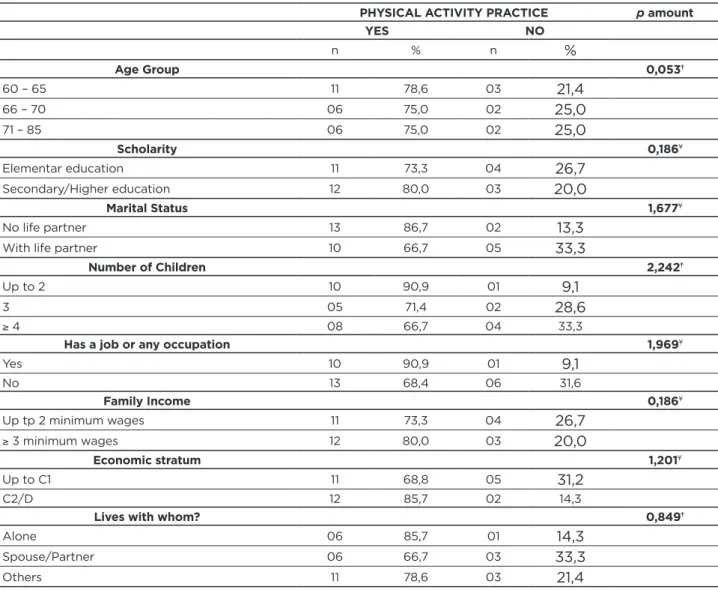
Table 1 - Relation between socioeconomic data and physical activity practice. Picos - PI, 2016. (n=30).
PHYSICAL ACTIVITY PRACTICE p amount
YES NO n % n % Age Group 0,053Ϯ 60 – 65 11 78,6 03 21,4 66 – 70 06 75,0 02 25,0 71 – 85 06 75,0 02 25,0 Scholarity 0,186Ұ Elementar education 11 73,3 04 26,7 Secondary/Higher education 12 80,0 03 20,0 Marital Status 1,677Ұ No life partner 13 86,7 02 13,3
With life partner 10 66,7 05 33,3
Number of Children 2,242Ϯ
Up to 2 10 90,9 01 9,1
3 05 71,4 02 28,6
≥ 4 08 66,7 04 33,3
Has a job or any occupation 1,969Ұ
Yes 10 90,9 01 9,1 No 13 68,4 06 31,6 Family Income 0,186Ұ Up tp 2 minimum wages 11 73,3 04 26,7 ≥ 3 minimum wages 12 80,0 03 20,0 Economic stratum 1,201Ұ Up to C1 11 68,8 05 31,2 C2/D 12 85,7 02 14,3
Lives with whom? 0,849Ϯ
Alone 06 85,7 01 14,3
Spouse/Partner 06 66,7 03 33,3
Others 11 78,6 03 21,4
SOURCE: research data.
Ұ – Pearson’s Chi Square; Ϯ – Likelihood Ratio
Regarding the information crossing between socioeconomic data and the practice of physical activity, it was observed that the age group that makes the most use of physical practice is the elderly between 60 and 65 years of age, making up a total of 11 elderly people (78.6%). Those who do not practice physical activity correspond to 7 elderly people distributed among the age groups presented in Table 1.
Of the elderly who practice physical activity, 80% have a higher education level, followed by 73.3% who have only elementary education. Among them, 86.7% live without
their partner and have up to two children (90.9%). However, of those who do not practice physical activity, the majority lives with the partner and has four or more children, both with 33.3%.
When questioned about work or occupation, 90.9% of the elderly who practice physical activity reported having some type of occupation, besides having a family income of three or more minimum wages (80.0%). Only one elderly person (9.1%), of the amount that does not practice physical activity, reported working.
Regarding the economic stratum, 85.7% of the elderly practicing physical activity belongs to the C2/D group and the majority lives with someone other than their partner, representing 78.6% of the elderly. Of the non-practitioners, only two elderly people (14.3%) belong to this class and only one elderly person (14.3%) lives alone.
Table 2 shows the relation between the practice of physical activity and the existence of some chronic non communicable disease (CNCD), if the elderly have guidance on the practice and what kind of professional provides this orientation.
Table 2 – Relation between the presence of chronic non communicable disease (CNCD), orientation, type of professional that
provides it and practice of physical activity. Picos - PI, 2016. (n = 30).
PRACTICE OF PHYSICAL ACTIVITY p valor YES NO
n % n %
Has any CNCD and has any guidance regarding physical
activity practice? 0,530€
Yes 13 86,7 02 13,3
No 03 75,0 01 25,0
Type of professional that provides the orientation 1,000€
Nurse/Other 04 80,0 01 20,0
Medic 09 90,0 01 10,0
SOURCE: research data. € - Fisher’s Exact Test
Of the elderly practicing physical activity, 86.7% have some CNCDs and receive orientation regarding the practice. Still in this same group, 75.0% reported not having CNCDs and receiving no guidance. Of those who did not practice physical activity, 13.3% reported having a CNCD and receiving orientation. While only one elderly person (25.0%) from the same group said he/she did not have any chronic diseases and did not receive guidance regarding the practice.
Regarding the type of professional that provides the orientation, 90.0% of the elderly who practice physical
activity responded that this orientation is provided by the medical professional. At the same time, 80.0% reported being guided by the nurse practitioner or other professional. Of the elderly who do not practice physical activity, 20.0% reported receiving guidance from the medical professional and 10.0% from the nurse/other professional.
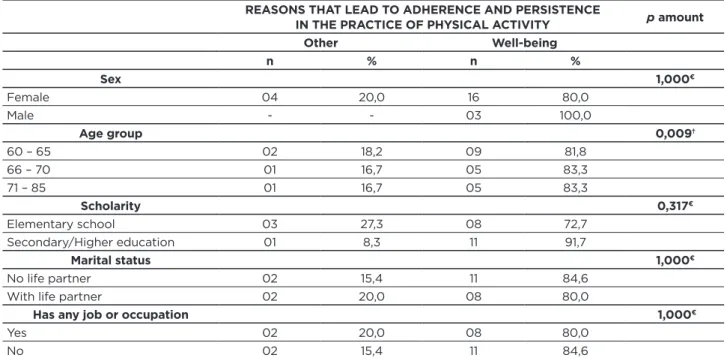
Table 3 explains the relationship between socioeconomic data and the reasons that led to adherence and persistence in the practice of physical activity among the elderly.
Table 3 - Relation between socioeconomic data and the reasons that led to adherence and persistence in the practice of
physical activity. Picos - PI, 2016. (n=30).
REASONS THAT LEAD TO ADHERENCE AND PERSISTENCE
IN THE PRACTICE OF PHYSICAL ACTIVITY p amount Other Well-being n % n % Sex 1,000€ Female 04 20,0 16 80,0 Male - - 03 100,0 Age group 0,009Ϯ 60 – 65 02 18,2 09 81,8 66 – 70 01 16,7 05 83,3 71 – 85 01 16,7 05 83,3 Scholarity 0,317€ Elementary school 03 27,3 08 72,7 Secondary/Higher education 01 8,3 11 91,7 Marital status 1,000€ No life partner 02 15,4 11 84,6
With life partner 02 20,0 08 80,0
Has any job or occupation 1,000€
Yes 02 20,0 08 80,0
No 02 15,4 11 84,6
REASONS THAT LEAD TO ADHERENCE AND PERSISTENCE
IN THE PRACTICE OF PHYSICAL ACTIVITY p amount Other Well-being n % n % Family income 0,317€ Up to 2 minimum wages 03 27,3 08 72,7 ≥ 3 minimum wages 01 8,3 11 91,7 Economic stratum 0,590€ Up to C1 01 9,1 10 90,9 C2/D 03 25,0 09 75,0
Lives with whom? 0,009Ϯ
Alone 01 16,7 05 83,3
Spouse/Partner 01 16,7 05 83,3
Others 02 18,2 09 81,8
SOURCE: research data.
€ – Fisher’s exact test; Ϯ - Likelihood Ratio
Regarding the relation between the socioeconomic data and the reasons that led to the adherence and persistence in the practice of physical activity, the female elderly referred the well-being, representing 80.0%. All elderly men also responded to well-being as a reason for adherence and persistence in the practice of physical activity, representing 100%.
Regarding the age group, 81.8% of the elderly who reported well-being as the main reason for adherence are part of the age group of 60-65 years and 83.3% are between 66-70 and 71-85 years each. Regarding scholarity, 91.7% of the participants who reported well-being as a reason for adherence had higher level education and 72.7% had elementary level education.
The majority of elderly people who reported well-being as a response, live without a partner (84.6%), had no job or occupation (84.6%), have a family income equal to or greater than three minimum wages (91.7% ), belong to economic stratum up to C1 (90.9%) and live alone or with their partner (83.3%).
The present study showed that among the elderly people practicing physical activities, 78.6% are in the age range of 60-65 years, corroborating with the results of a study carried out in Santa Catarina, where it was verified that the average age of the elderly was of 64.75 years.6 However, when evaluating the group of non-practitioners, it was observed that the majority are distributed among the highest age groups. Thus, it is perceived that the practice of physical activities decreases with advancing age, being associated with the physiological decline and the presence of functional limitations resulting from the aging process.
Regarding scholarity, it can be observed that among the elderly who are physically active, 80.0% have complete secondary and higher education. On the other hand, when evaluating the educational level of those who do not practice physical activities, only 20.0% reported having this level of education. Similarly, in a study carried out in the city of Porto Alegre with 50 elderly people, it was verified that the group of practitioners was related to the higher education levels, whereas, with the group of
non-practitioners, the level of study was associated with
incomplete elementary education.7
These results are justified by the fact that systematic physical activities require a minimum level of scholarity for participation and understanding of the importance of this practice, while individuals with low level of education choose to carry out playful, craft, and social activities, rather than physical exercises, as these do not require a high level of education and are easily understood.7
Regarding work or occupation, among the elderly practicing physical activities, it has been verified in the literature that the majority declared having some labourite occupation, while in the group of non-practitioners a number of elderly people who had already left their work prevailed, corroborating the data of the present study.8
The ability to perform daily activities is associated with the muscular strength presented by the elderly, which decreases considerably in the old age. However, the regular practice of physical activities strengthens the muscles, improving muscular endurance and flexibility, thus contributing for the elderly to perform their daily living activities (DLA).9
The scientific literature emphasizes that the practice of physical activities may be associated with income since individuals with higher purchasing power are more physically active when compared to those of low income, in agreement with the present research. Studies show that groups of practitioners with higher income have a greater understanding of the importance of performing these practices, as well as their participation in physical activity programs. Low-income groups, on the other hand, may experience increased idleness, since the probability of being relatively uninformed about the benefits of this practice is greater in this group.7
It was also verified that the elderly practicing physical activities have a higher percentage of CNCDs and are more educated about performing this practice when compared to non-practicing elderly, in accordance with a study conducted in Porto Alegre with 50 elderly people. It is estimated that the physically active elderly perform the activities as a complement to the treatment of basic pathologies.7
Regarding the type of professional that provides guidelines regarding the practice of physical activities, it was found that, among the practicing elderly, 90.0% said they received information from a medical professional. In agreement, a study carried out in municipalities of the five Brazilian regions showed that the majority of the elderly declared to receive medical guidelines for adherence to the practice of physical activities after receiving the diagnosis of their clinical condition, along with the necessary instructions.1
On the other hand, when evaluating the group of non-practitioners, it was found that the majority reported receiving instructions from other health professionals, including nurses. Thus, in order for the individual to present a good health during the aging process, it is necessary to have the guidelines of the health professionals. In this context, the nurse, as an integral part of this team, has room to contribute to the development of strategies of oriented physical activity, which are indispensable for achieving a better quality of life.11
Regarding the reasons that led to the adherence and permanence of the elderly in the practice of physical activity, correlated with socioeconomic data, all variables showed significance and relevance to well-being, motif most reported by the participants. Adherence and maintenance of physical activity are associated with the well-being provided by this practice, both in the physical domain and in the psychological or emotional domain.12,13
Thus, it is observed that the promotion of well-being is widely mentioned by the elderly population as a motivating factor for joining and staying in programs of physical activities. Physical, mental and social well-being are seen by the elderly as one of the factors that make it possible to face various obstacles and sufferings in life.14
CONCLUSION
Based on the results, it can be concluded that the proposed objectives were achieved, for it was possible to actually evaluate the practice of physical activity reported by the elderly members of the group.
Thus, it is worth stressing the important role played by the health promotion groups to which the elderly belong, since it can be clearly understood how the activities developed in the group contribute to positive changes in the participants’ lives, not only those related to the practice of physical activities, but changes in the life habits as a whole.
Thus, knowing of the growing increase of the elderly population in Brazil, it is necessary that more studies on the subject are developed, so that more professional nurses are aware of the benefits provided by the practice of physical activities and adopt them as strategies in their daily interaction with the study population. In addition, it is important to implement strategies to encourage the creation and expansion of Health Promotion Groups in view of the good results they promote in the quality of life of the elderly.
REFERENCES
1. Instituto Brasileiro de Geografia e Estatística. Censo Demográfico 2015. IBGE, Brasil. 2015
2. Ministério da Saúde (BR). Envelhecimento e saúde da pessoa idosa – 1ª edição, 1ª reimpressão, Série A. Normas e Manuais Técnicos. Cadernos de Atenção Básica, nº 19. Brasília (DF); 2007. 3. Ministério da Saúde (BR). Envelhecimento ativo: uma política de
saúde - 1.ª edição. Organização Pan-Americana da Saúde. Brasília (DF); 2005.
4. Santos RL. Relato de experiência: Importância da atividade física na qualidade de vida de idosas do “Grupo Renascer” [dissertation]. Campina Grande: Universidade Federal da Paraíba; 2014. 5. Ministério da Saúde (BR). Conselho Nacional de Saúde. Comissão
Nacional de Ética em Pesquisa, CONEP. Resolução nº 466/12 sobre pesquisa envolvendo seres humanos. Brasília (DF); 2012.
6. Gil PR, Streit IA, Contreira AR, Naman M, Mazo GZ. Hábitos de lazer e atividade física durante o curso de vida em idosos praticantes de dança. Revista Kairós Gerontologia. 2015; 18 (2): 227- 45. 7. Oliveira JGD, Stobaus CD, Moriguchi Y, Malezan WR, Filho AD,
Pacheco MN, et al. Correlação socioeconômica e antropométrica em idosos praticantes e não praticantes de exercícios físicos. RevBrasAtivFis e Saúde. 2013; 18 (1): 121-131.
8. Silva RN, PUREZA DY. Perfil dos praticantes de atividades físicas da academia da praça do município de Macapá. Fiepbulletin. 2015; 85: 1-6.
9. Souza VC, Júnior AS. Características de pessoas idosas fisicamente ativas e sua relação com a independência física nas atividades de Vida Diária (AVDs). BIUS. 2015; 6 (2): 15-29.
10. Seus TLC, Siqueira FV, Silveira DS, Tomasi E, Thumé E, Silva SM, et al. Autorrelato de diabetes e atividade física no Brasil. RevBrasAtivFis e Saúde. 2012;17 (6): 520-531.
11. Torres AG, Silva HMP, Torres DFN, Firmo WCA, Chaves AS. Efeitos da prática de caminhada de idosos em grupo: um olhar do protagonista. RevJ. ManagPrim Health Care. 2013;4 (1): 19-26. 12. Lopes AL, Streit IA, Medeiros PA, Mazo GZ. Motivos de ingresso e
permanência de idosos em um programa de atividades aquáticas: um estudo longitudinal. Rev. Educ. Fís/UEM. 2014; 25 (1): 23-32. 13. Eiras SB, Silva WHA, Souza DL, Vendruscolo R. Fatores de adesão e
manutenção da prática de atividade física por parte de idosos. Rev. Bras. Ceien. Esporte. 2010; 31 (2): 75-89.
14. Dias DSG, CARVALHO CS, ARAÚJO CV. Comparação da percepção subjetiva de qualidade de vida e bem-estar de idosos que vivem sozinhos, com a família e institucionalizados. Rev. Bras. Geriatr. Gerontol. 2013; 16 (1): 127-138.
Received on: 15/07/2016 Required for review: No Approved on: 04/01/2017 Published on: 25/10/2017 Contact of the corresponding author: Ana Klisse Silva Araújo Junco, Picos-PI ZIP-code: 64600-000 E-mail: <[email protected]>