Pedro Alexandre Boliqueime Sá e Costa
Development of sandwich panels of
customized functionalities for the
rehabilitation of the built patrimony
Pedro Alexandre Boliqueime Sá e Costa
De velopment of sandwic h panels of cus tomized functionalities for t he r ehabilit ation of t he built patr imon y
Master Thesis
iMiSBE - International Master Programme and
Post-graduation in Sustainable Built Environment
Supervisor
Professor Doutor Joaquim A. O. Barros
Pedro Alexandre Boliqueime Sá e Costa
Development of sandwich panels of
customized functionalities for the
rehabilitation of the built patrimony
ACKNOWLEDGEMENTS
The author would like to thank his supervisor, Professor Joaquim Barros, for his mentorship, motivation and commitment towards this work. Having been a remarkable professor during the curricular period of this Master Programme, his personal side and true concern for his students were something that captivated me from the very first moment. It has been a privilege that our paths have crossed and I am sure that the accomplishment of this work is not the end of our common journey. I would also like to thank Civitest for providing the installations and equipment to perform the experimental programs, including everybody there that, in a way or another, has contributed to my work. I would especially like to thank Delfina and Inês for their help during the tests.
Finally, and most importantly, I would like to thank my parents, my wife and my dear friends Fernanda, Nisa and Arjan for all their unlimited support and encouragement. This journey just wouldn’t have been possible without you.
This work is dedicated to my son Simão. May he soon realize that learning something new every day is the best feeling we can have.
ABSTRACT
The future of the construction in the next decades in most European Countries, especially those of Southern Europe, will mainly lie in the renovation of the existing building stock constructed over the past 40 years. Thousands of uncharacteristic buildings will need renovation in the next coming years forcing EU member states to reach the EU 2020 targets and implement the Energy Performance of Buildings Directive (EPBD), which recommends that by 31 December 2020 all new and retrofitted buildings in Europe will have to be nearly-zero energy buildings (NZEB). Sustainability and energy efficiency are closely linked to the building sector, having each country to address this problem now by investing in new buildings that can meet the highest standards of energy efficiency, but mostly by renovating the immense quantity of existing inefficient buildings where most of the population still lives. Seeing this crisis as an opportunity, this work aims to develop a concept for prefabricated customizable sandwich panels for the multifunctional renovation of buildings. More than a conventional solution, this proposal aims to combine sustainable building materials, available technologies and systems with advanced design and manufacturing tools within an integrated and mass-customizable approach of advanced building renovation prefabricated solutions. The adoption of the proposed solutions would not only contribute to the reduction of the energy inefficiency in buildings, but also minimize related construction problems, enabling some advanced features like the incorporation on the façade layout of advanced modules such as solar panels, to improve the system’s energy performance.
RESUMO
O futuro da construção nas próximas décadas, na maioria dos países europeus e especialmente nos do Sul da Europa, residirá principalmente na renovação do parque imobiliário existente construído ao longo dos últimos 40 anos. Milhares de edifícios incaracterísticos terão de ser renovados nos próximos anos para obrigar os Estados-Membros a atingir as metas energéticas da UE para 2020 e implementar a Diretiva Europeia relativa ao Desempenho Energético de Edifícios (EPBD) que exige que todos os edifícios novos e reabilitados a partir de 31 de dezembro de 2020 passem a ser Nearly-Zero Energy Buildings (NZEB). A sustentabilidade e eficiência energética estão intimamente ligados ao sector da construção, e cada país terá agora de encarar esse problema investindo em novos edifícios que possam atender aos mais altos padrões de eficiência energética, principalmente renovando a imensa quantidade de edifícios existentes e ineficientes onde a maioria da população vive. Vendo esta crise como uma oportunidade, este trabalho tem como objetivo desenvolver um conceito de painéis sandwich pré-fabricados customizáveis para a renovação multifuncional de edifícios. Mais do que uma solução convencional, esta proposta visa combinar materiais de construção sustentáveis, sistemas e tecnologias disponíveis com ferramentas de fabrico e design avançado, numa abordagem integrada e personalizada de soluções de pré-fabricação em massa para a reabilitação do parque habitacional. Pretende-se com a adoção das soluções propostas contribuir não só para a redução da ineficiência energética dos edifícios, mas também minimizar os problemas de construção existentes, permitindo também a incorporação no layout da fachada de módulos avançados, como painéis solares, para melhorar o desempenho energético do sistema.
TABLE OF CONTENTS
1 INTRODUCTION ... 1
1.1 Motivation ... 1
1.2 Objectives ... 2
1.3 Outlines ... 3
2 STATE OF THE ART ... 5
2.1 Framework of building renovation in Europe ... 5
2.1.1 Introduction ... 5
2.1.2 Differences on building renovation in Europe ... 6
2.2 Existing Solutions ... 9
2.2.1 Traditional Renovation vs. Prefabricated Building Renovation ... 9
2.2.2 ETICS - External Thermal Insulation Composite System ... 10
2.2.3 Multifunctional façade systems ... 11
2.3 The LEGOUSE Project ... 22
3 PROPOSED CONCEPT ... 25
3.1 New and existing materials for the prototype panels ... 27
3.1.1 Fibre Reinforced Cement Composites (FRCC) ... 28
3.1.2 Fibres to be used in FRCC – main properties ... 34
3.1.3 Glass Fibre Reinforced Polymer (GFRP) and steel connectors ... 37
3.1.4 Poltruded Glass Fibre Reinforced Polymer (GFRP) profiles ... 38
3.1.5 Galvanized Steel Profiles ... 40
3.1.6 Insulation: possible materials to be used in the panels ... 42
3.1.7 Finishing materials and other possibilities... 47
3.2 Technical modules ... 48
4 EXECUTION AND TESTING OF TWO PROTOTYPE PANELS ... 71
4.1 Panel 1 ... 71
4.2 Panel 2 ... 80
4.3 Mechanical properties of the cement based materials ... 84
4.3.1 Flexural behaviour of FRM ... 84
4.3.2 Flexural behaviour of LFRC ... 86
4.3.3 Compressive behaviour of FRM and LFRC ... 89
4.4 Creep tests on the prototype panels ... 89
4.5 Thermal performance of the prototype panels ... 94
4.6 Cost assessment of the two proposed solutions ... 99
4.7 Conclusions ... 101
5 RELEVANT RESULTS AND FUTURE DEVELOPMENTS ... 103
6 POSSIBLE ASSEMBLING OF THE PANELS IN A CASE STUDY BUILDING ... 105
LIST OF FIGURES
Figure 2 - Philip Lowe DG Energy, 2011 “Expected results in each of the "EU 20-20-20 by 2020"
goals. A new Directive on Energy Efficiency - Challenges addressed & solutions proposed ".
Link:<http://ec.europa.eu/energy/efficiency/eed/doc/2011_directive/country/20110622_energy
_efficiency_directive_uk_slides_presentation.pdf > [June 2014]
Figures 3a / 3b - Treberspurg, M.; Djalili, M., 2010 "New technical solutions for energy efficient
buildings - Multifunctional façade systems". Link: <
http://www.sci-network.eu/fileadmin/templates/sci-network/files/Resource_Centre/Innovative_Technologies/State_of_the_Art_Report_Multifunctional _Facade_Systems.pdf > [June 2014]
Figures 4a / 4b - TES Energy Façade, 2015 “Multifunctional timber based system for improving
energy efficiency of the building envelope” Link:
< http://www.tesenergyfacade.com/index.php?id=13_tes > [April 2015]
Figure 5 - Treberspurg, M.; Djalili, M., 2010 "New technical solutions for energy efficient buildings -
Multifunctional façade systems". Link: <
http://www.sci-network.eu/fileadmin/templates/sci-network/files/Resource_Centre/Innovative_Technologies/State_of_the_Art_Report_Multifunctional _Facade_Systems.pdf > [June 2014]
Figures 6 / 7 - Basic concept of the GAP Façade System / UMinho Prefabricated retrofit module
adapted to Portugal. Obtained from "01_EnEff in Building renovation.pdf". Images from lecture notes given by Professors Manuela Almeida/Sandra Silva at the International Master in Sustainable Built Environment, Minho University, Guimarães, March 2014
Figures 8 / 9 - Treberspurg, M.; Djalili, M., 2010 "New technical solutions for energy efficient
<
http://www.sci-network.eu/fileadmin/templates/sci-network/files/Resource_Centre/Innovative_Technologies/State_of_the_Art_Report_Multifunctional _Facade_Systems.pdf > [June 2014]
Figures 10 – Kevothermal, 2015 “The Science and Technology of Vacuum Insulation Panels”. Link:
<http://www.kevothermal.eu/index.php/the_science> [April 2015].
Figure 11 - Treberspurg, M.; Djalili, M., 2010 "New technical solutions for energy efficient buildings
- Multifunctional façade systems". Link: <
http://www.sci-network.eu/fileadmin/templates/sci-network/files/Resource_Centre/Innovative_Technologies/State_of_the_Art_Report_Multifunctional _Facade_Systems.pdf > [June 2014]
Figures 12 - InHabitat website - “Patrick Blanc Unveils New Oasis of Aboukir Vertical Garden”. Link:
< http://inhabitat.com/patrick-blancs-new-oasis-of-aboukir-vertical-garden-blooms-for-paris-design-week/patrick-blanc-oasis-daboukir3/> [February 2015]
Note: All the sources for the remaining figures that are not listed here are mentioned in the corresponding caption and referenced at the Reference Chapter. The remaining Figures without explicit source belong to the author of this work.
1 INTRODUCTION
1.1 Motivation
The current global crisis has revealed enormous fragilities in the model of development followed by many countries in recent times, especially those where the construction sector played a major role in the economy. Fuelled by cheap credit, the housing sector has been particularly responsible for this situation, having been built in the past decades in Europe millions of new homes - especially in southern European countries - that were made available at affordable prices to the great majority of the population. However, this mass construction driven by low standards and high demand led most of these buildings to lack the necessary quality, both at the level of indoor environment and aesthetical appeal. Another problem was the rise of private and public debt in southern Europe to unsustainable levels that led construction almost to a standstill. The consequence is a situation with many new unsold empty buildings without buyers due to the lack of credit and a vast quantity of existing inefficient buildings constructed over the past 40 years where most of the population still lives (Figure 1).
a) b)
Figure 1. Examples of large private owned buildings (a) and public social housing (b) with poor construction and repetitive façades
The constructive façade systems in this kind of buildings consists mostly on double walls with insufficient thermal insulation, which associated to poor framing contributes to high energy losses, often making the cost of heating unaffordable and forcing people to live with thermal discomfort for
most of the year. Other common construction related problems are thermal bridges, which cause condensations that affect the interior air quality and deteriorate the health of the occupants. Considering that the available housing stock has already reached a level that can guarantee the needs of the European population for the next decades, thousands of uncharacteristic buildings like these will need renovation in the next coming years as EU member states are required to fully implement the Energy Performance of Buildings Directive to meet new high demanding energy efficiency standards until 2020 (Concerted, 2014). The rehabilitation of this immense built patrimony will undoubtedly also be an essential opportunity to revitalise the construction sector, finding a more sustainable development model that can create new jobs and business opportunities based on innovative construction methods and energy efficient solutions.
1.2 Objectives
Considering this scenario, this project is based on the development of a prefabricated system of customizable sandwich panels for the multifunctional renovation of buildings, especially those built in the past four decades that are characterized by repetitive and monotonous façades, which present an ideal opportunity for modular renewal solutions. Most of the existing systems for the renovation of façades only increase the level of insulation and minimize thermal bridges, not solving other important pathologies.
More than a conventional solution, this prefabricated customized system consists of a new external skin that can not only renovate the outdated and unappealing aesthetics of the building but improve indoor environmental quality, minimize energy inefficiency and also other existing construction related problems. It proposes to combine building renovation with technologic innovation, incorporating sustainable and recycled building materials, available technologies and systems with advanced design and manufacturing tools within an integrated and mass-customizable approach of advanced building renovation prefabricated solutions. This modular solution will be based on a prefabricated Fibre Reinforced Cement Composite (FRCC) panel with an inner insulation core incorporating sustainable and recycled materials. FRCC panels would not only provide high mechanical stability to the façades but also offer a new possibility to explore interesting visual solutions to upgrade the visual aspect of existing buildings. For increased energy performance, technical components, such as photovoltaic (PV) or solar panels would also be incorporated in the panels, integrating harmoniously these elements on the façades. Advanced solutions to be explored in future works could include more sophisticated
systems like energy efficient windows featuring control units connected to a domotics system that would monitor the indoor environmental quality of each compartment.
This work plans to determine whether these more advanced materials that constitute the panel, properly positioned on an underperforming façade, can result in an efficient and competitive system, assuming that the panels will be used to improve both energy and structural performance, but could even be applied on new construction in the future.
1.3 Outlines
In the First chapter of this thesis plan, the main reasons to elaborate this work are provided, including motivation and the main objectives, as well as the main outlines.
The Second chapter is divided in three sections, being the first dedicated to the framework of building renovation in Europe, explaining its challenges and differences in the European context and in Portugal in particular while enhancing the main hurdles to be still overcome by most countries in order to reach a high level of energy efficiency in the existing building stock to comply with the new EU regulations. The second section explains the advantages and challenges of prefabrication, discusses the inconveniences of one of the most common solution used nowadays in building renovation (External Thermal Insulation Composite System – ETICS) and finally presents a selection of some of the most advanced solutions regarding prefabrication with the Multifunctional Façade Systems. The final section introduces a major reference in prefabrication that motivated the development for this work, the LEGOUSE Project.
The Third chapter explains the proposed concept, exploring the proposed materials that can constitute the panel, the technical modules to be included in the customization of the solution and a final section devoted to the potentialities of robotization and BIM in the fabrication and installation of the panels.
The Fourth chapter is dedicated to the execution and testing of the two prototype panels presenting the results, comparing the two solutions in terms of mechanical and thermal efficiency, as well as cost-efficiency.
Chapter five is dedicated to the presentation of the relevant results and potential future developments of the proposed concept, followed by Chapter six presenting a preliminary layout of the proposed panel concept assembled on two façades in a case-study building to illustrate the potential of the solution, concluding this work with the References.
2 STATE OF THE ART
2.1 Framework of building renovation in Europe
2.1.1 Introduction
Building renovation nowadays is a necessity not only because most buildings need to upgrade their outdated or neglected visual aspect, but mostly because they underperform in what concerns energy efficiency. The first Energy Performance of Buildings Directive (EPBD), published in 2002, required all EU countries to improve their building regulations and to introduce energy certification schemes for buildings, while upgrading inefficient and obsolete heating or cooling systems. This was an important step to raise public awareness to energy efficiency in buildings, but also a great challenge to implement the Directive at national levels. EPBD was recast in 2010, forcing each EU member state to move towards new and retrofitted Nearly-Zero Energy Buildings (NZEB) by 2020 (Official, 2010). It required also that each country should apply a cost-optimal methodology for setting minimum requirements for both the technical systems and the building's envelope. Additionally, environmental issues, the world economic crisis and the rise of energy prices in recent years have also increased the level of consciousness, leading people to look for renovation options that can effectively reduce energy costs. In this current negative scenario, most of the European population, especially in southern countries where the economic situation does not seem to improve, still cannot afford high investments in the necessary building renovations to optimize energy performance. However, this process can no longer be postponed if European member states are to move towards new and retrofitted Nearly-Zero Energy Buildings until 2020. Despite the negative economic environment, Europe has already implemented effective strategies to respond to this immense challenge putting forward in March 2011 the "Energy Efficiency Plan 2011", which aims at saving more energy and create substantial benefits mostly for households, while improving EU's industrial competitiveness and promoting the creation of more employment (European, 2011). Meanwhile, with Europe’s Energy Efficiency Directive (EED) coming into force in 2014, enthusiasts are pushing for the EU to come forward with a more realistic target for 2030 and adopt proposals to dramatically cut energy use in Europe’s building stock by 2050 (European, 2012). This directive was approved by the EU parliament in December 2012 after it became clear that the EU was not on track to meet its non-binding 20% energy savings target for 2020, and the main goal is to put EU member states back on the right path through a set of ambitious measures concerning all stakeholders, from public bodies to energy companies, industry and
consumers. Once again, as building renovation takes centre stage again and debate heats up over energy efficiency targets for 2030, much of the work is still to be done, as member states have to be able to implement what they committed to do in their national action plans on buildings (EurActiv, 2013). Figure 2 illustrates the expected results in each one of the three main EU 20-20-20 sustainability goals, clearly indicating that the reduction in energy consumption will not be achieved by 2020, as expected.
Figure 2. Expected results in each of the "EU 20-20-20 by 2020" goals (Source: Lowe, 2011).
Energy efficiency is a complex issue that deals with the whole economy and depends on a strong commitment of all European countries - and the world, at a global scale - but is necessary to change the mind-set concerning buildings, as they are expected to significantly contribute to the 80-95%
greenhouse gas (GHG) reduction target set for 2050 in Europe (BPIE, 2011a).This means that, on
average, each building will have to reach very low carbon emission levels and decrease energy consumption dramatically, as Europe heads towards a low carbon power sector, based more and more on renewable energy sources. This goal may seem hard to reach, but it will be attainable if building renovation is to be taken seriously by both governments and citizens, but the reality is that Europe as a whole is not responding in the same way, as explained in the next chapter.
2.1.2 Differences on building renovation in Europe
According to the report "High-rise Refurbishment: The energy-efficient upgrade of multi-story residences in the European Union", an extensive study published in 2006 by the International Energy Agency concerning research done on the energy-efficient refurbishment of the high-rise residential
European building stock, one in six of all households - or approximately 36 million European households - are in high-rise buildings, many of which are in urgent need of renovation. The energy efficiency of the European existing building stock varies according to the country of origin, building age, materials and techniques used in the construction and - most importantly - the public and governmental consciousness about this important issue.
In northern and most central European countries, encompassing Scandinavia, Benelux, Germany, Austria and France, where climate is more extreme, society and governments have been for a long time aware of the need to reduce energy consumption in existing buildings by increasing insulation levels. As buildings in these countries are usually kept in good condition due to state incentives and legislation that forces building owners to invest periodically in renovation, this process is done on a regular basis mostly by retrofitting the building envelope to reach the highest level possible of energy efficiency, while simultaneously upgrading existing heating and ventilation systems for new, more energy efficient ones. These countries represent the most advanced economies in Europe and have also reached the highest benchmark at the European level in terms of high energy efficiency in construction and reconstruction, where building refurbishment is already of a very high standard and the rehabilitation of the existing housing stock is widely considered as essential to promote sustainable building methodologies and to reach high energy efficiency levels. As a result of this already high level of energy efficiency, the cost-effectiveness of investment in high rise building renovation in this region is considered to be average (Waide et al, 2006), although there is still potential for improvement. Eastern European countries face similar climate conditions to northern and central European countries but, as a result of a completely different political regime and mass style house building projects done in previous decades, the existing building stock in these countries presents a high degree of energy inefficiency, most of the times consisting of poorly insulated prefabricated concrete panel walls, flat concrete roofs and ground floors above unheated basements, being the main heat system provided by district heating. This group encompasses cold climate countries and as a rule presents a rather standardized high-rise building stock with the highest dwelling proportion, a very high level of energy inefficiency and high energy saving potential and CO2 reductions. However, low local energy prices and the effects of the ongoing economic crisis contribute to a low cost-effectiveness in the investment, despite EU regulations and several incentive measures to promote building rehabilitation (Waide et al, 2006).
Southern European countries - Portugal, Spain, Italy, Greece and France, also classified as warm climate countries - can be considered to be the biggest and the most homogeneous group under study,
despite regional differences in countries located in more than one climate zone, such as France. The high rise building stock in southern Europe is considered to encompass a staggering 19.5 million dwellings in approximately 650.000 buildings, which account for 24% of the dwellings in the region. This translates in an energy-saving potential in stock of 25%, equivalent to 1.3% of region's final energy demand, which makes the cost-effectiveness of investment in building renovation in this region to be amongst the best, mostly due to the low initial thermal quality of the many buildings to be refurbished. These consist mostly of poorly insulated double brick or in situ concrete walls, flat concrete roofs and concrete floors, with single-glazed inefficient metal frame windows, and heating based mostly on inefficient energy electric systems or independent appliances (Waide et al, 2006). Additionally, the relatively low investment cost (depending on the solution to be adopted) and the high price of energy also contribute for the high return of the investment. Possibly excluding France, in this group building rehabilitation has been taken less seriously not only because of a warmer climate, but mostly due to the lack of incentives from central governments associated to the economic crisis and a less well informed society that does not see urban retrofitting and energy efficiency as a real priority. The nature of private ownership of many of the apartments that compose the existing building stock, which most of the times translates in a lack of agreement between homeowners on what to do and how much to spend on the rehabilitation, is an additional problem.
In Portugal the current crisis in the construction sector can be seen as the turning point from focusing exclusively on new construction - as it has been done until recently - embracing now rehabilitation. AECOPS, the Portuguese Association of Construction Companies, Public Works and Services, estimates in its 2009 report that the impacts of rehabilitation on the construction sector could increase its productivity, reaching a share of 6% of the country's GDP and increasing it even further in the period 2011/2030 (AECOPS, 2009). According to the same report, this would also have a positive impact on the creation of approximately more 196.000 direct and 587.000 indirect new jobs and estimated energy savings around 106.1 million Euros on the same period. It is important to note that these savings were only calculated considering interventions in existing buildings improving only thermal insulation and glazing, which is the basic approach commonly accepted as building rehabilitation in Portugal. If other measures were to be considered, such as integrating solar thermal energy systems, energy savings would be expected to more than double.
Energy efficiency in the Portuguese Residential Buildings Stock is also analysed according to the current national legislation, namely the SCE (National Energy and Indoor Air Quality in Buildings Certification System), RSECE (Regulation of Climate Energy Systems in Buildings) and RCCTE
(Regulation of Thermal Performance of Buildings). These regulations promote the rational use of energy in buildings and encourage the use of energy sources with low environmental impact in new and existing buildings, being SCE a national transposition of the Energy Performance of Buildings Directive (Directive 2002/91/EC, EPBD), materialized with the "Energy and Indoor Air Quality Certification", a mandatory certificate that home owners must obtain when selling, licensing or renting new or existing buildings. This mandatory document, however, does not require home owners to undertake any kind of renovation works to improve the energy performance of an underperforming building, which associated with the lack of real incentives for building rehabilitation results in little progress. Considering that in Portugal the existing building stock is estimated around 3.160.043 buildings of which 57% were built after 1971, most of it presenting a high degree of energy inefficiency, the potential for improvement is immense (AECOPS, 2009).
2.2 Existing Solutions
2.2.1 Traditional Renovation vs. Prefabricated Building Renovation
In most cases, rehabilitation only addresses partial solutions to solve visible problems, like thermal bridging, water leaks or condensations. In Portugal, this way of interpreting building renovation is widely spread, consisting mainly on solving specific problems and not addressing them in a comprehensive solution that encompasses all the possibilities to efficiently and sustainably upgrade a building. The consequences, as a rule, will probably be a less inefficient building, but not an efficient one.
Traditional renovation can hardly be considered a process with a bright a future to be adopted on large scale projects, as it involves most of the time ineffective construction processes with low quality levels, depends excessively on the craft skills of the workers (and the human error factor associated with it) and end up most of the time in too many technical compromises and poor on site coordination. This process may be an adjusted and realistic option when addressing a small scale project, as it deals more with detail and specific requests made by the homeowner, and in this sense good craftsman skills are an advantage.
Prefabrication is the future when thinking of large building renovations, as it addresses the building as a whole, focusing on specific problems that must be resolved a priori, such as the compatibility of the architectural elements with all the installations and the existing façade. This method allows rapid construction due to the fast assembly of the modular elements, requiring also fewer companies
involved in the process, few workers on site, less coordination than the traditional approach and technical compromises reduced to a minimum, showing great potential for costs reductions. Another advantage of prefabrication is that modular elements can assure their final expected quality level already at the production line. If well planned, this process may also avoid major disturbances to the occupants during the renovation process, something that could hardly be accomplished with a traditional method.
While it may seem that prefabrication is all about advantages, there are still many challenges for the future concerning the development of integral optimized solutions - a difficult task when buildings to be rehabilitated have always different features and requirements - which lead to the difficulty in implementing standardization in the construction process. For the same reason, detailing and customization possibilities are also limited, sometimes making all prefabricated buildings look alike. Other drawbacks related to this process are the lack of specialized workers and sometimes, the complexity of logistics and process organization, especially if the whole process is not well defined on the planning phase.
2.2.2 ETICS - External Thermal Insulation Composite System
Most efforts to increase thermal performance in buildings today consists in applying insulation materials to the entire wall, ideally as an added layer of external insulation that is applied to the structural or brick wall before the final rendering or cladding is added. The most common approach in Europe is to use an External Thermal Insulation Composite System (ETICS), which uses most of the times Expanded or Extruded Polystyrene (EPS or XPS) panels with different thicknesses, according to the thermal requirement specifications, embedded in a thin topcoat of cementitious material finish. This type of exterior solution, if properly executed, is air and moisture tight and offers significant energy efficiency improvement by eliminating thermal bridges and adding additional insulation to the entire wall but requires recladding the entire building and is only cost effective in a major refurbishment when other benefits can be also executed, such as the upgrading of the heating and ventilation systems of the building. Although ETICS can be considered a good, widely available and cost effective exterior insulating solution for new construction and rehabilitation, it also presents some disadvantages to have under consideration. This main one is that it consists of layers of different materials to be manually installed and depends exclusively on the skills of the workers in order to follow all the specifications of the manufacturer and the details of the project, making it more related to traditional renovation methods, with all the associated disadvantages already mentioned above. ETICS is also a light weight
insulating system, which per se is an advantage as it does not overload the building structure, but on the other hand it is a relatively fragile solution that can be easily damaged by impact, puncturing or abrasion. Moreover, if the system is not properly mechanically attached to the existing wall there is a strong possibility of system delamination from the substrate, as parts of the new façade may detach and fall over (Peter, 1996). The thin outer cimentitious layer also requires skilled workers to present a smooth continuous water tight surface wall, but if it is not properly executed and cracks, water might get inside the system causing major damages to the entire wall. On the other hand, if this solution is placed over existing walls with untreated moisture problems resulting from capillarity or other permanent sources of infiltrations, the water will most likely stay inside the wall creating serious problems in the future. Other problems with ETICS arise when using dark colours in the finishing layer along with the most typical insulation materials used in this system (EPS or XPS), as under direct sun exposure the walls can reach high superficial temperatures, causing the polystyrene in the insulating panels to self-extinguish and creating permanent damage to the façade and to the whole building. Additionally, EPS and XPS are also not fire resistant and fire regulations prevent their use in high rise buildings, having to be replaced in these cases by others, like rock wool, increasing the final price of the solution and most times its competitive edge.
ETICS presents many advantages, but when used alone in rehabilitation projects it is somehow limited to protecting the outer skin of the building against temperature oscillations not addressing other problems like upgrading of all the technical installations - which, in this case, still has to be done on the inside of the building, causing major inconveniences to the occupants. It is then necessary to search for a more integrated retrofit intervention and explore new solutions that effectively address this problem in a more holistic perspective.
2.2.3 Multifunctional façade systems
Prefabrication of modulated façade systems was initially used on the construction of large multifamily buildings in the 70's in Europe to cater to a large demand of housing resulting from population growth and the expansion of the cities. Examples of this kind of construction can be seen especially in northern and central European countries, but this system was especially popular is Eastern Europe, where a large percentage of the existing building stock consists today of mass prefabricated (and mostly energy inefficient) buildings. Today, Multifunctional Façade Systems are a new solution intended to be used in modular construction methods with the highest possible level of prefabrication. While this system was initially designed for new construction it has been also used on the rehabilitation of the existing
building stock. Modulated panels can be designed to fulfil high thermal requirements, eliminating thermal bridging in buildings, and also make use of the advantages of prefabrication, such as reducing on site construction time, achieving a high air tightness level when compared to traditional construction or renovation methods and - most importantly - they can integrate all the necessary installations, such as new windows, ducting and cabling, making the rehabilitation process more efficient. Moreover, this solution is open to the integration of new technologies, such as solar thermal and photovoltaic panels that can increase the building's energy efficiency levels, along with more advanced solutions like domotics and "smart materials" (temperature-responsive materials like PCM, self-cleaning materials, etc.), opening a new chapter on the industry of prefabricated façade panels, combining the flexibility of the manufacturing process to adapt each solution to a specific type of façade or need. The options are immense but the main challenge will be the development of sustainable solutions that can reach a high cost optimisation level and the return of the investment on a reasonable period. Another important aspect will be the adoption of new design and work methods such as IPD (Integrated Design Project) and BIM (Building Information Modelling) to promote an efficient inter and trans-disciplinary planning from the project start – topics to be addressed ahead on chapter 3.3 “Fabrication and installation using robotization and BIM". According to the study "New technical solutions for energy efficient buildings" conducted by Sci-Network, an European initiative to connect public authorities to procure innovative and sustainable solutions within their construction projects, multifunctional façade systems can be divided in five main categories, according to the several systems already available on the market, relying the main differences in the integration of materials, renewable energy or solar energy concepts, which are briefly described in the following sub-sections:
2.2.3.1
Wood façade systems
2.2.3.1.1 TES Energy Façade
Consists on a prefabricated building system of large scale wood frame elements that, according to the authors "introduces the benefits of modern timber construction to the modernisation process of the existing building stock" (Treberspurg and Djalili, 2010). The main advantages are the precise off site prefabrication methods, the fast assembling of the panels on site and the possibility to reduce to a minimum the disturbance to the inhabitants through noise and dirt. Moreover, this system also allows for the integration of the panel with windows, balconies and installations (electricity, plumbing, etc.) or technical modules (solar panels). While the authors state as an advantage "the ecological
performance of timber and other biogenic building materials", drawbacks can be the scarce availability of this material in most southern European countries where this solution would also underperform in the hot summer due to the lack of thermal inertia, as it was probably designed having in mind colder climates and specific heating needs. Other disadvantages are related to the considerable dimensions of each module, as their manipulation and application to large scale buildings may not be feasible. Examples of this panel are shown in Figure 3.
a) b)
Figure 3. Pilot project in Norway, Risor Technical College; existing façade (a) and rehabilitation (b) (Source: Treberspurg and Djalili, 2010).
Despite the use of timber as the main construction material, TES Energy Façade is an interesting case-study as it already uses the most advanced methods for on-site surveys (using photogrammetry and laser scanning) to generate precise data of the buildings to be retrofitted, converting this data in a 3D BIM model (BIM -Building Information Modelling to be explained more in detail in chapter 3.3) that is used to define the exact dimensions of the prefabricated modules to be produced for each existing façade. The generated dataflow also defines all the requirements for the digital process that controls all the different stages of the fabrication process, from site measuring to planning, prefabrication and on-site assembling (TES, 2015). Figure 4 illustrates this concept (left image), showing the use of photogrammetry and laser scanning for the on-site survey to obtain data that can be processed and converted in a 3D BIM model used to fabricate tailor–made panels (visible on the right image) to be finally assembled to the existing building.
a) b)
Figure 4. Main concept for the TES Energy façade (a) and the production of wood framed modules (b) (Source: TES, 2015)
This concept, using BIM as the preferential design tool, also claims to define in a basic element all the necessary details and technical solutions, material qualities and fire safety issues, reducing to a minimum the incompatibilities in the production chain between the various processes and ultimately making the whole process more cost and energy efficient. As this methodology is still recent, it would be interesting to adopt and further explore it in other contexts (such as in southern European countries) using other combination of materials (e.g. cement composite sandwich panels) for the renovation of the existing building stock.
2.2.3.1.2 PHI-Wood façade systems Naumann & Stahr
This solution was developed by a German architecture studio to be used both on new construction and on the rehabilitation of the existing building stock, having the system been certified by the Passive House Institute in Darmstadt, Germany. Figure 5 exemplifies in an axonometric view and horizontal section the wall concept used for new construction consisting on a wood frame structure made of I-wood beams (A) and OSB (Oriented Strand Board) panels (B) filled with insulation (C), with an outer casing made of thermo-wall plaster tiles (D) that are nailed to the beams, including a thermal image of the wall showing the very high insulation level of the solution, with low heat transfer between the heated interior (in red) and the cold exterior (in blue)
Figure 5. Concept of the Wood Façade System for new construction – axonometric view and horizontal section: I-wood beams (A); OSB (Oriented Strand Board) panels (B) insulation (C),
thermo-wall plaster tiles (D), including a thermal image of the thermo-wall (Source: Treberspurg and Djalili, 2010).
2.2.3.2
Solar-active façade systems
This category encompasses solutions that use and store solar radiation in passive energy concepts. The systems featured in this section were also designed for cold climates where energy storage is the main concern to reach maximum energy efficiency, meaning that its use in southern European climates would probably not reach the same performance levels.
2.2.3.2.1 GAP solution façade system
Investigating new ways to retrofit the existing building stock, the International Energy Agency promoted in 2006 the development and research of prefabricated systems for the renovation of existing residential buildings in order to increase energy efficiency. This program, which lasted until 2011, was the "IEA ECBCS Annex 50 / Prefabricated Systems for Low Energy Renovation of Residential Buildings" consisting on a joint venture of many institutions in some European countries dedicated to study the development and impact of prefabricated solutions that could not only reduce significantly energy consumption in low efficient existing residential buildings, but also adapt the solution according to the specificities of each country's reality. The countries involved in this project were Austria, Belgium, Czech Republic, France, Netherlands Portugal and Switzerland, covering diverse climate zones in Europe. The objectives were the development and demonstration of innovative concepts for the retrofitting of the building envelope in typical apartment buildings dating from the 50's, 60's and 70's. This research defined prototype solutions that could be prefabricated and integrate
simultaneously all the necessary technical installations for the rehabilitation of buildings. HVAC, water and solar systems would be integrated in the new highly insulated envelopes in order to upgrade or replace the existing heating, cooling and ventilation installations. This project focused on five research areas, from a comprehensive concept definition and specification to a more envelope oriented solution featuring integrated roof systems and façade elements, including also an area dedicated to HVAC and solar systems and finally a chapter on the monitoring of the solutions and dissemination of results. According to the study, the main goals of these prefabricated modules would be the retrofitting of existing apartment buildings in order to reach the same level of comfort found on the most advanced and energy efficient buildings. Prefabrication would also allow the optimizing of construction processes, insuring a high level of quality and cost control. Furthermore, the rehabilitation would allow existing buildings to create new additional areas within the building, by retrofitting attics and incorporating existing balconies into the living spaces. The final main advantage would be a rapid renewal process with minimal impact on the life of the inhabitants, as most of the works would be carried outside the apartments. This experimental project resulted in a business opportunity, as the
solution is presently available on the market. GAP3 solutions GmbH, an Austrian company, is selling
prefabricated panels for the renovation of the existing building stock based on the initial concept developed for the GAP panel (Figure 6).
Figure 6. Basic concept of the GAP Façade System (Source: Almeida, 2014).
The system consists on a honeycomb core structure made of natural materials that can store solar radiation, increasing its temperature and reducing heat loss and thermal bridging to almost zero. Designed specifically for cold climates, depending on the orientation of the building the improvement
of the U-value of the exterior wall can reach up to 90% or more, being U-Value the thermal transmittance of the wall, considering that a well-insulated building wall system will have a much lower U-value than an uninsulated or poorly insulated system (Insulation, 2009). However, the solution is also not suitable for the southern European climate, where any heat storage in the summer is a problem to be avoided. As part of this experimental project, the University of Minho also developed a prototype to attend to the specificities of the Portuguese climate featuring an inner insulation core of agglomerated black cork and an outer aluminium finishing layer, with interior space for technical installations. Unlike the GAP panel, this solution was based on a lightweight module with reduced dimensions, easy to be manipulated by average skilled workers with available working tools, making it a compromise between a fully customizable and mass produced system and a traditional renovation made with a high performance solution (Figure 7).
Figure 7. UMinho Prefabricated façade renovation module (Source: Almeida, 2014).
2.2.3.2.2 GLASSXcrystal - Phase Change Materials (PCM)
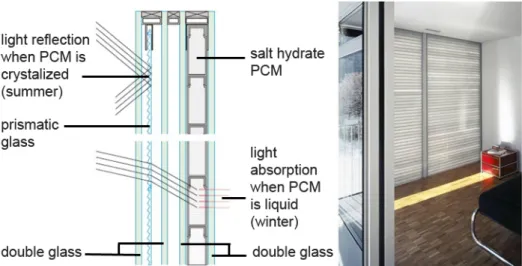
A more high-tech solar-active façade system, this solution consists of a quadruple glass with an inner layer of a salt hydrate PCM that absorbs solar radiation when in the liquid state, releasing heat during recrystallization to the interior space. The system also features a prismatic glass that allows solar radiation to pass in the winter, when the angle of incidence is low, protecting the space from excess
heat in the summer. Developed in Switzerland, the whole system appears as a translucent/transparent wall, but it may certainly be too high-tech to be used in standard building rehabilitation projects. Figure 8 illustrates the main concept.
Figure 8. Left: concept: above/summer, below/winter / Right: Ref. building, Arch. D. Schwarz, CH, 2004 (Source: Source: Treberspurg and Djalili, 2010).
2.2.3.3
Energy façade systems
Another type of multifunctional façade systems, these solutions are designed to integrate optimised building equipments in the façade panels (heating, cooling and ventilation) and/or renewable energy modules, which are mainly used for new construction and office buildings.
2.2.3.3.1 i-modul façade
This system is a building cladding solution consisting of 20 cm thick panels with integrated building services for heating, cooling, ventilation, heat recovery, lighting and sound installations. This solution may be energy effective but also cost forbidding for rehabilitation works, aiming more at private investors looking for a high performance and state of the art new building (Figure 9).
a) b)
Figure 9. Façade module (a); Building in Düsseldorf (b) Source: Treberspurg and Djalili, 2010).
2.2.3.3.2 Photovoltaic (PV) integration
Multifunctional façade systems with photovoltaic modules are solutions already provided by most of the major manufacturers of aluminium framed windows. The available solutions, however, are expensive and usually more appropriate for new construction. The adoption of such systems always require a thorough cost-benefit evaluation in order to assess its feasibility and its use in building rehabilitation will hardly become mainstream due to high price and poor thermal insulation of the façade system.
2.2.3.4
Hybrid façade systems
These solutions feature new "smart materials" such as nano materials, aero gel and vacuum insulated panels integrated in a façade system. As most of these materials are too recent and still need further development, more research is necessary to consider these solutions as a realistic alternative for new construction or even building rehabilitation. Nevertheless, some renovation and new modular building projects have already been executed using Vacuum Insulated Panels (VIP) and the results were promising, as the insulating effect of this kind of solution is 5 to 10 times better than any conventional insulating system. VIP panels consist on an amorphous silica based low thermal conductivity core with added infrared opacifiers encased in a multi-layered metallised barrier film, resulting in a much thinner insulation solution when compared to conventional alternatives - such as Polyurethane Foam (PU),
Extruded Polystyrene or Fiberglass - and reaching a U-value of just 0,10 W/m2K, also much lower than
Figure 10. Comparison between a VIP panel and the most common insulating materials available on the market for the same thermal performance (Source: Kevothermal, 2015).
Figure 10 compares the reduced thickness of a VIP panel with the most common insulating materials available on the market for the same thermal performance: Polyurethane Foam (PU), Extruded Polystyrene and Fiberglass. This lightweight and thin solution is already available in some prefabricated building elements, such as sandwich panels, but one of the main drawbacks is the fragility of the panel, as it may be easily damaged when manipulated on site. Further research must be done also on some aspects, such as its effectiveness on correcting thermal bridges, moisture problems, its fire resistance, the durability of the vacuum (which currently is 30 years), as well as maintenance, manipulation and replacement of single panels. Figure 11 illustrates a pilot project in Germany using VIP insulating panels with precast concrete.
a) b)
Figure 11. Precast Concrete with VIP, Demonstration project in Ravensburg, Germany (a); Façade elements (b) (Source: Source: Treberspurg and Djalili, 2010).
Although the constructive details of these panels are not made available for consultation, it is visible in the right image the existence of an outer thin concrete layer with the VIP panel inserted between this material and an inner OSB (oriented strand board) wood panel. The house resulting from this pilot project is already built and resulted in a “modern and energy-optimized building with passive house standard” (Weinbrenner, 2015), opening a new chapter for the manufacturing of high performance precast concrete insulating panels.
2.2.3.5
Green façade systems
Green façades can be a good solution, both for new construction and building rehabilitation, as they can help prevent overheating by providing shade to the façades and reduce air pollution in the cities by filtering dust and dirt particles while absorbing CO2. Green façades also promote biodiversity and present aesthetically appealing solutions, providing passive thermal control and reducing energy demand for air-conditioning up to 40 - 60% in Mediterranean climates (Haibo, 2013) (Peck et al.,1999) (Perini, 2013). The main challenges are costs concerning the right type of solution to be adopted and regular maintenance. In a specific context green façades may be an option to have under consideration, depending on type of building and client, however in housing rehabilitation its adoption seems to be a more difficult choice. Figure 12 illustrates the visual aspect of a green façade in an urban context.
2.3 The LEGOUSE Project
The Legouse project is based on the assemblage of prefabricated sandwich panels, whose constitution is made by outer layers of steel fibre reinforced self-compacting concrete (SFRSCC) connected by glass fibre reinforced polymer (GFRP) connectors. This project was developed in 2010 by the companies Mota-Engil, CiviTest, the ISISE/University of Minho and PIEP (Barros et al, 2012a) (Barros et al, 2015). Despite being destined to new construction and not building rehabilitation, this project was one of the main influences in the development of this work, as it developed a prefabricated and innovative thermally efficient sandwich structural panel for the structural walls of a modular housing system to be executed at controlled costs, being essentially based on a structural load bearing sandwich panel composed of two outer layers of concrete separated by an inner layer of insulating material (extruded polystyrene panels - XPS) linked by connectors made of composite materials (Lameiras et al, 2013a) (Lameiras et al, 2013b).
The SFRSCC applied in the external layers, of a thickness of 60 mm per layer, has the following composition: Portland cement, limestone filler, type 2 (5-12mm) gravel, sand, Viscocrete superplasticizer and Dramix steel fibres. As this panel was developed to be a load bearing wall destined for new construction, special care was given to avoid thermal bridging between the two external surfaces of the panel investigating the use and efficiency of Glass Fibre Reinforced Polymer (GFRP) connectors, as this composite material presents low thermal conductivity and high resistance. Subsequent tests demonstrated that this solution not only avoided significant loss of thermal performance to the panels, but several pull-out tests performed in laboratory also attested its mechanical efficiency as an alternative to the more common steel connectors (Lameiras et al, 2010, Barros et al, 2012b).
This solution was eventually tested with success in a prototype house built in Rio Maior, Portugal, and proved not only to be highly effective as a load bearing prefabricated structure, but also presented good thermal insulation levels with no thermal bridges between the outer layers of the panel and an excellent mechanical performance, allowing the solution to withstand very high wind load factors due to the panels’ ductile behaviour (Barros et al, 2015). Figures 13, 14 and 15 show the main concept for the modules, the assembling phase and final aspect of the prototype solution.
Figure 13. Proposed building system for sandwich structural panels comprising
thin-walled SFRSCC and FRP connectors: a) components of the devised load-bearing sandwich wall panel; b) cross-section (Source: Barros et al, 2012b)
a) b)
Figure 14. Assembling of the roof (a) and wall (b) modules. (Source: Barros et al, 2015)
a) b)
3 PROPOSED CONCEPT
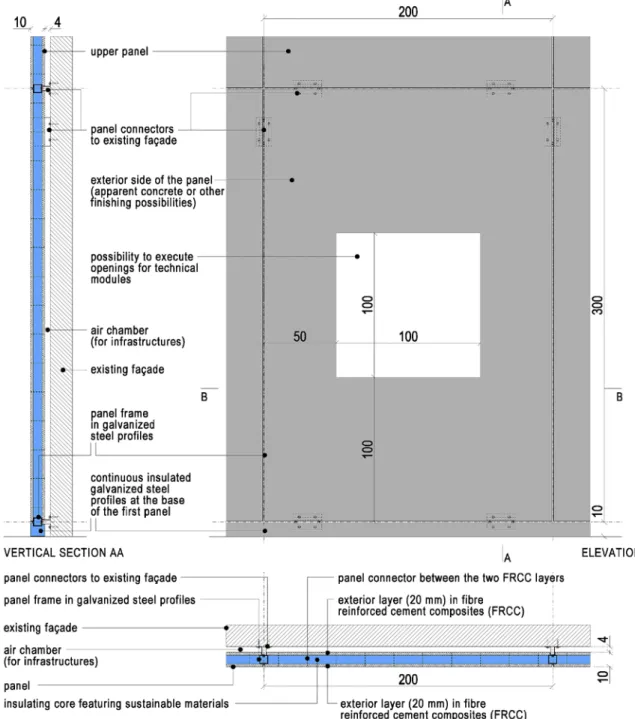
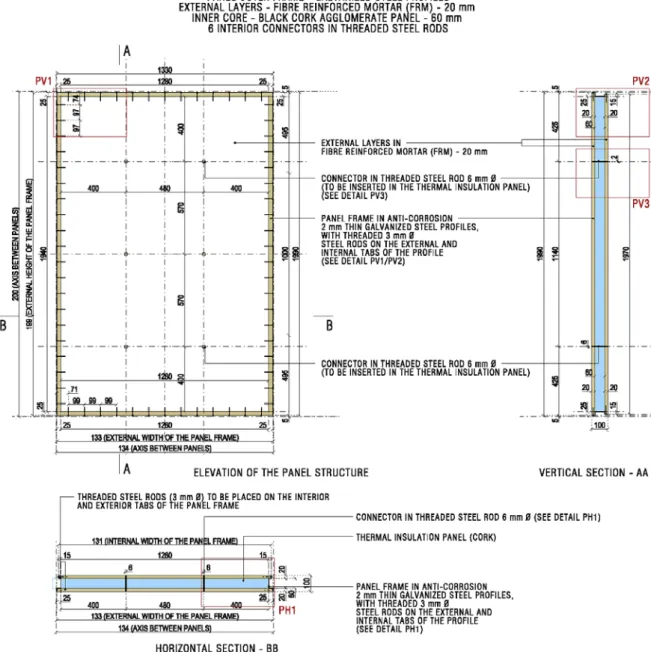
This work is the first step towards the development of a prefabricated customizable sandwich panel based on Fibre Reinforced Cement Composites (FRCC) intended to be used on the multifunctional renovation of buildings by combining FRCC with other materials of complementary performances. Although initially based on the LEGOUSE sandwich structural panels, the main goal was now to reduce the weight of the solution to a minimum, setting the panels’ thickness to just 100 mm and defining a possible maximum dimension compatible with the prefabrication method to be adopted in the future in a mass scale production (robotization), in order to obtain a light modular building solution to be easily manipulated and assembled in the renovation of high multi-storey buildings. As in this process oversized elements are to be avoided, the maximum dimension of each panel to be fabricated at the factory was set to be around 300x200 cm, big enough to cover floor to floor heights but small enough to allow a more simplified assembling of all modular units on the façade. Despite these assumptions, the final layout will always have to be custom made, as it ultimately depends on the proportions and openings of the existing building, but this assembling solution will be versatile enough to allow some panels to include openings for new windows or technical modules or to place them around the existing openings, creating a modulated pattern where more than one layout can be studied before choosing the final version. The proposed layout for the type-panel, including possible openings for technical modules, is presented on figure 16.
Figure 16. Proposed layout for the type-panel, including possible openings for technical modules
(dimensions in cm)
While the solution to be studied at this stage is focused not merely on upgrading the visual aspect of the building, but on the improvement of the overall mechanical behaviour and energy performance of existing façades, ultimately it must be seen also as part of a more comprehensive proposal that should encompass the optimization of the whole building envelope, namely the roof and floor, incorporating energy efficient windows, along with all the other necessary installations to improve the overall
performance of the building, like new water pipes and electricity circuits or ducts for mechanical ventilation with efficient heat recovery systems to reduce heating and cooling needs (BPIE, 2011b). As Nearly Zero Energy Buildings (NZEB) are the ultimate goal for renovation works in Europe after 2020, passive solar design – another essential aspect in this kind of buildings - will also be explored in this work through the study of the installation and compatibility of technical modules in openings to be executed on the panel or integrating them in the panel layout, such as solar collectors for domestic hot water and space heating or photovoltaic panels for electricity generation.
The development of this investigation in a subsequent phase will make possible to assess whether this solution and the proposed materials that constitute the panel, correctly positioned on an underperforming façade, can result in an efficient and competitive system that outperforms the already available solutions.
3.1 New and existing materials for the prototype panels
When designing a sandwich panel to rehabilitate an existing building and improve its level of thermal efficiency it is essential to understand which are the implications of choosing a specific material, so that the final solution can have the highest performance level possible. As each material possesses its own intrinsic characteristics, the main goal is to combine all the different components in a way that the final result is a lightweight, energy efficient and mechanically resistant panel.
The chemical and physical properties of a material are what characterize its mechanical resistance, durability and comfort, helping us to decide about its potential to be part of a constructive solution. The chemical properties are important when assessing the performance of a material against the external agents, such as humidity and air pollution or even fire, determining its resistance and durability. These properties are also essential to classify a material in terms of its environmental footprint, as a very resistant material can also be a wrong option when thinking of safety (e.g. asbestos and cement based roof plates known as “fibrocement”, a life-long but also cancer prone material that are now banned from construction in most countries). By interpreting the chemical components of a material and its embodied energy one can assess the potential risks that it may present to the environment at the end of its lifecycle. Resistant materials with incompatible compositions in the same constructive solution may also cause chemical reactions that ultimately can affect its performance, durability, aesthetics and eventually cause the release of greenhouse gases (Mendonça, 2005). On the other hand, the physical properties of a material can determine its hygrothermal and acoustic
performances and also luminosity. Concerning properties with energy implications, one can consider not only density, transparency and translucency, but also mechanical properties (resistance, elasticity modulus, shear modulus), rheological properties (thermal expansion), thermal properties (conductivity, specific heat) and finally wavelike properties (absorption, reflection, transmission, refraction, emissivity) (Mendonça, 2005). Apart from the chemical and physical characteristics of a material, other essential aspects to have under consideration are the economic and environmental factors, as these will ultimately assess the cost of the solution, as well as its embodied energy, the material resources necessary to obtain it, impact on ecosystems, toxicity levels and recyclability, helping us to determine if the final solution is a sustainable option at all levels - socially, economically and environmentally.
As the manufacture of prototypes with the dimensions set for the type-panel (300x200x10cm) was not possible at this stage, two smaller panels, each with 199x133x10 cm and featuring two different types of Fibre Reinforced Cement Composites (FRCC) were executed and tested to assess their mechanical and thermal properties, as explained more in detail in Chapter 4. However, the process of choosing the adequate materials to be tested on each prototype was note linear, having been considered many possibilities - from the solutions already tested in the LEGOUSE project to more sustainable and economic alternatives – in order to achieve a good balance between lightness, energy performance and the best cost for the proposed solution.
3.1.1 Fibre Reinforced Cement Composites (FRCC)
Technology has recently made possible the use of a wide variety of fibres in Fibre Reinforced Cement Composites (FRCC), a concept that includes all fibrous materials that can be applied to structural applications combined with concrete. It comprehends, for instance, the use of natural fibres as a concrete reinforcement material – an interesting concept that relates to sustainability, but that is still in an early stage of development and testing – but is mostly focused on the benefits of using artificial fibres such as steel, polypropylene and glass fibres in structural reinforcement. As this material is the main component of the proposed sandwich panels, a more detailed investigation is now presented in order to understand the main options that had to be taken in order to find the most adequate solution to be tested in the two prototype panels.
FRCC present a mechanical behaviour that results from a balance of several factors, namely the interfacial bonding and fibre pull-out properties, the parameters of the materials, the distribution of material flaw sizes in the cimentitious matrix, as well as fibre orientation and their dispersion in the
matrix (Pereira, 2012). These are complex parameters to be studied individually, as they perform in a combined manner, being this a research field where investigation is still underway, despite the considerable knowledge already available today about the micro-mechanisms and composite behaviour of these materials.
Concerning structural design, one of the most important is the material’s pseudo-strain hardening ability in tension, translated on the steady crack propagation mode and the real capacity of the composite to withstand increasing tensile loading after cracking under the imposed deformations. This property represents a dual advantage in engineering as while more cracks develop for the same tensile stress, the crack opening for each one is considerably smaller and energy dissipation is higher, resulting in improved durability, high tolerance to damage in tension and in the maintenance of the functional properties of the structural elements (Pereira, 2012). The design of FRCC, in order achieve multiple cracking and strain hardening in tension, is fundamentally related to the different aspects of the mechanical properties of the matrix, the fibres and their interaction, being necessary to thoroughly select the constituents in order to obtain a balance between strong and deformable fibres and the weak and brittle matrix.
Steel Fibre Reinforced Concrete (SFRC) was one of the first examples of fibre reinforcement used in concrete structures and can be described as "any material of cement matrix to which we add short steel fibres" (Barros, 2000). The main advantages of this composite material is that its post cracking residual strength can be much higher than in plain concrete of the same strength class due to fibre reinforcement mechanisms provided by fibres bridging the cracks, which in turn provide a high level of stress redistribution and significant deformation capacity of a structure between crack initiation and its failure, increasing the structural safety, especially in structures of redundant number of supports. When well-conceived, this technique can replace partially or totally steel reinforcement for the flexural and shear resistance of concrete elements. However, fibre geometric characteristics, fibre material properties, concrete properties, and the used method of SFRC application can influence the level of the post-cracking residual strength (Barros, 2011).
Adding the benefits provided by the fibre reinforcement to those resulting from the properties of self-compactness, it is possible to obtain Steel Fibre Reinforced Self-Compacting Concrete (SFRSCC), a high performance material that was used in the LEGOUSE experimental prefabricated house and is adequate for the casting of prefabricated and lightweight sandwich panels (Barros et al, 2005). One of the most important notions obtained from this investigation was that by reinforcing concrete with fibres, the fibre alignment and distribution tends to be determined by the concrete's flow in the
fresh state. As previous works had already shown that fibres are more efficient if they are oriented according to the principal tensile stresses, a recent study investigated how the fibre orientation and distribution affect the post-cracking behaviour of SFRSCC (Abrishambaf et al, 2013). As the casting process can strongly affect the dispersion and orientation of fibres and its mechanical performance, in this study the method adopted to minimize this phenomenon was to cast the panels with a uniform flow velocity, diffusing the mixture radially from the centre outwards, which led to a predisposition to have higher number of fibres orthogonal to the concrete flow direction, resulting in a more efficient solution. Having in mind this positive result, this methodology was also pondered to be used in the casting of the two prototype panels, but considering that this process would be exclusively manual, it was assumed that the final result would necessarily differ, eventually affecting the ideal dispersion and orientation of the fibres in the mixture. The evaluation if this phenomenon could also eventually affect the panels’ mechanical performance would be something only possible to assess upon their execution and testing.
Concerning prefabrication, research conducted under the PABERFIA project investigating a method for conceiving cost competitive SFRSCC and studying lightweight sandwich panels executed in this material pointed out that "when installed in building façades, the panel’s flexural strength is the principal design property since significant bending moments result from wind loading, which has the greatest impact on the most unfavourable load combination" (Barros, 2005). After testing different compositions for SFRSCC, this experimental project concluded that not only the panel's structural configuration and ductility provided by the fibres allowed a high stress redistribution level and increased punching resistance, but the final designed composition was also able to meet all the requirements of self-compatibility, validating its applicability to industrial production. In the end, the tested panel proved to have sufficient structural properties to withstand wind actions and punching, even when its thickness reached at times only 30 mm - coming close to the 20 mm that the first prototype panel (panel 1) will be featuring.
Having in mind that the this work is focused on the development of a non-structural modular panel, the use of two different formulations of FRCC on both prototypes will allow reducing the volume and weight of concrete, while keeping its impact resistance and crack-width control capacity through the addition of fibres, allowing great geometric and dimensional freedom and resulting in a lightweight façade renovation solution. Considering the panels and previous results already obtained on the LEGOUSE project using SFRSCC, it is also expected that the FRCC formulations now used for both prototype panels will develop a higher post-cracking tensile strength than the stress at cracking