URBAN AND ENVIRONMENTAL MANAGEMENT CHALLENGES
CONSIDERING TRANSFORMATIONS IN PROPERTY LAW IN BRAZIL
SANDRA REGINA MOTA SILVA1
BERNARDO ARANTES DO NASCIMENTO TEIXEIRA2
Introduction
In Brazil, there are different types of property rights. Among them, the Civil Code of 1916 recognized literary, scientific and artistic types, as well as those linked to real estate property rights. Throughout the twentieth century, there was a transformation concerning the treatment received by all of them, however land and property ownership encountered greater resistance, notably due to the traditional individualist and inviola-ble view attributed to this type of patrimony. Nevertheless, despite the staying power of paradigms stemming from liberal legalism, substantive transformations can be identified in the concepts that are based on the right to property (FERNANDES, 2004, 2008a, b, 2010; SILVA, 2011).
In order to analyse changes in the notions of law that have governed urban, terri-torial and environmental management policies, normative and constitutional apparatus was used as the guiding principle, as it initiated a discussion led by changes in the contents of the legal repertoire revealing contexts, contradictions and trends over time.
Considering the structural role in relation to other Brazilian laws, the view on the series of the Brazilian constitution from the first Republican Constitution of 1891 up to the most recent one of 1988, witnessed important transformations throughout the period. In addition to new understandings regarding the right to property, the same transforma-tive conditions can be found in legislation that governs urban and environmental policy. Situations can be identified in these topics that range from an individual right, full and absolute, going through a relativization process associated with the notions of public or collective interest, to the most recent concepts found in the Federal Constitution of 1988 in relation to the social right to housing; to rights arising from the principle of the social function of the city and of property, as well as to the ecologically balanced envi-ronment and common use of the people.
1. Architect and Urbanist graduated at FAU/USP; PhD in Urban Engineering at UFSCar; Lecturer at the Department of Civil Engineering at the Federal University of São Carlos (Brazil); e-mail: [email protected].
This paper discusses these transformations, bringing to light some of the key ele-ments of these relations, which are often ambiguous and contradictory. Different legiti-macies, competing or overlapping, can be produced when developing arguments based on different legal fields. The understanding of this simultaneity is an important factor to be considered in approaches concerning disputes and conflicts of use and appropriation of public, private, collective or environmentally protected spaces.
The aim of this article is to problematize the question based on the analysis of a normative repertoire comprising all Republican Federal Constitutions, as well as the urban and environmental legislation considered relevant for the objectives in discussion. Thus, this article seeks to identify and discuss transformations brought about in the ap-proaches of the right of ownership, especially regarding aspects applicable to territorial and environmental management.
Property rights in territorial and land issues
In the Brazilian context of a largely agrarian economy, although there have already been incipient questions, private individual ownership has maintained its hegemony, strongly linked to Civil Law. These fundaments were clearly stated both in the constitu-tional approaches of 1891 and 1937 and in the first Federal Decrees of the 1930s, issued for the purchase and sale of lots paid in installments. Decree-Law 58 of 10/12/1937 and Decree 3.079 of 15/09/1938, based on interpersonal relations and civil law, were devoid of public interest and urban aspects connotations.
The legal texts referred to the property maintained in “fullness” or to the “assured” property right, using the purchase and sale agreements registered in Real Estate Registry Offices (crucial institutions for the mediation and legitimization of these operations) as a support to the guarantee of business.
The Decree of 1937 attributed similar treatment to properties of “rural land or urban land”. This isonomy of urban/rural treatment reflects the inexistence of concerns regarding the control of cities sprawling towards the countryside. The lack of a natio-nal regulation, which would surpass typical procedures of commercial transactions for purchasing and selling lots, created a regulatory gap for urban and land aspects of land subdivision. This lack, which appeared exactly in a period when there was accelerated urban sprawl, resulted in a few legal regulations from a municipal perspective, usually circumscribed to larger urban centres.
In the context of the collective debate, this gap sensitized representatives from technical and administrative areas, motivated by the fight against clandestinity and by ensuring donations of public areas in new real estate developments.
When researching the seminal conditions of legislation regarding land subdivision in Brazil, Leonelli (2010) observes that, despite the validity of the Decrees for regulating these enterprises, in the 1930s, from the 1940s onwards, the demand for a federal law that regulated the matter, was already clearly recognised.
of municipalities, linking the provision of infrastructure to the public interest. From the perspective of avoiding disorderly urban sprawl, and based on legal grounds, it was already alleged that “property came about conditioned by the public interest and defended the application of restrictions on property rights” (LEONELLI, 2010, 65).
If, at first, the critical perception of the correlation between public interest and private property came about circumscribed to the technical and administrative means linked to urban policy, it also expanded to the normative sphere later. Within the scope of constitutional frameworks, incorporating the notion of “public interest”, “public utility”, “social interest” and “population welfare” can be identified from the Federal Constitution of 1934 and subsequent versions.
It is worth noting that in the field of law, the reconfiguration of the sense of public interest incorporated mechanisms to establish consensus to deal with disputes in public administration. Invoking public interest, as an instrument of conflict resolution, has made room for interaction and dialogue.
Conceptually, the literature on legal matters highlights the diversified character of the public interest, as the basis of consensual practices considering various collective interests. The understanding of the supremacy of public interest in relation to other interests of society is part of the gradual incorporation of Administrative Law in urban management practices (MEIRELLES, 2007; SILVA, 2012).
According to Meirelles (2007), legally, the understanding of social interest and public utility is conditioned to a convenience based on the best use of the property, in the perspective of the best benefit of a given community deserving public support.
However, within the framework of practices, the assimilation of these understan-dings did not take place at a fast pace. The first demands for formalization of the land subdivision, followed by compulsory licensing with municipal governments, were the object of much resistance on the part of the entrepreneurs.
However, regulations have now included civil, urban, administrative and penal standards, in the expectation of corresponding to growing urbanization. In the federal legislation of land subdivision in the 1960s (Decree 271 of 28/02/1967), urban control was already manifested through some incipient mechanisms to control clandestinity, land irregularity, providing infrastructure and the constitution of public areas (LEONELLI, 2010; SILVA, 2011).
Although surrounded by much controversy, in the late 1970s, Federal Law 6.766 of 19/12/1979 brought advances in reorganizing previous legal apparatus, incorporating more urgent urban and land issues, after a few decades of intensive urban sprawl. Still in force, its clauses have been updated, mainly through Federal Law 9785 of 29/01/1999.
Considering the gradual rise of urban law, collective social rights, the right to the city, the right to housing and the right to property have emerged, creating conditions for incorporating the constitutional principle of the social function of the city and of property in 1988. Dallari (2007) argues that the concept of social function was already the object of study in treaties published before the First World War, based on the basal concept that “property entails obligations.” It also alleges that innovation brought about by the 1988 Constitution resides in the institution of a “parameter for gauging its understanding [...] the set of measures to be adopted or actions to be undertaken, contained in the master plan” (DALLARI , 2007, p.25).
The Federal Constitution of 1967 linked this principle to economic issues, as set out in Art. 157, however, the 1988 version extended its meaning to land and urban policy relations, applicable to every property and city (BRASIL, 1988).
It is worth mentioning that, despite the advances in many social rights established in the 1988 Constitution, such as the right to education, health, work, leisure, security, among others in Art. 6, the right to housing was incorporated only through Constitutional Amendment No. 26 of February 14, 2000, by the initiative of the National Forum for Urban Reform. International references have pointed out this late incorporation, as the right to housing has been recognized by the General Assembly of the United Nations since 10/12/1948 when the Universal Declaration of Human Rights was adopted (SILVA, 2011).
Among the different types, the right of ownership concentrates, in a more ingrai-ned way, on Brazilian sociocultural values, as an expression of affirming unquestionable autonomy and security. However, creating this expectation, as a horizon to be socially universalized, within the scope of housing policy, has been questioned. Such allegations emphasize the substantial differences between the right to housing and the right to pro-perty (FERNANDES, 2008 a, b, MARCUSE, 2008).
In Brazil, the right to property has been hailed as an achievement in terms of setting up public housing access programs. However, there is no consensus as to its effectiveness as a policy of social interest. Its conception as a policy of obtaining titles and individual records is not defended with the same intensity as the right to housing, the right to the city or collective rights. The critique of prioritization in obtaining property titling shows the significant difference between the policies arising from these two types of rights, insofar as they have different purposes.
In cases of land regularization, there are risks of the use-value to be supplanted by the exchange value, stimulating the irregular commercialization of newly acquired pro-perty, perpetuating informality in new occupations. Marcuse (2008) alleges that among the benefits of property rights and the ills of illegality, there are alternatives to securing possession, without affecting social cohesion in consolidated communities and without incurring the misconception of the formulation of rights of use as if they were property rights. These considerations have sparked off important questions related to the debate on housing policy, mainly for the clear priority in offering programs aimed at titling and acquiring property, heightening social expectations based on this model.
housing property law, although it also includes land tenure, urban planning and envi-ronmental issues.
Known as the “Territorial Responsibility Law”, it seeks to incorporate and tackle more in-depth questions of the most popular sectors, related to the right to housing, land regularization, the social function of the city and property. On the other hand, it also includes new and controversial forms of land subdivision, as in the case of urban condo-miniums (gated communities) or closed housing developments, housing models resulting from real estate market pressures. In this sense, as a Bill, it has assimilated the demands of different social strata, both from segments affected by housing movements and from the business sectors involved in the legitimization of condominium projects with access control (SILVA, 2011; SILVA et al, 2015).
In relation to previous legislation, one of the innovative aspects of this Bill is the emphasis given to land regularization processes, with a view to overcoming the informal nature of urban settlements. The great dilemma of the conflict arising from informal settlements and environmental preservation was addressed for the first time in legisla-tion aimed at land subdivision. However, although it is fundamental for updating the legal repertoire of support for urban/environmental policies, its process has not yet been prioritized in decision-making centres of the congressional sphere.
Property rights considering socio-environmental issues
As in real estate issues, in land and property matters, from the point of view of the natural environment and exploitation of natural resources, property rights have also undergone transformations that have given greater importance to public interests, col-lective interests and especially diffuse interests.
Volatility in the concept of diffuse interest or entitlement has often been applied to environmental issues. According to GASTALDI (2014), in view of their indeterminacy of the subjects involved, situations of uncertainties are linked to conjunctural, generic, accidental or changeable factors, unlike the conditions of collective rights, although both are transindividual.
Historically, among the first legislations of the 1930s, the Forest Code (Decree 23.793 of 23/01/1934) already emphasized the public dimension, but from a nationalist point of view. It claimed that the forests within the national territory are “a good of common interest to all the inhabitants of the country”. Even if in an incipient, pragmatic and utilitarian way, it established limitations to the right to property, depending on the type of forest or exploration to be practiced. A literal interpretation could consider that Brazilian forests would not be privately owned, however, despite the legal text, private property remained strong in terms of its autonomy. Although these forestry devices did not guarantee the desired preservation, they were of fundamental importance for the formation of the first national parks (DRUMMOND, 1997; SILVA, 2011).
the prevalence of autonomy within private property. In the case of water, there was a legal ambiguity, because the Decree guaranteed border owners the preference for water bodies, but, on the other hand, it also guaranteed access to all, due to the principle of service to “the first necessities of life” or the “superior public interest”. In addition to the privileges of border owners, using water for economic activities was valued and prioritized, especially for commercial navigation and hydroelectric power generation, reinforcing conceptions based on the exploration of water as an abundant resource.
In the 1930s and 1940s, the utilitarian approach to water also rebounded in relation to fauna, despite the creation of the first reserves and refuges that began to be foreseen in the Hunting Code of 1943. This Decree-Law oscillated between protection and the exploitation of fauna, since hunting was still a usual practice as a commercial and sporting activity. In addition to the autonomy for exercising such activities in private territories, the classification of useful, ornamental, harmful animals also prevailed, facilitating the legitimization of destroying wild fauna. While some were endowed with the use and commercialization potential, others could be annihilated by alleging loss and hindering the good performance of agrarian activities.
The strength of private property, prioritization of economic activities and the utilitarian character of natural resources remained in the legislation of the 1960s, al-though some conceptual references began to undergo transformations as a result of the transformative agenda of grassroots reforms that emerged in the early years 1960. Even with the limitations arising from the military regime, after 1964, forest policy expanded its regulation to other forms of permanent preservation vegetation, in addition to forestry. Hunting gradually became an unpractised activity failing to report to the Hunting Code, radically and qualitatively changing its approach, making room for a Law to Protect Wildlife, Federal Law 5.197 dated 03/01/1967 (SILVA, 2011).
In the same period, however, from the point of view of basic sanitation, the Natio-nal Sanitation Policy, Federal Law 5.318 of 09/26/1967, regulated the provision of these services as part of a political and institutional reordering of the State. The model based on state-owned and mixed-economy enterprises, as executive entities of services, made it difficult to interact between sectoral and territorial policies, reducing possibilities for integration with environmental policies. At the institutional level, the National Sanitation Council prioritized technical, administrative and economic efficiency to ensure the return on investments made. In this equation there was no room for the unsolvable sectors of society, in such a way that the perspective of universalizing access was even considered (SILVA, 1999; SILVA, 2011).
Four decades later, the enactment of Federal Law 11.445 of 05/01/2007, which provides National Guidelines for Basic Sanitation, was fundamental to revert, at least at the level of the legal apparatus, the exclusionary logic of solvable demand, establishing as one of its fundamental principles the opposite: universal access to basic sanitation.
of sectoral and complementary norms, have contributed to the consolidation of an en-vironmental right that has a different rationality from previous periods. The turnaround occurred in conceptual terms of interpreting the environmental patrimony, with reflexes in participation systems, after the constitution of SISNAMA (National Environment System), as well as the institution of mechanisms of preservation, conservation, recovery, prevention and control of environmental assets.
In addition, the change in the forms of democratization of access to environmen-tal patrimony also contributed to the relativization in the right to private property. The concept of an environment as a “public patrimony of collective use” has led to many consequences, driven by the increased perception that involves benefits and burdens of the ways of appropriating this environmental patrimony. On the one hand, the rights to enjoy environmental goods and, on the other, the duty not to provoke and the right not to suffer diffuse effects due to environmental impacts and damages, requiring the imposition of limits to inviolability and the free disposition of private property.
In the same perspective, Federal Law 9.433 of 08/01/1997, which established the National Water Resources Policy (PNRH in Portuguese), defined water as a limited good with economic value, which should be a “public domain” and a priority for human consumption and animal welfare. A little more than six decades separate the conception that considered the typology of “particular waters”, as established in the Water Code of 1934, reflecting a period in whose scope of considerations did not foresee the risk of scarcity or loss of water quality.
Currently, in the same way that the use control was implemented, through granting priorities, the law began to recommend its universalization. Another means of relativi-zing the supremacy of conventional private property was the democratic nature of the Watershed Committees, with representatives from different sectors of civil society such as Non-Governmental Organisations (NGOs) defending diffuse and collective rights and indigenous or traditional communities, in cases of involvement of their lands.
However, in spite of the unequivocal achievements of the water resources policy, since 1997, contradictory relations remain, both in the field of socio-environmental conflicts and in the juridical-institutional sphere that affects the planning units of di-fferent scales. In the first case, the expansion of control brings a contradiction fueled by two distinct logics: on the one hand, the environmental impacts caused by irregular settlements and, on the other hand, the social risk faced by geotechnical weaknesses or precarious infrastructure. As a backdrop to the conflicts arising from this dubiousness, the challenge of reconciling two constitutional rights: on the one hand, the right to housing and, on the other, the right to an ecologically balanced environment (ROCCO, 2002; MARTINS, 2006; SILVA, 2011).
Due to the fact they are segmented, such territorialities are delimited by criteria established according to inconsistent logic between each other, insofar as the effects of environmental problems go beyond political and administrative boundaries leading to consequences that are not always predictable. These contexts reinforce the need to design operational and institutional mechanisms that induce the production of interactions [...] favoring a territorial management that incorporates environmental policy constraints and, vice versa, environmental management that incorporates elements of urban and territorial policy (SILVA, TEIXEIRA, 2012, p. 11).
Other authors argue that despite the “concomitances”, there remain gaps in the procedures and instruments that ensure a more articulated relationship in territorial and environmental policy practices (SCHULT et al., 2009, p.2.) Although there are contra-dictions in socio-environmental conflicts, difficulties in dealing with different scales of action, institutional limitations to apply many of the legal provisions already in force, the transformation of private property rights, over the last eight decades, points to their relativization considering new paradigms that have extrapolated the individual sphere.
Types of conflicts in the generations of law
Underlying the types of rights, conditions can be identified that lead to different interpretations. One of them refers to the clash between two antagonistic paradigms: on the one hand, the liberal legalism of the Civil Code and its unfolding, on the other, the principle of the social function of property and the public interest. According to Fernandes (2006, 2008b), in order for the side that imposes limits on the inviolable right of private property to prevail, it would be necessary to overcome the traditional legal-urbanistic order based on the “civilist-privatist” or “patrimonialist” view of property.
Another ambiguous situation stems from divergences between Urban Law and Environmental Law. The very notion of complementarity between diffuse and collective law does not always occur linearly, insofar as the notion of diffuse law applies more directly to Environmental Law, since it does not include the delimitations of certain collectivities. On the other hand, Urbanistic Law is more associated to the notion of collective law, which makes it possible to identify the subjects or groups involved more explicitly.
Differentials in the field of Rights are also reflected in the tense relations found in the duality in management of the built environment and the natural environment, arising from their distinct genesis, due to the specificity of their disciplinary fields, their research objects and areas of operation.
The simultaneity of legitimacy conditions makes it difficult to resolve conflicts as interpretations are made which are incompatible with each other, although based on arguments considering legal protection. These uncertain factors have brought challenges to the fields of urban and environmental management, thus identifying the types of rights found in each context can contribute to the equation of the issues involved.
used for the first time. The use of the term was intended to support, metaphorically, a supposed evolution in the scale of rights from the main motto of the French Revolution (liberty, equality and fraternity). However, the author emphasizes that one generation cannot exclude the other, i.e., the different types of law overlap or complement one another. The expression has been criticized for conveying a false impression of gradual replacement from one generation to another. Lima (2003) states that there is no accu-mulation process of different spheres of law, but a succession in which all are enforced.
Based on these understandings, the pertinence of the contribution of these in-terpretations in the present discussion is observed. The occurrence of different types of rights, applicable to the same case and, therefore concomitant reinforce contradictions in different areas of disputes within the scope of territorial and environmental policies and their consequences of a practical and reflective nature.
In this sense, Bobbio (2004) produced an exercise in exploring the types of law from a chronological logic that outlined some processes of acquisition of new rights that were, historically, added to struggles and social achievements. The author begins his proposal of classification with the individual right, consolidated at the end of the eighteenth century with the French Revolution, as part of the first generation, considering the conquest of individual liberties and formal equality before the law.
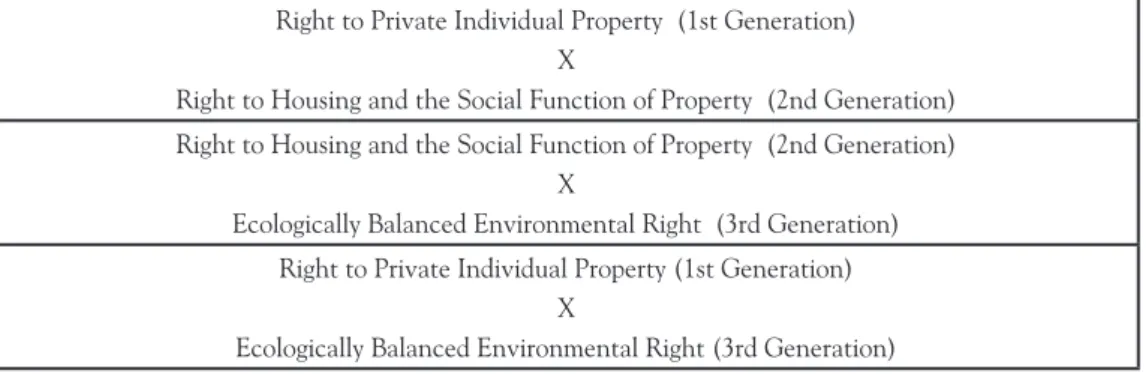
In the second generation, it places the collective rights that emerged in the central countries in response to the social and economic needs arising from industrial society, in which State intervention was necessary to ensure the material conditions of social welfare. In the third generation of rights, it identifies diffuse rights, basically related to environmental problems, arising from the exploitation of the physical base of the planet, enhanced by the increasing availability of technological resources. In this dimension there is a process of depersonalization of the rights of the first and second generations, in that their members are not restricted to the field of individual rights and may not fit into the collective. Thus, three main relationships of potential conflict that are dualities of con-frontation and have recurred in planning and territorial and environmental management practices are identified. Table 1 shows how to systematize some of these types of conflict.
Table 1 – TYPES OF CONFRONTATION AND GENERATIONS OF RIGHTS
Right to Private Individual Property (1st Generation) X
Right to Housing and the Social Function of Property (2nd Generation)
Right to Housing and the Social Function of Property (2nd Generation) X
Ecologically Balanced Environmental Right (3rd Generation)
Right to Private Individual Property (1st Generation) X
Ecologically Balanced Environmental Right (3rd Generation)
The conflict configured in the first type of confrontation shows different forms in opposing private property and the social function of property. Among them, the recurrent conflicts related to the collective occupations of private, empty or abandoned properties, promoted within the scope of social housing movements, occurring in peripheral areas as well as in buildings located in central metropolitan areas.
Generally, the second type is the same type of social deficiency, however the terri-torial object in dispute may involve environmentally protected areas or areas of social and environmental risk, with different causes and consequences. Among them, housing and land use informality sprawl in public water supply areas or in areas where there is a risk of soil or water contamination, as well as areas of flood risk or landslides. Removal and resettlement actions have been more frequent in situations that confine the effectiveness of imminent risks to the residents. However, when there is a lack of this evidence, these disputes are often made even more complex by contrasting two rights recognized by the Federal Constitution of 1988: the social right to housing and the right to the environ-mentally balanced environment.
From an environmental perspective, references to future generations and to na-ture itself have recurred in documents and academic productions as the new subjects of law that have emerged from constructing environmental citizenship processes (SILVA--SÁNCHEZ, 2000). However, contrary to such an abstract perspective of future and nature, Boaventura de Souza Santos defends a new rationality based on the pressing social and collective demands of the contemporary world (SANTOS, 2003: 3, 4). In these two views, the disputes between two priorities that pose challenges to procedures and actions of urban and environmental management are opposed.
The conflict of the third type may involve private economic interests and envi-ronmental protection, either by the appropriation or exploitation of natural resources, or by the impacts arising from implementing certain projects. These disputes are usually addressed through environmental licensing processes and studies and reports that are diagnostics and establish compensation, recovery, control or mitigation measures.
These relations of conflict show that, although these types of rights were in different periods, based on socially conquered transformations, all of them preserve their legitimacy and remain active within urban and environmental policies.
This analytical construction, linked to a historically determined temporal scale, in which the dimension of the law extends to new subjects of tutelage, contributes to the discussion of the right to property and other rights present in urban and environmental management, key elements of public policies cities applicable in cities, metropolitan areas and environmentally protected areas.
Final considerations
often appear concomitantly and competitively, increasing the complexity of the integrated treatment of interfaces that permeate territorial and environmental issues.
In environmental policy conflicts that often involve diffuse rights, the inconsistency of identification makes the objective determination of causal origins and involved sub-jects more complex, subverting the rationality that underpins private law and sometimes also collective law. Intangibility of diffuse rights is reflected in the frequent dissociation between the urban and environmental legal order, since the latter usually relies on an abstract, naturalized and landless environment, making it difficult to cope with socio--environmental conflicts.
Identifying and discussing the conflicts and contradictions underlying the types of private, collective or diffuse law, unfolding in the constitutional rights to housing and the ecologically balanced environment, among others, provide possibilities to construct socioenvironmental convergences in conflicts resulting from the production, appropriation , use and occupation of the territory.
The recognition of the different legitimacies embedded in generations of rights, coupled with the scale of prioritization of the subjects involved, as well as the integrated and articulated approaches of the different planning units, are essential elements to shape territorial and environmental policies, in addition to the rhetorical plan.
The equations of these variables found in the different fields of law, involving private property and challenging urban and environmental issues can contribute to the constitution of validating elements applicable to the different activities, practices and reflections, which congregate the field of action of planning and environmental urban management.
References
BOBBIO, N. A era dos direitos. Trad. Carlos Nelson Coutinho. Rio de Janeiro: Campus, 2004. 219 p.
DALLARI, A. A. Solo criado: constitucionalidade da outorga onerosa de potencial construtivo. In: DALLARI, A. A.; DI SARNO, D. C. L. (Coord.). Direito urbanístico e ambiental. Belo Horizonte: Fórum, 2007. p. 19-47.
DRUMMOND, J. A. A visão conservacionista (1920-1970). In: SVIRSKY, E.; CA-POBIANCO, J. P. R.; PÁDUA, J. A. (Orgs.). O ambientalismo no Brasil: passado, presente e futuro. São Paulo: Instituto Socioambiental e Secretaria de Meio Ambiente (SP), 1997. p. 19-26.
FERNANDES, E. Impacto socioambiental em áreas urbanas sob a perspectiva jurídica. In: MENDONÇA, F. (Org.). Impactos socioambientais urbanos. Curitiba: Ed. UFPR, 2004. p. 99-127.
______. Reforma urbana e reforma jurídica no Brasil: duas questões para reflexão. In: COSTA, G. M.; MENDONÇA, J. G. (Orgs.). Planejamento urbano no Brasil: trajetória, avanços e perspectivas. Belo Horizonte: C/Arte, 2008a. p. 123-135.
______. Do Código Civil ao Estatuto da Cidade: algumas notas sobre a trajetória do Direito Urbanístico no Brasil. In: VALENÇA, M. M. (Ed./Org.). Cidade (i) legal. Rio de Janeiro: Mauad, 2008b. p. 43-61.
______. O Estatuto da Cidade e a ordem jurídico-urbanística. In: CARVALHO, C. S.; ROSSBACH, A. (Orgs.). O Estatuto da Cidade comentado. São Paulo: Ministério das Cidades, Aliança das Cidades, 2010. p. 55–70.
GASTALDI, Suzana. Direitos difusos, coletivos em sentido estrito e individuais ho-mogêneos: conceito e diferenciação. In: Âmbito Jurídico, Rio Grande, XVII, n. 120, jan 2014. Available at: <http://www.ambito-juridico.com.br/site/?n_link=revista_arti-gos_leitura&artigo_id=14164>. Accessed on: Aug 2016.
LEONELLI, G. C. V. A construção da lei federal de parcelamento do solo urbano 6766: debates e propostas do início do século XX a 1979, 308 f. Tese de Doutorado apresentada ao Departamento de Arquitetura e Urbanismo da Escola de Engenharia de São Carlos, da Universidade de São Paulo, São Carlos, 2010.
LIMA, G. M. Críticas à teoria das gerações (ou mesmo dimensões) dos direitos funda-mentais. Revista Jus Navigandi, Teresina, ano 8, n. 173, 26 dez. 2003. Disponível em: <https://jus.com.br/artigos/4666>. Accessed on: May 2016.
MARCUSE, P. O caso contra os direitos de propriedade. In: VALENÇA, M. M. (Ed./ Org.). Cidade (i) legal. Rio de Janeiro: Mauad, 2008. p. 9-19.
MARTINS, M. L. R. Moradia e mananciais: tensão e diálogo na metrópole. São Paulo: FAUUSP/Fapesp, 2006. 206 p.
MEIRELLES, H. L. Direito Administrativo Brasileiro. 33ª ed. São Paulo: Editora Ma-lheiros, 2007.
ROCCO, R. (Org.). Legislação brasileira do meio ambiente. Rio de Janeiro: DP&A, 2002. 283 p.
SANTOS, B. S. Para uma sociologia das ausências e uma sociologia das emergências. In: ______ (Org.) Conhecimento prudente para uma vida decente. “um discurso sobre as ciências” revisitado. Porto: Afrontamento, 2003. Available at: <http://www.ces.uc.pt/ bss/documentos/sociologia_das_ausencias.pdf> Accessed on: Feb. 2011.
SCHULT, S. I. M.; JACOBI, P. R.; GROSTEIN, M. D. A articulação entre a gestão de recursos hídricos e a gestão do território: um estudo de caso na bacia hidrográfica do Rio Itajaí (SC). In: Anais do XIII Encontro da ANPUR, Florianópolis (SC), 2009.
SILVA, R. T. A regulação e o controle público da infraestrutura e dos serviços urbanos no Brasil. In: DEÁK, C.; SCHIFFER, S. R. (Orgs.) O processo de urbanização no Brasil.
SILVA-SÁNCHEZ, S. S. Cidadania ambiental: novos direitos no Brasil. São Paulo: Humanitas / FFLCH / USP, 2000. 203 p.
SILVA, G. A. A reconfiguração do conceito de interesse público à luz dos direitos funda-mentais como alicerce para a consensualidade na administração pública. In: Âmbito Jurí-dico, Rio Grande, XV, n. 100, maio 2012. Available at: <http://www.ambitojuridico.com. br/site/?n_link=revista_artigos_leitura&artigo_id=11624>. Accessed on: Aug. 2016.
SILVA, S. R. M. Transformação das abordagens urbanísticas e ambientais na política territorial brasileira: confluências e divergências no direito de propriedade, nos instru-mentos de gestão e no desenho institucional, 392 f. Tese de Doutorado apresentada no Programa de Pós-Graduação em Engenharia Urbana. Universidade Federal de São Carlos. São Carlos, 2011.
SILVA, S. R. M. S.; TEIXEIRA, B. A. N.; Desafios das escalas de gestão territorial e am-biental: avaliação dos marcos legais e de unidades de planejamento no contexto do Brasil e do estado de São Paulo. In: Anais do 5° Congresso Luso Brasileiro para o Planeja-mento Urbano, Regional, Integrado e Sustentável - PLURIS 2012, Brasília (DF), 2012.
SILVA, S. R. M.; SIQUEIRA, B. V.; BREDA, T. V.; SILVA, R. S. Mutações nas dinâmicas socioespaciais das periferias urbanas: reflexos na diversidade urbana e na composição social. In: UR Cadernos FA/UL/ (Re)inventar a Cidade em Tempos de Mudança. n. 8, Lisboa, 2015.
Related Legal Documents
BRASIL. Lei Federal nº 3.071 de 01/01/ 1916. Estabelece o Código Civil. Rio de Janeiro, 1916. Available at: <http://www.planalto.gov.br/ccivil_03/leis/l3071.htm>. Accessed on: May 2015.
BRASIL. Decreto nº 23.793 de 23/01/ 1934. Aprova o Código Florestal. Rio de Janeiro, 1934. Available at: <http://www.planalto.gov.br/ccivil_03/decreto/1930-1949/d23793. htm>. Accessed on: May 2015.
BRASIL. Decreto nº 24.643 de 10/07/1934. Decreta o Código de Águas. Rio de Janeiro, 1934. Available at: <http://www.planalto.gov.br/ccivil_03/decreto/d24643.htm >. Ac-cessed on: May 2015.
BRASIL. Constituição da República dos Estados Unidos do Brasil de 16/07/1934. Rio de Janeiro, 1934. Available at: <http://www.planalto.gov.br/ccivil_03/constituicao/ constituicao34.htm>. Accessed on: May 2015.
BRASIL. Constituição dos Estados Unidos do Brasil de 10/11/1937. Rio de Janeiro, 1937. Available at: <http://www.planalto.gov.br/ccivil_03/constituicao/constituicao37. htm>. Accessed on: May 2015.
BRASIL. Decreto nº 3.079 de 15/09/1938. Regulamenta o Decreto-Lei nº 58 de 10 de dezembro de 1937, que dispõe sobre o loteamento e a venda de terrenos para pagamento em prestações. Rio de Janeiro, 1938. Available at: <http://www.planalto.gov.br/ccivil_03/ decreto/1930-1949/D3079.htm>. Accessed on: May 2015.
BRASIL. Decreto-Lei nº 5.894 de 20/10/1943. Aprova e baixa o Código de Caça. Rio de Janeiro, 1943. Available at: <http://legis.senado.gov.br/legislacao/ListaPublicacoes. action?id=7488>. Accessed on: May 2015.
BRASIL. Constituição dos Estados Unidos do Brasil de 1809/1946. Rio de Janeiro, 1946. Available at: <http://www.planalto.gov.br/ccivil_03/constituicao/constituicao46. htm>. Accessed on: May 2015.
BRASIL. Lei nº 5.197 de 03/01/1967. Dispõe sobre a proteção à faunae dá outras pro-vidências. Brasília, 1967. Available at: < http://www.planalto.gov.br/ccivil_03/leis/l5197. htm >. Accessed on: May 2015.
BRASIL. Constituição da República Federativa do Brasil de 24/01/1967. Brasília, 1967. Available at: <http://www.planalto.gov.br/ccivil_03/constituicao/constituicao46.htm>. Accessed on: May 2015.
BRASIL. Decreto-Lei nº 271 de 28/02/1967. Dispõe sobre loteamento urbano, respon-sabilidade do loteador concessão de uso e espaço aéreo e dá outras providências. Brasília, 1967. Available at: <http://www.planalto.gov.br/ccivil_03/decreto-lei/del0271.htm>. Accessed on: May 2015.
BRASIL. Lei nº 5.318 de 26/09/1967. Institui a Política Nacional de Saneamentoe cria o Conselho Nacional de Saneamento. Brasília, 1967. Available at: <http://www.planalto. gov.br/ccivil_03/leis/1950-1969/L5318.htm>. Accessed on: May 2015.
BRASIL. Lei nº 6.766 de 19/12/1979. Dispõe sobre o parcelamento do solo e dá outras providências. Brasília. 1979. Available at: <http://www.planalto.gov.br/ccivil_03/leis/ l6766.htm>. Accessed on: May 2015.
BRASIL. Lei nº 6.938 de 31/08/1981. Dispõe sobre a Política Nacional do Meio Ambien-te,seus fins e mecanismos de formulação e aplicação, e dá outras providências. Brasília, 1981. Available at: <http://www.planalto.gov.br/ccivil_03/leis/l6938.htm>. Accessed on: May 2015.
BRASIL. Constituição da República Federativa do Brasil de 05/10/1988. Brasília, 1988. Available at: <http://www.planalto.gov.br/ccivil_03/constituicao/constituicao88.htm>. Accessed on: May 2015.
at: <http://www.planalto.gov.br/CCivil_03/leis/L9785.htm>. Accessed on: May 2015. BRASIL. Lei nº 10.257 de 10/07/2001 (Estatuto da Cidade). Regulamenta os arts. 182 e 183 da Constituição Federale estabelece diretrizes gerais da política urbana e dá outras providências. Brasília, 2001. Available at: <http://www.planalto.gov.br/ccivil_03/leis/ leis_2001/l10257.htm>. Accessed on: May 2015.
BRASIL. Projeto de Lei nº 3.057 de 2000. Dispõe sobre o parcelamento do solo para fins urbanose sobre a regularização fundiária sustentável de áreas urbanas, e dá outras providências. Em tramitação no Congresso Nacional. Brasília. Available at: <http://www. camara.gov.br/sileg/integras/516752.pdf> Accessed on: Nov. 2009.
BRASIL. Lei nº 11.445 de 05/01/2007. Estabelece diretrizes nacionais para o saneamento básico; altera as Leis nos 6.766, de 19/12/1979, 8.036, de 11/05/1990, 8.666, de 21/06/1993, 8.987, de 13/02/1995; revoga a Lei no 6.528, de 11/05/1978; e dá outras providências. Brasília, 2007. Available at: <http://www.planalto.gov.br/ccivil_03/_ato2007-2010/2007/ lei/l11445.htm>. Accessed on: May 2015.
Submitted: 28/08/2015 Accepted: 25/09/2017
Abstract: Hegemony of private property in Brazil is undergoing transformations which have made its absolute nature relative. Both in the urban and environmental fields, notions arising from reflections and practices, and mirrored in a number of legal frameworks, have brought new ideas to debate, as well as land and environmental management practices. The contributions made by the National Environmental Policy Act of 1981, the Federal Constitution of 1988, the City Statute of 2001, among other normative regulations, have led to different consequences, including in the field of private individual rights, collective rights and diffuse rights. Based on the guiding principle behind legislation, we attempt to discuss the conflicts and contradictions found in different types of property rights and their close ties with land ownership and home ownership, affecting the universe of reflections and practices of planning, as well as land and environmental management.
Keywords: property rights, urban law, environmental law, urban management,
environ-mental management.
Resumo: A hegemonia da propriedade privada no Brasil vem passando por transformações que têm relativizado seu caráter absoluto. Tanto pelo campo urbanístico, como ambiental, noções decorrentes das reflexões e práticas, espelhadas em um conjunto de marcos legais, têm trazido novos elementos para o debate que permeia a gestão territorial e ambiental. As contribuições trazidas pela Lei da Política Nacional do Meio Ambiente de 1981, pela Constituição Federal de 1988, pelo Estatuto da Cidade de 2001, dentre outros regramentos normativos, produziram diferentes decorrências, inclusive no campo do direito individual privado, do direito coletivo e do direito difuso. A partir do fio condutor da legislação, busca--se discutir os conflitos e contradições presentes em diferentes modalidades do direito de propriedade e seus estreitos vínculos com a propriedade fundiária e imobiliária, com efeitos no universo das reflexões e das práticas do planejamento e da gestão territorial e ambiental.
Palavras-chave: direito de propriedade, direito urbanístico, direito ambiental, gestão urbana, gestão ambiental.
URBAN AND ENVIRONMENTAL MANAGEMENT CHALLENGES
CONSIDERING TRANSFORMATIONS IN PROPERTY LAW IN BRAZIL
SANDRA REGINA MOTA SILVA
que han relativizado su carácter absoluto. En el campo urbanístico como en el ambiental, nociones resultantes de reflexiones y prácticas, espejadas en marcos legales, han aportado nuevos elementos al debate sobre la gestión territorial y ambiental. Las contribuciones de la Ley de la Política de Medio Ambiente (1981), de la Constitución Federal (1988) y del Estatuto de la Ciudad (2001), entre otros reglamentos normativos, han generado diferentes consecuencias, incluso en el campo del derecho individual privado, del derecho colectivo y del derecho difuso. A partir del hilo conductor de la legislación, se ha buscado discutir los conflictos y las contradicciones presentes en diferentes formas del derecho de propiedad y sus estrechos enlaces con la propiedad inmobiliaria, con efectos en el universo de las reflexiones y de las prácticas de planeamiento y gestión territorial y ambiental.