Clinical features of patients with chronic
non-specific neck pain per disability level:
A novel observational study
Hector Beltran-Alacreu, PT, PhD1,2,3 Ibai López-de-Uralde-Villanueva, PT, PhD1,2,3,4 César Calvo-Lobo PT, PhD5 Josué Fernández-Carnero, PT, PhD 2,3,4,6 Roy La Touche , PT, PhD1,2,3,4
1. Department of Physical Therapy, Superior Center for University Studies La Salle, Autonomous University, Autónoma University of Madrid, Spain. 2. Motion in Brains Research Group, Institute of Neuroscience and Movement Sciences (INCIMOV), Superior Center for University Studies La Salle, Autonomous University, Autónoma University of Madrid, Spain. 3. Institute of Neuroscience and Craniofacial Pain (INDCRAN), Madrid, Spain 4. Hospital La Paz Institute for Health Research, IdiPAZ, Madrid, Spain. 5. Nursing and Physical Therapy Department, Faculty of Health Sciences, Universidad de León, Ponferrada, León, Spain. 6. Department of Physical Therapy, Occupational Therapy, Rehabilitation and Physical Medicine,
Universidad Rey Juan Carlos, Alcorcón, Madrid, Spain.
http://dx.doi.org/10.1590/1806-9282.64.08.700
BACKGROUND: To date, there are no cross-sectional studies considering the influence of disability level in patients with non-specific chronic neck pain. Therefore, the main aim of this study was to determine kinesiophobia, active cervical range of movement (CROM), and pressure pain threshold (PPT) differences between different disability levels (mild, moderate, and severe) in subjects with non-spe-cific chronic neck pain and asymptomatic subjects.
METHODS: A descriptive cross-sectional study. Subjects were recruited from a primary health care center and an outpatient department hospital. A total sample of 128 subjects, 96 of them with nonspecific chronic neck pain and 32 asymptomatic, were recruited. The NDI was used to divide the subjects with chronic neck pain into 3 groups (mild, moderate, and severe disability). The main outcome mea-surement was the Tampa Scale of kinesiophobia (TSK-11). The secondary outcome meamea-surements were the Visual Analogue Scale (VAS), PPT (trapezius and tibialis anterior), CROM (flexion, extension, rotation, and lateral inclination) and pain duration.
RESULTS: The ANOVA results revealed, in the comparisons between groups, statistically significant differences for the VAS between the mild-severe (P < 0.01) and moderate-severe groups (P < 0.01), but not between the mild-moderate groups (P > 0.05); for the TSK, differences were not statistically significant (P > 0.05).
CONCLUSION: Kinesiophobia may not be influenced by disability level in patients with chronic non-specific neck pain. Nevertheless,
pain intensity and chronicity of patients with severe neck disability are increased with respect to mild and moderate disability index.
KEYWORDS: Neck pain. Chronic pain. Disability evaluation.
ABBREVIATIONS: Cervical range of movement (CROM); Neck disability index (NDI); Pressure pain threshold (PPT); Tampa Scale of
Kinesiophobia (TSK-11); Visual Analogue Scale (VAS).
DATE OF SUBMISSION: 15-Dec-2017
DATE OF ACCEPTANCE: 24-Dec-2017
CORRESPONDING AUTHOR: César Calvo Lobo
Av. Astorga, s/n – Ponferrada – León – Spain – 24401 – Tel: 605811782 E-mail: [email protected]
CORRESPONDING AUTHOR: Josué Fernández Carnero
Department of Physical Therapy, Occupational Therapy, Rehabilitation and Physical Medicine. Faculty of Health Sciences, Rey Juan Carlos University, Madrid, Spain.
Avda. Atenas s/n – 28922 Alcorcón — Madrid — Spain – Tel.: +34 914888949 Email: [email protected]
INTRODUCTION
Neck pain is a very common condition in clini-cal practice.1-5 Recently, the International Neck Pain Task Force reported the impact of neck pain in so-cial-related problems for families, work, health sys-tems, and economies.1-3 The prevalence of neck pain ranges between 30% and 50% in the general popula-tion of developed countries3,4 and is more prevalent in women than men.1,5 In 2010, 33.6 million people were affected worldwide, and neck pain was the 4th most frequent disability, with over 291 conditions studied.5 The most common form of neck pain is non-specific chronic pain, which has a postural or mechanical basis and affects about two-thirds of peo-ple at some stage in their lives.6,7
Previous studies have shown an association be-tween neck disability and chronic neck pain.8-10 In addition, physical factors, such as active range of movement (ROM), and psychological factors, such as fear of movement, anxiety, or depression, are also associated with chronic neck pain.8-10 To explain the relationship of neck pain with these factors, a “fear-avoidance model” may be used when the pa-tient demonstrates avoidance-hypervigilance, which triggers a vicious cycle in which the patient is affect-ed both physically and psychologically, leading to deconditioning.8,10-12 Fear of motion may be correlat-ed with neck kinematics, such as ROM or velocity. Also, The neck disability level may be partly related to ROM.9 Furthermore, the pressure pain thresholds (PPT) of muscles, such as upper trapezius and tibialis anterior, have been widely used in order to evaluate local tenderness and central sensitization associated to chronic neck pain.13
Currently, no observational studies exist on non-specific chronic neck pain with different levels of disability, according to the neck disability index (NDI).14,15the Neck Disability Index (NDI The NDI is a clinical screening tool established for pathology-relat-ed neck pain.16 The NDI has sufficient support in the literature and is the most commonly used self-report measure for neck pain.17 There is a lack of observation-al studies that make it more difficult to classify this type of patient,18 and classification could lead to a bet-ter therapeutic approach in the choice of treatment.
Therefore, the main aim of this study was to de-termine the kinesiophobia, active cervical range of movement (CROM), and PPT differences between different disability levels (mild, moderate, and se-vere) in subjects with non-specific chronic neck pain
and asymptomatic subjects. Indeed, the pain inten-sity and chronicity influence were only established regarding NDI levels in patients with neck pain. As a secondary purpose, the association between these physical and psychological variables was analyzed in patients with non-specific chronic neck pain.
METHODS
Study design
A descriptive cross-sectional study was per-formed to assess differences in various physical and psychological outcomes of subjects with differ-ent levels of neck disability and asymptomatic sub-jects. The investigation was conducted according to the STROBE statement from November 2014 to No-vember 2016,19which hampers the assessment of its strengths and weaknesses and of a study’s general-isability. The Strengthening the Reporting of Obser-vational Studies in Epidemiology (STROBE Before beginning the study, all participants were asked to read and sign an informed consent. Previously, the Ethics Committee for Clinical Research of the Hospi-tal Universitario La Paz, Madrid, Spain (Registration number: PI-1241) approved the study.
Setting, evaluators and blinding
Subjects with chronic neck pain were recruited by referral from the primary health care center of Cosla-da (Madrid, Spain) and from an outpatient department of University Hospital La Paz (Madrid, Spain).
Two physiotherapists with over 5 years of experi-ence in orthopedic manual therapy carried out the out-come measurement. A one-hour-long training session was scheduled to review how to perform measure-ment of the CROM and PPT protocols in the current study. In addition, they were responsible for collecting all outcome data without being aware of the subject’s group, resulting in a single-blinded study.
Sample
11.90) with severe disability (SEV; NDI 25–34 scores). The symptomatic subjects were selected upon ful-filling the following inclusion criteria: aged between 18 and 65 years; proper understanding, writing, and speaking ability of the Spanish language; experi-enced neck pain for at least 12 weeks and complained of pain localized in the neck region. Patients were not considered if they reported any of the following con-ditions: neck pain associated with whiplash injuries, a reported red flag medical history (tumor, fracture, metabolic diseases, rheumatoid arthritis, osteopo-rosis), neck pain with cervical radiculopathy, neck pain associated with externalized cervical disc her-niation, fibromyalgia syndrome (checked by a physi-cian against the criteria established by the American College of Rheumatology), 21 previous neck surgery, neck pain accompanied by vertigo caused by verte-brobasilar insufficiency, or neck pain accompanied by non-cervicogenic headaches. People were also not considered if they were undergoing any type of pain treatment, or had received physical therapy in the previous 3 months.8,13
The control group consisted of 25 females and 7 males (mean ± SD age, 43.38 ± 10.67) recruited from family, friends, and the same environment as the pa-tients’ primary health center. The approach for this group was to ask the relatives of the patients if they wanted to participate in the study. All subjects of this group presented an age range between 18-65 years and were excluded if they had a history of cervical, upper limb, orofacial, or upper thoracic pain in the previous 12 months.
Outcome measurements
The main outcome measurement was the Tampa Scale of kinesiophobia (TSK-11). The secondary out-come measurements were the Visual Analogue Scale (VAS), PPT (trapezius and tibialis anterior), CROM (flexion, extension, rotation, and lateral inclination) and pain duration (months). The TSK-11, PPT, and CROM were assessed in patients and asymptomatic subjects. Nevertheless, VAS and pain duration were only measured in patients with non-specific chronic neck pain.
Self-report measures
Neck Disability Index (NDI): The NDI is a well-val-idated 10-item questionnaire, with each item rated on a 0 to 5-point scale. The sum of the 10 items gives a score between 0-50.14 According to Vernon’s NDI
sub-classification,14,15 this scale divides the sample into 5 groups of disability: scores of <4 indicate no disability, 5–14 mild disability, 15–24 moderate ability, 25–34 severe disability, and >35 complete dis-ability. In the current study, the complete disability group was not taken into account due to the lack of sample in clinical practice. The NDI has sufficient support in the literature as the most commonly used instrument for reporting neck pain; 14,17 a Spanish val-idation of the index was used.20
Visual Analogue Scale (VAS): Pain intensity was measured via the VAS. A 100-mm horizontal line with pain descriptors marked “no pain” at the left side and “the worst pain imaginable” at the right side was used to measure pain intensity. Patients were asked to indicate their pain intensity at the time by marking the VAS with a perpendicular line. The VAS is a reliable and valid measurement of pain.22,23
Tampa Scale of Kinesiophobia (TSK): To evaluate the participants’ pain-related fear of movement and (re)injury, a Spanish-validated Tampa Scale of Kine-siophobia (TSK) was used.24a Spanish version of the TSK has not been available, up to now. Thus, the aim of this study was to validate the Spanish version of the TSK in 2 different pain samples: A\u00a0hetero-geneous chronic pain sample (n = 125 We used an 11-item version of it that has shown good psychometric reliability for chronic pain.25 Each item is scored on a 4-point Likert scale, ranging from “strongly agree” to “strongly disagree.” Total scores range from 11 to 44, with higher scores indicating more fear of movement and/or (re)injury.
Physical measures
Cervical range of movement (CROM): Active ROMs of the cervical spine was evaluated using the CROM, which consists of 3 inclinometers attached to a light-weight plastic frame secured with fastening straps. The protocol used was a sequence of 3 measure-ments, with an interval of 30 seconds between each measurement. The CROM has shown good intra-rat-er reliability for subjects with and without neck pain (ICC = 0.87 to 0.94 in asymptomatic subjects and ICC = 0.88 to 0.96 in neck pain subjects).26 The follow-ing movements were measured by the CROM device (Figure 1): flexion and extension, right and left lateral flexion, and right and left rotation.
pres-sure gauge, was used to meapres-sure the PPT, which is defined as the amount of pressure at which the sense of pressure first changes to pain.27fibrositis, myalgic spots, activity of arthritis as well as assessment of sensitivity to pain can be diagnosed by PTM. This study therefore established standards for pressure threshold as well as the reproducibility and validity of measurement in 24 male and 26 female normal
volunteers at 9 sites. Muscles frequently afflicted by trigger points were examined. The deltoid was cho-sen as a reference since it is rarely a site for trigger points. Comparison of corresponding muscles on opposite sides failed to demonstrate significant dif-ferences (except for 1 muscle in females The force was measured in kilograms (kg); therefore, thresh-olds were expressed in kg/cm2. The protocol used
FIGURE 1. Lateral (A) and cranial (B) views for the CROM device use for active cervical movement measurement. Abbrevia-tions: CROM, cervical range of movement.
was a sequence of 3 measurements, with an interval of 30 seconds between each of them. The reliability of the pressure algometry was high (ICC = 0.91 [95% confidence intervals (CI): 0.82–0.97]. 28 At a rate of 5 Newtons (N) PPT was assessed over the right upper trapezius muscle (midway between C7 and acromi-on; Figure 2A) and the right tibialis anterior muscle (upper one-third of the belly muscle; Figure 2B). The upper trapezius muscle was chosen as the most com-mon site of idiopathic neck pain, and the tibialis ante-rior was chosen as a remote distant site.
Procedure
The data collection was performed in a room in which only the assessor and patient were present. First, the measurement protocol was explained to the subject, then the informed consent was signed by the subject. Next, the questionnaires were filled out, and the patients’ CROM and PTT measured, always in the same order. This study was conducted just before pa-tients began treatment in their respective physiother-apy service. The asymptomatic subjects were healthy participants who accompanied the patients.
Sample size calculation
The sample size and power calculations were per-formed with appropriate software (G*Power 3.1).29 To obtain 95% statistical power (1-β error probability) with an α error level probability of 0.05, a one-way fixed-effects analysis of variance (ANOVA) model and
a large effect-size of 0.4 were used, generated for 4 groups and a total sample size of at least 112 partici-pants (28 participartici-pants per group).
Statistical methods
Data were analyzed using the Statistical Package for the Social Sciences (SPSS version 20.0; SPSS, Inc, Chicago, IL). Results are expressed as mean, standard deviation (SD), considering the 95% CI. The Z-score was assumed for all variables to follow a normal dis-tribution based on the central limit theorem,30,31 with 95% confidence intervals, and compute cost-effec-tiveness acceptability curves and confidence ellipses. Two alternative non-parametric methods for estimat-ing INB are to apply the central limit theorem (CLT Differences in demographic and clinical features be-tween all groups were compared using ANOVA for continuous data and the X2 test of independence for categorical data. Quantitative data (i.e., VAS TSK-11, pain duration, CROM, and PPT) were analyzed with parametric tests. One-way ANOVA with post hoc Bon-ferroni correction was used to analyze the outcome differences. TSK-11, PPT and CROM were compared between patients with different NDI level (MIL, MOD and SEV) and asymptomatic subjects. However, VAS and pain duration were only analyzed between these disability levels in patients with non-specific chron-ic neck pain. Pearson’s correlations were calculated separately for MIL, MOD and SEV groups and were also calculated for subjects with NDI scores between 5-34 (total sample with disability). The values of r for moderate or high correlation were considered be-tween 0.50-0.70 and 0.70-0.90, respectively.32 For all analyses, statistical significance was set at P < 0.05.
RESULTS
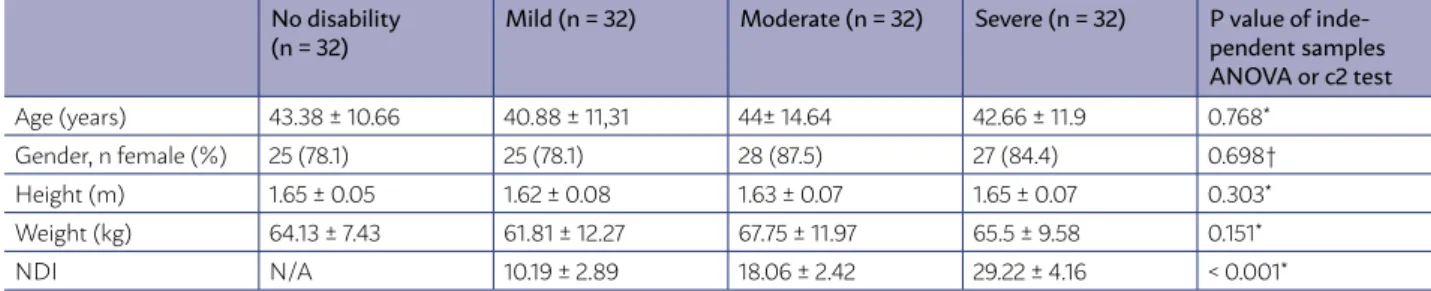
A total of 142 subjects were screened, out of which 128 (90.1%) were eligible and agreed to participate in the study. The mean age of all subjects was 42.67 ± 12.01 years, and 82.03% were female. There were no significant differences (P > 0.05) between groups in age (F = 0.379), gender (F = 0.467), height (F = 1.226), or weight (F = 1.797). All demographic data for each group are shown in Table 1.
Outcome measurements
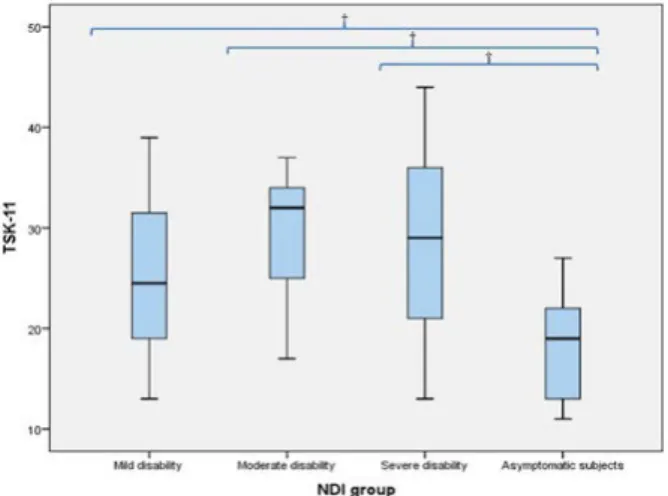
The ANOVA results revealed a significant effect for the group factor [NDI (F = 278.198; P < 0.001); VAS (F = 24.61; P < 0.001); TSK-11 (F = 17.55; P < 0.001); Pain Du-FIGURE 3. Box-plot to illustrate the TSK-11 differences
TABLE 1. DEMOGRAPHIC CHARACTERISTICS OF THE NDI GROUPS. VALUES ARE MEAN ± SD AND N (%).
No disability
(n = 32) Mild (n = 32) Moderate (n = 32) Severe (n = 32) P value of inde-pendent samples ANOVA or c2 test
Age (years) 43.38 ± 10.66 40.88 ± 11,31 44± 14.64 42.66 ± 11.9 0.768* Gender, n female (%) 25 (78.1) 25 (78.1) 28 (87.5) 27 (84.4) 0.698† Height (m) 1.65 ± 0.05 1.62 ± 0.08 1.63 ± 0.07 1.65 ± 0.07 0.303* Weight (kg) 64.13 ± 7.43 61.81 ± 12.27 67.75 ± 11.97 65.5 ± 9.58 0.151* NDI N/A 10.19 ± 2.89 18.06 ± 2.42 29.22 ± 4.16 < 0.001*
Abbreviations: ANOVA, analysis of variance; N/A, not applicable; NDI, Neck Disability Index; SD, standard deviation. * ANOVA with independent samples was applied. † c2 test was applied.
TABLE 2. COMPARISONS BETWEEN GROUPS.
Mean ± SD Mean difference (95% CI);
Mild Moderate Severe No Disability a) Mild vs. Moderate b) Mild vs. Severe d) Moderate vs. Severe
c) Mild vs. No Disability e) Moderate vs. No Disability f) Severe vs. No Disability VAS
(mm)
50 ± 10.24 53.78 ± 10.7 69.34 ± 13.79 0 ± 0 a) -0.37 (-1.05 to 0.3) b) -1.93 (-2.61 to -1.25) † c) -1.55 (-2.23 to -0.87) †
d) N/A e) N/A f) N/A Pain Duration
(months)
72.53 ± 54.4 64.53 ± 48.54
211.41 ± 152.74
0 ± 0 a) 8 (-48.73 to 64.73) b) -138.87 (-195.61 to -82.14) † c) -146.87 (-203.61 to -90.14) †
d) N/A e) N/A f) N/A
TSK-11 (11-44)
25.25 ± 7.03 29.59 ± 5.52 28.72 ± 9 18.56 ± 4.8 a) -4.34 (-8.85 to 0.16) b) -3.47 (-8.1 to 1.15) c) 0.87 (-3.75 to 5.49)
d) 6.68 (2.18 to 11.20) † e) 11.03 (6.52 to 15.54) † f) 10.16 (5.54 to 14.78) †
Trapezius- PPT (kg/cm2)
2.74 ± 0.93 2.21 ± 0.59 1.37 ± 0.84 3.79 ± 0.84
a) 0.52 (-0.1 to 1.15) b) 1.36 (0.68 to 2.05) † c) 0.84 (0.16 to 1.52) †
d) -1.04 (-1.67 to -0.41) † e) -1.57 (-2.2 to -0.94) † f) -2.41 (-3.09 to -1.73) †
Tibialis- PPT (kg/cm2)
5.61 ± 1.83 4.75 ± 1.46 3.46 ± 1.59 5.79 ± 1.84 a) 0.85 (-0.28 to 2) b) 2.15 (0.8 to 3.5) † c) 1.29 (-0.05 to 2.64)
d) -0.17 (-1.32 to 0.96) e) -1.03 (-2.18 to 0.11) f) -2.32 (-3.67 to -0.97) †
Flexion 52.34 ± 8.63
49.06 ± 11.48 38.89 ± 13.94
58.65 ± 8.27 a) 3.28 (-3.82 to 10.38) b) 13.44 (5.77 to 21.12) † c) 10.16 (2.49 to 17.83) †
d) -6.31 (-13.41 to 0.78) e) -9.59 (-16.69 to -2.49) † f) -19.76 (-27.43 to -12.09) † Extension 60.39 ±
18.47
54.03 ± 15.46 48.76 ± 19.66 72.07 ± 9.17 a) 6.35 (-4.34 to 17.06) b) 11.62 (0.69 to 23.18)* c) 5.26 (-6.29 to 16.82)
d) 11.68 (-22.38 to -0.98)* e) 18.04 (-28.74 to -7.34) † f) 23.31 (-34.87 to -11.75) † Lateral
Inclina-tion
34.97 ± 7.41 33.46 ± 7.63 24.57 ± 16.51 40.42 ± 4.76 a) 1.51 (-5.25 to 8.29) b) 10.4 (3.63 to 17.18) † c) 8.89 (15.66 to 2.11) †
d) -5.44 (-12.21 to 1.32) e) 6.96 (-13.73 to -0.18)* f) 15.85 (-22.62 to -9.07) † Rotation 58.17 ± 9.79 56.36 ± 12.32 39.13 ± 26.8 67.16 ± 7.6 a) 1.81 (-8.94 to 12.57)
b) 19.04 (8.27 to 29.8) † c) 17.22 (6.46 to 27.99) †
d) 8.98 (-19.83 to 1.85) e) -10.8 (-21.65 to -0.04) f) -28.03 (-38.88 to -17.18) † Abbreviations: CI, confidence interval; N/A, not applicable; PPT, pressure pain threshold; SD, standard deviation; TSK, Tampa Scale of kinesiophobia; VAS, Visual Analogue Scale. * P < 0.05. † P < 0.01
ration (F = 22.85; P < 0.001); Trapezius-PPT (F = 32.65; P < 0.001); Tibialis-PPT (F = 8.67; P < 0.001); Flexion (F = 16.85; P < 0.001); Extension (F =11.55; P < 0.001); Lateral flexion’s (F = 13.55; P < 0.001); Rotations (F = 16.85; P < 0.001)]. In the comparisons between groups for the VAS, the differences between the MIL-SEV (P < 0.01) and MOD-SEV (P < 0.01) disability groups were statistically significant but not between MIL-MOD (P
> 0.05). For the TSK, there were no statistically sig-nificant differences between these groups (P > 0.05).
Figure 3 shows the box-plots to illustrate the TSK-11 differences between patients with different NDI level and asymptomatic subjects. Table 2 shows the values as the mean ± SD of each group and the means differ-ences (95% CI) between them.
Correlations
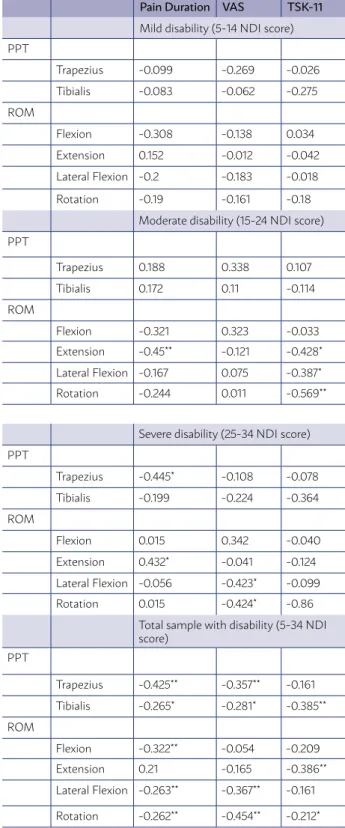
mod-TABLE 3. CORRELATIONS BETWEEN PSYCHOLOGICAL AND PHYSICAL MEASURES.
Pain Duration VAS TSK-11
Mild disability (5-14 NDI score) PPT
Trapezius -0.099 -0.269 -0.026
Tibialis -0.083 -0.062 -0.275
ROM
Flexion -0.308 -0.138 0.034
Extension 0.152 -0.012 -0.042
Lateral Flexion -0.2 -0.183 -0.018
Rotation -0.19 -0.161 -0.18
Moderate disability (15-24 NDI score)
PPT
Trapezius 0.188 0.338 0.107
Tibialis 0.172 0.11 -0.114
ROM
Flexion -0.321 0.323 -0.033
Extension -0.45** -0.121 -0.428*
Lateral Flexion -0.167 0.075 -0.387*
Rotation -0.244 0.011 -0.569**
Severe disability (25-34 NDI score)
PPT
Trapezius -0.445* -0.108 -0.078
Tibialis -0.199 -0.224 -0.364
ROM
Flexion 0.015 0.342 -0.040
Extension 0.432* -0.041 -0.124
Lateral Flexion -0.056 -0.423* -0.099 Rotation 0.015 -0.424* -0.86
Total sample with disability (5-34 NDI score)
PPT
Trapezius -0.425** -0.357** -0.161
Tibialis -0.265* -0.281* -0.385**
ROM
Flexion -0.322** -0.054 -0.209
Extension 0.21 -0.165 -0.386**
Lateral Flexion -0.263** -0.367** -0.161
Rotation -0.262** -0.454** -0.212*
Abbreviations: NDI, Neck Disability Index; PPT, pressure pain threshold; ROM, range of motion; TSK, Tampa kinesiophobia Scale; VAS, Visual Analogue Scale. *p < 0.05; **p < 0.01
erate correlation was observed between TSK and Ro-tation (r= -0.569) in the MOD group. Considering the subjects with NDI scores between 5-34 (total sample with disability), a moderate correlation was observed between NDI and VAS (r= 0.566), as well as between NDI and Trapezius-PPT (r= -0.559).
DISCUSSION
This is the first study to show the differences between the psychological and physical variables according to different degrees of cervical disability using the NDI sub-classification described by Ver-non14,15the Neck Disability Index (NDI in 1991. The number of studies on this topic proved to be very small. No studies were found on non-specific neck pain. On the other hand, the authors found a classifi-cation model for whiplash using Vernon’s NDI (1996) but used another form of classification. 33,34
For the VAS, differences between MIL-MOD were not statistically significant, but differences between the MIL-SEV and MOD-SEV were significant. Due to the lack of studies that use levels of disability as a means of classification, the authors compared their mean ± SD VAS scores for the MIL-MOD disability level to those in the literature, and VAS levels were very similar.9,35 The SEV group had similar VAS lev-els to that of chronic whiplash patients. In the same article, MIL-MOD had different VAS scores, but this could be because the sample was comprised of recov-ering whiplash patients.36 Emshoff et al.37 reported that, for chronic pain, the cutoff for minimal detect-able change for VAS was 11.5 - 28.5 mm, indicating that there are clinical differences between the MIL-SEV and MOD-MIL-SEV disability groups, but not be-tween the MIL-MOD groups. According to Collins et al.38, a VAS above 54 mm is considered severe, and over 30 mm moderate, indicating that the SEV group (69.34 mm) was different than MIL (50 mm) and MOD (53.78mm).
The kinesiophobia levels were higher in patients with disability in comparison to those without it, but there were no differences between groups with dif-ferent levels of disability. Overall, the kinesiophobia levels were moderate, in agreement with a recent study in which the authors found a moderate (r = 0.46) correlation between TSK and NDI in patients with chronic neck pain; however, they included trau-matic and non-trautrau-matic neck pain disorders.9
used a larger version of the TSK (17-items). Saave-dra-Hernández et al. reported similar levels of ki-nesiophobia to our study (25.4 ±6.5), but in patients with moderate disability.8
Regarding the PPT results, there were no statis-tically significant differences in the trapezius for MIL and MOD, but differences were statistically significant between the MIL-SEV and MOD-SEV groups. In addition, all groups had differences com-pared to the non-disabled group. For the right tibial anterior, differences were only found between the MIL-SEV and SEV-Control groups. These results are in agreement with La Touche et al.39, who compared groups with moderate disability versus no disability subjects and had very similar PPT values in the tra-pezius and anterior tibial muscles and conclusions similar to ours. 39 Furthermore, PPT differences ranging from 123 kPa to 200 kPa (1.2–2 kg) are considered minimal detectable change differenc-es28,40-42 at two points on the trapezius muscles on each side and at the sternum as the only non-mus-cular site. The intratester repeatability of the PPT measurements was satisfactory or good (Intraclass correlation coefficient (ICC 0.78-0.93 Therefore, it can be suggested that, for trapezius-PPT, there are real differences between the SEV-MIL (1.37 kg/cm2) and SEV-no disability (2.42 kg/cm2) groups, but not between the SEV-MOD (0.84 kg/cm2) or MOD-MIL (0.53 kg/cm2) ones. This suggestion could be related to mechanical hyperalgesia.
In relation with ROMs, disability groups had sig-nificant differences with respect to the non-disabled group, which coincides with previous studies.9,16,26,43 In addition, the SEV group has more differences from the other disability groups, especially in rota-tion movements. Sarig Bahat et al.9 demonstrated that decreased CROM correlates with more kinesi-ophobia, more pain intensity, and a higher level of disability. This could explain our results, in which a higher level of disability obtained minor ROMs. Fur-thermore, the relationship between kinematics and fear of motion suggests that psychological fear may affect cervical motion control.9,12,16,36,43NDI and other questionnaires, whiplash and NDI and cervical range of motion and NDI. The NDI was shown to be a well validated and reliable self-reported questionnaire, es-pecially when compared to other questionnaires, in both neck pain and whiplash (WAD This also justifies our results, in which all disability groups presented kinesiophobia and reduced ROMs.
Study limitations
This study has several limitations. First, the complete disability group (NDI between 35-50)15 es-pecially those involving the soft tissues, represent a significant source of chronic disability. Methods of assessment for such disability, especially those targeted at activities of daily living which are most affected by neck pain, are few in number. A modi-fication of the Oswestry Low Back Pain Index was conducted producing a 10-item scaled questionnaire entitled the Neck Disability Index (NDI was not ac-counted for due to the lack of sample in clinical prac-tice; this type of subject usually has polytrauma or accidents, and the access necessary to take certain measurements is limited. Second, because of the in-volvement of the psychological factor in chronic pain, we only measured kinesiophobia, but we should ac-count for the measurement of depression, anxiety, and catastrophizing to observe if there are differ-ences in different levels of neck disability. Third, the authors did not evaluate the reliability of the ROM and PPT measures, and this kind of clinical measure could be influenced by the skills of the rater. Another limitation is that this research was a cross-sectional study; hence, its results should be considered with caution because we do not know the outcomes of these patients over time. Thus, future studies should consider a longitudinal design and the implementa-tion of linear regression analysis to establish a causal relationship per disability group.
Interpretation
Our findings suggest that there are differenc-es between the different typdifferenc-es of disability, which may have implications in both clinical practice and research. Having the NDI tool to classify disability in nonspecific neck pain will increase awareness of their differences and can be the key to selecting the best intervention for each patient. In research, non-specific neck pain randomized controlled trials (RCT) are almost nonexistent when it comes to samples exclusively composed of severely disabled patients; most have a mild to moderate disability level.
Prospective and future studies
pro-grams combined with multimodal treatments were shown to be beneficial for patients with chronic neck pain,44 nevertheless the neck disability level should be related to the clinical course and treatment effec-tiveness.
CONCLUSIONS
Kinesiophobia may not be influenced by disability level in patients with chronic non-specific neck pain.
Nevertheless, pain intensity and chronicity of pa-tients with severe neck disability are increased with respect to mild and moderate disability indexes. In addition, patients with more disability showed high-er local hyphigh-eralgesia, although diffhigh-erences in wide-spread hyperalgesia were only found when mild and severe disabilities were compared. Finally, the severe disability group showed more differences in ROM than the rest of the subgroups, especially in rotation movements.
RESUMO
CONTEXTO: Até a data, não há estudos transversais considerando a influência do nível de incapacidade em pacientes com dor de garganta crônica não específica. Portanto, o objetivo principal deste estudo foi determinar a diferença entre os níveis de diminuição do colesterol cervical (Crom) e o limiar por dor de pressão (PPT) entre diferentes níveis de incapacidade (leve, moderada e grave) em indivíduos com dor crônica não específica no pescoço e sujeitos assintomáticos.
MÉTODOS: Estudo descritivo transversal. Os indivíduos foram recrutados de um centro de saúde primário e de um hospital do
depar-tamento ambulatorial. Uma amostra total de 128 indivíduos, 96 indivíduos com dor no pescoço crônica não específica e 32 indivíduos assintomáticos, foi recrutada. O NDI foi usado para dividir os indivíduos com dor no pescoço crônica em três grupos (incapacidade leve, moderada e grave). A principal medida de resultados foi a Tampa Scale of Kinesiophobia (TSK-11). As medidas de resultado secundário foram a Escala Analógica Visual (VAS), PPT (trapézio e tibial anterior), Crom (flexão, extensão, rotação e inclinação lateral) e duração da dor.
RESULTADOS: Nos resultados da Anova revelados nas comparações entre os grupos, diferenças estatisticamente significativas para o
VAS foram observadas entre os grupos leve-grave (P<0,01) e moderado-grave (P<0,01), mas não entre os grupos moderado-moderado (P>0,05). Para o TSK, as diferenças não foram estatisticamente significativas (P>0,05).
CONCLUSÃO: A cinesiofobia pode não ser influenciada pelo nível de incapacidade em pacientes com dor no pescoço crônica não
espe-cífica. No entanto, a intensidade da dor e a cronicidade de pacientes com deficiência grave do pescoço são aumentadas em relação ao índice de incapacidade leve e moderada.
PALAVRAS-CHAVE: Cervicalgia. Dor crônica. Avaliação da deficiência.
ABREVIAÇÕES: Faixa de movimento cervical (Crom); Índice de incapacidade do pescoço (NDI); Limiar da dor de pressão (PPT); Tampa Scale of Kinesiophobia (TSK-11); Escala Visual Analógica (VAS).
REFERENCES
1. Haldeman S, Carroll L, Cassidy JD. Findings from the bone and joint de-cade 2000 to 2010 task force on neck pain and its associated disorders. J Occup Environ Med. 2010;52(4):424-7.
2. Carroll LJ, Hogg-Johnson S, van der Velde G, Haldeman S, Holm LW, Car-ragee EJ, et al. Course and prognostic factors for neck pain in the general population: results of the Bone and Joint Decade 2000-2010 Task Force on Neck Pain and Its Associated Disorders. J Manipulative Physiol Ther. 2009;32(2 Suppl):S87-96.
3. Hogg-Johnson S, van der Velde G, Carroll LJ, Holm LW, Cassidy JD, Guz-man J, et al. The burden and determinants of neck pain in the general population: results of the Bone and Joint Decade 2000-2010 Task Force on Neck Pain and Its Associated Disorders. J Manipulative Physiol Ther. 2009;32(2 Suppl):S46-60.
4. Fejer R, Kyvik KO, Hartvigsen J. The prevalence of neck pain in the world population: a systematic critical review of the literature. Eur Spine J. 2006;15(6):834-48.
5. Hoy D, March L, Woolf A, Blyth F, Brooks P, Smith E, et al. The global bur-den of neck pain: estimates from the global burbur-den of disease 2010 study. Ann Rheum Dis. 2014;73(7):1309-15.
6. Binder AI. Neck pain. BMJ Clin Evid. 2008;2008. pii: 1103.
7. Bogduk N. Neck pain. Aust Fam Physician. 1984;13(1):26-30.
8. Saavedra-Hernández M, Castro-Sánchez AM, Cuesta-Vargas AI, Cle-land JA, Fernández-de-las-Peñas C, Arroyo-Morales M. The contribution of previous episodes of pain, pain intensity, physical impairment, and
pain-related fear to disability in patients with chronic mechanical neck pain. Am J Phys Med Rehabil. 2012;91(12):1070-6.
9. Sarig Bahat H, Weiss PL, Sprecher E, Krasovsky A, Laufer Y. Do neck kine-matics correlate with pain intensity, neck disability or with fear of motion? Man Ther. 2014;19(3):252-8.
10. Hudes K. The Tampa Scale of Kinesiophobia and neck pain, disability and range of motion: a narrative review of the literature. J Can Chiropr Assoc. 2011;55(3):222-32.
11. Vlaeyen JW, Linton SJ. Fear-avoidance and its consequences in chronic musculoskeletal pain: a state of the art. Pain. 2000;85(3):317-32.
12. Leeuw M, Goossens ME, Linton SJ, Crombez G, Boersma K, Vlaeyen JW. The fear-avoidance model of musculoskeletal pain: current state of scien-tific evidence. J Behav Med. 2007;30(1):77-94.
13. Sá S, Silva AG. Repositioning error, pressure pain threshold, catastrophiz-ing and anxiety in adolescents with chronic idiopathic neck pain. Muscu-loskelet Sci Pract. 2017;30:18-24.
14. Vernon H. The Neck Disability Index: state-of-the-art, 1991-2008. J Ma-nipulative Physiol Ther. 2008;31(7):491-502.
15. Vernon H, Mior S. The Neck Disability Index: a study of reliability and va-lidity. J Manipulative Physiol Ther. 1991;14(7):409-15.
17. MacDermid JC, Walton DM, Avery S, Blanchard A, Etruw E, McAlpine C, et al. Measurement properties of the neck disability index: a systematic review. J Orthop Sports Phys Ther. 2009;39(5):400-17.
18. Borghouts JA, Koes BW, Bouter LM. The clinical course and prognostic factors of non-specific neck pain: a systematic review. Pain. 1998;77(1):1-13.
19. von Elm E, Altman DG, Egger M, Pocock SJ, Gøtzsche PC, Vandenbroucke JP; Iniciativa STROBE. The Strengthening the Reporting of Observational Studies in Epidemiology (STROBE) statement: guidelines for reporting observational studies. Rev Esp Salud Publica. 2008;82(3):251-9.
20. Andrade Ortega JA, Delgado Martínez AD, Almécija Ruiz R. Validation of the Spanish version of the Neck Disability Index. Spine (Phila Pa 1976). 2010;35(4):E114-8.
21. Wolfe F, Clauw DJ, Fitzcharles MA, Goldenberg DL, Katz RS, Mease P, et al. The American College of Rheumatology preliminary diagnostic criteria for fibromyalgia and measurement of symptom severity. Arthritis Care Res (Hoboken). 2010;62(5):600-10.
22. Jensen MP, Turner JA, Romano JM, Fisher LD. Comparative reliability and validity of chronic pain intensity measures. Pain. 1999;83(2):157-62.
23. Katz J, Melzack R. Measurement of pain. Surg Clin North Am. 1999;79(2):231-52.
24. Gómez-Pérez L, López-Martínez AE, Ruiz-Párraga GT. Psychometric properties of the Spanish version of the Tampa Scale for Kinesiophobia (TSK). J Pain. 2011;12(4):425-35.
25. Roelofs J, Goubert L, Peters ML, Vlaeyen JW, Crombez G. The Tampa Scale for Kinesiophobia: further examination of psychometric proper-ties in patients with chronic low back pain and fibromyalgia. Eur J Pain. 2004;8(5):495-502.
26. Fletcher JP, Bandy WD. Intrarater reliability of CROM measurement of cervical spine active range of motion in persons with and without neck pain. J Orthop Sports Phys Ther. 2008;38(10):640-5.
27. Fischer AA. Pressure algometry over normal muscles. Standard values, validity and reproducibility of pressure threshold. Pain. 1987;30(1):115-26.
28. Chesterton LS, Sim J, Wright CC, Foster NE. Interrater reliability of algom-etry in measuring pressure pain thresholds in healthy humans, using mul-tiple raters. Clin J Pain. 2007;23(9):760-6.
29. Faul F, Erdfelder E, Lang AG, Buchner A. G*Power 3: a flexible statistical power analysis program for the social, behavioral, and biomedical scienc-es. Behav Res Methods. 2007;39(2):175-91.
30. Nixon RM, Wonderling D, Grieve RD. Non-parametric methods for cost-effectiveness analysis: the central limit theorem and the bootstrap compared. Health Econ. 2010;19(3):316-33.
31. Mouri H. Log-normal distribution from a process that is not mul-tiplicative but is additive. Phys Rev E Stat Nonlin Soft Matter Phys. 2013;88(4):042124.
32. Mukaka MM. Statistics corner: a guide to appropriate use of correlation coefficient in medical research. Malawi Med J. 2012;24(3):69-71.
33. Sterling M, Jull G, Vicenzino B, Kenardy J, Darnell R. Physical and psycho-logical factors predict outcome following whiplash injury. Pain. 2005;114(1-2):141-8.
34. Vernon H. The neck disability index: patient assessment and outcome monitoring in whiplash. J Musculoskelatal Pain. 1996;4(4).
35. Leaver AM, Maher CG, McAuley JH, Jull GA, Refshauge KM. Characteris-tics of a new episode of neck pain. Man Ther. 2013;18(3):254-7.
36. Nederhand MJ, Ijzerman MJ, Hermens HJ, Turk DC, Zilvold G. Predic-tive value of fear avoidance in developing chronic neck pain disabili-ty: consequences for clinical decision making. Arch Phys Med Rehabil. 2004;85(3):496-501.
37. Emshoff R, Bertram S, Emshoff I. Clinically important difference thresholds of the visual analog scale: a conceptual model for identifying meaningful intraindividual changes for pain intensity. Pain. 2011;152(10):2277-82.
38. Collins SL, Moore RA, McQuay HJ. The visual analogue pain intensity scale: what is moderate pain in millimetres? Pain. 1997;72(1-2):95-7.
39. La Touche R, Fernández-de-Las-Peñas C, Fernández-Carnero J, Díaz-Par-reño S, Paris-Alemany A, Arendt-Nielsen L. Bilateral mechanical-pain sensitivity over the trigeminal region in patients with chronic mechanical neck pain. J Pain. 2010;11(3):256-63.
40. Ylinen J, Nykänen M, Kautiainen H, Häkkinen A. Evaluation of repeatabil-ity of pressure algometry on the neck muscles for clinical use. Man Ther. 2007;12(2):192-7.
41. Sterling M, Jull G, Carlsson Y, Crommert L. Are cervical physical outcome measures influenced by the presence of symptomatology? Physiother Res Int. 2002;7(3):113-21.
42. Walton DM, Macdermid JC, Nielson W, Teasell RW, Chiasson M, Brown L. Reliability, standard error, and minimum detectable change of clinical pressure pain threshold testing in people with and without acute neck pain. J Orthop Sports Phys Ther. 2011;41(9):644-50.
43. Howell ER, Hudes K, Vernon H, Soave D. Relationships between cervi-cal range of motion, self-rated disability and fear of movement beliefs in chronic neck pain patients. J Musculoskelet Pain. 2012;20(1):18-24.