ABSTRACT
RESUMO
Cantaloupe melon (
Cucumis melo
L.) conservation using hydrocooling
Maintaining cantaloupe melon at field temperature impairs conservation as it speeds up cell metabolism and transpiration, and, consequently, reduces shelf life. This study aimed to evaluate the conservation of Torreon hybrid cantaloupe using the hydrocooling treatment. Fruits were harvested at the commercial maturity stage (60 days after planting), in the morning, at the Nova California Farm, municipality of Mossoró-RN, in September 2007. One set of fruit was immersed in chilled water at 5 ºC for 5 min, at the packing house, while the remaining set was not hydro cooled. Then, both sets (treated and untreated with hydrocooling) were pre-cooled in air forced tunnels at 7 ºC, until the temperature in the pulp reached 10 ºC. Both fruit sets were stored for 0, 14, 21, 28 and 35 days under modified atmosphere at 3 ± 1 oC and 90 ± 5% RH. After each storage period, the fruits were incubated in an atmosphere-controlled chamber at 20 ± 2 oC and 80 ± 5% de RH, for seven days. The following characteristics were evaluated: external and internal appearance, mass loss, soluble solids, firmness and titrable acidity. The experiment was arranged in a completely randomized split-plot design with four replications of three fruits. The plots consisted of the hydrocooling conditions (with and without fruit soaking in chilled water), and the sub-plots consisted of the storage times (0, 14, 21, 28 and 35 days).The treatment with hydrocooling was efficient in keeping the firmness and soluble solids of the fruits and shortened the pre-cooling time in the cooling tunnel. However, hydrocooling did not increase fruit shelf-life.
Key words: Storage, Cucumis melo L., Storage, Quality.
Edna Maria Mendes Aroucha1, Jeane Medeiros Martins de Araujo2, Glauber Henrique de Sousa Nunes3, Maria
Zuleide de Negreiros4, Cristiane Alves de Paiva5*, Marcelo Sobreira de Souza6
10.1590/0034-737X201663020010
Conservação de melão Cantaloupe (Cucumis melo L.) com o uso de hidrorresfriamento
A manutenção da temperatura de campo dos frutos é prejudicial à sua conservação, porque acelera o metabolis-mo celular e a transpiração e, cometabolis-mo consequência, reduz sua vida útil. Este trabalho teve por objetivo avaliar a conser-vação do melão Cantaloupe, híbrido ‘Torreon’, com o uso de hidrorresfriamento. Os frutos foram colhidos em setembro de 2007, pela manhã, na Fazenda Nova Califórnia, localizada no município de Mossoró-RN, na maturidade comercial (60 dias após a semeadura). Na casa de embalagem da fazenda, um grupo de frutos foi pré-resfriado (imersão em água fria, a 5 ºC, por 5 min.), enquanto o outro grupo permaneceu sem resfriar. Logo após, os dois grupos foram submetidos a um pré-resfriamento em túneis de circulação forçada de ar, à temperatura de 7 ºC, até que a polpa atingisse 10 ºC. Ambos foram armazenados por 0, 14, 21, 28 e 35 dias, sob atmosfera modificada, a 3 ± 1 oC e 90 ± 5% de UR. Após cada intervalo de tempo, os frutos foram transferidos para uma câmara regulada a 20 ± 2 oC e 80 ± 5% de UR, em que permaneceram por
Submitted on 12/09/2013 and approved on 09/18/2015.
1 Universidade Federal Rural do Semiárido, Mossoró, Rio Grande do Norte, Brasil. [email protected] 2 Universidade Potiguar, Mossoró, Rio Grande do Norte, Brasil. [email protected]
3 Universidade Federal Rural do Semiárido, Mossoró, Rio Grande do Norte, Brasil. [email protected] 4 Universidade Federal Rural do Semiárido, Mossoró, Rio Grande do Norte, Brasil. [email protected]
5 Universidade Federal Rural do Semiárido, Departamento de Agrotecnologia e Ciências Sociais, Mossoró, Rio Grande do Norte, Brasil. [email protected] 6 Universidade Federal Rural do Semiárido, Departamento de Ciências Ambientais e Tecnológicas, Mossoró, Rio Grande do Norte, Brasil. [email protected]
INTRODUCTION
Melon production is very important in the semiarid region of northeastern Brazil, since it generates foreign currency and jobs. Most of the domestic production (87%) is concentrated in Mossoró-Assu, state of Rio Grande do Norte, and Vale do Jaguaribe, state of Ceará, which together produced 466,892 tons in 2013 (IBGE, 2015).
Most melons produced in Mossoró-Assu are of the yellow type, belonging to the botanical group inodorus. Nevertheless, to diversify product range, many companies cultivate other fruit types, including Cantaloupe melons, which belong to cantaloupensis group. Cantaloupe is a variety of melon having a tan rind with netlike ridges and sweet fragrant orange flesh. It is considered a noble melon, due to the high contents of soluble solids and carotenoids (Cuevas et al., 2010). About 16.1% of melons exported through the port of Natal belong to the cantaloupe type. Farmers intend to increase the area planted with cantaloupe, because of its high price on the international market (Sales Júnior et al., 2006)
Cantaloupe is a climacteric fruit, i.e., it has high ethylene production and high respiratory rate when separated from the vine (Beaulieu & Lea, 2007). This is the reason farmers want to reduce the fruit metabolism, so to maintain fruit quality until it reaches the foreign market. It is therefore common practice to store cantaloupes at refrigeration temperatures, usually between 3 °C and 6 °C (Mendonça et al., 2005).
Some companies also apply a pre-cooling treatment to the fruit after harvest. Pre-cooling aims to remove rapidly field heat to decrease perspiration and enzymatic activity, and therefore respiration (Chitarra & Chitarra, 2005). The pre-cooling treatment has been effective for different species such as apples (Becker & Fricke, 2002), lychee (Aguila et al., 2009) and green pepper (Antoniali et al., 2012). Brackmann et al. (2011) concluded that the best pre-cooling methods to extend the postharvest life of ‘Hy Mark’ cantaloupes are forced air up to 8 °C and water up to 15 °C, which is measured by the greater firmness and less browning of the fruit pulp.
In Mossoró-Assu, cantaloupes used to be hydro-cooled (immersion of fruit in water at 5 °C) for about five minutes and, after packaging, pre-cooled in forced air tunnel. Currently, the pre-cooling is done only in a forced-air tunnel. Information on the pre-cooling of cantaloupes is scarce in the literature. Moreover, in the case of fruits produced in northeastern semi-arid conditions, farmers still have doubt about hydro-cooling, because some of them believe that the method is associated with the development of spots on cantaloupe hybrids during cold storage.
Therefore, this study aimed to investigate the effect of hydro-cooling on the quality of “Torreon” hybrid cantaloupe produced in Mossoró-Assu.
MATERIAL AND METHODS
‘Torreon’ hybrid cantaloupes were collected at Nova California farmer, municipality of Natal, RN (5º11’S; 37º20’W; 18 m altitude), in the morning, in September 2007. The climate, according to Koppen classification, is ‘BSWh’: very dry, with summer rainfalls delaying until fall (Carmo Filho & Oliveira, 1995).
Cantaloupes were harvested according to their stage of maturity (around 60 days after sowing) and transported to the farm packing house, where the damaged fruits were discarded. Then, two sets of 80 fruit were formed. One set underwent hydrocooling (immersion in water at 5 °C) for approximately five minutes and the other set did not. Then, both sets were subjected to the same handling steps at the packing house, consisting of pre-cooling fruits in a forced air circulation tunnel, 7 °C, until the pulp temperature dropped to 7-10 ° C.
Cantaloupes were classified according to size, using the types 5 and 6 (five and six fruits per box respectively), treated with fungicide Imazalil in the peduncle region and packaged in 20-µm thick polymeric bags with passage of 250-260 g m-1 of daily water vapor. Fruits were then stored for 0, 14, 21, 28 and 35 days, at 3 ± 2 °C and 90 ± 3% relative humidity. After each storage time, the fruits were incubated in a temperature and humidity controlled chamber at 20 ± 2 °C and 80 ± 5% relative humidity for seven days to simulate the ambient conditions of the consumer market.
sete dias. Foram avaliadas as seguintes características: aparência externa e aparência interna dos frutos, perda de massa, firmeza da polpa, sólidos solúveis e acidez titulável. O delineamento experimental foi inteiramente casualizado, em esquema de parcelas subdivididas, com quatro repetições de três frutos. As parcelas foram constituídas pelas condi-ções de hidrorresfriamento (com e sem imersão dos frutos em água fria) e, as sub-parcelas, pelo tempo de armazenamento (0, 14, 21, 28 e 35 dias). O hidrorresfriamento foi eficiente em manter a firmeza e os teores de sólidos solúveis dos frutos e abreviou o tempo de pré-resfriamento no túnel, porém, não prolongou o tempo de vida útil.
The following characteristics were evaluated: exteri-or appearance - a visual and subjective scale ranging from 1 to 5, where score 1 = extremely severe defect, above 50% of the fruit affected, 2 = severe defect, 31-50%, 3 = moderate defect, 11-30%, 4 = light defect, 1-10%, and 5 = no default; internal appearance - flesh collapsed, loose seeds and/or liquid accumulation, using a scale similar to the one used for the exterior appearance; weight loss -subtracting the initial weight from the weight obtained after each storage time and expressed as a percentage (%); pulp firmness- two readings on both sides in the equatorial region using a McCormick FT 327 penetrometer with an 8 mm tip and data expressed as Newton (N); soluble solids - refractometry, according to the methodology of Nunes et al. (2006), results expressed in %; titratable acidity - following the procedure established by the Adolfo Lutz Institute (1985).
The experiment was arranged in a split plot, completely randomized design, with four replications. The plots consisted of the hydrocooling conditions (with and without soaking the fruit in chilled water at 5 °C), and the subplots consisted of the storage time (0, 14, 21, 28 and 35 days). Four fruits were evaluated at each storage time. Analysis of variance and the mean comparison t test were carried out for the hydrocooling effect and regression analysis for the storage time. All statistical analyzes were performed using the SISVAR software (Ferreira, 2011).
RESULTS AND DISCUSSION
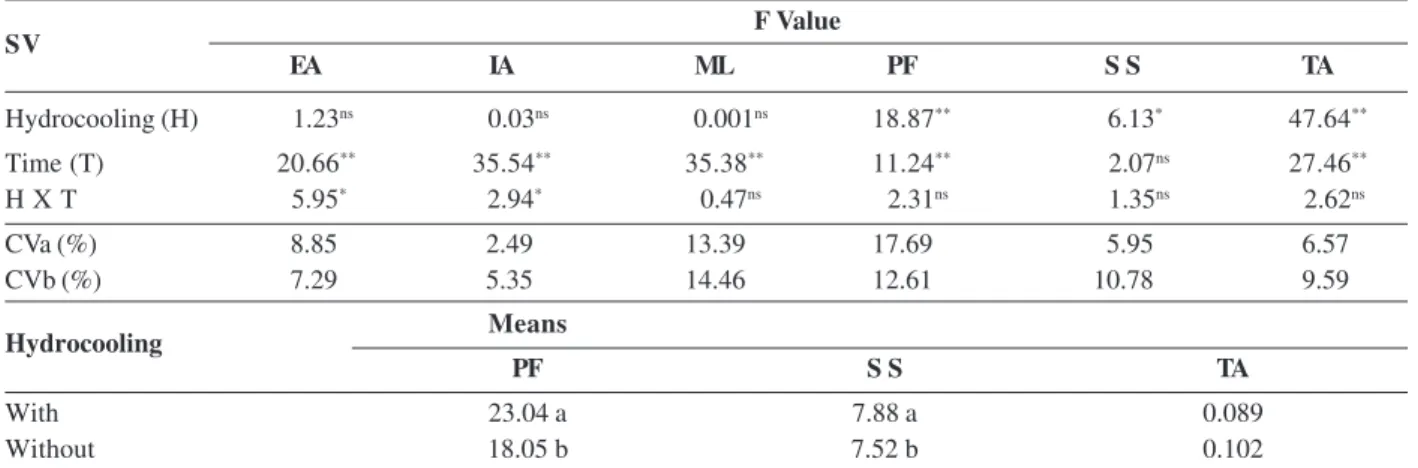
The hydrocooling treatment influenced the characteristics firmness, soluble solids and titratable acidity (Table 1). The storage time influenced almost all characteristics, except for soluble solids.
There was significant interaction between the factors hydrocooling and storage time only for the characteristics external appearance and internal appearance, indicating different behavior of the two hydrocooling levels at the different storage times.
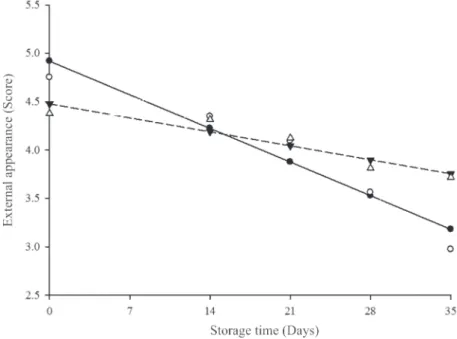
There was a linear and decreasing trend for fruit external appearance throughout the storage time of both fruit sets, with and without cooling (Figure 1). Even with the higher mean of external appearance at day 0, hydrocooled cantaloupes had greater decrease per unit time than non-hydrocooled ones, which resulted in greater reduction of the external appearance score, at the end of the storage time. Reduction in hydrocooled fruits was 35.64%, while in non-hydrocooled fruits, was 15.63%. The scores of external appearance of non-hydrocooled cantaloupes, at 35 days, were higher than those treated with hydrocooling, possibly because of the residual moisture left on the fruit surface after the hydrocooling, which increases the chance of fungal disease and predisposes the net-like skin of the fruit to mechanical injury, such as scratches in the skin when in contact with other fruits.
Although there was a decrease in the scores of external appearance over time, no hydrocooling treatment gave scores of external appearance below 3.0 (11 to 30% of the external area with defects) (Figure 1), which are fruits considered unsuitable for trading (Tomaz et al., 2009). Unlike the reports of some farmers, who pointed the hydrocooling as a possible cause of skin spots, such occurrence was not observed in the present study.
This is an important finding of this study, since the external appearance is a major characteristic for European companies that import melon from Mossoró-Assu. Also, knowing that the fruit produced in northeastern Brazil takes nearly a month to reach the shelves of main supermarkets
Table 1: F values for the characteristics external appearance (EA), internal appearance (IA), mass loss (ML), pulp firmness (PF), soluble solids (SS) and titratable acidity (TA), and means for last three characteristics for hydrocooled cantaloupe hybrid ‘Torreon’, as a function of storage time
F Value
EA IA ML PF S S TA
Hydrocooling (H) 1.23ns 0.03ns 0.001ns 18.87** 6.13* 47.64**
Time (T) 20.66** 35.54** 35.38** 11.24** 2.07ns 27.46**
H X T 5.95* 2.94* 0.47ns 2.31ns 1.35ns 2.62ns
CVa (%) 8.85 2.49 13.39 17.69 5.95 6.57
CVb (%) 7.29 5.35 14.46 12.61 10.78 9.59
SV
Means
PF S S TA
With 23.04 a 7.88 a 0.089
Without 18.05 b 7.52 b 0.102
**, *: Significant at p < 0.01 and p < 0.05, respectively. ns: non-significant (p > 0.05). Means followed by the same letter are not significantly different by the t test (p > 0.05).
in the European Union, and that, on average, they are purchased at an interval of three days and soon consumed, it appears that the fruits would be traded without any problem if stored under the conditions of this study, regardless of the hydrocooling treatment.
The internal appearance also showed a linear and decreasing trend throughout the storage period (Figure 2). At the end of storage, the score means were 3.76 for hydrocooled fruits and 3.01 for non-hydrocooled fruits. An important finding was that, regardless of whether or not applying hydrocooling, the internal appearance score was greater than 3.0, therefore, not compromising the internal appearance of the fruit. There was no pulp darkening with or without hydrocooling, reinforcing the
hypothesis that the external or internal darkening of the fruit has no association with hydrocooling, as it was mentioned by some farmers. Gomes Junior et al. (2001) found that cantaloupe melons, without prior chilling and stored at 20 ± 1 °C and 50 ± 2% RH, showed mean scores of external and internal appearance above or equal to 3.0, (marketable), after 25 and 19 days, respectively.
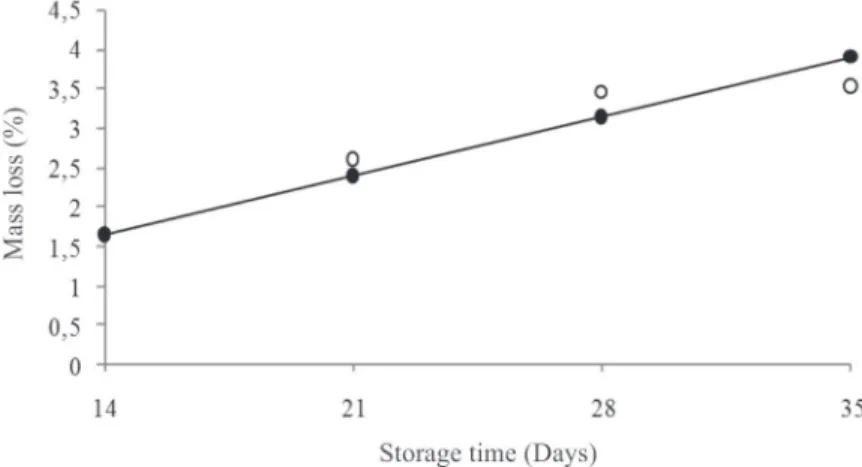
There was an increasing linear trend for mass loss as a function of storage time, with rate of increase of 0.106 per unit time (day) (Figure 3), resulting in a final mass loss of 3.89%. The mass loss during storage did not influence the external and internal appearance of the fruit (Figures 1 and 2, respectively). The estimates found in the current study were below the means, 3.95% and 6%, recorded in hybrid
Figure 2: Mean scores for internal appearance of cantaloupe hybrid ‘Torreon’, sujected to hydrocooling (- -) and without hydrocooling (- -), as a function of storage time. Observed values with hydrocooling (- -) and without hydrocooling (- -). *
Significant by the t test (p < 0.05).
Figure 1: Mean scores for external appearance of cantaloupe hybrid ‘Torreon’ subjected to hydrocooling (- -) and without hydrocooling (- -), as a function of storage time. Observed values with hydrocooling (- -) and without hydrocooling (- -). *
‘Hy Mark’ cantaloupes stored at 5 °C and 10 °C for 35 days (Gomes Junior et al., 2000), and 7.22% in Orange Flesh melons stored at room temperature for 21 and 28 days (Mendonça et al., 2005). The mass loss is an important characteristic associated with fruit quality during storage. Another important aspect of this characteristic is of economic significance, since melons are sold by weight. Indeed, treatments that increase mass loss are not desirable, because they will bring financial losses to farmers.
Hydrocooled cantaloupes retained greater firmness (23.04 N) than non-hydrocooled ones (18.05 N) (Table 1). One possible explanation for the effect of hydrocooling is the immediate removal of fruit heat after harvesting. In this situation, cooling in cold water was efficient, as it provided a high heat transfer rate, helping to reduce physiological and biochemical metabolism of cantaloupes. Brackmann et al., (2011), studying various methods of cooling
cantaloupe hybrid ‘Hy Mark’, found that delay cooling in 24 hours caused a significant loss of firmness after 20 days of storage at 3 °C and two days more at 20 °C, since mean firmness of fruits under delayed cooling was 11 N, and of fruits hydrocooled to 8 °C was 30.5 N. The authors concluded that the best pre-cooling methods for ‘Hy Mark’ cantaloupes are air-forced cooling at 8 °C and hydrocooling up to 15 °C, since both retain firmness and do not cause browning.
Firmness decreased with the storage time regardless of the hydrocooling treatments (Figure 4), and the reduction at 35 days after hydrocooling was 28.74%. Lower estimates were found in studies with cantaloupe ‘In 3984’ stored at 20 °C and 50% relative humidity (Gomes Junior et al., 2001), with linear decrease in firmness during storage, regardless of the maturation stage. The speed of reduction of firmness in melons during storage is reported in all studies about
Figure 4: Pulp firmness (N) of cantaloupe hybrid ‘Torreon’, as a function of storage time. Observed values (- -). * Significant by
the t test (p < 0.05).
Figure 3: Mass loss (%) of cantaloupe hybrid ‘Torreon’ as a function of storage time. Observed values (- -). * Significant by the
conservation. However, the speed of reduction is a function of various environmental conditions such as the maturity stage at the time of harvesting, handling and storage conditions, fertilization and in particular the genotype of the cultivar.
Hydrocooled cantaloupes had soluble solids mean greater than that recorded for non-hydrocooled ones (Table 1). Brackmann et al. (2011) did not detect differences among the cooling methods applied to the hybrid ‘Hy Mark’. In the current study, there was no effect of storage time on the total solids content (Table 1).
The content of soluble solids is an important quality characteristic for cantaloupe classification (Lester et al., 2007). In the case of cantaloupes, it is established at least 10% as a minimum quality standard. Indeed, in this work, fruits showed soluble solids contents below the minimum acceptable in foreign markets. At first, these fruits could be rejected by foreign markets, however, on some occasions, at the Port of Natal, cantaloupe melons from Mossoró-Assu, with contents below 10%, were sold to the European community (Sales Jr. et al., 2006).
Non-hydrocooled fruits showed higher titratable acidity (Table 1). This finding was unexpected, because hydrocooling reduces the fruit temperature and, consequently, the degradative metabolism of melons. Therefore, considering that the hybrid ‘Torreon’, as a climacteric fruit, has peak ethylene production, whereby the respiratory and enzymatic activities are influenced (Payasi et al, 2009) and that, therefore, the consumption of acid organic is influenced by the respiratory rate, it is essential the immediate removal of field heat to maintain the physical and chemical properties of cantaloupes. Brackmann et al. (2011) reported that the cooling of the pulp increased acidity.
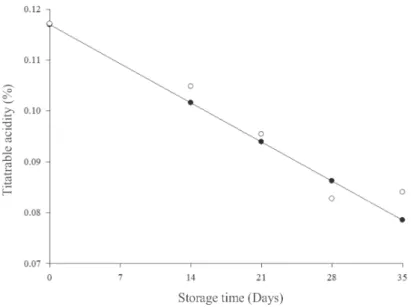
Figure 5: Titratable acidity of cantaloupe hybrid ‘Torreon’, as a function of storage time. Observed values (- -). * Significant by
the t test (p < 0.05).
There was a linear decrease of acidity as a function of storage time, regardless of the hydrocooling treatment (Fi-gure 5). This declining trend was expected, because, after harvest, the concentration of organic acids tended to de-cline in most fruits, as a result of the intensive use of these compounds as respiratory substrate and as the carbon skeleton for the synthesis of new compounds (Tang et al., 2010). However, when stored under conditions of limiting atmospheric O2, with fermentation, there may be an increase in the acid content (Chitarra & Chitarra, 2005).
In most fruit titratable acidity is one of the main components of flavor, as market acceptance depends on the balance between acids and sugars. In melon, the variation in acidity levels has little importance, because of the low concentration. Nevertheless, genetic improvement has been used to obtain melons with higher levels of sucrose and organic acids, aiming to produce tastier fruits.
CONCLUSION
The use of hydrocooling in cantaloupe ‘Torreon’ melons was effective in maintaining the firmness and soluble solids of fruits and shortened the pre-cooling time in the air-forced cooling tunnel.
However, the hydrocooling did not prolong cantaloupe shelf life, since the external and internal appearance of the fruits, with and without the hydrocooling treatment remained marketable up to 35 days.
REFERENCES
Antoniali S, Leal PAM, Magalhaes AM & Sanches J (2012) Resfriamento rápido de pimentão amarelo com ar forçado. Ci-ência Rural, 42:1110-1116.
Beaulieu JC & Lea JM (2007) Quality changes in cantaloupe during growth, maturation, and in stored fresh-cut cubes prepared from fruit harvested at various maturities. Journal American Society Horticulture Science, 132:720-728.
Becker BR & Fricke BA (2002) Hydrocooling time estimation methods. International Communications in Heat and Mass Transfer, 29:165-174.
Brackmann A, Anese RO, Giehl RFH, Weber A, Eisermann AC & Sestari I (2011) Pré-resfriamento para conservação pós-co-lheita de melões Cantaloupe ‘Hy Mark’. Bragantia, Campinas, 70:672-676.
Carmo Filho F & Oliveira OF (1995) Mossoró: um município do semi-árido nordestino, caracterização climática e aspecto florístico. Mossoró, ESAM. 62p. (Coleção Mossoroense, série B).
Chitarra MIF & Chitarra AB (2005) Pós-colheita de frutos horta-liças: fisiologia e manuseio. 2ª ed. Lavras, UFLA. 785p.
Cuevas HE, Staub JE & Simon PW (2010) Inheritance of beta-carotene-associated mesocarp color and fruit maturity of melon (Cucumis melo L.). Euphytica, 170:129-140.
Ferreira DF & SISVAR (2011) A computer statistical analysis system. Ciência e Agrotecnologia, 35:1039-1042.
Gomes Júnior J, Menezes JB, Souza PA de, Guimarães AA & Simões NA (2000) Armazenamento refrigerado de melão Hy-mark. In: 40º Congresso Brasileiro de Olericultura, Brasília. Anais, Horticultura Brasileira. p.308-309. (Suplemento, 1).
Gomes Júnior J, Menezes JB, Nunes GHS, Costa FB & Souza PA (2001) Qualidade pós-colheita do melão tipo Cantaloupe, co-lhido em dois estádios de maturação. Horticultura Brasileira, 19:356-360.
IBGE (2015) Produção agrícola municipal. Disponível em: <http:/ /www.ibge.gov.br/servidor_arquivos_est/>. Acessado em: 15 de agosto de 2015.
Instituto Adolfo Lutz (1985) Normas analíticas, métodos quími-cos e físiquími-cos para análise de alimentos. 3ª ed. São Paulo, Institu-to Adolfo Lutz. 533p.
Lester GE, Robert A, Saftner RA & Hodges DM (2007) Market quality attributes of orange-fleshed, non-netted honey dew melon genotypes following different growing seasons and storage temperature durations. HortTechnology, 17:346-352.
Mendonça FVS, Menezes JB, Gois VA, Nunes GHS, Souza PA & Mendonça Júnior CF (2005) Armazenamento refrigerado de melão Orange Flesh.Horticultura Brasileira, 23:12-17.
Nunes GHS, Medeiros AES, Grangeiro LC, Santos GM & Sales Junior R (2006) Estabilidade fenotípica de híbridos de melão amarelo avaliados no Pólo Agroindustrial Mossoró-Assu. Pes-quisa Agropecuária Brasileira, 41:57-67.
Payasi A, Mishra NN, Chaves ALS & Singh R (2009) Biochemistry of fruit softening: an overview. Physiology and Molecular Biology of Plants, 15:103-113.
Sales Junior R, Dantas FF, Salviano AM & Nunes GHS (2006) Qualidade do melão exportado pelo porto de Natal-RN. Ciência Rural, 36:286-289.
Tang M, Zhi-long bie Z, Ming-zhu W, Hong-ping YI & Jong-xin F (2010) Changes in organic acids and acid metabolism enzymes in melon fruit during development. Scientia Horticulturae, 123:360-365.