Received 7/17/2013 Accepted 10/16/2013 (006169)
1 Department of Food Science and Technology, Center for Agricultural Sciences, Federal University of Santa Catarina – UFSC, Rod. Admar Gonzaga, 1346, CEP 88034-001, Itacorubi, Florianópolis, SC, Brazil, e-mail: [email protected]
*Corresponding author
Evaluation of the Petrifilm™ and TEMPO® systems and the conventional
method for counting microorganisms in pasteurized milk
Andréia CIROLINI1*, Andressa Mara BASEGGIO1, Marília MIOTTO1, Roberta Juliano RAMOS1,
Cristhiane Stecanella de Oliveira CATTANI1, Cleide Rosana Werneck VIEIRA1
1 Introduction
Milk is a nutritionally complete food; therefore, it can serve as a substrate for the growth of microorganisms. Pasteurization of raw milk was introduced in the late nineteenth century to increase the safety of milk. This process is crucial to eliminate the pathogenic microbiota and part of deteriorating microbiota (MATTA; TOLEDO; PAVIA, 2012). During pasteurization, milk is heated from 72 °C to 75 °C for 15 to 20 seconds, using a plate heat exchanger, followed by immediate cooling until the temperature at or below 4 °C (BRASIL, 2011).
The pasteurization time-temperature binomial was adjusted according to the thermal parameters of the most resistant non-sporulating pathogenic bacteria, Mycobacterium tuberculosis
(TRONCO, 2010). However, pasteurized milk can contain thermo-resistant bacteria and/or present after-pasteurization contamination (CHAMPAGNE et al., 2009).
Ensuring food safety is a challenge. Accordingly, frequent testing of foods by analytical laboratories plays a significant role. The microbiolgical assay has been adopted to determine the quality and hygiene of products, in addition to ensuring the use of corrective actions during the production process (LAKMINI; MADHUJIYH, 2012).
Although conventional methods for detection and enumeration of microorganisms are well-documented, the time required to obtain the results is often too long for the requirements of the industry (REITER et al., 2010). As a result, new methods have been developed as an alternative to
conventional methods in order to provide faster results and simplify the analytical process (LOSS et al., 2012).
One of the alternative methods applied to microbial counts in foods is the Petrifilm™ system (3M Company, St. Paul, MN, USA), which makes use of a thin plastic film as carrier of the culture medium. Its base is coated with dehydrated nutrients and water soluble gelling agents, and the upper film contains gelling substances and dying agents (JASSON et al., 2010).
Another alternative method for counting microorganisms is the TEMPO® system (bioMérieux SA), one of the most recent automated solution for quality indicator enumeration in food products. Based on the MPN technique, this system consists of a card and a vial containing the culture medium and a fluorescent indicator. The inoculated medium is transferred automatically into the card containing 48 wells of three different volumes. The microorganism hydrolyzes the substrate present in the culture medium during incubation, thus producing a fluorescent signal that is detected by the TEMPO® Reader, which calculates the number of positive wells and expresses the results as CFU mL–1 (TORLAK; AKAN; GÖKMEN, 2008; OWEN; WILLIS;
LAMPH, 2010).
However, regional variations either in microbiota or in the food matrix or even some intrinsic characteristics of food may influence the performance of alternative methods (TAVOLARO et al., 2005; CASAROTTI; PAULA; ROSSI, 2007). Beloti et al. (2002) showed that the microbiota of pasteurized
Abstract
New microbiological methods have been developed and commercialized, but their performance must be guaranteed. The aim of the present study was to evaluate the PetrifilmTM and TEMPO® systems compared to the conventional method for counting
microorganisms in pasteurized milk. A total of 141 samples of pasteurized milk were analyzed by counting mesophilic aerobic, Coliforms at 35 °C, Coliforms at 45 °C, and Escherichia coli microorganisms. High correlation was found between the methods for counting Coliforms at 35 °C, but low correlation was found for counting mesophilic aerobic, Coliforms at 45 °C, and Escherichia coli. No significant statistical difference was found among the three methods for counting Coliforms at 35 °C; however, the mean counts of mesophilic aerobic, Coliforms at 45 °C, and Escherichia coli showed significant statistical difference. PetrifilmTM
and TEMPO® systems had satisfactory results for Coliforms at 35 °C in pasteurized milk but low performance for mesophilic aerobic, Coliforms at 45 °C and Escherichia coli.
(EC - Oxoid Ltd., Basingstoke, Hampshire, England) to confirm Coliforms at 35 °C and 45 °C. BVB tubes were incubated at 35 °C (± 1 °C) for 48 h and EC tubes were incubated in a water bath at 45.0 °C (± 0.2 °C) for 48 h. EC tubes presenting turbidity and gas production were streaked onto Eosin Methylene Blue agar plates (EMB - Oxoid Ltd., Basingstoke, Hampshire, England), which were incubated at 35 °C (± 1 °C) for 24 h. The typical colonies of
Escherichia coli (bright green) were submitted to the biochemical test Indole, Methyl Red, Voges Proskauer and Citrate (IMViC). The final result for Coliforms at 35 °C and Coliforms at 45 °C is shown by the positivity of the tubes, which are characterized by turbidity and production of gas. The counting of Escherichia coli was performed by the confirmation of the typical colonies isolated in the IMViC biochemical test.
Petrifilm™ System (3M Company, St. Paul, MN, EUA)
Petrifilm™ System was usedfor counting mesophilic aerobic, Coliforms at 35 °C and Escherichia coli, and Coliforms at 45 °C. An aliquot of 1ml of the sample was plated on AC plates, EC plates, and CC plates, respectively. AC plates were incubated at 35 °C for 48 h, and after this period red colonies were selected and counted (MORTON, 2001). EC plates were incubated at 35 °C for 24 h, and after the incubation period, the plates that presented red colonies associated with gas bubbles were counted as Coliforms at 35 °C. These plates were then incubated for another 24 h to confirm Escherichia coli, which is represented by blue colonies and gas. CC plates were incubated at 44 °C for 24 h, and after this period the red colonies associated with gas bubbles were counted as Coliforms at 45 °C (KORNACKI; JOHNSON, 2001).
TEMPO® System (Biomérieux S.A)
Aliquots containing different levels of inoculum were transferred to TEMPO® vials (BioMerieux S.A.). These aliquots were diluted and automatically transferred into a card containing 48 wells of three different volumes (16 × 225; 16 × 22.5; and 16 × 2.25 µL) using the TEMPO Filler® (BioMerieux
S.A.). After filling, the cards were incubated at 32 °C for 48 h and at 35 °C for 24 h for the counting of mesophilic aerobic, and Coliforms at 35 °C and Escherichia coli, respectively. After the incubation period, the results were read on the TEMPO®
Reader (BioMerieux S.A.). The results were automatically analyzed by the software system that determines which of the wells tested positive. The number of positive wells obtained in relation to the volume of wells and the dilution of the samples, automatically allowed enumeration of the results in CFU mL–¹
(ASSOCIATION..., 2012).
2.3 Statistical analysis
The values were transformed into logarithmic values, and the results were subjected to regression analysis to determine the Pearson correlation coefficient (r) and analysis of variance (ANOVA) with Tukey’s test at the 95% level of confidence. The statistical analyses were performed using the software Statistica® 8.0 (STATSOFT, 2004). For the purpose of statistical calculations, the results < 1CFU mL–1 were replaced by the next
lower number, that is, 0.9 CFU/mL–1.
milk produced in some regions of Brazil may significantly influence the performance of alternative methods.
Therefore, the aim of this study was to evaluate the performance of Petrifilm™ (3M Company, St. Paul, MN, USA) and TEMPO® systems (Biomerieux SA) compared to the conventional method for counting microorganisms in pasteurized milk produced in dairy plants located in Santa Catarina State - Brazil.
2 Materials and methods
2.1 Samples
A total of 141 samples (using one liter plastic bags) from six federally licensed dairy processing plants in Santa Catarina State, Brazil, were collected from December 2009 to November 2011. Sample collection was performed by a health inspector of the Ministry of Agriculture responsible for supervising the industry.
The samples were stored in isothermal boxes containing ice packs in order to maintain the temperature below 4 °C (BRASIL, 2002). Next, they were transported to the Laboratory of Microbiology of the Department of Food Science and Technology at Federal University of Santa Catarina.
2.2 Microbiological analysis
The packages were homogenized by manual shaking and disinfected with 70 °GL alcohol before opening. Decimal dilutions were performed using 0.1% peptone water (Oxoid Ltd., Basingstoke, Hampshire, England) (BRASIL, 2003).
The following analises were carried out using both Petrifilm™ system (3M Company, St. Paul, MN, USA) and the conventional method: mesophilic aerobic, Coliforms at 35 °C, Coliforms at 45 °C and Escherichia coli. The TEMPO® system (Biomerieux SA) was used for counting mesophilic aerobic, Coliforms at 35 °C and Escherichia coli.
Conventional method
The counting of mesophilic aerobic was performed according to Laird et al. (2004). Plate Count Agar (PCA - Oxoid Ltd., Basingstoke, Hampshire, England) was previously kept in a water bath at 44 °C-46 °C. Then, 1.0 ml aliquots of the dilutions were transferred to duplicate Petri plates and PCA was added. The plates containing the aliquots were incubated at 32 ± 1 °C for 48 h.
Regarding the counting of Coliforms at 45 °C, as highlighted by Ortiz and Rios (2006), the 3M™ Company has designed plates for the enumeration of coliforms and Escherichia coli, which were approved by the AOAC, Association Française de Normalization (AFNOR) and Nordic Committee on Food Analysis (NMKL). The 3M Company and AFNOR suggest using Coliforms at 35 °C plates to investigate Coliforms at 45 °C. This study used Petrifilm™ CC plates for the counting of Coliforms at 45 °C, which were incubated at 44 °C, according to the validated method by AFNOR.
Poor correlation was found between the alternative methods and the conventional method for Escherichia coli counts; discrepant result was found by Lakmini and Madhujith (2012) comparing the Petrifilm™ system and the conventional method in a sample of milk powder.
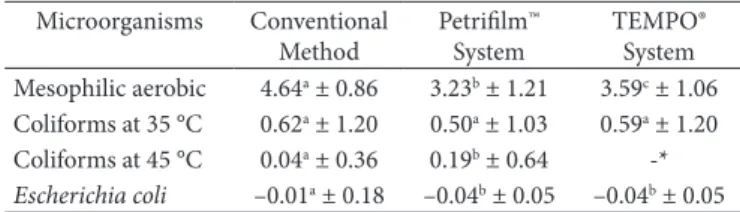
The results of the analysis of variance showed no statistical difference among the methods studied for the counting of Coliforms at 35 °C, but both mesophilic aerobic and Coliforms at 45 °C counts were statistically different in the three methods studied. The results of Escherichia coli showed no statistical difference between the Petrifilm™ and TEMPO® systems, but they were statistically different from the conventional method (Table 2).
As can be seen in Table 2, mesophilic aerobic counts were statistically different in the methods studied. These results corroborate and strengthen the data and discussion of Table 1, as previously mentioned the microbiota of pasteurized milk produzed in certain regions can influence the performance of alternative methods because of the presence of thermoduric microorganisms that poorly reduce dye indicator. McAuley et al. (2012) highlights that the resistance of some species can be influenced by location. Possible reasons for these variations may be due to influences on the original environments, including exposure to different chemicals, heat, and cold; all of which may have influenced thermal tolerance (FERNÁNDEZ et al., 2009).
The results obtained by Freitas, Nero and Carvalho (2009) showed no difference between the conventional method and the PetrifilmTM system when pasteurized milk samples were
incubated for 72 h, suggesting that this period of incubation would be required for the adequate development of microbial colonies unable to reduce TTC in pasteurized milk.
The results showed no statistical difference between the methods used for enumerating Coliforms at 35 °C and are not consistent with those found by Raybaudi et al. (2005), who compared three methods for the detection of coliforms in pasteurized milk: Petrifilm™ system, Most Probable Number
3 Results and discussion
The results of the regression analysis of counts of mesophilic aerobic, Coliforms at 35 °C, Coliforms at 45 °C and Escherichia coli of the conventional and alternative methods are shown in Table 1.
Poor correlations were found between the different methods used for counting mesophilic aerobic in pasteurized milk. Unlike the alternative methods, the conventional method does not use the indicator dye 2,3,5-triphenyltetrazolium chloride (TTC). Freitas, Nero and Carvalho (2009)argued that the microbiota of pasteurized milk can affect negatively the performance of the methods, such as the PetrifilmTM system,
based on the formation of red colonies because of the presence of thermoduric microorganismos that are unable to reduce the dye indicator in this system.
The PetrifilmTM plates, which use tetrazolium salt as an
indicator, are convenient and easier-to-use alternatives. This indicator turns red when it is reduced by mitochondrial enzyme succinate dehydrogenase of the bacteria due to formation of formazan (CATTANI et al., 2013).
The poor correlation between the conventional method and the TEMPO® system for the counting of mesophilic aerobic may be due to the low enzymatic activity of these microorganisms in pasteurized milk, similar to what happened with the PetrifilmTM
system, in which bacteria from the milk did not reduce TTC (2,3,5-triphenyltetrazolium chloride). The TEMPO® TVC system used for the counting of mesophilic aerobic in foods is based on the growth of the micro-organism and on the fluorescent reaction produced by 4-methyl umbelliferone (4MU). The micro-organism hydrolyzes the culture medium during incubation, thereby producing a fluorescent signal (CROWLEY et al., 2009).
The counting of Coliforms at 35 °C showed a high correlation between the methods studied. On the other hand, the regression analysis of Coliforms at 45 °C showed a poor correlation between the conventional method and the Petrifilm™ system.
As for the Coliforms at 35 °C, some authors (SILVA; CAVALLI; OLIVEIRA, 2006) reported lower correlation coefficients (0.76, 0.77 and 0.79) for vegetables, cheese, and sausages, respectively, when comparing the PetrifilmTM system
and Conventional Multiple Tube Technique; however this technique is different from the conventional plate count used in this study.
Table 1. Correlation coefficient (r) for the counting of Mesophilic aerobic, Coliforms 35 °C, Coliforms 45 °C and Escherichia coli in pasteurized milk obtained with the conventional method compared with those obtained with the Petrifilm™ and TEMPO® systems and correlation between the alternative methods.
Methods Mesophilic aerobic Coliforms at 35 °C Coliforms at 45 °C Escherichia coli
Conventional × Petrifilm™ 0.28 0.94 0.25 0.53
Conventional × TEMPO® 0.58 0.83 -* 0.55
Petrifilm™ × TEMPO® 0.58 0.88 -* 0.72
Table 3 shows the assay time (in hours) of the methods used for detecting mesophilic aerobic, Coliforms at 35 °C, Coliforms at 45 °C and Escherichia coli.
There was no difference in the assay time for detecting mesophilic aerobic by the different methods. However, it should be taken into account that these alternative methods are easier to use and more efficient in reducing laboratory material, culture media preparation time and the amount of waste generated during the tests.
Nevertheless, the tests performed for the counting of Coliforms 35 °C and Coliforms at 45 °C showed that the conventional method requires 48 hours more than the alternative methods for obtaining the final result. In the test performed for the counting of Escherichia coli, the TEMPO® system was the fastest method followed by Petrifilm™ system and the conventional method. Kunicka (2007) also found a reduction in the assay time using the TEMPO® system.
4 Conclusion
It can be concluded that the Petrifilm™ and TEMPO® systems showed satisfactory results for counting Coliforms at 35 °C in pasteurized milk; nevertheless, poor performance was observed by these systems for the counting mesophilic aerobic, Coliforms at 45 °C and Escherichia coli. Therefore, the Petrifilm™ and TEMPO® systems can be an alternative to the conventional method for counting Coliforms at 35 °C in pasteurized milk since there was a good correlation between the results combined with the ease of use and the time reduction achieved for conducting the microbiological assay using these systems.
method, and a method proposed by Shrestha and Sinha (1990) using Violet Red Bile (VRB), and found a significant statistical difference between these techniques.
The TEMPO® system for counting coliforms is based on micro-organism growth resulting in the acidification of the culture medium caused by carbohydrate fermentation, and on extinguishing the positive tubes fluorescence (JOHSON; MILLS; BEZZOLE, 2009). On the other hand, the selective culture medium of Petrifilm™ EC plates for detecting coliforms use Violet Red Bile agar (VRB) and the dye tetrazolium chloride (TTC), which form red colonies by TTC reduction and gas bubbles caused by lactose fermentation (ORTIZ; RIOS, 2006).
The Petrifilm™ CC plates that were used to count Coliforms at 45 °C, use the same principle as those of Petrifilm™ EC plates for counting coliforms at 35 °C; however, a statistical difference was observed between the conventional method and Petrifilm™ system for the count of Coliform at 45 °C.
The analyses of variance showed no statistical difference between the alternative methods used for counting Escherichia coli. The Petrifilm™ and TEMPO® system have the same detection principle based on the glucuronidase activity of the Escherichia coli; however, the alternative methods were statistically different from conventional method. The conventional method is based on some factors such as the ability of the microorganism to ferment lactose with gas production in 48h, tryptophan degradation, glucose fermentation, detecting the presence of acethylmethylcarbinol produced by the metabolism of certain microorganisms, and citrate utilization as a source of carbon (IMViC patterns + + - -Biotype I or IMViC - + - - Biotype II) (DAVIDSON; ROTH; GAMBREL-LENARZ, 2004).
The Petrifilm™ plates used for the counting of Escherichia coli were the same used for the counting of coliforms, but they require 48 hours of incubation. These plates show glucuronidase activity of the Escherichia coli. Around 94-96% of the strains of Escherichia coli produce the enzyme glucuronidase causing the colony to turns blue along with gas bubbles produced by the fermentation of lactose (SAMARAJEEWA; GLASAUER; DUNFIELD, 2010).
The principle of detection of the TEMPO® EC (Escherichia coli count) is based on the growth of the microorganism and the fluorescent reaction produced by the molecule 4-methylumbelliferone (4MU). The selective medium containing 4-methylumbelliferyl-β-D-glucuronide (MUG) is hydrolyzed by the enzyme β-glucoronidase produced by
Escherichia coli emitting a fluorescent signal (CROWLEY et al., 2010).
Crowley et al. (2010) studied artificially contaminated pasteurized milk with 3 levels of contamination and compared TEMPO® EC and AOAC 966.24 Official Method for identification of Escherichia coli. The results found by these authors showed no statistical difference between the methods studied in terms of medium and high level of contamination, but the results of the comparison of these two methods showed significant difference in terms of a low level of contamination, similar to those found in the present study.
Table 2. Mean count (log10 CFU ml–1) of Mesophilic aerobic, Coliforms at 35 °C, Coliforms at 45 °C, and Escherichia coli in pasteurized milk obtained with the conventional method and the Petrifilm™ and TEMPO® systems.
Microorganisms Conventional Method
Petrifilm™ System
TEMPO® System Mesophilic aerobic 4.64a ± 0.86 3.23b ± 1.21 3.59c ± 1.06
Coliforms at 35 °C 0.62a ± 1.20 0.50a ± 1.03 0.59a ± 1.20
Coliforms at 45 °C 0.04a ± 0.36 0.19b ± 0.64 -*
Escherichia coli –0.01a ± 0.18 –0.04b ± 0.05 –0.04b ± 0.05
Means followed by the same letters in the same row are not statistically different at P <0.05. *Analysis unavailable by TEMPO® system.
Table 3. Assay time (in hours) for detecting Mesophilic aerobic, Coliforms at 35 °C, Coliforms at 45 °C and Escherichia coli using the conventional method and the Petrifilm™ and TEMPO® systems.
Microorganisms Conventional Method
Petrifilm™ System
TEMPO® System
Mesophilic aerobic 48 48 48
Coliforms at 35 °C 72 24 24
Coliforms at 45 °C 72 24 -*
Escherichia coli 168 48 24
FREITAS, R.; NERO, L. A.; CARVALHO, A. F. Enumeration of mesophilic aerobes in milk: Evaluation of standard official protocols and Petrifilm aerobic count plates. Journal of Dairy Science, v. 92, p. 3069-3073, 2009. http://dx.doi.org/10.3168/jds.2008-1705 JASSON, V. et al. Alternative microbial methods: An overview and
selection criteria. Food Microbiology, v. 27, n. 6, p. 710-730, 2010. http://dx.doi.org/10.1016/j.fm.2010.04.008
JOHSON, R. L.; MILLS, J. C.; BEZZOLE, L. Biomerieux TEMPO CC Test Granted PTM Status. Journal of AOAC International, v. 1, p. 40-43, 2009.
KORNACKI, J. L.; JOHNSON, J. L. Enterobacteriaceae, Coliforms and Escherichia coli as Quality and Safety Indicators. In: DOWNES, F. P.; ITO, K. (Eds.). Compendium of Methods for the Microbiological Examination of Foods. Washington: APHA, 2001. cap. 8, p. 69-82. KUNICKA, A. Health and Medicine. Journal of Biotechnology, v. 131,
p. 69-72, 2007. http://dx.doi.org/10.1016/j.jbiotec.2007.07.119 LAIR, D. T. et al. Microbiological Count Methods. In: WEHR, H. M.;
FRANK, J. F. (Eds.). Standard Methods for the Examination of Dairy Products. Washington: APHA, 2004. cap. 6, p. 153-185. LAKMINI, N. K. A.; MADHUJITH, T. Comparison of Performance
of Rapid Petrifilm Test Method and Standart Test Method for Enumeration of Aerobic Microorganisms, Coliforms and E. coli in Food. Tropical Agricultural Research, v. 23, n. 4, p. 363-369, 2012. http://dx.doi.org/10.4038/tar.v23i4.4872
LOSS, G. et al. Appropriate and alternative methods to determine viable bacterial counts in cow milk samples. Journal of Dairy Science, v. 95, p. 2916-2918, 2012. http://dx.doi.org/10.3168/jds.2011-4897 MATTA, N. F.; TOLEDO, P. S.; PAVIA, P. C. A importância da
pasteurização: comparação microbiológica entre leite cru e pasteurizado, do tipo B. Revista do Instituto de Laticínios Cândido Tostes, v. 67, n. 384, p. 66-70, 2012. http://dx.doi.org/10.5935/2238-6416.20120010
McAULEY, C. M. et al. Heat resistance of thermoduric enterococci isolated from milk. International Journal of Food Microbiology, v. 154, p. 162-168, 2012. http://dx.doi.org/10.1016/j. ijfoodmicro.2011.12.033
MORTON, D. R. Aerobic Plate Count. In: DOWNES, F. P.; ITO, K.
Compendium of Methods for the Microbiological Examination of Foods. Washington: APHA, 2001. cap. 7, p. 63-67.
ORTIZ, L. M. C.; RIOS, S. M. Comparación de los métodos PetrifilmTM coliformes y Número Más Probable (NMP) para la determinación de coliformes fecales en muestras de queso blanco. Revista del Instituto Nacional de Higiene Rafael Rangel, v. 37, n. 2, p. 15-18, 2006.
OWEN, M.; WILLIS, C.; LAMPH, D. Evaluation of the TEMPO® most probable number technique for the enumeration of Enterobacteriaceae in food and dairy products. Journal of Applied Microbiology, v. 109, p. 1810-1816, 2010.
RAYBAUDI, R. M. et al. Comparison of a rapid procedure with the MPN and petrifilm methods for the detection of coliforms in pasteurized milk. Journal of Rapid Methods & Automation in Microbiology, v. 13, p. 11-18, 2005. http://dx.doi.org/10.1111/ j.1745-4581.2005.00002.x
REITER, M. G. et al. Comparative Study of Alternative Methods for Food Safety Control in Poultry Slaughterhouses. Food Analytical Methods, v. 3, p. 253-260, 2010. http://dx.doi.org/10.1007/s12161-010-9129-5
Acknowledgements
The authors are grateful for the financial support provided by the National Council for Scientific and Technological Development (CNPq) and the Ministry of Agriculture, Livestock and Food Supply.
References
ASSOCIATION OF OFFICIAL ANALYTICAL CHEMISTS - AOAC. Research Institute, 2013. Certificado nº 120602, de 12/12/12, TEMPO TVC REF 80007. Certificado nº 060702, de 19/12/12, TEMPO CC REF 80044. Certificado nº 080603, de 19/12/12, TEMPO EC REF 80004. bioMérieux S.A.
BELOTI, V. et al. Quality of pasteurized milk influences the performance of ready-to-use systems for enumeration of aerobic microorganisms. International Dairy Journal, v. 12, p. 413-418, 2002. http://dx.doi.org/10.1016/S0958-6946(02)00021-3
BRASIL. Instrução Normativa nº 51, de 18 de setembro de 2002. Aprova os Regulamentos Técnicos de Produção, Identidade e Qualidade do Leite tipo A, do Leite tipo B, do Leite tipo C, do Leite Pasteurizado e do Leite Cru Refrigerado e o Regulamento Técnico da Coleta de Leite Cru Refrigerado e seu Transporte a Granel. Diário Oficial da República Federativa do Brasil, Brasília, DF, 29 set. 2002. BRASIL. Instrução Normativa nº 62, de 26 de agosto de 2003. Oficializar
os Métodos Analíticos Oficiais para Análises Microbiológicas para Controle de Produtos de Origem Animal e Água. Diário Oficial da República Federativa do Brasil, Brasília, DF, 18 set. 2003. BRASIL. Instrução Normativa nº 62 de 29 de dezembro de 2011.
Regulamento Técnico de Produção, Identidade eQualidade de Leite Tipo A, Cru refrigerado, Leite Pasteurizado, Coleta de Leite Cru Refrigerado e seu Transporte a Granel. Diário Oficial da República Federativa do Brasil, Brasília, DF, 30 dez. 2011. Seção 1.
CASAROTTI, S. N.; PAULA, A. T.; ROSSI, D. A. Correlação entre métodos cromogênicos e o método convencional na enumeração de coliformes e Escherichia coli em carne bovina moída. Revista do Instituto Adolfo Lutz, v. 66, n. 3, p. 278-286, 2007.
CATTANI, C. S. O. et al. Métodos alternativos para contagem de micro-organismos em carcaças suínas. Ciência Rural, v. 43, n. 6, p. 1031-1036, 2013. http://dx.doi.org/10.1590/S0103-84782013005000072 CHAMPAGNE, C. P. et al. Enumeration of the contaminating
bacterial microbiota in unfermented pasteurized milks enriched with probiotic bacteria. Canadian Journal of Microbiology, v. 55, p. 410-418, 2009. http://dx.doi.org/10.1139/W08-151
CROWLEY, E. S. et al. TEMPO®TVC for the enumeration of Aerobic Mesophilic Flora in Foods: Collaborative Study. Journal of AOAC International, v. 92, n. 1, p. 165-174, 2009.
CROWLEY, E. et al. TEMPO®EC for the enumeration of Escherichia coli in Foods: Collaborative Study. Journal of AOAC International, v. 93, n. 2, p. 576-586, 2010.
DAVIDSON, P. M.; ROTH, L. A.; GAMBREL-LENARZ, S. A. Coliform and other Indicator Bacteria. In: WEHR, H. M.; FRANK, J. F. (Eds.). Standard Methods for the Examination of Dairy Products. Washington: APHA, 2004. cap. 7, p. 187-203.
STATSOFT. Statistica. Data Analysis Software System. version 8. 2004.
TAVOLARO, P. et al. Performance of two ready-to-use systems for enumeration of aerobic mesophilic microorganisms in frozen goat milk. Brazilian Journal of Microbiology, v. 36, p. 295-300, 2005. http://dx.doi.org/10.1590/S1517-83822005000300017
TORLAK, E.; AKAN, I. M.; GÖKMEN, M. Comparison of TEMPO® EC and TBX medium for the enumeration of Escherichia coli in cheese. Letters in Applied Microbiology, v. 47, p. 566-570, 2008. http://dx.doi.org/10.1111/j.1472-765X.2008.02467.x
TRONCO, V. M. Manual para inspeção da qualidade do leite. 4. ed. Santa Maria: UFSM, 2010. 195 p.
SAMARAJEEWA, A. D.; GLASAUER, S. M.; DUNFIELD, K. E. Evaluation of PetrifilmTM EC method for enumeration of E. coli from soil. Letters in Applied Microbiology, v. 50, p. 457-461, 2010. http://dx.doi.org/10.1111/j.1472-765X.2010.02819.x
SHRESTHA, K. G.; SINHA, R. N. A rapid method for detection of coliforms in processed milk products. Australian Journal of Dairy Technology, v. 5, p. 27-30, 1990.