Evaluation of the Petrifilm™ EB and TEMPO
®EB systems with ISO 21528-2:2004
method for the count of
Enterobacteriaceae
in milk
Andréia Cirolini
1, Marília Miotto
1, Fernanda Morgana Machado
1,
Helen Silvestre da Silva
1, Paulo José Ogliari
2, Cleide Rosana Werneck Vieira
11
Departamento de Ciência e Tecnologia de Alimentos, Centro de Ciências Agrárias, Universidade Federal de Santa Catarina, Brazil.
2
Departamento de Informática e Estatística, Centro de Tecnologia, Universidade Federal de Santa Catarina, Brazil.
Submitted: March 19, 2012; Approved: November 13, 2012.
Abstract
The development of alternative microbiological techniques is driven by the necessity to meet the cur-rent needs to deliver rapid results in the manufacturing process of foods, but it is important that these methods be evaluated for each application. The objective of the present study was to assess the Petrifilm™ EB and the TEMPO® EB systems with ISO 21528-2:2004 for the count of
Enterobacteriaceaein pasteurized and UHT milk samples. We analyzed the microflora of 141 pas-teurized milk samples, 15 samples of artificially contaminated paspas-teurized milk and 15 samples of ar-tificially contaminated UHT milk. Investigation of the method Petrifilm™ EB and ISO 21528:2 regression analysis showed a high correlation in the samples, r = 0.90 for the microflora of pasteur-ized milk, r = 0.98 for artificially contaminated pasteurpasteur-ized milk and r = 0.99 for the artificially con-taminated UHT milk. In evaluating the system TEMPO EB ® method and ISO 21528:2 correlation was also significant in the analyzed samples, with r = 0.86 for the microflora of pasteurized milk, r = 0.96 for artificially contaminated pasteurized milk and r = 0.99 for artificially contaminated UHT milk. No statistically significant differences were observed between the three methods conducted to analyze artificially contaminated pasteurized and UHT milk at three inoculum levels. In conclusion, the Petrifilm™ EB system and the TEMPO® EB system may be an alternative to the ISO 21528-2:2004 for theEnterobacteriaceaeassay for milk as because of the ease-of-operation and the time reduction achieved for conducting the microbiological assay using these systems.
Key words:Enterobacteriaceae,milk, alternative methods, ISO 21528-2:2004, count.
Introduction
TheEnterobacteriaceaeare a large family of Gram-negative, rod-shaped, facultative anaerobic bacteria. They have been used for many years as microbiological quality indicators and food safety index organisms in Europe. The presence ofEnterobacteriaceaegenerally indicates prob-lems with food processing hygiene, such as inadequate heat treatments or post-processing contamination from raw ma-terials or the environment (Kornacki and Johnson, 2001; Owenet al., 2010).
In the European Union and in other developed nations, theEnterobacteriaceaetest is a mandatory analysis for many types of food products. On the other hand, in Brazil, one of the largest producers of milk and dairy products, food regu-lations do not require theEnterobacteriaceaetest for these foods, being only the analysis of Coliforms andSamonella
sp mandatory. It makes it difficult for the insertion capability of Brazilian products in the global market, which is depend-ent on the international standards, such as the microbiologi-cal quality (Ferrazet al., 2010).
Traditionally, methods for count of bacteria by plat-ing into or onto agar have been used for microbiological
Send correspondence to C.R.W. Vieira. Federal University of Santa Catarina, Department of Food Science and Technology, Center for Agricultural Sci-ences, Brazil. E-mail: [email protected].
evaluation. However, new methods based on the technol-ogy of chromogenic and fluorogenic indicators have been developed to serve as alternative to the conventional meth-ods. These new methods deliver not only faster results, economy of space and materials, but also increase labora-tory productivity as compared to the conventional tech-niques (Belotiet al., 2003; Casarottiet al., 2007).
One of the alternative methods employed for count-ingEnterobacteriaceaein foods is the Petrifilm™ EB sys-tem (3M Company, St. Paul, MN, EUA) - a ready-to-use system consisting of a double-film system. The bottom film is covered with dehydrated nutrients and a cold-water-soluble gelling agents, whereas the top film contains gel-ling agents and a color indicator. The Petrifilm™ EB plate is a rapid alternative for performing Enterobacteriaceae
counts using Violet Red Bile Glucose as culture medium (VRBG) and tetrazolium red as color indicator (TTC), with incubation at 35 °C for 24 hours (Nero et al., 2000; Kornacki and Johnson, 2001; Jassonet al., 2010).
Another alternative method is the TEMPO® (Bio-mérieux S.A.) system, one of the most recently developed au-tomated count systems for indicators of the microbiological quality of foods. The system consists of a card and a vial con-taining the dried culture medium and a fluorescent indicator. The inoculated medium is automatically transferred by TEMPO®Filler to a card containing three levels of 16 wells each, with the volume of each well of the first row being 225mL, 22.5mL being the volume of the wells of the second row and 2.25mL that of the third row. The card is incubated for 24 hours at 35 °C (TEMPO®EB) and after the reading is performed by the TEMPO®Reader based on the fluorescence which calculates the number of positive wells and expresses the results in CFU mL-1. The TEMPO®EB system is based on the fermentation of glucose by theEnterobacteriaceae, which causes acidification of the reagent and results in the extinction of the fluorescence in the tubes that tested a positive reaction. (Torlaket al., 2008; Owenet al., 2010).
However, due to interference of regional variations in microflora or the food matrix, comparative investigations between conventional methods of analysis should be con-ducted, since very often intrinsic characteristics of foods may interfere with the results produced by these alternative methods (Casarottiet al., 2007).
Based on these considerations, the objective of this study was to compare the Petrifilm™ EB system (3M Com-pany, St. Paul, MN, EUA) and the TEMPO® EB system (Biomérieux S.A.) with ISO 21528-2:2004 in performing
Enterobacteriaceae counts in samples of pasteurized and UHT milk.
Material and Methods
Milk samples
A total of 156 samples of pasteurized milk and 15 samples of UHT milk, all produced under the supervision
of the Brazilian Federal Food Inspection Service (SIF) in the State of Santa Catarina were collected from different dairy plants located throughout the State of Santa Catarina, Brazil. The samples were collected and stored in iceboxes containing recyclable ice to keep the temperature below 4 °C (Brasil, 2002). Next, they were transported to the Mi-crobiology Laboratory of the Department of Food Science and Technology of the Federal University of Santa Cata-rina.
The contents of the packages was homogenized by manual agitation. The packages were cleaned with cotton and disinfected with 70% alcohol. After opening, 9 mL vol-umes were withdrawn from each package and transferred to sterile tubes. These samples were then diluted with 0.1% peptone water (British Standards Institution, 1999).
Artificial contamination
15 pasteurized milk samples and 15 UHT milk sam-ples randomly selected were artificially contaminated. These samples were divided into two groups, one group was contaminated with a culture of theEnterobacteriaceae
family (Salmonella Typhimurium ATCC 14028) and an-other group with a negative control culture, a strain of
Staphylococcus aureus(ATCC 02923). The cultures were reactivated in nutrient broth (Oxoid, Ltd, Basingstoke, UK) and incubated at 37 °C for 18 h (Owenet al., 2010). The samples were adjusted by the dilution technique in 0.1% peptone water, in order to obtain three different inoculum levels, in accordance with the procedure described by Feldsineet al.(2002). The milk samples were divided over four groups. The first group (five samples) was inoculated with 101cfu mL-1(low level), the second (five samples) with 102 cfu mL-1 (medium level), the third group (five samples) with 103cfu mL-1(high level). A fourth group was left un-inoculated to serve as negative control sample, and used to calculate the difference between artificial contami-nation and microflora of the milk, in a way such that would express only the value of the inoculum added at the differ-ent levels investigated.
Analysis
We analyzed the microflora of 141 pasteurized milk samples, 15 samples of artificially contaminated pasteur-ized milk and 15 samples of artificially contaminated UHT milk by method ISO 21528-2:2004, Petrifilm™ System and TEMPO®System. All analyzes were performed in du-plicate.
Microbiological techniques
ISO 21528-2:2004
inoculum was carefully homogenized with the culture me-dium until total solidification. Next, a second layer (15 mL) of the same culture medium was added and left to stand un-til complete solidification and followed by incubation at 37 °C for 24±2 hours. Once this period had elapsed, the pink-to-red-to-purple colored colonies were counted, sur-rounded or not by a precipitation halo. Five colonies were transferred and sub-cultured on plates with Nutrient Agar (AN- Oxoid Ltd., Basingstoke, Hampshire, England) (37 °C for 24±2 hours) for further confirmation with the oxidase and glucose fermentation tests, being confirmed as oxidase-negative and glucose-positiveEnterobacteriaceae
(British Standards Institution, 2004).
Petrifilm™ system
Using the Petrifilm™ system (3M Company, St. Paul, MN, EUA), the EB (Enterobacteriaceae) plates were inoculated with 1.0 mL of each of the dilutions and gently and evenly spread with a plastic spreader over the plate growth surface of the 20 cm2plates. The plates were incu-bated with the transparent side facing upward in a labora-tory incubator at 35 °C for 24 hours. According to the instructions of the manufacturer, red colonies with or with-out gas production and/or yellow zone are considered posi-tive forEnterobacteriaceae(Kornacki and Johnson, 2001).
TEMPO®system
Aliquots containing different levels of inoculum were transferred to TEMPO® EB flasks (Biomérieux S.A.). These aliquots were diluted and automatically transferred to a card containing 48 wells of three different volumes (16 x 225, 16 x 22.5, 16 x 2.25mL), using TEMPO Filler®. After incubation for 24 hours at 35 °C, the results were read on the TEMPO Reader®. Once the reading of the results was concluded, they were automatically analyzed by the
softwaresystem that determines which of the wells tested positive. The number of positive wells obtained in relation to the volume of wells and the dilution of the samples, auto-matically allows the enumeration of the results in CFU mL-1, based the Most Probable Number (MPN) tables (AOAC Research Institute, 2011).
Statistical analysis
The values obtained were converted to logarithmic form, and the results subsequently subjected to regression analysis. The data of artificial contamination were sub-jected to analysis of variance (ANOVA). All statistical analyses were performed using the Statistica®8.0 Software program (Statsoft, Inc, Statistica, 2004).
For the purpose of statistical calculation, whenever the results obtained were < 1 CFU mL-1, these results were replaced by the number immediately below, that is, 0.9 CFU mL-1.
Results
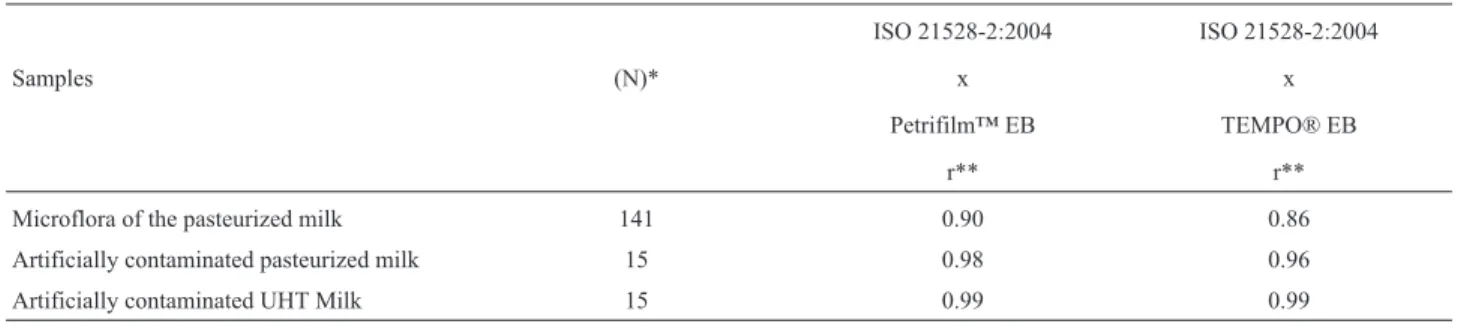
It can be observed that there was a positive relation-ship between the different methods used for the enumera-tion of Enterobacteriaceae, as shown by the correlation coefficient (r), which demonstrated a positive linear associ-ation between the methods, as can be seen from Table 1. The countings microflora of UHT milk were not shown in Table 1, since all samples produced < 1 CFU/mL.
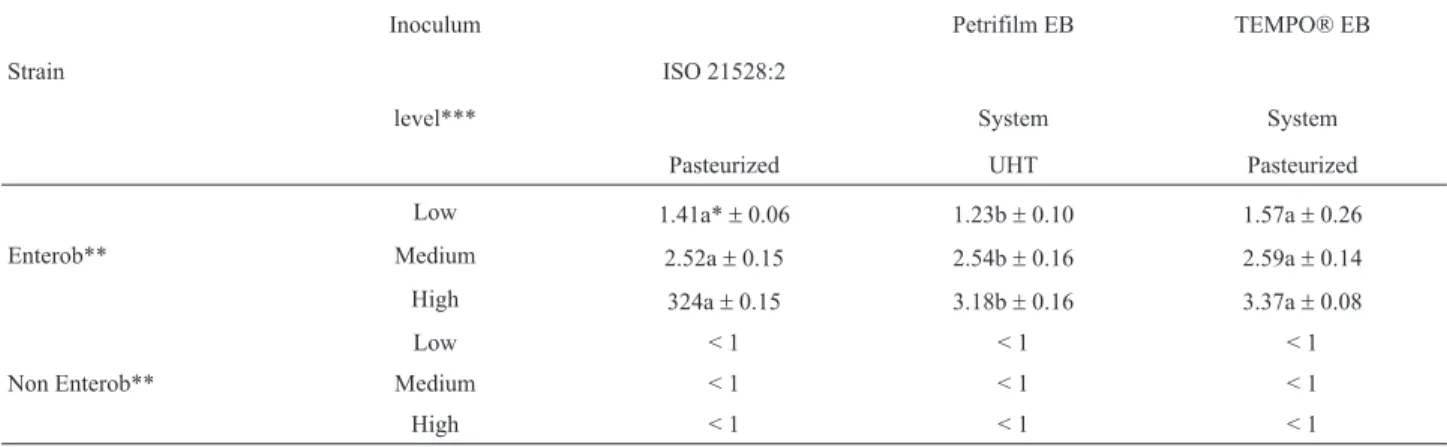
With regard to the evaluation of the artificial contami-nation with different levels of inoculum, (low, medium, high), the data were subjected to analysis of variance (Table 2). The results indicated that there was no statisti-cally significant difference between the three methods in-vestigated (ISO 21528-2:2004, Petrifilm™ EB system and the TEMPO®EB) system for countsEnterobacteriaceae, both in the pasteurized as in the UHT milk, at the three inoculum concentrations (101, 102, 103cfu mL-1) artificially added with a strain ofSalmonella Typhimurium.
The results also show that the three methods analyzed for the count ofEnterobacteriaceaedid not identify at the three inoculum levels (101, 102, 103cfu mL-1) any count of the presence of the strain ofStaphylococcus aureusadded to the pasteurized and UHT milk (Table 2).
Discussion
The correlation coefficients yielded by the analysis of the Petrifilm EB system with ISO 21528-2:2004 (Table 1)
Table 1- Correlation coefficient between ISO 21528-2:2004 and the Petrifilm™ EB and the TEMPO® EB in the enumeration of Enterobacteriaceae ob-tained by the microflora and artificially contaminated pasteurized milk and artificially contaminated UHT milk.
ISO 21528-2:2004 ISO 21528-2:2004
Samples (N)* x x
Petrifilm™ EB TEMPO® EB
r** r**
Microflora of the pasteurized milk 141 0.90 0.86
Artificially contaminated pasteurized milk 15 0.98 0.96
Artificially contaminated UHT Milk 15 0.99 0.99
show a high correlation in countingEnterobacteriaceaof microflora pasteurized milk samples, artificially contami-nated pasteurized milk and artificially contamicontami-nated UHT milk.
Ferrazet al.(2010) also obtained a similarity between the Petrifilm EB system and ISO 21528:2 in the enumera-tion results ofEnterobacteriaceaein a powdered milk pro-duction chain, after having analyzed raw milk, pasteurized milk, milk powder, equipment swabs and hand swabs.
The results relative to the correlation between ISO 21528-2:2004 and the TEMPO®EB system also showed a high correlation the counts ofEnterobacteriaceaof micro-flora pasteurized milk samples, artificially contaminated pasteurized milk samples and artificially contaminated UHT milk, as can be seen in Table 1.
Lower correlation coefficients were found by Owen
et al.(2010), when they evaluated 209 samples of foods and dairy products using the TEMPO® EB system, the MPN method, the pour plate and the spread plate techniques, cording correlation coefficients of 0.78, 0.75 and 0.78 re-spectively.
Paulsenet al.(2008) evaluated the TEMPO®EB and PetrifilmTMEB systems and ISO method 21528-2 in 411 naturally contaminated foods and their results did not pres-ent any significant difference between the methods, with means and standard deviation values of 2.540 ± 1.026, 2.547 ± 0.995 and 2.456 ± 1.014 log UFC/g for ISO 21528-2, PetrifilmTMEB and TEMPO®EB, respectively.
It may also be observed in Table 1 the correlation co-efficient obtained from the analysis of microflora pasteur-ized milk and artificially contaminated pasteurpasteur-ized milk obtained similar results in the correlation analysis (high correlation coefficients), showing a good performance of alternative methods analysis with pasteurized milk.
Evaluation of artificial contamination with different levels of inoculum (101, 102, 103cfu mL-1) of a strain of
Sal-monella Typhimuriumin pasteurized and UHT milk, indi-cated that there were no statistical differences between the three methods analyzed (ISO 21528-2:2004, the Petrifilm EB system and the TEMPO®EB system) at each level of inoculum in the Enterobacteriaceacounts. These results demonstrate that the alternative methods presented good identification results in environments of low, medium and high contamination.
A different result was reported by Silbernagel and Linderberg (2003), who in a study on artificial contamina-tion withProteus vulgarisat different inoculum levels in milk samples evaluated the performance of the Petrifilm EB system and compared the results to those obtained with the plate count method and the Most Probable Number (MPN) technique. In this study, the results showed that there was no statistical difference between the methods at an medium level of inoculation (103CFU mL-1). However, as for low (102CFU mL-1) and high inoculation concentra-tions (104CFU mL-1) they did exhibit a statistical differ-ence, with the Petrifilm EB system presenting the highest mean value.
It may also be observed that the methods for the de-tection of Enterobacteriaceae were species-specific, i.e.
unable to detect counts a strain not belonging to the
Enterobacteriaceae (Staphylococcus aureus)family. They also demonstrated sensitivity since they also detected counts at the different contamination levels tested.
The specificity and sensitivity of the Petrifilm EB system can be explained by the detection principle of the method, with the plates using Violet Red Bile Glucose Agar (VRBG) as culture medium and 2, 3, 5-trifeniltetrazolium (TTC) as color indicator. This colorant is colorless in the oxidized form, and turns red when reduced by the mito-chondrial succinate-desidrogenase enzyme of the microor-ganism, imparted by the formation of the formazan
precipi-Table 2- Average counts in log CFU mL-1of Enterobacteriacea and those of a strain not belonging to the Enterobacteriaceae family yielded by ISO 21528-2:2004, Petrifilm EB and TEMPO® EB at different inoculum levels artificially added to pasteurized and UHT milk.
Inoculum Petrifilm EB TEMPO® EB
Strain ISO 21528:2
level*** System System
Pasteurized UHT Pasteurized
Low 1.41a*±0.06 1.23b±0.10 1.57a±0.26
Enterob** Medium 2.52a±0.15 2.54b±0.16 2.59a±0.14
High 324a±0.15 3.18b±0.16 3.37a±0.08
Low < 1 < 1 < 1
Non Enterob** Medium < 1 < 1 < 1
High < 1 < 1 < 1
*Means followed by the same letters, in the same row and type of milk did not present any statistical difference at the p < 0.05 level of significance. **Enterobacteriaceae:Salmonella Typhimurium(ATCC 14028), NonEnterobacteriaceae:Staphylococcus aureus(ATCC 02923).
tate, which is a dark-colored product (Kornacki and Johnson, 2001).
As for the TEMPO®EB system, the culture used in this system contains a fluorescent molecule (4-methyl um-belliferone). The growth of the microorganism hydrolyzes the culture medium during incubation, - a reaction that is accompanied by an increase in the pH value caused by the fermentation of the carbohydrate, resulting in the extinction of the fluorescence in tubes with a positive reaction (Owen
et al., 2010).
Silbernagel and Lindberg (2002) also conducted a similar study with 174 samples of naturally contaminated and 120 artificially contaminated dairy and non-dairy prod-ucts, inoculated with three different inoculum levels (low, medium and high) and 45 pure non-Enterobacteriaceae
strains and 65 pure cultures ofEnterobacteriaceae, with the aim of evaluating the Petrifilm™ EB system and compare it against the performance of the VRBG Standard Method. The results showed that the Petrifilm™ EB system had an equal or better performance than the VRBG standard method and showed to be sensitive with a recovery rate of 97% of theEnterobacteriaceaepresent and also selective with only 16% of the non-Enterobacteriaceaebeing capa-ble to grow on the Petrifilm™ EB plate.
Owenet al.(2010) also analyzed the sensitivity and specificity of the TEMPO® EB system by testing
Enterobacteriaceae strains and non-Enterobacteriaceae
strains at two inoculum levels (low and high). They con-cluded that the TEMPO®EB showed to be sensitive and specific.
According to the results, the Petrifilm EB system and the TEMPO® EB system can both be used as a valid alter-native to ISO 21528-2:2004 for theEnterobacteriacea as-say in milk, based on the good correlation between the results, enhanced ease-of-operation and a reduction in the amount of time customarily required by these systems.
Acknowledgments
The authors are grateful to National Council for Sci-entific and Technological Development and to Ministry of Agriculture, Livestock and Food Supply for providing the funds for this study.
References
AOAC Research Institute (2011) Certificado n° 050801, de 07/05/2008. EN ISO 16140. AFAQ AFNOR BIO 12/21-12/06. TEMPO EB REF 80003. bioMérieux SA. Beloti V, Souza JA, Barros MAF, Nero LA, Mattos MR, Gusmão
VV, Moraes LB (2003) Evaluation of Petrifilm EC and HS for total Coliforms andEscherichia colienumeration in wa-ter. Braz. J Microbiol 34:301-304.
Brasil (2002) Ministério da Agricultura, Pecuária e Abasteci-mento. Instrução Normativa No. 51. Diário Oficial da
Repú-blica Federativa do Brasil, Brasília, Seção 1, vinte e nove de setembro de 2002.
British Standards Institution (1999) ISO 6887-1:1999. Microbiol-ogy of Food and Animal Feeding stuffs - Preparation of Test Samples, Initial Suspension and Decimal Dilutions for Mi-crobiological Examination- Part 1: General rules for the preparation of the initial suspension and decimal dilutions. London: BSI.
British Standards Institution (2004) ISO 21528-2:2004. Microbiol-ogy of Food and Animal Feeding stuffs - Horizontal Methods for the Detection and Enumeration of Enterobacteriaceae -Part 2: Colony Count Method. London: BSI.
Casarotti SN, Paula AT, Rossi DA (2007) Correlação entre méto-dos cromogênicos e o método convencional na enumeração de coliformes eEscherichia coliem carne bovina moída. Rev Inst Adolfo Lutz 66:278-286.
Feldsine P, Abeyta C, Andrews W (2002) AOAC international methods committee guidelines for validation of qualitative and quantitative food microbiological official methods of analysis. J AOAC Int 85:1187-1200.
Ferraz MA, Cerqueira MMOP, Souza MR (2010) Evaluation of
Enterobacteriaceaein the powdered Milk production chain using both traditional (ISO 21528-2:2004) and rapid (3M Petrifilm) methods. Ann Microbiol 60:373-376.
Jasson V, Jacxsens L, Luning P, Rajkovic A, Uyttendaele M (2010) Alternative microbial methods: An overview and se-lection criteria. Food Microbiol 27:710-730.
Kornacki JL, Johnson JL (2001)Enterobacteriaceae, Coliforms and Escherichia colias Quality and Safety Indicators. In: Downes, F.P., Ito, K. (eds). Compendium of Methods for the Microbiological Examination of Foods. American Public Health Association, Washington, USA, pp. 69-82.
Nero LA, Beloti V, Barros MAF (2000) Métodos Rápidos e Automatizados para Enumeração de Microrganismos Indi-cadores em Leite - Utilização no Brasil. Semina Ciênc Agrar 21:115-126.
Owen M, Willis C, Lamph D (2010) Evaluation of the TEMPO® most probable number technique for the enumeration of
Enterobacteriaceae in food and dairy products. J Appl Microbiol 109:1810-1816.
Paulsen P, Borgetti C, Schopf E, Smulders FJM (2008) Enumera-tion of Enterobacteriaceaein Various Foods with a New Automated Most-Probable-Number Method Compared with Petrifilm and International Organization for Standardization Procedures. J Food Prot 71:376-379.
Silbernagel KM, Lindberg KG (2002) Evaluation of the 3M Petri-filmEnterobacteriaceaeCount Plate Method for the Enu-meration of Enterobacteriaceae in Foods. J Food Prot 65:1452-1456.
Silbernagel KM, Lindberg KG (2003) 3M Petrifilm
EnterobacteriaceaeCount Plate Method for the Enumera-tion ofEnterobacteriaceaein Selected Foods: Collaborative study. J AOAC Int 86:802-815.
Statsoft, Inc, Statistica (2004) Data Analysis Software System, version 8.
Torlak E, Akan IM, Gökmen M (2008) Comparison of TEMPO® EC and TBX medium for the enumeration ofEscherichia coliin cheese. Lett Appl Microbiol 47:566-570.