THE IMPACT OF ONLINE TESTIMONIALS ON JOB
SEEKERS’ PERCEPTIONS OF ORGANIZATIONAL
ATTRACTIVENESS
Maria Madalena de Almeida Ribeiro Anglin de Castro
Dissertation submitted as partial requirement for the conferral of
Master in Human Resources Management
Supervisor:
Alzira Duarte, Assistant, ISCTE Business School, Human Resources and Organisational Behavior Department
iii
THE IMPACT OF ONLINE TESTIMONIALS ON JOB
SEEKERS’ PERCEPTIONS OF ORGANIZATIONAL
ATTRACTIVENESS
Maria Madalena de Almeida Ribeiro Anglin de Castro
Dissertation submitted as partial requirement for the conferral of
Master in Human Resources Management
Supervisor:
Alzira Duarte, Assistant, ISCTE Business School, Human Resources and Organisational Behavior Department
iv Resumo
O mundo está em constante mudança e o grande desafio está em acompanhar essa evolução.
Vivemos num mundo onde as fronteiras se extinguem e as distâncias se encurtam.Para enfrentar os desafios da globalização, as empresas precisam de ferramentas que lhes permitam trabalhar mais depressa, com agilidade e simplificação, e que lhe garantam no mercado uma vantagem competitiva, considerando essencial o investimento no seu capital humano.
Este estudo foi orientado no sentido de identificar as perspetivas dos potenciais candidatos face às estratégias de atratividade que as empresas utilizam, particularmente os testemunhos online.
Num primeiro momento foi feito um estudo qualitativo, dirigido às empresas, com o objetivo de identificar os canais de divulgação utilizados, as motivações que as levaram a adotar a metodologia dos testemunhos online e a forma como os implementaram com vista à definição de estratégias a aplicar no futuro.
Foi também objetivo deste trabalho, avaliar de que forma os websites das empresas influenciam a imagem que os potenciais candidatos criam da mesma, analisar o impacto que os testemunhos online têm na perceção dos candidatos sobre a empresa, estudar o grau de credibilidade dos testemunhos online e perceber de que forma esta ferramenta contribui para a eficácia da mensagem que a empresa quer veicular.
Dos resultados obtidos conclui-se que apesar das empresas estarem a apostar cada vez mais nesta abordagem, os potenciais candidatos demonstram ainda algumas reservas embora não recusem a sua importância.
Códigos JEL: O15 – Recursos Humanos; Desenvolvimento Pessoal; O33 – Mudança
Tecnológica: Escolhas e consequências; Processos de difusão.
v Abstract
The world is constantly changing and the great challenge is to keep up with this evolution. We live in a world where boundaries are being extinguished and distances becoming shorter. To meet the new challenges of globalization, companies need tools that allow them to work faster, with agility and simplicity, in order to guarantee a competitive advantage in the labor market, always being essential the investment in their human capital.
This study was conducted to identify the perspective of potential candidates regarding the attractiveness strategies adopted by companies, particularly the online testimonials. In a first moment a qualitative study was addressed to companies, with the aim of identifying which are their disclosure channels, the reasons that led them to adopt the strategy of online testimonials and how they managed their implementation, with a view to defining strategies to be applied in the future.
It was also a goal of this study to evaluate how the corporate websites influence the image that potential candidates create about the company, to analyze the impact of online testimonials on the potential candidates' perceptions about the company, to study the degree of credibility associated with online testimonials and to understand how this tool contributes to the effectiveness of the message that the company wants to convey. From the results it is concluded that although companies are increasingly investing on this approach, potential applicants still show some reservations towards it, though not refusing its importance.
JEL Code: O15 – Human Resources; Human Development; O33 – Technological
Change: Choices and Consequences; Diffusion Processes
vi Index
1. Introduction ... 1
2. Theoretical Framework ... 3
2.1 Technological Developments ... 3
2.2 The Human Resources Challenge... 6
2.2.1 Electronic Human Resources Management (e-HRM) ... 7
2.2.2 The Recruitment Process ... 8
2.2.3 Online Recruitment ... 10
2.3 Employer branding ... 12
2.4 Online Testimonials ... 25
2.5 Research Questions ... 26
3. Methodology ... 28
3.1. Study A) Employers’ perceptions of online testimonials as a recruitment tool ... 28
3.1.1. Participants ... 28
3.1.2 Instruments ... 29
3.1.3. Procedure ... 29
3.1.3.1. Content Analysis ... 29
3.2. Study B) The role of corporate websites in job search and the impact of online testimonials on job seekers organizational’ perceptions ... 31
3.2.1. Participants ... 31
3.2.2. Instruments ... 32
3.2.3 Procedure ... 33
4. Analysis of Results ... 34
4.1. Study A) Employers’ perceptions of online testimonials as a recruitment tool ... 34
4.2. – Study B) The role of corporate websites in job search and the impact of online testimonials on job seekers organizational’ perceptions ... 43
4. Discussion of Results ... 58 5. Conclusion ... 64 Limitations ... 67 Future research ... 67 References ... 69 Annexes ... 78
vii
Annex A – Interview Guide... 79
Annex B – Research of companies that use online testimonials in their websites ... 80
Annex C – Questionnaire ... 84
Annex D – Sample characterization ... 88
Annex E – Factorial Analysis ... 92
Annex F – Outputs ... 97
viii Tables Index
Table 1 - Characterization of the overall sample ... 32
Table 2 – Dimension: Strategy ... 35
Table 3 - Dimension: Motivations ... 36
Table 4 - Dimension: Operationalization ... 39
Table 5 - Dimension: Future intentions ... 41
ix Figures Index
Figure 1 - Internet adoption percentage rates, for business (1998-2003) and individuals
(1997-2007) ... 4
Figure 2 - Effects of employer branding. ... 17
Figure 3 - A conceptualization of the employer branding process ... 19
Figure 4 - Means used by jobseekers to search for companies ... 45
Figure 5 - Advantages of online testimonials compared with other more traditional forms of organizational disclosure ... 53
Figure 6 - Most valued aspects in online testimonial ... 55
1 1. Introduction
Over the past years, the world has witnessed an increasing globalization, where boundaries are gradually disappearing and distances becoming shorter.
It is undeniable that this universal phenomenon has changed our lives in many levels.One of the most visibly affected was undoubtedly the technological sector. Several authors have approached the relation between technology – more specifically information and communication technologies (ICT) – and globalization, and also the effects they have on each other. In fact, literature tends to be unanimous in telling that information and technology promotes globalization (Madon, 1997; James 2001, 2002; Pieterse, 2002). Technological developments brought us innovative tools that enable new forms of communicating. Consequently, the nature of communication was profoundly transformed in today’s societies and the interactional field was strongly affected. From the most traditional ways, including radio and television, into a vast interactive network, its use has already reshaped the communications patterns for countless individuals and organizations1 around the world (Slevin, 2000).
The technological evolution has also positioned internet in a predominant and privileged place (Reynolds & Weiner, 2009). Its field of action has becoming more and more wide and its impacts have introduced profound changes on people’s behaviors. Internet new functionalities allowed individuals to broader their experiences beyond their immediate social surroundings and social habits began naturally to meet new boundaries (Slevin, 2000).
For instance, getting information from newspapers, journals or magazines has never been so easy. Nowadays it is possible to acquire the same information in a more instantaneous and faster way. Also several daily activities such as shopping and travel have been affected as people started to take advantage of new technologies’ functionalities to managing it (Reynolds & Weiner, 2009). Internet has thus become one of the most popular tools for searching all kinds of information and for reach more and more people.
1 The concepts “organization” and “company” are considered synonyms, for the purposes of this
2
Thus, for better understanding the transformations taking place in modern societies, it is crucial for us to recognize the central role such media achieved so we can be more aware of its implications (Slevin, 2000).
All these impacts had important repercussions and not only the personal life has been deeply affected but also organizations have constantly to adapt their strategies if they want their practices to be the updated and sophisticated. It is a real challenge for organizations, and for human resources departments, once new discovers are always emerging and they must be aligned with it in order to guarantee their competitive advantage in the labor market.
Additionally, if organizations actually give an increasing acceptance and importance to the innovative practices so they can ensure a privileged place in the labor market, also applicants2 must be well informed about how they should position themselves in the recruitment process. It is a virtuous cycle and it takes two actors to be aware of the innovation that characterizes the current business environment and, when done successfully, it is a win-win process.
Due to the new features internet gave to recruitment methods, job seekers have now more and more access to a variety of options and are able to critically compare employers and therefore support their decision of choosing them (Van Hoye & Lievens, 2007). This gives companies an increased demand. If they want to attract and retain the most talented applicants, they have no choice but to participate in the “war for talent”.
Attracting potential candidates by captivating them with the right online message is thus crucial as, more and more, they have at their disposal several tools that enable them to be more conscious about their career choices and professional decisions and how they should put themselves on job market (Smith & Rupp, 2004). Therefore, with the increasingly wider labor market and number of job offers, the concept of employer branding become more powerful in the context of the new recruitment practices (Wright, 2011).
2 The concepts “applicant”, “job seeker” and “potential candidate” are considered synonyms, for the
3 2. Theoretical Framework
2.1 Technological Developments
Even though we can easily find the most varied signs of changes caused by the Internet in our daily lives, it may not be as clear to us quantify its impacts on organizations. However, it is already known that the use of information technologies became a present reality in corporate environments, being introduced in all its forms, from private to public, from local to global, old and new. Having at their disposal several new tools, organizations attempt to adopt strategies by integrating information technologies and taking advantage of them to better organize their activities (Slevin, 2000).
The rapid growth and acceptance of the internet was certainly the major trend of the last years that mostly influenced and reshaped the recruitment and selection practices (Reynolds & Weiner, 2009).
The internet usage has undergone a massive growth in the late 1990’s and early 2000’s (Reynolds & Weiner, 2009). The following figure shows the internet usage’ evolution over a period of ten years (1997-2007) in two perspectives: the solid-line represents the “Business Use for Recruiting” and the dotted line refers to the “Individual Internet usage”. From the graph’s analysis, it is clear that the adoption rate of online recruiting tools reached its maximum values between 1998 and 2003. Reynolds and Weiner (2009) estimated that, by 2002, about 90% were already using the internet for recruitment purposes and more than 70% integrate in their practices specific features that enable candidates to communicate between each other, and searching for job openings.
4
Figure 1 - Internet adoption percentage rates, for business (1998-2003) and individuals
(1997-2007) Sources: iLogos, 2003; U.S. Dept. of Commerce, 2002; Pew Internet and American Life Project, 2007. (Reynolds & Weinor, 2009: 9)
They also concluded through the surveys they did to organizations that, at the same time, 35% of them had an online application form as their primary method for applying for jobs and this percentage has been increasing following the technological evolution.
However, there were soon important differences within the access and the use of the internet that deserved researchers’ attention. These differences – concerning the race, gender and age – have yet been decreasing over time (Reynolds & Weiner, 2009), probably due to the extension internet achieved, which has promoting an increasingly access to all people.
Another issue has to do with the reasons behind each individual choice to use the web. Surprisingly, job search has ranked high on the list. Accordingly to a study developed in the USA, concerning the demographic differences, minorities did not have the same access but, when having the opportunity to use the internet, they used it for job search (Reynolds & Weiner, 2009).
Reynolds and Weiner (2009) have already clarified the internet adoption percentage rates between 1997 and 2007 (when internet became more popular). In 2010, the Nielson Company revealed also that, for a year (December 2008 to December 2009), the time spent on social media websites has increased in 82%. Still, further statistics about the use of social media for jobseeking were reported by Wright (2011). Based on the employment search engine “simply hired”, he found that in UK more than a half of job seekers use the internet for searching for employment.
5
Still, a survey carried out by Potentialpark (2011) included answers of over 30,000 graduates, students and early career professionals worldwide. This survey was made in Europe and the results showed that close to 100% of the participants demonstrate interest in interacting with employers via online. Also the youngest reported to be increasingly using online features for both better search for jobs and consolidate their “professional online presence” (Broughton, Foley, Ledermaier & Cox, 2013). All these facts demonstrate the large presence and a strong willingness of today’s job seekers to interact with companies via online.
Internet has indeed achieved an unquestionable importance in every ways. As the authors say, as a consequence of internet’s major growth, it is currently the core tool for people searching and finding jobs, as it has become the main accepted and recognized way for doing it (Reynolds & Weiner, 2009). The impact it had on the way potential candidates look for a job was such powerful that the habits have dramatically changed.
Nowadays, the searching for information is much easier and faster, contrasting with the past when job seekers had to resort to newspapers or contact people so they could be aware of suitable job opportunities. Job seekers have now at their disposal a lot of available job openings in the internet. The same goes for the way organizations recruit and select them for work (Van Rooy, Alonso, & Fairchild, 2003; Van Hoye & Lievens, 2007). Internet technologies have facilitated in a large-scale the process of exchanging information between employees and organizations (Reynolds & Weiner, 2009).
Therefore, the use of internet as a recruitment tool throws up some opportunities and challenges for employers. Internet potentially offers speed, efficiency and the ability to target and attract specific, particularly apposite candidates in the recruitment process. It can provide a useful additional source of information on potential job candidates, especially since some data (at both personal and professional levels) may not be generated for the purpose of recruitment, and therefore may provide candid supplementary information on the applicant. For candidates it potentially offers multiple sources of information about the employer and the possibility of contact with existing employees to gain a more realistic job preview.
6 2.2 The Human Resources Challenge
The impact that the information technologies (IT) had on organizations was of such a dimension that naturally it had major repercussions on the way the human resources were managed. It has allowed the increasing of human resources management’ potential, not only because of the computerization of the administrative processes but also due to the decentralization of the human resources functions. Owing to the automatization of human resources practices, monitoring all the company’s employees has started to be much easier and precise. The IT turned out to be a precious help in decision-makings, such as discussing wage deals, understanding if there are training needs or even if there are recruitment needs (Cabrera & Bonache, 2002).
Organizations, executives, managers and HR professionals face now important challenges during this time of major technological changes. The priority must be to understand how they can make the most of the innovated technological tools to reshape the processes and systems, in order to support the organizational staffing and, thereafter, add value to organizations.
The “pressure” to join these new methods is specially felt by HR professionals, once all the HR functions and practices have been re-directed to engage the new technology features (Reynolds & Weiner, 2009). It is very important for HR professionals to be aware of the benefits of these innovative procedures, so they can persuade the broader organization to invest in them.
Yet, it should be noted that, when a company undergoes major changes, it is always a complex process usually leading to an internal restructuring with strong implication on the organizational system. Not being an easy process, organizations need to have a solid structure and a well-defined strategy to sustain it, once technology advancements by itself aren’t enough. Therefore, before diving into this change, organizations should carefully measure the benefits behind its drivers (Reynolds & Weiner, 2009).
Each company has a particular identity and the best way of how to invest in technology tools and make the most use of them may differ from company to company. Certain measures can fit in the organizational culture of a company and may not serve to another. Thus, for this process to succeed it is crucial to know well the organization. All
7
organizations are distinguished for having a specific culture and the role of the HR managers is to do a diagnosis gathering all the organizational needs so they can properly adjust the available technological tools to face those gaps (Reynolds & Weiner, 2009). Having it settled, it is part of the HR role building the bridge between those new technological developments and the way organization makes use of it. They must play a key role in challenging and pushing the organization forward (Reynolds & Weiner, 2009). Fortunately, there is an understandable acceptance by HR executives and staffing managers in adhering to that, since it represents more effective practices at a lower cost, wherein the rapid evolution of internet-based technologies facilitated and accelerated the staffing process. Recruitment and selection were among the first human resources functions that rapidly took advantage of the internet, placing it as a core element of the organizational processes. HR professionals have, then, to assume new technology responsibilities alongside with other related practices such as the accountability for recruitment, hiring and integrating new employees (Reynolds & Weiner, 2009).
A new vision emerges defending the reduction of costs and the spent time in the recruitment processes by attenuating the bureaucracy inherent to the most traditional methods. Several traditional features started to remake their operational processes and become more technology-driven (Reynolds & Weiner, 2009).
2.2.1 Electronic Human Resources Management (e-HRM)
The concept of Electronic Human Resources Management (e-HRM) has emerged throughout this process of technological development and it is defined by Strohmeier (2007; p.20) as “the (planning, implementation and) application of information technology for both networking and supporting at least two individual or collective actors in their shared performing of HR activities”. From the e-HRM earliest times, the new management practices rapidly began to gain notoriety among HR Managers due to the several benefits associated with it. According to Lengnick-Hall and Moritz (2003) and Strohmeier (2009), e-HRM improves all HR’s activities by defining strategic roles and providing sustainable competitive advantage, all in less time, money and better quality.
8
According to Bondarouk and Ruël (2009), the use of corporate websites to “e-recruit” has placed “talent acquisition services” as the second most common e-HRM strategic application. It is such a crucial element that, at the time of 2005, it was already used by almost all companies and it also represented a huge monetary investment (Lee, 2005; van Birgelen, Wetzels & van Dolen, 2008).
Earlier research based on a survey to a leading US employers (Cober & Brown, 2006) found that over 50% of all new hires originated from the internet and that the greatest number of those came from the corporation’s own web site (e.g., Anderson, 2003; Cober, Brown, Keeping & Levy, 2004; Lievens & Harris, 2003). These numbers show how important is to organizations to have accomplished corporate websites so they can be managed as a successful recruitment tool.
The use of corporate websites for recruitment purposes are, therefore, a strong example of a practice that emerged with the technological evolution and that had major impacts in the human resources practices. In this way, for the purposes of this study, the focus will be precisely on one of the human resources expertise areas: the recruitment.
2.2.2 The Recruitment Process
Individuals and organizations make part of a continuous process of attraction between each other. In the same way individuals are interested in organizations, seeking information and asking questions about them, also organizations aim to attract potential candidates, looking for information about them so they can decide if they should be admitted or not. To this complex process we might call the recruitment and selection process (Pires, 1993).
The attraction of potential candidates is implicit in the process of recruitment and not in the selection phase. Whilst recruitment covers the entire process running from the decision to fill an available position until the searching for all the candidates potentially suitable for performing a required function, the selection process consists in the decision on which of the recruitment process’ finalists are better to fill the vacancy, for gathering all the conditions to be part of the organization.
9
Recruitment is defined as a set of activities conducted by organizations with the primary purpose of identifying a considerable group of potential candidates, informing them about job and organization attributes, and persuading them to join the organization. It consists in attracting new employees with the appropriate knowledge, skills, abilities, and aptitudes, and retaining them to the company at least in a short term (Taylor & Collins, 2000). It is an important part of human resource management as it performs the essential function of drawing an important resource – human capital – into the organization (Barber, 1998; Taylor & Collins, 2000; Breaugh & Starke, 2000).
In short, it is through the process of recruitment that organizations determine the quantity and the type of candidates they want to attract (Ivancevich, 2013). Those practices that aim to attract potential candidates can be manifested in several ways and various methods may be adopted. For instance, potential candidates and job seekers may be attracted through newspapers’ advertisements, employment agencies, employment forums, employee referrals, outplacement companies, head-hunting, university campus, informal methods (personal approach), via internet (online recruitment). The practices should be properly applied for each organization, in other words, which might be suitable for one situation or function may not be for another (Cunha, Marques, Cabral-Cardoso, Rego, Pina e Cunha & Gomes, 2010).
The organizational culture of a company is particularly important when deciding whether a candidate should be selected or not. Beyond the required technical skills, it is very important for the candidate to be well integrated and share the organization’s values, beliefs and attitudes. Catanzaro, Moore and Marshall (2010) reinforces that a candidate must identify himself with the organizational context for which he is applying for. Fortunately, nowadays organizations are integrating this whole organizational perspective by searching for the right people to work in the organization rather than just looking for the right people to fill a job position, ignoring their fit in the organizational context, which used to mostly happen within the traditional methods (Domingues, 2003).
10 2.2.3 Online Recruitment
Recruitment has emerged in a competitive labor market environment, in a context of great employees’ mobility, and became a critical human resource function for organizations (Allen, Scotter & Otondo, 2004). There was a need to rethink the way recruitment methods were being applied, taking into account the technological advancements, with the purpose of optimizing the practices carried out so far. It was out of this need that the online recruitment emerged, inaugurating a new era. Since it is relatively recent, organizations are yet improving their processes and online recruitment still has much room to grow and to mature its methods. Nevertheless, it is possible to find already several signs of their success, which leads us to think that organizations that opt for innovation are increasingly more likely to dominate the market.
Although it has suffered an abysmal growth over the past years, according to Parry & Wilson, at the time of 2009, the online recruitment was still a topic sparsely discussed among researches.
The mission of the online recruitment has not distanced itself from the traditional recruitment. However, the great difference is in the way it is exercised, since internet provided a host of features that had not been explored in the most conventional recruitment methods.
In order to obtain competitive advantage and organizational excellence it is required for online recruitment to make use of the information technology (IT) and to develop processes able to understand and respond quickly to customer and market needs (Araújo & Ramos, 2002).
For Thomas and Ray (2000), online recruitment is a process that has at its disposal several tools and resources that can be used and organized in different combinations. Data bases, specialized websites containing job offers, chat rooms, discussion forums and company’s own websites are some of the main used techniques.Some organizations give a step ahead and include a specific space for recruitment purposes in their own webpage. However, it is important that these systems are properly used by companies. Technology has a lot to offer, but only for the ones who know how to manage it in the best possible way.
11
As mentioned earlier, the internet growth had major consequences in organizations and in the way recruitment processes are conducted nowadays. These consequences led the human resources departments to figure out how to better adequate the technological advancements with the human resources practices. Employers must now position themselves, actively and strategically, by defining an appropriate e-recruitment program so they can better find suitable candidates and improve their hiring decisions. In this way they are saving time and money (Smith & Rupp, 2004).
It is possible to say that “e-recruitment” is the joint result of the internet development and the recruitment practices. Employers are somehow using the internet as a tool to complement the conventional recruitment methods (Smith & Rupp, 2004)
The quality of the recruitment services is either better when taking advantage of the advanced computer settings. As the authors say, the new automated methods, in contrast to the traditional ones (paper and massive manuals), are less time consuming – which increases the productivity by shorten the period of time of vacant positions –; help on reducing recruitment costs, once publishing a job add online is cheaper than posting it in newspapers; and also promote employee turnover (Smith & Rupp, 2004), .
Furthermore, e-recruitment offers the possibility of substantially reaching more and diversified people, over a much wider geographical area than the traditional recruitment methods. However, albeit in a significantly smaller dimension, there are still differences in the internet access rates, which raise important questions for human resources practitioners about the viability of online hiring tools. Reynolds and Weiner (2009) drew attention to the constant challenge that the human resources departments are required to deal with, in order to avoid those differences and cover as many suitable job applicants as possible.
Although it is usual to find research that value more the innovativeness of e-recruitment in contrast with the outdated traditional recruitment methods, there are still authors as Wright (2011) insisting that, besides all the e-recruitment advantages, the great asset for organizations is to operate with the complementarily of both traditional and technology-based recruiting methods.
12 2.3 Employer branding
The concept of employer branding is based on the premise that human capital is an extremely valuable asset to organizations. Thus, by investing in human capital, the organization performance is likely to be enhanced. For that reason, as recruitment serves the main purpose of attracting the best talent, the human capital theory is closely related to employer branding.
Therefore, the practice of employer branding brings together the process of attracting the best talent for a specific job offer (human capital theory) combined with the necessity of gathering the right equipment and technological resources for the company, with the main purpose of obtaining competitive advantage (Backhaus & Tikoo, 2004).
Cappelli (2001) explains that the online hiring process is composed by three different steps: attracting, sorting, and contacting candidates. Organizations should attract potential candidates through publicity, adds and benefits.
The author reinforces the importance of companies’ recruiting practices to be updated and innovative, in contrast to old systems viewed as largely outdated among the human resources departments. Therefore, recruiters should be: agile in their movements, present a different approach from the usual and lastly, be flexible (Cappelli, 2001).
The solution he proposed to address this situation involves organizing the companies’ system in order to behave as a market. In other words, a strong restructuring is needed to adopt a new vision based on a marketing perspective, which means that the potential candidates should be approached as potential clients: carefully identified and targeted, attracted to the company and its brand, and then sold to the job. According to Cappelli (2001) the companies that opt to incorporate this strategy in their recruitment policies are more likely to succeed by attracting and retaining the best talent.
Therefore, it is expected that investing in the attracting phase, by making the best use of online recruitment innovativeness, will add great value to the company. In this sense, it is easy to understand why the attracting phase has such an important role in the whole recruitment process. This phase corresponds to the initial part, where the first contact between job seekers and organizations happens and it is crucial to define the quality of the applicants’ pool that contains the future employees that will make part of the
13
organization’s workforce (Cober, Brown, Keeping & Levy, 2004). It is also where the first consistent organizational image is formed by job seekers, which will naturally influence their future perceptions about the company. Cable and Yu (2006, p. 828) define image “as an audience’s beliefs about the traits that are central, distinctive, and relatively enduring about the company”.
In this stage, the organizational image begin to presocialize job seekers in terms of what to expect from the company and what would be expected of them if they join it as employees (Cable, Aiman-Smith, Mulvey & Edwards, 2000) and it matters once it helps them to differentiate a firm from its competitors and encourage them to develop feelings of attachment to certain firm instead of others (Dutton & Dukerich, 1991; Scott & Lane, 2000).
The consumer-based brand equity theory (Aaker, 1991; Keller, 1993) took scholars to access if organizations’ ability to create an unique and favourable corporate image brand would somehow determine their recruitment success (Bernerth, Field, Giles, Short & Walker, 2011). According to Wilden, Gudergan and Lings (2010), this theory defends that organizations with favourable brand images have a positive influence on potential applicants’ willingness to apply for it and encourages current employees to stay in the company (Wallace, Lings, Cameron & Sheldon, 2014). For a better understanding, job seekers are treated as the “consumers” and the organization as the “brand” (Keller, 1993). Through the organizational image, organizations send signals to society about their employees (Dutton, Dukerich & Harquail, 1994). If job seekers feel identified with those messages, pursuing and joining a particular organization becomes a concrete, public expression of a job seeker’s own traits (Ashforth & Mael, 1989; Popovich & Wanous, 1982). Due to the processes of self-selection and presocialization, organizational images develop a certain type of workforce (Cable & Judge, 1996; Judge & Bretz, 1992; Schneider, 1987).
Regarding this topic, there is a theory – named signalling theory – that has already been approached from several authors (e.g. Spence, 1973, 1974; Rynes & Miller, 1983; Wallace et al., 2014). This theory explores the mental representations job seekers develop about a firm, based on the inferences they draw about the available information. It happens whenever individuals have limited knowledge about an organization and capture
14
the information they see and use it as signals to form their own organizational image. As it will be further evident, this signalling theory will take a central role in this dissertation. Moreover, the information shared by a company may have a decisive impact on job seekers’ attraction towards hiring organizations (Rynes, Bretz, & Gerhart, 1991; Turban, 2001; Turban, Forret, & Hendrickson, 1998).
According to Braddy, Meade and Kroustalis (2008), the application of the signalling theory in the recruitment context suggests that internet, particularly corporate websites, play a crucial role in the process of creation of job seekers’ organizational impressions, once its characteristics serve as cues for them to base their inferences about the organization (especially when the information about the organization is scarce). Furthermore, applicants extrapolate these cues and believe they are representative of the whole organization (Rynes et al., 1991).
Although, despite there being an evidence of similarity between job seekers’ perceptions of website’ characteristics and the formation of their own organizational images, there are some variables that should be taken into account when analysing this correlation. One variable refers to the familiarity – the signalling theory suggests that the less familiarity with the hiring company, the greater the effect of recruitment websites on applicants’ organizational images (Braddy, Meade and Kroustalis, 2008).
Recent recruitment research has made substantial progress in conceptualizing and determining organizations’ images in the earliest stages of recruitment. However, the issue of how organizations manage their images during recruitment has received less attention. The main question that firms aim to answer is: Which investments in recruitment media are more effective to approach job seekers’ image with the firms’ projected image?
The topics on how to allocate resources among different communication media and how and whether job seekers’ image beliefs can be modified are key theoretical implications for this study. Job seekers’ beliefs are formed early and are perceived as very difficult to change. For that reason, firms should have incentives to manage them in order to avoid mismatches between job seekers’ image believes and the firm projected image, and also be cautious once they should only transmit substantiated ideas, otherwise job seekers’
15
will doubt about the truthfulness of that information which will negatively impact on company’s credibility.
Backhaus and Tikoo (2004) developed a framework regarding the concept of Employer Branding that helps firms managing the organizational image they want to convey to potential candidates and how to avoid those mismatches and, therefore, improve their ability to attract and retain talented employees. First of all, it is important for organizations to identify which are the factors that mostly influence the applicants’ decision process in order to define their strategy for better attract the future employees who will best fit in the organization (Wallace et al., 2014).
The marketing and branding practices adopted by organizations are increasingly decisive elements for potential employees to make the differentiation between organizations (Collins & Stevens, 2002) and are crucial concepts for making organizations attractive from the employees’ perspective (Wallace et al., 2014).
The ultimate goal of employer branding is to enable organizations to transmit to potential employees the benefits of working there (Ambler & Barrow, 1996). This goal is accomplished through a branding process where some activities are developed in order to create a unique image in the applicants’ mind and influence their beliefs and perceptions about it (Wallace et al., 2014; Business Dictionary, 2013; Collins & Stevens, 2002). Wallace et al. (2014) state that organizations with a strong employer brand are perceived as being more valued and attractive than the ones that have lower employer brand value. The initial evaluation that potential applicants make of competing jobs and firms’ attributes depends on the perceptions they have of them. These perceptions, in most cases, are transmitted through word of mouth, personal experiences or marketing strategies (Wallace et al., 2014).
Employer branding can be defined as “the package of functional, economic, and psychological benefits provided by employment, and identified with the employing company” (Ambler & Barrow, 1996; p.186). It does not operate in isolation. Instead, it is translated into practices that are cut-across the whole business and that also involve the current employees, who turn to be essential for spreading a good organizational image. Thus, the process of attraction should guarantee that the projected brand matches the
16
reality of the organization, once it represents a promise that is made by the company to potential candidates.
Regarding this employer brand’ promise, there is still a concept that arises that has to do with a psychological contract that is made between the company and employees (Foster, Punjaisri & Cheng, 2010). Through this contract, potential employees develop a multifaceted image of the employer (Keller, 1993) and perceive the functional, economic and psychological benefits intrinsic in the brand message, compare them with their own needs and corporate image perceptions and realize if they actually fit in the organization (Foster et al., 2010). In order to generate a realistic preview of the psychological contract between employees and the organization, brand messages provided by organizations – about their work, culture, values and identity – need to be as accurate and real as possible, in order to avoid potential employees’ mistrust towards the company, which would certainly cause negative impacts (Schein, 1996; Backhaus & Tikoo, 2004).
According to Ambler and Barrow (1996), the primary purpose of this framework about employer branding was to facilitate the HRM role, helping in the definition of priorities and, therefore, increasing productivity and improving the recruitment process, retention of current and future employees and promote a solid commitment (Barrow & Mosley, 2006).
The concept of employer branding as part of the HRM field involves a process that may be divided into three stages, as it was described by Backhaus and Tikoo (2004). First of all, a firm develops a value proposition that is created and spread crosswise the organizations’ culture and identity. Secondly, it is through their organizational projected image that organizations are able to manage the value they offer to the current and potential employees; and in third place, the value that is transferred to potential or targeted employees is also captured and accepted by the current employees, who play an active role in this process (Wallace et al., 2014).
In order to provide a better understanding of this topic and its influence on organizations context, Backhaus and Tikoo (2004) designed a model that explains the effects of employer branding.
17
Figure 2 - Effects of employer branding. (Backhaus & Tikko, 2004: 505)
The reason why organizations keep investing in taking advantage of employer branding is largely supported by the numerous advantages associated with it, which will be further explained.
Van Dam (2006) stresses that organizations use the employer branding for reaching their final goal in the recruitment process: project the right message and have a strong and positive image among their current and future employees.
According to Kucherov and Zavylola (2012), when organizations are capable of achieving that strong appealed brand, they are most likely to have a positive and highly recognized employer image; to make potential employees believe in their brand’ promises; to have valuable economic and symbolic features from the potential employees’ perspective; to be positively differentiated from the other organizations; and finally to develop a solid strategy and establish activities for being well-positioned in the labor market (Wallace et al., 2014). Results have shown that successful employer branding increases substantially the quality and quantity of job applicants (Collins & Han, 2004).
Still under the HR field, economical impacts that employer branding could have in organizations have been already experienced. Namely, the recruitment costs decrease through a better communication with potential employees. Employer branding also promotes employee engagement and strengthens the corporate culture (Barrow & Mosley, 2006; Backhaus & Tikoo, 2004).
18
There are three different concepts derived from employer branding that matter to highlight: brand clarity, brand consistency and brand credibility: “Brand clarity refers to employer information that is unambiguous and instantly recognizable; brand consistency refers to the employer’s image being reinforced across all information sources; and brand credibility refers to recruits’ confidence that an organization’s employment promise can be delivered” (Wallace et al., 2014; p. 22). These three sources will influence the organizational image that potential employees will form and, consequently, determine the success of the organizational implemented measures to attract them.
Wallace et al., (2014) add that the information that is related through firsthand experiences usually is seen as being the most credible, and the information based on word of mouth from impartial sources is accepted as more credible compared with information generated and controlled by the company. Furthermore, the value of the company as an employer is strongly determined by what candidates think about it (Erdem & Swait, 1998).
If the recruitment messages are not consistent with the policies advocated by the company – particularly concerning the protection of candidates – the credibility of its brand will certainly be negatively affected.
Consistency and ambiguity of the information received by potential candidates about the company represent two key variables in determining the company's branding gains (Fernández-Barcala & González-Díaz, 2006). If potential employees perceive that information to be ambiguous or contradictory, their reliability on organizations’ promises decrease, which make them less attractive from their perspective (Wallace et al., 2014). From a different perspective, but not dissociated from employer branding, “employee branding” also plays an important role around the attractiveness’ issues, as the organizational identity and culture is transmitted by current employees, once it is reflected in their attitudes and work behavior (Wallace et al., 2014). In other words, if the employees of an organization experience, in their daily working routines, the values and culture of their company, it is expected that the desired brand image of the organization will be successfully conveyed, once it becomes more real and concrete for potential candidates.
19
If the employee branding process is well executed, it brings together a role of positive tangible impacts for the organization’s human resources functions, which can lead to a great-value toward the organization’s competitive advantage. These positive outcomes may be translated, for instance, in the improvement of employee satisfaction and retention (Miles & Mangold, 2005). Therefore, this could also have significant good effects on the organizational reputation both internally (for the current employees who develop feelings of belonging to the company) and externally (for future employees who develop the desire organizational brand image).
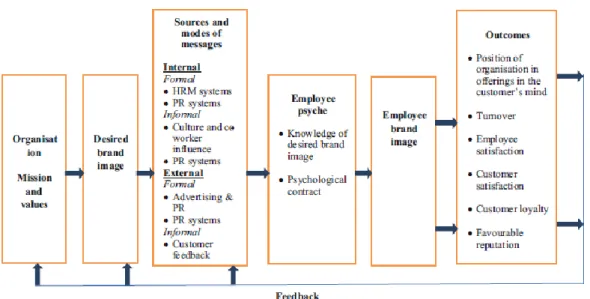
Miles and Mangold (2005) propose the following model, where they systematize a conceptualization of the employer branding process.
Figure 3 - A conceptualization of the employer branding process (Miles &
Mangold, 2005: 537)
According to Berthon, Ewing and Hah (2005), a company can benefit from five principles regarding the employer image, which are believed to be the ones potential employees most value: interest value, social value, economic value, development value and application value.
20
Interest value is based on the premise that the organization promotes a good working environment, invests in innovative procedures and policies and creates respectable products and services through its workers’ skills.
Social value has to do with the organization’s ability to provide a pleasant working atmosphere to potential employees, valuing teamwork and interpersonal relationships. Economic value refers to potential employees’ perceptions about the organization’s attractive remuneration, employment stability and job opportunities.
Development value is based on the employees’ achievements, and on how they perceive organizations to recognize them and create opportunities to launch employees to future employment challenges, by establishing measures to promote their careers.
Lastly, application value refers to the perception potential employees have that will be possible for them to apply their acquired skills, competences and knowledge on their job and that organizations also promote the opportunity for them to participate in training, coaching and mentoring sessions.
These are essential insights for organizations to help them guiding their strategy towards the attraction of potential employees (Wallace at al., 2014).
The perceptions potential candidates have about these benefits may strongly influence their willingness to apply for a company. Moreover, organizations should take into account that the weight potential candidates give to the companies’ attributes differs from candidate to candidate, so it is important for companies to know which attributes should be enhanced taking into account the target that the company intends to drive. It is natural that each age group values different organizational characteristics, since they are in different stages of life and it is likely that motivations are not the same.
Keller (1993) developed a research that gave important contributes regarding the organizational attractiveness from the potential employee’ perspective. His theory approach the evaluation potential employees make about organizational features, which could be organized into four categories: functional or instrumental, experimental and symbolic. The perceptions that potential candidates have about the company’s attractiveness are based on the assessment they make of those features. The value assigned to the features represents, therefore, the value of the employer as a brand.
21
Functional or instrumental brand benefits correspond to tangible attributes, whilst experimental and symbolic to intangible attributes.
Tangible attributes consist of objective characteristics or specific motivations (in the recruitment context) such as payments, remuneration, benefits and compensation, work conditions, training and development, promotion opportunities, geographic location and job security (Cable & Graham, 2000; Lievens, Van Hoye & Schreurs, 2005).
In opposition, intangible attributes are more subjective, once they are more related to emotions, and evaluate the effect of the brand on potential employees’ sensory satisfaction, contributing to a more abstract description of the organization (Bernerth, Field, Giles, Short & Walker, 2011). Within the experiential benefits are, for instance, social activities, team accomplishments, job diversity, work environment and travel opportunities (Ambler & Barrow, 1996; Lievens et al. 2005). The symbolic values represent “the more intrinsic benefits of employment with an organization that satisfies an individual’s need for social approval, personal expression and self-esteem” (Wallace at al., 2014; p. 26).
Moreover, Lievens (2007); Lievens and Highhouse (2003); Lievens et al., (2005); and Slaughter and Greguras (2009) claim that symbolic brand attributes contribute in a particular way for the formation of job seekers’ organizational attractiveness perceptions, far beyond what is explained by instrumental attributes (Bernerth, Field, Giles, Short & Walker, 2011) and oftentimes job seekers also resort to symbolic traits as a mechanism to distinguish and evaluate organizations” (Cable & Turban, 2001; Lievens & Highhouse, 2003).
However, there is yet scarce literature regarding how organizations can manage their symbolic brand image during recruitment due to its subjectivity, even existing general agreement among recruitment researchers concerning the importance of job seekers’ symbolic organizational inferences (Highhouse, Thornbury, & Little, 2007; Lievens, 2007; Lievens & Highhouse, 2003; Lievens et al., 2005; Slaughter, Zickar, Highhouse, & Mohr, 2004).
Nevertheless, Cable and Yu’s (2006) are among the main authors who gave relevant contributes in this field, namely by demonstrating that organizations still have space to improve the match between the images they want to convey and the ones developed by
22
potential employees. To sustain their study, the authors based it on the theory of persuasive communication and media richness and came to the conclusion that the more is the perceived credibility and richness of the Media – as a tool to communicate organizational information – the more is the probability of job seekers’ develop positive image beliefs (Bernerth, Field, Giles, Short & Walker, 2011).
Credibility is an essential concept when foreseeing how an information source affects the audience. This concept has already been carried out by several authors, who strove to realize what was its effect, particularly regarding the study of marketing communication and advertisement, where the outcomes were expected to help understand how to better sell a product or a service (Eisend, 2004; Pornpitakpan, 2004). Hovland, Janis and Kelley (1953; p.21) describe credibility as a concept that “refers to a person’s perception of the truth of a piece of information. It serves as a means for the receiver of the information to rate the source or transmitter of the communication in relation to the information. This rating correlates with the willingness of the receiver to attribute truth and substance to the information”. Naturally, the study of the credibility source assumes that there is a communication between at least two parties with the intention of influencing the other, once it implies a relation between a sender and a receiver who evaluates da trustworthiness of the message (Eisend, 2004).
Additionally, Hovland et al. (1953) points out the concepts of expertise and trustworthiness as being the main dimensions of the source credibility. By “expertise” the author “refers to the extent to which a speaker is perceived to be capable of making correct assertions”, whilst “trustworthiness refers to the degree to which an audience perceives the assertions made by a communicator to be ones that the speaker considers valid” (Pornpitakpan, 2004; p. 244). Empirical insights revealed that a source high in expertise appears to lead to more positive attitudes than a low in expertise one (Braunsberger, 1996). Also, other studies have confirmed that the perceived trustworthiness of the source affects the process of persuasion (Pornitakpan, 2004).
The impact of the source credibility is, thus, strongly associated with the persuasion research (McGuire, 1978; O’keefe, 1990; Perloff, 1993). McGuire (1978) developed his investigation on attitude change and persuasion to discover how to effectively persuade consumers. He identified five components comprised by persuasive communication – source, message,channel, receiver and destination variables. Furthermore, three aspects
23
could characterize these five components and they are: credibility, attractiveness and power.
The framework developed by O’keefe (1990) and Perloff (1993) organizes its theory by separating independent from dependent variables. As independent variables the authors take into account the characteristics of the source, the message and the transmitter. By dependent variables, they assume the attitude formation or attitude change (Eisend, 2004). As some authors suggest, people tend to be more persuaded when there isn’t the intention of persuading behind the message. When receivers have the perception that a certain message has the specific purpose of convincing them, they see it as being less reliable and therefore do not believe in the truthfulness of that message, which makes its purpose of persuading unsuccessful (Hass & Grady, 1975; Kiesler & Kiesler, 1964).
However, on the other hand, there are authors such as Hovland & Mandell (1952) who seemed to show that the low perception of source trustworthiness does not necessarily reduce the power of persuasion. Hass (1981) also suggested that are another related concepts, in addition to the trustworthiness source, such as disinterestedness, sincerity, persuasive intent, objectivity, and biases that may not be related to the persuasiveness of the message.
For McGinnies and Ward (1980) the concept of source trustworthiness seems to be more impactful than the concept of expertise when evaluating the source, once a reliable communicator tends to be more influential when compared with an untrustworthy one, regardless being or not expert.
Nevertheless, these are not the only factors affecting the credibility source. Variables such as involvement or commitment also moderate its impact and, curiously, sometimes it can happen that a source perceived as having only moderate credibility is more persuasive than a highly credible one (Sternthal, Dholakia & Leavitt, 1978).
Given this, research in several topics have approached if a source perceived as having high credibility is more effective when compared with a low credible one, or simply does not have differences in the audience’s changing beliefs, attitudes or behaviors. Some results have shown that when a message is perceived by the receiver has being high in credibility, he is more likely to be persuaded since his attitude is early more receptive to the message (Horai, Naccari, & Fatoullah, 1974; Hovland & Weiss, 1951; Johnson &
24
Izzett, 1969; Johnson, Torvicia, & Poprick, 1968; Kelman & Hovland, 1953; Lirtzman & Shuv-Ami, 1986; Maddux & Rogers, 1980; Miller & Baseheart, 1969; Powell, 1965; Ross, 1973; Schulman & Worrall, 1970; Warren, 1969; Watts & McGuire, 1964; Whittaker & Meade, 1968). In this way, when it comes to attraction of potential candidates, it is apparently easier when the source is seen as more credible, once its feedback is usually evaluated more favourably (Freeman, 1957; Pornitakpan, 2004; Albright & Levy, 1995).
In fact, the concept and ideas associated with the credibility source emerged a long time ago and its meaning has not changed throughout the ages. However, society has suffered major transformations and the great effort has been realizing to what extent the credibility source is having different impacts on people’s perceptions and behaviors (Eisend, 2004). Another concept that is pointed out to influence the organizational image perception is named Media Richness Theory. It is about communicating equivocal messages and is considered one of the most relevant for understanding recruitment purposes. The term rich media refers to communication channels that permit timely feedback (e.g. real-time exchange of messages), the ability to convey multiple language cues (e.g. words, face expressions, body posture), the tailoring of messages to personal circumstances (e.g. customized to the needs of a recipient), and language variety (e.g. written text, charts and graphs, verbal expression (Huber & Daft, 1987).
In general, oral and synchronous media (e.g. face-to-face interactions, telephone) are believed to be richer than written and asynchronous media (e.g. mail, web pages) (Markus, 1994).
In a recruitment context, these criteria suggest that face-to-face interactions with company representatives (such as career fair interactions) should be perceived by applicants as more rich than the viewing of static messages (such as brochures and reading information on a company’s web site or browsing an electronic bulletim board) (Cable & Yu, 2006). However this theory does not take into account the credibility of the sources.
Allen et al. (2004) were among the few authors who had applied this theory to the recruitment literature. They meant to find how a group of undergraduate students responded to an organization’s recruitment message received through different media (face-to-face interaction, video, audiotape, and text) and the study’s results revealed that
25
the type of the media has impact on the way potential employees evaluate the company and therefore affect their perceptions of it (Cable & Yu, 2006).
Thereby, from all the possible ways of innovating the recruitment systems, investing in corporate websites is becoming increasingly important once they could be crucial tools for achieving and attracting potential candidates. By the year of 2003, the use of company web pages to attract prospective job applicants had already experienced an enormous growth (Williamson, Lepak & King, 2003).
Research on the influence corporate websites have on job seekers during recruitment processes concluded that websites can influence job seekers’ organizational attractiveness perceptions and their image of the organization as employer (Braddy, Meade & Kroustalis, 2008). According to these authors there are certain variables that may have strong impact on job seekers perceptions. For instance, web site usability’ perceptions may be an important insight for job seekers, once they may assume the way the organizational web site is designed as a representative characteristic of the organization.
2.4 Online Testimonials3
It is during this growth that emerge the concept of online testimonials. Online testimonials are an example of company dependent recruitment sources, which are organization’s recruitment activities that can be directly controlled by the organization to transmit positive messages to potential candidates (Van Hoye & Lievens, 2007) and oftentimes appear in companies’ own websites. It consists in a process of content management in which organizations follow specific strategies with the purpose of attracting the applicants they want.
In a recruitment context, online testimonials are nothing but the sharing of individuals who work in a company and give insights (usually positive) about their professional and personal experience, with the explicit purpose of presenting the company and attracting new employees. These testimonials reflect the culture of the organization and its values
3 The concepts “online testimonial” and “employee testimonial” are considered synonyms, for the purposes
26
once they are intrinsic in current employees and conveyed through their experiences’ sharing. In their testimonials, employees also empower the advantages of working there (Maagaard, 2014).
Throughout her analysis of online testimonials, Maagaard (2014) makes several references that lead to stress the persuasive power that testimonials may have through their style and content.
2.5 Research Questions
Based on the literature review, the aim of this work is to deepen some of the topics that were already addressed by different authors.
Following the technological evolution, some recruitment practices have suffered significant transformations. Organizations have now demanding challenges to keep up with this evolution. This investigation aims to give a special focus on corporate websites and employee testimonials.
According to Braddy, Meade and Kroustalis (2008), there is theory – signalling theory – that suggests that corporate websites may have a crucial role in the process of job seekers creation of organizational impressions. In this way, for this investigation it is intended to know in which way corporate websites influence the image job seekers develop about the company.
Following the work of Maagaard (2014) employee testimonials could be important tools for attracting and persuading job seekers to join the organization. Still, once this is a relatively recent topic, the literature about it is yet quite scarce. In this way, the other major goal of this study is to analyse the impact online testimonials have on job seekers’ perceptions about the organizations.
Finally, based on the work of Wallace, Lings, Cameron & Sheldon (2014), the credibility is a key concept that may affect the success of the message that is being transmitted and, therefore, affect the image of the company as an employer. In this way, the last goal of
27
this study is to assess in which extent job seekers believe that the online testimonials are credible sources.
28 3. Methodology
This project consists of an exploratory study that aims to analyze the impact of online testimonials (current employees’ appreciation and/or sharing of their own experiences in the company) on job seekers. It was adopted an own initiative methodology and two different approaches are used:
A) A qualitative study addressed to employers was conducted through semi structured interviews (content analysis);
B) A quantitative study was addressed to potential candidates through the application of questionnaires (statistical analysis).
3.1. Study A) Employers’ perceptions of online testimonials as a recruitment tool
The main goal of this study was to understand how the companies manage the whole process regarding the implementation of employee testimonials, namely: which are their motivations, the reasons behind the use of testimonials, and in which criteria HR practitioners rely on, when it comes to choose and select the right employees to give the testimonials.
3.1.1. Participants
For selecting the companies that could eventually come to participate in the study, the only criterion was having online testimonials in their corporate website. After some research to identify and approach several companies that use online testimonials, this qualitative study was addressed to two renowned Portuguese companies – from the energy and food sector –. Both the interviews were held to HR professionals.
29 3.1.2 Instruments
For the qualitative study, a semi-structured interview was conducted for each of the two companies and consisted of eleven open questions so that respondents could talk widely about their organizational experiences, especially the process that involves the use of online testimonials (see Annex A).
3.1.3. Procedure
To start this study, a first search was made on corporate websites to do a prior identification of the companies that use online testimonials on their websites, as a strategy for attracting potential employees (see the list in annex B). After identifying and contacting them, only two (Portuguese) companies have expressed their willingness to collaborate in this research.
After contacting the two companies, due to schedule incompatibilities one of them has only shown willingness to reply to the interview by writing down the answers in the guide itself and send it back via email. The other company immediately expressed their availability to schedule a meeting in their offices so they could answer to the interview in person. This second interview has lasted about thirty minutes. For that reason, in this last interview, it was possible to somehow deepen and gather further information about the topics in question.
Nonetheless, both companies have fully collaborated in the qualitative study by responding to all the interview questions despite having preferred – for internal reasons – to stay anonymous during the data analysis.
After all the necessary information being gathered, the following step was the data processing which was done through content analysis.
3.1.3.1. Content Analysis
The analysis of the interviews conducted to the two Portuguese companies was based on the method of Content Analysis (Bardin, 1979; Vala, 1986).