This content is licensed under a Creative Commons Attribution License, which permits unrestricted use and distribution, provided the original author and source are credited.
D.E.L.T.A., 34.4, 2018 (1105-1133)
D E L TA
The grammatical codifi cation of self-movement in
cyberspace: A phenomenological-cognitivist study
A codifi cação gramatical do automovimento no ciberespaço:
Um estudo fenomenológico-cognitivista
Enrique Huelva Unternbäumen
Professor Associado III do Instituto de Letras da Universidade de Brasília - Brasília, Brasil
ABSTRACT
The aim of this paper is to explain why we utilize a grammar typical of movement when referring to activities conducted in cyberspace. We argue that to a large degree, perception of our activities in cyberspace has recourse to the same image schemas inherent to the concept of self-movement in physical space. This sharing of image schemas unleashes a complex process of conceptual integration, which results in the construction of a concept of self-movement proper to cyberspace. We argue on behalf of perceptual (rather than an ontological) underpinnings of grammar, in the sense that it codifi es image schemas inherent to our perceptions. We concretely demonstrate that thematic roles correspond to salient aspects of the image schematic structure underlying our perception of self-movement in cyberspace. Finally, we postulate that the process of grammatical codifi cation is regulated by the principle of perceptual prominence.
Keywords: self-movement; cyberspace; principle of perceptual
1106
RESUMO
O objetivo principal do presente trabalho é explicar por que usamos uma gramática típica do movimento quando nos referimos a atividades realizadas no ciberespaço
.
Argumentamos que, em grande medida, a percepção das nossas atividades no ciberespaço se utiliza dos mesmos esquemas imagéticos inerentes ao conceito de automovimento no espaço físico. Esse compartilhamento de esquemas imagéticos desencadeia um complexo processo de integração conceitual que resulta na construção de um conceito de automovimento sui generis do ciberespaço. Arguimos em favor de uma fundamentação perceptiva (e não ontológica) da gramática, no sentido de que a gramática codifi ca esquemas imagéticos presentes nas nossas percepções. Demostramos, concretamente, que papéis temáticos correspondem a aspectos proeminentes da estrutura de esquemas imagéticos que subjaz à percepção do automovimento no ciberespaço. Finalmente, defendemos que o processo de codifi cação gramatical é regulado pelo Princípio da Proeminência Perceptiva.Palavras-chave: automovimento; ciberespaço; Princípio da Proeminência
Perceptiva; blending.
1. Introduction
1107
and I have a meeting with my students scheduled on Moodle. Today, in a chat, we will discuss the topic of cyberspace.”
This brief report, in addition to telling you about my morning routine, serves to exemplify the way changing pages when we are in (and acting in) cyberspace is grammatically conceptualized as though it were a question of self-movement, i.e., a movement generated and maintained by ourselves which permits us to really go from place A to place B, within one same extended space. Concretely, we conceptualize
this change using expressions like enter, access, go to, go to the previous
page, go to the next page, etc. The use of these expressions raises the following question: Why do we employ a grammar typical of movement precisely to conceptualize situations in which, objectively, our body does not experience any physical dislocation? In this paper, we shall attempt to answer this question from a cognitive-phenomenological perspective.
As we shall see, one adequate explanation for this apparent contradiction depends largely on two fundamental analytical procedures. In the fi rst place, it should be possible for us to develop a phenomenological description from a first person perspective (Gallagher/Zahavi 2008: 15-23; Depraz/Varela/Vermersch 2011; Gallagher 2012: 56-60) of the perceptions and experiences we have when we are, and act, in cyberspace. With the help of this procedure, we shall attempt to show that the page turning that is the object of our visualization, our “transit” through cyberspace, is perceived and experienced through the use of the same images schematic structure that underlies our prototypical experience of self-movement in the physical world. As we shall see, this structure encompasses the image schemas inherent to our experience of space and time and their temporalization, as well as self-movement itself.
1108
mentioned above. The second analytical procedure to which we were referring consists of describing in detail how to carry out this process of integration.
The paper is divided up into the following sections: fi rst (Section 2), we shall draw up a description, from a fi rst person perspective, of our perception and experience of being and acting in cyberspace, focusing especially on changing pages. The section is divided up into
three sub-sections: 2.1 Movement-Space; 2.2 Movement-Time; and 2.3
Movement-Action. Subsequently, in Section 3, we shall describe the process of integration between the conceptual domain of translative self-movement and the perceptual-experiential domain of changing pages in cyberspace. Section 4 analyzes the grammatical codifi cation of self-movement in cyberspace. Finally, in Section 5, we shall present a few conclusions regarding the relationship among perception, conceptual integration and grammatical codifi cation. The utterances analyzed are in Spanish and have been extracted from different websites.
2. The phenomenology of self-movement in cyberspace
Cyberspace does not present itself to us as a fi ctitious space, or as a
space for what is fi ctitious. It isn’t as if I were in it, but that I really am
in it; it isn’t as if I put a book in a cart to buy it at the virtual bookstore,
but that I really do put it; it isn’t as if I went from one page to another,
but that I really do go. I perceive cyberspace and I perceive myself under the same lenses as in reality. The change of space that occurs when I enter or exit cyberspace does not presuppose a change in mode of perception (real>fi ctitious>real). Transit between cyberspace and my traditional life world is fl uid, smooth and integrated. I feel no rupture, not even a need to surpass barriers that might be erected between the two spaces. In many cases, a single activity begins in one space and is prolonged and culminates in the other: I put the book in the cart at the virtual bookstore and pay with my credit card; after a few days, I receive it in the mailbox at my home. As Pierre Lévy (1995: 8-9)
remarked, we are constantly here and there at the same time: buying a
book at the virtual bookstore and at the same time talking to my boy
about his homework, participating in a faculty meeting and at the same
1109
In that sense, my perception of cyberspace differs radically from what I would have, admiring a painting or watching a movie showing a person (or me myself!) buying a book at a bookstore, situations in which we go from a real mode to a fi ctitious mode.
2.1. Movement-space
If I want to perform actions in cyberspace, I have to move around. If I want to buy a book from a virtual bookstore, I have to go to it, select it and take it to the cart. Afterwards, I have to go to another page to communicate the required information to conclude the purchase: the address to which the book is to be sent, the mode of shipment, the information from my credit card, etc. Accomplishment of each of these little communicative acts requires dislocation: I fi ll out the form line by line. Likewise, to communicate with a friend via Facebook Messenger, I have to fi rst access the front page of the social network, go the Messenger column, and in it, “follow” the friend I want to chat with, clicking on his or her photo.
In these brief descriptions, we may discern two types of space and, consequently, of movements. The fi rst corresponds to the page which
I am on now. This constitutes my immediate context of perception
and action. Perception of the current page generates a structural
coupling, in Gallagher’s (2012: 114-115) sense, between me, as an agent, and a determined environment consistent of a (limited) set of possibilities of action: I perceive the current page as a context for performing the actions of selecting a book, giving my mailing address or communicating with a friend. But at the same time, I perceive it as a context which does not permit me to perform a set of many other actions: on the current page of the virtual bookstore, I can’t see my bank balance or communicate with my students, or see the latest clip of my favorite female vocalist.
1110
to go to the corresponding line of the form and click on it. Or if I want to chat with one of my Facebook friends, I have to move the cursor over his or her photo and click it. We might say that the cursor marks the focal point of my perception, and of my action in the immediate pragmatic context. The accomplishment of each new aim presupposes a movement of the focal point.
Likewise, when the current pragmatic context is not in accordance with my intention, I have the possibility of moving to others, i.e., changing pages. This is the second kind of space and movement to which we referred above. As is well known, such movement is carried out in two different ways. If it involves changing pages on the same website, I click the link of the current page (focus point) to access the next. Normally, the link icon, and/or a short text, anticipates, and consequently projects, what awaits me on the next page, i.e., the possible perceptions and actions in my next pragmatic context. The other possibility is to access a page of another website. For that to happen, I have two alternatives: I can go to the web address fi eld and insert the address of the website I want to access or I can go to a web browser and access it through a search.
Two aspects related to changing pages deserve special attention. First, it should be pointed out that as we change pages, we are creating a
known space, where we have already been, and to which we may return.
From the current page, I can go back to the previous page, and from it
to its previous page, etc., until I reach the fi rst page, which served as my entry into cyberspace. Likewise, from any previous page I can once again go to the following page, where I was at a few moments before. In
this way, through the movement made possible by the use of the move
1111
an anterior past or a future in the past, and never to a future space. In principle, it would be possible to increase the complexity infi nitely, as we return, advance and return again to already known pages. In the second place, it should be stressed that the “rest” of cyberspace, the pages I have yet to visit, presents itself to me as a space bordering the already known space, an intuitive horizon upon which I can project, with greater or lesser precision, certain expectations, but which moves and expands at the same time that I advance, in an undefi ned, and in principle also unlimited, manner.
Finally, it should be pointed out that this division we have created in cyberspace when we move about in it coincides with the different forms of presence of the objects of our intention. With respect to the space already visited, I have, to a greater or lesser degree, retention of my objects of intention and of the possibility of satisfying them. I know, or rather I recall, what is found there, and I have a conviction that it remains there, in case I need to return. In contrast, with regard to the as yet untraveled space, I can only project expectations concerning its potential ability to encounter and satisfy objects of my intention, expectations that gradually become less clear and more diffuse as they
distance themselves from my current pragmatic context.
1112
2.2. Movement-time
In his analysis of temporality, Merleau-Ponty (1945: 471-496) reminds us that time is not a real process, an actual succession that I might limit myself to recording. Rather, it is born out of my relationship with things. In the case of cyberspace, the relationship with things takes shape grounded in what we have called the immediate pragmatic
context. The web page I have before me, on which I fi nd myself at this
very moment, presents me with the set of objects of intention that I can
satisfy, as well as the possible and necessary activities to do so. I can give the address to which I want them to send me the book I’m buying in the virtual bookstore, or publish the photos of my latest trip in a social network, or make a bank transfer. At the same time, there coexists in the current pragmatic context, together with these action possibilities, the possibility to access others that we have already encountered, or to which we may go. Just before concluding the purchase, I remember that my son had asked me to buy a videogame. From the current page,
I go back to the fi rst page, to proceed with the search. After choosing
the game and putting it in my shopping cart, I go back to the payment
page to fi nalize the process.
Thus the current pragmatic context confi gures what
Merleau-Ponty (1945: 477) calls my fi eld of presence, the present moment
that encompasses the current possibilities of action and the (present) retention of the past possibilities of action, as well as the (present) projection of the future possibilities of action. Each moment is temporally confi gured vis-à-vis these three dimensions (Gallagher 2012:103). However, it should be pointed out that this synthesis is never concluded; rather, it has to be renewed with each movement, with each change of page I perform in cyberspace, every time I go or go back, or once again go to another page.
Thus as I move around cyberspace, I go about constructing a temporality, which may become quite complex as I advance or retrogress. Every time I click to go to a new page (that is, a page in space where I haven’t been before), I transform the current page into
a page through which I have already passed. My fi eld of presence is
1113
corresponds to my current pragmatic context, grounded in which, new projections may be established. Even more complex is the temporality
constructed out of movements initiated from pages already in the past.
If, for example, I go back three pages, I fi nd myself at a place where my immediate temporal contextualization consists only of those in the past, of pages through which I had already passed: I am anteceded by a past perfect, a previous past; while I have before me a future in the past. Consequently, projection in such cases is always a projection grounded in a retention: we anticipate an already known future. As Merleau-Ponty (1945; 477-479) pointed out, I have not only a notion regarding the things that are to come, but also an expectation that I will once again fi nd them the way I left them.
As we see, my experience of time and temporality in cyberspace is not essentially different from what I construct from my relationship with things in the ‘traditional world’, as postulated by Husserl (2002: 80-165) and Merleau-Ponty (1945). The constant construction of a current synthesis of retentions and projections (“protensions,” in Husserl’s terminology) applies in both cases.
However, above and beyond the application of this general mechanism, one signifi cant difference may be noted. In contrast to ‘the traditional world’, in cyberspace temporality is constructed only to the degree that one acts in it. That is to say, there is no other way to relate to things. Either one acts as an agent, going to and returning to (or from) other pages, or the process of construction of temporality is not unleashed. There is nothing that passes my way; rather, I am the one who has to pass their way. As we shall see below, this aspect is important to the proper characterization of grammatical concepts of self-movement in cyberspace.
2.3. Movement-action
1114
(and in) my actions; and without them, there would be no movement. Having concluded the change of pages, I perceive that I fi nd myself in a different pragmatic context, within which I can establish new focal points. In that sense, we may say that changing pages constitutes a self-movement.
However, it is important to observe that the set of perceptions-actions to which we have just referred occurs in a specifi c spatial-temporal and intentional context. There is a “structural coupling” (Gallaher 2012: 114) between my agentive body and the current pragmatic context; and it is precisely in this coupling that the action of my hand on the mouse acquires signifi cance. Because although it is my hand that moves and presses a (material) mouse on the desk in my offi ce, the true action is produced in cyberspace, or, more precisely, in the current pragmatic context. Clicking on a determined focal point, motivated by the intention to go to another pragmatic context, I observe that with this action I am able to move around as planned.
This observation is extremely important: I perceive the possibility of action in cyberspace. That is to say, similarly to my ‘traditional world’, cyberspace presents me with a world endowed with possibilities of action, or, as Gallagher and Zahavi (2012: 171) point out (alluding to Heidegger), – “as a world saturated by practical references of use”. To the degree that I perceive these “affordances for action” (Gallagher 2012: 114) and correspond to them through performing actions (to the degree that I move, buy, pay, communicate with my friends, etc.), I enact cyberspace as a world for action (Di Paolo/Rohde/De Jaegher 2010: 39).
3. Image schemas in the perception of cyberspace
1115
of movement in physical space. And as we said in the introduction, this correspondence of image schemas is responsible for unleashing a complex process of integration, in the sense of Blending Theory (Fauconnier and Turner 2002), between the domain of (translative) self-movement and the perceptual-experiential domain of self-self-movement in cyberspace. In this section, we shall concern ourselves with describing the image schemas involved in that correspondence. However, before doing so, it is necessary to briefl y elucidate two assumptions contained in the affi rmations we have just made. The fi rst has to do with the concept of perception, and the second with the role the image schemas play in it.
3.1. The status of perception and the image schemas
In our analysis, we have adopted the phenomenological and enactivist position, according to which perception must not be understood as a mere representationistic process through which our senses receive (already existing) external information, which is later transformed into interior (mental) representations. Rather, perceiving is an active process of generating meaning, through which I identify the things in the world as actionable, i.e., via which I identify how my agentive body normally relates with a determined thing to attain my objects of intention (Varela/Thompson/Rosch 1993: 172-180; Di Paolo/Rohde/De Jaegher 2012: 39-40; Gallagher 2012: 114-115). Thus, for example, I identify a book as readable, an apple as edible, a car as drivable, etc.
1116
mental scanning. The link schema could be thought of as the capacity to exploit a conceptual connection. The center-periphery schema might be thought of as an asymmetry in mental access.” In effect, image schemas are essential structural elements in the construction of the agentive body-world-action-perception-cognition continuum. It is these elements that enable us to legitimately speak of enactive cognition.
3.2. Image schemas structures in the conceptualization of self-movement in cyberspace
Following the conceptual clarifi cations, we have just provided, we may now proceed to analyze the image schemas that structure the perception of self-movement in cyberspace. The analysis encompasses four fundamental elements: (i) the activated generic image schemas, (ii) their particularization in cyberspace, (iii) their particularization in the ‘traditional’ physical world, and (iv) the conceptual integration between (i), (ii) and (iii).
Let us begin with the schemas inherent to the perception of what we have called movement-action. As stated above, in cyberspace I perceive my movement as self-movement, i.e., as movement caused by my own volitional actions: I click a certain focal point, motivated by the intention to go to another place in cyberspace, and I observe that with this action I am able to move as intended. Inherent to this perception is the schema of self-movement, as represented in Figure 1 (cf. Johnson 1989: 32-33).
Figure 1 – Schema of self-movement.
1117 Figure 2 – Conceptual integration of self-movement in cyberspace.
We experience self-movement in the ‘traditional’ world as a complex set of forces produced by our own body and a no less complex set of kinesthetic realizations that guarantee that we initiate the movement and maintain it in a determined direction until we reach our goal. Especially pertinent to this experience is what Sheets-Johnstone (2012: 37-41) calls the primary qualities of all bodily movement: (i) the tensional quality, which refers to the intensity of our movements, to the effort we make and the force we apply to perform them; (ii) the linear quality of our movements, which includes the linearity (orientation) of our body in movement, as well as the linearity of the dislocation per se; (iii) the areal quality, which designates the degree of expansion or contraction of our body in motion, as well as the movement per se performed; and (iv) the proportional quality, which describes how the force or effort manifests itself (abruptly, softly, persistently, intermittently, etc.).
Most of these qualitative bodily aspects are lost in the case of movement in cyberspace. All that remains is the bodily effort in itself (the click of the mouse and its projection on the screen as the cause of the self-movement) and its directionality (from the current pragmatic context to another). In fact, we might say that in cyberspace a reduction of our corporality is produced. In the blend, this fact is represented by the diffuse human image (cf. fi gure 2).
1118
refl ected in the grammatical conceptualization. The verbs that indicate movement in cyberspace do not admit satellites that might codify the way it plays out:
(1) a. En este tutorial te brindaremos dos métodos sencillos para poder entrar a la página web de Facebook bloqueada.
[http://www.solucionfacebook.com]
In this tutorial we will show you two simple ways to enter a blocked Facebook web page.
*b. En este tutorial te brindaremos dos métodos sencillos para poder entrar deslizando, saltando, tropezando a la página web de Facebook bloqueada.
In this tutorial we will show you two simple ways to enter a blocked Facebook web page, scrolling, jumping, scrolling down.
(2) a. Vuelve a la pantalla de inicio y abre una segunda app. [https://support.microsoft.com/pt-br]
Go back to the fi rst screen and open a second app.
*b. Vuelve corriendo, en cuclillas, de sopetón a la pantalla de inicio y abre una segunda app.
Go back to the fi rst screen running, crouching, unexpectedly and open a second app.
(3) a. (…) si la página que tenemos es muy grande, deberemos facilitarle que suba al principio de la página.
pagina-web]
(…) if the page we have is very big, we will make it easy for you to go up to the top of the page.
*b. (…) si la página que tenemos es muy grande, deberemos
facilitarle que suba trompicando, agitándose, alborotándose al principio de la página.
(…) if the page we have is very big, we will make it easy for you to go up to the top of the page, stumbling, getting worked up, getting agitated.
(4) a. Si hace clic en Cerrar, para volver a la edición y visualización del formulario, vaya a Inicio > Encuesta en Excel Online.
[https://support.offi ce.com/es]
1119
*b. Si hace clic en Cerrar, para volver a la edición y visualización del formulario, vaya, arrastrándose, tambaleando, renqueando, a
Inicio > Encuesta en Excel Online.
Click close to return to editing and visualizing the form. Go, dragging yourself, tottering, limping, to start > online Excel survey.
Although in principle they do not represent agrammatical constructions, all the versions (b) of the examples in (1-4) are inappropriate in Spanish (as well in other languages).
At this point, let us move on to the movement-time dimension. As we saw in Section 2.2, our perception of temporality in cyberspace arises as we move about in it, i.e., to the degree that we advance, we go back and once again advance from one web page to another, grounded in a current fi eld of presence. The perception of a temporality that emerges as we move from one page to another legitimates the use of grammatical elements specialized in the conceptualization of temporality, especially verbal tense:
(5) Con frecuencia se encontrará necesitando volver a una página que acaba de visitar hace pocos minutos atrás. Después quisiera saltar de vuelta a la página que acaba de dejar. Los botones Atrás y Adelante simplifi can esto inmensamente, cuando usted se encuentra dentro de unas cuantas páginas donde ya estuvo (…).
You will often fi nd yourself needing to return to a page you visited a few minutes ago. Then you might want to pop right back to the page you just left. The Back and Forward buttons simplify this immensely when you are within a few pages of where you have already been.
Los Navegadores modernos lo llevarán de vuelta a través de cada una de las páginas enmarcadas que haya estado viendo.
Modern browsers will take you back through each of the framed pages you saw.
http://www.jegsworks.com/lessons/web/basics/step-backforward. htm].
1120
a few minutes ago,” and returning to a prior page makes it legitimate to refer to the page of origin as the page “you have just left” or that “you have been looking at.”
We have also seen that self-movement is the only possibility for the construction of temporality in cyberspace: things do not pass my way; rather, I pass their way. Consequently, of the two concrete forms taken by the general conceptual metaphor traditionally proposed in the literature, TIME IS SPACE, to wit, THE MOVING TIME METAPHOR and THE MOVING OBSERVER METAPHOR (Lakoff/Johnson 1999: 137-169), we only employ the second in cyberspace.
However, it is important to take caution in analyzing this MOVING OBSERVER (or, rather, myself as agent of self-movement) in relation to the temporal dimension. There is a fundamental difference, which needs to be made clear, between the action of clicking, on the one hand, and changing pages, on the other. The action of clicking is an intentional act, with intrinsic temporality and duration (Gallagher 2012: 112-113): it has a beginning and an end, and a duration between the two. In contrast, as we have seen, changing pages, per se, creates a temporality without itself possessing an intrinsic temporal structure: I go from one
page to another, and consequently from a moment t1 to another, t2,
without perceiving a duration between the two. We do not experience changing pages as a process consisting of a series of spatial-temporal points (like when we walk down a hall to go from the bedroom to the living room); rather, it presents itself to us as an immediate change from one pragmatic context to another. The linguistic consequence of this fact is that we may not employ grammatical constructions that codify duration with verbs of movement in cyberspace:
(6) (a) El problema se produce cuando quiero retroceder a la página anterior o cuando a través de un link se vuelve a la página anterior. [https://productforums.google.com/forum]
The problem occurs when I want to return to the previous page or when, through a link, one goes back to the previous page.
(b)* EL problema se produce cuando quiero ir retrocediendo poco a poco a la página anterior o cuando a través de un link se está
volviendo paso a paso a la página anterior.
The problem occurs when I want to little by little return to the previous
page or when, through a link, one is going step by step back to the
1121
(7) a. Salí del facebook y entré enel twiter. [http://el-amor-sorprende.blogspot.com]
I left Facebook and entered Twitter.
*b. Seguía saliendo del facebook y entrando en el twiter.
I continued leaving Facebook and entering Twitter.
As seen in (6) and (7), the use of verbal periphrasis with the gerund (walking/continuing/being/following, etc.), of adverbs denoting duration, of verbal tenses with an imperfect aspect, and in general, of all linguistic elements with a durational semantic, is incompatible with verbs of self-movement in cyberspace.
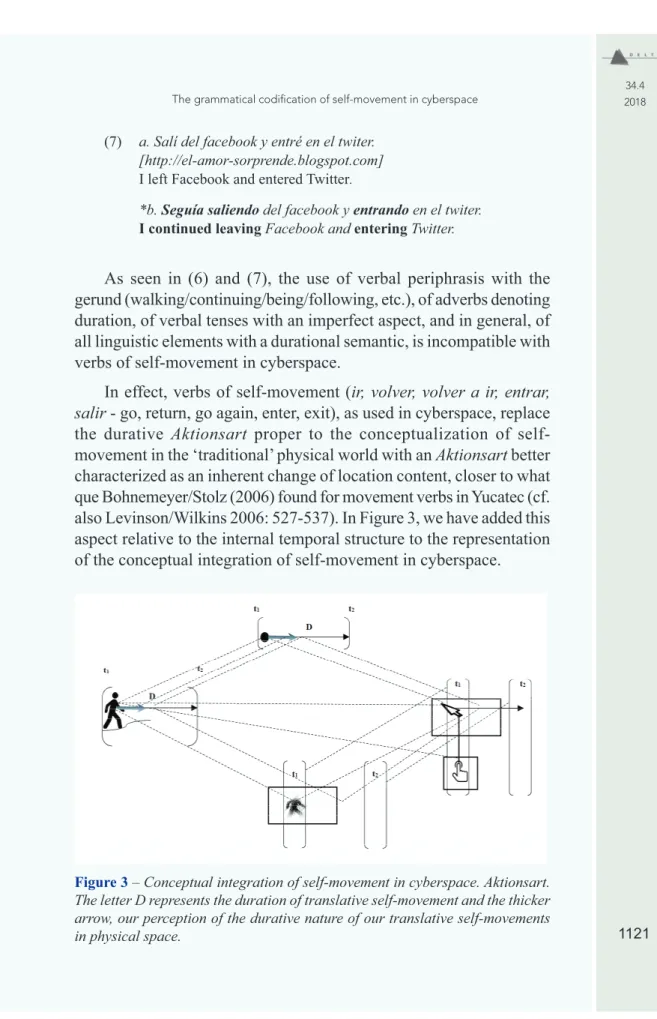
In effect, verbs of self-movement (ir, volver, volver a ir, entrar,
salir - go, return, go again, enter, exit), as used in cyberspace, replace
the durative Aktionsart proper to the conceptualization of
self-movement in the ‘traditional’ physical world with an Aktionsart better
characterized as an inherent change of location content, closer to what que Bohnemeyer/Stolz (2006) found for movement verbs in Yucatec (cf. also Levinson/Wilkins 2006: 527-537). In Figure 3, we have added this aspect relative to the internal temporal structure to the representation of the conceptual integration of self-movement in cyberspace.
1122
As shown in Figure 3, it is not the duration inherent to our experience of translative self-movement in the ‘traditional’ physical world that is projected onto the blend, but rather the instantaneous change of location characteristic of our perception of changing pages in cyberspace.
The absence of duration of movement has a logical correlate in the dimension of movement-space: contrary to what occurs when we move about in ‘traditional’ physical space, in cyberspace we do not perceive self-movement as our continuous dislocation along a (an infi nite) series of points which together form a trajectory in physical space. Consequently, neither do we see the change of perspective that is produced as we advance through physical space (Zlatev/Blomberg/Magnusson 2012: 427-428); that is to say, the gradual alteration of our relative position in space and of our viewpoint, and perhaps of our orientation with respect to the objects around us (Croft/Cruse 2004: 58-63).
This loss of the perception of a path as an element that is inherent to our self-movement is total in the case of changing pages. Nevertheless, a certain path experience does remain when we scroll from one part of the page to another, utilizing the cursor. This difference manifests itself linguistically in the appropriateness vs. inappropriateness of the use of grammatical elements that codify the path
(8)(a) Hay distintas formas de desplazarse por una hoja de cálculo. Puede
utilizar las teclas de dirección, las barras de desplazamiento o el mouse para moverse entre las celdas y desplazarse rápidamente a las distintas áreas de la hoja de cálculo. En Microsoft Offi ce Excel 2007, puede benefi ciarse de una mayor velocidad de desplazamiento, de un desplazamiento fácil hasta el fi nal de un rango y de la información en pantalla, que le permite saber
el punto de la hoja de cálculo en el que se encuentra. [https://support.offi ce. com/es-es/]
There are different ways to scroll through a worksheet. You can use the arrow keys, the scroll bars, or the mouse to move between cells and to move quickly to different areas of the worksheet. In Microsoft Offi ce Excel 2007, you can take advantage of increased scroll speeds, easy scrolling to the end of ranges, and ScreenTips that let you know where you are in the worksheet.
1123
In (8b), in contrast to (8a), we note that it is inappropriate to utilize linguistic elements that refer to the whole path (por, a lo largo de) or to parts of it (hasta).
Non-codifi cation of the path is not exclusive to self-movement in cyberspace. Languages such as Yucatec (Bohnemeyer/Stolz 2006) and Japanese (Kita 2006) codify movement in the ‘traditional’ physical world as a chance of location (in the fi rst case) or as a change of locative relation (in the second), without making reference to the path that takes one from one location to another, or a locative relation to the other. With regard to these languages, Levinson / Wilkins (2006: 531) point out that “how the fi gure got from source to goal is not relevant – details of the trajectory, the manner of motion, the medium and the instruments involved are out of focus as it were.” These cases differ, however, from codifi cation of movement in cyberspace with regard to the possibility of perceiving the path: in the case of cyberspace, the path is imperceptible. That is to say, its codifi cation is not presented to the language as an option. Figure 4 shows the fi nal version of the conceptual integration of self-movement in cyberspace with the incorporation of the attenuation/disappearance of the path.
1124
4. Grammatical codifi cation of self-movement in cyberspace
Grammar does not directly codify reality (in a representationist sense), but rather codifi es our perceptions of it. That is to say, grammar operates on a perceptual, not an ontological, basis. By grammatical codifi cation we understand the subsumption (or categorization) of aspects of our perception to the semantics of grammatical constructions, particularly to the set of thematic roles associated with a determined construction. In this sense, codifi cation is a central constitutive part of the process of grammatical conceptualization, the function of which is to determine the conceptual contents that may be associated with a certain construction. Although this is not the focus of the present study, it should be mentioned that the process of grammatical conceptualization encompasses a second aspect, called in Cognitive Linguistics “constual,” which refers to the different ways the same content can be constructed (Croft/Cruse 2004: 40-73; Langacker 2008: 55-89).
For analysis of self-movement in cyberspace, we propose the following thematic roles: agent, source, goal, path, location, container, manner of motion. These thematic roles correspond to specifi c aspects of the image schematic structure of self-movement. That is to say, with respect to their semantic essence there is no difference between the image schemas and the thematic roles. The difference is not in the essence of the meaning, but rather in the scope; in that with the thematic roles we choose particular aspects for the purposes of grammatical codifi cation, aspects that are experienced in a holistic manner in our perception. To perceive myself or another person in movement, it is not necessary (or possible) to fi rst perceive a source, then a path, then a form of movement, and fi nally a goal, in order to, at a second moment, unite them in one single perception of movement. The perception does not need to be compound; rather, it is complete right from the start.
1125
(9)
TRANSLATIVE SELF-MOVEMENT
X moves (to/from) Y (agent source path manner goal)
(10)
NON-TRANSLATIVE SELF-MOVEMENT X moves (to/from) Y (agent source goal)
Grammatical codification is regulated by one fundamental
principle: all the focal aspects of a given perception (focal image
schematic structures), but only the focal aspects, must be codifi ed. We
intend to call this key principle the principle of perceptive prominence.
In effect, this principle makes (9) non-applicable to the perception of self-movement in cyberspace, given that the path, its intrinsic duration and the manner of movement are not prominent perceptive aspects. On the other hand, (10) is not appropriate for grammatically conceptualizing translative self-movement in physical space, because of its prior exclusion of prominent aspects such as the path.
1126
Figure 5 – Grammatical codifi cation of self-movement in cyberspace.
1127
(11) *(a) Vuelve corriendo, en cuclillas, de sopetón a la pantalla de inicio y abre una segunda app.
Go back to the fi rst screen running, crouching, unexpectedly and open a second app.
(b) (…) si la página que tenemos es muy grande, deberemos facilitarle que suba trompicando, agitándose, alborotándose al principio de la página.
(…) if the page we have is very big, we will make it easy for you to go up to the top of the page, stumbling, getting worked up, getting agitated.)
(c) Si hace clic en Cerrar, para volver a la edición y visualización del formulario, vaya, arrastrándose, tambaleando, renqueando, Inicio > Encuesta en Excel Online.
Click close to return to editing and visualizing the form. Go, dragging yourself, tottering, limping, to start > online Excel survey.
Let us now move on to the source. This thematic role codifi es what in Chapter 2 we called my immediate pragmatic context, and more concretely, the focal point of my perception and action. That is to say, it is not merely a question of a point in physical space (a location). This characterization of the source is valid for both physical space and cyberspace. Furthermore, in both cases it is also the locus of my intentional projections (or “protensions,” in phenomenological terminology), the locus in which I identify another pragmatic context, different from the current one, as the appropriate place for actions to satisfy my intentions. Obviously, the difference resides in the fact that in the case of cyberspace, this pragmatic context does not materialize as a space that encompasses my body. This constitutive aspect of the source in physical space is not incorporated into its counterpart in cyberspace. One consequence of this is the grammatical inappropriateness of the use of linguistic elements (adjectival or prepositional phrases or other modifi ers) that express how the body experiences aspects of the surrounding space
(12) (a) Salí de un piso angosto / maloliente / húmedo / confortable / de
amplios espacios.
1128
*(b) Salí de una website angosta / maloliente / húmeda / confortable / de amplios espacios.
I left a narrow/smelly/humid/comfortable/spacious website.
As for the goal in cyberspace, it may also be seen that its semantics retain a volitional, as well as a locative, directive, telic nature, characteristic of the goal of self-movement in physical space. Also in cyberspace, the goal represents the place we intend to arrive at, in order (in most cases) to perform actions that meet our intentions. However, with respect to its materiality, the goal presents the same restrictions we have confi rmed for the source: it is a pragmatic context, a context for action, but not a space that surrounds us. Therefore, expressions such as those in (13) are grammatically inappropriate:
(13) *(a) Ir a / entrar en una página ventosa / profunda / apretada. To go to / enter into a windy, deep or tight-fi tting page.
Another well-known aspect of codifi cation of self-movement in cyberspace is that the thematic role path is inapplicable, because it does not represent a focal aspect of our perception (principle of perceptual prominence). This means that the source and the goal are not united by a translative movement along a vector connecting point A to point B. As we mentioned above, this implies that the use of expressions codifying the path is inappropriate (we have reproduced (8) in (14)).
(14) *(a) *Me desplacé por el/a lo largo del link hasta llegar a la página siguiente.
I scrolled by the/all along the link until arriving at the following page.
1129
(15) *Vuelve corriendo, en cuclillas, de sopetón a la pantalla de inicio y abre una segunda app.
Go back to the fi rst screen running, crouching, unexpectedly and open a second app.
On the other hand, certain aspects of the ground, such as the place of entry to a space, are indeed codifi able:
(16) (a) También pueda darse el caso de que quieras entrar a tu correo desde un celular o tablet, en ese caso puedes hacerlo a través de tu página web para móviles. [https://www.google.es/#q=entrar+a+mi+correo+ Gmail]
You may also wish to check your email from a cell phone or tablet; if so, you can do it via your webpage for mobile devices.
(b) Accede al formulario de matrícula a través del correo electrónico.
[http://esdmadrid.es/esdmadrid]
Access the enrolment form via your email.
(c) Hola, no puedo entrar a Badoo por Facebook porque me da error. [http://es.ccm.net/forum/]
Hi. I can’t enter Badoo via Facebook, because I get an error message.
Finally, although it is not the focus of this paper, It should be pointed out that the generic semantic pole of self-movement in cyberspace X moves (to/from) Y (agent source goal) can be particularized when it is
integrated with the semantics of a determined verb of motion. 1 In (17),
we show this particularization in the case of the verb entrar (enter) (as
in entré en el Facebook); for it, we have adopted Goldberg’s (2006) conventions:
(17) X moves (to/from) Y (agent source goal) | | | | | | | | enter agent outer container space cyberspace
1130
In (17), the thematic roles source and goal, when integrated with the semantics of the verb to enter, are particularized in outer space and cyberspace (container), respectively.
We may defi nitely state that with the appearance of the need to codify self-movement in the new kind of space we know as cyberspace, language has had to readjust, via processes of conceptual integration, the set of thematic roles that were available to it to codify self-movement in physical space. The general result of this readjustment is a concept of movement that approaches the non-translative self-movement we fi nd in languages such as Yucatec and Japanese (Levinson/Wilkins 2006: 527-537). In this way, Spanish, like other languages such as English and German, etc., has available the two typologically distinguishable concepts of self-movement proposed by (Levinson/Wilkins 2006: 535-536). The particularity is that they are applied by the same language but in different spaces (cf. Figure 6).
Figure 6 – Concepts of self-movement by type of space.
5. Conclusion
We have attempted to show why we utilize a grammar typical of movement when referring to activities performed in cyberspace. We have argued that this is due to the fact that we perceive many activities in cyberspace as self-movements.
1131
an external reality; rather, it is a dynamic process of construction. In it, the activation of image schemas and their linkages with concepts already existing in our cognition play an essential role. This association between perceptions and concepts, through the identifi cation of shared image schemas, unleashes powerful process of conceptual integration. As we have seen, perception of our activities in cyberspace has, in large measure, recourse to the same image schemas inherent to the concept of self-movement in physical space. This sharing of image schematic structure unleashes a complex process of conceptual integration, resulting in a concept of self-movement proper to cyberspace. It has certain similarities with self-movement in physical space, but also certain differences. Among the latter are the absence of a path, and related aspects (such as duration).
The second important element of our hypotheses resides in the postulate that grammar has a perceptual, rather than an ontological, basis. That is to say, grammar codifi es our perceptions, in the active and dynamic sense we have just mentioned. Concretely, we argue that thematic roles correspond to salient aspects of our perception. The principle of perceptual prominence explains why thematic roles typical of movement, such as the path and manner of movement, are not applicable to the codifi cation of self-movement in cyberspace. Furthermore, in forming a part of networks of conceptual integration, the thematic roles have a much more complex and differentiated semantics that was traditionally attributed to them. This greater semantic density makes it possible, for example, to appropriately characterize the agent of self-movement in cyberspace as an agent who possesses volition, and who, in order to move himself or herself, must apply bodily force; but who, on the other hand, does not perceive the body advancing through cyberspace, or, consequently, its manner of movement.
Finally, we would like to take these last lines to once again stress the undoubted linguistic and cognitive importance of the appearance of a new concept of movement, especially considering the growing presence of this new space we call cyberspace.
Recebido em: 06/04/2017
1132
References
BARBARAS, Renaud. 2010. Life and Exteriority: The Problem of Metabolism.
In: STEWART, John; GAPENNE, Olivier; DI PAOLO, Ezequiel A. (eds.).
Enaction. Toward a New Paradigm for Cognitive Sciences. Cambridge
(Massachusetts) & London: The MIT Press: 89-122.
BOHNEMEYER, Juergen; STOLZ, Christel. 2006. Spatial reference in Yukatek
Maya: a survey. In: LEVINSON, Stephen C.; WILKINS, David. P. (eds.).
Grammars of Space. Explorations in Cognitive Diversity. Cambridge
University Press: Cambridge: 273-310.
CROFT, William; CRUSE, Alan D. 2004. Cognitive Linguistics. Cambridge:
CUP.
DEPRAZ, Natalie; VARELA, Francisco; VERMERSCH, Pierre. 2011. À l’épreuve
de l’expérience. Pour une practique phénoménologique. Bucarest:
ZETA books.
DI PAOLO, Ezequiel A.; ROHDE, Marieke; DE JAEGHER, Hanne. 2010.
Horizons for the Enactive Mind: Values, Social Interaction, and Play.
In: STEWART, John; GAPENNE, Olivier; DI PAOLO, Ezequiel A. (eds.).
Enaction. Toward a New Paradigm for Cognitive Sciences. Cambridge
(Massachusetts) & London: The MIT Press: 33-87.
FAUCONNIER, Gilles; TURNER, Mark. 2002. The Way We Think. Conceptual
Blending and the Mind’s Hidden Complexities. New Yok: Basic
Books.
GALLAGHER, Shaun. 2008. Understanding others: Embodied Social
Cognition. In:
CALVO, Paco; GOMILA, Antoni (eds.). Handbook of Cognitive Science. An
Embodied Approach. Amsterdam: Elsevier: 437-452.
______. 2012. Phenomenology. London: Palgrave-Macmillan.
GALLAGHER, Shaun; ZAHAVI, Dan. 2008. The Phenomenological Mind.
London & New York: Routledge.
GOLDBERG, Adele E. 2006. Constructions at Work. The Nature of
Generalization in Language. Oxford: OUP.
______. 2013. Argument Structure Constructions versus Lexical Rules or
Derivational Verb Templates. Mind & Languages, 28: 435-465.
HUELVA UNTERNBÄUMEN, Enrique. 2011. Esquemas imaginísticos y la base
perceptiva de la gramática. Hacia una (re-)lectura fenomenológica.
Lingüística, 26: 55-77.
HUSSERL, Edmund. 2002. Konstitution der Intersubjektivität. In: Klaus
Held (ed.). Phänomenologie der Lebenswelt. Ausgewählte Texte II.
Stuttgart: Reclam: 80-165.
1133
Imagination, and Reason. Chicago & London: The University of
Chicago Press.
KITA, Sotaro. 2006. A grammar of space in Japanese. In: LEVINSON, Stephen
C.; WILKINS, David. P. (eds.). Grammars of Space. Explorations in
Cognitive Diversity. Cambridge: Cambridge University Press:
437-474.
LANGACKER, Ronald. 2006. Subjectifi cation, grammaticalization, and
conceptual archetypes. In: ATHANASIADOU, Angeliki; CANAKIS, Costas;
CORNILLIE, Bert (eds.). Subjectifi cation: Various Paths to Subjectivity.
Berlin: Mouton de Gruyter: 17-40.
______. 2008. Cognitive Grammar. A Basic Introduction. Oxford: OUP.
LEVINSON, Stephen C.; WILKINS, David. P. 2006. Patterns in the data: towards
a semantic typology of spatial description. In: LEVINSON, Stephen
C.; WILKINS, David. P. (eds.). Grammars of Space. Explorations in
Cognitive Diversity. Cambridge: Cambridge University Press:
512-552.
LÉVY, Pierre. 1995. Qu’est-ce que le virtuel? Paris: Éditions La
Découverte.
MERLEAU-PONTY, Maurice. 1945. Phénomenologie de la perception. Paris:
Gallimard.
RUIZDE MENDOZA, Francisco; MAIRAL, Ricardo. 2008. Levels of description
and constraining factors in meaning construction: An introduction
to the Lexical Constructional Model. Folia Linguistica, 42, 2:
355-400.
SHEETS-JOHNSTONE, Maxine. 2012. Fundamental and inherently interrelated
aspects of animation. In: FOOLEN, Ad; LÜDTKE, Ulrike M.; RACINE,
Timothy P.; ZLATEV, Jordan. (eds.). Moving Ourselves, Moving Others.
Motion and emotion in intersubjectivity, consciousness and language.
Amsterdam & Philadelphia: John Benjamins: 29-55.
VARELA, Francisco J.; THOMPSON, Evan; ROSCH, Eleanor. 1993. The
Embodied Mind. Cognitive Science and Human Experience.
Cambridge (Massachusetts) & London: The MIT Press.
ZLATEV, Jordan; BLOMBERG, Johan; MAGNUSSON, Ulf. 2012. Metaphor
and subjective experience: A study of motion-emotion metaphors
in English, Swedish, Bulgarian, and Thai. In: FOOLEN, Ad; LÜDTKE,
Ulrike M.; RACINE, Timothy P.; ZLATEV, Jordan (eds.). Moving
Ourselves, Moving Others. Motion and emotion in intersubjectivity,
consciousness and language. Amsterdam & Philadelphia: John