Repositório ISCTE-IUL
Deposited in Repositório ISCTE-IUL: 2019-04-16
Deposited version: Post-print
Peer-review status of attached file: Peer-reviewed
Citation for published item:
Clegg, S., Cunha, M. P., Munro, I., Rego, J. & de Sousa, M. O. (2016). Kafkaesque power and bureaucracy. Journal of Political Power. 9 (2), 157-181
Further information on publisher's website: 10.1080/2158379X.2016.1191161
Publisher's copyright statement:
This is the peer reviewed version of the following article: Clegg, S., Cunha, M. P., Munro, I., Rego, J. & de Sousa, M. O. (2016). Kafkaesque power and bureaucracy. Journal of Political Power. 9 (2), 157-181, which has been published in final form at https://dx.doi.org/10.1080/2158379X.2016.1191161. This article may be used for non-commercial purposes in accordance with the Publisher's Terms and Conditions for self-archiving.
Use policy
Creative Commons CC BY 4.0
The full-text may be used and/or reproduced, and given to third parties in any format or medium, without prior permission or charge, for personal research or study, educational, or not-for-profit purposes provided that:
• a full bibliographic reference is made to the original source • a link is made to the metadata record in the Repository • the full-text is not changed in any way
KAFKAESQUE POWER & BUREAUCRACY1
Stewart Clegg
University of Technology Sydney and
Nova School of Business and Economics, Universidade Nova de Lisboa [email protected]
Miguel Pina e Cunha
Nova School of Business and Economics, Universidade Nova de Lisboa [email protected]
Iain Munro
Newcastle University Business School, Newcastle University, United Kingdom [email protected]
Arménio Rego
Universidade de Aveiro and
Business Research Unit (UNIDE; ISCTE, IUL), Lisboa [email protected]
Marta Oom de Sousa
Nova School of Business and Economics, Universidade Nova de Lisboa
1 This study is part of a larger project (FCT, PTDC/IIM-GES/5015/2012). We are grateful to our generous informants, Pedro Pita Barros, Jorge F. Gomes, Carlos Alves Marques, Miguel Morin, Francisco Nunes, Paulo Trigo Pereira, Vitor Corado Simões, and the participants in the INDEG-ISCTE and Facultad de Administracion, Universidad de Los Andes research seminars for their contributions to our work, in different ways, in diverse moments. Miguel Cunha gratefully acknowledges support from Nova Forum. We are especially grateful for the comments made by the members of the CMOS (Centre for Management and Organization Studies) Clinic on an earlier version of this paper, especially by Alison Errington and Marco Berti. We would also like to thank our reviewers, and the editor, Mark Haugaard, for appreciation and advice.
KAFKAESQUE POWER & BUREAUCRACY
Abstract
The metaphor of Kafkaesque bureaucracy has attracted the imagination of organization theorists for decades. While the critical and metaphorical approach offers vibrant insights about organizing, it has not been complemented by systematic empirical analysis. We take a step in that direction and conduct an inductive study of how people experience and deal with the Kafkaesque bureaucracy. We focus on the Kafkaesque organization as constructed in process and practice by those who experience its effects as citizens and clients. Data uncovered three major affordances of Kafkaesque bureaucracy: inactiveness, helplessness, and meaninglessness. These combine in a mutually debilitating configuration that constitutes the Kafkaesque bureaucracy as an effortful everyday accomplishment.
INTRODUCTION
Max Weber (1864-1920) and Franz Kafka (1883-1924) were contemporaries. Each was fascinated by the industrial modernity of their times, and each in their own way had a deep understanding of bureaucracy. Kafka and Weber are amongst the most important 20th century writers on bureaucracy and organisation. Despite these similarities, on most fronts the two are both different and similar – one was a successful academic, prolific writer and groundbreaking sociologist, albeit riven by neuroses, while the other was a novelist and short story writer who never saw success in his own lifetime but who was also depressive and sickly. Further, though each was concerned with bureaucracy, they approached the matter from radically different perspectives. While Weber suggests the inevitability of the technical superiority of bureaucratic forms and describes the attendant ‘iron cage’ that it produces, Kafka spoke from within this cage, telling dark and enigmatic stories of the ironic futility of bureaucratic life. While Weber told us about bureaucracy’s rationality, Kafka led us through its dark labyrinth. While Weber wrote about the impersonality of bureaucracy, Kafka vividly evoked the lived experience of its supplicants being constantly confounded by its machinations. In terms of the formal study of organisations Weber’s influence is uncontestably significant. Organisation Studies as a discipline has a great debt to Weber and any intellectual discussion of organisation tends to draw, either directly or indirectly on his ideas (Clegg 1990). This legacy has seen organisational scholars take as central concerns issues of power and authority, specialisation and hierarchy, control and decision making, rationality and rationalisation and so forth – all themes that emanate from Weber’s work.
In contrast to Weber, despite Kafka’s influence in literary and social theory and his position as a seminal postmodern figure, he has been less often used by organisation theory. Born as the son of a wealthy Prague businessman and spending most of his short adult life working in the Workers Accident Insurance Bureau in Austria, Kafka was an insider to the workings of bureaucracy. Kafka’s
fictional work preceded contemporary criticism of bureaucracy from management thinkers. While spending his days as an insurance clerk, at night Kafka became a compulsive writer. Part of Kafka’s work focused on the nature of bureaucratic organization, featured in novels such as The Trial and The Castle (Kafka, 1999, 2000), literary works that, posthumously, elevated their author to an exalted status not only in the Western literary canon (Bloom, 1994) but also led Wasserman (2001) to count him as a “key industrial reformer”.
Kafka’s bureaucracy, unlike Weber’s ideal type, is not one formed by rationality into an iron cage but is cast from irony, in which the expectation of rationality is confounded at every turn by the experience of being in organisations. In novels such as The Trial and The Castle the reader is transported into the life of the character K and his experience of bureaucracy. In confronting legal (The Trial) and government (The Castle) organisations, K unfalteringly proceeds, almost as an ‘ideal typist’, with the expectation that these organisations will behave in a way consistent with an orderly, predictable and rational system of rules and regulations mediated through a rigid organisation of offices. He is seduced by the rational promise of bureaucracy. K’s experience, however, is far from what he expects (although arguably he never gives up on his expectations). As Zizek (2001: 64) suggests of Kafka’s Castle, it is ‘sublime and majestic when first seen from afar, but then changing into a “paradise of filth”, a gigantic pile of shit, as soon as one actually enters the city’. K’s experience with bureaucracy is one that is, as the term goes, Kafkaesque – that is to say that it is fuelled by contradiction, irony, despair and futility, characterised by a dark enigmatic shadow cast such that nothing is ever what it seems to be yet what it might actually be is never revealed. Kafka offers an incisive perspective on modern society; a perspective from the dirty inside that asks troublesome questions about the effects of bureaucracy and rationality as the basis for modern society: a society with no promise of a better life nor dream of utopia to sustain it. Here, the ideal-type of bureaucracy exists as a false and catastrophic promise, a delusion of reason, ‘a symbol of K.'s doomed search for order through a ‘permanent resolution’ of his case ... related to the modern desire
for order ... for both philosophical and political frameworks that provide narratives or certainty’ (Smith 2008, p. 8).
Based on Kafka’s critical approach to bureaucracy, the adjective “Kafkaesque” gained use as a way to describe a condition in which those subject to bureaucracy as citizens or clients typically feel trapped in a vicious circle created by bureaucratic rules that they can neither understand nor escape (Garud and Kumaraswamy 2005). As Warner (2007) explains, the adjective is used to describe dysfunctional encounters with bureaucracies. Kafkaesque bureaucracy thus represents a corruption of an organizational form that, in Weberian theory, should constitute a moral project (du Gay, 2005).
While Kafkaesque bureaucracy has largely escaped systematic empirical scrutiny, despite the obvious centrality of its connections with organization studies, exceptions include work by Hodson and his co-authors (see Hodson, Martin et al. [2013] and Hodson, Roscigno et al. [2013]). Kafka’s relation to power, as Balazs (2015, note 7, p.101) explains, has been explored in the politics literature in terms that clearly connect with the concerns of organization studies, most explicitly in Bennett (1991), Corbella (2007) and Arneson (1988), more generally in Speirs and Sandberg (1997), Dodd (2002), and Zilcosky (2002). The most obvious point of reference is Foucault’s (1977) analysis of the panopticon:
Not surprisingly, it is the Foucauldian approach that has been found the most congenial one to the conception and atmosphere of the novel … One of Foucault’s central concerns was the ubiquity of power, captured by the image of the Panopticon. There is indeed much gazing, observing, supervising in The Castle. For K., constant exposure to the eyes of others and the lack of a private sphere in the school where he is given a job as a janitor and is supposed to live, makes even the reader feel uncomfortable, sometimes claustrophobic. Another characteristically Foucauldian topic is the link between sexuality and power (Arneson 1988, Burke 1988), and Kafka does indeed strike, even shock, us by making it clear that the relation between castle and village is a twofold one in which the exclusively male officials provide administration for the village which in return provides female sexual services. This appears utterly perverse, for something inherently bad (administration with no purpose) is paid for by something inherently evil (making love without love and by order). Further, the ubiquity and all-pervasiveness of power in the Foucauldian perspective is echoed in the novel by the repeated omnipresence, omnicompetence, infallibility of The Castle authorities; yet, as
the point that it not only can endure their revolts but essentially feeds on them. As Bennett observes, The Castle is a timeless place, it has premodern and modern, feudalist-familial and highly rationalized bureaucratic features, emphasizing the unchanging essence of power in every human society, as asserted by Foucault’s historically so diverse studies (Bennett 1991) (Balazs (2015, p.89).
The opportunities for organization studies to forge further links with Kafka are manifold. Franz Kafka’s writings on bureaucracy afford a penetrating perspective on organizational life, one that is no less prescient today than was the case when Kafka was writing in the early twentieth century. Many critics would agree with Davis and Cobb (2010, p. 40) when they point out, “Kafka is still the greatest chronicler of life in a bureaucracy.” In The Castle, K may be regarded as the quintessential Weickian (1995) sense-maker, constantly seeking to interpret the inscrutability, equivocality and confounding non-sense he finds himself mired in. Sensemaking practice is at the core of K’s quest for interpretive understanding.
The present study contributes to the Kafka canon not just a metaphor but with empirical work on the Kafkaesque organization as a set of practices. Grounded in first hand individual experiences with bureaucracies, we approached the contents of Kafkaesque interactions inductively, with the goal of developing a close understanding of how people report the main features characterizing Kafkaesque experiences and what these descriptions tell us about the processes and practices making up Kafkaesque organization for citizens and clients.
Bureaucratic organization is as much one of the key universals of organization theory (Pugh and Hickson 1976) as Kafka is a staple of the modern literary consciousness. In literary terms, one of the reasons for the potential reach and diffusion of Kafkaesque notions of organizing and their relevance as an object of study, as his novels can be found in translation in just about every corner of the world. The number of interpretations and studies based on Kafka’s works is significant: indeed, the issues that Kafka explored remain at the heart of the debate about organizational society. The field of organizational theory has not excluded itself from this debate. With the use of literary sources
(Rhodes 2001, Phillips 1995, Czarniawska-Joerges and de Monthoux 1994) in organization studies relating Kafka and his writings on bureaucracy to contemporary research is apposite. Having done so Warner (2007) defends the view that Kafka depicted the reality of bureaucratic organizing rather than producing a surreal commentary in which people were trapped by the rituals, routines, and rules of bureaucracy. Lost in a mechanism that they cannot comprehend, they experience senselessness, disorientation, and helplessness, lacking any clear course of action with which to escape perceived injustice, organizational perversity, personal disorientation and power abuse.
Weber was not unaware of the pitfalls caused by human behaviour in a bureaucratic setting; rather, he proposed an ideal type model that condensed the features of actually occurring bureaucracies into an artificially accentuated model. Objective analysts could use such a model as a forensic tool for actual investigations. For Weber, being a bureaucrat is a vocation, one that demands an exemplary professional ethic. Weber’s focus is concentrated on the mechanics and working of bureaucracy from the insider point of view of the ideal typical bureaucrat; Kafka looks at the bureaucratic subject from the experience of the outsider, from the perspective of the subject; his interest is in the
phenomenology of power rather than issues of governance. Where Weber sees a character-forming ethic Kafka sees only doorkeepers, both in The Trial and in The Castle. For example, “I’m powerful. And I’m only the lowliest of all the doormen. But there’s a doorkeeper for each of the rooms and each of them is more powerful than the last. It’s more than I can stand just to look at the third one” (Kafka 2003, p.153). While for Weber the bureaucracy is typified by its legal rationality for Kafka’s outsiders the bureaucracy appears as a hegemon that is surrounded by myth and superstition. The clients and citizens that a Weberian bureaucracy deals with are cases to be treated in terms of the merits of their case, as adjudged against the rules, while for Kafka (2009, p.46), these rules are far more parochial rather than universal: the visitor at the door of the castle is a “stranger, a superfluous person getting in everyone’s way, a man who is always causing trouble”, rather than a client to be
accessible in the bureau; in Kafka (2009, p.161) even lowly bureaucrats dare not speak to anyone for fear losing their job “through some kind of unintentional infringement of unknown rules”. In a rational legal bureaucracy authority is embedded in the rules and their sense of binding obligation; they serve no one in particular and everyone in general while in Kafka (2009) there are inscrutable, invisible, unknowable ultimate personal sources of authority. Finally, Weber’s bureaucratic rules confer rights and obligations equally on the subjects of and those subject to bureaucracy; in Kafka those subject to bureaucracy are reduced to supplicants:
You’re under arrest, aren’t you.” “But how can I be under arrest? And how come it’s like this?” “Now you’re starting again,” said the policeman, dipping a piece of buttered bread in the honeypot. “We don’t answer questions like that.” “You will have to answer them,” said K. “Here are my identification papers, now show me yours and I certainly want to see the arrest warrant.” “Oh, my God!” said the policeman. “In a position like yours, and you think you can start giving orders, do you?” (Kafka, 2003, p. 4)
In a nutshell, Weber offers an elite and informed view of the characteristics of bureaucracy as a moral project for those who conduct it while Kafka provides a street-level view (literally, in The Castle) of what it means to be an outsider, someone without appropriate sensemaking procedures with which to deal with its rules and routines. These outsider experiences contribute microfoundations as grounds from which to build theory. We will explore the practical nature of Kafkaesque bureaucracy. Studying experience of Kafkaesque bureaucracy as practice rather than as metaphor informs organization studies about the perceptions of micro-processes that create obstacles to change. Following Masuch (1985, p. 19), we can regard these perceptions as indicators of “suboptimality … based on a stable vicious circle”.
Research questions
Because references to the Kafkaesque organization are often metaphorical, we defined as our goal the study of actual, lived experiences with bureaucracies that, from the perspective of the client, contained some Kafkaesque component. Our research interests led us to ask simple questions: what are the attributes (cognitive, socio-material, emotional) of close encounters with bureaucracy? Why and how do these types of encounter unfold and with what consequences? In cases where these encounters correspond to organizational vicious circularity, what are the microfoundations of the bureaucratic vicious circle?
The research was conducted in Portugal during the deep economic and social crisis shaking Southern Europe since the advent of the Euro Crisis in 2009. Debt became a burden as a result of a decade of low interest rates fuelling debt in both households and the financial sector. As the crisis deepened, unemployment and hardship increased the welfare bill, which deepened state expenditures just as tax receipts became shallower as a consequence of business recession and customers unable to access credit as financial institutions restricted lending in the face of their escalating debts. With the state expending more and receiving less, Portugal found itself in a similar position to other southern European states, a position that from the viewpoint of key European institutions such as the European Central Bank required immediate austerity. In such a climate, with the pressing need for austerity being demanded at every turn, organizational processes of bureaucracy became increasingly questioned by those subject to them, especially as the rhetoric of market efficiency intensified. There is a need to understand how and what clients perceive as Kafkaesque in public and private sector bureaucracies’ service in these austere times.
To answer our research questions, we conducted an inductive analysis of the topic. As the main data collection technique, we used retrospective interviewing (Langley, 2009), asking our informants to reflect upon their close encounters with ‘Kafkaesque’ bureaucracy. We interviewed only those respondents that were able to identify what the notion meant in terms that signified bureaucratic dysfunctionality from the client perspective. Experiences were thus reported according to the informant’s perspective, following an introductory line of inquiry: can you recall for us any experience that you have had that revealed this negative side of the bureaucracy and its impact on you?
Data collection and analysis occurred via in vivo interviewing and followed the general precepts advanced by the Gioia methodology (Gioia, Corley, and Hamilton, 2012). As a qualitative study, it was oriented towards discovery, not verification, as it intended to explore the essence of direct, first hand experience rather than examining if it corresponded with some previously formed hypothesis. The main goal of the study was thus to explore the phenomenology of encounters deemed Kafkaesque so as to understand the process better by studying it from an external perspective. With this aim, our interviewees were given time to describe and reflect on their experience, as well as to share and advocate their ideas and points of view regarding the whole process through semi-structured interviews with open-ended questions. Data was sorted and included and excluded by discussion amongst the authors as trained organization scientists to overcome one potential limitation of the research method: the risk of co-created subjectivities and interpretations by interviewer and respondent (Ambert et al., 1995). Multiple discussion between multiple authors enhanced validity procedures, mitigating this limitation (some authors were closer and others more distant from the field process; see Langley, 2009). Data collection followed a snowball sampling procedure (Goodman, 1961): at the end of each interview, with the goal of randomizing the sample, the respondent was asked to help us identify a new informant that might be able to describe some further bureaucratic encounters.
Sample and procedures
We gathered data from 18 interviews. A first e-mail, Facebook, mobile phone or personal contact, explaining the request and context of the proposed interview, preceded data collection. Interviews were conducted face to face, in a location selected by the interviewees, were audio-recorded, and transcribed verbatim (for technical reasons, one interview was not recorded; abundant notes were taken in real time). Respondents (half of them female) had experienced some situation labelled as “Kafkaesque” as clients of public sector bureaucracies. Their age ranged from 17 to 77 (mean: 32). They represented a variety of professional activities in both the private and public sectors, including students and teachers, engineers and homemakers, psychologists and physicians. The sample was purposefully diverse, as we were interested in reaching a variety of experiences covering multiple facets of a Kafkaesque encounter.
Defining the sample size
As is usual in grounded theorizing (Chamaz, 2006), the decision about the number of interviews to conduct was contingent on the progress of the interviews. As Glaser and Strauss (1967) observed, making theory-based judgments about saturation is not an exercise in objectivity (see also Bowen, 2008; Morse, 1995). It is theoretically based confidence in the saturation of the relevant categories that defines the final number of interviews (Charmaz, 2006). One withdraws from the field as the sense of returns become increasingly diminishing, when one finds that data is not disconfirming the emergent hypotheses; hence, as a sense of saturation emerged in collecting the data, when novelty in findings was greatly diminished, the decision was made to withdraw from the field and concentrate on analysis of the data collected. As major themes became apparent through a process of constant case-by-case comparison of the data, the inductive process stabilized on emergent first-order categories that seemed best to capture the variance and similarities in the data.
Data sorting and analysis
Semiotic clustering (Feldman, 1995) was used to organize the data and build conceptual meaning. Key features characterizing a phenomenon of interest were identified through a three-step procedure. The first step consisted of identifying the features of the topic denoted by interviewees (Feldman, 1995). These were then arranged tentatively in clusters of similarity and distinction. On the basis of what were now emergent clusters, concepts were grouped with the relations between them leading to theoretical clustering on the basis of similarities, complementarities, paradoxes, oppositions or other forms of conceptual sensemaking. The process of research moved from the subjects’ first order data to second order constructs, guided by conceptual meaning. These constructs resulted in a smaller number of concepts, as the first categories were organized into encompassing thematic categories. Finally, third order abstract concepts resulted from further clustering of the concepts presented in the second order column, providing a deeper characterization of the first order data in meanings that formed the essential structure of the explanation.
In this type of analysis, the main assumption is that words on the surface, the signs of discourse, express a deep structure (Feldman, 1995). Making this underlying structure explicit is thus the main goal, achieved by reducing a significant quantity of superficial information to its essential, non-visible, and abstract deep core. These methodological steps are usually presented in a three-column figure, in order to facilitate ease of explanation of the process they subsume (Feldman, 1995), allowing the emergence of relationships and characteristics that were not explicitly presented by informants but that formed an underlying ‘grammar’ for them. Information not initially accessible in the direct data can thus be uncovered when investigating the common themes across a process (Clark et al., 2010), as successive layers of meaning are articulated (Manning, 1987) and transformed into a deeper, more abstract and encompassing conceptual order. During the process, analysis travels between the data, emergent concepts and the literature, in order to develop a set of theoretical ideas.
FINDINGS
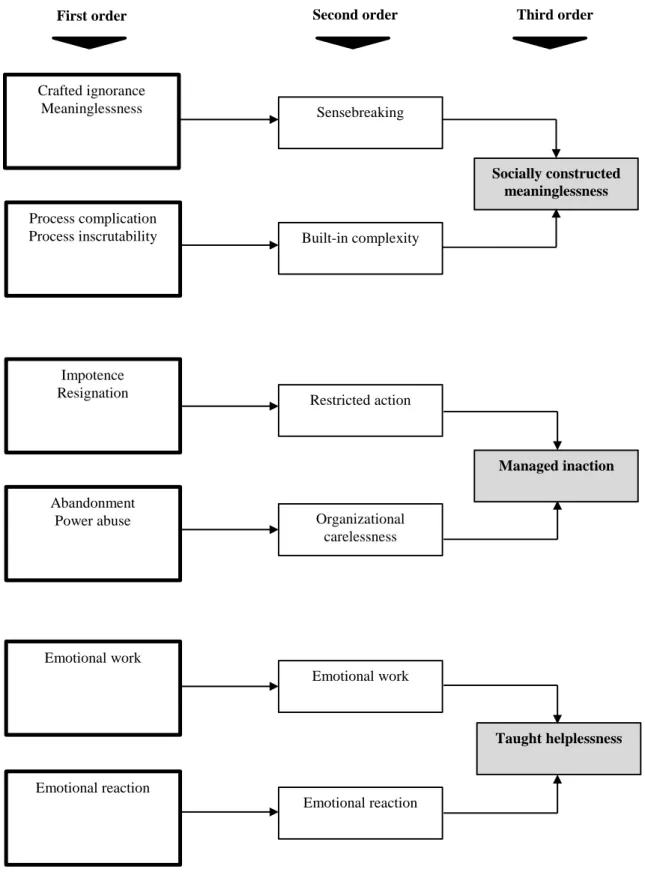
Original data (about 239 pages of outsider interview transcripts, approximately 71.758 words) were reduced to ten categories directly related to the interview data. These categories, represented in the left side of Figure 1, referred to a diversity of topics. A first group of categories synthesized the cognitions elicited by the Kafkaesque experience. It included the following aspects: the notion that the system produces a state of ignorance; that it is meaningless for an outsider; that it is unnecessarily complicated; that it is inscrutable. A second group of categories explained behavioural responses: the system produces restrictions to action; it stimulates a state of resignation in the face of its actions; people consider themselves abandoned by the system; it treats them in a careless, non-regarding manner. Finally, people mentioned emotionality: the way they responded emotionally on some occasions and their failure to do so in other occasions. Respondents explicitly mentioned all these points. Sorting these emergent concepts consisted in finding the best label and definition of what the interviewees mentioned. At this stage, the interpretive effort was still limited, but we were already travelling back and forth between the data and the emerging categories in order to arrange data in a conceptually elegant, but theoretically rigorous and meaningful way. First order concepts are present in Appendix 2, together with illustrative quotes extracted from the interviews.
These data were subsequently organized into broader categories constructed to represent thematic consistency; in this, we generated second order themes. The second step involved an element of analytic interpretation, in the sense that these more encompassing labels reflected a conceptual order that was not directly offered by the participants but that reorganized their existential concerns in a more reflexive set of categories, leading to the centre columns of Figure 1. We interpreted the informants as telling us that their experiences of bureaucracy were characterized by a lack of meaning or sensebreaking, conforming to representations of Kafkaesque organization. In a classic formulation, they experience something going on but they do not know what it is (Dylan 1965).
Experiencing a lack of meaning, they regarded the organization as creating a form of purposeful complexity that restricted action and confounded understanding. The routines of the Kafkaesque organization were seen as careless; impersonality was interpreted as a lack of care. Dealing with this lack of regard involved both emotional work and emotional reaction. Hence, responding to the perception of a Kafkaesque organization entailed cognitive, behavioural, and emotional responses by those subjected by it as clients.
These categories of intermediate conceptual abstractness led to the development of three final third order themes. Third order components signify the Kafkaesque organization as an active, purposeful social construction rather than as an organizational residue that resulted from the organization being unmanaged, its actions accidental and undesired, and their angst unexpected and unexplained. Hence, our informants regarded themselves as victims of organizational actions and inactions designed to paralyze outsiders, a paralysis partly achieved through the organizational construction of meaninglessness. Finally, the Kafkaesque organization is a product of emotions, channelling emotional work, offering opportunities for people to vent their frustration, in the process of making sense of the seemingly senseless; they end up naturalizing the attributes of the Kafkaesque organization as essential features of bureaucracy. We explain the different interpretative levels next.
Figure 1 about here
Meaninglessness: Meaning work in Kafkaesque organizing
Interacting with a Kafkaesque organization is cognitively challenging: It does not make any sense how the process was done” as one informant explained”. It involves intense attempts at understanding apparently meaningless actions in a struggle to produce meaning (Benford and Snow, 2000). Our informants mentioned two main cognitive difficulties raised by the interactions they described: (1) sensebreaking; and (2) built-in complexity. Sensebreaking represents the perception
that the organization was actively blocking their attempts at comprehension. Sensebreaking, it was felt, was promoted by a degree of complexity that was a product of the organization’s ongoing design. Built-in complexity made the system inscrutable and difficult to understand.
Sensebreaking
Sensebreaking, understood as the blocking of meaning (Mantere et al., 2012), resulted from respondents’ ignorance and confusion. On the part of our respondents, information about organizational processes was limited and the functioning of the system was seen as involving an element of uncertainty and surprise regarding its outcomes, as well as frustration at barriers to sensemaking. Every interviewee mentioned these processes. In different ways, lack of understanding was a constant in the episodes documented.
Making contact with the Kafkaesque organization seems to be akin to entering terra incognita, an organizational territory where the habitual rules of sensemaking are suspended and sense is broken and constantly challenged. Informants found sensemaking impossible when they explained, “I don't understand the reason for this formality (…). I don't understand” or “The request was denied (…) without any explanation about the reason for refusing it.” People were confronted with decisions that lacked explanation, with processes that unfolded in mysterious ways for which explanation is refused, making sensemaking in terms other than common vocabularies of motive (Mills, 1940) about “red tape” a virtual impossibility.
Built-in complexity
In addition to the lack of explanation, our informants considered the level of complexity developed by the bureaucratic organizations they encountered as puzzling. The system, as one informant reported, is “unable to achieve something that is apparently simple in other places”. As a result,
another informant put it, “people feel very small” in front of the big organizational machinery. Attempts to penetrate the nature of the “machine” were condemned to failure, as Kafka would have predicted and as one of our informants reported: “Since the beginning, it was impossible to reach the Director”. That everyday interpretations are reminiscent of The Castle is possibly more than mere coincidence.
The trope of The Castle is well established; it captures a representative experience of our respondents and many others as well. Bureaucratic systems are sometimes both overly complex and also too opaque to be understood (Ballas and Tsoukas, 2004). It is in this sense that we describe their complexity as built-in to their design - a carefully weaved construction, a product of vested interest, tradition, and mutual adjustment to the status quo. The complexity of a large bureaucratic apparatus
protects its incumbents and ensures that its work is hidden from meaningful external scrutiny.
Inaction: Practice work in Kafkaesque organizing
The construct of the Kafkaesque organization restricts individual behavioural options by socializing clients in their respective lack of agency, subjecting them to reminders of their impotence, inviting them to give up any attempts to persuade the organization to be responsive to what they want and need when and how they express these desires: “There is nothing to do” one informant explained. Kafkaesque organizations can actually be seen as actively training people to feel impotent in the face of their masterly incapacity to provide satisfaction. In part, this is achieved through sensebreaking and complexity but is also translated into active behavioural restrictions. Organizational carelessness transmits a perception of individual abandonment that renders further attempts towards action futile and thus less likely. The Kafkaesque organization, in summary, as clients experience it, reduces the sense of agency of outsiders; it creates a perception of disempowerment via carelessness, leading to inaction.
Restrictions to action
Significant restrictions to action characterize the Kafkaesque organization. People are often forced to take a multiplicity of steps and to follow a strict bureaucratic path to be able to reach their goals. Nonetheless, the notion that they lack the means to solve problems, even when the complex steps are followed, is frequent, which convinces people that their efforts will not necessarily lead to successful accomplishment. As one of our informants described, “Maybe we could have continued arguing with the woman, but we left already tired of the entire situation.” Restrictions on their action led respondents to desist because of “tiredness, exhaustion or ignorance”, as one of them pointed out. Barriers to knowledge and action were associated with our interviewees’ predominant perception: the scarcity of information about the process they were embroiled in severely constrained available behavioural options and transmitted an impression of organizational carelessness.
Organizational carelessness
The sensebreaking experience and the lack of organizational support produced paralyzing effects. Organizational scholars have mentioned the importance of care for virtuous leadership (Cameron and Winn, 2012; Rego, Cunha and Clegg, 2012), something these organizations failed to express. The obligation to follow a rigid path, in order to solve one’s situation without guarantees of success, narrowed perceptions of action possibilities sympathetic to one’s circumstances and neutralized realistic attempts to open alternative behavioural options. The result was behavioural paralysis or inaction. The lack of organizational care was seen as expressing a paucity of interest in individual problems and of a limited capacity for response from the organization via its employees as reflected in quotes such as “I have nothing to do with it” or “That is not my job”, typical formulae of bureaucratic dysfunction and disdain.
Successively being rerouted inside the organization seemed senseless and useless to interviewees, creating perceptions of the organization on their part as lacking a capacity for attention, rigor, support, and care. Respondents felt powerless in the face of such a system and considered their powerlessness aggravated by the abuse of power by employees. A key dimension of the Kafkaesque bureaucracy, as represented by its users, was that the unknown internal rules, rather than the interests of the public, guide its operations at large. The organization is not genuinely oriented to open possibilities of action but rather seeks to close them down, creating rigid bureaucratic ways that the public knows so well, a typical organizational response that communicates lack of service personalization and minor interest for the user.
The organization’s response ultimately depends upon the people who have authority: in the eyes of our respondents, authorities are less professional Weberian bureaucrats than petty tyrants who give bureaucracy its bad name. Disregarding the client’s problem, lack of effort in helping, and indifference toward problems (for example, providing inaccurate or wrong information) are the main causes of the perception of not being taken care of, feeling abandoned, making respondents feel neglected, and unable to act.
Helplessness: Emotion work in Kafkaesque organizingInteractions with Kafkaesque
organizations produced significant emotional work and emotional reactions by clients. People expressed two types of emotional displays: (1) those intended to manage, control and alter one’s emotions in the process known as emotional work, i.e. the conscious effort to alter one’s sentiments (Hochschild, 1979), and (2) emotional reactions, such as anger, occurring in spite of emotional work. Together and supported by the cognitive and behavioural aspects considered previously, those two types of emotion created a learned form of helplessness (Seligman, 1972), a notion whose central premise refers to the effects, including the emotional effects, resulting from the perception of
powerlessness: “Revolt against them, because supposedly it is an institution that must defend our rights.”
People in this psychological condition have learned to believe that any effort will be insufficient and that an attempt to solve a problem will possibly aggravate it, an indicator of vicious circularity. There is a component of emotional work in learned helplessness, a dimension reflected in interviewees’ responses such as “There is nothing that can be done” or the perception that one “has no control over (the) situation and that whatever he/she does is futile”. Helplessness translates into a combination of intense emotional work with the behavioural passivity discussed before.
Emotional work
Interactions with Kafkaesque bureaucracies involve significant emotional work, i.e. “making a conscious, intended try to alter feeling” (Hochschild, 1979, p. 56). Time, paperwork, money, and psychological energy, as well as other personal resources, were perceived as emotionally taxing and requiring emotional work, as defined above. The repetitive explanation of one’s situation and the need to go to different places to solve a single problem were the main emotional burden associated with Kafkaesque organizing. The emotional costs require purposeful management of one’s emotions. One of our respondents expressed the desire to forget about the experience. Interviewees considered that they were “paying the price” (as one of them pointed out) for something that was not their fault, such as the flawed functioning of the system. Such perceptions forced respondents to expend emotional work to manage their own emotions. Emotional work could assume multiple forms such as accommodating (“But I have to follow all the bureaucracies, all the procedures, every paper, and so I have to wait”) or forgetting (“When it was over […] we only wanted to forget the experience”).
Experiences with Kafkaesque bureaucracies were not only wearisome and resource consuming. They also produced emotional reactions and proved to be emotionally costly. Our data contained references to intensely emotional responses, such as a desire to “payback” the harm caused by the organization. Revolt, fury, despair, and anger emerged in the interviews. As one informant put it, “The word with which I can describe [the organization] is ‘irritating’.” Or, as another explained, “I was revolted knowing that there was an easier way.” An informant said, “Every time people argued with us and we fought their arguments, they raised yet another argument, and they were always inventing new ones until a certain moment in which we, because of tiredness, exhaustion or ignorance, quit.”
Constructing an emergent model
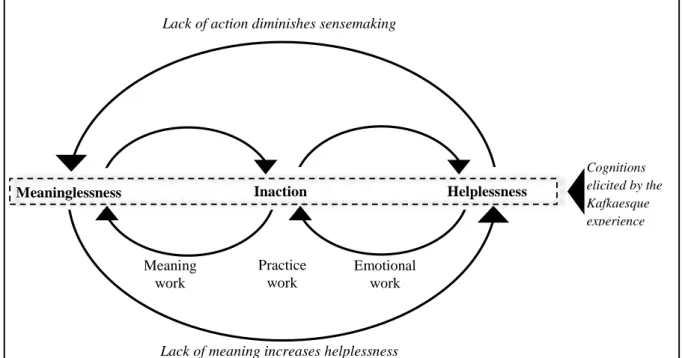
Based on the findings, we will now turn these middle level interpretations of our respondents into a theoretical model integrating the findings (see figure 2). In general, the findings suggest that perceptions of the Kafkaesque organization differ from Weberian principles of bureaucracy in terms of three main processes: the social construction of meaninglessness, managed inaction, and taught helplessness.
Figure 2 about here
We offered preliminary evidence of how organizations teach people to feel helpless and accept their situation. Emotional work may produce powerful emotions but these are rendered ultimately unproductive because they are interpreted as part of the experience of dealing with the strange and ultimately incomprehensible world of the Kafkaesque bureaucracy. Avoidance and forgetting on the part of clients becomes the lived experiential counter to blocked external pressure for organizational change. Because “everybody knows” that bureaucracies are often Kafkaesque, their impenetrability becomes all too natural: it cannot be changed, as it corresponds to its deep nature.
The passivity, the assumption that costs incurred in connecting with the bureaucracy are sunk, and the cathartic effects of emotional responses such as anger and revolt, may paradoxically end up reinforcing the system. The next interaction with some bureaucracy will be less costly because one will be more prepared: expectations will be aligned. As a Danish CEO operating in Portugal pointed out (in Santos, 2005, p. 103):
“In contact with local authorities, I usually expect a poor service and a bad time management, therefore I don’t react. On the contrary, I’m glad whenever they provide a good service and make good time management.”
But one will also be more helpless and more prepared for helplessness, closing another round of the vicious circle. As expressed in the outer arrows of figure 2, the state of inaction diminishes opportunities for sensemaking, and the lack of meaning promotes helplessness, which reinforces inaction. The process is imbued with a quality of the self-fulfilling prophecy, another characteristic evocative of the vicious circle (Cunha and Tsoukas, 2015; Masuch, 1985; Weick, 1979).
Validity issues
To test if our conceptual interpretations respected our informants’ perspectives, a validity procedure was undertaken. The major goal was to find out if the emergent interpretations plausibly reflected the meanings that formed the essential structure of the phenomenon as we had encountered it in the respondents’ stories. As explained in the methods section, by further clustering the concepts initially found, more abstract and simplified themes emerged. To validate the findings, half of the informants were questioned to see if they agreed that the emergent dimensions could be considered to compose the basic underlying structure of their experiences. They also reviewed the conclusions. The explanation was received with general agreement, given that respondents “discovered” (as one of
them pointed out) that Figure 1 expressed what they meant. The validity procedure suggests that the interpretations drawn here can thus be considered robust.
DISCUSSION
The trope of The Castle is well established; it captures a representative experience of our respondents and many others as well. Bureaucratic systems are sometimes both overly complex and also too opaque to be understood (Ballas and Tsoukas, 2004). It is in this sense that we describe their complexity as built-in to their design: it is not necessarily something inherent to the system, an out-pouring of routine, so much as a carefully weaved construction, a product of vested interest, tradition, mutual adjustment to the status quo, and a lack of accountability other than in accord with its own devices. Much as a giant arachnid, the bureaucracy is seen as spinning networks of confusion to entrap the unwary. Built-in complexity protects opacity, making organizational functioning less amenable to scrutiny, less sensible.
Sensemaking difficulties on the part of clients are countered by practices that make routines recognizable and acceptable (Zietsma and Lawrence, 2010). Such practices refer to efforts to encourage clients to accept a given set of routines rather than to simply engage with them, irrespective of perceived legitimacy (Phillips and Lawrence, 2012). Kafkaesque routines do not simply “happen”: they happen because they are actively enacted. Practice means that clients do not “just” become engaged in and by a routine: they actively support the routine while practicing it. An extreme case of such compliance has been described by Bauman in his classic study of the Holocaust which observed that the cooperation of the Jewish leaders was solicited by the Nazis on the understanding that they must ‘sacrifice some, in order to save many’ (Bauman, 1991, p.140). This kind of solicitation plays an important role in Kafkaesque bureaucracies where clients are typically advised not to make a fuss since this may endanger the treatment of their particular case, and they may also be offered informal leverage within the system in exchange for their compliance (Kafka,
1999, 2000). Such engagement severely restricts possibilities of action and reinforces client inaction via a cultivated expression of organizational carelessness.
Our first-order interpretations corroborate some of the findings revealed by previous research (Hodson et al., 2013a, 2013b) relating to the chaos, fear, patrimonialism and abuse that may be rife in bureaucracies, but in addition the deeper analysis results reveal how these have become institutionalized as apparently inescapable vicious circles. First, Kafkaesque organizing creates a socially constructed meaninglessness. As the results indicate, organizations are not Kafkaesque effortlessly. On the contrary, creating a Kafkaesque organization requires intense institutional work, i.e., the ceaseless attempt to create a certain type of organization (Lawrence, Leca and Zilber, 2013), an organization whose interiority makes it impermeable to external attempts to render its functioning more transparent and modifiable. As our informants noted, attempts to understand the inner workings of the organization are actively and purposefully countered by the organization via its representatives. Our informants offered abundant evidence of the active construction of meaninglessness (see Appendix 2). Functionaries, it was shown, actively sustain the meaninglessness of the system. Explanations for this process may include the standardized, depersonalized nature of the work being done that eventually renders it meaningless for the functionaries themselves (Grant et al., 2014), a meaninglessness that is then projected onto all they deal with.
Second, organizations become Kafkaesque through managed inaction. In other words, they neutralize the agency of external interlocutors by confronting them with progressive layers of rules and obstacles. The more the outsider tries to penetrate the system, the more the system responds by raising yet another rule, in a cycle of positive feedback characteristic of the vicious circle (Weick, 1979). A rule always seems to lead to another rule. A routine intersects with some other routine. A solution leads to a problem, and an open channel comes to an unexpected dead end. The bureaucratic apparatus reveals a strange capacity to multiply its legalistic resources via the expression of a twisted
form of creativity: rules that were not invoked previously are suddenly activated, impeding the stranger from getting inside the metaphorical “castle”. The notion that bureaucracies are devoid of creative skills seems to be challenged in the descriptions collected here. Informants actually describe a system with an unexpected capacity to improvise new rules where and when the old ones seem to be insufficient to deter the questioning of the outsider. The system seems all too creative in its own dark and twisted form of bureaucratic fantasy.
Finally, the Kafkaesque organization operates and sustains itself by educating users in helplessness. If helplessness is learned (Seligman, 1972), then it can also be taught. People caught in the dynamics of Kafkaesque organizing have learnt to feel trapped: they don’t know what to do, what to think, and what to feel. They are disempowered of their agency and devoid of their singularity. As Huber and Munro (2014, p. 263) put it, “the institutions that are supposed to help us, such as the law, confront us as an inhuman and alienating force.” Citizens are stripped of their citizenship and are not allowed to escape the organization. They participate in their own disenfranchisement via learned helplessness: their passivity, accommodation, and distress (Seligman, 1972) are naturalized as organizational normality. Their compliance becomes part of the process, a feeder of the vicious circle.
The findings suggest that if the Kafkaesque bureaucracy is a product of effort and work, consistently woven together over time, then solutions blind to this genealogy will be destined to fail. Internally focused solutions without clear incentives and implications management (e.g., empowerment, leadership training, performance assessment, de-bureaucratization) will potentially be neutralized by vested interests (see Clegg and Gordon 2012; Gordon, Clegg, and Kornberger 2009; Gordon, Kornberger, and Clegg 2009 for relevant examples). It is not only vested interests that are at work. Tendencies towards enhanced accountability and transparency in organizations can further institutionalize bureaucratic devices such as audit. Power’s (1999; 2007) work on the audit society,
performance measures and risk, has noted an “explosion” of bureaucracy. This is one of the Kafkaesque aspects of the “audit society”, associated with a focus on neoliberal forms of “self-regulation” and an “audit explosion” to regulate the “self-“self-regulation”.
Existing research into the Kafkaesque organization has focused upon both the existential issues of organizational life (e.g., McCabe, 2015; Munro and Huber, 2012), and governance issues (e.g. Hodson et al., 2013a, 2013b). The existential approach highlights the intractable problems that are entailed in the individual’s sensemaking, highlighting the emotional dimension of the Kafkaesque nightmare. In contrast, the governance approach tends to call for greater levels of industrial democracy and transparency in an attempt to mitigate the corrupting and dehumanizing aspects of bureaucracy (e.g. Hodson et al., 2013a, 2013b). As we have pointed out, Kafkaesque organization has so far been mostly approached from a metaphorical perspective. In this study, the metaphor was scrutinized empirically.
The findings of this research have identified three key processes that characterize the active construction of the Kafkaesque bureaucracy: i) socially constructed meaninglessness, ii) managed inaction, and iii) taught helplessness. These findings reveal the processes underlying formal bureaucratic mechanisms that explain not only the corruption of bureaucracy ideals (Hodson et al, 2013a, 2013b; Huber and Munro, 2014) but also the active cooperation of those subject to it in the perpetuation of the vicious circle. In contrast to existing research (Hodson et al., 2013a) that has recommended empowering the workforce to address such bureaucratic dysfunctions, the present findings reveal that the clients and subjects of bureaucracy must also play an important role in breaking the vicious circle. The question then becomes one of how to restructure unwieldy organizations without succumbing to the bureaucratic temptations of the audit society (Power, 1999). The process through which organizations protect their opacity, how they normalize negative emotions associated with Kafkaesque experience, and the way they sustain their traditional routines
without genuine attempts to change, are all ripe for investigation. We found that persisting suboptimal practices are not necessarily unintended by-products of organizational routine but involve an effortful practice, resulting from the interplay between different forms of work. Such intentionality is not necessarily activated by unethical motives, as will be discussed below, but it has grave ethical implications. This work can be taken as an invitation for researchers to uncover these implications. Organizations having recognizably Kafkaesque traits are actively constructed, products of effort and human diligence. In this sense, a significant part of our contribution is to extend research on Kafkaesque bureaucracy from metaphor to practice.
No organization is born Kafkaesque, which means that researchers should try to better understand the longitudinal process of “Kafkaesquing” organizational practice. We offered some possibilities, but more needs to be known about the process. How does the Kafkaesquing of organizations start? Studying newly created organizations may shed light on the origins of this process. How is the division of Kafkaesque labour done between managers and the managed? More specifically, how do leaders sustain the Kafkaesque organization? How do they counter it? What management practices fortify the Kafkaesque bureaucracy? How does the cultural/societal/political context influence the Kafkaesque intensity and nature of state bureaucracies?2
Given that organizations are highly intricate organizational ecologies, facilitative of vicious circles (Masuch, 1985; Weick, 1979), and considering that they are often poor setters of explicit goals, people can be motivated by unconscious goals, including those that subtly protect the status quo via interlocked patterns of action (Tsoukas, 2012) and that buffer the organization from external scrutiny and from externally-caused disturbances of standard operating procedures. Future research may
2 The problems of unconscious goals and the implications of complacent management practices are possibly especially acute in the case of Portuguese organizations, whose performance management systems tend to be poor (Bloom et al., 2012; World Economic Forum, 2013).
explore how employees internalize those roles that are perceived so adversely by those whom they subject to their routines. Why is the Kafkaesque organization so persistent? These and similar questions are worth pursuing, given the familiarity of the form to our informants. Future research should continue the analysis of the collective construction of the organizational form that Kafka so vehemently criticized and that, with Kafkaesque irony, his critical writings may have partially naturalized.
Finally, there is an intriguing issue, raised by a reviewer: Kafkaesque organization crystallizes what Arendt called, with percipience, “the latest and perhaps most formidable form of domination: bureaucracy or the rule of an intricate system of bureaus in which no men, neither one nor the best, neither the few nor the many, can be held responsible, and which could properly be called rule by nobody” (Arendt, 1970, p 38). Rule by nobody protects bureaucratic face, by making nobody accountable. For the client there is no one responsible: just a set of rules that defer forever.
Government by nobody has this unique quality that there is no centre of power. There is no king’s head to be cut off (Foucault 1978). In terms of the Lukes and Hayward debate (Journal of Power 2008), there is nobody to shoot. A functional bureaucracy has a goal other than its perpetuation and there are visible decision-makers. A Kafkaesque bureaucracy seems mostly to be concerned with perpetuating itself, which it does by protecting its bureaucrats from responsibility, by positioning nobody in charge, all being imbricated but none ultimately accountable in a vicious circle of rules.
CONCLUSION
The current work should be taken as a preliminary step for more research on Kafkaesque organizations’ causes and processes leading to an experience of labyrinthine bureaucracy understood in terms of vicious circles. Our research question explicitly asked informants to reflect on those bureaucracies that, in their experience, they would label in terms that, following their understanding,
question, then, clearly established the limits for the findings and the applicability of the conclusions. Those bureaucracies standing outside the initial definition of “Kafkaesque” were not considered by respondents. In this sense, the study’s conclusions should not be extrapolated or regarded as a critique of bureaucracy per se, because this is clearly beyond the scope of the paper. It must be considered that data were collected in a particular cultural-institutional context (Cunha, Clegg, and Rego, 2009), a condition that establishes a relevant conceptual boundary and suggest the importance of cross-national research on the topic. Given the pressures of austerity politics and economics on state functioning in Southern European societies, Portugal affords an example of a naturally occurring experiment in increased bureaucratic dysfunction as resources have been tightened and cut since 2008.
Kafkaesque bureaucracies confront people with a barrage of seemingly pointless rules. The findings of this study suggest that the ethos of the Kafkaesque organization is not a matter of organizational stupidity (Alvesson and Spicer, 2012). The findings indicate that it would be naïve to assume that stupid results are the product of stupid organizers or stupid organizing. The Kafkaesque organization can be explained as the result of the interplay of intense and sophisticated forms of work (namely meaning, practice, and emotion work), conducted at several layers by different participants. The study uncovered three main processes intervening in the development and consolidation of the Kafkaesque organization: the social construction of meaninglessness, managed inaction, and taught helplessness, the building blocks of the Kafkaesque bureaucracy. The organizational form is not an unintended degeneration of healthy bureaucracies but a purposeful product of meaning, practice and emotional work.
In summary, the Kafkaesque bureaucracy should not be viewed complacently, as a literary curiosity, but as an intentional, socially constructed form of organization that needs to be de-naturalized as a first condition for change. The ‘circular’ nature of the Kafkesque problems are revealed by the
present study, manifested both in existential meaninglessness (failures of sensemaking), and in managed inaction (failures of governance). Kafkaesque organizations thrive on opacity and lack of accountability, suggesting that pressure for external scrutiny must come from outside the system, namely from civil society. Hodson et al.’s (2013a) call for greater industrial democracy is by itself not enough to address the thorny issues that the Kafkaesque organization presents, however. Opening the system via democratizing public innovations and co-creating improvement initiatives with the collaboration of the public (e.g. Sifry, 2011; Von Hippel, 2005) may help to break closed loops and increase openness to public scrutiny and “open innovation” (Von Hippel, 2005) and “open politics” (Sifry, 2011) offer fruitful possibilities for mitigating against systems of “managed inaction” and “taught helplessness” in providing platforms for participation and outside intervention, as well as greater levels of transparency. Sifry’s (2011) work has demonstrated that platforms for “open” politics have generated numerous successful reform movements (e.g., Mysociety.org; Theyworkforyou.com; Fixmystreet.com) which have used social media platforms to enable citizens to intervene from outside of impersonal political bureaucracies to help improve local regeneration as well as improve the governance of these bureaucracies.
Kafkaesque power is pervasive, especially in these times of austerity when the servants of the state are unable to offer an ethic of care, consideration and compassion that once marked the sense of public service. A vigilant, constructive and persistent pressure for transparency and improvement is necessary to reduce and correct dysfunctional practices and to remove the very complex and intricate institutional ecology of bureaucratic organizations (Tsoukas, 2012). It is, perhaps, time not only to rediscover bureaucracy (Olsen 2005) as a moral project (du Gay 2002) but also to render its more Kafkaesque elements less “obese”, “anarchic”, “inefficient”, “incomprehensible” and “idiotic” (Bennett, 1994, p. 650). Citizens, desperately seeking sensemaking while entangled up in the ‘hermeneutic machines’ (Bernheimer 1977) that power and bureaucracy’s enmeshing produces,
References
Adler PS and Borys B (1996) Two types of bureaucracy: Enabling and coercive. Administrative Science Quarterly 41: 61-89.
Alvesson M and Spicer, A (2012) A stupidity-based theory of organizations. Journal of Management Studies 49(7): 1194-1220.
Ambert AM, Adler PA, Adler P and Detzner DF (1995) Understanding and evaluating qualitative research. Journal of Marriage and the Family 57: 879-893.
Arendt, H. (1970) On Violence. New York: Harcourt, Brace and World.
Arneson, R.J., 1988. Power and authority in Franz Kafka’s The Castle. In: H. Bloom, ed. Franz Kafka’s The Castle. New York, NY: Chelsea House, 107–124.
Ballas AA and Tsoukas H (2004) Measuring nothing: The case of the Greek National Health System. Human Relations 57: 661-690.
Balazs, Z. (2015) Power and animality in Kafka’s The Castle, Journal of Political Power, 8:1, 85-107.
Benford R and Snow D (2000) Framing processes and social movements: An overview and assessment. Annual Review of Sociology 26(1): 611-650.
Bennett J (1994) Kafka, genealogy, and the spiritualization of politics. Journal of Politics 56(3): 650-670.
Bernheimer, C., (1977). Symbolic bond and textual play: structure of The Castle. In: A. Flores, (ed.) The Kafka debate: New perspectives for our time. New York: Gordian Press, 367–384.
Bloom H (1994) The western canon. London: Papermac.
Bloom H (2003) Franz Kafka. New York: Chelsea House.
Bloom N, Genakos C, Sadun R, and Van Reenen JM (2012) Management practices across firms and countries. Academy of Management Perspectives February: 12-33.
Bowen GA (2008) Naturalistic inquiry and the saturation concept: A research note. Qualitative Research 8(1): 137-152.
Burke, K., (1988). The caricature of courtship. In: Franz Kafka’s The Castle. New York: Chelsea House, 23–33
Cameron KS and Winn B (2012). Virtuousness in organizations. In K.S. Cameron & G.M. Spreitzer (Eds.), The Oxford handbook of positive organizational scholarship (pp. 231-243). Oxford: Oxford University Press.
Charmaz K (2006) Constructing grounded theory: A practical guide through qualitative analysis. Thousand Oaks, CA: Sage.
Clark SM, Gioia DA, Ketchen DJ and Thomas, JB (2010) Transitional identity as a facilitator of organizational identity change during a merger. Administrative Science Quarterly 55(3): 397-438.
Clegg, S. (1990) Modern organizations: Organization Studies in the Postmodern World, London Sage.
Clegg SR and Gordon R (2012) Accounting for ethics in action: problems with localised constructions of legitimacy. Financial and Accountability Management 28(4): 417-436.
Corbella, W (2007). Panopticism and the construction of power in Franz Kafka’s The Castle. Papers on Language and Literature, 43 (1), 68–88.
Cunha MP, Clegg SR and Rego A (2009) An essay on archaic postmodernity: The case of Portugal. Management Research 7(3): 191-201.
Cunha MP and Tsoukas H (2015) Reforming the State: Understanding the vicious circles of reform. European Management Journal 33(4): 225-229.
Davis GF and Cobb JA (2010) Corporations and economic inequality around the world: The paradox of hierarchy. Research in Organizational Behavior 30: 35-53.
Dodd, B., (2002). The case for a political reading. In: J. Preece, ed. The Cambridge companion to Kafka. Cambridge: Cambridge University Press, 131–149.
du Gay P (2002) In Praise of Bureaucracy. London: Sage.
du Gay P (Ed)(2005) The values of bureaucracy (Oxford University Press, Oxford).
Dur R and Zoutenbier R (2014) Working for a good cause. Public Administration Review 74(2): 144-155.
Dylan B (1965) Ballad of a Thin Man, Highway 61 Revisited, New York: Columbia.
Foucault, M. (1977) Discipline and Punish: the Birth of the Prison. London: Allen Lane
Foucault, M. (1980) The History of Sexuality, Volume 1: An Introduction. New York: Random House.
Garud R. and Kumaraswamy A (2005) Vicious circles in the management of knowledge: The case of Infosys Technologies. MIS Quarterly 29(1): 9-33.
Gioia DA, Corley KG and Hamilton AL (2012) Seeking qualitative rigor in inductive research: Notes on the Gioia methodology. Organizational Research Methods 16(1): 15-31.
Glaser BG and Strauss AL (1967) The discovery of grounded theory: Strategies for qualitative research. New York: Aldine.
Goffee R and Jones G (2013) Creating the best workplace on Earth. Harvard Business Review May: 98-106.
Goodman LA (1961) Snowball sampling. Annals of Mathematical Statistics 32(1): 148-170.
Gordon R, Kornberger M and Clegg SR (2009) Power, rationality and legitimacy in public organizations. Public Administration: An International Quarterly 27(1): 15-34.
Gordon R, Clegg SR and Kornberger M (2009) Embedded ethics: Discourse and power in the New South Wales Police Service. Organization Studies 30(1): 73-99.
Grant AM, Berg JM, and Cable, DM (2014) Job titles as identity badges: How self-reflective titles can reduce emotional exhaustion. Academy of Management Journal 57(4): 1201-1225.
Hayward, C. and Lukes, S. (2008) Nobody to shoot? Power, structure, and agency: A dialogue Journal of Power, 1(1): 5-20
Hochschild AR (1979) Emotion work, feeling rules, and social structure. American Journal of Sociology 85(3): 551-575.
Hodson R., Martin AW, Lopez SH and Roscigno VJ (2013) Rules don’t apply: Kafka’s insights on bureaucracy. Organization 20(2): 256-278.
Hodson R, Roscigno VJ, Martin AW and Lopez SH (2013) The ascension of Kafkaesque bureaucracy in private sector organizations. Human Relations 66(9): 1249-1273.
Huber C. and Munro I (2014) Moral distance in organizations: An inquiry into ethical violence in the works of Kafka. Journal of Business Ethics 124: 259-269.
Kafka F (1999) The trial. London: Vintage Classics.
Kafka F (2000) The castle. London: Penguin.
Langley A (2009) Studying processes in and around organizations. In D. Buchanan and A. Bryman (Eds), The SAGE handbook of organizational research methods (pp. 409-429). Los Angeles: Sage.
Lawrence TB, Leca B, and Zilber, TB (2013) Institutional work: Current research, new directions and overlooked issues. Organization Studies 34(8): 1023-1033.
Manning PK (1987) Semiotics and fieldwork. Thousand Oaks, CA: Sage.
McCabe D (2015) The tyranny of distance: Kafka and the problem of distance in bureaucratic organizations. Organization 22(1): 58-77.